

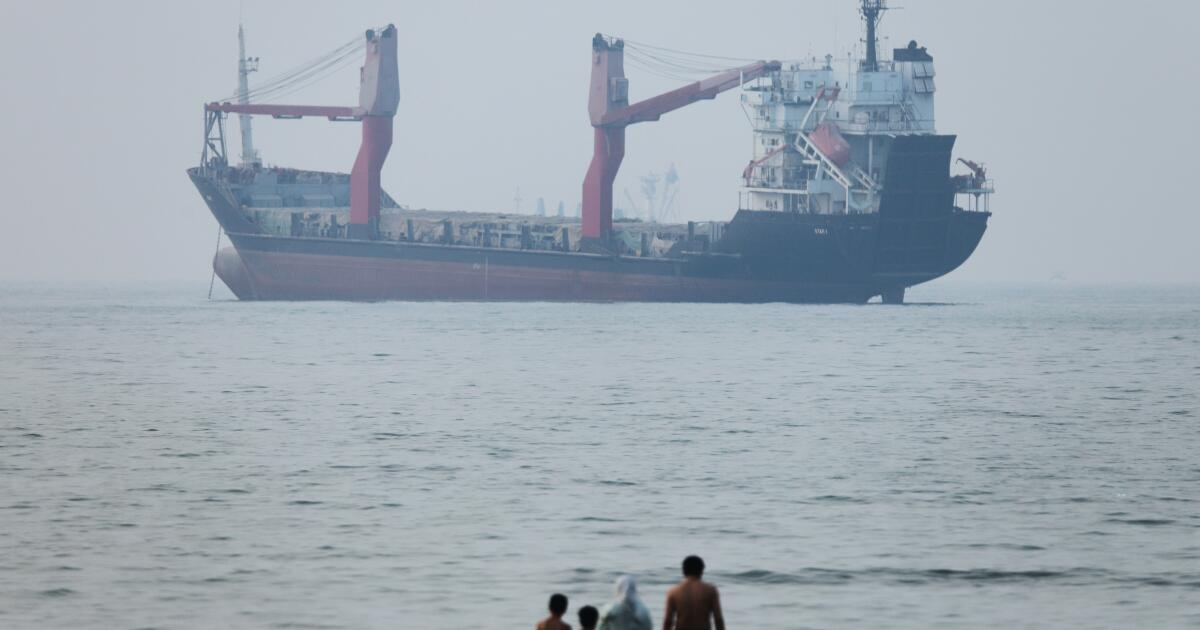
WASHINGTON — A tentative armistice between the United States and Iran reached less than a month ago appeared all but dead Wednesday after the two sides traded fresh military strikes, and as President Trump threatened further attacks on the Islamic Republic.
The escalation marked a dramatic turn after the Trump administration spent weeks selling a diplomatic breakthrough with Tehran that proved controversial across the political aisle, lifting oil sanctions and a naval blockade on Iran in exchange for the promise of talks over the status of the Strait of Hormuz and its decades-old nuclear program.
Now, speaking to reporters at the NATO summit in Turkey, Trump said he believed the truce — which diplomats describe as a memorandum of understanding — was “over” and that it was a “waste of time” dealing with Iranian leadership.
“They’re scum. They’re sick people,” Trump said of Iranian leaders, whom he had characterized last month as “very rational people” and “very nice to deal with.”
The president’s dim views of the ceasefire agreement’s fate were shared by Iran’s foreign ministry, which issued a statement on Wednesday saying the American attacks, the reinstatement of a U.S. naval blockade on the Strait of Hormuz, and Israel’s continuing attacks in Lebanon rendered “important and fundamental” parts of the deal “ineffective.”
The possibility of the truce’s unraveling was underscored by Trump saying that the United States planned to “hit them hard” on Wednesday night and floated the possibility of taking over Kharg Island, which is vital to Iran’s economy. His remarks quickly prompted oil prices to rise and global stock markets to fall, a worry that Trump acknowledged but did not seem to sway his decision-making in relation to Iran.
“If we hit Iran, oil goes up a little bit, it is all right,” Trump said. He later added that the United States may “do some other thing that could lift it a little bit, but I don’t think it’s gonna lift it a lot at all.”
As Trump signals the continuation of fighting, his administration has been seeking more than $67 billion in funding to cover expenses related to the Iran war, a request that Congress has not yet approved as lawmakers have been split over the president’s handling of the conflict.
“The American people are paying the price for Trump’s total failure in Iran,” Senate Minority Leader Chuck Schumer (D-N.Y.) said in a statement Wednesday. “Our troops are back in harm’s way and high gas costs are continuing to punish working families.”
The president’s stance on the war marked the latest setback to a fragile truce that has barely held since the 14-page agreement was signed June 17, as the U.S. and Iran engaged over the last few weeks in cycles of attacks and counterattacks.
Trump was noticeably angrier at Iran on Wednesday as he cast doubt over the deal. Last month, Trump had complimented Iranian leadership for trying to reach a peace deal and celebrated the reopening of the Strait of Hormuz, a crucial shipping route for the world’s oil and gas. But based on his remarks, it was clear he was out of patience.
“I am not happy with them,” Trump said. “They’re cuckoo. There’s something wrong with these people. For 47 years, they’ve been the bully of the Middle East and they are not the bully anymore. They are not the bully anymore.”
Trump expressed frustration with Iran’s negotiators and their resistance to abide by U.S. demands to reopen the strait. When asked if he intended to send troops to Iran, the president dismissed the idea.
“Why would I go in now?” Trump said. “I’d go in when they’re completely eliminated or an agreement is made.”
Still, the president kept the door open for negotiations, saying that his envoys Steve Witkoff and Jared Kushner “want to negotiate.”
“They’re good people, Steve Witkoff, Jared Kushner, but they have to come back to me,” Trump said. “As far as I’m concerned, it’s just a waste of time dealing with [the Iranians]. They’re liars.”
The latest breakdown to the ceasefire followed a now-familiar chain reaction of tit-for-tat attacks, starting with a series of strikes on three oil tankers transiting the Strait of Hormuz on Tuesday, including a Qatari vessel carrying natural gas, according to the United Kingdom Maritime Trade Operations center.
The Qatari tanker was off the coast of Oman when it was hit and caught fire, the maritime monitor said, in what experts say was a move to thwart ships attempting to use an alternate transit route to the one Iran specified. Iran did not claim responsibility, but a report on Iranian state television said the Qatari tanker came under attack after ignoring warnings to turn back.
The two other vessels were damaged but were able to continue to their destination, according to the U.K. group.
Qatar, which has played a vital role in facilitating negotiations between the U.S. and Iran, condemned the attack on its tanker as “unacceptable.”
The U.S. responded with a wave of strikes against more than 80 Iranian targets aimed at “impos[ing] heavy costs for targeting and attacking commercial shipping crewed by innocent civilians in an international waterway,” according to a statement from U.S. Central Command. That tally included roughly 60 Islamic Revolutionary Guard Corps small boats in the strait.
Iranian state media said U.S. strikes targeted Sirik, Qeshm Island and Bushehr and Bandar Abbas, while a U.S. drone strike on the port city of Mahshahr killed one IRGC member.
Ahead of the strikes, the White House revoked the 60-day temporary license given to Tehran to sell and deliver oil during the truce.
Iran’s military countered with its own strikes on 85 U.S. military facilities in Bahrain and Kuwait; it also shot down an MQ-9 drone, according to a statement on Wednesday.
Kuwait said its military intercepted two ballistic missiles and 13 drones, but that none had resulted in material damage of casualties.
Global oil prices surged 6% on news of Trump’s reversal on the deal, rising to more than $78 a barrel, down from the peak during the war but still above prewar levels.
The renewed violence appeared to have little effect on the funeral for Iran’s Supreme Leader Ali Khamenei, who was killed in an Israeli strike on Feb. 28, in the war’s opening hours.
The funeral, a days-long period of mourning, is set to end on Thursday, when Khamenei’s body will return from Iraq to be buried in the city of Mashhad, his birthplace. Negotiations were to begin once more.
In his remarks Wednesday, Trump said Iranian leaders had asked for a “timeout” to attend the funeral, and that he had promised not to kill them.
“And I said give it to them, and they start shooting missiles,” Trump said.
Whether those talks — which were meant to deal with the thorniest issues between the two countries, including the Strait of Hormuz and Iran’s nuclear program — will go ahead remains unclear. Iran, for its part, maintained a defiant attitude.
“The era of bullying and extortion is over,” wrote Mohammad Ghalibaf, Iran’s parliamentary speaker. “It leads nowhere. We don’t fold.”
Ali Akbar Velayati, a senior advisor to the supreme leader, posted on X that Trump’s policy had “driven the region towards fire.”
“We had previously warned that the region is not a place for the political gambling of small countries, and we have repeatedly proven that adventures are met with an immediate response,” he wrote.
He added that the Axis of Resistance — a reference to Iran’s network of allied groups in Lebanon, Iraq and Yemen — would not be “silent against humiliation and adventurism” and has “its finger on the trigger.”
Bulos reported from Beirut and Ceballos from Washington.

WASHINGTON — A tentative armistice between the United States and Iran reached less than a month ago appeared all but dead Wednesday after the two sides traded fresh military strikes, and as President Trump threatened further attacks on the Islamic Republic.
The escalation marked a dramatic turn after the Trump administration spent weeks selling a diplomatic breakthrough with Tehran that proved controversial across the political aisle, lifting oil sanctions and a naval blockade on Iran in exchange for the promise of talks over the status of the Strait of Hormuz and its decades-old nuclear program.
Now, speaking to reporters at the NATO summit in Turkey, Trump said he believed the truce — which diplomats describe as a memorandum of understanding — was “over” and that it was a “waste of time” dealing with Iranian leadership.
“They’re scum. They’re sick people,” Trump said of Iranian leaders, whom he had characterized last month as “very rational people” and “very nice to deal with.”
The president’s dim views of the ceasefire agreement’s fate were shared by Iran’s foreign ministry, which issued a statement on Wednesday saying the American attacks, the reinstatement of a U.S. naval blockade on the Strait of Hormuz, and Israel’s continuing attacks in Lebanon rendered “important and fundamental” parts of the deal “ineffective.”
The possibility of the truce’s unraveling was underscored by Trump saying that the United States planned to “hit them hard” on Wednesday night and floated the possibility of taking over Kharg Island, which is vital to Iran’s economy. His remarks quickly prompted oil prices to rise and global stock markets to fall, a worry that Trump acknowledged but did not seem to sway his decision-making in relation to Iran.
“If we hit Iran, oil goes up a little bit, it is all right,” Trump said. He later added that the United States may “do some other thing that could lift it a little bit, but I don’t think it’s gonna lift it a lot at all.”
As Trump signals the continuation of fighting, his administration has been seeking more than $67 billion in funding to cover expenses related to the Iran war, a request that Congress has not yet approved as lawmakers have been split over the president’s handling of the conflict.
“The American people are paying the price for Trump’s total failure in Iran,” Senate Minority Leader Chuck Schumer (D-N.Y.) said in a statement Wednesday. “Our troops are back in harm’s way and high gas costs are continuing to punish working families.”
The president’s stance on the war marked the latest setback to a fragile truce that has barely held since the 14-page agreement was signed June 17, as the U.S. and Iran engaged over the last few weeks in cycles of attacks and counterattacks.
Trump was noticeably angrier at Iran on Wednesday as he cast doubt over the deal. Last month, Trump had complimented Iranian leadership for trying to reach a peace deal and celebrated the reopening of the Strait of Hormuz, a crucial shipping route for the world’s oil and gas. But based on his remarks, it was clear he was out of patience.
“I am not happy with them,” Trump said. “They’re cuckoo. There’s something wrong with these people. For 47 years, they’ve been the bully of the Middle East and they are not the bully anymore. They are not the bully anymore.”
Trump expressed frustration with Iran’s negotiators and their resistance to abide by U.S. demands to reopen the strait. When asked if he intended to send troops to Iran, the president dismissed the idea.
“Why would I go in now?” Trump said. “I’d go in when they’re completely eliminated or an agreement is made.”
Still, the president kept the door open for negotiations, saying that his envoys Steve Witkoff and Jared Kushner “want to negotiate.”
“They’re good people, Steve Witkoff, Jared Kushner, but they have to come back to me,” Trump said. “As far as I’m concerned, it’s just a waste of time dealing with [the Iranians]. They’re liars.”
The latest breakdown to the ceasefire followed a now-familiar chain reaction of tit-for-tat attacks, starting with a series of strikes on three oil tankers transiting the Strait of Hormuz on Tuesday, including a Qatari vessel carrying natural gas, according to the United Kingdom Maritime Trade Operations center.
The Qatari tanker was off the coast of Oman when it was hit and caught fire, the maritime monitor said, in what experts say was a move to thwart ships attempting to use an alternate transit route to the one Iran specified. Iran did not claim responsibility, but a report on Iranian state television said the Qatari tanker came under attack after ignoring warnings to turn back.
The two other vessels were damaged but were able to continue to their destination, according to the U.K. group.
Qatar, which has played a vital role in facilitating negotiations between the U.S. and Iran, condemned the attack on its tanker as “unacceptable.”
The U.S. responded with a wave of strikes against more than 80 Iranian targets aimed at “impos[ing] heavy costs for targeting and attacking commercial shipping crewed by innocent civilians in an international waterway,” according to a statement from U.S. Central Command. That tally included roughly 60 Islamic Revolutionary Guard Corps small boats in the strait.
Iranian state media said U.S. strikes targeted Sirik, Qeshm Island and Bushehr and Bandar Abbas, while a U.S. drone strike on the port city of Mahshahr killed one IRGC member.
Ahead of the strikes, the White House revoked the 60-day temporary license given to Tehran to sell and deliver oil during the truce.
Iran’s military countered with its own strikes on 85 U.S. military facilities in Bahrain and Kuwait; it also shot down an MQ-9 drone, according to a statement on Wednesday.
Kuwait said its military intercepted two ballistic missiles and 13 drones, but that none had resulted in material damage of casualties.
Global oil prices surged 6% on news of Trump’s reversal on the deal, rising to more than $78 a barrel, down from the peak during the war but still above prewar levels.
The renewed violence appeared to have little effect on the funeral for Iran’s Supreme Leader Ali Khamenei, who was killed in an Israeli strike on Feb. 28, in the war’s opening hours.
The funeral, a days-long period of mourning, is set to end on Thursday, when Khamenei’s body will return from Iraq to be buried in the city of Mashhad, his birthplace. Negotiations were to begin once more.
In his remarks Wednesday, Trump said Iranian leaders had asked for a “timeout” to attend the funeral, and that he had promised not to kill them.
“And I said give it to them, and they start shooting missiles,” Trump said.
Whether those talks — which were meant to deal with the thorniest issues between the two countries, including the Strait of Hormuz and Iran’s nuclear program — will go ahead remains unclear. Iran, for its part, maintained a defiant attitude.
“The era of bullying and extortion is over,” wrote Mohammad Ghalibaf, Iran’s parliamentary speaker. “It leads nowhere. We don’t fold.”
Ali Akbar Velayati, a senior advisor to the supreme leader, posted on X that Trump’s policy had “driven the region towards fire.”
“We had previously warned that the region is not a place for the political gambling of small countries, and we have repeatedly proven that adventures are met with an immediate response,” he wrote.
He added that the Axis of Resistance — a reference to Iran’s network of allied groups in Lebanon, Iraq and Yemen — would not be “silent against humiliation and adventurism” and has “its finger on the trigger.”
Bulos reported from Beirut and Ceballos from Washington.

WASHINGTON — A tentative armistice between the United States and Iran reached less than a month ago appeared all but dead Wednesday after the two sides traded fresh military strikes, and as President Trump threatened further attacks on the Islamic Republic.
The escalation marked a dramatic turn after the Trump administration spent weeks selling a diplomatic breakthrough with Tehran that proved controversial across the political aisle, lifting oil sanctions and a naval blockade on Iran in exchange for the promise of talks over the status of the Strait of Hormuz and its decades-old nuclear program.
Now, speaking to reporters at the NATO summit in Turkey, Trump said he believed the truce — which diplomats describe as a memorandum of understanding — was “over” and that it was a “waste of time” dealing with Iranian leadership.
“They’re scum. They’re sick people,” Trump said of Iranian leaders, whom he had characterized last month as “very rational people” and “very nice to deal with.”
The president’s dim views of the ceasefire agreement’s fate were shared by Iran’s foreign ministry, which issued a statement on Wednesday saying the American attacks, the reinstatement of a U.S. naval blockade on the Strait of Hormuz, and Israel’s continuing attacks in Lebanon rendered “important and fundamental” parts of the deal “ineffective.”
The possibility of the truce’s unraveling was underscored by Trump saying that the United States planned to “hit them hard” on Wednesday night and floated the possibility of taking over Kharg Island, which is vital to Iran’s economy. His remarks quickly prompted oil prices to rise and global stock markets to fall, a worry that Trump acknowledged but did not seem to sway his decision-making in relation to Iran.
“If we hit Iran, oil goes up a little bit, it is all right,” Trump said. He later added that the United States may “do some other thing that could lift it a little bit, but I don’t think it’s gonna lift it a lot at all.”
As Trump signals the continuation of fighting, his administration has been seeking more than $67 billion in funding to cover expenses related to the Iran war, a request that Congress has not yet approved as lawmakers have been split over the president’s handling of the conflict.
“The American people are paying the price for Trump’s total failure in Iran,” Senate Minority Leader Chuck Schumer (D-N.Y.) said in a statement Wednesday. “Our troops are back in harm’s way and high gas costs are continuing to punish working families.”
The president’s stance on the war marked the latest setback to a fragile truce that has barely held since the 14-page agreement was signed June 17, as the U.S. and Iran engaged over the last few weeks in cycles of attacks and counterattacks.
Trump was noticeably angrier at Iran on Wednesday as he cast doubt over the deal. Last month, Trump had complimented Iranian leadership for trying to reach a peace deal and celebrated the reopening of the Strait of Hormuz, a crucial shipping route for the world’s oil and gas. But based on his remarks, it was clear he was out of patience.
“I am not happy with them,” Trump said. “They’re cuckoo. There’s something wrong with these people. For 47 years, they’ve been the bully of the Middle East and they are not the bully anymore. They are not the bully anymore.”
Trump expressed frustration with Iran’s negotiators and their resistance to abide by U.S. demands to reopen the strait. When asked if he intended to send troops to Iran, the president dismissed the idea.
“Why would I go in now?” Trump said. “I’d go in when they’re completely eliminated or an agreement is made.”
Still, the president kept the door open for negotiations, saying that his envoys Steve Witkoff and Jared Kushner “want to negotiate.”
“They’re good people, Steve Witkoff, Jared Kushner, but they have to come back to me,” Trump said. “As far as I’m concerned, it’s just a waste of time dealing with [the Iranians]. They’re liars.”
The latest breakdown to the ceasefire followed a now-familiar chain reaction of tit-for-tat attacks, starting with a series of strikes on three oil tankers transiting the Strait of Hormuz on Tuesday, including a Qatari vessel carrying natural gas, according to the United Kingdom Maritime Trade Operations center.
The Qatari tanker was off the coast of Oman when it was hit and caught fire, the maritime monitor said, in what experts say was a move to thwart ships attempting to use an alternate transit route to the one Iran specified. Iran did not claim responsibility, but a report on Iranian state television said the Qatari tanker came under attack after ignoring warnings to turn back.
The two other vessels were damaged but were able to continue to their destination, according to the U.K. group.
Qatar, which has played a vital role in facilitating negotiations between the U.S. and Iran, condemned the attack on its tanker as “unacceptable.”
The U.S. responded with a wave of strikes against more than 80 Iranian targets aimed at “impos[ing] heavy costs for targeting and attacking commercial shipping crewed by innocent civilians in an international waterway,” according to a statement from U.S. Central Command. That tally included roughly 60 Islamic Revolutionary Guard Corps small boats in the strait.
Iranian state media said U.S. strikes targeted Sirik, Qeshm Island and Bushehr and Bandar Abbas, while a U.S. drone strike on the port city of Mahshahr killed one IRGC member.
Ahead of the strikes, the White House revoked the 60-day temporary license given to Tehran to sell and deliver oil during the truce.
Iran’s military countered with its own strikes on 85 U.S. military facilities in Bahrain and Kuwait; it also shot down an MQ-9 drone, according to a statement on Wednesday.
Kuwait said its military intercepted two ballistic missiles and 13 drones, but that none had resulted in material damage of casualties.
Global oil prices surged 6% on news of Trump’s reversal on the deal, rising to more than $78 a barrel, down from the peak during the war but still above prewar levels.
The renewed violence appeared to have little effect on the funeral for Iran’s Supreme Leader Ali Khamenei, who was killed in an Israeli strike on Feb. 28, in the war’s opening hours.
The funeral, a days-long period of mourning, is set to end on Thursday, when Khamenei’s body will return from Iraq to be buried in the city of Mashhad, his birthplace. Negotiations were to begin once more.
In his remarks Wednesday, Trump said Iranian leaders had asked for a “timeout” to attend the funeral, and that he had promised not to kill them.
“And I said give it to them, and they start shooting missiles,” Trump said.
Whether those talks — which were meant to deal with the thorniest issues between the two countries, including the Strait of Hormuz and Iran’s nuclear program — will go ahead remains unclear. Iran, for its part, maintained a defiant attitude.
“The era of bullying and extortion is over,” wrote Mohammad Ghalibaf, Iran’s parliamentary speaker. “It leads nowhere. We don’t fold.”
Ali Akbar Velayati, a senior advisor to the supreme leader, posted on X that Trump’s policy had “driven the region towards fire.”
“We had previously warned that the region is not a place for the political gambling of small countries, and we have repeatedly proven that adventures are met with an immediate response,” he wrote.
He added that the Axis of Resistance — a reference to Iran’s network of allied groups in Lebanon, Iraq and Yemen — would not be “silent against humiliation and adventurism” and has “its finger on the trigger.”
Bulos reported from Beirut and Ceballos from Washington.
WASHINGTON — A tentative armistice between the United States and Iran reached less than a month ago appeared all but dead Wednesday after the two sides traded fresh military strikes, and as President Trump threatened further attacks on the Islamic Republic.
The escalation marked a dramatic turn after the Trump administration spent weeks selling a diplomatic breakthrough with Tehran that proved controversial across the political aisle, lifting oil sanctions and a naval blockade on Iran in exchange for the promise of talks over the status of the Strait of Hormuz and its decades-old nuclear program.
Now, speaking to reporters at the NATO summit in Turkey, Trump said he believed the truce — which diplomats describe as a memorandum of understanding — was “over” and that it was a “waste of time” dealing with Iranian leadership.
“They’re scum. They’re sick people,” Trump said of Iranian leaders, whom he had characterized last month as “very rational people” and “very nice to deal with.”
The president’s dim views of the ceasefire agreement’s fate were shared by Iran’s foreign ministry, which issued a statement on Wednesday saying the American attacks, the reinstatement of a U.S. naval blockade on the Strait of Hormuz, and Israel’s continuing attacks in Lebanon rendered “important and fundamental” parts of the deal “ineffective.”
The possibility of the truce’s unraveling was underscored by Trump saying that the United States planned to “hit them hard” on Wednesday night and floated the possibility of taking over Kharg Island, which is vital to Iran’s economy. His remarks quickly prompted oil prices to rise and global stock markets to fall, a worry that Trump acknowledged but did not seem to sway his decision-making in relation to Iran.
“If we hit Iran, oil goes up a little bit, it is all right,” Trump said. He later added that the United States may “do some other thing that could lift it a little bit, but I don’t think it’s gonna lift it a lot at all.”
As Trump signals the continuation of fighting, his administration has been seeking more than $67 billion in funding to cover expenses related to the Iran war, a request that Congress has not yet approved as lawmakers have been split over the president’s handling of the conflict.
“The American people are paying the price for Trump’s total failure in Iran,” Senate Minority Leader Chuck Schumer (D-N.Y.) said in a statement Wednesday. “Our troops are back in harm’s way and high gas costs are continuing to punish working families.”
The president’s stance on the war marked the latest setback to a fragile truce that has barely held since the 14-page agreement was signed June 17, as the U.S. and Iran engaged over the last few weeks in cycles of attacks and counterattacks.
Trump was noticeably angrier at Iran on Wednesday as he cast doubt over the deal. Last month, Trump had complimented Iranian leadership for trying to reach a peace deal and celebrated the reopening of the Strait of Hormuz, a crucial shipping route for the world’s oil and gas. But based on his remarks, it was clear he was out of patience.
“I am not happy with them,” Trump said. “They’re cuckoo. There’s something wrong with these people. For 47 years, they’ve been the bully of the Middle East and they are not the bully anymore. They are not the bully anymore.”
Trump expressed frustration with Iran’s negotiators and their resistance to abide by U.S. demands to reopen the strait. When asked if he intended to send troops to Iran, the president dismissed the idea.
“Why would I go in now?” Trump said. “I’d go in when they’re completely eliminated or an agreement is made.”
Still, the president kept the door open for negotiations, saying that his envoys Steve Witkoff and Jared Kushner “want to negotiate.”
“They’re good people, Steve Witkoff, Jared Kushner, but they have to come back to me,” Trump said. “As far as I’m concerned, it’s just a waste of time dealing with [the Iranians]. They’re liars.”
The latest breakdown to the ceasefire followed a now-familiar chain reaction of tit-for-tat attacks, starting with a series of strikes on three oil tankers transiting the Strait of Hormuz on Tuesday, including a Qatari vessel carrying natural gas, according to the United Kingdom Maritime Trade Operations center.
The Qatari tanker was off the coast of Oman when it was hit and caught fire, the maritime monitor said, in what experts say was a move to thwart ships attempting to use an alternate transit route to the one Iran specified. Iran did not claim responsibility, but a report on Iranian state television said the Qatari tanker came under attack after ignoring warnings to turn back.
The two other vessels were damaged but were able to continue to their destination, according to the U.K. group.
Qatar, which has played a vital role in facilitating negotiations between the U.S. and Iran, condemned the attack on its tanker as “unacceptable.”
The U.S. responded with a wave of strikes against more than 80 Iranian targets aimed at “impos[ing] heavy costs for targeting and attacking commercial shipping crewed by innocent civilians in an international waterway,” according to a statement from U.S. Central Command. That tally included roughly 60 Islamic Revolutionary Guard Corps small boats in the strait.
Iranian state media said U.S. strikes targeted Sirik, Qeshm Island and Bushehr and Bandar Abbas, while a U.S. drone strike on the port city of Mahshahr killed one IRGC member.
Ahead of the strikes, the White House revoked the 60-day temporary license given to Tehran to sell and deliver oil during the truce.
Iran’s military countered with its own strikes on 85 U.S. military facilities in Bahrain and Kuwait; it also shot down an MQ-9 drone, according to a statement on Wednesday.
Kuwait said its military intercepted two ballistic missiles and 13 drones, but that none had resulted in material damage of casualties.
Global oil prices surged 6% on news of Trump’s reversal on the deal, rising to more than $78 a barrel, down from the peak during the war but still above prewar levels.
The renewed violence appeared to have little effect on the funeral for Iran’s Supreme Leader Ali Khamenei, who was killed in an Israeli strike on Feb. 28, in the war’s opening hours.
The funeral, a days-long period of mourning, is set to end on Thursday, when Khamenei’s body will return from Iraq to be buried in the city of Mashhad, his birthplace. Negotiations were to begin once more.
In his remarks Wednesday, Trump said Iranian leaders had asked for a “timeout” to attend the funeral, and that he had promised not to kill them.
“And I said give it to them, and they start shooting missiles,” Trump said.
Whether those talks — which were meant to deal with the thorniest issues between the two countries, including the Strait of Hormuz and Iran’s nuclear program — will go ahead remains unclear. Iran, for its part, maintained a defiant attitude.
“The era of bullying and extortion is over,” wrote Mohammad Ghalibaf, Iran’s parliamentary speaker. “It leads nowhere. We don’t fold.”
Ali Akbar Velayati, a senior advisor to the supreme leader, posted on X that Trump’s policy had “driven the region towards fire.”
“We had previously warned that the region is not a place for the political gambling of small countries, and we have repeatedly proven that adventures are met with an immediate response,” he wrote.
He added that the Axis of Resistance — a reference to Iran’s network of allied groups in Lebanon, Iraq and Yemen — would not be “silent against humiliation and adventurism” and has “its finger on the trigger.”
Bulos reported from Beirut and Ceballos from Washington.

WASHINGTON — A tentative armistice between the United States and Iran reached less than a month ago appeared all but dead Wednesday after the two sides traded fresh military strikes, and as President Trump threatened further attacks on the Islamic Republic.
The escalation marked a dramatic turn after the Trump administration spent weeks selling a diplomatic breakthrough with Tehran that proved controversial across the political aisle, lifting oil sanctions and a naval blockade on Iran in exchange for the promise of talks over the status of the Strait of Hormuz and its decades-old nuclear program.
Now, speaking to reporters at the NATO summit in Turkey, Trump said he believed the truce — which diplomats describe as a memorandum of understanding — was “over” and that it was a “waste of time” dealing with Iranian leadership.
“They’re scum. They’re sick people,” Trump said of Iranian leaders, whom he had characterized last month as “very rational people” and “very nice to deal with.”
The president’s dim views of the ceasefire agreement’s fate were shared by Iran’s foreign ministry, which issued a statement on Wednesday saying the American attacks, the reinstatement of a U.S. naval blockade on the Strait of Hormuz, and Israel’s continuing attacks in Lebanon rendered “important and fundamental” parts of the deal “ineffective.”
The possibility of the truce’s unraveling was underscored by Trump saying that the United States planned to “hit them hard” on Wednesday night and floated the possibility of taking over Kharg Island, which is vital to Iran’s economy. His remarks quickly prompted oil prices to rise and global stock markets to fall, a worry that Trump acknowledged but did not seem to sway his decision-making in relation to Iran.
“If we hit Iran, oil goes up a little bit, it is all right,” Trump said. He later added that the United States may “do some other thing that could lift it a little bit, but I don’t think it’s gonna lift it a lot at all.”
As Trump signals the continuation of fighting, his administration has been seeking more than $67 billion in funding to cover expenses related to the Iran war, a request that Congress has not yet approved as lawmakers have been split over the president’s handling of the conflict.
“The American people are paying the price for Trump’s total failure in Iran,” Senate Minority Leader Chuck Schumer (D-N.Y.) said in a statement Wednesday. “Our troops are back in harm’s way and high gas costs are continuing to punish working families.”
The president’s stance on the war marked the latest setback to a fragile truce that has barely held since the 14-page agreement was signed June 17, as the U.S. and Iran engaged over the last few weeks in cycles of attacks and counterattacks.
Trump was noticeably angrier at Iran on Wednesday as he cast doubt over the deal. Last month, Trump had complimented Iranian leadership for trying to reach a peace deal and celebrated the reopening of the Strait of Hormuz, a crucial shipping route for the world’s oil and gas. But based on his remarks, it was clear he was out of patience.
“I am not happy with them,” Trump said. “They’re cuckoo. There’s something wrong with these people. For 47 years, they’ve been the bully of the Middle East and they are not the bully anymore. They are not the bully anymore.”
Trump expressed frustration with Iran’s negotiators and their resistance to abide by U.S. demands to reopen the strait. When asked if he intended to send troops to Iran, the president dismissed the idea.
“Why would I go in now?” Trump said. “I’d go in when they’re completely eliminated or an agreement is made.”
Still, the president kept the door open for negotiations, saying that his envoys Steve Witkoff and Jared Kushner “want to negotiate.”
“They’re good people, Steve Witkoff, Jared Kushner, but they have to come back to me,” Trump said. “As far as I’m concerned, it’s just a waste of time dealing with [the Iranians]. They’re liars.”
The latest breakdown to the ceasefire followed a now-familiar chain reaction of tit-for-tat attacks, starting with a series of strikes on three oil tankers transiting the Strait of Hormuz on Tuesday, including a Qatari vessel carrying natural gas, according to the United Kingdom Maritime Trade Operations center.
The Qatari tanker was off the coast of Oman when it was hit and caught fire, the maritime monitor said, in what experts say was a move to thwart ships attempting to use an alternate transit route to the one Iran specified. Iran did not claim responsibility, but a report on Iranian state television said the Qatari tanker came under attack after ignoring warnings to turn back.
The two other vessels were damaged but were able to continue to their destination, according to the U.K. group.
Qatar, which has played a vital role in facilitating negotiations between the U.S. and Iran, condemned the attack on its tanker as “unacceptable.”
The U.S. responded with a wave of strikes against more than 80 Iranian targets aimed at “impos[ing] heavy costs for targeting and attacking commercial shipping crewed by innocent civilians in an international waterway,” according to a statement from U.S. Central Command. That tally included roughly 60 Islamic Revolutionary Guard Corps small boats in the strait.
Iranian state media said U.S. strikes targeted Sirik, Qeshm Island and Bushehr and Bandar Abbas, while a U.S. drone strike on the port city of Mahshahr killed one IRGC member.
Ahead of the strikes, the White House revoked the 60-day temporary license given to Tehran to sell and deliver oil during the truce.
Iran’s military countered with its own strikes on 85 U.S. military facilities in Bahrain and Kuwait; it also shot down an MQ-9 drone, according to a statement on Wednesday.
Kuwait said its military intercepted two ballistic missiles and 13 drones, but that none had resulted in material damage of casualties.
Global oil prices surged 6% on news of Trump’s reversal on the deal, rising to more than $78 a barrel, down from the peak during the war but still above prewar levels.
The renewed violence appeared to have little effect on the funeral for Iran’s Supreme Leader Ali Khamenei, who was killed in an Israeli strike on Feb. 28, in the war’s opening hours.
The funeral, a days-long period of mourning, is set to end on Thursday, when Khamenei’s body will return from Iraq to be buried in the city of Mashhad, his birthplace. Negotiations were to begin once more.
In his remarks Wednesday, Trump said Iranian leaders had asked for a “timeout” to attend the funeral, and that he had promised not to kill them.
“And I said give it to them, and they start shooting missiles,” Trump said.
Whether those talks — which were meant to deal with the thorniest issues between the two countries, including the Strait of Hormuz and Iran’s nuclear program — will go ahead remains unclear. Iran, for its part, maintained a defiant attitude.
“The era of bullying and extortion is over,” wrote Mohammad Ghalibaf, Iran’s parliamentary speaker. “It leads nowhere. We don’t fold.”
Ali Akbar Velayati, a senior advisor to the supreme leader, posted on X that Trump’s policy had “driven the region towards fire.”
“We had previously warned that the region is not a place for the political gambling of small countries, and we have repeatedly proven that adventures are met with an immediate response,” he wrote.
He added that the Axis of Resistance — a reference to Iran’s network of allied groups in Lebanon, Iraq and Yemen — would not be “silent against humiliation and adventurism” and has “its finger on the trigger.”
Bulos reported from Beirut and Ceballos from Washington.
WASHINGTON — A tentative armistice between the United States and Iran reached less than a month ago appeared all but dead Wednesday after the two sides traded fresh military strikes, and as President Trump threatened further attacks on the Islamic Republic.
The escalation marked a dramatic turn after the Trump administration spent weeks selling a diplomatic breakthrough with Tehran that proved controversial across the political aisle, lifting oil sanctions and a naval blockade on Iran in exchange for the promise of talks over the status of the Strait of Hormuz and its decades-old nuclear program.
Now, speaking to reporters at the NATO summit in Turkey, Trump said he believed the truce — which diplomats describe as a memorandum of understanding — was “over” and that it was a “waste of time” dealing with Iranian leadership.
“They’re scum. They’re sick people,” Trump said of Iranian leaders, whom he had characterized last month as “very rational people” and “very nice to deal with.”
The president’s dim views of the ceasefire agreement’s fate were shared by Iran’s foreign ministry, which issued a statement on Wednesday saying the American attacks, the reinstatement of a U.S. naval blockade on the Strait of Hormuz, and Israel’s continuing attacks in Lebanon rendered “important and fundamental” parts of the deal “ineffective.”
The possibility of the truce’s unraveling was underscored by Trump saying that the United States planned to “hit them hard” on Wednesday night and floated the possibility of taking over Kharg Island, which is vital to Iran’s economy. His remarks quickly prompted oil prices to rise and global stock markets to fall, a worry that Trump acknowledged but did not seem to sway his decision-making in relation to Iran.
“If we hit Iran, oil goes up a little bit, it is all right,” Trump said. He later added that the United States may “do some other thing that could lift it a little bit, but I don’t think it’s gonna lift it a lot at all.”
As Trump signals the continuation of fighting, his administration has been seeking more than $67 billion in funding to cover expenses related to the Iran war, a request that Congress has not yet approved as lawmakers have been split over the president’s handling of the conflict.
“The American people are paying the price for Trump’s total failure in Iran,” Senate Minority Leader Chuck Schumer (D-N.Y.) said in a statement Wednesday. “Our troops are back in harm’s way and high gas costs are continuing to punish working families.”
The president’s stance on the war marked the latest setback to a fragile truce that has barely held since the 14-page agreement was signed June 17, as the U.S. and Iran engaged over the last few weeks in cycles of attacks and counterattacks.
Trump was noticeably angrier at Iran on Wednesday as he cast doubt over the deal. Last month, Trump had complimented Iranian leadership for trying to reach a peace deal and celebrated the reopening of the Strait of Hormuz, a crucial shipping route for the world’s oil and gas. But based on his remarks, it was clear he was out of patience.
“I am not happy with them,” Trump said. “They’re cuckoo. There’s something wrong with these people. For 47 years, they’ve been the bully of the Middle East and they are not the bully anymore. They are not the bully anymore.”
Trump expressed frustration with Iran’s negotiators and their resistance to abide by U.S. demands to reopen the strait. When asked if he intended to send troops to Iran, the president dismissed the idea.
“Why would I go in now?” Trump said. “I’d go in when they’re completely eliminated or an agreement is made.”
Still, the president kept the door open for negotiations, saying that his envoys Steve Witkoff and Jared Kushner “want to negotiate.”
“They’re good people, Steve Witkoff, Jared Kushner, but they have to come back to me,” Trump said. “As far as I’m concerned, it’s just a waste of time dealing with [the Iranians]. They’re liars.”
The latest breakdown to the ceasefire followed a now-familiar chain reaction of tit-for-tat attacks, starting with a series of strikes on three oil tankers transiting the Strait of Hormuz on Tuesday, including a Qatari vessel carrying natural gas, according to the United Kingdom Maritime Trade Operations center.
The Qatari tanker was off the coast of Oman when it was hit and caught fire, the maritime monitor said, in what experts say was a move to thwart ships attempting to use an alternate transit route to the one Iran specified. Iran did not claim responsibility, but a report on Iranian state television said the Qatari tanker came under attack after ignoring warnings to turn back.
The two other vessels were damaged but were able to continue to their destination, according to the U.K. group.
Qatar, which has played a vital role in facilitating negotiations between the U.S. and Iran, condemned the attack on its tanker as “unacceptable.”
The U.S. responded with a wave of strikes against more than 80 Iranian targets aimed at “impos[ing] heavy costs for targeting and attacking commercial shipping crewed by innocent civilians in an international waterway,” according to a statement from U.S. Central Command. That tally included roughly 60 Islamic Revolutionary Guard Corps small boats in the strait.
Iranian state media said U.S. strikes targeted Sirik, Qeshm Island and Bushehr and Bandar Abbas, while a U.S. drone strike on the port city of Mahshahr killed one IRGC member.
Ahead of the strikes, the White House revoked the 60-day temporary license given to Tehran to sell and deliver oil during the truce.
Iran’s military countered with its own strikes on 85 U.S. military facilities in Bahrain and Kuwait; it also shot down an MQ-9 drone, according to a statement on Wednesday.
Kuwait said its military intercepted two ballistic missiles and 13 drones, but that none had resulted in material damage of casualties.
Global oil prices surged 6% on news of Trump’s reversal on the deal, rising to more than $78 a barrel, down from the peak during the war but still above prewar levels.
The renewed violence appeared to have little effect on the funeral for Iran’s Supreme Leader Ali Khamenei, who was killed in an Israeli strike on Feb. 28, in the war’s opening hours.
The funeral, a days-long period of mourning, is set to end on Thursday, when Khamenei’s body will return from Iraq to be buried in the city of Mashhad, his birthplace. Negotiations were to begin once more.
In his remarks Wednesday, Trump said Iranian leaders had asked for a “timeout” to attend the funeral, and that he had promised not to kill them.
“And I said give it to them, and they start shooting missiles,” Trump said.
Whether those talks — which were meant to deal with the thorniest issues between the two countries, including the Strait of Hormuz and Iran’s nuclear program — will go ahead remains unclear. Iran, for its part, maintained a defiant attitude.
“The era of bullying and extortion is over,” wrote Mohammad Ghalibaf, Iran’s parliamentary speaker. “It leads nowhere. We don’t fold.”
Ali Akbar Velayati, a senior advisor to the supreme leader, posted on X that Trump’s policy had “driven the region towards fire.”
“We had previously warned that the region is not a place for the political gambling of small countries, and we have repeatedly proven that adventures are met with an immediate response,” he wrote.
He added that the Axis of Resistance — a reference to Iran’s network of allied groups in Lebanon, Iraq and Yemen — would not be “silent against humiliation and adventurism” and has “its finger on the trigger.”
Bulos reported from Beirut and Ceballos from Washington.
WASHINGTON — A tentative armistice between the United States and Iran reached less than a month ago appeared all but dead Wednesday after the two sides traded fresh military strikes, and as President Trump threatened further attacks on the Islamic Republic.
The escalation marked a dramatic turn after the Trump administration spent weeks selling a diplomatic breakthrough with Tehran that proved controversial across the political aisle, lifting oil sanctions and a naval blockade on Iran in exchange for the promise of talks over the status of the Strait of Hormuz and its decades-old nuclear program.
Now, speaking to reporters at the NATO summit in Turkey, Trump said he believed the truce — which diplomats describe as a memorandum of understanding — was “over” and that it was a “waste of time” dealing with Iranian leadership.
“They’re scum. They’re sick people,” Trump said of Iranian leaders, whom he had characterized last month as “very rational people” and “very nice to deal with.”
The president’s dim views of the ceasefire agreement’s fate were shared by Iran’s foreign ministry, which issued a statement on Wednesday saying the American attacks, the reinstatement of a U.S. naval blockade on the Strait of Hormuz, and Israel’s continuing attacks in Lebanon rendered “important and fundamental” parts of the deal “ineffective.”
The possibility of the truce’s unraveling was underscored by Trump saying that the United States planned to “hit them hard” on Wednesday night and floated the possibility of taking over Kharg Island, which is vital to Iran’s economy. His remarks quickly prompted oil prices to rise and global stock markets to fall, a worry that Trump acknowledged but did not seem to sway his decision-making in relation to Iran.
“If we hit Iran, oil goes up a little bit, it is all right,” Trump said. He later added that the United States may “do some other thing that could lift it a little bit, but I don’t think it’s gonna lift it a lot at all.”
As Trump signals the continuation of fighting, his administration has been seeking more than $67 billion in funding to cover expenses related to the Iran war, a request that Congress has not yet approved as lawmakers have been split over the president’s handling of the conflict.
“The American people are paying the price for Trump’s total failure in Iran,” Senate Minority Leader Chuck Schumer (D-N.Y.) said in a statement Wednesday. “Our troops are back in harm’s way and high gas costs are continuing to punish working families.”
The president’s stance on the war marked the latest setback to a fragile truce that has barely held since the 14-page agreement was signed June 17, as the U.S. and Iran engaged over the last few weeks in cycles of attacks and counterattacks.
Trump was noticeably angrier at Iran on Wednesday as he cast doubt over the deal. Last month, Trump had complimented Iranian leadership for trying to reach a peace deal and celebrated the reopening of the Strait of Hormuz, a crucial shipping route for the world’s oil and gas. But based on his remarks, it was clear he was out of patience.
“I am not happy with them,” Trump said. “They’re cuckoo. There’s something wrong with these people. For 47 years, they’ve been the bully of the Middle East and they are not the bully anymore. They are not the bully anymore.”
Trump expressed frustration with Iran’s negotiators and their resistance to abide by U.S. demands to reopen the strait. When asked if he intended to send troops to Iran, the president dismissed the idea.
“Why would I go in now?” Trump said. “I’d go in when they’re completely eliminated or an agreement is made.”
Still, the president kept the door open for negotiations, saying that his envoys Steve Witkoff and Jared Kushner “want to negotiate.”
“They’re good people, Steve Witkoff, Jared Kushner, but they have to come back to me,” Trump said. “As far as I’m concerned, it’s just a waste of time dealing with [the Iranians]. They’re liars.”
The latest breakdown to the ceasefire followed a now-familiar chain reaction of tit-for-tat attacks, starting with a series of strikes on three oil tankers transiting the Strait of Hormuz on Tuesday, including a Qatari vessel carrying natural gas, according to the United Kingdom Maritime Trade Operations center.
The Qatari tanker was off the coast of Oman when it was hit and caught fire, the maritime monitor said, in what experts say was a move to thwart ships attempting to use an alternate transit route to the one Iran specified. Iran did not claim responsibility, but a report on Iranian state television said the Qatari tanker came under attack after ignoring warnings to turn back.
The two other vessels were damaged but were able to continue to their destination, according to the U.K. group.
Qatar, which has played a vital role in facilitating negotiations between the U.S. and Iran, condemned the attack on its tanker as “unacceptable.”
The U.S. responded with a wave of strikes against more than 80 Iranian targets aimed at “impos[ing] heavy costs for targeting and attacking commercial shipping crewed by innocent civilians in an international waterway,” according to a statement from U.S. Central Command. That tally included roughly 60 Islamic Revolutionary Guard Corps small boats in the strait.
Iranian state media said U.S. strikes targeted Sirik, Qeshm Island and Bushehr and Bandar Abbas, while a U.S. drone strike on the port city of Mahshahr killed one IRGC member.
Ahead of the strikes, the White House revoked the 60-day temporary license given to Tehran to sell and deliver oil during the truce.
Iran’s military countered with its own strikes on 85 U.S. military facilities in Bahrain and Kuwait; it also shot down an MQ-9 drone, according to a statement on Wednesday.
Kuwait said its military intercepted two ballistic missiles and 13 drones, but that none had resulted in material damage of casualties.
Global oil prices surged 6% on news of Trump’s reversal on the deal, rising to more than $78 a barrel, down from the peak during the war but still above prewar levels.
The renewed violence appeared to have little effect on the funeral for Iran’s Supreme Leader Ali Khamenei, who was killed in an Israeli strike on Feb. 28, in the war’s opening hours.
The funeral, a days-long period of mourning, is set to end on Thursday, when Khamenei’s body will return from Iraq to be buried in the city of Mashhad, his birthplace. Negotiations were to begin once more.
In his remarks Wednesday, Trump said Iranian leaders had asked for a “timeout” to attend the funeral, and that he had promised not to kill them.
“And I said give it to them, and they start shooting missiles,” Trump said.
Whether those talks — which were meant to deal with the thorniest issues between the two countries, including the Strait of Hormuz and Iran’s nuclear program — will go ahead remains unclear. Iran, for its part, maintained a defiant attitude.
“The era of bullying and extortion is over,” wrote Mohammad Ghalibaf, Iran’s parliamentary speaker. “It leads nowhere. We don’t fold.”
Ali Akbar Velayati, a senior advisor to the supreme leader, posted on X that Trump’s policy had “driven the region towards fire.”
“We had previously warned that the region is not a place for the political gambling of small countries, and we have repeatedly proven that adventures are met with an immediate response,” he wrote.
He added that the Axis of Resistance — a reference to Iran’s network of allied groups in Lebanon, Iraq and Yemen — would not be “silent against humiliation and adventurism” and has “its finger on the trigger.”
Bulos reported from Beirut and Ceballos from Washington.
WASHINGTON — A tentative armistice between the United States and Iran reached less than a month ago appeared all but dead Wednesday after the two sides traded fresh military strikes, and as President Trump threatened further attacks on the Islamic Republic.
The escalation marked a dramatic turn after the Trump administration spent weeks selling a diplomatic breakthrough with Tehran that proved controversial across the political aisle, lifting oil sanctions and a naval blockade on Iran in exchange for the promise of talks over the status of the Strait of Hormuz and its decades-old nuclear program.
Now, speaking to reporters at the NATO summit in Turkey, Trump said he believed the truce — which diplomats describe as a memorandum of understanding — was “over” and that it was a “waste of time” dealing with Iranian leadership.
“They’re scum. They’re sick people,” Trump said of Iranian leaders, whom he had characterized last month as “very rational people” and “very nice to deal with.”
The president’s dim views of the ceasefire agreement’s fate were shared by Iran’s foreign ministry, which issued a statement on Wednesday saying the American attacks, the reinstatement of a U.S. naval blockade on the Strait of Hormuz, and Israel’s continuing attacks in Lebanon rendered “important and fundamental” parts of the deal “ineffective.”
The possibility of the truce’s unraveling was underscored by Trump saying that the United States planned to “hit them hard” on Wednesday night and floated the possibility of taking over Kharg Island, which is vital to Iran’s economy. His remarks quickly prompted oil prices to rise and global stock markets to fall, a worry that Trump acknowledged but did not seem to sway his decision-making in relation to Iran.
“If we hit Iran, oil goes up a little bit, it is all right,” Trump said. He later added that the United States may “do some other thing that could lift it a little bit, but I don’t think it’s gonna lift it a lot at all.”
As Trump signals the continuation of fighting, his administration has been seeking more than $67 billion in funding to cover expenses related to the Iran war, a request that Congress has not yet approved as lawmakers have been split over the president’s handling of the conflict.
“The American people are paying the price for Trump’s total failure in Iran,” Senate Minority Leader Chuck Schumer (D-N.Y.) said in a statement Wednesday. “Our troops are back in harm’s way and high gas costs are continuing to punish working families.”
The president’s stance on the war marked the latest setback to a fragile truce that has barely held since the 14-page agreement was signed June 17, as the U.S. and Iran engaged over the last few weeks in cycles of attacks and counterattacks.
Trump was noticeably angrier at Iran on Wednesday as he cast doubt over the deal. Last month, Trump had complimented Iranian leadership for trying to reach a peace deal and celebrated the reopening of the Strait of Hormuz, a crucial shipping route for the world’s oil and gas. But based on his remarks, it was clear he was out of patience.
“I am not happy with them,” Trump said. “They’re cuckoo. There’s something wrong with these people. For 47 years, they’ve been the bully of the Middle East and they are not the bully anymore. They are not the bully anymore.”
Trump expressed frustration with Iran’s negotiators and their resistance to abide by U.S. demands to reopen the strait. When asked if he intended to send troops to Iran, the president dismissed the idea.
“Why would I go in now?” Trump said. “I’d go in when they’re completely eliminated or an agreement is made.”
Still, the president kept the door open for negotiations, saying that his envoys Steve Witkoff and Jared Kushner “want to negotiate.”
“They’re good people, Steve Witkoff, Jared Kushner, but they have to come back to me,” Trump said. “As far as I’m concerned, it’s just a waste of time dealing with [the Iranians]. They’re liars.”
The latest breakdown to the ceasefire followed a now-familiar chain reaction of tit-for-tat attacks, starting with a series of strikes on three oil tankers transiting the Strait of Hormuz on Tuesday, including a Qatari vessel carrying natural gas, according to the United Kingdom Maritime Trade Operations center.
The Qatari tanker was off the coast of Oman when it was hit and caught fire, the maritime monitor said, in what experts say was a move to thwart ships attempting to use an alternate transit route to the one Iran specified. Iran did not claim responsibility, but a report on Iranian state television said the Qatari tanker came under attack after ignoring warnings to turn back.
The two other vessels were damaged but were able to continue to their destination, according to the U.K. group.
Qatar, which has played a vital role in facilitating negotiations between the U.S. and Iran, condemned the attack on its tanker as “unacceptable.”
The U.S. responded with a wave of strikes against more than 80 Iranian targets aimed at “impos[ing] heavy costs for targeting and attacking commercial shipping crewed by innocent civilians in an international waterway,” according to a statement from U.S. Central Command. That tally included roughly 60 Islamic Revolutionary Guard Corps small boats in the strait.
Iranian state media said U.S. strikes targeted Sirik, Qeshm Island and Bushehr and Bandar Abbas, while a U.S. drone strike on the port city of Mahshahr killed one IRGC member.
Ahead of the strikes, the White House revoked the 60-day temporary license given to Tehran to sell and deliver oil during the truce.
Iran’s military countered with its own strikes on 85 U.S. military facilities in Bahrain and Kuwait; it also shot down an MQ-9 drone, according to a statement on Wednesday.
Kuwait said its military intercepted two ballistic missiles and 13 drones, but that none had resulted in material damage of casualties.
Global oil prices surged 6% on news of Trump’s reversal on the deal, rising to more than $78 a barrel, down from the peak during the war but still above prewar levels.
The renewed violence appeared to have little effect on the funeral for Iran’s Supreme Leader Ali Khamenei, who was killed in an Israeli strike on Feb. 28, in the war’s opening hours.
The funeral, a days-long period of mourning, is set to end on Thursday, when Khamenei’s body will return from Iraq to be buried in the city of Mashhad, his birthplace. Negotiations were to begin once more.
In his remarks Wednesday, Trump said Iranian leaders had asked for a “timeout” to attend the funeral, and that he had promised not to kill them.
“And I said give it to them, and they start shooting missiles,” Trump said.
Whether those talks — which were meant to deal with the thorniest issues between the two countries, including the Strait of Hormuz and Iran’s nuclear program — will go ahead remains unclear. Iran, for its part, maintained a defiant attitude.
“The era of bullying and extortion is over,” wrote Mohammad Ghalibaf, Iran’s parliamentary speaker. “It leads nowhere. We don’t fold.”
Ali Akbar Velayati, a senior advisor to the supreme leader, posted on X that Trump’s policy had “driven the region towards fire.”
“We had previously warned that the region is not a place for the political gambling of small countries, and we have repeatedly proven that adventures are met with an immediate response,” he wrote.
He added that the Axis of Resistance — a reference to Iran’s network of allied groups in Lebanon, Iraq and Yemen — would not be “silent against humiliation and adventurism” and has “its finger on the trigger.”
Bulos reported from Beirut and Ceballos from Washington.

WASHINGTON — A tentative armistice between the United States and Iran reached less than a month ago appeared all but dead Wednesday after the two sides traded fresh military strikes, and as President Trump threatened further attacks on the Islamic Republic.
The escalation marked a dramatic turn after the Trump administration spent weeks selling a diplomatic breakthrough with Tehran that proved controversial across the political aisle, lifting oil sanctions and a naval blockade on Iran in exchange for the promise of talks over the status of the Strait of Hormuz and its decades-old nuclear program.
Now, speaking to reporters at the NATO summit in Turkey, Trump said he believed the truce — which diplomats describe as a memorandum of understanding — was “over” and that it was a “waste of time” dealing with Iranian leadership.
“They’re scum. They’re sick people,” Trump said of Iranian leaders, whom he had characterized last month as “very rational people” and “very nice to deal with.”
The president’s dim views of the ceasefire agreement’s fate were shared by Iran’s foreign ministry, which issued a statement on Wednesday saying the American attacks, the reinstatement of a U.S. naval blockade on the Strait of Hormuz, and Israel’s continuing attacks in Lebanon rendered “important and fundamental” parts of the deal “ineffective.”
The possibility of the truce’s unraveling was underscored by Trump saying that the United States planned to “hit them hard” on Wednesday night and floated the possibility of taking over Kharg Island, which is vital to Iran’s economy. His remarks quickly prompted oil prices to rise and global stock markets to fall, a worry that Trump acknowledged but did not seem to sway his decision-making in relation to Iran.
“If we hit Iran, oil goes up a little bit, it is all right,” Trump said. He later added that the United States may “do some other thing that could lift it a little bit, but I don’t think it’s gonna lift it a lot at all.”
As Trump signals the continuation of fighting, his administration has been seeking more than $67 billion in funding to cover expenses related to the Iran war, a request that Congress has not yet approved as lawmakers have been split over the president’s handling of the conflict.
“The American people are paying the price for Trump’s total failure in Iran,” Senate Minority Leader Chuck Schumer (D-N.Y.) said in a statement Wednesday. “Our troops are back in harm’s way and high gas costs are continuing to punish working families.”
The president’s stance on the war marked the latest setback to a fragile truce that has barely held since the 14-page agreement was signed June 17, as the U.S. and Iran engaged over the last few weeks in cycles of attacks and counterattacks.
Trump was noticeably angrier at Iran on Wednesday as he cast doubt over the deal. Last month, Trump had complimented Iranian leadership for trying to reach a peace deal and celebrated the reopening of the Strait of Hormuz, a crucial shipping route for the world’s oil and gas. But based on his remarks, it was clear he was out of patience.
“I am not happy with them,” Trump said. “They’re cuckoo. There’s something wrong with these people. For 47 years, they’ve been the bully of the Middle East and they are not the bully anymore. They are not the bully anymore.”
Trump expressed frustration with Iran’s negotiators and their resistance to abide by U.S. demands to reopen the strait. When asked if he intended to send troops to Iran, the president dismissed the idea.
“Why would I go in now?” Trump said. “I’d go in when they’re completely eliminated or an agreement is made.”
Still, the president kept the door open for negotiations, saying that his envoys Steve Witkoff and Jared Kushner “want to negotiate.”
“They’re good people, Steve Witkoff, Jared Kushner, but they have to come back to me,” Trump said. “As far as I’m concerned, it’s just a waste of time dealing with [the Iranians]. They’re liars.”
The latest breakdown to the ceasefire followed a now-familiar chain reaction of tit-for-tat attacks, starting with a series of strikes on three oil tankers transiting the Strait of Hormuz on Tuesday, including a Qatari vessel carrying natural gas, according to the United Kingdom Maritime Trade Operations center.
The Qatari tanker was off the coast of Oman when it was hit and caught fire, the maritime monitor said, in what experts say was a move to thwart ships attempting to use an alternate transit route to the one Iran specified. Iran did not claim responsibility, but a report on Iranian state television said the Qatari tanker came under attack after ignoring warnings to turn back.
The two other vessels were damaged but were able to continue to their destination, according to the U.K. group.
Qatar, which has played a vital role in facilitating negotiations between the U.S. and Iran, condemned the attack on its tanker as “unacceptable.”
The U.S. responded with a wave of strikes against more than 80 Iranian targets aimed at “impos[ing] heavy costs for targeting and attacking commercial shipping crewed by innocent civilians in an international waterway,” according to a statement from U.S. Central Command. That tally included roughly 60 Islamic Revolutionary Guard Corps small boats in the strait.
Iranian state media said U.S. strikes targeted Sirik, Qeshm Island and Bushehr and Bandar Abbas, while a U.S. drone strike on the port city of Mahshahr killed one IRGC member.
Ahead of the strikes, the White House revoked the 60-day temporary license given to Tehran to sell and deliver oil during the truce.
Iran’s military countered with its own strikes on 85 U.S. military facilities in Bahrain and Kuwait; it also shot down an MQ-9 drone, according to a statement on Wednesday.
Kuwait said its military intercepted two ballistic missiles and 13 drones, but that none had resulted in material damage of casualties.
Global oil prices surged 6% on news of Trump’s reversal on the deal, rising to more than $78 a barrel, down from the peak during the war but still above prewar levels.
The renewed violence appeared to have little effect on the funeral for Iran’s Supreme Leader Ali Khamenei, who was killed in an Israeli strike on Feb. 28, in the war’s opening hours.
The funeral, a days-long period of mourning, is set to end on Thursday, when Khamenei’s body will return from Iraq to be buried in the city of Mashhad, his birthplace. Negotiations were to begin once more.
In his remarks Wednesday, Trump said Iranian leaders had asked for a “timeout” to attend the funeral, and that he had promised not to kill them.
“And I said give it to them, and they start shooting missiles,” Trump said.
Whether those talks — which were meant to deal with the thorniest issues between the two countries, including the Strait of Hormuz and Iran’s nuclear program — will go ahead remains unclear. Iran, for its part, maintained a defiant attitude.
“The era of bullying and extortion is over,” wrote Mohammad Ghalibaf, Iran’s parliamentary speaker. “It leads nowhere. We don’t fold.”
Ali Akbar Velayati, a senior advisor to the supreme leader, posted on X that Trump’s policy had “driven the region towards fire.”
“We had previously warned that the region is not a place for the political gambling of small countries, and we have repeatedly proven that adventures are met with an immediate response,” he wrote.
He added that the Axis of Resistance — a reference to Iran’s network of allied groups in Lebanon, Iraq and Yemen — would not be “silent against humiliation and adventurism” and has “its finger on the trigger.”
Bulos reported from Beirut and Ceballos from Washington.
WASHINGTON — A tentative armistice between the United States and Iran reached less than a month ago appeared all but dead Wednesday after the two sides traded fresh military strikes, and as President Trump threatened further attacks on the Islamic Republic.
The escalation marked a dramatic turn after the Trump administration spent weeks selling a diplomatic breakthrough with Tehran that proved controversial across the political aisle, lifting oil sanctions and a naval blockade on Iran in exchange for the promise of talks over the status of the Strait of Hormuz and its decades-old nuclear program.
Now, speaking to reporters at the NATO summit in Turkey, Trump said he believed the truce — which diplomats describe as a memorandum of understanding — was “over” and that it was a “waste of time” dealing with Iranian leadership.
“They’re scum. They’re sick people,” Trump said of Iranian leaders, whom he had characterized last month as “very rational people” and “very nice to deal with.”
The president’s dim views of the ceasefire agreement’s fate were shared by Iran’s foreign ministry, which issued a statement on Wednesday saying the American attacks, the reinstatement of a U.S. naval blockade on the Strait of Hormuz, and Israel’s continuing attacks in Lebanon rendered “important and fundamental” parts of the deal “ineffective.”
The possibility of the truce’s unraveling was underscored by Trump saying that the United States planned to “hit them hard” on Wednesday night and floated the possibility of taking over Kharg Island, which is vital to Iran’s economy. His remarks quickly prompted oil prices to rise and global stock markets to fall, a worry that Trump acknowledged but did not seem to sway his decision-making in relation to Iran.
“If we hit Iran, oil goes up a little bit, it is all right,” Trump said. He later added that the United States may “do some other thing that could lift it a little bit, but I don’t think it’s gonna lift it a lot at all.”
As Trump signals the continuation of fighting, his administration has been seeking more than $67 billion in funding to cover expenses related to the Iran war, a request that Congress has not yet approved as lawmakers have been split over the president’s handling of the conflict.
“The American people are paying the price for Trump’s total failure in Iran,” Senate Minority Leader Chuck Schumer (D-N.Y.) said in a statement Wednesday. “Our troops are back in harm’s way and high gas costs are continuing to punish working families.”
The president’s stance on the war marked the latest setback to a fragile truce that has barely held since the 14-page agreement was signed June 17, as the U.S. and Iran engaged over the last few weeks in cycles of attacks and counterattacks.
Trump was noticeably angrier at Iran on Wednesday as he cast doubt over the deal. Last month, Trump had complimented Iranian leadership for trying to reach a peace deal and celebrated the reopening of the Strait of Hormuz, a crucial shipping route for the world’s oil and gas. But based on his remarks, it was clear he was out of patience.
“I am not happy with them,” Trump said. “They’re cuckoo. There’s something wrong with these people. For 47 years, they’ve been the bully of the Middle East and they are not the bully anymore. They are not the bully anymore.”
Trump expressed frustration with Iran’s negotiators and their resistance to abide by U.S. demands to reopen the strait. When asked if he intended to send troops to Iran, the president dismissed the idea.
“Why would I go in now?” Trump said. “I’d go in when they’re completely eliminated or an agreement is made.”
Still, the president kept the door open for negotiations, saying that his envoys Steve Witkoff and Jared Kushner “want to negotiate.”
“They’re good people, Steve Witkoff, Jared Kushner, but they have to come back to me,” Trump said. “As far as I’m concerned, it’s just a waste of time dealing with [the Iranians]. They’re liars.”
The latest breakdown to the ceasefire followed a now-familiar chain reaction of tit-for-tat attacks, starting with a series of strikes on three oil tankers transiting the Strait of Hormuz on Tuesday, including a Qatari vessel carrying natural gas, according to the United Kingdom Maritime Trade Operations center.
The Qatari tanker was off the coast of Oman when it was hit and caught fire, the maritime monitor said, in what experts say was a move to thwart ships attempting to use an alternate transit route to the one Iran specified. Iran did not claim responsibility, but a report on Iranian state television said the Qatari tanker came under attack after ignoring warnings to turn back.
The two other vessels were damaged but were able to continue to their destination, according to the U.K. group.
Qatar, which has played a vital role in facilitating negotiations between the U.S. and Iran, condemned the attack on its tanker as “unacceptable.”
The U.S. responded with a wave of strikes against more than 80 Iranian targets aimed at “impos[ing] heavy costs for targeting and attacking commercial shipping crewed by innocent civilians in an international waterway,” according to a statement from U.S. Central Command. That tally included roughly 60 Islamic Revolutionary Guard Corps small boats in the strait.
Iranian state media said U.S. strikes targeted Sirik, Qeshm Island and Bushehr and Bandar Abbas, while a U.S. drone strike on the port city of Mahshahr killed one IRGC member.
Ahead of the strikes, the White House revoked the 60-day temporary license given to Tehran to sell and deliver oil during the truce.
Iran’s military countered with its own strikes on 85 U.S. military facilities in Bahrain and Kuwait; it also shot down an MQ-9 drone, according to a statement on Wednesday.
Kuwait said its military intercepted two ballistic missiles and 13 drones, but that none had resulted in material damage of casualties.
Global oil prices surged 6% on news of Trump’s reversal on the deal, rising to more than $78 a barrel, down from the peak during the war but still above prewar levels.
The renewed violence appeared to have little effect on the funeral for Iran’s Supreme Leader Ali Khamenei, who was killed in an Israeli strike on Feb. 28, in the war’s opening hours.
The funeral, a days-long period of mourning, is set to end on Thursday, when Khamenei’s body will return from Iraq to be buried in the city of Mashhad, his birthplace. Negotiations were to begin once more.
In his remarks Wednesday, Trump said Iranian leaders had asked for a “timeout” to attend the funeral, and that he had promised not to kill them.
“And I said give it to them, and they start shooting missiles,” Trump said.
Whether those talks — which were meant to deal with the thorniest issues between the two countries, including the Strait of Hormuz and Iran’s nuclear program — will go ahead remains unclear. Iran, for its part, maintained a defiant attitude.
“The era of bullying and extortion is over,” wrote Mohammad Ghalibaf, Iran’s parliamentary speaker. “It leads nowhere. We don’t fold.”
Ali Akbar Velayati, a senior advisor to the supreme leader, posted on X that Trump’s policy had “driven the region towards fire.”
“We had previously warned that the region is not a place for the political gambling of small countries, and we have repeatedly proven that adventures are met with an immediate response,” he wrote.
He added that the Axis of Resistance — a reference to Iran’s network of allied groups in Lebanon, Iraq and Yemen — would not be “silent against humiliation and adventurism” and has “its finger on the trigger.”
Bulos reported from Beirut and Ceballos from Washington.
WASHINGTON — A tentative armistice between the United States and Iran reached less than a month ago appeared all but dead Wednesday after the two sides traded fresh military strikes, and as President Trump threatened further attacks on the Islamic Republic.
The escalation marked a dramatic turn after the Trump administration spent weeks selling a diplomatic breakthrough with Tehran that proved controversial across the political aisle, lifting oil sanctions and a naval blockade on Iran in exchange for the promise of talks over the status of the Strait of Hormuz and its decades-old nuclear program.
Now, speaking to reporters at the NATO summit in Turkey, Trump said he believed the truce — which diplomats describe as a memorandum of understanding — was “over” and that it was a “waste of time” dealing with Iranian leadership.
“They’re scum. They’re sick people,” Trump said of Iranian leaders, whom he had characterized last month as “very rational people” and “very nice to deal with.”
The president’s dim views of the ceasefire agreement’s fate were shared by Iran’s foreign ministry, which issued a statement on Wednesday saying the American attacks, the reinstatement of a U.S. naval blockade on the Strait of Hormuz, and Israel’s continuing attacks in Lebanon rendered “important and fundamental” parts of the deal “ineffective.”
The possibility of the truce’s unraveling was underscored by Trump saying that the United States planned to “hit them hard” on Wednesday night and floated the possibility of taking over Kharg Island, which is vital to Iran’s economy. His remarks quickly prompted oil prices to rise and global stock markets to fall, a worry that Trump acknowledged but did not seem to sway his decision-making in relation to Iran.
“If we hit Iran, oil goes up a little bit, it is all right,” Trump said. He later added that the United States may “do some other thing that could lift it a little bit, but I don’t think it’s gonna lift it a lot at all.”
As Trump signals the continuation of fighting, his administration has been seeking more than $67 billion in funding to cover expenses related to the Iran war, a request that Congress has not yet approved as lawmakers have been split over the president’s handling of the conflict.
“The American people are paying the price for Trump’s total failure in Iran,” Senate Minority Leader Chuck Schumer (D-N.Y.) said in a statement Wednesday. “Our troops are back in harm’s way and high gas costs are continuing to punish working families.”
The president’s stance on the war marked the latest setback to a fragile truce that has barely held since the 14-page agreement was signed June 17, as the U.S. and Iran engaged over the last few weeks in cycles of attacks and counterattacks.
Trump was noticeably angrier at Iran on Wednesday as he cast doubt over the deal. Last month, Trump had complimented Iranian leadership for trying to reach a peace deal and celebrated the reopening of the Strait of Hormuz, a crucial shipping route for the world’s oil and gas. But based on his remarks, it was clear he was out of patience.
“I am not happy with them,” Trump said. “They’re cuckoo. There’s something wrong with these people. For 47 years, they’ve been the bully of the Middle East and they are not the bully anymore. They are not the bully anymore.”
Trump expressed frustration with Iran’s negotiators and their resistance to abide by U.S. demands to reopen the strait. When asked if he intended to send troops to Iran, the president dismissed the idea.
“Why would I go in now?” Trump said. “I’d go in when they’re completely eliminated or an agreement is made.”
Still, the president kept the door open for negotiations, saying that his envoys Steve Witkoff and Jared Kushner “want to negotiate.”
“They’re good people, Steve Witkoff, Jared Kushner, but they have to come back to me,” Trump said. “As far as I’m concerned, it’s just a waste of time dealing with [the Iranians]. They’re liars.”
The latest breakdown to the ceasefire followed a now-familiar chain reaction of tit-for-tat attacks, starting with a series of strikes on three oil tankers transiting the Strait of Hormuz on Tuesday, including a Qatari vessel carrying natural gas, according to the United Kingdom Maritime Trade Operations center.
The Qatari tanker was off the coast of Oman when it was hit and caught fire, the maritime monitor said, in what experts say was a move to thwart ships attempting to use an alternate transit route to the one Iran specified. Iran did not claim responsibility, but a report on Iranian state television said the Qatari tanker came under attack after ignoring warnings to turn back.
The two other vessels were damaged but were able to continue to their destination, according to the U.K. group.
Qatar, which has played a vital role in facilitating negotiations between the U.S. and Iran, condemned the attack on its tanker as “unacceptable.”
The U.S. responded with a wave of strikes against more than 80 Iranian targets aimed at “impos[ing] heavy costs for targeting and attacking commercial shipping crewed by innocent civilians in an international waterway,” according to a statement from U.S. Central Command. That tally included roughly 60 Islamic Revolutionary Guard Corps small boats in the strait.
Iranian state media said U.S. strikes targeted Sirik, Qeshm Island and Bushehr and Bandar Abbas, while a U.S. drone strike on the port city of Mahshahr killed one IRGC member.
Ahead of the strikes, the White House revoked the 60-day temporary license given to Tehran to sell and deliver oil during the truce.
Iran’s military countered with its own strikes on 85 U.S. military facilities in Bahrain and Kuwait; it also shot down an MQ-9 drone, according to a statement on Wednesday.
Kuwait said its military intercepted two ballistic missiles and 13 drones, but that none had resulted in material damage of casualties.
Global oil prices surged 6% on news of Trump’s reversal on the deal, rising to more than $78 a barrel, down from the peak during the war but still above prewar levels.
The renewed violence appeared to have little effect on the funeral for Iran’s Supreme Leader Ali Khamenei, who was killed in an Israeli strike on Feb. 28, in the war’s opening hours.
The funeral, a days-long period of mourning, is set to end on Thursday, when Khamenei’s body will return from Iraq to be buried in the city of Mashhad, his birthplace. Negotiations were to begin once more.
In his remarks Wednesday, Trump said Iranian leaders had asked for a “timeout” to attend the funeral, and that he had promised not to kill them.
“And I said give it to them, and they start shooting missiles,” Trump said.
Whether those talks — which were meant to deal with the thorniest issues between the two countries, including the Strait of Hormuz and Iran’s nuclear program — will go ahead remains unclear. Iran, for its part, maintained a defiant attitude.
“The era of bullying and extortion is over,” wrote Mohammad Ghalibaf, Iran’s parliamentary speaker. “It leads nowhere. We don’t fold.”
Ali Akbar Velayati, a senior advisor to the supreme leader, posted on X that Trump’s policy had “driven the region towards fire.”
“We had previously warned that the region is not a place for the political gambling of small countries, and we have repeatedly proven that adventures are met with an immediate response,” he wrote.
He added that the Axis of Resistance — a reference to Iran’s network of allied groups in Lebanon, Iraq and Yemen — would not be “silent against humiliation and adventurism” and has “its finger on the trigger.”
Bulos reported from Beirut and Ceballos from Washington.
WASHINGTON — A tentative armistice between the United States and Iran reached less than a month ago appeared all but dead Wednesday after the two sides traded fresh military strikes, and as President Trump threatened further attacks on the Islamic Republic.
The escalation marked a dramatic turn after the Trump administration spent weeks selling a diplomatic breakthrough with Tehran that proved controversial across the political aisle, lifting oil sanctions and a naval blockade on Iran in exchange for the promise of talks over the status of the Strait of Hormuz and its decades-old nuclear program.
Now, speaking to reporters at the NATO summit in Turkey, Trump said he believed the truce — which diplomats describe as a memorandum of understanding — was “over” and that it was a “waste of time” dealing with Iranian leadership.
“They’re scum. They’re sick people,” Trump said of Iranian leaders, whom he had characterized last month as “very rational people” and “very nice to deal with.”
The president’s dim views of the ceasefire agreement’s fate were shared by Iran’s foreign ministry, which issued a statement on Wednesday saying the American attacks, the reinstatement of a U.S. naval blockade on the Strait of Hormuz, and Israel’s continuing attacks in Lebanon rendered “important and fundamental” parts of the deal “ineffective.”
The possibility of the truce’s unraveling was underscored by Trump saying that the United States planned to “hit them hard” on Wednesday night and floated the possibility of taking over Kharg Island, which is vital to Iran’s economy. His remarks quickly prompted oil prices to rise and global stock markets to fall, a worry that Trump acknowledged but did not seem to sway his decision-making in relation to Iran.
“If we hit Iran, oil goes up a little bit, it is all right,” Trump said. He later added that the United States may “do some other thing that could lift it a little bit, but I don’t think it’s gonna lift it a lot at all.”
As Trump signals the continuation of fighting, his administration has been seeking more than $67 billion in funding to cover expenses related to the Iran war, a request that Congress has not yet approved as lawmakers have been split over the president’s handling of the conflict.
“The American people are paying the price for Trump’s total failure in Iran,” Senate Minority Leader Chuck Schumer (D-N.Y.) said in a statement Wednesday. “Our troops are back in harm’s way and high gas costs are continuing to punish working families.”
The president’s stance on the war marked the latest setback to a fragile truce that has barely held since the 14-page agreement was signed June 17, as the U.S. and Iran engaged over the last few weeks in cycles of attacks and counterattacks.
Trump was noticeably angrier at Iran on Wednesday as he cast doubt over the deal. Last month, Trump had complimented Iranian leadership for trying to reach a peace deal and celebrated the reopening of the Strait of Hormuz, a crucial shipping route for the world’s oil and gas. But based on his remarks, it was clear he was out of patience.
“I am not happy with them,” Trump said. “They’re cuckoo. There’s something wrong with these people. For 47 years, they’ve been the bully of the Middle East and they are not the bully anymore. They are not the bully anymore.”
Trump expressed frustration with Iran’s negotiators and their resistance to abide by U.S. demands to reopen the strait. When asked if he intended to send troops to Iran, the president dismissed the idea.
“Why would I go in now?” Trump said. “I’d go in when they’re completely eliminated or an agreement is made.”
Still, the president kept the door open for negotiations, saying that his envoys Steve Witkoff and Jared Kushner “want to negotiate.”
“They’re good people, Steve Witkoff, Jared Kushner, but they have to come back to me,” Trump said. “As far as I’m concerned, it’s just a waste of time dealing with [the Iranians]. They’re liars.”
The latest breakdown to the ceasefire followed a now-familiar chain reaction of tit-for-tat attacks, starting with a series of strikes on three oil tankers transiting the Strait of Hormuz on Tuesday, including a Qatari vessel carrying natural gas, according to the United Kingdom Maritime Trade Operations center.
The Qatari tanker was off the coast of Oman when it was hit and caught fire, the maritime monitor said, in what experts say was a move to thwart ships attempting to use an alternate transit route to the one Iran specified. Iran did not claim responsibility, but a report on Iranian state television said the Qatari tanker came under attack after ignoring warnings to turn back.
The two other vessels were damaged but were able to continue to their destination, according to the U.K. group.
Qatar, which has played a vital role in facilitating negotiations between the U.S. and Iran, condemned the attack on its tanker as “unacceptable.”
The U.S. responded with a wave of strikes against more than 80 Iranian targets aimed at “impos[ing] heavy costs for targeting and attacking commercial shipping crewed by innocent civilians in an international waterway,” according to a statement from U.S. Central Command. That tally included roughly 60 Islamic Revolutionary Guard Corps small boats in the strait.
Iranian state media said U.S. strikes targeted Sirik, Qeshm Island and Bushehr and Bandar Abbas, while a U.S. drone strike on the port city of Mahshahr killed one IRGC member.
Ahead of the strikes, the White House revoked the 60-day temporary license given to Tehran to sell and deliver oil during the truce.
Iran’s military countered with its own strikes on 85 U.S. military facilities in Bahrain and Kuwait; it also shot down an MQ-9 drone, according to a statement on Wednesday.
Kuwait said its military intercepted two ballistic missiles and 13 drones, but that none had resulted in material damage of casualties.
Global oil prices surged 6% on news of Trump’s reversal on the deal, rising to more than $78 a barrel, down from the peak during the war but still above prewar levels.
The renewed violence appeared to have little effect on the funeral for Iran’s Supreme Leader Ali Khamenei, who was killed in an Israeli strike on Feb. 28, in the war’s opening hours.
The funeral, a days-long period of mourning, is set to end on Thursday, when Khamenei’s body will return from Iraq to be buried in the city of Mashhad, his birthplace. Negotiations were to begin once more.
In his remarks Wednesday, Trump said Iranian leaders had asked for a “timeout” to attend the funeral, and that he had promised not to kill them.
“And I said give it to them, and they start shooting missiles,” Trump said.
Whether those talks — which were meant to deal with the thorniest issues between the two countries, including the Strait of Hormuz and Iran’s nuclear program — will go ahead remains unclear. Iran, for its part, maintained a defiant attitude.
“The era of bullying and extortion is over,” wrote Mohammad Ghalibaf, Iran’s parliamentary speaker. “It leads nowhere. We don’t fold.”
Ali Akbar Velayati, a senior advisor to the supreme leader, posted on X that Trump’s policy had “driven the region towards fire.”
“We had previously warned that the region is not a place for the political gambling of small countries, and we have repeatedly proven that adventures are met with an immediate response,” he wrote.
He added that the Axis of Resistance — a reference to Iran’s network of allied groups in Lebanon, Iraq and Yemen — would not be “silent against humiliation and adventurism” and has “its finger on the trigger.”
Bulos reported from Beirut and Ceballos from Washington.
WASHINGTON — A tentative armistice between the United States and Iran reached less than a month ago appeared all but dead Wednesday after the two sides traded fresh military strikes, and as President Trump threatened further attacks on the Islamic Republic.
The escalation marked a dramatic turn after the Trump administration spent weeks selling a diplomatic breakthrough with Tehran that proved controversial across the political aisle, lifting oil sanctions and a naval blockade on Iran in exchange for the promise of talks over the status of the Strait of Hormuz and its decades-old nuclear program.
Now, speaking to reporters at the NATO summit in Turkey, Trump said he believed the truce — which diplomats describe as a memorandum of understanding — was “over” and that it was a “waste of time” dealing with Iranian leadership.
“They’re scum. They’re sick people,” Trump said of Iranian leaders, whom he had characterized last month as “very rational people” and “very nice to deal with.”
The president’s dim views of the ceasefire agreement’s fate were shared by Iran’s foreign ministry, which issued a statement on Wednesday saying the American attacks, the reinstatement of a U.S. naval blockade on the Strait of Hormuz, and Israel’s continuing attacks in Lebanon rendered “important and fundamental” parts of the deal “ineffective.”
The possibility of the truce’s unraveling was underscored by Trump saying that the United States planned to “hit them hard” on Wednesday night and floated the possibility of taking over Kharg Island, which is vital to Iran’s economy. His remarks quickly prompted oil prices to rise and global stock markets to fall, a worry that Trump acknowledged but did not seem to sway his decision-making in relation to Iran.
“If we hit Iran, oil goes up a little bit, it is all right,” Trump said. He later added that the United States may “do some other thing that could lift it a little bit, but I don’t think it’s gonna lift it a lot at all.”
As Trump signals the continuation of fighting, his administration has been seeking more than $67 billion in funding to cover expenses related to the Iran war, a request that Congress has not yet approved as lawmakers have been split over the president’s handling of the conflict.
“The American people are paying the price for Trump’s total failure in Iran,” Senate Minority Leader Chuck Schumer (D-N.Y.) said in a statement Wednesday. “Our troops are back in harm’s way and high gas costs are continuing to punish working families.”
The president’s stance on the war marked the latest setback to a fragile truce that has barely held since the 14-page agreement was signed June 17, as the U.S. and Iran engaged over the last few weeks in cycles of attacks and counterattacks.
Trump was noticeably angrier at Iran on Wednesday as he cast doubt over the deal. Last month, Trump had complimented Iranian leadership for trying to reach a peace deal and celebrated the reopening of the Strait of Hormuz, a crucial shipping route for the world’s oil and gas. But based on his remarks, it was clear he was out of patience.
“I am not happy with them,” Trump said. “They’re cuckoo. There’s something wrong with these people. For 47 years, they’ve been the bully of the Middle East and they are not the bully anymore. They are not the bully anymore.”
Trump expressed frustration with Iran’s negotiators and their resistance to abide by U.S. demands to reopen the strait. When asked if he intended to send troops to Iran, the president dismissed the idea.
“Why would I go in now?” Trump said. “I’d go in when they’re completely eliminated or an agreement is made.”
Still, the president kept the door open for negotiations, saying that his envoys Steve Witkoff and Jared Kushner “want to negotiate.”
“They’re good people, Steve Witkoff, Jared Kushner, but they have to come back to me,” Trump said. “As far as I’m concerned, it’s just a waste of time dealing with [the Iranians]. They’re liars.”
The latest breakdown to the ceasefire followed a now-familiar chain reaction of tit-for-tat attacks, starting with a series of strikes on three oil tankers transiting the Strait of Hormuz on Tuesday, including a Qatari vessel carrying natural gas, according to the United Kingdom Maritime Trade Operations center.
The Qatari tanker was off the coast of Oman when it was hit and caught fire, the maritime monitor said, in what experts say was a move to thwart ships attempting to use an alternate transit route to the one Iran specified. Iran did not claim responsibility, but a report on Iranian state television said the Qatari tanker came under attack after ignoring warnings to turn back.
The two other vessels were damaged but were able to continue to their destination, according to the U.K. group.
Qatar, which has played a vital role in facilitating negotiations between the U.S. and Iran, condemned the attack on its tanker as “unacceptable.”
The U.S. responded with a wave of strikes against more than 80 Iranian targets aimed at “impos[ing] heavy costs for targeting and attacking commercial shipping crewed by innocent civilians in an international waterway,” according to a statement from U.S. Central Command. That tally included roughly 60 Islamic Revolutionary Guard Corps small boats in the strait.
Iranian state media said U.S. strikes targeted Sirik, Qeshm Island and Bushehr and Bandar Abbas, while a U.S. drone strike on the port city of Mahshahr killed one IRGC member.
Ahead of the strikes, the White House revoked the 60-day temporary license given to Tehran to sell and deliver oil during the truce.
Iran’s military countered with its own strikes on 85 U.S. military facilities in Bahrain and Kuwait; it also shot down an MQ-9 drone, according to a statement on Wednesday.
Kuwait said its military intercepted two ballistic missiles and 13 drones, but that none had resulted in material damage of casualties.
Global oil prices surged 6% on news of Trump’s reversal on the deal, rising to more than $78 a barrel, down from the peak during the war but still above prewar levels.
The renewed violence appeared to have little effect on the funeral for Iran’s Supreme Leader Ali Khamenei, who was killed in an Israeli strike on Feb. 28, in the war’s opening hours.
The funeral, a days-long period of mourning, is set to end on Thursday, when Khamenei’s body will return from Iraq to be buried in the city of Mashhad, his birthplace. Negotiations were to begin once more.
In his remarks Wednesday, Trump said Iranian leaders had asked for a “timeout” to attend the funeral, and that he had promised not to kill them.
“And I said give it to them, and they start shooting missiles,” Trump said.
Whether those talks — which were meant to deal with the thorniest issues between the two countries, including the Strait of Hormuz and Iran’s nuclear program — will go ahead remains unclear. Iran, for its part, maintained a defiant attitude.
“The era of bullying and extortion is over,” wrote Mohammad Ghalibaf, Iran’s parliamentary speaker. “It leads nowhere. We don’t fold.”
Ali Akbar Velayati, a senior advisor to the supreme leader, posted on X that Trump’s policy had “driven the region towards fire.”
“We had previously warned that the region is not a place for the political gambling of small countries, and we have repeatedly proven that adventures are met with an immediate response,” he wrote.
He added that the Axis of Resistance — a reference to Iran’s network of allied groups in Lebanon, Iraq and Yemen — would not be “silent against humiliation and adventurism” and has “its finger on the trigger.”
Bulos reported from Beirut and Ceballos from Washington.
WASHINGTON — A tentative armistice between the United States and Iran reached less than a month ago appeared all but dead Wednesday after the two sides traded fresh military strikes, and as President Trump threatened further attacks on the Islamic Republic.
The escalation marked a dramatic turn after the Trump administration spent weeks selling a diplomatic breakthrough with Tehran that proved controversial across the political aisle, lifting oil sanctions and a naval blockade on Iran in exchange for the promise of talks over the status of the Strait of Hormuz and its decades-old nuclear program.
Now, speaking to reporters at the NATO summit in Turkey, Trump said he believed the truce — which diplomats describe as a memorandum of understanding — was “over” and that it was a “waste of time” dealing with Iranian leadership.
“They’re scum. They’re sick people,” Trump said of Iranian leaders, whom he had characterized last month as “very rational people” and “very nice to deal with.”
The president’s dim views of the ceasefire agreement’s fate were shared by Iran’s foreign ministry, which issued a statement on Wednesday saying the American attacks, the reinstatement of a U.S. naval blockade on the Strait of Hormuz, and Israel’s continuing attacks in Lebanon rendered “important and fundamental” parts of the deal “ineffective.”
The possibility of the truce’s unraveling was underscored by Trump saying that the United States planned to “hit them hard” on Wednesday night and floated the possibility of taking over Kharg Island, which is vital to Iran’s economy. His remarks quickly prompted oil prices to rise and global stock markets to fall, a worry that Trump acknowledged but did not seem to sway his decision-making in relation to Iran.
“If we hit Iran, oil goes up a little bit, it is all right,” Trump said. He later added that the United States may “do some other thing that could lift it a little bit, but I don’t think it’s gonna lift it a lot at all.”
As Trump signals the continuation of fighting, his administration has been seeking more than $67 billion in funding to cover expenses related to the Iran war, a request that Congress has not yet approved as lawmakers have been split over the president’s handling of the conflict.
“The American people are paying the price for Trump’s total failure in Iran,” Senate Minority Leader Chuck Schumer (D-N.Y.) said in a statement Wednesday. “Our troops are back in harm’s way and high gas costs are continuing to punish working families.”
The president’s stance on the war marked the latest setback to a fragile truce that has barely held since the 14-page agreement was signed June 17, as the U.S. and Iran engaged over the last few weeks in cycles of attacks and counterattacks.
Trump was noticeably angrier at Iran on Wednesday as he cast doubt over the deal. Last month, Trump had complimented Iranian leadership for trying to reach a peace deal and celebrated the reopening of the Strait of Hormuz, a crucial shipping route for the world’s oil and gas. But based on his remarks, it was clear he was out of patience.
“I am not happy with them,” Trump said. “They’re cuckoo. There’s something wrong with these people. For 47 years, they’ve been the bully of the Middle East and they are not the bully anymore. They are not the bully anymore.”
Trump expressed frustration with Iran’s negotiators and their resistance to abide by U.S. demands to reopen the strait. When asked if he intended to send troops to Iran, the president dismissed the idea.
“Why would I go in now?” Trump said. “I’d go in when they’re completely eliminated or an agreement is made.”
Still, the president kept the door open for negotiations, saying that his envoys Steve Witkoff and Jared Kushner “want to negotiate.”
“They’re good people, Steve Witkoff, Jared Kushner, but they have to come back to me,” Trump said. “As far as I’m concerned, it’s just a waste of time dealing with [the Iranians]. They’re liars.”
The latest breakdown to the ceasefire followed a now-familiar chain reaction of tit-for-tat attacks, starting with a series of strikes on three oil tankers transiting the Strait of Hormuz on Tuesday, including a Qatari vessel carrying natural gas, according to the United Kingdom Maritime Trade Operations center.
The Qatari tanker was off the coast of Oman when it was hit and caught fire, the maritime monitor said, in what experts say was a move to thwart ships attempting to use an alternate transit route to the one Iran specified. Iran did not claim responsibility, but a report on Iranian state television said the Qatari tanker came under attack after ignoring warnings to turn back.
The two other vessels were damaged but were able to continue to their destination, according to the U.K. group.
Qatar, which has played a vital role in facilitating negotiations between the U.S. and Iran, condemned the attack on its tanker as “unacceptable.”
The U.S. responded with a wave of strikes against more than 80 Iranian targets aimed at “impos[ing] heavy costs for targeting and attacking commercial shipping crewed by innocent civilians in an international waterway,” according to a statement from U.S. Central Command. That tally included roughly 60 Islamic Revolutionary Guard Corps small boats in the strait.
Iranian state media said U.S. strikes targeted Sirik, Qeshm Island and Bushehr and Bandar Abbas, while a U.S. drone strike on the port city of Mahshahr killed one IRGC member.
Ahead of the strikes, the White House revoked the 60-day temporary license given to Tehran to sell and deliver oil during the truce.
Iran’s military countered with its own strikes on 85 U.S. military facilities in Bahrain and Kuwait; it also shot down an MQ-9 drone, according to a statement on Wednesday.
Kuwait said its military intercepted two ballistic missiles and 13 drones, but that none had resulted in material damage of casualties.
Global oil prices surged 6% on news of Trump’s reversal on the deal, rising to more than $78 a barrel, down from the peak during the war but still above prewar levels.
The renewed violence appeared to have little effect on the funeral for Iran’s Supreme Leader Ali Khamenei, who was killed in an Israeli strike on Feb. 28, in the war’s opening hours.
The funeral, a days-long period of mourning, is set to end on Thursday, when Khamenei’s body will return from Iraq to be buried in the city of Mashhad, his birthplace. Negotiations were to begin once more.
In his remarks Wednesday, Trump said Iranian leaders had asked for a “timeout” to attend the funeral, and that he had promised not to kill them.
“And I said give it to them, and they start shooting missiles,” Trump said.
Whether those talks — which were meant to deal with the thorniest issues between the two countries, including the Strait of Hormuz and Iran’s nuclear program — will go ahead remains unclear. Iran, for its part, maintained a defiant attitude.
“The era of bullying and extortion is over,” wrote Mohammad Ghalibaf, Iran’s parliamentary speaker. “It leads nowhere. We don’t fold.”
Ali Akbar Velayati, a senior advisor to the supreme leader, posted on X that Trump’s policy had “driven the region towards fire.”
“We had previously warned that the region is not a place for the political gambling of small countries, and we have repeatedly proven that adventures are met with an immediate response,” he wrote.
He added that the Axis of Resistance — a reference to Iran’s network of allied groups in Lebanon, Iraq and Yemen — would not be “silent against humiliation and adventurism” and has “its finger on the trigger.”
Bulos reported from Beirut and Ceballos from Washington.
WASHINGTON — A tentative armistice between the United States and Iran reached less than a month ago appeared all but dead Wednesday after the two sides traded fresh military strikes, and as President Trump threatened further attacks on the Islamic Republic.
The escalation marked a dramatic turn after the Trump administration spent weeks selling a diplomatic breakthrough with Tehran that proved controversial across the political aisle, lifting oil sanctions and a naval blockade on Iran in exchange for the promise of talks over the status of the Strait of Hormuz and its decades-old nuclear program.
Now, speaking to reporters at the NATO summit in Turkey, Trump said he believed the truce — which diplomats describe as a memorandum of understanding — was “over” and that it was a “waste of time” dealing with Iranian leadership.
“They’re scum. They’re sick people,” Trump said of Iranian leaders, whom he had characterized last month as “very rational people” and “very nice to deal with.”
The president’s dim views of the ceasefire agreement’s fate were shared by Iran’s foreign ministry, which issued a statement on Wednesday saying the American attacks, the reinstatement of a U.S. naval blockade on the Strait of Hormuz, and Israel’s continuing attacks in Lebanon rendered “important and fundamental” parts of the deal “ineffective.”
The possibility of the truce’s unraveling was underscored by Trump saying that the United States planned to “hit them hard” on Wednesday night and floated the possibility of taking over Kharg Island, which is vital to Iran’s economy. His remarks quickly prompted oil prices to rise and global stock markets to fall, a worry that Trump acknowledged but did not seem to sway his decision-making in relation to Iran.
“If we hit Iran, oil goes up a little bit, it is all right,” Trump said. He later added that the United States may “do some other thing that could lift it a little bit, but I don’t think it’s gonna lift it a lot at all.”
As Trump signals the continuation of fighting, his administration has been seeking more than $67 billion in funding to cover expenses related to the Iran war, a request that Congress has not yet approved as lawmakers have been split over the president’s handling of the conflict.
“The American people are paying the price for Trump’s total failure in Iran,” Senate Minority Leader Chuck Schumer (D-N.Y.) said in a statement Wednesday. “Our troops are back in harm’s way and high gas costs are continuing to punish working families.”
The president’s stance on the war marked the latest setback to a fragile truce that has barely held since the 14-page agreement was signed June 17, as the U.S. and Iran engaged over the last few weeks in cycles of attacks and counterattacks.
Trump was noticeably angrier at Iran on Wednesday as he cast doubt over the deal. Last month, Trump had complimented Iranian leadership for trying to reach a peace deal and celebrated the reopening of the Strait of Hormuz, a crucial shipping route for the world’s oil and gas. But based on his remarks, it was clear he was out of patience.
“I am not happy with them,” Trump said. “They’re cuckoo. There’s something wrong with these people. For 47 years, they’ve been the bully of the Middle East and they are not the bully anymore. They are not the bully anymore.”
Trump expressed frustration with Iran’s negotiators and their resistance to abide by U.S. demands to reopen the strait. When asked if he intended to send troops to Iran, the president dismissed the idea.
“Why would I go in now?” Trump said. “I’d go in when they’re completely eliminated or an agreement is made.”
Still, the president kept the door open for negotiations, saying that his envoys Steve Witkoff and Jared Kushner “want to negotiate.”
“They’re good people, Steve Witkoff, Jared Kushner, but they have to come back to me,” Trump said. “As far as I’m concerned, it’s just a waste of time dealing with [the Iranians]. They’re liars.”
The latest breakdown to the ceasefire followed a now-familiar chain reaction of tit-for-tat attacks, starting with a series of strikes on three oil tankers transiting the Strait of Hormuz on Tuesday, including a Qatari vessel carrying natural gas, according to the United Kingdom Maritime Trade Operations center.
The Qatari tanker was off the coast of Oman when it was hit and caught fire, the maritime monitor said, in what experts say was a move to thwart ships attempting to use an alternate transit route to the one Iran specified. Iran did not claim responsibility, but a report on Iranian state television said the Qatari tanker came under attack after ignoring warnings to turn back.
The two other vessels were damaged but were able to continue to their destination, according to the U.K. group.
Qatar, which has played a vital role in facilitating negotiations between the U.S. and Iran, condemned the attack on its tanker as “unacceptable.”
The U.S. responded with a wave of strikes against more than 80 Iranian targets aimed at “impos[ing] heavy costs for targeting and attacking commercial shipping crewed by innocent civilians in an international waterway,” according to a statement from U.S. Central Command. That tally included roughly 60 Islamic Revolutionary Guard Corps small boats in the strait.
Iranian state media said U.S. strikes targeted Sirik, Qeshm Island and Bushehr and Bandar Abbas, while a U.S. drone strike on the port city of Mahshahr killed one IRGC member.
Ahead of the strikes, the White House revoked the 60-day temporary license given to Tehran to sell and deliver oil during the truce.
Iran’s military countered with its own strikes on 85 U.S. military facilities in Bahrain and Kuwait; it also shot down an MQ-9 drone, according to a statement on Wednesday.
Kuwait said its military intercepted two ballistic missiles and 13 drones, but that none had resulted in material damage of casualties.
Global oil prices surged 6% on news of Trump’s reversal on the deal, rising to more than $78 a barrel, down from the peak during the war but still above prewar levels.
The renewed violence appeared to have little effect on the funeral for Iran’s Supreme Leader Ali Khamenei, who was killed in an Israeli strike on Feb. 28, in the war’s opening hours.
The funeral, a days-long period of mourning, is set to end on Thursday, when Khamenei’s body will return from Iraq to be buried in the city of Mashhad, his birthplace. Negotiations were to begin once more.
In his remarks Wednesday, Trump said Iranian leaders had asked for a “timeout” to attend the funeral, and that he had promised not to kill them.
“And I said give it to them, and they start shooting missiles,” Trump said.
Whether those talks — which were meant to deal with the thorniest issues between the two countries, including the Strait of Hormuz and Iran’s nuclear program — will go ahead remains unclear. Iran, for its part, maintained a defiant attitude.
“The era of bullying and extortion is over,” wrote Mohammad Ghalibaf, Iran’s parliamentary speaker. “It leads nowhere. We don’t fold.”
Ali Akbar Velayati, a senior advisor to the supreme leader, posted on X that Trump’s policy had “driven the region towards fire.”
“We had previously warned that the region is not a place for the political gambling of small countries, and we have repeatedly proven that adventures are met with an immediate response,” he wrote.
He added that the Axis of Resistance — a reference to Iran’s network of allied groups in Lebanon, Iraq and Yemen — would not be “silent against humiliation and adventurism” and has “its finger on the trigger.”
Bulos reported from Beirut and Ceballos from Washington.
WASHINGTON — A tentative armistice between the United States and Iran reached less than a month ago appeared all but dead Wednesday after the two sides traded fresh military strikes, and as President Trump threatened further attacks on the Islamic Republic.
The escalation marked a dramatic turn after the Trump administration spent weeks selling a diplomatic breakthrough with Tehran that proved controversial across the political aisle, lifting oil sanctions and a naval blockade on Iran in exchange for the promise of talks over the status of the Strait of Hormuz and its decades-old nuclear program.
Now, speaking to reporters at the NATO summit in Turkey, Trump said he believed the truce — which diplomats describe as a memorandum of understanding — was “over” and that it was a “waste of time” dealing with Iranian leadership.
“They’re scum. They’re sick people,” Trump said of Iranian leaders, whom he had characterized last month as “very rational people” and “very nice to deal with.”
The president’s dim views of the ceasefire agreement’s fate were shared by Iran’s foreign ministry, which issued a statement on Wednesday saying the American attacks, the reinstatement of a U.S. naval blockade on the Strait of Hormuz, and Israel’s continuing attacks in Lebanon rendered “important and fundamental” parts of the deal “ineffective.”
The possibility of the truce’s unraveling was underscored by Trump saying that the United States planned to “hit them hard” on Wednesday night and floated the possibility of taking over Kharg Island, which is vital to Iran’s economy. His remarks quickly prompted oil prices to rise and global stock markets to fall, a worry that Trump acknowledged but did not seem to sway his decision-making in relation to Iran.
“If we hit Iran, oil goes up a little bit, it is all right,” Trump said. He later added that the United States may “do some other thing that could lift it a little bit, but I don’t think it’s gonna lift it a lot at all.”
As Trump signals the continuation of fighting, his administration has been seeking more than $67 billion in funding to cover expenses related to the Iran war, a request that Congress has not yet approved as lawmakers have been split over the president’s handling of the conflict.
“The American people are paying the price for Trump’s total failure in Iran,” Senate Minority Leader Chuck Schumer (D-N.Y.) said in a statement Wednesday. “Our troops are back in harm’s way and high gas costs are continuing to punish working families.”
The president’s stance on the war marked the latest setback to a fragile truce that has barely held since the 14-page agreement was signed June 17, as the U.S. and Iran engaged over the last few weeks in cycles of attacks and counterattacks.
Trump was noticeably angrier at Iran on Wednesday as he cast doubt over the deal. Last month, Trump had complimented Iranian leadership for trying to reach a peace deal and celebrated the reopening of the Strait of Hormuz, a crucial shipping route for the world’s oil and gas. But based on his remarks, it was clear he was out of patience.
“I am not happy with them,” Trump said. “They’re cuckoo. There’s something wrong with these people. For 47 years, they’ve been the bully of the Middle East and they are not the bully anymore. They are not the bully anymore.”
Trump expressed frustration with Iran’s negotiators and their resistance to abide by U.S. demands to reopen the strait. When asked if he intended to send troops to Iran, the president dismissed the idea.
“Why would I go in now?” Trump said. “I’d go in when they’re completely eliminated or an agreement is made.”
Still, the president kept the door open for negotiations, saying that his envoys Steve Witkoff and Jared Kushner “want to negotiate.”
“They’re good people, Steve Witkoff, Jared Kushner, but they have to come back to me,” Trump said. “As far as I’m concerned, it’s just a waste of time dealing with [the Iranians]. They’re liars.”
The latest breakdown to the ceasefire followed a now-familiar chain reaction of tit-for-tat attacks, starting with a series of strikes on three oil tankers transiting the Strait of Hormuz on Tuesday, including a Qatari vessel carrying natural gas, according to the United Kingdom Maritime Trade Operations center.
The Qatari tanker was off the coast of Oman when it was hit and caught fire, the maritime monitor said, in what experts say was a move to thwart ships attempting to use an alternate transit route to the one Iran specified. Iran did not claim responsibility, but a report on Iranian state television said the Qatari tanker came under attack after ignoring warnings to turn back.
The two other vessels were damaged but were able to continue to their destination, according to the U.K. group.
Qatar, which has played a vital role in facilitating negotiations between the U.S. and Iran, condemned the attack on its tanker as “unacceptable.”
The U.S. responded with a wave of strikes against more than 80 Iranian targets aimed at “impos[ing] heavy costs for targeting and attacking commercial shipping crewed by innocent civilians in an international waterway,” according to a statement from U.S. Central Command. That tally included roughly 60 Islamic Revolutionary Guard Corps small boats in the strait.
Iranian state media said U.S. strikes targeted Sirik, Qeshm Island and Bushehr and Bandar Abbas, while a U.S. drone strike on the port city of Mahshahr killed one IRGC member.
Ahead of the strikes, the White House revoked the 60-day temporary license given to Tehran to sell and deliver oil during the truce.
Iran’s military countered with its own strikes on 85 U.S. military facilities in Bahrain and Kuwait; it also shot down an MQ-9 drone, according to a statement on Wednesday.
Kuwait said its military intercepted two ballistic missiles and 13 drones, but that none had resulted in material damage of casualties.
Global oil prices surged 6% on news of Trump’s reversal on the deal, rising to more than $78 a barrel, down from the peak during the war but still above prewar levels.
The renewed violence appeared to have little effect on the funeral for Iran’s Supreme Leader Ali Khamenei, who was killed in an Israeli strike on Feb. 28, in the war’s opening hours.
The funeral, a days-long period of mourning, is set to end on Thursday, when Khamenei’s body will return from Iraq to be buried in the city of Mashhad, his birthplace. Negotiations were to begin once more.
In his remarks Wednesday, Trump said Iranian leaders had asked for a “timeout” to attend the funeral, and that he had promised not to kill them.
“And I said give it to them, and they start shooting missiles,” Trump said.
Whether those talks — which were meant to deal with the thorniest issues between the two countries, including the Strait of Hormuz and Iran’s nuclear program — will go ahead remains unclear. Iran, for its part, maintained a defiant attitude.
“The era of bullying and extortion is over,” wrote Mohammad Ghalibaf, Iran’s parliamentary speaker. “It leads nowhere. We don’t fold.”
Ali Akbar Velayati, a senior advisor to the supreme leader, posted on X that Trump’s policy had “driven the region towards fire.”
“We had previously warned that the region is not a place for the political gambling of small countries, and we have repeatedly proven that adventures are met with an immediate response,” he wrote.
He added that the Axis of Resistance — a reference to Iran’s network of allied groups in Lebanon, Iraq and Yemen — would not be “silent against humiliation and adventurism” and has “its finger on the trigger.”
Bulos reported from Beirut and Ceballos from Washington.

