

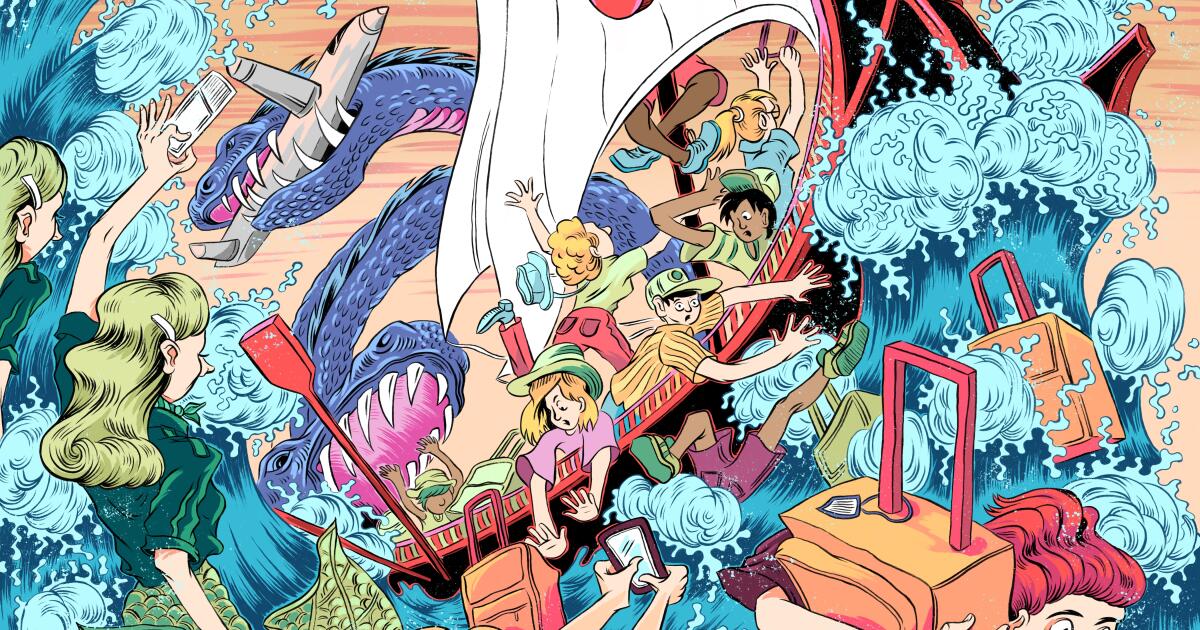
Lost luggage? Tarmac delays? Rental-car blues? No whining about measly travel headaches with the mother of all bad-trip sagas looming on the big screen.
“The Odyssey,” Christopher Nolan’s epic take on the Trojan War’s fallout, debuts July 17. Spoiler alert, if you somehow avoided Homer in community college: Nobody, save biblical Job, has had more misery hurled at them.
Outflanked by cruel and fickle gods at every turn, legendary Greek hero Odysseus outsmarted a one-eyed giant, suffered through the bewitching Sirens’ song and braved the Underworld’s dead denizens. He battled oversize cannibals, outmaneuvered a witch and lost scores of men at every turn. Then made it back to Ithaca after 10 years only to find his home overrun by suitors wooing his wife.
It’s a tale packed with bad decisions, failure, heartbreak and death. Perfect story fodder, given how much we love bad-trip stories. We consume lists of the worst airports and wonder at accounts of illness-plagued cruises. We scroll through videos starring unruly passengers or mangled bags, and read about the last resting place for lost luggage.
Hollywood has created a whole franchise around road trips gone wrong. Think of “The Hangover” or “Sideways” or “Little Miss Sunshine.” Screenwriter-director John Hughes perfected the big-screen comedic treatment of travel gone south with classics such as “Home Alone,” “National Lampoon’s Vacation” and “Planes, Trains and Automobiles.”
Let’s not even talk about the “three-hour tour” that left Gilligan and friends stranded on a deserted island for 98 episodes, or how Jack Dawson’s voyage ended aboard 1997’s “Titanic.”
A significant body of evidence even indicates that travel makes us sick. Trip-related problems are so common, in fact, that consumer advocate Christopher Elliott has stitched an entire career out of resolving them — from timeshare scams to horrible airline customer service and beyond.
Still, we keep buying tickets and packing our bags to sail into the great unknown, across Homer’s wine-dark sea. Why? Elliott attributes it to what he terms “traveler’s amnesia.”
“It amazes me that travelers are not up in arms about the way they get treated,” he said. “They take a trip, have a terrible experience, and forget about everything that went wrong and only remember what went right.”
He suggests that avoiding a bad trip starts with choosing companies noted for strong customer service. He cited some name-brand examples: Marriott for hotels, Alaska Airlines, and Enterprise Rent-A-Car. He avoids cruises as much as possible.
Which is funny, because when I think about cruising, I don’t revisit the miserable 36 hours that norovirus confined us in our cabin. I instead recall coasting past a flotilla of icebergs in Alaska’s Glacier Bay.
When I think about Mexico, I don’t wallow in memories involving Montezuma and his gastrointestinal revenge. But I do cherish thoughts of snorkeling with playful sea lion pups.
And when I consider airports, I blot the memory of the woman next to me at Gate 66 who insists on blaring a video call at maximum volume. Instead, wielding my noise-canceling earbuds, Odysseus-like, I plan to smother this screeching sound to preserve my sanity. But before I can insert them, a voice speaks to me.
To all of us, to be technically correct, since it emanates from the speakers of Los Angeles International Airport’s Terminal 6.
“It’s time to play TSA’s favorite game!” says the voice, mimicking a game-show host’s hustle. “You lost it, we found it!”
The speaker explained that someone had left a laptop computer at a checkpoint. The two were reunited moments later, which set my feet in motion, wondering whose voice it was. There at the checkpoint I met Carl Revis, a TSA supervisory officer with a penchant for comedy.
“You don’t have to be a jerk to get things done,” he told me. “I think reaching people through comedy is a lot easier than screaming and yelling at them.”
Taken together, my trip recollections probably qualify me as living proof of Elliott’s traveler’s amnesia theory. The final diagnosis should be clear soon. I’m retiring from full-time work this year, and people inevitably ask what’s next.
It’s not completely clear, I tell them. But I’ll definitely have more time to travel. Maybe sail across the Aegean … what could go wrong?

Lost luggage? Tarmac delays? Rental-car blues? No whining about measly travel headaches with the mother of all bad-trip sagas looming on the big screen.
“The Odyssey,” Christopher Nolan’s epic take on the Trojan War’s fallout, debuts July 17. Spoiler alert, if you somehow avoided Homer in community college: Nobody, save biblical Job, has had more misery hurled at them.
Outflanked by cruel and fickle gods at every turn, legendary Greek hero Odysseus outsmarted a one-eyed giant, suffered through the bewitching Sirens’ song and braved the Underworld’s dead denizens. He battled oversize cannibals, outmaneuvered a witch and lost scores of men at every turn. Then made it back to Ithaca after 10 years only to find his home overrun by suitors wooing his wife.
It’s a tale packed with bad decisions, failure, heartbreak and death. Perfect story fodder, given how much we love bad-trip stories. We consume lists of the worst airports and wonder at accounts of illness-plagued cruises. We scroll through videos starring unruly passengers or mangled bags, and read about the last resting place for lost luggage.
Hollywood has created a whole franchise around road trips gone wrong. Think of “The Hangover” or “Sideways” or “Little Miss Sunshine.” Screenwriter-director John Hughes perfected the big-screen comedic treatment of travel gone south with classics such as “Home Alone,” “National Lampoon’s Vacation” and “Planes, Trains and Automobiles.”
Let’s not even talk about the “three-hour tour” that left Gilligan and friends stranded on a deserted island for 98 episodes, or how Jack Dawson’s voyage ended aboard 1997’s “Titanic.”
A significant body of evidence even indicates that travel makes us sick. Trip-related problems are so common, in fact, that consumer advocate Christopher Elliott has stitched an entire career out of resolving them — from timeshare scams to horrible airline customer service and beyond.
Still, we keep buying tickets and packing our bags to sail into the great unknown, across Homer’s wine-dark sea. Why? Elliott attributes it to what he terms “traveler’s amnesia.”
“It amazes me that travelers are not up in arms about the way they get treated,” he said. “They take a trip, have a terrible experience, and forget about everything that went wrong and only remember what went right.”
He suggests that avoiding a bad trip starts with choosing companies noted for strong customer service. He cited some name-brand examples: Marriott for hotels, Alaska Airlines, and Enterprise Rent-A-Car. He avoids cruises as much as possible.
Which is funny, because when I think about cruising, I don’t revisit the miserable 36 hours that norovirus confined us in our cabin. I instead recall coasting past a flotilla of icebergs in Alaska’s Glacier Bay.
When I think about Mexico, I don’t wallow in memories involving Montezuma and his gastrointestinal revenge. But I do cherish thoughts of snorkeling with playful sea lion pups.
And when I consider airports, I blot the memory of the woman next to me at Gate 66 who insists on blaring a video call at maximum volume. Instead, wielding my noise-canceling earbuds, Odysseus-like, I plan to smother this screeching sound to preserve my sanity. But before I can insert them, a voice speaks to me.
To all of us, to be technically correct, since it emanates from the speakers of Los Angeles International Airport’s Terminal 6.
“It’s time to play TSA’s favorite game!” says the voice, mimicking a game-show host’s hustle. “You lost it, we found it!”
The speaker explained that someone had left a laptop computer at a checkpoint. The two were reunited moments later, which set my feet in motion, wondering whose voice it was. There at the checkpoint I met Carl Revis, a TSA supervisory officer with a penchant for comedy.
“You don’t have to be a jerk to get things done,” he told me. “I think reaching people through comedy is a lot easier than screaming and yelling at them.”
Taken together, my trip recollections probably qualify me as living proof of Elliott’s traveler’s amnesia theory. The final diagnosis should be clear soon. I’m retiring from full-time work this year, and people inevitably ask what’s next.
It’s not completely clear, I tell them. But I’ll definitely have more time to travel. Maybe sail across the Aegean … what could go wrong?

Lost luggage? Tarmac delays? Rental-car blues? No whining about measly travel headaches with the mother of all bad-trip sagas looming on the big screen.
“The Odyssey,” Christopher Nolan’s epic take on the Trojan War’s fallout, debuts July 17. Spoiler alert, if you somehow avoided Homer in community college: Nobody, save biblical Job, has had more misery hurled at them.
Outflanked by cruel and fickle gods at every turn, legendary Greek hero Odysseus outsmarted a one-eyed giant, suffered through the bewitching Sirens’ song and braved the Underworld’s dead denizens. He battled oversize cannibals, outmaneuvered a witch and lost scores of men at every turn. Then made it back to Ithaca after 10 years only to find his home overrun by suitors wooing his wife.
It’s a tale packed with bad decisions, failure, heartbreak and death. Perfect story fodder, given how much we love bad-trip stories. We consume lists of the worst airports and wonder at accounts of illness-plagued cruises. We scroll through videos starring unruly passengers or mangled bags, and read about the last resting place for lost luggage.
Hollywood has created a whole franchise around road trips gone wrong. Think of “The Hangover” or “Sideways” or “Little Miss Sunshine.” Screenwriter-director John Hughes perfected the big-screen comedic treatment of travel gone south with classics such as “Home Alone,” “National Lampoon’s Vacation” and “Planes, Trains and Automobiles.”
Let’s not even talk about the “three-hour tour” that left Gilligan and friends stranded on a deserted island for 98 episodes, or how Jack Dawson’s voyage ended aboard 1997’s “Titanic.”
A significant body of evidence even indicates that travel makes us sick. Trip-related problems are so common, in fact, that consumer advocate Christopher Elliott has stitched an entire career out of resolving them — from timeshare scams to horrible airline customer service and beyond.
Still, we keep buying tickets and packing our bags to sail into the great unknown, across Homer’s wine-dark sea. Why? Elliott attributes it to what he terms “traveler’s amnesia.”
“It amazes me that travelers are not up in arms about the way they get treated,” he said. “They take a trip, have a terrible experience, and forget about everything that went wrong and only remember what went right.”
He suggests that avoiding a bad trip starts with choosing companies noted for strong customer service. He cited some name-brand examples: Marriott for hotels, Alaska Airlines, and Enterprise Rent-A-Car. He avoids cruises as much as possible.
Which is funny, because when I think about cruising, I don’t revisit the miserable 36 hours that norovirus confined us in our cabin. I instead recall coasting past a flotilla of icebergs in Alaska’s Glacier Bay.
When I think about Mexico, I don’t wallow in memories involving Montezuma and his gastrointestinal revenge. But I do cherish thoughts of snorkeling with playful sea lion pups.
And when I consider airports, I blot the memory of the woman next to me at Gate 66 who insists on blaring a video call at maximum volume. Instead, wielding my noise-canceling earbuds, Odysseus-like, I plan to smother this screeching sound to preserve my sanity. But before I can insert them, a voice speaks to me.
To all of us, to be technically correct, since it emanates from the speakers of Los Angeles International Airport’s Terminal 6.
“It’s time to play TSA’s favorite game!” says the voice, mimicking a game-show host’s hustle. “You lost it, we found it!”
The speaker explained that someone had left a laptop computer at a checkpoint. The two were reunited moments later, which set my feet in motion, wondering whose voice it was. There at the checkpoint I met Carl Revis, a TSA supervisory officer with a penchant for comedy.
“You don’t have to be a jerk to get things done,” he told me. “I think reaching people through comedy is a lot easier than screaming and yelling at them.”
Taken together, my trip recollections probably qualify me as living proof of Elliott’s traveler’s amnesia theory. The final diagnosis should be clear soon. I’m retiring from full-time work this year, and people inevitably ask what’s next.
It’s not completely clear, I tell them. But I’ll definitely have more time to travel. Maybe sail across the Aegean … what could go wrong?
Lost luggage? Tarmac delays? Rental-car blues? No whining about measly travel headaches with the mother of all bad-trip sagas looming on the big screen.
“The Odyssey,” Christopher Nolan’s epic take on the Trojan War’s fallout, debuts July 17. Spoiler alert, if you somehow avoided Homer in community college: Nobody, save biblical Job, has had more misery hurled at them.
Outflanked by cruel and fickle gods at every turn, legendary Greek hero Odysseus outsmarted a one-eyed giant, suffered through the bewitching Sirens’ song and braved the Underworld’s dead denizens. He battled oversize cannibals, outmaneuvered a witch and lost scores of men at every turn. Then made it back to Ithaca after 10 years only to find his home overrun by suitors wooing his wife.
It’s a tale packed with bad decisions, failure, heartbreak and death. Perfect story fodder, given how much we love bad-trip stories. We consume lists of the worst airports and wonder at accounts of illness-plagued cruises. We scroll through videos starring unruly passengers or mangled bags, and read about the last resting place for lost luggage.
Hollywood has created a whole franchise around road trips gone wrong. Think of “The Hangover” or “Sideways” or “Little Miss Sunshine.” Screenwriter-director John Hughes perfected the big-screen comedic treatment of travel gone south with classics such as “Home Alone,” “National Lampoon’s Vacation” and “Planes, Trains and Automobiles.”
Let’s not even talk about the “three-hour tour” that left Gilligan and friends stranded on a deserted island for 98 episodes, or how Jack Dawson’s voyage ended aboard 1997’s “Titanic.”
A significant body of evidence even indicates that travel makes us sick. Trip-related problems are so common, in fact, that consumer advocate Christopher Elliott has stitched an entire career out of resolving them — from timeshare scams to horrible airline customer service and beyond.
Still, we keep buying tickets and packing our bags to sail into the great unknown, across Homer’s wine-dark sea. Why? Elliott attributes it to what he terms “traveler’s amnesia.”
“It amazes me that travelers are not up in arms about the way they get treated,” he said. “They take a trip, have a terrible experience, and forget about everything that went wrong and only remember what went right.”
He suggests that avoiding a bad trip starts with choosing companies noted for strong customer service. He cited some name-brand examples: Marriott for hotels, Alaska Airlines, and Enterprise Rent-A-Car. He avoids cruises as much as possible.
Which is funny, because when I think about cruising, I don’t revisit the miserable 36 hours that norovirus confined us in our cabin. I instead recall coasting past a flotilla of icebergs in Alaska’s Glacier Bay.
When I think about Mexico, I don’t wallow in memories involving Montezuma and his gastrointestinal revenge. But I do cherish thoughts of snorkeling with playful sea lion pups.
And when I consider airports, I blot the memory of the woman next to me at Gate 66 who insists on blaring a video call at maximum volume. Instead, wielding my noise-canceling earbuds, Odysseus-like, I plan to smother this screeching sound to preserve my sanity. But before I can insert them, a voice speaks to me.
To all of us, to be technically correct, since it emanates from the speakers of Los Angeles International Airport’s Terminal 6.
“It’s time to play TSA’s favorite game!” says the voice, mimicking a game-show host’s hustle. “You lost it, we found it!”
The speaker explained that someone had left a laptop computer at a checkpoint. The two were reunited moments later, which set my feet in motion, wondering whose voice it was. There at the checkpoint I met Carl Revis, a TSA supervisory officer with a penchant for comedy.
“You don’t have to be a jerk to get things done,” he told me. “I think reaching people through comedy is a lot easier than screaming and yelling at them.”
Taken together, my trip recollections probably qualify me as living proof of Elliott’s traveler’s amnesia theory. The final diagnosis should be clear soon. I’m retiring from full-time work this year, and people inevitably ask what’s next.
It’s not completely clear, I tell them. But I’ll definitely have more time to travel. Maybe sail across the Aegean … what could go wrong?

Lost luggage? Tarmac delays? Rental-car blues? No whining about measly travel headaches with the mother of all bad-trip sagas looming on the big screen.
“The Odyssey,” Christopher Nolan’s epic take on the Trojan War’s fallout, debuts July 17. Spoiler alert, if you somehow avoided Homer in community college: Nobody, save biblical Job, has had more misery hurled at them.
Outflanked by cruel and fickle gods at every turn, legendary Greek hero Odysseus outsmarted a one-eyed giant, suffered through the bewitching Sirens’ song and braved the Underworld’s dead denizens. He battled oversize cannibals, outmaneuvered a witch and lost scores of men at every turn. Then made it back to Ithaca after 10 years only to find his home overrun by suitors wooing his wife.
It’s a tale packed with bad decisions, failure, heartbreak and death. Perfect story fodder, given how much we love bad-trip stories. We consume lists of the worst airports and wonder at accounts of illness-plagued cruises. We scroll through videos starring unruly passengers or mangled bags, and read about the last resting place for lost luggage.
Hollywood has created a whole franchise around road trips gone wrong. Think of “The Hangover” or “Sideways” or “Little Miss Sunshine.” Screenwriter-director John Hughes perfected the big-screen comedic treatment of travel gone south with classics such as “Home Alone,” “National Lampoon’s Vacation” and “Planes, Trains and Automobiles.”
Let’s not even talk about the “three-hour tour” that left Gilligan and friends stranded on a deserted island for 98 episodes, or how Jack Dawson’s voyage ended aboard 1997’s “Titanic.”
A significant body of evidence even indicates that travel makes us sick. Trip-related problems are so common, in fact, that consumer advocate Christopher Elliott has stitched an entire career out of resolving them — from timeshare scams to horrible airline customer service and beyond.
Still, we keep buying tickets and packing our bags to sail into the great unknown, across Homer’s wine-dark sea. Why? Elliott attributes it to what he terms “traveler’s amnesia.”
“It amazes me that travelers are not up in arms about the way they get treated,” he said. “They take a trip, have a terrible experience, and forget about everything that went wrong and only remember what went right.”
He suggests that avoiding a bad trip starts with choosing companies noted for strong customer service. He cited some name-brand examples: Marriott for hotels, Alaska Airlines, and Enterprise Rent-A-Car. He avoids cruises as much as possible.
Which is funny, because when I think about cruising, I don’t revisit the miserable 36 hours that norovirus confined us in our cabin. I instead recall coasting past a flotilla of icebergs in Alaska’s Glacier Bay.
When I think about Mexico, I don’t wallow in memories involving Montezuma and his gastrointestinal revenge. But I do cherish thoughts of snorkeling with playful sea lion pups.
And when I consider airports, I blot the memory of the woman next to me at Gate 66 who insists on blaring a video call at maximum volume. Instead, wielding my noise-canceling earbuds, Odysseus-like, I plan to smother this screeching sound to preserve my sanity. But before I can insert them, a voice speaks to me.
To all of us, to be technically correct, since it emanates from the speakers of Los Angeles International Airport’s Terminal 6.
“It’s time to play TSA’s favorite game!” says the voice, mimicking a game-show host’s hustle. “You lost it, we found it!”
The speaker explained that someone had left a laptop computer at a checkpoint. The two were reunited moments later, which set my feet in motion, wondering whose voice it was. There at the checkpoint I met Carl Revis, a TSA supervisory officer with a penchant for comedy.
“You don’t have to be a jerk to get things done,” he told me. “I think reaching people through comedy is a lot easier than screaming and yelling at them.”
Taken together, my trip recollections probably qualify me as living proof of Elliott’s traveler’s amnesia theory. The final diagnosis should be clear soon. I’m retiring from full-time work this year, and people inevitably ask what’s next.
It’s not completely clear, I tell them. But I’ll definitely have more time to travel. Maybe sail across the Aegean … what could go wrong?
Lost luggage? Tarmac delays? Rental-car blues? No whining about measly travel headaches with the mother of all bad-trip sagas looming on the big screen.
“The Odyssey,” Christopher Nolan’s epic take on the Trojan War’s fallout, debuts July 17. Spoiler alert, if you somehow avoided Homer in community college: Nobody, save biblical Job, has had more misery hurled at them.
Outflanked by cruel and fickle gods at every turn, legendary Greek hero Odysseus outsmarted a one-eyed giant, suffered through the bewitching Sirens’ song and braved the Underworld’s dead denizens. He battled oversize cannibals, outmaneuvered a witch and lost scores of men at every turn. Then made it back to Ithaca after 10 years only to find his home overrun by suitors wooing his wife.
It’s a tale packed with bad decisions, failure, heartbreak and death. Perfect story fodder, given how much we love bad-trip stories. We consume lists of the worst airports and wonder at accounts of illness-plagued cruises. We scroll through videos starring unruly passengers or mangled bags, and read about the last resting place for lost luggage.
Hollywood has created a whole franchise around road trips gone wrong. Think of “The Hangover” or “Sideways” or “Little Miss Sunshine.” Screenwriter-director John Hughes perfected the big-screen comedic treatment of travel gone south with classics such as “Home Alone,” “National Lampoon’s Vacation” and “Planes, Trains and Automobiles.”
Let’s not even talk about the “three-hour tour” that left Gilligan and friends stranded on a deserted island for 98 episodes, or how Jack Dawson’s voyage ended aboard 1997’s “Titanic.”
A significant body of evidence even indicates that travel makes us sick. Trip-related problems are so common, in fact, that consumer advocate Christopher Elliott has stitched an entire career out of resolving them — from timeshare scams to horrible airline customer service and beyond.
Still, we keep buying tickets and packing our bags to sail into the great unknown, across Homer’s wine-dark sea. Why? Elliott attributes it to what he terms “traveler’s amnesia.”
“It amazes me that travelers are not up in arms about the way they get treated,” he said. “They take a trip, have a terrible experience, and forget about everything that went wrong and only remember what went right.”
He suggests that avoiding a bad trip starts with choosing companies noted for strong customer service. He cited some name-brand examples: Marriott for hotels, Alaska Airlines, and Enterprise Rent-A-Car. He avoids cruises as much as possible.
Which is funny, because when I think about cruising, I don’t revisit the miserable 36 hours that norovirus confined us in our cabin. I instead recall coasting past a flotilla of icebergs in Alaska’s Glacier Bay.
When I think about Mexico, I don’t wallow in memories involving Montezuma and his gastrointestinal revenge. But I do cherish thoughts of snorkeling with playful sea lion pups.
And when I consider airports, I blot the memory of the woman next to me at Gate 66 who insists on blaring a video call at maximum volume. Instead, wielding my noise-canceling earbuds, Odysseus-like, I plan to smother this screeching sound to preserve my sanity. But before I can insert them, a voice speaks to me.
To all of us, to be technically correct, since it emanates from the speakers of Los Angeles International Airport’s Terminal 6.
“It’s time to play TSA’s favorite game!” says the voice, mimicking a game-show host’s hustle. “You lost it, we found it!”
The speaker explained that someone had left a laptop computer at a checkpoint. The two were reunited moments later, which set my feet in motion, wondering whose voice it was. There at the checkpoint I met Carl Revis, a TSA supervisory officer with a penchant for comedy.
“You don’t have to be a jerk to get things done,” he told me. “I think reaching people through comedy is a lot easier than screaming and yelling at them.”
Taken together, my trip recollections probably qualify me as living proof of Elliott’s traveler’s amnesia theory. The final diagnosis should be clear soon. I’m retiring from full-time work this year, and people inevitably ask what’s next.
It’s not completely clear, I tell them. But I’ll definitely have more time to travel. Maybe sail across the Aegean … what could go wrong?
Lost luggage? Tarmac delays? Rental-car blues? No whining about measly travel headaches with the mother of all bad-trip sagas looming on the big screen.
“The Odyssey,” Christopher Nolan’s epic take on the Trojan War’s fallout, debuts July 17. Spoiler alert, if you somehow avoided Homer in community college: Nobody, save biblical Job, has had more misery hurled at them.
Outflanked by cruel and fickle gods at every turn, legendary Greek hero Odysseus outsmarted a one-eyed giant, suffered through the bewitching Sirens’ song and braved the Underworld’s dead denizens. He battled oversize cannibals, outmaneuvered a witch and lost scores of men at every turn. Then made it back to Ithaca after 10 years only to find his home overrun by suitors wooing his wife.
It’s a tale packed with bad decisions, failure, heartbreak and death. Perfect story fodder, given how much we love bad-trip stories. We consume lists of the worst airports and wonder at accounts of illness-plagued cruises. We scroll through videos starring unruly passengers or mangled bags, and read about the last resting place for lost luggage.
Hollywood has created a whole franchise around road trips gone wrong. Think of “The Hangover” or “Sideways” or “Little Miss Sunshine.” Screenwriter-director John Hughes perfected the big-screen comedic treatment of travel gone south with classics such as “Home Alone,” “National Lampoon’s Vacation” and “Planes, Trains and Automobiles.”
Let’s not even talk about the “three-hour tour” that left Gilligan and friends stranded on a deserted island for 98 episodes, or how Jack Dawson’s voyage ended aboard 1997’s “Titanic.”
A significant body of evidence even indicates that travel makes us sick. Trip-related problems are so common, in fact, that consumer advocate Christopher Elliott has stitched an entire career out of resolving them — from timeshare scams to horrible airline customer service and beyond.
Still, we keep buying tickets and packing our bags to sail into the great unknown, across Homer’s wine-dark sea. Why? Elliott attributes it to what he terms “traveler’s amnesia.”
“It amazes me that travelers are not up in arms about the way they get treated,” he said. “They take a trip, have a terrible experience, and forget about everything that went wrong and only remember what went right.”
He suggests that avoiding a bad trip starts with choosing companies noted for strong customer service. He cited some name-brand examples: Marriott for hotels, Alaska Airlines, and Enterprise Rent-A-Car. He avoids cruises as much as possible.
Which is funny, because when I think about cruising, I don’t revisit the miserable 36 hours that norovirus confined us in our cabin. I instead recall coasting past a flotilla of icebergs in Alaska’s Glacier Bay.
When I think about Mexico, I don’t wallow in memories involving Montezuma and his gastrointestinal revenge. But I do cherish thoughts of snorkeling with playful sea lion pups.
And when I consider airports, I blot the memory of the woman next to me at Gate 66 who insists on blaring a video call at maximum volume. Instead, wielding my noise-canceling earbuds, Odysseus-like, I plan to smother this screeching sound to preserve my sanity. But before I can insert them, a voice speaks to me.
To all of us, to be technically correct, since it emanates from the speakers of Los Angeles International Airport’s Terminal 6.
“It’s time to play TSA’s favorite game!” says the voice, mimicking a game-show host’s hustle. “You lost it, we found it!”
The speaker explained that someone had left a laptop computer at a checkpoint. The two were reunited moments later, which set my feet in motion, wondering whose voice it was. There at the checkpoint I met Carl Revis, a TSA supervisory officer with a penchant for comedy.
“You don’t have to be a jerk to get things done,” he told me. “I think reaching people through comedy is a lot easier than screaming and yelling at them.”
Taken together, my trip recollections probably qualify me as living proof of Elliott’s traveler’s amnesia theory. The final diagnosis should be clear soon. I’m retiring from full-time work this year, and people inevitably ask what’s next.
It’s not completely clear, I tell them. But I’ll definitely have more time to travel. Maybe sail across the Aegean … what could go wrong?
Lost luggage? Tarmac delays? Rental-car blues? No whining about measly travel headaches with the mother of all bad-trip sagas looming on the big screen.
“The Odyssey,” Christopher Nolan’s epic take on the Trojan War’s fallout, debuts July 17. Spoiler alert, if you somehow avoided Homer in community college: Nobody, save biblical Job, has had more misery hurled at them.
Outflanked by cruel and fickle gods at every turn, legendary Greek hero Odysseus outsmarted a one-eyed giant, suffered through the bewitching Sirens’ song and braved the Underworld’s dead denizens. He battled oversize cannibals, outmaneuvered a witch and lost scores of men at every turn. Then made it back to Ithaca after 10 years only to find his home overrun by suitors wooing his wife.
It’s a tale packed with bad decisions, failure, heartbreak and death. Perfect story fodder, given how much we love bad-trip stories. We consume lists of the worst airports and wonder at accounts of illness-plagued cruises. We scroll through videos starring unruly passengers or mangled bags, and read about the last resting place for lost luggage.
Hollywood has created a whole franchise around road trips gone wrong. Think of “The Hangover” or “Sideways” or “Little Miss Sunshine.” Screenwriter-director John Hughes perfected the big-screen comedic treatment of travel gone south with classics such as “Home Alone,” “National Lampoon’s Vacation” and “Planes, Trains and Automobiles.”
Let’s not even talk about the “three-hour tour” that left Gilligan and friends stranded on a deserted island for 98 episodes, or how Jack Dawson’s voyage ended aboard 1997’s “Titanic.”
A significant body of evidence even indicates that travel makes us sick. Trip-related problems are so common, in fact, that consumer advocate Christopher Elliott has stitched an entire career out of resolving them — from timeshare scams to horrible airline customer service and beyond.
Still, we keep buying tickets and packing our bags to sail into the great unknown, across Homer’s wine-dark sea. Why? Elliott attributes it to what he terms “traveler’s amnesia.”
“It amazes me that travelers are not up in arms about the way they get treated,” he said. “They take a trip, have a terrible experience, and forget about everything that went wrong and only remember what went right.”
He suggests that avoiding a bad trip starts with choosing companies noted for strong customer service. He cited some name-brand examples: Marriott for hotels, Alaska Airlines, and Enterprise Rent-A-Car. He avoids cruises as much as possible.
Which is funny, because when I think about cruising, I don’t revisit the miserable 36 hours that norovirus confined us in our cabin. I instead recall coasting past a flotilla of icebergs in Alaska’s Glacier Bay.
When I think about Mexico, I don’t wallow in memories involving Montezuma and his gastrointestinal revenge. But I do cherish thoughts of snorkeling with playful sea lion pups.
And when I consider airports, I blot the memory of the woman next to me at Gate 66 who insists on blaring a video call at maximum volume. Instead, wielding my noise-canceling earbuds, Odysseus-like, I plan to smother this screeching sound to preserve my sanity. But before I can insert them, a voice speaks to me.
To all of us, to be technically correct, since it emanates from the speakers of Los Angeles International Airport’s Terminal 6.
“It’s time to play TSA’s favorite game!” says the voice, mimicking a game-show host’s hustle. “You lost it, we found it!”
The speaker explained that someone had left a laptop computer at a checkpoint. The two were reunited moments later, which set my feet in motion, wondering whose voice it was. There at the checkpoint I met Carl Revis, a TSA supervisory officer with a penchant for comedy.
“You don’t have to be a jerk to get things done,” he told me. “I think reaching people through comedy is a lot easier than screaming and yelling at them.”
Taken together, my trip recollections probably qualify me as living proof of Elliott’s traveler’s amnesia theory. The final diagnosis should be clear soon. I’m retiring from full-time work this year, and people inevitably ask what’s next.
It’s not completely clear, I tell them. But I’ll definitely have more time to travel. Maybe sail across the Aegean … what could go wrong?

Lost luggage? Tarmac delays? Rental-car blues? No whining about measly travel headaches with the mother of all bad-trip sagas looming on the big screen.
“The Odyssey,” Christopher Nolan’s epic take on the Trojan War’s fallout, debuts July 17. Spoiler alert, if you somehow avoided Homer in community college: Nobody, save biblical Job, has had more misery hurled at them.
Outflanked by cruel and fickle gods at every turn, legendary Greek hero Odysseus outsmarted a one-eyed giant, suffered through the bewitching Sirens’ song and braved the Underworld’s dead denizens. He battled oversize cannibals, outmaneuvered a witch and lost scores of men at every turn. Then made it back to Ithaca after 10 years only to find his home overrun by suitors wooing his wife.
It’s a tale packed with bad decisions, failure, heartbreak and death. Perfect story fodder, given how much we love bad-trip stories. We consume lists of the worst airports and wonder at accounts of illness-plagued cruises. We scroll through videos starring unruly passengers or mangled bags, and read about the last resting place for lost luggage.
Hollywood has created a whole franchise around road trips gone wrong. Think of “The Hangover” or “Sideways” or “Little Miss Sunshine.” Screenwriter-director John Hughes perfected the big-screen comedic treatment of travel gone south with classics such as “Home Alone,” “National Lampoon’s Vacation” and “Planes, Trains and Automobiles.”
Let’s not even talk about the “three-hour tour” that left Gilligan and friends stranded on a deserted island for 98 episodes, or how Jack Dawson’s voyage ended aboard 1997’s “Titanic.”
A significant body of evidence even indicates that travel makes us sick. Trip-related problems are so common, in fact, that consumer advocate Christopher Elliott has stitched an entire career out of resolving them — from timeshare scams to horrible airline customer service and beyond.
Still, we keep buying tickets and packing our bags to sail into the great unknown, across Homer’s wine-dark sea. Why? Elliott attributes it to what he terms “traveler’s amnesia.”
“It amazes me that travelers are not up in arms about the way they get treated,” he said. “They take a trip, have a terrible experience, and forget about everything that went wrong and only remember what went right.”
He suggests that avoiding a bad trip starts with choosing companies noted for strong customer service. He cited some name-brand examples: Marriott for hotels, Alaska Airlines, and Enterprise Rent-A-Car. He avoids cruises as much as possible.
Which is funny, because when I think about cruising, I don’t revisit the miserable 36 hours that norovirus confined us in our cabin. I instead recall coasting past a flotilla of icebergs in Alaska’s Glacier Bay.
When I think about Mexico, I don’t wallow in memories involving Montezuma and his gastrointestinal revenge. But I do cherish thoughts of snorkeling with playful sea lion pups.
And when I consider airports, I blot the memory of the woman next to me at Gate 66 who insists on blaring a video call at maximum volume. Instead, wielding my noise-canceling earbuds, Odysseus-like, I plan to smother this screeching sound to preserve my sanity. But before I can insert them, a voice speaks to me.
To all of us, to be technically correct, since it emanates from the speakers of Los Angeles International Airport’s Terminal 6.
“It’s time to play TSA’s favorite game!” says the voice, mimicking a game-show host’s hustle. “You lost it, we found it!”
The speaker explained that someone had left a laptop computer at a checkpoint. The two were reunited moments later, which set my feet in motion, wondering whose voice it was. There at the checkpoint I met Carl Revis, a TSA supervisory officer with a penchant for comedy.
“You don’t have to be a jerk to get things done,” he told me. “I think reaching people through comedy is a lot easier than screaming and yelling at them.”
Taken together, my trip recollections probably qualify me as living proof of Elliott’s traveler’s amnesia theory. The final diagnosis should be clear soon. I’m retiring from full-time work this year, and people inevitably ask what’s next.
It’s not completely clear, I tell them. But I’ll definitely have more time to travel. Maybe sail across the Aegean … what could go wrong?
Lost luggage? Tarmac delays? Rental-car blues? No whining about measly travel headaches with the mother of all bad-trip sagas looming on the big screen.
“The Odyssey,” Christopher Nolan’s epic take on the Trojan War’s fallout, debuts July 17. Spoiler alert, if you somehow avoided Homer in community college: Nobody, save biblical Job, has had more misery hurled at them.
Outflanked by cruel and fickle gods at every turn, legendary Greek hero Odysseus outsmarted a one-eyed giant, suffered through the bewitching Sirens’ song and braved the Underworld’s dead denizens. He battled oversize cannibals, outmaneuvered a witch and lost scores of men at every turn. Then made it back to Ithaca after 10 years only to find his home overrun by suitors wooing his wife.
It’s a tale packed with bad decisions, failure, heartbreak and death. Perfect story fodder, given how much we love bad-trip stories. We consume lists of the worst airports and wonder at accounts of illness-plagued cruises. We scroll through videos starring unruly passengers or mangled bags, and read about the last resting place for lost luggage.
Hollywood has created a whole franchise around road trips gone wrong. Think of “The Hangover” or “Sideways” or “Little Miss Sunshine.” Screenwriter-director John Hughes perfected the big-screen comedic treatment of travel gone south with classics such as “Home Alone,” “National Lampoon’s Vacation” and “Planes, Trains and Automobiles.”
Let’s not even talk about the “three-hour tour” that left Gilligan and friends stranded on a deserted island for 98 episodes, or how Jack Dawson’s voyage ended aboard 1997’s “Titanic.”
A significant body of evidence even indicates that travel makes us sick. Trip-related problems are so common, in fact, that consumer advocate Christopher Elliott has stitched an entire career out of resolving them — from timeshare scams to horrible airline customer service and beyond.
Still, we keep buying tickets and packing our bags to sail into the great unknown, across Homer’s wine-dark sea. Why? Elliott attributes it to what he terms “traveler’s amnesia.”
“It amazes me that travelers are not up in arms about the way they get treated,” he said. “They take a trip, have a terrible experience, and forget about everything that went wrong and only remember what went right.”
He suggests that avoiding a bad trip starts with choosing companies noted for strong customer service. He cited some name-brand examples: Marriott for hotels, Alaska Airlines, and Enterprise Rent-A-Car. He avoids cruises as much as possible.
Which is funny, because when I think about cruising, I don’t revisit the miserable 36 hours that norovirus confined us in our cabin. I instead recall coasting past a flotilla of icebergs in Alaska’s Glacier Bay.
When I think about Mexico, I don’t wallow in memories involving Montezuma and his gastrointestinal revenge. But I do cherish thoughts of snorkeling with playful sea lion pups.
And when I consider airports, I blot the memory of the woman next to me at Gate 66 who insists on blaring a video call at maximum volume. Instead, wielding my noise-canceling earbuds, Odysseus-like, I plan to smother this screeching sound to preserve my sanity. But before I can insert them, a voice speaks to me.
To all of us, to be technically correct, since it emanates from the speakers of Los Angeles International Airport’s Terminal 6.
“It’s time to play TSA’s favorite game!” says the voice, mimicking a game-show host’s hustle. “You lost it, we found it!”
The speaker explained that someone had left a laptop computer at a checkpoint. The two were reunited moments later, which set my feet in motion, wondering whose voice it was. There at the checkpoint I met Carl Revis, a TSA supervisory officer with a penchant for comedy.
“You don’t have to be a jerk to get things done,” he told me. “I think reaching people through comedy is a lot easier than screaming and yelling at them.”
Taken together, my trip recollections probably qualify me as living proof of Elliott’s traveler’s amnesia theory. The final diagnosis should be clear soon. I’m retiring from full-time work this year, and people inevitably ask what’s next.
It’s not completely clear, I tell them. But I’ll definitely have more time to travel. Maybe sail across the Aegean … what could go wrong?
Lost luggage? Tarmac delays? Rental-car blues? No whining about measly travel headaches with the mother of all bad-trip sagas looming on the big screen.
“The Odyssey,” Christopher Nolan’s epic take on the Trojan War’s fallout, debuts July 17. Spoiler alert, if you somehow avoided Homer in community college: Nobody, save biblical Job, has had more misery hurled at them.
Outflanked by cruel and fickle gods at every turn, legendary Greek hero Odysseus outsmarted a one-eyed giant, suffered through the bewitching Sirens’ song and braved the Underworld’s dead denizens. He battled oversize cannibals, outmaneuvered a witch and lost scores of men at every turn. Then made it back to Ithaca after 10 years only to find his home overrun by suitors wooing his wife.
It’s a tale packed with bad decisions, failure, heartbreak and death. Perfect story fodder, given how much we love bad-trip stories. We consume lists of the worst airports and wonder at accounts of illness-plagued cruises. We scroll through videos starring unruly passengers or mangled bags, and read about the last resting place for lost luggage.
Hollywood has created a whole franchise around road trips gone wrong. Think of “The Hangover” or “Sideways” or “Little Miss Sunshine.” Screenwriter-director John Hughes perfected the big-screen comedic treatment of travel gone south with classics such as “Home Alone,” “National Lampoon’s Vacation” and “Planes, Trains and Automobiles.”
Let’s not even talk about the “three-hour tour” that left Gilligan and friends stranded on a deserted island for 98 episodes, or how Jack Dawson’s voyage ended aboard 1997’s “Titanic.”
A significant body of evidence even indicates that travel makes us sick. Trip-related problems are so common, in fact, that consumer advocate Christopher Elliott has stitched an entire career out of resolving them — from timeshare scams to horrible airline customer service and beyond.
Still, we keep buying tickets and packing our bags to sail into the great unknown, across Homer’s wine-dark sea. Why? Elliott attributes it to what he terms “traveler’s amnesia.”
“It amazes me that travelers are not up in arms about the way they get treated,” he said. “They take a trip, have a terrible experience, and forget about everything that went wrong and only remember what went right.”
He suggests that avoiding a bad trip starts with choosing companies noted for strong customer service. He cited some name-brand examples: Marriott for hotels, Alaska Airlines, and Enterprise Rent-A-Car. He avoids cruises as much as possible.
Which is funny, because when I think about cruising, I don’t revisit the miserable 36 hours that norovirus confined us in our cabin. I instead recall coasting past a flotilla of icebergs in Alaska’s Glacier Bay.
When I think about Mexico, I don’t wallow in memories involving Montezuma and his gastrointestinal revenge. But I do cherish thoughts of snorkeling with playful sea lion pups.
And when I consider airports, I blot the memory of the woman next to me at Gate 66 who insists on blaring a video call at maximum volume. Instead, wielding my noise-canceling earbuds, Odysseus-like, I plan to smother this screeching sound to preserve my sanity. But before I can insert them, a voice speaks to me.
To all of us, to be technically correct, since it emanates from the speakers of Los Angeles International Airport’s Terminal 6.
“It’s time to play TSA’s favorite game!” says the voice, mimicking a game-show host’s hustle. “You lost it, we found it!”
The speaker explained that someone had left a laptop computer at a checkpoint. The two were reunited moments later, which set my feet in motion, wondering whose voice it was. There at the checkpoint I met Carl Revis, a TSA supervisory officer with a penchant for comedy.
“You don’t have to be a jerk to get things done,” he told me. “I think reaching people through comedy is a lot easier than screaming and yelling at them.”
Taken together, my trip recollections probably qualify me as living proof of Elliott’s traveler’s amnesia theory. The final diagnosis should be clear soon. I’m retiring from full-time work this year, and people inevitably ask what’s next.
It’s not completely clear, I tell them. But I’ll definitely have more time to travel. Maybe sail across the Aegean … what could go wrong?
Lost luggage? Tarmac delays? Rental-car blues? No whining about measly travel headaches with the mother of all bad-trip sagas looming on the big screen.
“The Odyssey,” Christopher Nolan’s epic take on the Trojan War’s fallout, debuts July 17. Spoiler alert, if you somehow avoided Homer in community college: Nobody, save biblical Job, has had more misery hurled at them.
Outflanked by cruel and fickle gods at every turn, legendary Greek hero Odysseus outsmarted a one-eyed giant, suffered through the bewitching Sirens’ song and braved the Underworld’s dead denizens. He battled oversize cannibals, outmaneuvered a witch and lost scores of men at every turn. Then made it back to Ithaca after 10 years only to find his home overrun by suitors wooing his wife.
It’s a tale packed with bad decisions, failure, heartbreak and death. Perfect story fodder, given how much we love bad-trip stories. We consume lists of the worst airports and wonder at accounts of illness-plagued cruises. We scroll through videos starring unruly passengers or mangled bags, and read about the last resting place for lost luggage.
Hollywood has created a whole franchise around road trips gone wrong. Think of “The Hangover” or “Sideways” or “Little Miss Sunshine.” Screenwriter-director John Hughes perfected the big-screen comedic treatment of travel gone south with classics such as “Home Alone,” “National Lampoon’s Vacation” and “Planes, Trains and Automobiles.”
Let’s not even talk about the “three-hour tour” that left Gilligan and friends stranded on a deserted island for 98 episodes, or how Jack Dawson’s voyage ended aboard 1997’s “Titanic.”
A significant body of evidence even indicates that travel makes us sick. Trip-related problems are so common, in fact, that consumer advocate Christopher Elliott has stitched an entire career out of resolving them — from timeshare scams to horrible airline customer service and beyond.
Still, we keep buying tickets and packing our bags to sail into the great unknown, across Homer’s wine-dark sea. Why? Elliott attributes it to what he terms “traveler’s amnesia.”
“It amazes me that travelers are not up in arms about the way they get treated,” he said. “They take a trip, have a terrible experience, and forget about everything that went wrong and only remember what went right.”
He suggests that avoiding a bad trip starts with choosing companies noted for strong customer service. He cited some name-brand examples: Marriott for hotels, Alaska Airlines, and Enterprise Rent-A-Car. He avoids cruises as much as possible.
Which is funny, because when I think about cruising, I don’t revisit the miserable 36 hours that norovirus confined us in our cabin. I instead recall coasting past a flotilla of icebergs in Alaska’s Glacier Bay.
When I think about Mexico, I don’t wallow in memories involving Montezuma and his gastrointestinal revenge. But I do cherish thoughts of snorkeling with playful sea lion pups.
And when I consider airports, I blot the memory of the woman next to me at Gate 66 who insists on blaring a video call at maximum volume. Instead, wielding my noise-canceling earbuds, Odysseus-like, I plan to smother this screeching sound to preserve my sanity. But before I can insert them, a voice speaks to me.
To all of us, to be technically correct, since it emanates from the speakers of Los Angeles International Airport’s Terminal 6.
“It’s time to play TSA’s favorite game!” says the voice, mimicking a game-show host’s hustle. “You lost it, we found it!”
The speaker explained that someone had left a laptop computer at a checkpoint. The two were reunited moments later, which set my feet in motion, wondering whose voice it was. There at the checkpoint I met Carl Revis, a TSA supervisory officer with a penchant for comedy.
“You don’t have to be a jerk to get things done,” he told me. “I think reaching people through comedy is a lot easier than screaming and yelling at them.”
Taken together, my trip recollections probably qualify me as living proof of Elliott’s traveler’s amnesia theory. The final diagnosis should be clear soon. I’m retiring from full-time work this year, and people inevitably ask what’s next.
It’s not completely clear, I tell them. But I’ll definitely have more time to travel. Maybe sail across the Aegean … what could go wrong?
Lost luggage? Tarmac delays? Rental-car blues? No whining about measly travel headaches with the mother of all bad-trip sagas looming on the big screen.
“The Odyssey,” Christopher Nolan’s epic take on the Trojan War’s fallout, debuts July 17. Spoiler alert, if you somehow avoided Homer in community college: Nobody, save biblical Job, has had more misery hurled at them.
Outflanked by cruel and fickle gods at every turn, legendary Greek hero Odysseus outsmarted a one-eyed giant, suffered through the bewitching Sirens’ song and braved the Underworld’s dead denizens. He battled oversize cannibals, outmaneuvered a witch and lost scores of men at every turn. Then made it back to Ithaca after 10 years only to find his home overrun by suitors wooing his wife.
It’s a tale packed with bad decisions, failure, heartbreak and death. Perfect story fodder, given how much we love bad-trip stories. We consume lists of the worst airports and wonder at accounts of illness-plagued cruises. We scroll through videos starring unruly passengers or mangled bags, and read about the last resting place for lost luggage.
Hollywood has created a whole franchise around road trips gone wrong. Think of “The Hangover” or “Sideways” or “Little Miss Sunshine.” Screenwriter-director John Hughes perfected the big-screen comedic treatment of travel gone south with classics such as “Home Alone,” “National Lampoon’s Vacation” and “Planes, Trains and Automobiles.”
Let’s not even talk about the “three-hour tour” that left Gilligan and friends stranded on a deserted island for 98 episodes, or how Jack Dawson’s voyage ended aboard 1997’s “Titanic.”
A significant body of evidence even indicates that travel makes us sick. Trip-related problems are so common, in fact, that consumer advocate Christopher Elliott has stitched an entire career out of resolving them — from timeshare scams to horrible airline customer service and beyond.
Still, we keep buying tickets and packing our bags to sail into the great unknown, across Homer’s wine-dark sea. Why? Elliott attributes it to what he terms “traveler’s amnesia.”
“It amazes me that travelers are not up in arms about the way they get treated,” he said. “They take a trip, have a terrible experience, and forget about everything that went wrong and only remember what went right.”
He suggests that avoiding a bad trip starts with choosing companies noted for strong customer service. He cited some name-brand examples: Marriott for hotels, Alaska Airlines, and Enterprise Rent-A-Car. He avoids cruises as much as possible.
Which is funny, because when I think about cruising, I don’t revisit the miserable 36 hours that norovirus confined us in our cabin. I instead recall coasting past a flotilla of icebergs in Alaska’s Glacier Bay.
When I think about Mexico, I don’t wallow in memories involving Montezuma and his gastrointestinal revenge. But I do cherish thoughts of snorkeling with playful sea lion pups.
And when I consider airports, I blot the memory of the woman next to me at Gate 66 who insists on blaring a video call at maximum volume. Instead, wielding my noise-canceling earbuds, Odysseus-like, I plan to smother this screeching sound to preserve my sanity. But before I can insert them, a voice speaks to me.
To all of us, to be technically correct, since it emanates from the speakers of Los Angeles International Airport’s Terminal 6.
“It’s time to play TSA’s favorite game!” says the voice, mimicking a game-show host’s hustle. “You lost it, we found it!”
The speaker explained that someone had left a laptop computer at a checkpoint. The two were reunited moments later, which set my feet in motion, wondering whose voice it was. There at the checkpoint I met Carl Revis, a TSA supervisory officer with a penchant for comedy.
“You don’t have to be a jerk to get things done,” he told me. “I think reaching people through comedy is a lot easier than screaming and yelling at them.”
Taken together, my trip recollections probably qualify me as living proof of Elliott’s traveler’s amnesia theory. The final diagnosis should be clear soon. I’m retiring from full-time work this year, and people inevitably ask what’s next.
It’s not completely clear, I tell them. But I’ll definitely have more time to travel. Maybe sail across the Aegean … what could go wrong?
Lost luggage? Tarmac delays? Rental-car blues? No whining about measly travel headaches with the mother of all bad-trip sagas looming on the big screen.
“The Odyssey,” Christopher Nolan’s epic take on the Trojan War’s fallout, debuts July 17. Spoiler alert, if you somehow avoided Homer in community college: Nobody, save biblical Job, has had more misery hurled at them.
Outflanked by cruel and fickle gods at every turn, legendary Greek hero Odysseus outsmarted a one-eyed giant, suffered through the bewitching Sirens’ song and braved the Underworld’s dead denizens. He battled oversize cannibals, outmaneuvered a witch and lost scores of men at every turn. Then made it back to Ithaca after 10 years only to find his home overrun by suitors wooing his wife.
It’s a tale packed with bad decisions, failure, heartbreak and death. Perfect story fodder, given how much we love bad-trip stories. We consume lists of the worst airports and wonder at accounts of illness-plagued cruises. We scroll through videos starring unruly passengers or mangled bags, and read about the last resting place for lost luggage.
Hollywood has created a whole franchise around road trips gone wrong. Think of “The Hangover” or “Sideways” or “Little Miss Sunshine.” Screenwriter-director John Hughes perfected the big-screen comedic treatment of travel gone south with classics such as “Home Alone,” “National Lampoon’s Vacation” and “Planes, Trains and Automobiles.”
Let’s not even talk about the “three-hour tour” that left Gilligan and friends stranded on a deserted island for 98 episodes, or how Jack Dawson’s voyage ended aboard 1997’s “Titanic.”
A significant body of evidence even indicates that travel makes us sick. Trip-related problems are so common, in fact, that consumer advocate Christopher Elliott has stitched an entire career out of resolving them — from timeshare scams to horrible airline customer service and beyond.
Still, we keep buying tickets and packing our bags to sail into the great unknown, across Homer’s wine-dark sea. Why? Elliott attributes it to what he terms “traveler’s amnesia.”
“It amazes me that travelers are not up in arms about the way they get treated,” he said. “They take a trip, have a terrible experience, and forget about everything that went wrong and only remember what went right.”
He suggests that avoiding a bad trip starts with choosing companies noted for strong customer service. He cited some name-brand examples: Marriott for hotels, Alaska Airlines, and Enterprise Rent-A-Car. He avoids cruises as much as possible.
Which is funny, because when I think about cruising, I don’t revisit the miserable 36 hours that norovirus confined us in our cabin. I instead recall coasting past a flotilla of icebergs in Alaska’s Glacier Bay.
When I think about Mexico, I don’t wallow in memories involving Montezuma and his gastrointestinal revenge. But I do cherish thoughts of snorkeling with playful sea lion pups.
And when I consider airports, I blot the memory of the woman next to me at Gate 66 who insists on blaring a video call at maximum volume. Instead, wielding my noise-canceling earbuds, Odysseus-like, I plan to smother this screeching sound to preserve my sanity. But before I can insert them, a voice speaks to me.
To all of us, to be technically correct, since it emanates from the speakers of Los Angeles International Airport’s Terminal 6.
“It’s time to play TSA’s favorite game!” says the voice, mimicking a game-show host’s hustle. “You lost it, we found it!”
The speaker explained that someone had left a laptop computer at a checkpoint. The two were reunited moments later, which set my feet in motion, wondering whose voice it was. There at the checkpoint I met Carl Revis, a TSA supervisory officer with a penchant for comedy.
“You don’t have to be a jerk to get things done,” he told me. “I think reaching people through comedy is a lot easier than screaming and yelling at them.”
Taken together, my trip recollections probably qualify me as living proof of Elliott’s traveler’s amnesia theory. The final diagnosis should be clear soon. I’m retiring from full-time work this year, and people inevitably ask what’s next.
It’s not completely clear, I tell them. But I’ll definitely have more time to travel. Maybe sail across the Aegean … what could go wrong?
Lost luggage? Tarmac delays? Rental-car blues? No whining about measly travel headaches with the mother of all bad-trip sagas looming on the big screen.
“The Odyssey,” Christopher Nolan’s epic take on the Trojan War’s fallout, debuts July 17. Spoiler alert, if you somehow avoided Homer in community college: Nobody, save biblical Job, has had more misery hurled at them.
Outflanked by cruel and fickle gods at every turn, legendary Greek hero Odysseus outsmarted a one-eyed giant, suffered through the bewitching Sirens’ song and braved the Underworld’s dead denizens. He battled oversize cannibals, outmaneuvered a witch and lost scores of men at every turn. Then made it back to Ithaca after 10 years only to find his home overrun by suitors wooing his wife.
It’s a tale packed with bad decisions, failure, heartbreak and death. Perfect story fodder, given how much we love bad-trip stories. We consume lists of the worst airports and wonder at accounts of illness-plagued cruises. We scroll through videos starring unruly passengers or mangled bags, and read about the last resting place for lost luggage.
Hollywood has created a whole franchise around road trips gone wrong. Think of “The Hangover” or “Sideways” or “Little Miss Sunshine.” Screenwriter-director John Hughes perfected the big-screen comedic treatment of travel gone south with classics such as “Home Alone,” “National Lampoon’s Vacation” and “Planes, Trains and Automobiles.”
Let’s not even talk about the “three-hour tour” that left Gilligan and friends stranded on a deserted island for 98 episodes, or how Jack Dawson’s voyage ended aboard 1997’s “Titanic.”
A significant body of evidence even indicates that travel makes us sick. Trip-related problems are so common, in fact, that consumer advocate Christopher Elliott has stitched an entire career out of resolving them — from timeshare scams to horrible airline customer service and beyond.
Still, we keep buying tickets and packing our bags to sail into the great unknown, across Homer’s wine-dark sea. Why? Elliott attributes it to what he terms “traveler’s amnesia.”
“It amazes me that travelers are not up in arms about the way they get treated,” he said. “They take a trip, have a terrible experience, and forget about everything that went wrong and only remember what went right.”
He suggests that avoiding a bad trip starts with choosing companies noted for strong customer service. He cited some name-brand examples: Marriott for hotels, Alaska Airlines, and Enterprise Rent-A-Car. He avoids cruises as much as possible.
Which is funny, because when I think about cruising, I don’t revisit the miserable 36 hours that norovirus confined us in our cabin. I instead recall coasting past a flotilla of icebergs in Alaska’s Glacier Bay.
When I think about Mexico, I don’t wallow in memories involving Montezuma and his gastrointestinal revenge. But I do cherish thoughts of snorkeling with playful sea lion pups.
And when I consider airports, I blot the memory of the woman next to me at Gate 66 who insists on blaring a video call at maximum volume. Instead, wielding my noise-canceling earbuds, Odysseus-like, I plan to smother this screeching sound to preserve my sanity. But before I can insert them, a voice speaks to me.
To all of us, to be technically correct, since it emanates from the speakers of Los Angeles International Airport’s Terminal 6.
“It’s time to play TSA’s favorite game!” says the voice, mimicking a game-show host’s hustle. “You lost it, we found it!”
The speaker explained that someone had left a laptop computer at a checkpoint. The two were reunited moments later, which set my feet in motion, wondering whose voice it was. There at the checkpoint I met Carl Revis, a TSA supervisory officer with a penchant for comedy.
“You don’t have to be a jerk to get things done,” he told me. “I think reaching people through comedy is a lot easier than screaming and yelling at them.”
Taken together, my trip recollections probably qualify me as living proof of Elliott’s traveler’s amnesia theory. The final diagnosis should be clear soon. I’m retiring from full-time work this year, and people inevitably ask what’s next.
It’s not completely clear, I tell them. But I’ll definitely have more time to travel. Maybe sail across the Aegean … what could go wrong?
Lost luggage? Tarmac delays? Rental-car blues? No whining about measly travel headaches with the mother of all bad-trip sagas looming on the big screen.
“The Odyssey,” Christopher Nolan’s epic take on the Trojan War’s fallout, debuts July 17. Spoiler alert, if you somehow avoided Homer in community college: Nobody, save biblical Job, has had more misery hurled at them.
Outflanked by cruel and fickle gods at every turn, legendary Greek hero Odysseus outsmarted a one-eyed giant, suffered through the bewitching Sirens’ song and braved the Underworld’s dead denizens. He battled oversize cannibals, outmaneuvered a witch and lost scores of men at every turn. Then made it back to Ithaca after 10 years only to find his home overrun by suitors wooing his wife.
It’s a tale packed with bad decisions, failure, heartbreak and death. Perfect story fodder, given how much we love bad-trip stories. We consume lists of the worst airports and wonder at accounts of illness-plagued cruises. We scroll through videos starring unruly passengers or mangled bags, and read about the last resting place for lost luggage.
Hollywood has created a whole franchise around road trips gone wrong. Think of “The Hangover” or “Sideways” or “Little Miss Sunshine.” Screenwriter-director John Hughes perfected the big-screen comedic treatment of travel gone south with classics such as “Home Alone,” “National Lampoon’s Vacation” and “Planes, Trains and Automobiles.”
Let’s not even talk about the “three-hour tour” that left Gilligan and friends stranded on a deserted island for 98 episodes, or how Jack Dawson’s voyage ended aboard 1997’s “Titanic.”
A significant body of evidence even indicates that travel makes us sick. Trip-related problems are so common, in fact, that consumer advocate Christopher Elliott has stitched an entire career out of resolving them — from timeshare scams to horrible airline customer service and beyond.
Still, we keep buying tickets and packing our bags to sail into the great unknown, across Homer’s wine-dark sea. Why? Elliott attributes it to what he terms “traveler’s amnesia.”
“It amazes me that travelers are not up in arms about the way they get treated,” he said. “They take a trip, have a terrible experience, and forget about everything that went wrong and only remember what went right.”
He suggests that avoiding a bad trip starts with choosing companies noted for strong customer service. He cited some name-brand examples: Marriott for hotels, Alaska Airlines, and Enterprise Rent-A-Car. He avoids cruises as much as possible.
Which is funny, because when I think about cruising, I don’t revisit the miserable 36 hours that norovirus confined us in our cabin. I instead recall coasting past a flotilla of icebergs in Alaska’s Glacier Bay.
When I think about Mexico, I don’t wallow in memories involving Montezuma and his gastrointestinal revenge. But I do cherish thoughts of snorkeling with playful sea lion pups.
And when I consider airports, I blot the memory of the woman next to me at Gate 66 who insists on blaring a video call at maximum volume. Instead, wielding my noise-canceling earbuds, Odysseus-like, I plan to smother this screeching sound to preserve my sanity. But before I can insert them, a voice speaks to me.
To all of us, to be technically correct, since it emanates from the speakers of Los Angeles International Airport’s Terminal 6.
“It’s time to play TSA’s favorite game!” says the voice, mimicking a game-show host’s hustle. “You lost it, we found it!”
The speaker explained that someone had left a laptop computer at a checkpoint. The two were reunited moments later, which set my feet in motion, wondering whose voice it was. There at the checkpoint I met Carl Revis, a TSA supervisory officer with a penchant for comedy.
“You don’t have to be a jerk to get things done,” he told me. “I think reaching people through comedy is a lot easier than screaming and yelling at them.”
Taken together, my trip recollections probably qualify me as living proof of Elliott’s traveler’s amnesia theory. The final diagnosis should be clear soon. I’m retiring from full-time work this year, and people inevitably ask what’s next.
It’s not completely clear, I tell them. But I’ll definitely have more time to travel. Maybe sail across the Aegean … what could go wrong?

