

- AfD reaffirmed governing ambition after leadership re-election.
- Newly elected board confirms party’s hardline, far-right strategy.
- Domestic intelligence agencies classify AfD as suspected extremist.
Reported by: Hans Pfeifer
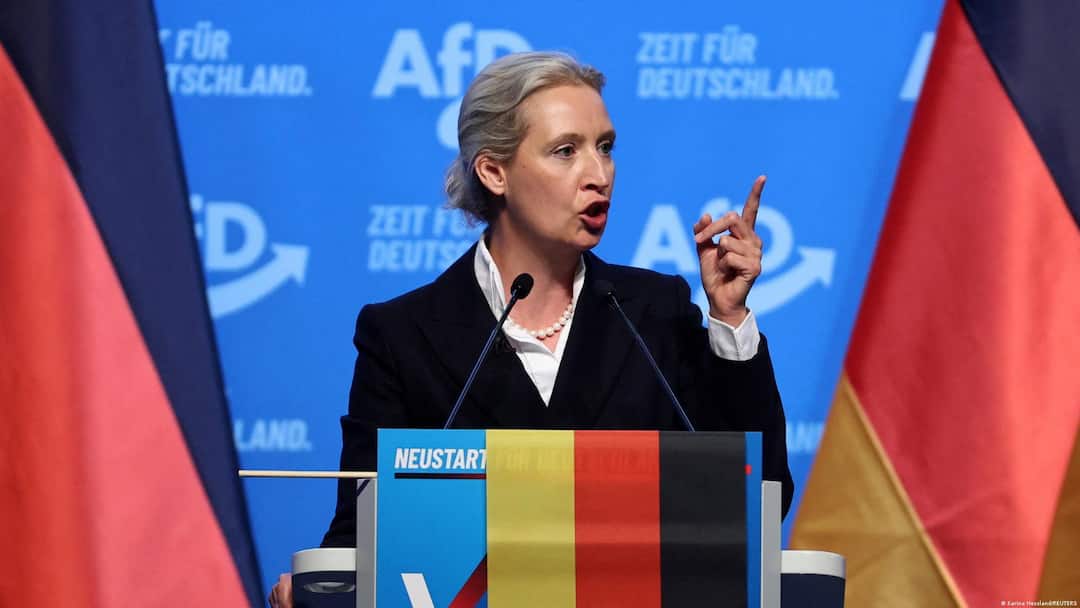
Germany’s far-right Alternative for Germany (AfD) has reaffirmed its ambition to govern the country. Wrapping up the party’s national convention in Erfurt, the capital of the eastern state of Thuringia, re-elected co-leader Alice Weidel was pointing to current opinion polls that see the party in the lead across Germany. “We are the strongest force. We are a people’s party with 30% support. And we will govern,” she said.
Earlier, delegates had confirmed the party’s co-leadership. Weidel, who ran as the AfD’s main candidate in Germany’s 2025 federal election, slightly improved on her result from two years ago, winning 81.3% of the vote. Her co-chair, Tino Chrupalla, by contrast, lost significant support and received just 70%.

More importantly for Weidel, many of her supporters were elected to the new federal board. This has strengthened the influence of Weidel, who holds a doctorate in economics, over the party’s future direction. Within the AfD and in the media, there has long been speculation over Weidel’s ambition to lead the party on her own in the future.

Boost for the far-right wing
The composition of the newly elected board suggests that the AfD is set to continue pursuing a hardline strategy to set itself apart from all other parties. No fewer than six of the 14 members of the new board come from state branches that Germany’s domestic intelligence authorities classify as right-wing extremist organizations.
One of the new additions to the party leadership is Jean-Pascal Hohm, a far-right politician who also heads the newly founded party youth group, “Generation Deutschland.” In the past, Hohm had to give up his job with the AfD parliamentary group in the eastern state of Brandenburg because of his contacts to right-wing extremists.
Stefan Möller, from Thuringia, is also joining the board. He is considered one of the closest political allies of Björn Höcke, one of the AfD’s most controversial figures. In 2025, Höcke was twice ordered to pay fines after repeatedly using a slogan associated with the Nazi-era SA, a paramilitary organization under Adolf Hitler. His ally Möller is now expected to oversee the party’s dealings with Germany’s security authorities.
Domestic intelligence agencies versus the AfD
Germany’s domestic intelligence agency, the Federal Office for the Protection of the Constitution, along with its state-level counterparts, is a particular target of AfD criticism. In five states — Brandenburg, Lower Saxony, Saxony, Saxony-Anhalt and Thuringia — the AfD is officially classified as confirmed right-wing extremist. In six other states, and at the national level, it is under observation as a suspected extremist organization.
The authorities point to repeated negative statements by party members about Germany’s democracy and judiciary. But above all, they point to repeated attempts by AfD politicians to question the legal equality of German citizens, especially when it comes to migrants, Muslims and Black people.
Stefan Möller, now a member of the federal board, has also questioned the equality of all Germans in the past. In a post published on Twitter, now X, on July 17, 2023, he wrote: “What makes someone German is decided between the ears, not on paper.”

Unlike at previous AfD conventions, the party’s internal power struggles this time played out without major clashes or splits. Earlier gatherings had seen furious public infighting and attacks from the convention stage, with party leaders repeatedly toppled after bitter verbal battles.
In Erfurt, by contrast, there were no such escalations. With three important state elections still to be held in 2026, and the AfD hoping to get its first state premier in either Saxony-Anhalt or Mecklenburg-Western Pomerania, party leaders successfully avoided any conflict that might affect the favorable poll numbers.
Few policy details from Weidel
But the absence of open conflict also meant there was little real policy debate. In her speech, Weidel largely avoided making concrete policy proposals. Instead, she stuck to a general critique of German government policy over the past 20 years: “Saving the euro, saving refugees, saving the climate, saving Ukrainians — while consistently deindustrializing the country and pursuing disastrous energy policies — is overwhelming the people in our country.”
In the past, Weidel and the AfD have called for a return to nuclear energy, the resumption of Russian gas deliveries to Germany, an end to climate protection measures and an end to German support for Ukraine, which was invaded by Russia in 2022 and has been defending itself ever since.

At the convention, however, Weidel limited herself to stressing the AfD’s claim to government responsibility. She did not propose any specific measures. Instead, to loud applause from delegates, she invoked a spirit of German nationalism: “Let us drape the entire country in black, red and gold. Black, red and gold — that is what we live. Those are our colors.”
Peaceful anti-AfD protests
The party convention was accompanied by largely peaceful protests. Tens of thousands of people demonstrated against the AfD in Erfurt. The protests were backed by trade unions, churches, political parties and numerous civil society organizations.
At one rally in Erfurt, Jens-Christian Wagner, the director of the Buchenwald Memorial at the site of the former concentration camp in Thuringia, addressed the AfD with a pointed message: “Remigrate yourselves into the history books.”
His remark referred to the AfD’s use of the term “remigration,” which the party uses to describe large-scale deportations of migrants, including some people with legal residence or citizenship according to proposals by some party figures.
(Disclaimer: This report first appeared on Deutsche Welle, and has been republished on ABP Live as part of a special arrangement. Apart from the headline, no changes have been made in the report by ABP Live.)
Breaking: Ram Temple Trust Set to Accept Resignations as Leadership Transition Plans Move to Next Phase

