

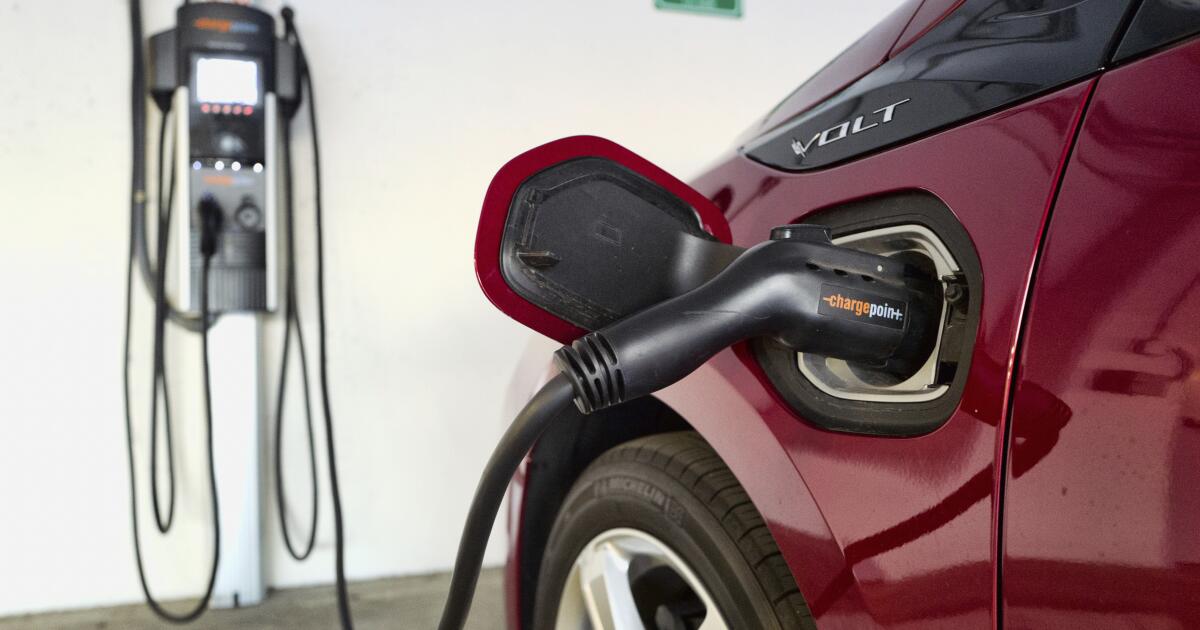
Nearly a year after the expiration of a $7,500 federal tax incentive for new electric vehicles, California is stepping in to try to motivate buyers to go electric.
Gov. Gavin Newsom allocated $135 million in his new state budget to provide incentives for new and used EVs. Participating automakers will match the funds.
California leads the nation in EV adoption, though the market has taken a hit under the Trump administration.
The state budget — a more than $350-billion spending plan — went into effect Wednesday. The EV incentives will take effect in the coming weeks as the California Air Resources Board irons out agreements with dealerships.
Here’s what you need to know.
What are the incentives worth?
Senate Bill 168 tasked the California Air Resources Board with setting incentive amounts for new and used electric vehicles sold in California.
Eligible buyers will receive $3,500 off for new EVs and $1,750 off for used ones. Unlike the federal tax credits that expired in September, these incentives offer an instant discount and don’t require buyers to apply for credit later.
State funds will cover half of the incentive amount, and auto manufacturers will cover the other half.
The rebates will mean that most eligible buyers will effectively get between 4% and 7% of their money back.
For used EVs, “this incentive helps what’s already a good deal become an even better deal,” said auto analyst Brian Moody. “I think that’s the perfect use of these kinds of dollars.”
What are the rules and exceptions?
The new incentives can’t be used on all electric vehicles — they apply only to new EVs with a manufacturer’s suggested retail price of $50,000 or less, and used EVs with a sale price of $25,000 or less.
The $50,000 maximum rules out many options on the market, but legislation outlining the incentive program makes a special exception for California-based companies. Buyers purchasing a new or used EV from a company with headquarters in California can claim the discount regardless of the vehicle price.
That’s good news for Lucid, with headquarters in Newark, Calif., and for Irvine-based Rivian. Neither company currently offers new vehicles for less than $50,000. Rivian said it plans to launch a $44,990 SUV in 2027.
Who is eligible?
California’s new EV discounts are available only to first-time EV buyers, according to the legislation.
SB 168 says the buyer’s eligibility will be “confirmed by a buyer attestation” that they have not previously owned a zero-emission vehicle.
The new EV incentive is less than half of the federal incentive that expired nine months ago. Whereas the federal incentive may have been enough to spark interest in a range of buyers, Moody said the lesser amount will probably appeal mainly to people who already have their eye on an EV.
“I think you have to already be considering it, or in the market,” Moody said. “I think that the amount is just right for that.”
What are California’s clean car goals?
The incentives are intended to help California reach its electric vehicle and air quality goals as those targets have been under fire from President Trump.
Shortly after taking office, Trump signed an executive order that revoked California’s authority to set its own EV regulations, which included a goal of having 100% of new vehicle sales in the state be zero-emission by 2035.
California sued the administration in response. The state also has goals, including some that have been in place since 2012, that set declining limits on smog-causing pollutants and required automakers to sell increasing percentages of electric and hybrid vehicles through 2025.
In March, the administration filed a new lawsuit again trying to block California’s ability to set stricter-than-federal emissions standards for cars.
Early this year, California announced that more than 2.5 million zero-emission vehicles had been sold in the state since 2010, surpassing a target to put 1.5 million zero-emission vehicles on the road by 2025.

Nearly a year after the expiration of a $7,500 federal tax incentive for new electric vehicles, California is stepping in to try to motivate buyers to go electric.
Gov. Gavin Newsom allocated $135 million in his new state budget to provide incentives for new and used EVs. Participating automakers will match the funds.
California leads the nation in EV adoption, though the market has taken a hit under the Trump administration.
The state budget — a more than $350-billion spending plan — went into effect Wednesday. The EV incentives will take effect in the coming weeks as the California Air Resources Board irons out agreements with dealerships.
Here’s what you need to know.
What are the incentives worth?
Senate Bill 168 tasked the California Air Resources Board with setting incentive amounts for new and used electric vehicles sold in California.
Eligible buyers will receive $3,500 off for new EVs and $1,750 off for used ones. Unlike the federal tax credits that expired in September, these incentives offer an instant discount and don’t require buyers to apply for credit later.
State funds will cover half of the incentive amount, and auto manufacturers will cover the other half.
The rebates will mean that most eligible buyers will effectively get between 4% and 7% of their money back.
For used EVs, “this incentive helps what’s already a good deal become an even better deal,” said auto analyst Brian Moody. “I think that’s the perfect use of these kinds of dollars.”
What are the rules and exceptions?
The new incentives can’t be used on all electric vehicles — they apply only to new EVs with a manufacturer’s suggested retail price of $50,000 or less, and used EVs with a sale price of $25,000 or less.
The $50,000 maximum rules out many options on the market, but legislation outlining the incentive program makes a special exception for California-based companies. Buyers purchasing a new or used EV from a company with headquarters in California can claim the discount regardless of the vehicle price.
That’s good news for Lucid, with headquarters in Newark, Calif., and for Irvine-based Rivian. Neither company currently offers new vehicles for less than $50,000. Rivian said it plans to launch a $44,990 SUV in 2027.
Who is eligible?
California’s new EV discounts are available only to first-time EV buyers, according to the legislation.
SB 168 says the buyer’s eligibility will be “confirmed by a buyer attestation” that they have not previously owned a zero-emission vehicle.
The new EV incentive is less than half of the federal incentive that expired nine months ago. Whereas the federal incentive may have been enough to spark interest in a range of buyers, Moody said the lesser amount will probably appeal mainly to people who already have their eye on an EV.
“I think you have to already be considering it, or in the market,” Moody said. “I think that the amount is just right for that.”
What are California’s clean car goals?
The incentives are intended to help California reach its electric vehicle and air quality goals as those targets have been under fire from President Trump.
Shortly after taking office, Trump signed an executive order that revoked California’s authority to set its own EV regulations, which included a goal of having 100% of new vehicle sales in the state be zero-emission by 2035.
California sued the administration in response. The state also has goals, including some that have been in place since 2012, that set declining limits on smog-causing pollutants and required automakers to sell increasing percentages of electric and hybrid vehicles through 2025.
In March, the administration filed a new lawsuit again trying to block California’s ability to set stricter-than-federal emissions standards for cars.
Early this year, California announced that more than 2.5 million zero-emission vehicles had been sold in the state since 2010, surpassing a target to put 1.5 million zero-emission vehicles on the road by 2025.

Nearly a year after the expiration of a $7,500 federal tax incentive for new electric vehicles, California is stepping in to try to motivate buyers to go electric.
Gov. Gavin Newsom allocated $135 million in his new state budget to provide incentives for new and used EVs. Participating automakers will match the funds.
California leads the nation in EV adoption, though the market has taken a hit under the Trump administration.
The state budget — a more than $350-billion spending plan — went into effect Wednesday. The EV incentives will take effect in the coming weeks as the California Air Resources Board irons out agreements with dealerships.
Here’s what you need to know.
What are the incentives worth?
Senate Bill 168 tasked the California Air Resources Board with setting incentive amounts for new and used electric vehicles sold in California.
Eligible buyers will receive $3,500 off for new EVs and $1,750 off for used ones. Unlike the federal tax credits that expired in September, these incentives offer an instant discount and don’t require buyers to apply for credit later.
State funds will cover half of the incentive amount, and auto manufacturers will cover the other half.
The rebates will mean that most eligible buyers will effectively get between 4% and 7% of their money back.
For used EVs, “this incentive helps what’s already a good deal become an even better deal,” said auto analyst Brian Moody. “I think that’s the perfect use of these kinds of dollars.”
What are the rules and exceptions?
The new incentives can’t be used on all electric vehicles — they apply only to new EVs with a manufacturer’s suggested retail price of $50,000 or less, and used EVs with a sale price of $25,000 or less.
The $50,000 maximum rules out many options on the market, but legislation outlining the incentive program makes a special exception for California-based companies. Buyers purchasing a new or used EV from a company with headquarters in California can claim the discount regardless of the vehicle price.
That’s good news for Lucid, with headquarters in Newark, Calif., and for Irvine-based Rivian. Neither company currently offers new vehicles for less than $50,000. Rivian said it plans to launch a $44,990 SUV in 2027.
Who is eligible?
California’s new EV discounts are available only to first-time EV buyers, according to the legislation.
SB 168 says the buyer’s eligibility will be “confirmed by a buyer attestation” that they have not previously owned a zero-emission vehicle.
The new EV incentive is less than half of the federal incentive that expired nine months ago. Whereas the federal incentive may have been enough to spark interest in a range of buyers, Moody said the lesser amount will probably appeal mainly to people who already have their eye on an EV.
“I think you have to already be considering it, or in the market,” Moody said. “I think that the amount is just right for that.”
What are California’s clean car goals?
The incentives are intended to help California reach its electric vehicle and air quality goals as those targets have been under fire from President Trump.
Shortly after taking office, Trump signed an executive order that revoked California’s authority to set its own EV regulations, which included a goal of having 100% of new vehicle sales in the state be zero-emission by 2035.
California sued the administration in response. The state also has goals, including some that have been in place since 2012, that set declining limits on smog-causing pollutants and required automakers to sell increasing percentages of electric and hybrid vehicles through 2025.
In March, the administration filed a new lawsuit again trying to block California’s ability to set stricter-than-federal emissions standards for cars.
Early this year, California announced that more than 2.5 million zero-emission vehicles had been sold in the state since 2010, surpassing a target to put 1.5 million zero-emission vehicles on the road by 2025.
Nearly a year after the expiration of a $7,500 federal tax incentive for new electric vehicles, California is stepping in to try to motivate buyers to go electric.
Gov. Gavin Newsom allocated $135 million in his new state budget to provide incentives for new and used EVs. Participating automakers will match the funds.
California leads the nation in EV adoption, though the market has taken a hit under the Trump administration.
The state budget — a more than $350-billion spending plan — went into effect Wednesday. The EV incentives will take effect in the coming weeks as the California Air Resources Board irons out agreements with dealerships.
Here’s what you need to know.
What are the incentives worth?
Senate Bill 168 tasked the California Air Resources Board with setting incentive amounts for new and used electric vehicles sold in California.
Eligible buyers will receive $3,500 off for new EVs and $1,750 off for used ones. Unlike the federal tax credits that expired in September, these incentives offer an instant discount and don’t require buyers to apply for credit later.
State funds will cover half of the incentive amount, and auto manufacturers will cover the other half.
The rebates will mean that most eligible buyers will effectively get between 4% and 7% of their money back.
For used EVs, “this incentive helps what’s already a good deal become an even better deal,” said auto analyst Brian Moody. “I think that’s the perfect use of these kinds of dollars.”
What are the rules and exceptions?
The new incentives can’t be used on all electric vehicles — they apply only to new EVs with a manufacturer’s suggested retail price of $50,000 or less, and used EVs with a sale price of $25,000 or less.
The $50,000 maximum rules out many options on the market, but legislation outlining the incentive program makes a special exception for California-based companies. Buyers purchasing a new or used EV from a company with headquarters in California can claim the discount regardless of the vehicle price.
That’s good news for Lucid, with headquarters in Newark, Calif., and for Irvine-based Rivian. Neither company currently offers new vehicles for less than $50,000. Rivian said it plans to launch a $44,990 SUV in 2027.
Who is eligible?
California’s new EV discounts are available only to first-time EV buyers, according to the legislation.
SB 168 says the buyer’s eligibility will be “confirmed by a buyer attestation” that they have not previously owned a zero-emission vehicle.
The new EV incentive is less than half of the federal incentive that expired nine months ago. Whereas the federal incentive may have been enough to spark interest in a range of buyers, Moody said the lesser amount will probably appeal mainly to people who already have their eye on an EV.
“I think you have to already be considering it, or in the market,” Moody said. “I think that the amount is just right for that.”
What are California’s clean car goals?
The incentives are intended to help California reach its electric vehicle and air quality goals as those targets have been under fire from President Trump.
Shortly after taking office, Trump signed an executive order that revoked California’s authority to set its own EV regulations, which included a goal of having 100% of new vehicle sales in the state be zero-emission by 2035.
California sued the administration in response. The state also has goals, including some that have been in place since 2012, that set declining limits on smog-causing pollutants and required automakers to sell increasing percentages of electric and hybrid vehicles through 2025.
In March, the administration filed a new lawsuit again trying to block California’s ability to set stricter-than-federal emissions standards for cars.
Early this year, California announced that more than 2.5 million zero-emission vehicles had been sold in the state since 2010, surpassing a target to put 1.5 million zero-emission vehicles on the road by 2025.

Nearly a year after the expiration of a $7,500 federal tax incentive for new electric vehicles, California is stepping in to try to motivate buyers to go electric.
Gov. Gavin Newsom allocated $135 million in his new state budget to provide incentives for new and used EVs. Participating automakers will match the funds.
California leads the nation in EV adoption, though the market has taken a hit under the Trump administration.
The state budget — a more than $350-billion spending plan — went into effect Wednesday. The EV incentives will take effect in the coming weeks as the California Air Resources Board irons out agreements with dealerships.
Here’s what you need to know.
What are the incentives worth?
Senate Bill 168 tasked the California Air Resources Board with setting incentive amounts for new and used electric vehicles sold in California.
Eligible buyers will receive $3,500 off for new EVs and $1,750 off for used ones. Unlike the federal tax credits that expired in September, these incentives offer an instant discount and don’t require buyers to apply for credit later.
State funds will cover half of the incentive amount, and auto manufacturers will cover the other half.
The rebates will mean that most eligible buyers will effectively get between 4% and 7% of their money back.
For used EVs, “this incentive helps what’s already a good deal become an even better deal,” said auto analyst Brian Moody. “I think that’s the perfect use of these kinds of dollars.”
What are the rules and exceptions?
The new incentives can’t be used on all electric vehicles — they apply only to new EVs with a manufacturer’s suggested retail price of $50,000 or less, and used EVs with a sale price of $25,000 or less.
The $50,000 maximum rules out many options on the market, but legislation outlining the incentive program makes a special exception for California-based companies. Buyers purchasing a new or used EV from a company with headquarters in California can claim the discount regardless of the vehicle price.
That’s good news for Lucid, with headquarters in Newark, Calif., and for Irvine-based Rivian. Neither company currently offers new vehicles for less than $50,000. Rivian said it plans to launch a $44,990 SUV in 2027.
Who is eligible?
California’s new EV discounts are available only to first-time EV buyers, according to the legislation.
SB 168 says the buyer’s eligibility will be “confirmed by a buyer attestation” that they have not previously owned a zero-emission vehicle.
The new EV incentive is less than half of the federal incentive that expired nine months ago. Whereas the federal incentive may have been enough to spark interest in a range of buyers, Moody said the lesser amount will probably appeal mainly to people who already have their eye on an EV.
“I think you have to already be considering it, or in the market,” Moody said. “I think that the amount is just right for that.”
What are California’s clean car goals?
The incentives are intended to help California reach its electric vehicle and air quality goals as those targets have been under fire from President Trump.
Shortly after taking office, Trump signed an executive order that revoked California’s authority to set its own EV regulations, which included a goal of having 100% of new vehicle sales in the state be zero-emission by 2035.
California sued the administration in response. The state also has goals, including some that have been in place since 2012, that set declining limits on smog-causing pollutants and required automakers to sell increasing percentages of electric and hybrid vehicles through 2025.
In March, the administration filed a new lawsuit again trying to block California’s ability to set stricter-than-federal emissions standards for cars.
Early this year, California announced that more than 2.5 million zero-emission vehicles had been sold in the state since 2010, surpassing a target to put 1.5 million zero-emission vehicles on the road by 2025.
Nearly a year after the expiration of a $7,500 federal tax incentive for new electric vehicles, California is stepping in to try to motivate buyers to go electric.
Gov. Gavin Newsom allocated $135 million in his new state budget to provide incentives for new and used EVs. Participating automakers will match the funds.
California leads the nation in EV adoption, though the market has taken a hit under the Trump administration.
The state budget — a more than $350-billion spending plan — went into effect Wednesday. The EV incentives will take effect in the coming weeks as the California Air Resources Board irons out agreements with dealerships.
Here’s what you need to know.
What are the incentives worth?
Senate Bill 168 tasked the California Air Resources Board with setting incentive amounts for new and used electric vehicles sold in California.
Eligible buyers will receive $3,500 off for new EVs and $1,750 off for used ones. Unlike the federal tax credits that expired in September, these incentives offer an instant discount and don’t require buyers to apply for credit later.
State funds will cover half of the incentive amount, and auto manufacturers will cover the other half.
The rebates will mean that most eligible buyers will effectively get between 4% and 7% of their money back.
For used EVs, “this incentive helps what’s already a good deal become an even better deal,” said auto analyst Brian Moody. “I think that’s the perfect use of these kinds of dollars.”
What are the rules and exceptions?
The new incentives can’t be used on all electric vehicles — they apply only to new EVs with a manufacturer’s suggested retail price of $50,000 or less, and used EVs with a sale price of $25,000 or less.
The $50,000 maximum rules out many options on the market, but legislation outlining the incentive program makes a special exception for California-based companies. Buyers purchasing a new or used EV from a company with headquarters in California can claim the discount regardless of the vehicle price.
That’s good news for Lucid, with headquarters in Newark, Calif., and for Irvine-based Rivian. Neither company currently offers new vehicles for less than $50,000. Rivian said it plans to launch a $44,990 SUV in 2027.
Who is eligible?
California’s new EV discounts are available only to first-time EV buyers, according to the legislation.
SB 168 says the buyer’s eligibility will be “confirmed by a buyer attestation” that they have not previously owned a zero-emission vehicle.
The new EV incentive is less than half of the federal incentive that expired nine months ago. Whereas the federal incentive may have been enough to spark interest in a range of buyers, Moody said the lesser amount will probably appeal mainly to people who already have their eye on an EV.
“I think you have to already be considering it, or in the market,” Moody said. “I think that the amount is just right for that.”
What are California’s clean car goals?
The incentives are intended to help California reach its electric vehicle and air quality goals as those targets have been under fire from President Trump.
Shortly after taking office, Trump signed an executive order that revoked California’s authority to set its own EV regulations, which included a goal of having 100% of new vehicle sales in the state be zero-emission by 2035.
California sued the administration in response. The state also has goals, including some that have been in place since 2012, that set declining limits on smog-causing pollutants and required automakers to sell increasing percentages of electric and hybrid vehicles through 2025.
In March, the administration filed a new lawsuit again trying to block California’s ability to set stricter-than-federal emissions standards for cars.
Early this year, California announced that more than 2.5 million zero-emission vehicles had been sold in the state since 2010, surpassing a target to put 1.5 million zero-emission vehicles on the road by 2025.
Nearly a year after the expiration of a $7,500 federal tax incentive for new electric vehicles, California is stepping in to try to motivate buyers to go electric.
Gov. Gavin Newsom allocated $135 million in his new state budget to provide incentives for new and used EVs. Participating automakers will match the funds.
California leads the nation in EV adoption, though the market has taken a hit under the Trump administration.
The state budget — a more than $350-billion spending plan — went into effect Wednesday. The EV incentives will take effect in the coming weeks as the California Air Resources Board irons out agreements with dealerships.
Here’s what you need to know.
What are the incentives worth?
Senate Bill 168 tasked the California Air Resources Board with setting incentive amounts for new and used electric vehicles sold in California.
Eligible buyers will receive $3,500 off for new EVs and $1,750 off for used ones. Unlike the federal tax credits that expired in September, these incentives offer an instant discount and don’t require buyers to apply for credit later.
State funds will cover half of the incentive amount, and auto manufacturers will cover the other half.
The rebates will mean that most eligible buyers will effectively get between 4% and 7% of their money back.
For used EVs, “this incentive helps what’s already a good deal become an even better deal,” said auto analyst Brian Moody. “I think that’s the perfect use of these kinds of dollars.”
What are the rules and exceptions?
The new incentives can’t be used on all electric vehicles — they apply only to new EVs with a manufacturer’s suggested retail price of $50,000 or less, and used EVs with a sale price of $25,000 or less.
The $50,000 maximum rules out many options on the market, but legislation outlining the incentive program makes a special exception for California-based companies. Buyers purchasing a new or used EV from a company with headquarters in California can claim the discount regardless of the vehicle price.
That’s good news for Lucid, with headquarters in Newark, Calif., and for Irvine-based Rivian. Neither company currently offers new vehicles for less than $50,000. Rivian said it plans to launch a $44,990 SUV in 2027.
Who is eligible?
California’s new EV discounts are available only to first-time EV buyers, according to the legislation.
SB 168 says the buyer’s eligibility will be “confirmed by a buyer attestation” that they have not previously owned a zero-emission vehicle.
The new EV incentive is less than half of the federal incentive that expired nine months ago. Whereas the federal incentive may have been enough to spark interest in a range of buyers, Moody said the lesser amount will probably appeal mainly to people who already have their eye on an EV.
“I think you have to already be considering it, or in the market,” Moody said. “I think that the amount is just right for that.”
What are California’s clean car goals?
The incentives are intended to help California reach its electric vehicle and air quality goals as those targets have been under fire from President Trump.
Shortly after taking office, Trump signed an executive order that revoked California’s authority to set its own EV regulations, which included a goal of having 100% of new vehicle sales in the state be zero-emission by 2035.
California sued the administration in response. The state also has goals, including some that have been in place since 2012, that set declining limits on smog-causing pollutants and required automakers to sell increasing percentages of electric and hybrid vehicles through 2025.
In March, the administration filed a new lawsuit again trying to block California’s ability to set stricter-than-federal emissions standards for cars.
Early this year, California announced that more than 2.5 million zero-emission vehicles had been sold in the state since 2010, surpassing a target to put 1.5 million zero-emission vehicles on the road by 2025.
Nearly a year after the expiration of a $7,500 federal tax incentive for new electric vehicles, California is stepping in to try to motivate buyers to go electric.
Gov. Gavin Newsom allocated $135 million in his new state budget to provide incentives for new and used EVs. Participating automakers will match the funds.
California leads the nation in EV adoption, though the market has taken a hit under the Trump administration.
The state budget — a more than $350-billion spending plan — went into effect Wednesday. The EV incentives will take effect in the coming weeks as the California Air Resources Board irons out agreements with dealerships.
Here’s what you need to know.
What are the incentives worth?
Senate Bill 168 tasked the California Air Resources Board with setting incentive amounts for new and used electric vehicles sold in California.
Eligible buyers will receive $3,500 off for new EVs and $1,750 off for used ones. Unlike the federal tax credits that expired in September, these incentives offer an instant discount and don’t require buyers to apply for credit later.
State funds will cover half of the incentive amount, and auto manufacturers will cover the other half.
The rebates will mean that most eligible buyers will effectively get between 4% and 7% of their money back.
For used EVs, “this incentive helps what’s already a good deal become an even better deal,” said auto analyst Brian Moody. “I think that’s the perfect use of these kinds of dollars.”
What are the rules and exceptions?
The new incentives can’t be used on all electric vehicles — they apply only to new EVs with a manufacturer’s suggested retail price of $50,000 or less, and used EVs with a sale price of $25,000 or less.
The $50,000 maximum rules out many options on the market, but legislation outlining the incentive program makes a special exception for California-based companies. Buyers purchasing a new or used EV from a company with headquarters in California can claim the discount regardless of the vehicle price.
That’s good news for Lucid, with headquarters in Newark, Calif., and for Irvine-based Rivian. Neither company currently offers new vehicles for less than $50,000. Rivian said it plans to launch a $44,990 SUV in 2027.
Who is eligible?
California’s new EV discounts are available only to first-time EV buyers, according to the legislation.
SB 168 says the buyer’s eligibility will be “confirmed by a buyer attestation” that they have not previously owned a zero-emission vehicle.
The new EV incentive is less than half of the federal incentive that expired nine months ago. Whereas the federal incentive may have been enough to spark interest in a range of buyers, Moody said the lesser amount will probably appeal mainly to people who already have their eye on an EV.
“I think you have to already be considering it, or in the market,” Moody said. “I think that the amount is just right for that.”
What are California’s clean car goals?
The incentives are intended to help California reach its electric vehicle and air quality goals as those targets have been under fire from President Trump.
Shortly after taking office, Trump signed an executive order that revoked California’s authority to set its own EV regulations, which included a goal of having 100% of new vehicle sales in the state be zero-emission by 2035.
California sued the administration in response. The state also has goals, including some that have been in place since 2012, that set declining limits on smog-causing pollutants and required automakers to sell increasing percentages of electric and hybrid vehicles through 2025.
In March, the administration filed a new lawsuit again trying to block California’s ability to set stricter-than-federal emissions standards for cars.
Early this year, California announced that more than 2.5 million zero-emission vehicles had been sold in the state since 2010, surpassing a target to put 1.5 million zero-emission vehicles on the road by 2025.

Nearly a year after the expiration of a $7,500 federal tax incentive for new electric vehicles, California is stepping in to try to motivate buyers to go electric.
Gov. Gavin Newsom allocated $135 million in his new state budget to provide incentives for new and used EVs. Participating automakers will match the funds.
California leads the nation in EV adoption, though the market has taken a hit under the Trump administration.
The state budget — a more than $350-billion spending plan — went into effect Wednesday. The EV incentives will take effect in the coming weeks as the California Air Resources Board irons out agreements with dealerships.
Here’s what you need to know.
What are the incentives worth?
Senate Bill 168 tasked the California Air Resources Board with setting incentive amounts for new and used electric vehicles sold in California.
Eligible buyers will receive $3,500 off for new EVs and $1,750 off for used ones. Unlike the federal tax credits that expired in September, these incentives offer an instant discount and don’t require buyers to apply for credit later.
State funds will cover half of the incentive amount, and auto manufacturers will cover the other half.
The rebates will mean that most eligible buyers will effectively get between 4% and 7% of their money back.
For used EVs, “this incentive helps what’s already a good deal become an even better deal,” said auto analyst Brian Moody. “I think that’s the perfect use of these kinds of dollars.”
What are the rules and exceptions?
The new incentives can’t be used on all electric vehicles — they apply only to new EVs with a manufacturer’s suggested retail price of $50,000 or less, and used EVs with a sale price of $25,000 or less.
The $50,000 maximum rules out many options on the market, but legislation outlining the incentive program makes a special exception for California-based companies. Buyers purchasing a new or used EV from a company with headquarters in California can claim the discount regardless of the vehicle price.
That’s good news for Lucid, with headquarters in Newark, Calif., and for Irvine-based Rivian. Neither company currently offers new vehicles for less than $50,000. Rivian said it plans to launch a $44,990 SUV in 2027.
Who is eligible?
California’s new EV discounts are available only to first-time EV buyers, according to the legislation.
SB 168 says the buyer’s eligibility will be “confirmed by a buyer attestation” that they have not previously owned a zero-emission vehicle.
The new EV incentive is less than half of the federal incentive that expired nine months ago. Whereas the federal incentive may have been enough to spark interest in a range of buyers, Moody said the lesser amount will probably appeal mainly to people who already have their eye on an EV.
“I think you have to already be considering it, or in the market,” Moody said. “I think that the amount is just right for that.”
What are California’s clean car goals?
The incentives are intended to help California reach its electric vehicle and air quality goals as those targets have been under fire from President Trump.
Shortly after taking office, Trump signed an executive order that revoked California’s authority to set its own EV regulations, which included a goal of having 100% of new vehicle sales in the state be zero-emission by 2035.
California sued the administration in response. The state also has goals, including some that have been in place since 2012, that set declining limits on smog-causing pollutants and required automakers to sell increasing percentages of electric and hybrid vehicles through 2025.
In March, the administration filed a new lawsuit again trying to block California’s ability to set stricter-than-federal emissions standards for cars.
Early this year, California announced that more than 2.5 million zero-emission vehicles had been sold in the state since 2010, surpassing a target to put 1.5 million zero-emission vehicles on the road by 2025.
Nearly a year after the expiration of a $7,500 federal tax incentive for new electric vehicles, California is stepping in to try to motivate buyers to go electric.
Gov. Gavin Newsom allocated $135 million in his new state budget to provide incentives for new and used EVs. Participating automakers will match the funds.
California leads the nation in EV adoption, though the market has taken a hit under the Trump administration.
The state budget — a more than $350-billion spending plan — went into effect Wednesday. The EV incentives will take effect in the coming weeks as the California Air Resources Board irons out agreements with dealerships.
Here’s what you need to know.
What are the incentives worth?
Senate Bill 168 tasked the California Air Resources Board with setting incentive amounts for new and used electric vehicles sold in California.
Eligible buyers will receive $3,500 off for new EVs and $1,750 off for used ones. Unlike the federal tax credits that expired in September, these incentives offer an instant discount and don’t require buyers to apply for credit later.
State funds will cover half of the incentive amount, and auto manufacturers will cover the other half.
The rebates will mean that most eligible buyers will effectively get between 4% and 7% of their money back.
For used EVs, “this incentive helps what’s already a good deal become an even better deal,” said auto analyst Brian Moody. “I think that’s the perfect use of these kinds of dollars.”
What are the rules and exceptions?
The new incentives can’t be used on all electric vehicles — they apply only to new EVs with a manufacturer’s suggested retail price of $50,000 or less, and used EVs with a sale price of $25,000 or less.
The $50,000 maximum rules out many options on the market, but legislation outlining the incentive program makes a special exception for California-based companies. Buyers purchasing a new or used EV from a company with headquarters in California can claim the discount regardless of the vehicle price.
That’s good news for Lucid, with headquarters in Newark, Calif., and for Irvine-based Rivian. Neither company currently offers new vehicles for less than $50,000. Rivian said it plans to launch a $44,990 SUV in 2027.
Who is eligible?
California’s new EV discounts are available only to first-time EV buyers, according to the legislation.
SB 168 says the buyer’s eligibility will be “confirmed by a buyer attestation” that they have not previously owned a zero-emission vehicle.
The new EV incentive is less than half of the federal incentive that expired nine months ago. Whereas the federal incentive may have been enough to spark interest in a range of buyers, Moody said the lesser amount will probably appeal mainly to people who already have their eye on an EV.
“I think you have to already be considering it, or in the market,” Moody said. “I think that the amount is just right for that.”
What are California’s clean car goals?
The incentives are intended to help California reach its electric vehicle and air quality goals as those targets have been under fire from President Trump.
Shortly after taking office, Trump signed an executive order that revoked California’s authority to set its own EV regulations, which included a goal of having 100% of new vehicle sales in the state be zero-emission by 2035.
California sued the administration in response. The state also has goals, including some that have been in place since 2012, that set declining limits on smog-causing pollutants and required automakers to sell increasing percentages of electric and hybrid vehicles through 2025.
In March, the administration filed a new lawsuit again trying to block California’s ability to set stricter-than-federal emissions standards for cars.
Early this year, California announced that more than 2.5 million zero-emission vehicles had been sold in the state since 2010, surpassing a target to put 1.5 million zero-emission vehicles on the road by 2025.
Nearly a year after the expiration of a $7,500 federal tax incentive for new electric vehicles, California is stepping in to try to motivate buyers to go electric.
Gov. Gavin Newsom allocated $135 million in his new state budget to provide incentives for new and used EVs. Participating automakers will match the funds.
California leads the nation in EV adoption, though the market has taken a hit under the Trump administration.
The state budget — a more than $350-billion spending plan — went into effect Wednesday. The EV incentives will take effect in the coming weeks as the California Air Resources Board irons out agreements with dealerships.
Here’s what you need to know.
What are the incentives worth?
Senate Bill 168 tasked the California Air Resources Board with setting incentive amounts for new and used electric vehicles sold in California.
Eligible buyers will receive $3,500 off for new EVs and $1,750 off for used ones. Unlike the federal tax credits that expired in September, these incentives offer an instant discount and don’t require buyers to apply for credit later.
State funds will cover half of the incentive amount, and auto manufacturers will cover the other half.
The rebates will mean that most eligible buyers will effectively get between 4% and 7% of their money back.
For used EVs, “this incentive helps what’s already a good deal become an even better deal,” said auto analyst Brian Moody. “I think that’s the perfect use of these kinds of dollars.”
What are the rules and exceptions?
The new incentives can’t be used on all electric vehicles — they apply only to new EVs with a manufacturer’s suggested retail price of $50,000 or less, and used EVs with a sale price of $25,000 or less.
The $50,000 maximum rules out many options on the market, but legislation outlining the incentive program makes a special exception for California-based companies. Buyers purchasing a new or used EV from a company with headquarters in California can claim the discount regardless of the vehicle price.
That’s good news for Lucid, with headquarters in Newark, Calif., and for Irvine-based Rivian. Neither company currently offers new vehicles for less than $50,000. Rivian said it plans to launch a $44,990 SUV in 2027.
Who is eligible?
California’s new EV discounts are available only to first-time EV buyers, according to the legislation.
SB 168 says the buyer’s eligibility will be “confirmed by a buyer attestation” that they have not previously owned a zero-emission vehicle.
The new EV incentive is less than half of the federal incentive that expired nine months ago. Whereas the federal incentive may have been enough to spark interest in a range of buyers, Moody said the lesser amount will probably appeal mainly to people who already have their eye on an EV.
“I think you have to already be considering it, or in the market,” Moody said. “I think that the amount is just right for that.”
What are California’s clean car goals?
The incentives are intended to help California reach its electric vehicle and air quality goals as those targets have been under fire from President Trump.
Shortly after taking office, Trump signed an executive order that revoked California’s authority to set its own EV regulations, which included a goal of having 100% of new vehicle sales in the state be zero-emission by 2035.
California sued the administration in response. The state also has goals, including some that have been in place since 2012, that set declining limits on smog-causing pollutants and required automakers to sell increasing percentages of electric and hybrid vehicles through 2025.
In March, the administration filed a new lawsuit again trying to block California’s ability to set stricter-than-federal emissions standards for cars.
Early this year, California announced that more than 2.5 million zero-emission vehicles had been sold in the state since 2010, surpassing a target to put 1.5 million zero-emission vehicles on the road by 2025.
Nearly a year after the expiration of a $7,500 federal tax incentive for new electric vehicles, California is stepping in to try to motivate buyers to go electric.
Gov. Gavin Newsom allocated $135 million in his new state budget to provide incentives for new and used EVs. Participating automakers will match the funds.
California leads the nation in EV adoption, though the market has taken a hit under the Trump administration.
The state budget — a more than $350-billion spending plan — went into effect Wednesday. The EV incentives will take effect in the coming weeks as the California Air Resources Board irons out agreements with dealerships.
Here’s what you need to know.
What are the incentives worth?
Senate Bill 168 tasked the California Air Resources Board with setting incentive amounts for new and used electric vehicles sold in California.
Eligible buyers will receive $3,500 off for new EVs and $1,750 off for used ones. Unlike the federal tax credits that expired in September, these incentives offer an instant discount and don’t require buyers to apply for credit later.
State funds will cover half of the incentive amount, and auto manufacturers will cover the other half.
The rebates will mean that most eligible buyers will effectively get between 4% and 7% of their money back.
For used EVs, “this incentive helps what’s already a good deal become an even better deal,” said auto analyst Brian Moody. “I think that’s the perfect use of these kinds of dollars.”
What are the rules and exceptions?
The new incentives can’t be used on all electric vehicles — they apply only to new EVs with a manufacturer’s suggested retail price of $50,000 or less, and used EVs with a sale price of $25,000 or less.
The $50,000 maximum rules out many options on the market, but legislation outlining the incentive program makes a special exception for California-based companies. Buyers purchasing a new or used EV from a company with headquarters in California can claim the discount regardless of the vehicle price.
That’s good news for Lucid, with headquarters in Newark, Calif., and for Irvine-based Rivian. Neither company currently offers new vehicles for less than $50,000. Rivian said it plans to launch a $44,990 SUV in 2027.
Who is eligible?
California’s new EV discounts are available only to first-time EV buyers, according to the legislation.
SB 168 says the buyer’s eligibility will be “confirmed by a buyer attestation” that they have not previously owned a zero-emission vehicle.
The new EV incentive is less than half of the federal incentive that expired nine months ago. Whereas the federal incentive may have been enough to spark interest in a range of buyers, Moody said the lesser amount will probably appeal mainly to people who already have their eye on an EV.
“I think you have to already be considering it, or in the market,” Moody said. “I think that the amount is just right for that.”
What are California’s clean car goals?
The incentives are intended to help California reach its electric vehicle and air quality goals as those targets have been under fire from President Trump.
Shortly after taking office, Trump signed an executive order that revoked California’s authority to set its own EV regulations, which included a goal of having 100% of new vehicle sales in the state be zero-emission by 2035.
California sued the administration in response. The state also has goals, including some that have been in place since 2012, that set declining limits on smog-causing pollutants and required automakers to sell increasing percentages of electric and hybrid vehicles through 2025.
In March, the administration filed a new lawsuit again trying to block California’s ability to set stricter-than-federal emissions standards for cars.
Early this year, California announced that more than 2.5 million zero-emission vehicles had been sold in the state since 2010, surpassing a target to put 1.5 million zero-emission vehicles on the road by 2025.
Nearly a year after the expiration of a $7,500 federal tax incentive for new electric vehicles, California is stepping in to try to motivate buyers to go electric.
Gov. Gavin Newsom allocated $135 million in his new state budget to provide incentives for new and used EVs. Participating automakers will match the funds.
California leads the nation in EV adoption, though the market has taken a hit under the Trump administration.
The state budget — a more than $350-billion spending plan — went into effect Wednesday. The EV incentives will take effect in the coming weeks as the California Air Resources Board irons out agreements with dealerships.
Here’s what you need to know.
What are the incentives worth?
Senate Bill 168 tasked the California Air Resources Board with setting incentive amounts for new and used electric vehicles sold in California.
Eligible buyers will receive $3,500 off for new EVs and $1,750 off for used ones. Unlike the federal tax credits that expired in September, these incentives offer an instant discount and don’t require buyers to apply for credit later.
State funds will cover half of the incentive amount, and auto manufacturers will cover the other half.
The rebates will mean that most eligible buyers will effectively get between 4% and 7% of their money back.
For used EVs, “this incentive helps what’s already a good deal become an even better deal,” said auto analyst Brian Moody. “I think that’s the perfect use of these kinds of dollars.”
What are the rules and exceptions?
The new incentives can’t be used on all electric vehicles — they apply only to new EVs with a manufacturer’s suggested retail price of $50,000 or less, and used EVs with a sale price of $25,000 or less.
The $50,000 maximum rules out many options on the market, but legislation outlining the incentive program makes a special exception for California-based companies. Buyers purchasing a new or used EV from a company with headquarters in California can claim the discount regardless of the vehicle price.
That’s good news for Lucid, with headquarters in Newark, Calif., and for Irvine-based Rivian. Neither company currently offers new vehicles for less than $50,000. Rivian said it plans to launch a $44,990 SUV in 2027.
Who is eligible?
California’s new EV discounts are available only to first-time EV buyers, according to the legislation.
SB 168 says the buyer’s eligibility will be “confirmed by a buyer attestation” that they have not previously owned a zero-emission vehicle.
The new EV incentive is less than half of the federal incentive that expired nine months ago. Whereas the federal incentive may have been enough to spark interest in a range of buyers, Moody said the lesser amount will probably appeal mainly to people who already have their eye on an EV.
“I think you have to already be considering it, or in the market,” Moody said. “I think that the amount is just right for that.”
What are California’s clean car goals?
The incentives are intended to help California reach its electric vehicle and air quality goals as those targets have been under fire from President Trump.
Shortly after taking office, Trump signed an executive order that revoked California’s authority to set its own EV regulations, which included a goal of having 100% of new vehicle sales in the state be zero-emission by 2035.
California sued the administration in response. The state also has goals, including some that have been in place since 2012, that set declining limits on smog-causing pollutants and required automakers to sell increasing percentages of electric and hybrid vehicles through 2025.
In March, the administration filed a new lawsuit again trying to block California’s ability to set stricter-than-federal emissions standards for cars.
Early this year, California announced that more than 2.5 million zero-emission vehicles had been sold in the state since 2010, surpassing a target to put 1.5 million zero-emission vehicles on the road by 2025.
Nearly a year after the expiration of a $7,500 federal tax incentive for new electric vehicles, California is stepping in to try to motivate buyers to go electric.
Gov. Gavin Newsom allocated $135 million in his new state budget to provide incentives for new and used EVs. Participating automakers will match the funds.
California leads the nation in EV adoption, though the market has taken a hit under the Trump administration.
The state budget — a more than $350-billion spending plan — went into effect Wednesday. The EV incentives will take effect in the coming weeks as the California Air Resources Board irons out agreements with dealerships.
Here’s what you need to know.
What are the incentives worth?
Senate Bill 168 tasked the California Air Resources Board with setting incentive amounts for new and used electric vehicles sold in California.
Eligible buyers will receive $3,500 off for new EVs and $1,750 off for used ones. Unlike the federal tax credits that expired in September, these incentives offer an instant discount and don’t require buyers to apply for credit later.
State funds will cover half of the incentive amount, and auto manufacturers will cover the other half.
The rebates will mean that most eligible buyers will effectively get between 4% and 7% of their money back.
For used EVs, “this incentive helps what’s already a good deal become an even better deal,” said auto analyst Brian Moody. “I think that’s the perfect use of these kinds of dollars.”
What are the rules and exceptions?
The new incentives can’t be used on all electric vehicles — they apply only to new EVs with a manufacturer’s suggested retail price of $50,000 or less, and used EVs with a sale price of $25,000 or less.
The $50,000 maximum rules out many options on the market, but legislation outlining the incentive program makes a special exception for California-based companies. Buyers purchasing a new or used EV from a company with headquarters in California can claim the discount regardless of the vehicle price.
That’s good news for Lucid, with headquarters in Newark, Calif., and for Irvine-based Rivian. Neither company currently offers new vehicles for less than $50,000. Rivian said it plans to launch a $44,990 SUV in 2027.
Who is eligible?
California’s new EV discounts are available only to first-time EV buyers, according to the legislation.
SB 168 says the buyer’s eligibility will be “confirmed by a buyer attestation” that they have not previously owned a zero-emission vehicle.
The new EV incentive is less than half of the federal incentive that expired nine months ago. Whereas the federal incentive may have been enough to spark interest in a range of buyers, Moody said the lesser amount will probably appeal mainly to people who already have their eye on an EV.
“I think you have to already be considering it, or in the market,” Moody said. “I think that the amount is just right for that.”
What are California’s clean car goals?
The incentives are intended to help California reach its electric vehicle and air quality goals as those targets have been under fire from President Trump.
Shortly after taking office, Trump signed an executive order that revoked California’s authority to set its own EV regulations, which included a goal of having 100% of new vehicle sales in the state be zero-emission by 2035.
California sued the administration in response. The state also has goals, including some that have been in place since 2012, that set declining limits on smog-causing pollutants and required automakers to sell increasing percentages of electric and hybrid vehicles through 2025.
In March, the administration filed a new lawsuit again trying to block California’s ability to set stricter-than-federal emissions standards for cars.
Early this year, California announced that more than 2.5 million zero-emission vehicles had been sold in the state since 2010, surpassing a target to put 1.5 million zero-emission vehicles on the road by 2025.
Nearly a year after the expiration of a $7,500 federal tax incentive for new electric vehicles, California is stepping in to try to motivate buyers to go electric.
Gov. Gavin Newsom allocated $135 million in his new state budget to provide incentives for new and used EVs. Participating automakers will match the funds.
California leads the nation in EV adoption, though the market has taken a hit under the Trump administration.
The state budget — a more than $350-billion spending plan — went into effect Wednesday. The EV incentives will take effect in the coming weeks as the California Air Resources Board irons out agreements with dealerships.
Here’s what you need to know.
What are the incentives worth?
Senate Bill 168 tasked the California Air Resources Board with setting incentive amounts for new and used electric vehicles sold in California.
Eligible buyers will receive $3,500 off for new EVs and $1,750 off for used ones. Unlike the federal tax credits that expired in September, these incentives offer an instant discount and don’t require buyers to apply for credit later.
State funds will cover half of the incentive amount, and auto manufacturers will cover the other half.
The rebates will mean that most eligible buyers will effectively get between 4% and 7% of their money back.
For used EVs, “this incentive helps what’s already a good deal become an even better deal,” said auto analyst Brian Moody. “I think that’s the perfect use of these kinds of dollars.”
What are the rules and exceptions?
The new incentives can’t be used on all electric vehicles — they apply only to new EVs with a manufacturer’s suggested retail price of $50,000 or less, and used EVs with a sale price of $25,000 or less.
The $50,000 maximum rules out many options on the market, but legislation outlining the incentive program makes a special exception for California-based companies. Buyers purchasing a new or used EV from a company with headquarters in California can claim the discount regardless of the vehicle price.
That’s good news for Lucid, with headquarters in Newark, Calif., and for Irvine-based Rivian. Neither company currently offers new vehicles for less than $50,000. Rivian said it plans to launch a $44,990 SUV in 2027.
Who is eligible?
California’s new EV discounts are available only to first-time EV buyers, according to the legislation.
SB 168 says the buyer’s eligibility will be “confirmed by a buyer attestation” that they have not previously owned a zero-emission vehicle.
The new EV incentive is less than half of the federal incentive that expired nine months ago. Whereas the federal incentive may have been enough to spark interest in a range of buyers, Moody said the lesser amount will probably appeal mainly to people who already have their eye on an EV.
“I think you have to already be considering it, or in the market,” Moody said. “I think that the amount is just right for that.”
What are California’s clean car goals?
The incentives are intended to help California reach its electric vehicle and air quality goals as those targets have been under fire from President Trump.
Shortly after taking office, Trump signed an executive order that revoked California’s authority to set its own EV regulations, which included a goal of having 100% of new vehicle sales in the state be zero-emission by 2035.
California sued the administration in response. The state also has goals, including some that have been in place since 2012, that set declining limits on smog-causing pollutants and required automakers to sell increasing percentages of electric and hybrid vehicles through 2025.
In March, the administration filed a new lawsuit again trying to block California’s ability to set stricter-than-federal emissions standards for cars.
Early this year, California announced that more than 2.5 million zero-emission vehicles had been sold in the state since 2010, surpassing a target to put 1.5 million zero-emission vehicles on the road by 2025.
Nearly a year after the expiration of a $7,500 federal tax incentive for new electric vehicles, California is stepping in to try to motivate buyers to go electric.
Gov. Gavin Newsom allocated $135 million in his new state budget to provide incentives for new and used EVs. Participating automakers will match the funds.
California leads the nation in EV adoption, though the market has taken a hit under the Trump administration.
The state budget — a more than $350-billion spending plan — went into effect Wednesday. The EV incentives will take effect in the coming weeks as the California Air Resources Board irons out agreements with dealerships.
Here’s what you need to know.
What are the incentives worth?
Senate Bill 168 tasked the California Air Resources Board with setting incentive amounts for new and used electric vehicles sold in California.
Eligible buyers will receive $3,500 off for new EVs and $1,750 off for used ones. Unlike the federal tax credits that expired in September, these incentives offer an instant discount and don’t require buyers to apply for credit later.
State funds will cover half of the incentive amount, and auto manufacturers will cover the other half.
The rebates will mean that most eligible buyers will effectively get between 4% and 7% of their money back.
For used EVs, “this incentive helps what’s already a good deal become an even better deal,” said auto analyst Brian Moody. “I think that’s the perfect use of these kinds of dollars.”
What are the rules and exceptions?
The new incentives can’t be used on all electric vehicles — they apply only to new EVs with a manufacturer’s suggested retail price of $50,000 or less, and used EVs with a sale price of $25,000 or less.
The $50,000 maximum rules out many options on the market, but legislation outlining the incentive program makes a special exception for California-based companies. Buyers purchasing a new or used EV from a company with headquarters in California can claim the discount regardless of the vehicle price.
That’s good news for Lucid, with headquarters in Newark, Calif., and for Irvine-based Rivian. Neither company currently offers new vehicles for less than $50,000. Rivian said it plans to launch a $44,990 SUV in 2027.
Who is eligible?
California’s new EV discounts are available only to first-time EV buyers, according to the legislation.
SB 168 says the buyer’s eligibility will be “confirmed by a buyer attestation” that they have not previously owned a zero-emission vehicle.
The new EV incentive is less than half of the federal incentive that expired nine months ago. Whereas the federal incentive may have been enough to spark interest in a range of buyers, Moody said the lesser amount will probably appeal mainly to people who already have their eye on an EV.
“I think you have to already be considering it, or in the market,” Moody said. “I think that the amount is just right for that.”
What are California’s clean car goals?
The incentives are intended to help California reach its electric vehicle and air quality goals as those targets have been under fire from President Trump.
Shortly after taking office, Trump signed an executive order that revoked California’s authority to set its own EV regulations, which included a goal of having 100% of new vehicle sales in the state be zero-emission by 2035.
California sued the administration in response. The state also has goals, including some that have been in place since 2012, that set declining limits on smog-causing pollutants and required automakers to sell increasing percentages of electric and hybrid vehicles through 2025.
In March, the administration filed a new lawsuit again trying to block California’s ability to set stricter-than-federal emissions standards for cars.
Early this year, California announced that more than 2.5 million zero-emission vehicles had been sold in the state since 2010, surpassing a target to put 1.5 million zero-emission vehicles on the road by 2025.

