

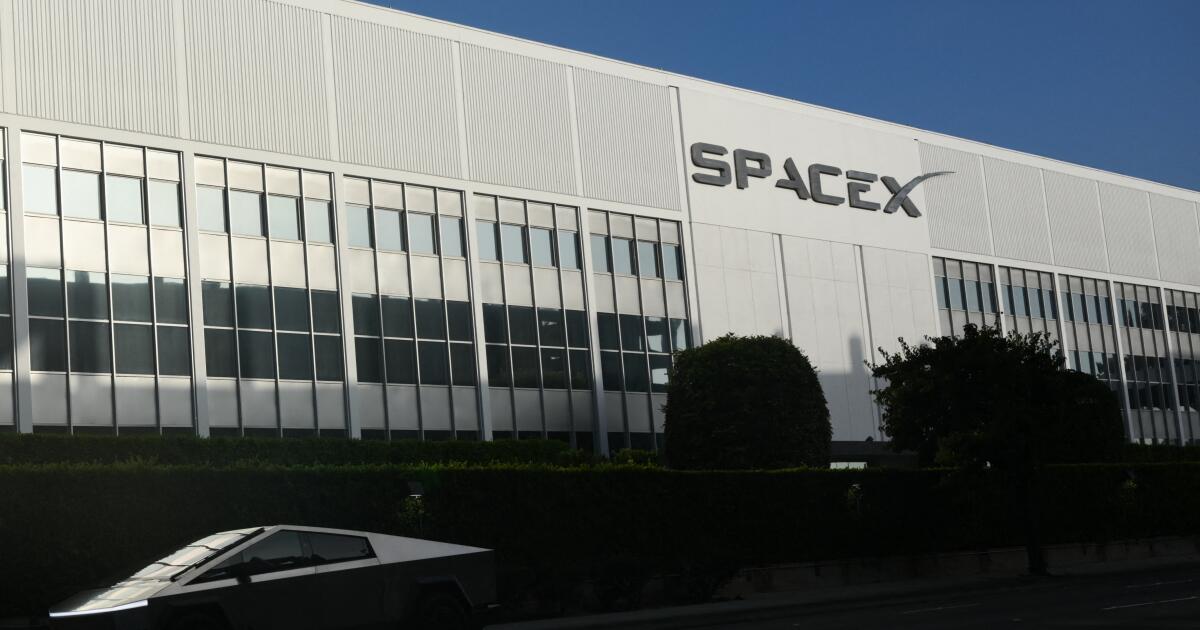

SpaceX is poised to make history on Friday with a record-setting IPO that will catapult the once fledgling aerospace startup into one of the most valuable companies on Earth.
The company, founded in El Segundo in 2002, is selling at least 555 million shares at $135 apiece, which could raise $75 billion or more. That could give Elon Musk’s rocket, communications and AI company a valuation of at least $1.77 trillion.
The IPO would be the largest on record, by far eclipsing the 2019 offering by Saudi Arabia’s state-owned oil giant Saudi Aramco, which raised $29.4 billion.
It could also make Musk — whose net worth is now pegged at $707 billion by Bloomberg — the world’s first trillionaire, given his other holdings in Tesla.
Though it moved its headquarters from Hawthorne to Texas in 2024, SpaceX retains large operations in the South Bay city and blasts off regularly from Vandenberg Space Force Base in Santa Barbara County.
Some investors and industry analysts wonder whether SpaceX might be overvalued and question a governance structure that puts Musk firmly in control of the company and its board of directors.
However, demand for the shares being sold by nearly two dozen investment banks is so high that the offering is said to be oversubscribed by at least three times by big institutions.
That means investors are buying into Musk’s vision for the company as a leader in rocketry, internet communications and artificial intelligence.
SpaceX’s Falcon 9 is the world’s dominant launch vehicle, and the company is developing Starship, a massive rocket that will send astronauts to the moon and possibly Mars, while supporting the build-out of the company’s Starlink satellite internet communications system.
Musk also envisions a network of orbiting AI satellite data centers. And the company has purchased spectrum to build a satellite-based mobile communications network.
Most important for investors wanting to ride the AI wave, Musk merged his xAi artificial intelligence company into SpaceX this year. The company already has built large AI data centers and has leased AI compute capacity to Anthropic and Google.
“It is one of the most highly anticipated, if not the most highly anticipated, IPOs of all time and obviously the biggest to date,” said Nicholas Smith, an analyst at Renaissance Capital.
SpaceX has sought to sell to institutional investors who will hold the stock, but Musk also set aside 30% of the offering for retail investors — an unusually high percentage. It is being sold through a select group of brokerages, including Charles Schwab, Robinhood and Fidelity.
Some of those buyers are expected to be Elon Musk true believers who hold on to the shares, while others could sell them for a quick profit when trading starts on Friday.
“You’re definitely going to have people kind of wanting to capitalize on any sort of pop that occurs, so trading could definitely bounce around quite a bit,” Smith said.
Although enthusiasm for the offering on Wall Street is extraordinarily high, the sentiment is not universally shared given the company’s valuation and Musk’s tight control of its governance through his ownership of special shares with 10 times the voting power of common shares.
If the IPO holds its value on the first day of trading, SpaceX would become one of the top ten U.S. public companies by market capitalization, yet it recorded only $18.7 billion in revenue last year. Most others in that group had hundreds of billions of revenue.
In a report earlier this month, investment research company Morningstar valued SpaceX at just $780 billion, based largely on its dominant rocket business, which has reduced launch costs by 95%, and its profitable Starlink satellite broadband network.
The report said that plans to build orbiting satellite data centers powered by the sun that would perform AI calculations were plausible but would require “uproven engineering to succeed.”
“To get to the valuation at the IPO price you have to basically assume that everything goes perfectly well for the company — it’s priced for perfection,” said report co-author Nicolas Owens, an equity analyst at Morningstar.
The report expects that shares could rise after trading starts but will probably depreciate in coming months as employees and other inside shareholders are allowed to sell their shares — suggesting investors wait before buying into the stock.
Sen. Elizabeth Warren (D-Mass.), ranking member of the Senate’s banking committee, sent a letter Tuesday to Securities and Exchange Commission Chair Paul Atkins, asking for the offering to be paused.
The letter questions the company’s valuation, Musk’s control over the board and other issues, including plans by the Nasdaq 100 and FTSE Russell indices — which are tracked by mutual fund companies — to buy shares prior to any public financial reports by SpaceX.
“Should the IPO be approved in its current form, the uniquely unchecked power Musk will have at SpaceX creates serious concerns for investors, markets, and the public at large,” Warren wrote in her letter.
CalPERS, the California public employees retirement system and one of the country’s largest institutional investors, joined other pension funds in seeking a meeting last month with Musk over similar concerns.
On Wednesday, New York State Comptroller Thomas DiNapoli and pension fund leaders in New York City, Maryland and Illinois sent a letter to the ownership of the FTSE Russell indices asking them to reconsider their decision to buy into the stock early.
A representative of SpaceX did not respond to a request for comment. The SEC declined to comment.
Much of the excitement surrounding the stock involves the promise of unproven technology — Musk’s plan to launch thousands of satellites powered by the sun that would perform artificial intelligence computer calculations in space.
That would require SpaceX to perfect its massive Starship rocket — which can launch more than 100 metric tons of cargo and is more powerful and taller than the Saturn V that sent Apollo astronauts to the moon.
SpaceX launched its 12th test flight last month. It was largely successful but resulted in the rocket being grounded after the booster suffered an uncontrolled landing in the Gulf of Mexico.
The SpaceX IPO has generated enthusiasm across Southern California’s expanding aerospace and defense sector.
Entrepreneur Euwyn Poon is excited by the IPO. This year he founded one of the few startups that is working on satellite data centers, a company called Orbital based in Los Angeles.
Poon said that SpaceX work on the data centers will help catalyze development of the technology — and he expects his company will be able to hire SpaceX engineers seeking to work at a startup.
“The whole industry hinges on SpaceX’s ability to execute on Starship,” he said. “Heightened interest in the space is good. There is potentially more talent available with people that have liquidity at SpaceX and are seeking new adventures.”

SpaceX is poised to make history on Friday with a record-setting IPO that will catapult the once fledgling aerospace startup into one of the most valuable companies on Earth.
The company, founded in El Segundo in 2002, is selling at least 555 million shares at $135 apiece, which could raise $75 billion or more. That could give Elon Musk’s rocket, communications and AI company a valuation of at least $1.77 trillion.
The IPO would be the largest on record, by far eclipsing the 2019 offering by Saudi Arabia’s state-owned oil giant Saudi Aramco, which raised $29.4 billion.
It could also make Musk — whose net worth is now pegged at $707 billion by Bloomberg — the world’s first trillionaire, given his other holdings in Tesla.
Though it moved its headquarters from Hawthorne to Texas in 2024, SpaceX retains large operations in the South Bay city and blasts off regularly from Vandenberg Space Force Base in Santa Barbara County.
Some investors and industry analysts wonder whether SpaceX might be overvalued and question a governance structure that puts Musk firmly in control of the company and its board of directors.
However, demand for the shares being sold by nearly two dozen investment banks is so high that the offering is said to be oversubscribed by at least three times by big institutions.
That means investors are buying into Musk’s vision for the company as a leader in rocketry, internet communications and artificial intelligence.
SpaceX’s Falcon 9 is the world’s dominant launch vehicle, and the company is developing Starship, a massive rocket that will send astronauts to the moon and possibly Mars, while supporting the build-out of the company’s Starlink satellite internet communications system.
Musk also envisions a network of orbiting AI satellite data centers. And the company has purchased spectrum to build a satellite-based mobile communications network.
Most important for investors wanting to ride the AI wave, Musk merged his xAi artificial intelligence company into SpaceX this year. The company already has built large AI data centers and has leased AI compute capacity to Anthropic and Google.
“It is one of the most highly anticipated, if not the most highly anticipated, IPOs of all time and obviously the biggest to date,” said Nicholas Smith, an analyst at Renaissance Capital.
SpaceX has sought to sell to institutional investors who will hold the stock, but Musk also set aside 30% of the offering for retail investors — an unusually high percentage. It is being sold through a select group of brokerages, including Charles Schwab, Robinhood and Fidelity.
Some of those buyers are expected to be Elon Musk true believers who hold on to the shares, while others could sell them for a quick profit when trading starts on Friday.
“You’re definitely going to have people kind of wanting to capitalize on any sort of pop that occurs, so trading could definitely bounce around quite a bit,” Smith said.
Although enthusiasm for the offering on Wall Street is extraordinarily high, the sentiment is not universally shared given the company’s valuation and Musk’s tight control of its governance through his ownership of special shares with 10 times the voting power of common shares.
If the IPO holds its value on the first day of trading, SpaceX would become one of the top ten U.S. public companies by market capitalization, yet it recorded only $18.7 billion in revenue last year. Most others in that group had hundreds of billions of revenue.
In a report earlier this month, investment research company Morningstar valued SpaceX at just $780 billion, based largely on its dominant rocket business, which has reduced launch costs by 95%, and its profitable Starlink satellite broadband network.
The report said that plans to build orbiting satellite data centers powered by the sun that would perform AI calculations were plausible but would require “uproven engineering to succeed.”
“To get to the valuation at the IPO price you have to basically assume that everything goes perfectly well for the company — it’s priced for perfection,” said report co-author Nicolas Owens, an equity analyst at Morningstar.
The report expects that shares could rise after trading starts but will probably depreciate in coming months as employees and other inside shareholders are allowed to sell their shares — suggesting investors wait before buying into the stock.
Sen. Elizabeth Warren (D-Mass.), ranking member of the Senate’s banking committee, sent a letter Tuesday to Securities and Exchange Commission Chair Paul Atkins, asking for the offering to be paused.
The letter questions the company’s valuation, Musk’s control over the board and other issues, including plans by the Nasdaq 100 and FTSE Russell indices — which are tracked by mutual fund companies — to buy shares prior to any public financial reports by SpaceX.
“Should the IPO be approved in its current form, the uniquely unchecked power Musk will have at SpaceX creates serious concerns for investors, markets, and the public at large,” Warren wrote in her letter.
CalPERS, the California public employees retirement system and one of the country’s largest institutional investors, joined other pension funds in seeking a meeting last month with Musk over similar concerns.
On Wednesday, New York State Comptroller Thomas DiNapoli and pension fund leaders in New York City, Maryland and Illinois sent a letter to the ownership of the FTSE Russell indices asking them to reconsider their decision to buy into the stock early.
A representative of SpaceX did not respond to a request for comment. The SEC declined to comment.
Much of the excitement surrounding the stock involves the promise of unproven technology — Musk’s plan to launch thousands of satellites powered by the sun that would perform artificial intelligence computer calculations in space.
That would require SpaceX to perfect its massive Starship rocket — which can launch more than 100 metric tons of cargo and is more powerful and taller than the Saturn V that sent Apollo astronauts to the moon.
SpaceX launched its 12th test flight last month. It was largely successful but resulted in the rocket being grounded after the booster suffered an uncontrolled landing in the Gulf of Mexico.
The SpaceX IPO has generated enthusiasm across Southern California’s expanding aerospace and defense sector.
Entrepreneur Euwyn Poon is excited by the IPO. This year he founded one of the few startups that is working on satellite data centers, a company called Orbital based in Los Angeles.
Poon said that SpaceX work on the data centers will help catalyze development of the technology — and he expects his company will be able to hire SpaceX engineers seeking to work at a startup.
“The whole industry hinges on SpaceX’s ability to execute on Starship,” he said. “Heightened interest in the space is good. There is potentially more talent available with people that have liquidity at SpaceX and are seeking new adventures.”

SpaceX is poised to make history on Friday with a record-setting IPO that will catapult the once fledgling aerospace startup into one of the most valuable companies on Earth.
The company, founded in El Segundo in 2002, is selling at least 555 million shares at $135 apiece, which could raise $75 billion or more. That could give Elon Musk’s rocket, communications and AI company a valuation of at least $1.77 trillion.
The IPO would be the largest on record, by far eclipsing the 2019 offering by Saudi Arabia’s state-owned oil giant Saudi Aramco, which raised $29.4 billion.
It could also make Musk — whose net worth is now pegged at $707 billion by Bloomberg — the world’s first trillionaire, given his other holdings in Tesla.
Though it moved its headquarters from Hawthorne to Texas in 2024, SpaceX retains large operations in the South Bay city and blasts off regularly from Vandenberg Space Force Base in Santa Barbara County.
Some investors and industry analysts wonder whether SpaceX might be overvalued and question a governance structure that puts Musk firmly in control of the company and its board of directors.
However, demand for the shares being sold by nearly two dozen investment banks is so high that the offering is said to be oversubscribed by at least three times by big institutions.
That means investors are buying into Musk’s vision for the company as a leader in rocketry, internet communications and artificial intelligence.
SpaceX’s Falcon 9 is the world’s dominant launch vehicle, and the company is developing Starship, a massive rocket that will send astronauts to the moon and possibly Mars, while supporting the build-out of the company’s Starlink satellite internet communications system.
Musk also envisions a network of orbiting AI satellite data centers. And the company has purchased spectrum to build a satellite-based mobile communications network.
Most important for investors wanting to ride the AI wave, Musk merged his xAi artificial intelligence company into SpaceX this year. The company already has built large AI data centers and has leased AI compute capacity to Anthropic and Google.
“It is one of the most highly anticipated, if not the most highly anticipated, IPOs of all time and obviously the biggest to date,” said Nicholas Smith, an analyst at Renaissance Capital.
SpaceX has sought to sell to institutional investors who will hold the stock, but Musk also set aside 30% of the offering for retail investors — an unusually high percentage. It is being sold through a select group of brokerages, including Charles Schwab, Robinhood and Fidelity.
Some of those buyers are expected to be Elon Musk true believers who hold on to the shares, while others could sell them for a quick profit when trading starts on Friday.
“You’re definitely going to have people kind of wanting to capitalize on any sort of pop that occurs, so trading could definitely bounce around quite a bit,” Smith said.
Although enthusiasm for the offering on Wall Street is extraordinarily high, the sentiment is not universally shared given the company’s valuation and Musk’s tight control of its governance through his ownership of special shares with 10 times the voting power of common shares.
If the IPO holds its value on the first day of trading, SpaceX would become one of the top ten U.S. public companies by market capitalization, yet it recorded only $18.7 billion in revenue last year. Most others in that group had hundreds of billions of revenue.
In a report earlier this month, investment research company Morningstar valued SpaceX at just $780 billion, based largely on its dominant rocket business, which has reduced launch costs by 95%, and its profitable Starlink satellite broadband network.
The report said that plans to build orbiting satellite data centers powered by the sun that would perform AI calculations were plausible but would require “uproven engineering to succeed.”
“To get to the valuation at the IPO price you have to basically assume that everything goes perfectly well for the company — it’s priced for perfection,” said report co-author Nicolas Owens, an equity analyst at Morningstar.
The report expects that shares could rise after trading starts but will probably depreciate in coming months as employees and other inside shareholders are allowed to sell their shares — suggesting investors wait before buying into the stock.
Sen. Elizabeth Warren (D-Mass.), ranking member of the Senate’s banking committee, sent a letter Tuesday to Securities and Exchange Commission Chair Paul Atkins, asking for the offering to be paused.
The letter questions the company’s valuation, Musk’s control over the board and other issues, including plans by the Nasdaq 100 and FTSE Russell indices — which are tracked by mutual fund companies — to buy shares prior to any public financial reports by SpaceX.
“Should the IPO be approved in its current form, the uniquely unchecked power Musk will have at SpaceX creates serious concerns for investors, markets, and the public at large,” Warren wrote in her letter.
CalPERS, the California public employees retirement system and one of the country’s largest institutional investors, joined other pension funds in seeking a meeting last month with Musk over similar concerns.
On Wednesday, New York State Comptroller Thomas DiNapoli and pension fund leaders in New York City, Maryland and Illinois sent a letter to the ownership of the FTSE Russell indices asking them to reconsider their decision to buy into the stock early.
A representative of SpaceX did not respond to a request for comment. The SEC declined to comment.
Much of the excitement surrounding the stock involves the promise of unproven technology — Musk’s plan to launch thousands of satellites powered by the sun that would perform artificial intelligence computer calculations in space.
That would require SpaceX to perfect its massive Starship rocket — which can launch more than 100 metric tons of cargo and is more powerful and taller than the Saturn V that sent Apollo astronauts to the moon.
SpaceX launched its 12th test flight last month. It was largely successful but resulted in the rocket being grounded after the booster suffered an uncontrolled landing in the Gulf of Mexico.
The SpaceX IPO has generated enthusiasm across Southern California’s expanding aerospace and defense sector.
Entrepreneur Euwyn Poon is excited by the IPO. This year he founded one of the few startups that is working on satellite data centers, a company called Orbital based in Los Angeles.
Poon said that SpaceX work on the data centers will help catalyze development of the technology — and he expects his company will be able to hire SpaceX engineers seeking to work at a startup.
“The whole industry hinges on SpaceX’s ability to execute on Starship,” he said. “Heightened interest in the space is good. There is potentially more talent available with people that have liquidity at SpaceX and are seeking new adventures.”
SpaceX is poised to make history on Friday with a record-setting IPO that will catapult the once fledgling aerospace startup into one of the most valuable companies on Earth.
The company, founded in El Segundo in 2002, is selling at least 555 million shares at $135 apiece, which could raise $75 billion or more. That could give Elon Musk’s rocket, communications and AI company a valuation of at least $1.77 trillion.
The IPO would be the largest on record, by far eclipsing the 2019 offering by Saudi Arabia’s state-owned oil giant Saudi Aramco, which raised $29.4 billion.
It could also make Musk — whose net worth is now pegged at $707 billion by Bloomberg — the world’s first trillionaire, given his other holdings in Tesla.
Though it moved its headquarters from Hawthorne to Texas in 2024, SpaceX retains large operations in the South Bay city and blasts off regularly from Vandenberg Space Force Base in Santa Barbara County.
Some investors and industry analysts wonder whether SpaceX might be overvalued and question a governance structure that puts Musk firmly in control of the company and its board of directors.
However, demand for the shares being sold by nearly two dozen investment banks is so high that the offering is said to be oversubscribed by at least three times by big institutions.
That means investors are buying into Musk’s vision for the company as a leader in rocketry, internet communications and artificial intelligence.
SpaceX’s Falcon 9 is the world’s dominant launch vehicle, and the company is developing Starship, a massive rocket that will send astronauts to the moon and possibly Mars, while supporting the build-out of the company’s Starlink satellite internet communications system.
Musk also envisions a network of orbiting AI satellite data centers. And the company has purchased spectrum to build a satellite-based mobile communications network.
Most important for investors wanting to ride the AI wave, Musk merged his xAi artificial intelligence company into SpaceX this year. The company already has built large AI data centers and has leased AI compute capacity to Anthropic and Google.
“It is one of the most highly anticipated, if not the most highly anticipated, IPOs of all time and obviously the biggest to date,” said Nicholas Smith, an analyst at Renaissance Capital.
SpaceX has sought to sell to institutional investors who will hold the stock, but Musk also set aside 30% of the offering for retail investors — an unusually high percentage. It is being sold through a select group of brokerages, including Charles Schwab, Robinhood and Fidelity.
Some of those buyers are expected to be Elon Musk true believers who hold on to the shares, while others could sell them for a quick profit when trading starts on Friday.
“You’re definitely going to have people kind of wanting to capitalize on any sort of pop that occurs, so trading could definitely bounce around quite a bit,” Smith said.
Although enthusiasm for the offering on Wall Street is extraordinarily high, the sentiment is not universally shared given the company’s valuation and Musk’s tight control of its governance through his ownership of special shares with 10 times the voting power of common shares.
If the IPO holds its value on the first day of trading, SpaceX would become one of the top ten U.S. public companies by market capitalization, yet it recorded only $18.7 billion in revenue last year. Most others in that group had hundreds of billions of revenue.
In a report earlier this month, investment research company Morningstar valued SpaceX at just $780 billion, based largely on its dominant rocket business, which has reduced launch costs by 95%, and its profitable Starlink satellite broadband network.
The report said that plans to build orbiting satellite data centers powered by the sun that would perform AI calculations were plausible but would require “uproven engineering to succeed.”
“To get to the valuation at the IPO price you have to basically assume that everything goes perfectly well for the company — it’s priced for perfection,” said report co-author Nicolas Owens, an equity analyst at Morningstar.
The report expects that shares could rise after trading starts but will probably depreciate in coming months as employees and other inside shareholders are allowed to sell their shares — suggesting investors wait before buying into the stock.
Sen. Elizabeth Warren (D-Mass.), ranking member of the Senate’s banking committee, sent a letter Tuesday to Securities and Exchange Commission Chair Paul Atkins, asking for the offering to be paused.
The letter questions the company’s valuation, Musk’s control over the board and other issues, including plans by the Nasdaq 100 and FTSE Russell indices — which are tracked by mutual fund companies — to buy shares prior to any public financial reports by SpaceX.
“Should the IPO be approved in its current form, the uniquely unchecked power Musk will have at SpaceX creates serious concerns for investors, markets, and the public at large,” Warren wrote in her letter.
CalPERS, the California public employees retirement system and one of the country’s largest institutional investors, joined other pension funds in seeking a meeting last month with Musk over similar concerns.
On Wednesday, New York State Comptroller Thomas DiNapoli and pension fund leaders in New York City, Maryland and Illinois sent a letter to the ownership of the FTSE Russell indices asking them to reconsider their decision to buy into the stock early.
A representative of SpaceX did not respond to a request for comment. The SEC declined to comment.
Much of the excitement surrounding the stock involves the promise of unproven technology — Musk’s plan to launch thousands of satellites powered by the sun that would perform artificial intelligence computer calculations in space.
That would require SpaceX to perfect its massive Starship rocket — which can launch more than 100 metric tons of cargo and is more powerful and taller than the Saturn V that sent Apollo astronauts to the moon.
SpaceX launched its 12th test flight last month. It was largely successful but resulted in the rocket being grounded after the booster suffered an uncontrolled landing in the Gulf of Mexico.
The SpaceX IPO has generated enthusiasm across Southern California’s expanding aerospace and defense sector.
Entrepreneur Euwyn Poon is excited by the IPO. This year he founded one of the few startups that is working on satellite data centers, a company called Orbital based in Los Angeles.
Poon said that SpaceX work on the data centers will help catalyze development of the technology — and he expects his company will be able to hire SpaceX engineers seeking to work at a startup.
“The whole industry hinges on SpaceX’s ability to execute on Starship,” he said. “Heightened interest in the space is good. There is potentially more talent available with people that have liquidity at SpaceX and are seeking new adventures.”

SpaceX is poised to make history on Friday with a record-setting IPO that will catapult the once fledgling aerospace startup into one of the most valuable companies on Earth.
The company, founded in El Segundo in 2002, is selling at least 555 million shares at $135 apiece, which could raise $75 billion or more. That could give Elon Musk’s rocket, communications and AI company a valuation of at least $1.77 trillion.
The IPO would be the largest on record, by far eclipsing the 2019 offering by Saudi Arabia’s state-owned oil giant Saudi Aramco, which raised $29.4 billion.
It could also make Musk — whose net worth is now pegged at $707 billion by Bloomberg — the world’s first trillionaire, given his other holdings in Tesla.
Though it moved its headquarters from Hawthorne to Texas in 2024, SpaceX retains large operations in the South Bay city and blasts off regularly from Vandenberg Space Force Base in Santa Barbara County.
Some investors and industry analysts wonder whether SpaceX might be overvalued and question a governance structure that puts Musk firmly in control of the company and its board of directors.
However, demand for the shares being sold by nearly two dozen investment banks is so high that the offering is said to be oversubscribed by at least three times by big institutions.
That means investors are buying into Musk’s vision for the company as a leader in rocketry, internet communications and artificial intelligence.
SpaceX’s Falcon 9 is the world’s dominant launch vehicle, and the company is developing Starship, a massive rocket that will send astronauts to the moon and possibly Mars, while supporting the build-out of the company’s Starlink satellite internet communications system.
Musk also envisions a network of orbiting AI satellite data centers. And the company has purchased spectrum to build a satellite-based mobile communications network.
Most important for investors wanting to ride the AI wave, Musk merged his xAi artificial intelligence company into SpaceX this year. The company already has built large AI data centers and has leased AI compute capacity to Anthropic and Google.
“It is one of the most highly anticipated, if not the most highly anticipated, IPOs of all time and obviously the biggest to date,” said Nicholas Smith, an analyst at Renaissance Capital.
SpaceX has sought to sell to institutional investors who will hold the stock, but Musk also set aside 30% of the offering for retail investors — an unusually high percentage. It is being sold through a select group of brokerages, including Charles Schwab, Robinhood and Fidelity.
Some of those buyers are expected to be Elon Musk true believers who hold on to the shares, while others could sell them for a quick profit when trading starts on Friday.
“You’re definitely going to have people kind of wanting to capitalize on any sort of pop that occurs, so trading could definitely bounce around quite a bit,” Smith said.
Although enthusiasm for the offering on Wall Street is extraordinarily high, the sentiment is not universally shared given the company’s valuation and Musk’s tight control of its governance through his ownership of special shares with 10 times the voting power of common shares.
If the IPO holds its value on the first day of trading, SpaceX would become one of the top ten U.S. public companies by market capitalization, yet it recorded only $18.7 billion in revenue last year. Most others in that group had hundreds of billions of revenue.
In a report earlier this month, investment research company Morningstar valued SpaceX at just $780 billion, based largely on its dominant rocket business, which has reduced launch costs by 95%, and its profitable Starlink satellite broadband network.
The report said that plans to build orbiting satellite data centers powered by the sun that would perform AI calculations were plausible but would require “uproven engineering to succeed.”
“To get to the valuation at the IPO price you have to basically assume that everything goes perfectly well for the company — it’s priced for perfection,” said report co-author Nicolas Owens, an equity analyst at Morningstar.
The report expects that shares could rise after trading starts but will probably depreciate in coming months as employees and other inside shareholders are allowed to sell their shares — suggesting investors wait before buying into the stock.
Sen. Elizabeth Warren (D-Mass.), ranking member of the Senate’s banking committee, sent a letter Tuesday to Securities and Exchange Commission Chair Paul Atkins, asking for the offering to be paused.
The letter questions the company’s valuation, Musk’s control over the board and other issues, including plans by the Nasdaq 100 and FTSE Russell indices — which are tracked by mutual fund companies — to buy shares prior to any public financial reports by SpaceX.
“Should the IPO be approved in its current form, the uniquely unchecked power Musk will have at SpaceX creates serious concerns for investors, markets, and the public at large,” Warren wrote in her letter.
CalPERS, the California public employees retirement system and one of the country’s largest institutional investors, joined other pension funds in seeking a meeting last month with Musk over similar concerns.
On Wednesday, New York State Comptroller Thomas DiNapoli and pension fund leaders in New York City, Maryland and Illinois sent a letter to the ownership of the FTSE Russell indices asking them to reconsider their decision to buy into the stock early.
A representative of SpaceX did not respond to a request for comment. The SEC declined to comment.
Much of the excitement surrounding the stock involves the promise of unproven technology — Musk’s plan to launch thousands of satellites powered by the sun that would perform artificial intelligence computer calculations in space.
That would require SpaceX to perfect its massive Starship rocket — which can launch more than 100 metric tons of cargo and is more powerful and taller than the Saturn V that sent Apollo astronauts to the moon.
SpaceX launched its 12th test flight last month. It was largely successful but resulted in the rocket being grounded after the booster suffered an uncontrolled landing in the Gulf of Mexico.
The SpaceX IPO has generated enthusiasm across Southern California’s expanding aerospace and defense sector.
Entrepreneur Euwyn Poon is excited by the IPO. This year he founded one of the few startups that is working on satellite data centers, a company called Orbital based in Los Angeles.
Poon said that SpaceX work on the data centers will help catalyze development of the technology — and he expects his company will be able to hire SpaceX engineers seeking to work at a startup.
“The whole industry hinges on SpaceX’s ability to execute on Starship,” he said. “Heightened interest in the space is good. There is potentially more talent available with people that have liquidity at SpaceX and are seeking new adventures.”
SpaceX is poised to make history on Friday with a record-setting IPO that will catapult the once fledgling aerospace startup into one of the most valuable companies on Earth.
The company, founded in El Segundo in 2002, is selling at least 555 million shares at $135 apiece, which could raise $75 billion or more. That could give Elon Musk’s rocket, communications and AI company a valuation of at least $1.77 trillion.
The IPO would be the largest on record, by far eclipsing the 2019 offering by Saudi Arabia’s state-owned oil giant Saudi Aramco, which raised $29.4 billion.
It could also make Musk — whose net worth is now pegged at $707 billion by Bloomberg — the world’s first trillionaire, given his other holdings in Tesla.
Though it moved its headquarters from Hawthorne to Texas in 2024, SpaceX retains large operations in the South Bay city and blasts off regularly from Vandenberg Space Force Base in Santa Barbara County.
Some investors and industry analysts wonder whether SpaceX might be overvalued and question a governance structure that puts Musk firmly in control of the company and its board of directors.
However, demand for the shares being sold by nearly two dozen investment banks is so high that the offering is said to be oversubscribed by at least three times by big institutions.
That means investors are buying into Musk’s vision for the company as a leader in rocketry, internet communications and artificial intelligence.
SpaceX’s Falcon 9 is the world’s dominant launch vehicle, and the company is developing Starship, a massive rocket that will send astronauts to the moon and possibly Mars, while supporting the build-out of the company’s Starlink satellite internet communications system.
Musk also envisions a network of orbiting AI satellite data centers. And the company has purchased spectrum to build a satellite-based mobile communications network.
Most important for investors wanting to ride the AI wave, Musk merged his xAi artificial intelligence company into SpaceX this year. The company already has built large AI data centers and has leased AI compute capacity to Anthropic and Google.
“It is one of the most highly anticipated, if not the most highly anticipated, IPOs of all time and obviously the biggest to date,” said Nicholas Smith, an analyst at Renaissance Capital.
SpaceX has sought to sell to institutional investors who will hold the stock, but Musk also set aside 30% of the offering for retail investors — an unusually high percentage. It is being sold through a select group of brokerages, including Charles Schwab, Robinhood and Fidelity.
Some of those buyers are expected to be Elon Musk true believers who hold on to the shares, while others could sell them for a quick profit when trading starts on Friday.
“You’re definitely going to have people kind of wanting to capitalize on any sort of pop that occurs, so trading could definitely bounce around quite a bit,” Smith said.
Although enthusiasm for the offering on Wall Street is extraordinarily high, the sentiment is not universally shared given the company’s valuation and Musk’s tight control of its governance through his ownership of special shares with 10 times the voting power of common shares.
If the IPO holds its value on the first day of trading, SpaceX would become one of the top ten U.S. public companies by market capitalization, yet it recorded only $18.7 billion in revenue last year. Most others in that group had hundreds of billions of revenue.
In a report earlier this month, investment research company Morningstar valued SpaceX at just $780 billion, based largely on its dominant rocket business, which has reduced launch costs by 95%, and its profitable Starlink satellite broadband network.
The report said that plans to build orbiting satellite data centers powered by the sun that would perform AI calculations were plausible but would require “uproven engineering to succeed.”
“To get to the valuation at the IPO price you have to basically assume that everything goes perfectly well for the company — it’s priced for perfection,” said report co-author Nicolas Owens, an equity analyst at Morningstar.
The report expects that shares could rise after trading starts but will probably depreciate in coming months as employees and other inside shareholders are allowed to sell their shares — suggesting investors wait before buying into the stock.
Sen. Elizabeth Warren (D-Mass.), ranking member of the Senate’s banking committee, sent a letter Tuesday to Securities and Exchange Commission Chair Paul Atkins, asking for the offering to be paused.
The letter questions the company’s valuation, Musk’s control over the board and other issues, including plans by the Nasdaq 100 and FTSE Russell indices — which are tracked by mutual fund companies — to buy shares prior to any public financial reports by SpaceX.
“Should the IPO be approved in its current form, the uniquely unchecked power Musk will have at SpaceX creates serious concerns for investors, markets, and the public at large,” Warren wrote in her letter.
CalPERS, the California public employees retirement system and one of the country’s largest institutional investors, joined other pension funds in seeking a meeting last month with Musk over similar concerns.
On Wednesday, New York State Comptroller Thomas DiNapoli and pension fund leaders in New York City, Maryland and Illinois sent a letter to the ownership of the FTSE Russell indices asking them to reconsider their decision to buy into the stock early.
A representative of SpaceX did not respond to a request for comment. The SEC declined to comment.
Much of the excitement surrounding the stock involves the promise of unproven technology — Musk’s plan to launch thousands of satellites powered by the sun that would perform artificial intelligence computer calculations in space.
That would require SpaceX to perfect its massive Starship rocket — which can launch more than 100 metric tons of cargo and is more powerful and taller than the Saturn V that sent Apollo astronauts to the moon.
SpaceX launched its 12th test flight last month. It was largely successful but resulted in the rocket being grounded after the booster suffered an uncontrolled landing in the Gulf of Mexico.
The SpaceX IPO has generated enthusiasm across Southern California’s expanding aerospace and defense sector.
Entrepreneur Euwyn Poon is excited by the IPO. This year he founded one of the few startups that is working on satellite data centers, a company called Orbital based in Los Angeles.
Poon said that SpaceX work on the data centers will help catalyze development of the technology — and he expects his company will be able to hire SpaceX engineers seeking to work at a startup.
“The whole industry hinges on SpaceX’s ability to execute on Starship,” he said. “Heightened interest in the space is good. There is potentially more talent available with people that have liquidity at SpaceX and are seeking new adventures.”
SpaceX is poised to make history on Friday with a record-setting IPO that will catapult the once fledgling aerospace startup into one of the most valuable companies on Earth.
The company, founded in El Segundo in 2002, is selling at least 555 million shares at $135 apiece, which could raise $75 billion or more. That could give Elon Musk’s rocket, communications and AI company a valuation of at least $1.77 trillion.
The IPO would be the largest on record, by far eclipsing the 2019 offering by Saudi Arabia’s state-owned oil giant Saudi Aramco, which raised $29.4 billion.
It could also make Musk — whose net worth is now pegged at $707 billion by Bloomberg — the world’s first trillionaire, given his other holdings in Tesla.
Though it moved its headquarters from Hawthorne to Texas in 2024, SpaceX retains large operations in the South Bay city and blasts off regularly from Vandenberg Space Force Base in Santa Barbara County.
Some investors and industry analysts wonder whether SpaceX might be overvalued and question a governance structure that puts Musk firmly in control of the company and its board of directors.
However, demand for the shares being sold by nearly two dozen investment banks is so high that the offering is said to be oversubscribed by at least three times by big institutions.
That means investors are buying into Musk’s vision for the company as a leader in rocketry, internet communications and artificial intelligence.
SpaceX’s Falcon 9 is the world’s dominant launch vehicle, and the company is developing Starship, a massive rocket that will send astronauts to the moon and possibly Mars, while supporting the build-out of the company’s Starlink satellite internet communications system.
Musk also envisions a network of orbiting AI satellite data centers. And the company has purchased spectrum to build a satellite-based mobile communications network.
Most important for investors wanting to ride the AI wave, Musk merged his xAi artificial intelligence company into SpaceX this year. The company already has built large AI data centers and has leased AI compute capacity to Anthropic and Google.
“It is one of the most highly anticipated, if not the most highly anticipated, IPOs of all time and obviously the biggest to date,” said Nicholas Smith, an analyst at Renaissance Capital.
SpaceX has sought to sell to institutional investors who will hold the stock, but Musk also set aside 30% of the offering for retail investors — an unusually high percentage. It is being sold through a select group of brokerages, including Charles Schwab, Robinhood and Fidelity.
Some of those buyers are expected to be Elon Musk true believers who hold on to the shares, while others could sell them for a quick profit when trading starts on Friday.
“You’re definitely going to have people kind of wanting to capitalize on any sort of pop that occurs, so trading could definitely bounce around quite a bit,” Smith said.
Although enthusiasm for the offering on Wall Street is extraordinarily high, the sentiment is not universally shared given the company’s valuation and Musk’s tight control of its governance through his ownership of special shares with 10 times the voting power of common shares.
If the IPO holds its value on the first day of trading, SpaceX would become one of the top ten U.S. public companies by market capitalization, yet it recorded only $18.7 billion in revenue last year. Most others in that group had hundreds of billions of revenue.
In a report earlier this month, investment research company Morningstar valued SpaceX at just $780 billion, based largely on its dominant rocket business, which has reduced launch costs by 95%, and its profitable Starlink satellite broadband network.
The report said that plans to build orbiting satellite data centers powered by the sun that would perform AI calculations were plausible but would require “uproven engineering to succeed.”
“To get to the valuation at the IPO price you have to basically assume that everything goes perfectly well for the company — it’s priced for perfection,” said report co-author Nicolas Owens, an equity analyst at Morningstar.
The report expects that shares could rise after trading starts but will probably depreciate in coming months as employees and other inside shareholders are allowed to sell their shares — suggesting investors wait before buying into the stock.
Sen. Elizabeth Warren (D-Mass.), ranking member of the Senate’s banking committee, sent a letter Tuesday to Securities and Exchange Commission Chair Paul Atkins, asking for the offering to be paused.
The letter questions the company’s valuation, Musk’s control over the board and other issues, including plans by the Nasdaq 100 and FTSE Russell indices — which are tracked by mutual fund companies — to buy shares prior to any public financial reports by SpaceX.
“Should the IPO be approved in its current form, the uniquely unchecked power Musk will have at SpaceX creates serious concerns for investors, markets, and the public at large,” Warren wrote in her letter.
CalPERS, the California public employees retirement system and one of the country’s largest institutional investors, joined other pension funds in seeking a meeting last month with Musk over similar concerns.
On Wednesday, New York State Comptroller Thomas DiNapoli and pension fund leaders in New York City, Maryland and Illinois sent a letter to the ownership of the FTSE Russell indices asking them to reconsider their decision to buy into the stock early.
A representative of SpaceX did not respond to a request for comment. The SEC declined to comment.
Much of the excitement surrounding the stock involves the promise of unproven technology — Musk’s plan to launch thousands of satellites powered by the sun that would perform artificial intelligence computer calculations in space.
That would require SpaceX to perfect its massive Starship rocket — which can launch more than 100 metric tons of cargo and is more powerful and taller than the Saturn V that sent Apollo astronauts to the moon.
SpaceX launched its 12th test flight last month. It was largely successful but resulted in the rocket being grounded after the booster suffered an uncontrolled landing in the Gulf of Mexico.
The SpaceX IPO has generated enthusiasm across Southern California’s expanding aerospace and defense sector.
Entrepreneur Euwyn Poon is excited by the IPO. This year he founded one of the few startups that is working on satellite data centers, a company called Orbital based in Los Angeles.
Poon said that SpaceX work on the data centers will help catalyze development of the technology — and he expects his company will be able to hire SpaceX engineers seeking to work at a startup.
“The whole industry hinges on SpaceX’s ability to execute on Starship,” he said. “Heightened interest in the space is good. There is potentially more talent available with people that have liquidity at SpaceX and are seeking new adventures.”
SpaceX is poised to make history on Friday with a record-setting IPO that will catapult the once fledgling aerospace startup into one of the most valuable companies on Earth.
The company, founded in El Segundo in 2002, is selling at least 555 million shares at $135 apiece, which could raise $75 billion or more. That could give Elon Musk’s rocket, communications and AI company a valuation of at least $1.77 trillion.
The IPO would be the largest on record, by far eclipsing the 2019 offering by Saudi Arabia’s state-owned oil giant Saudi Aramco, which raised $29.4 billion.
It could also make Musk — whose net worth is now pegged at $707 billion by Bloomberg — the world’s first trillionaire, given his other holdings in Tesla.
Though it moved its headquarters from Hawthorne to Texas in 2024, SpaceX retains large operations in the South Bay city and blasts off regularly from Vandenberg Space Force Base in Santa Barbara County.
Some investors and industry analysts wonder whether SpaceX might be overvalued and question a governance structure that puts Musk firmly in control of the company and its board of directors.
However, demand for the shares being sold by nearly two dozen investment banks is so high that the offering is said to be oversubscribed by at least three times by big institutions.
That means investors are buying into Musk’s vision for the company as a leader in rocketry, internet communications and artificial intelligence.
SpaceX’s Falcon 9 is the world’s dominant launch vehicle, and the company is developing Starship, a massive rocket that will send astronauts to the moon and possibly Mars, while supporting the build-out of the company’s Starlink satellite internet communications system.
Musk also envisions a network of orbiting AI satellite data centers. And the company has purchased spectrum to build a satellite-based mobile communications network.
Most important for investors wanting to ride the AI wave, Musk merged his xAi artificial intelligence company into SpaceX this year. The company already has built large AI data centers and has leased AI compute capacity to Anthropic and Google.
“It is one of the most highly anticipated, if not the most highly anticipated, IPOs of all time and obviously the biggest to date,” said Nicholas Smith, an analyst at Renaissance Capital.
SpaceX has sought to sell to institutional investors who will hold the stock, but Musk also set aside 30% of the offering for retail investors — an unusually high percentage. It is being sold through a select group of brokerages, including Charles Schwab, Robinhood and Fidelity.
Some of those buyers are expected to be Elon Musk true believers who hold on to the shares, while others could sell them for a quick profit when trading starts on Friday.
“You’re definitely going to have people kind of wanting to capitalize on any sort of pop that occurs, so trading could definitely bounce around quite a bit,” Smith said.
Although enthusiasm for the offering on Wall Street is extraordinarily high, the sentiment is not universally shared given the company’s valuation and Musk’s tight control of its governance through his ownership of special shares with 10 times the voting power of common shares.
If the IPO holds its value on the first day of trading, SpaceX would become one of the top ten U.S. public companies by market capitalization, yet it recorded only $18.7 billion in revenue last year. Most others in that group had hundreds of billions of revenue.
In a report earlier this month, investment research company Morningstar valued SpaceX at just $780 billion, based largely on its dominant rocket business, which has reduced launch costs by 95%, and its profitable Starlink satellite broadband network.
The report said that plans to build orbiting satellite data centers powered by the sun that would perform AI calculations were plausible but would require “uproven engineering to succeed.”
“To get to the valuation at the IPO price you have to basically assume that everything goes perfectly well for the company — it’s priced for perfection,” said report co-author Nicolas Owens, an equity analyst at Morningstar.
The report expects that shares could rise after trading starts but will probably depreciate in coming months as employees and other inside shareholders are allowed to sell their shares — suggesting investors wait before buying into the stock.
Sen. Elizabeth Warren (D-Mass.), ranking member of the Senate’s banking committee, sent a letter Tuesday to Securities and Exchange Commission Chair Paul Atkins, asking for the offering to be paused.
The letter questions the company’s valuation, Musk’s control over the board and other issues, including plans by the Nasdaq 100 and FTSE Russell indices — which are tracked by mutual fund companies — to buy shares prior to any public financial reports by SpaceX.
“Should the IPO be approved in its current form, the uniquely unchecked power Musk will have at SpaceX creates serious concerns for investors, markets, and the public at large,” Warren wrote in her letter.
CalPERS, the California public employees retirement system and one of the country’s largest institutional investors, joined other pension funds in seeking a meeting last month with Musk over similar concerns.
On Wednesday, New York State Comptroller Thomas DiNapoli and pension fund leaders in New York City, Maryland and Illinois sent a letter to the ownership of the FTSE Russell indices asking them to reconsider their decision to buy into the stock early.
A representative of SpaceX did not respond to a request for comment. The SEC declined to comment.
Much of the excitement surrounding the stock involves the promise of unproven technology — Musk’s plan to launch thousands of satellites powered by the sun that would perform artificial intelligence computer calculations in space.
That would require SpaceX to perfect its massive Starship rocket — which can launch more than 100 metric tons of cargo and is more powerful and taller than the Saturn V that sent Apollo astronauts to the moon.
SpaceX launched its 12th test flight last month. It was largely successful but resulted in the rocket being grounded after the booster suffered an uncontrolled landing in the Gulf of Mexico.
The SpaceX IPO has generated enthusiasm across Southern California’s expanding aerospace and defense sector.
Entrepreneur Euwyn Poon is excited by the IPO. This year he founded one of the few startups that is working on satellite data centers, a company called Orbital based in Los Angeles.
Poon said that SpaceX work on the data centers will help catalyze development of the technology — and he expects his company will be able to hire SpaceX engineers seeking to work at a startup.
“The whole industry hinges on SpaceX’s ability to execute on Starship,” he said. “Heightened interest in the space is good. There is potentially more talent available with people that have liquidity at SpaceX and are seeking new adventures.”

