

By the time electronic producer-DJ Anyma debuted his ÆDEN World Tour on Weekend 2 of Coachella 2026, his set had already taken on multiple forms. One version — the one that had been scheduled for Weekend 1 — never happened, canceled before it could become part of the official narrative. In its place were a few other things: a joint message from the artist and Coachella producers Goldenvoice citing high winds and safety concerns; a weary crowd scattering from the main stage to the exit; apoplectic tweets and TikTok takes proliferating across social media; and a livestream audience that had already moved on. What would unfold in the space a week later felt less like just a performance than a confluence of those competing versions, a set shaped as much by his Weekend 1 absence, the prism of the livestream and online discourse of what was actually happening onstage.
What it also made clear is that Coachella is no longer a single cultural event but several overlapping ones divided across weekends, refracted through screens and increasingly calibrated for different audiences altogether. In its nearly three-decade evolution from DIY subcultural gathering to global behemoth, Coachella has not just expanded but split: Weekend 1, Weekend 2, and the YouTube livestream.
Adam Rey, 30, from left, Lilia Souri, 29, Brian Lin, 30, and Melody Iro 29, dance to Addison Rae’s performance April 11 at the Coachella Stage during the Coachella Valley Music and Arts Festival at the Empire Polo Club.
(Kayla Bartkowski / Los Angeles Times)
Weekend 1: The content engine
Walking the site on Friday evening Weekend 1, it dawned on me just how much being at Coachella felt kind of like being on the internet in real life — hopping from one genre and crowd to another like a playlist on shuffle, taking in one dopamine-inducing visual after another, while brand activations vied for my attention along the way like so many pop-up ads. I was strolling, rather than scrolling, the feed.
I say this not as a critique — and to be clear, reception on site is terrible, so it’s very hard to be on the actual internet there — but as an example of how, year after year, Coachella doubles as a reflection of how we as a society consume and relate to culture.
Since Coachella’s tandem cultural ascent with social media and the influencer in the 2010s, Weekend 1 has increasingly functioned less as a traditional festival and more as a kind of content engine. It not only generates headlines and moments that travel far beyond the Empire Polo Club, but serves as a microcosm of the attention economy underpinning the broader media and entertainment landscape. Creators pose before aesthetically pleasing backdrops for brand partnerships. Activations — from banks to big tech, booze to beauty products — beckon attendees with the siren call of air conditioning and free WiFi, trading comfort for content and brand loyalty. Media outlets deploy squads of writers, videographers and social editors to produce a steady stream of clips and dispatches, the kind of coverage that now determines their relevance as much as their reporting.
For artists, Weekend 1 functions as something like up-fronts for a music industry increasingly propped up by a kind of live experience arms race. It’s where they promote new releases and merch, premiere new tour productions and, among the most savvy performers, engineer at least one moment that everyone will be talking about the next day. Justin Bieber understood that golden rule instinctively when he performed off of his laptop Weekend 1, turning a relatively brief portion of his set into both a commercial for YouTube and a performance-defining image that circulated far more quickly than the performance itself. Two weeks later, his streams are still spiking, with record-smashing numbers typically reserved for Super Bowl halftime headliners.
It makes sense. As one fellow music journalist recently said to me, “Coachella is the only music festival that’s also a spectator sport.” I even heard about bars hosting watch parties.
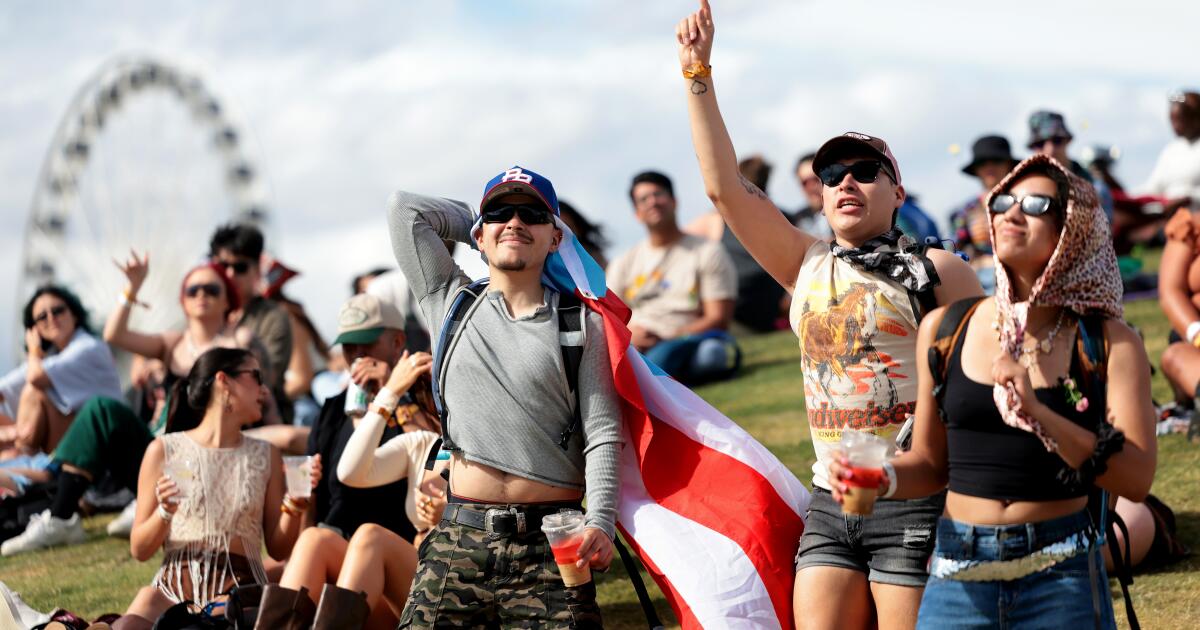
For a few days each April, the Coachella Valley Music and Arts Festival becomes a kind of center of gravity for the music industry and its surrounding ecosystems. On the ground, for most of the roughly 125,000 people there each weekend, it’s still functionally a traditional festival, shaped by the sets you catch, the friends you’re with, and discoveries you stumble onto. The dominant image of Coachella as a teeming court of celebrities and influencers is less reality than distortion, itself a byproduct of the version of Coachella defined by what gets captured, circulated and remembered afterward. Weekend 1, in that sense, isn’t simply the start of the festival but a point of transmission from which Coachella is translated into something for the rest of the world to consume.

Ommi, left, and Leah, center, dance in GV Black’s “Party in my Living Room” at Coachella.
(Christina House / Los Angeles Times)
Weekend 2: The festival
Upon my return on Weekend 2, it doesn’t take much for a fellow journalist friend and me to fall out of Coachella’s orbit of constant documentation. Just a couple of dead phones. It’s Saturday night, our reporting for the day is done, and we’ve got no signal, no camera and no way of monitoring the schedule or meeting up with friends. We forgo charging our phones at the Amex Experience Lounge in favor of drifting into a couple of the smaller dance tents away from the spectacle of the main stages. In lieu of towering screens and moments concocted for capture, we find a packed dance floor and the silhouettes of two DJs putting in the work. We dance, we chat with strangers, we dance with strangers. No one seems in a hurry to be anywhere else. No one is looking at their phones.
For the rest of the night, we encounter that feeling wherever we go, a throughline that has permeated Coachella’s second weekend since it was introduced in 2012. It’s why my friend and I always try to come back — to check out what we couldn’t while covering Weekend 1, and experience more of a festival than a broadcast. By Weekend 2, most of the heavy lifting has been done, expectations shaped, narratives set, content circulated. In its wake is something looser and less surveiled, if no less intentional. Performances are more relaxed and artists are more playful; the sound is dialed in. The crowd is different too — less polished and more interested in seeing music than being seen. “Weekend 2 is for the heads” is a common refrain.
This year, however, even that distinction began to blur a little. Weekend 2, historically the twin that nobody quite pays attention to, no longer carried the air of an afterthought or a well-kept secret. Yes, the crowd still skewed toward the heads, but it also felt noticeably denser, more alert and aware of itself. Part of that is likely the result of a week’s worth of buildup: livestream highlights, viral clips and a subsequently creeping FOMO that pushed many an attendee to cave to the secondary market for last-minute tickets.
Most notably, many of the festival’s biggest surprises (see: Madonna, Billie Eilish, Billy Idol, Olivia Rodrigo, Snoop Dogg) didn’t happen until the second weekend. It’s a total inversion of past years, when guest appearances were the hallmark of Weekend 1, in turn giving Weekend 2 a sense of novelty and momentum that no longer felt, well, just for the heads.
Perhaps that’s the next phase of Coachella’s mitosis: Weekend 1 determines how Coachella is seen, and Weekend 2 is where that attention is extended, maybe even reshaped.

Karol G performs at the Coachella stage April 12 on Weekend 1 of the Coachella Valley Music and Arts Festival at the Empire Polo Club in Indio.
(Christina House / Los Angeles Times)
The livestream
Back home in L.A., I sink into my couch and fire up Coachella’s YouTube channel, revisiting my favorites and filling in the gaps of what I missed; even after attending both weekends, it’s still impossible to see it all. But even if one could, the Coachella that exists on YouTube is now squarely some other third thing. It’s not that it feels inaccurate or, with the exception of Anyma’s livestream-conjured hologram, dishonest to the IRL experience. It’s more like the difference between being on the set of a film or documentary versus watching the final product. The production value — the caliber of cameras and the direction alone — is spectacular. God, I wish they would put this out as a film, I find myself thinking. Visually speaking, it’s tighter and more legible than it could ever possibly feel from the field. Little details impossible to see even from the front row — fingers triggering thunderous beats from a drum machine, the sweat beading on an artist’s forehead — are intercut rhythmically with sweeping wide shots that reveal dramatic lighting schemes and enraptured masses. There’s narrative, and pacing and drama.
It’s not that you can’t see all this at Coachella. Most stages feature the same camerawork in real time on their flanking screens, but that tends to feel more distracting if you’re up close — especially as the videographers are now nearly as present onstage as the artists — and purely functional if you’re somewhere in the back. But from the comfort of my couch, Coachella (YouTube’s version) is something greater than the sum of its parts. I am captivated by sets that failed to move me in person. I feel nostalgic for sets I never saw at all.
For a few years now, but this year in particular, I’ve been noticing that many of the festival’s biggest sets feel designed with this livestream-first version of Coachella in mind. Elaborate stages are built for the camera close-ups as much as the crowd, often featuring prefab cinematic interludes, ornately detailed costumes, titillating dance moves and surreal, maximalist graphics. They’re moments calibrated to read clearly on a screen. From the field, that doesn’t always translate well, as evidenced by the backlash headliner Sabrina Carpenter received for her set’s seven-minute theatrical monologue by Susan Sarandon — baffling in the first place — that became even more baffling when no one in the audience could make out what she was saying. But it was crystal clear on the livestream. Sometimes the stream doesn’t just show you the performance but reveals the version it was built to be.
For most people, this is Coachella now. It’s not a place, but a mass televisual event reaching a global audience of millions, far eclipsing the 125,000 on the ground each weekend. The numbers are still out for 2026, but it’s safe to say that they were big enough to thrust Coachella to the forefront of the cultural conversation in an unprecedented way. Coachella and its headliners far surpassed major news events like the Artemis II landing and the Iran war in topical engagement on social media, according to data from the communications firm Magnitude Media, splintering across platforms as different audiences organized around different versions of the same event.
The livestream isn’t simply a concert feed for those unable to attend. It interprets Coachella as a cultural event, deciding what matters, where to look, and how the festival is ultimately remembered. Sometimes that means getting something more complete and thrilling than what you’d experience in person. Sometimes it flattens the experience into palatable passive consumption. At this point, YouTube is basically TV, and Coachella plays like one of its biggest annual broadcasts, programmed, paced and consumed accordingly.

Fans watch Justin Beiber perform at the Coachella stage April 11 on Weekend 1 of the Coachella Valley Music and Arts Festival.
(Christina House / Los Angeles Times)
The shape of Coachellas to come
Along the way, the YouTube livestream is becoming something closer to a central version of Coachella itself. If Weekend 1 generates the moments and Weekend 2 extends them, the livestream is where they reach their widest audience.
Together, they start to look less like a single festival and more like a system.
This evolution isn’t accidental or opportunistic. In the wake of a burst festival bubble, a music industry in flux and the broader consolidation of media and entertainment, Coachella has had to adapt, both in order to sustain itself and to keep pace with how we now consume and relate to culture. Increasingly, that happens through platforms and feeds that reward constant attention, the steady production of shareable content and by “meeting the audience where they’re at.”
Still, some of the most standout moments at Coachella 2026 seemed almost indifferent to that logic, suggesting that — as music is wont to do — a countercurrent may be bubbling up. Sets from upstarts like Creepy Nuts, Pawsa, Geese and Slayyyter, along with emphatic crowds at rock heavyweights like Jack White, Turnstile and even Sombr, traded seamlessness and precision for immediacy and friction — louder, looser, more physical in ways that were best felt than watched. The same could even be extended to Bieber’s set, whose lo-fi flouting of traditional Coachella spectacle seemed to play with that tension directly. In a moment when AI and digital technology allows for on-demand perfection, there’s a creeping thrill to the possibility of flaws and dissonance.
But even that pull toward something messier and more immediate doesn’t sit outside the festival so much as become another version of it. As attention splinters and our realities feel increasingly fractured, it makes sense that Coachella would begin to mirror that condition, each version just real enough to feel like the whole thing.

By the time electronic producer-DJ Anyma debuted his ÆDEN World Tour on Weekend 2 of Coachella 2026, his set had already taken on multiple forms. One version — the one that had been scheduled for Weekend 1 — never happened, canceled before it could become part of the official narrative. In its place were a few other things: a joint message from the artist and Coachella producers Goldenvoice citing high winds and safety concerns; a weary crowd scattering from the main stage to the exit; apoplectic tweets and TikTok takes proliferating across social media; and a livestream audience that had already moved on. What would unfold in the space a week later felt less like just a performance than a confluence of those competing versions, a set shaped as much by his Weekend 1 absence, the prism of the livestream and online discourse of what was actually happening onstage.
What it also made clear is that Coachella is no longer a single cultural event but several overlapping ones divided across weekends, refracted through screens and increasingly calibrated for different audiences altogether. In its nearly three-decade evolution from DIY subcultural gathering to global behemoth, Coachella has not just expanded but split: Weekend 1, Weekend 2, and the YouTube livestream.
Adam Rey, 30, from left, Lilia Souri, 29, Brian Lin, 30, and Melody Iro 29, dance to Addison Rae’s performance April 11 at the Coachella Stage during the Coachella Valley Music and Arts Festival at the Empire Polo Club.
(Kayla Bartkowski / Los Angeles Times)
Weekend 1: The content engine
Walking the site on Friday evening Weekend 1, it dawned on me just how much being at Coachella felt kind of like being on the internet in real life — hopping from one genre and crowd to another like a playlist on shuffle, taking in one dopamine-inducing visual after another, while brand activations vied for my attention along the way like so many pop-up ads. I was strolling, rather than scrolling, the feed.
I say this not as a critique — and to be clear, reception on site is terrible, so it’s very hard to be on the actual internet there — but as an example of how, year after year, Coachella doubles as a reflection of how we as a society consume and relate to culture.
Since Coachella’s tandem cultural ascent with social media and the influencer in the 2010s, Weekend 1 has increasingly functioned less as a traditional festival and more as a kind of content engine. It not only generates headlines and moments that travel far beyond the Empire Polo Club, but serves as a microcosm of the attention economy underpinning the broader media and entertainment landscape. Creators pose before aesthetically pleasing backdrops for brand partnerships. Activations — from banks to big tech, booze to beauty products — beckon attendees with the siren call of air conditioning and free WiFi, trading comfort for content and brand loyalty. Media outlets deploy squads of writers, videographers and social editors to produce a steady stream of clips and dispatches, the kind of coverage that now determines their relevance as much as their reporting.
For artists, Weekend 1 functions as something like up-fronts for a music industry increasingly propped up by a kind of live experience arms race. It’s where they promote new releases and merch, premiere new tour productions and, among the most savvy performers, engineer at least one moment that everyone will be talking about the next day. Justin Bieber understood that golden rule instinctively when he performed off of his laptop Weekend 1, turning a relatively brief portion of his set into both a commercial for YouTube and a performance-defining image that circulated far more quickly than the performance itself. Two weeks later, his streams are still spiking, with record-smashing numbers typically reserved for Super Bowl halftime headliners.
It makes sense. As one fellow music journalist recently said to me, “Coachella is the only music festival that’s also a spectator sport.” I even heard about bars hosting watch parties.
For a few days each April, the Coachella Valley Music and Arts Festival becomes a kind of center of gravity for the music industry and its surrounding ecosystems. On the ground, for most of the roughly 125,000 people there each weekend, it’s still functionally a traditional festival, shaped by the sets you catch, the friends you’re with, and discoveries you stumble onto. The dominant image of Coachella as a teeming court of celebrities and influencers is less reality than distortion, itself a byproduct of the version of Coachella defined by what gets captured, circulated and remembered afterward. Weekend 1, in that sense, isn’t simply the start of the festival but a point of transmission from which Coachella is translated into something for the rest of the world to consume.
Ommi, left, and Leah, center, dance in GV Black’s “Party in my Living Room” at Coachella.
(Christina House / Los Angeles Times)
Weekend 2: The festival
Upon my return on Weekend 2, it doesn’t take much for a fellow journalist friend and me to fall out of Coachella’s orbit of constant documentation. Just a couple of dead phones. It’s Saturday night, our reporting for the day is done, and we’ve got no signal, no camera and no way of monitoring the schedule or meeting up with friends. We forgo charging our phones at the Amex Experience Lounge in favor of drifting into a couple of the smaller dance tents away from the spectacle of the main stages. In lieu of towering screens and moments concocted for capture, we find a packed dance floor and the silhouettes of two DJs putting in the work. We dance, we chat with strangers, we dance with strangers. No one seems in a hurry to be anywhere else. No one is looking at their phones.
For the rest of the night, we encounter that feeling wherever we go, a throughline that has permeated Coachella’s second weekend since it was introduced in 2012. It’s why my friend and I always try to come back — to check out what we couldn’t while covering Weekend 1, and experience more of a festival than a broadcast. By Weekend 2, most of the heavy lifting has been done, expectations shaped, narratives set, content circulated. In its wake is something looser and less surveiled, if no less intentional. Performances are more relaxed and artists are more playful; the sound is dialed in. The crowd is different too — less polished and more interested in seeing music than being seen. “Weekend 2 is for the heads” is a common refrain.
This year, however, even that distinction began to blur a little. Weekend 2, historically the twin that nobody quite pays attention to, no longer carried the air of an afterthought or a well-kept secret. Yes, the crowd still skewed toward the heads, but it also felt noticeably denser, more alert and aware of itself. Part of that is likely the result of a week’s worth of buildup: livestream highlights, viral clips and a subsequently creeping FOMO that pushed many an attendee to cave to the secondary market for last-minute tickets.
Most notably, many of the festival’s biggest surprises (see: Madonna, Billie Eilish, Billy Idol, Olivia Rodrigo, Snoop Dogg) didn’t happen until the second weekend. It’s a total inversion of past years, when guest appearances were the hallmark of Weekend 1, in turn giving Weekend 2 a sense of novelty and momentum that no longer felt, well, just for the heads.
Perhaps that’s the next phase of Coachella’s mitosis: Weekend 1 determines how Coachella is seen, and Weekend 2 is where that attention is extended, maybe even reshaped.
Karol G performs at the Coachella stage April 12 on Weekend 1 of the Coachella Valley Music and Arts Festival at the Empire Polo Club in Indio.
(Christina House / Los Angeles Times)
The livestream
Back home in L.A., I sink into my couch and fire up Coachella’s YouTube channel, revisiting my favorites and filling in the gaps of what I missed; even after attending both weekends, it’s still impossible to see it all. But even if one could, the Coachella that exists on YouTube is now squarely some other third thing. It’s not that it feels inaccurate or, with the exception of Anyma’s livestream-conjured hologram, dishonest to the IRL experience. It’s more like the difference between being on the set of a film or documentary versus watching the final product. The production value — the caliber of cameras and the direction alone — is spectacular. God, I wish they would put this out as a film, I find myself thinking. Visually speaking, it’s tighter and more legible than it could ever possibly feel from the field. Little details impossible to see even from the front row — fingers triggering thunderous beats from a drum machine, the sweat beading on an artist’s forehead — are intercut rhythmically with sweeping wide shots that reveal dramatic lighting schemes and enraptured masses. There’s narrative, and pacing and drama.
It’s not that you can’t see all this at Coachella. Most stages feature the same camerawork in real time on their flanking screens, but that tends to feel more distracting if you’re up close — especially as the videographers are now nearly as present onstage as the artists — and purely functional if you’re somewhere in the back. But from the comfort of my couch, Coachella (YouTube’s version) is something greater than the sum of its parts. I am captivated by sets that failed to move me in person. I feel nostalgic for sets I never saw at all.
For a few years now, but this year in particular, I’ve been noticing that many of the festival’s biggest sets feel designed with this livestream-first version of Coachella in mind. Elaborate stages are built for the camera close-ups as much as the crowd, often featuring prefab cinematic interludes, ornately detailed costumes, titillating dance moves and surreal, maximalist graphics. They’re moments calibrated to read clearly on a screen. From the field, that doesn’t always translate well, as evidenced by the backlash headliner Sabrina Carpenter received for her set’s seven-minute theatrical monologue by Susan Sarandon — baffling in the first place — that became even more baffling when no one in the audience could make out what she was saying. But it was crystal clear on the livestream. Sometimes the stream doesn’t just show you the performance but reveals the version it was built to be.
For most people, this is Coachella now. It’s not a place, but a mass televisual event reaching a global audience of millions, far eclipsing the 125,000 on the ground each weekend. The numbers are still out for 2026, but it’s safe to say that they were big enough to thrust Coachella to the forefront of the cultural conversation in an unprecedented way. Coachella and its headliners far surpassed major news events like the Artemis II landing and the Iran war in topical engagement on social media, according to data from the communications firm Magnitude Media, splintering across platforms as different audiences organized around different versions of the same event.
The livestream isn’t simply a concert feed for those unable to attend. It interprets Coachella as a cultural event, deciding what matters, where to look, and how the festival is ultimately remembered. Sometimes that means getting something more complete and thrilling than what you’d experience in person. Sometimes it flattens the experience into palatable passive consumption. At this point, YouTube is basically TV, and Coachella plays like one of its biggest annual broadcasts, programmed, paced and consumed accordingly.
Fans watch Justin Beiber perform at the Coachella stage April 11 on Weekend 1 of the Coachella Valley Music and Arts Festival.
(Christina House / Los Angeles Times)
The shape of Coachellas to come
Along the way, the YouTube livestream is becoming something closer to a central version of Coachella itself. If Weekend 1 generates the moments and Weekend 2 extends them, the livestream is where they reach their widest audience.
Together, they start to look less like a single festival and more like a system.
This evolution isn’t accidental or opportunistic. In the wake of a burst festival bubble, a music industry in flux and the broader consolidation of media and entertainment, Coachella has had to adapt, both in order to sustain itself and to keep pace with how we now consume and relate to culture. Increasingly, that happens through platforms and feeds that reward constant attention, the steady production of shareable content and by “meeting the audience where they’re at.”
Still, some of the most standout moments at Coachella 2026 seemed almost indifferent to that logic, suggesting that — as music is wont to do — a countercurrent may be bubbling up. Sets from upstarts like Creepy Nuts, Pawsa, Geese and Slayyyter, along with emphatic crowds at rock heavyweights like Jack White, Turnstile and even Sombr, traded seamlessness and precision for immediacy and friction — louder, looser, more physical in ways that were best felt than watched. The same could even be extended to Bieber’s set, whose lo-fi flouting of traditional Coachella spectacle seemed to play with that tension directly. In a moment when AI and digital technology allows for on-demand perfection, there’s a creeping thrill to the possibility of flaws and dissonance.
But even that pull toward something messier and more immediate doesn’t sit outside the festival so much as become another version of it. As attention splinters and our realities feel increasingly fractured, it makes sense that Coachella would begin to mirror that condition, each version just real enough to feel like the whole thing.

By the time electronic producer-DJ Anyma debuted his ÆDEN World Tour on Weekend 2 of Coachella 2026, his set had already taken on multiple forms. One version — the one that had been scheduled for Weekend 1 — never happened, canceled before it could become part of the official narrative. In its place were a few other things: a joint message from the artist and Coachella producers Goldenvoice citing high winds and safety concerns; a weary crowd scattering from the main stage to the exit; apoplectic tweets and TikTok takes proliferating across social media; and a livestream audience that had already moved on. What would unfold in the space a week later felt less like just a performance than a confluence of those competing versions, a set shaped as much by his Weekend 1 absence, the prism of the livestream and online discourse of what was actually happening onstage.
What it also made clear is that Coachella is no longer a single cultural event but several overlapping ones divided across weekends, refracted through screens and increasingly calibrated for different audiences altogether. In its nearly three-decade evolution from DIY subcultural gathering to global behemoth, Coachella has not just expanded but split: Weekend 1, Weekend 2, and the YouTube livestream.
Adam Rey, 30, from left, Lilia Souri, 29, Brian Lin, 30, and Melody Iro 29, dance to Addison Rae’s performance April 11 at the Coachella Stage during the Coachella Valley Music and Arts Festival at the Empire Polo Club.
(Kayla Bartkowski / Los Angeles Times)
Weekend 1: The content engine
Walking the site on Friday evening Weekend 1, it dawned on me just how much being at Coachella felt kind of like being on the internet in real life — hopping from one genre and crowd to another like a playlist on shuffle, taking in one dopamine-inducing visual after another, while brand activations vied for my attention along the way like so many pop-up ads. I was strolling, rather than scrolling, the feed.
I say this not as a critique — and to be clear, reception on site is terrible, so it’s very hard to be on the actual internet there — but as an example of how, year after year, Coachella doubles as a reflection of how we as a society consume and relate to culture.
Since Coachella’s tandem cultural ascent with social media and the influencer in the 2010s, Weekend 1 has increasingly functioned less as a traditional festival and more as a kind of content engine. It not only generates headlines and moments that travel far beyond the Empire Polo Club, but serves as a microcosm of the attention economy underpinning the broader media and entertainment landscape. Creators pose before aesthetically pleasing backdrops for brand partnerships. Activations — from banks to big tech, booze to beauty products — beckon attendees with the siren call of air conditioning and free WiFi, trading comfort for content and brand loyalty. Media outlets deploy squads of writers, videographers and social editors to produce a steady stream of clips and dispatches, the kind of coverage that now determines their relevance as much as their reporting.
For artists, Weekend 1 functions as something like up-fronts for a music industry increasingly propped up by a kind of live experience arms race. It’s where they promote new releases and merch, premiere new tour productions and, among the most savvy performers, engineer at least one moment that everyone will be talking about the next day. Justin Bieber understood that golden rule instinctively when he performed off of his laptop Weekend 1, turning a relatively brief portion of his set into both a commercial for YouTube and a performance-defining image that circulated far more quickly than the performance itself. Two weeks later, his streams are still spiking, with record-smashing numbers typically reserved for Super Bowl halftime headliners.
It makes sense. As one fellow music journalist recently said to me, “Coachella is the only music festival that’s also a spectator sport.” I even heard about bars hosting watch parties.
For a few days each April, the Coachella Valley Music and Arts Festival becomes a kind of center of gravity for the music industry and its surrounding ecosystems. On the ground, for most of the roughly 125,000 people there each weekend, it’s still functionally a traditional festival, shaped by the sets you catch, the friends you’re with, and discoveries you stumble onto. The dominant image of Coachella as a teeming court of celebrities and influencers is less reality than distortion, itself a byproduct of the version of Coachella defined by what gets captured, circulated and remembered afterward. Weekend 1, in that sense, isn’t simply the start of the festival but a point of transmission from which Coachella is translated into something for the rest of the world to consume.
Ommi, left, and Leah, center, dance in GV Black’s “Party in my Living Room” at Coachella.
(Christina House / Los Angeles Times)
Weekend 2: The festival
Upon my return on Weekend 2, it doesn’t take much for a fellow journalist friend and me to fall out of Coachella’s orbit of constant documentation. Just a couple of dead phones. It’s Saturday night, our reporting for the day is done, and we’ve got no signal, no camera and no way of monitoring the schedule or meeting up with friends. We forgo charging our phones at the Amex Experience Lounge in favor of drifting into a couple of the smaller dance tents away from the spectacle of the main stages. In lieu of towering screens and moments concocted for capture, we find a packed dance floor and the silhouettes of two DJs putting in the work. We dance, we chat with strangers, we dance with strangers. No one seems in a hurry to be anywhere else. No one is looking at their phones.
For the rest of the night, we encounter that feeling wherever we go, a throughline that has permeated Coachella’s second weekend since it was introduced in 2012. It’s why my friend and I always try to come back — to check out what we couldn’t while covering Weekend 1, and experience more of a festival than a broadcast. By Weekend 2, most of the heavy lifting has been done, expectations shaped, narratives set, content circulated. In its wake is something looser and less surveiled, if no less intentional. Performances are more relaxed and artists are more playful; the sound is dialed in. The crowd is different too — less polished and more interested in seeing music than being seen. “Weekend 2 is for the heads” is a common refrain.
This year, however, even that distinction began to blur a little. Weekend 2, historically the twin that nobody quite pays attention to, no longer carried the air of an afterthought or a well-kept secret. Yes, the crowd still skewed toward the heads, but it also felt noticeably denser, more alert and aware of itself. Part of that is likely the result of a week’s worth of buildup: livestream highlights, viral clips and a subsequently creeping FOMO that pushed many an attendee to cave to the secondary market for last-minute tickets.
Most notably, many of the festival’s biggest surprises (see: Madonna, Billie Eilish, Billy Idol, Olivia Rodrigo, Snoop Dogg) didn’t happen until the second weekend. It’s a total inversion of past years, when guest appearances were the hallmark of Weekend 1, in turn giving Weekend 2 a sense of novelty and momentum that no longer felt, well, just for the heads.
Perhaps that’s the next phase of Coachella’s mitosis: Weekend 1 determines how Coachella is seen, and Weekend 2 is where that attention is extended, maybe even reshaped.
Karol G performs at the Coachella stage April 12 on Weekend 1 of the Coachella Valley Music and Arts Festival at the Empire Polo Club in Indio.
(Christina House / Los Angeles Times)
The livestream
Back home in L.A., I sink into my couch and fire up Coachella’s YouTube channel, revisiting my favorites and filling in the gaps of what I missed; even after attending both weekends, it’s still impossible to see it all. But even if one could, the Coachella that exists on YouTube is now squarely some other third thing. It’s not that it feels inaccurate or, with the exception of Anyma’s livestream-conjured hologram, dishonest to the IRL experience. It’s more like the difference between being on the set of a film or documentary versus watching the final product. The production value — the caliber of cameras and the direction alone — is spectacular. God, I wish they would put this out as a film, I find myself thinking. Visually speaking, it’s tighter and more legible than it could ever possibly feel from the field. Little details impossible to see even from the front row — fingers triggering thunderous beats from a drum machine, the sweat beading on an artist’s forehead — are intercut rhythmically with sweeping wide shots that reveal dramatic lighting schemes and enraptured masses. There’s narrative, and pacing and drama.
It’s not that you can’t see all this at Coachella. Most stages feature the same camerawork in real time on their flanking screens, but that tends to feel more distracting if you’re up close — especially as the videographers are now nearly as present onstage as the artists — and purely functional if you’re somewhere in the back. But from the comfort of my couch, Coachella (YouTube’s version) is something greater than the sum of its parts. I am captivated by sets that failed to move me in person. I feel nostalgic for sets I never saw at all.
For a few years now, but this year in particular, I’ve been noticing that many of the festival’s biggest sets feel designed with this livestream-first version of Coachella in mind. Elaborate stages are built for the camera close-ups as much as the crowd, often featuring prefab cinematic interludes, ornately detailed costumes, titillating dance moves and surreal, maximalist graphics. They’re moments calibrated to read clearly on a screen. From the field, that doesn’t always translate well, as evidenced by the backlash headliner Sabrina Carpenter received for her set’s seven-minute theatrical monologue by Susan Sarandon — baffling in the first place — that became even more baffling when no one in the audience could make out what she was saying. But it was crystal clear on the livestream. Sometimes the stream doesn’t just show you the performance but reveals the version it was built to be.
For most people, this is Coachella now. It’s not a place, but a mass televisual event reaching a global audience of millions, far eclipsing the 125,000 on the ground each weekend. The numbers are still out for 2026, but it’s safe to say that they were big enough to thrust Coachella to the forefront of the cultural conversation in an unprecedented way. Coachella and its headliners far surpassed major news events like the Artemis II landing and the Iran war in topical engagement on social media, according to data from the communications firm Magnitude Media, splintering across platforms as different audiences organized around different versions of the same event.
The livestream isn’t simply a concert feed for those unable to attend. It interprets Coachella as a cultural event, deciding what matters, where to look, and how the festival is ultimately remembered. Sometimes that means getting something more complete and thrilling than what you’d experience in person. Sometimes it flattens the experience into palatable passive consumption. At this point, YouTube is basically TV, and Coachella plays like one of its biggest annual broadcasts, programmed, paced and consumed accordingly.
Fans watch Justin Beiber perform at the Coachella stage April 11 on Weekend 1 of the Coachella Valley Music and Arts Festival.
(Christina House / Los Angeles Times)
The shape of Coachellas to come
Along the way, the YouTube livestream is becoming something closer to a central version of Coachella itself. If Weekend 1 generates the moments and Weekend 2 extends them, the livestream is where they reach their widest audience.
Together, they start to look less like a single festival and more like a system.
This evolution isn’t accidental or opportunistic. In the wake of a burst festival bubble, a music industry in flux and the broader consolidation of media and entertainment, Coachella has had to adapt, both in order to sustain itself and to keep pace with how we now consume and relate to culture. Increasingly, that happens through platforms and feeds that reward constant attention, the steady production of shareable content and by “meeting the audience where they’re at.”
Still, some of the most standout moments at Coachella 2026 seemed almost indifferent to that logic, suggesting that — as music is wont to do — a countercurrent may be bubbling up. Sets from upstarts like Creepy Nuts, Pawsa, Geese and Slayyyter, along with emphatic crowds at rock heavyweights like Jack White, Turnstile and even Sombr, traded seamlessness and precision for immediacy and friction — louder, looser, more physical in ways that were best felt than watched. The same could even be extended to Bieber’s set, whose lo-fi flouting of traditional Coachella spectacle seemed to play with that tension directly. In a moment when AI and digital technology allows for on-demand perfection, there’s a creeping thrill to the possibility of flaws and dissonance.
But even that pull toward something messier and more immediate doesn’t sit outside the festival so much as become another version of it. As attention splinters and our realities feel increasingly fractured, it makes sense that Coachella would begin to mirror that condition, each version just real enough to feel like the whole thing.
By the time electronic producer-DJ Anyma debuted his ÆDEN World Tour on Weekend 2 of Coachella 2026, his set had already taken on multiple forms. One version — the one that had been scheduled for Weekend 1 — never happened, canceled before it could become part of the official narrative. In its place were a few other things: a joint message from the artist and Coachella producers Goldenvoice citing high winds and safety concerns; a weary crowd scattering from the main stage to the exit; apoplectic tweets and TikTok takes proliferating across social media; and a livestream audience that had already moved on. What would unfold in the space a week later felt less like just a performance than a confluence of those competing versions, a set shaped as much by his Weekend 1 absence, the prism of the livestream and online discourse of what was actually happening onstage.
What it also made clear is that Coachella is no longer a single cultural event but several overlapping ones divided across weekends, refracted through screens and increasingly calibrated for different audiences altogether. In its nearly three-decade evolution from DIY subcultural gathering to global behemoth, Coachella has not just expanded but split: Weekend 1, Weekend 2, and the YouTube livestream.
Adam Rey, 30, from left, Lilia Souri, 29, Brian Lin, 30, and Melody Iro 29, dance to Addison Rae’s performance April 11 at the Coachella Stage during the Coachella Valley Music and Arts Festival at the Empire Polo Club.
(Kayla Bartkowski / Los Angeles Times)
Weekend 1: The content engine
Walking the site on Friday evening Weekend 1, it dawned on me just how much being at Coachella felt kind of like being on the internet in real life — hopping from one genre and crowd to another like a playlist on shuffle, taking in one dopamine-inducing visual after another, while brand activations vied for my attention along the way like so many pop-up ads. I was strolling, rather than scrolling, the feed.
I say this not as a critique — and to be clear, reception on site is terrible, so it’s very hard to be on the actual internet there — but as an example of how, year after year, Coachella doubles as a reflection of how we as a society consume and relate to culture.
Since Coachella’s tandem cultural ascent with social media and the influencer in the 2010s, Weekend 1 has increasingly functioned less as a traditional festival and more as a kind of content engine. It not only generates headlines and moments that travel far beyond the Empire Polo Club, but serves as a microcosm of the attention economy underpinning the broader media and entertainment landscape. Creators pose before aesthetically pleasing backdrops for brand partnerships. Activations — from banks to big tech, booze to beauty products — beckon attendees with the siren call of air conditioning and free WiFi, trading comfort for content and brand loyalty. Media outlets deploy squads of writers, videographers and social editors to produce a steady stream of clips and dispatches, the kind of coverage that now determines their relevance as much as their reporting.
For artists, Weekend 1 functions as something like up-fronts for a music industry increasingly propped up by a kind of live experience arms race. It’s where they promote new releases and merch, premiere new tour productions and, among the most savvy performers, engineer at least one moment that everyone will be talking about the next day. Justin Bieber understood that golden rule instinctively when he performed off of his laptop Weekend 1, turning a relatively brief portion of his set into both a commercial for YouTube and a performance-defining image that circulated far more quickly than the performance itself. Two weeks later, his streams are still spiking, with record-smashing numbers typically reserved for Super Bowl halftime headliners.
It makes sense. As one fellow music journalist recently said to me, “Coachella is the only music festival that’s also a spectator sport.” I even heard about bars hosting watch parties.
For a few days each April, the Coachella Valley Music and Arts Festival becomes a kind of center of gravity for the music industry and its surrounding ecosystems. On the ground, for most of the roughly 125,000 people there each weekend, it’s still functionally a traditional festival, shaped by the sets you catch, the friends you’re with, and discoveries you stumble onto. The dominant image of Coachella as a teeming court of celebrities and influencers is less reality than distortion, itself a byproduct of the version of Coachella defined by what gets captured, circulated and remembered afterward. Weekend 1, in that sense, isn’t simply the start of the festival but a point of transmission from which Coachella is translated into something for the rest of the world to consume.
Ommi, left, and Leah, center, dance in GV Black’s “Party in my Living Room” at Coachella.
(Christina House / Los Angeles Times)
Weekend 2: The festival
Upon my return on Weekend 2, it doesn’t take much for a fellow journalist friend and me to fall out of Coachella’s orbit of constant documentation. Just a couple of dead phones. It’s Saturday night, our reporting for the day is done, and we’ve got no signal, no camera and no way of monitoring the schedule or meeting up with friends. We forgo charging our phones at the Amex Experience Lounge in favor of drifting into a couple of the smaller dance tents away from the spectacle of the main stages. In lieu of towering screens and moments concocted for capture, we find a packed dance floor and the silhouettes of two DJs putting in the work. We dance, we chat with strangers, we dance with strangers. No one seems in a hurry to be anywhere else. No one is looking at their phones.
For the rest of the night, we encounter that feeling wherever we go, a throughline that has permeated Coachella’s second weekend since it was introduced in 2012. It’s why my friend and I always try to come back — to check out what we couldn’t while covering Weekend 1, and experience more of a festival than a broadcast. By Weekend 2, most of the heavy lifting has been done, expectations shaped, narratives set, content circulated. In its wake is something looser and less surveiled, if no less intentional. Performances are more relaxed and artists are more playful; the sound is dialed in. The crowd is different too — less polished and more interested in seeing music than being seen. “Weekend 2 is for the heads” is a common refrain.
This year, however, even that distinction began to blur a little. Weekend 2, historically the twin that nobody quite pays attention to, no longer carried the air of an afterthought or a well-kept secret. Yes, the crowd still skewed toward the heads, but it also felt noticeably denser, more alert and aware of itself. Part of that is likely the result of a week’s worth of buildup: livestream highlights, viral clips and a subsequently creeping FOMO that pushed many an attendee to cave to the secondary market for last-minute tickets.
Most notably, many of the festival’s biggest surprises (see: Madonna, Billie Eilish, Billy Idol, Olivia Rodrigo, Snoop Dogg) didn’t happen until the second weekend. It’s a total inversion of past years, when guest appearances were the hallmark of Weekend 1, in turn giving Weekend 2 a sense of novelty and momentum that no longer felt, well, just for the heads.
Perhaps that’s the next phase of Coachella’s mitosis: Weekend 1 determines how Coachella is seen, and Weekend 2 is where that attention is extended, maybe even reshaped.
Karol G performs at the Coachella stage April 12 on Weekend 1 of the Coachella Valley Music and Arts Festival at the Empire Polo Club in Indio.
(Christina House / Los Angeles Times)
The livestream
Back home in L.A., I sink into my couch and fire up Coachella’s YouTube channel, revisiting my favorites and filling in the gaps of what I missed; even after attending both weekends, it’s still impossible to see it all. But even if one could, the Coachella that exists on YouTube is now squarely some other third thing. It’s not that it feels inaccurate or, with the exception of Anyma’s livestream-conjured hologram, dishonest to the IRL experience. It’s more like the difference between being on the set of a film or documentary versus watching the final product. The production value — the caliber of cameras and the direction alone — is spectacular. God, I wish they would put this out as a film, I find myself thinking. Visually speaking, it’s tighter and more legible than it could ever possibly feel from the field. Little details impossible to see even from the front row — fingers triggering thunderous beats from a drum machine, the sweat beading on an artist’s forehead — are intercut rhythmically with sweeping wide shots that reveal dramatic lighting schemes and enraptured masses. There’s narrative, and pacing and drama.
It’s not that you can’t see all this at Coachella. Most stages feature the same camerawork in real time on their flanking screens, but that tends to feel more distracting if you’re up close — especially as the videographers are now nearly as present onstage as the artists — and purely functional if you’re somewhere in the back. But from the comfort of my couch, Coachella (YouTube’s version) is something greater than the sum of its parts. I am captivated by sets that failed to move me in person. I feel nostalgic for sets I never saw at all.
For a few years now, but this year in particular, I’ve been noticing that many of the festival’s biggest sets feel designed with this livestream-first version of Coachella in mind. Elaborate stages are built for the camera close-ups as much as the crowd, often featuring prefab cinematic interludes, ornately detailed costumes, titillating dance moves and surreal, maximalist graphics. They’re moments calibrated to read clearly on a screen. From the field, that doesn’t always translate well, as evidenced by the backlash headliner Sabrina Carpenter received for her set’s seven-minute theatrical monologue by Susan Sarandon — baffling in the first place — that became even more baffling when no one in the audience could make out what she was saying. But it was crystal clear on the livestream. Sometimes the stream doesn’t just show you the performance but reveals the version it was built to be.
For most people, this is Coachella now. It’s not a place, but a mass televisual event reaching a global audience of millions, far eclipsing the 125,000 on the ground each weekend. The numbers are still out for 2026, but it’s safe to say that they were big enough to thrust Coachella to the forefront of the cultural conversation in an unprecedented way. Coachella and its headliners far surpassed major news events like the Artemis II landing and the Iran war in topical engagement on social media, according to data from the communications firm Magnitude Media, splintering across platforms as different audiences organized around different versions of the same event.
The livestream isn’t simply a concert feed for those unable to attend. It interprets Coachella as a cultural event, deciding what matters, where to look, and how the festival is ultimately remembered. Sometimes that means getting something more complete and thrilling than what you’d experience in person. Sometimes it flattens the experience into palatable passive consumption. At this point, YouTube is basically TV, and Coachella plays like one of its biggest annual broadcasts, programmed, paced and consumed accordingly.
Fans watch Justin Beiber perform at the Coachella stage April 11 on Weekend 1 of the Coachella Valley Music and Arts Festival.
(Christina House / Los Angeles Times)
The shape of Coachellas to come
Along the way, the YouTube livestream is becoming something closer to a central version of Coachella itself. If Weekend 1 generates the moments and Weekend 2 extends them, the livestream is where they reach their widest audience.
Together, they start to look less like a single festival and more like a system.
This evolution isn’t accidental or opportunistic. In the wake of a burst festival bubble, a music industry in flux and the broader consolidation of media and entertainment, Coachella has had to adapt, both in order to sustain itself and to keep pace with how we now consume and relate to culture. Increasingly, that happens through platforms and feeds that reward constant attention, the steady production of shareable content and by “meeting the audience where they’re at.”
Still, some of the most standout moments at Coachella 2026 seemed almost indifferent to that logic, suggesting that — as music is wont to do — a countercurrent may be bubbling up. Sets from upstarts like Creepy Nuts, Pawsa, Geese and Slayyyter, along with emphatic crowds at rock heavyweights like Jack White, Turnstile and even Sombr, traded seamlessness and precision for immediacy and friction — louder, looser, more physical in ways that were best felt than watched. The same could even be extended to Bieber’s set, whose lo-fi flouting of traditional Coachella spectacle seemed to play with that tension directly. In a moment when AI and digital technology allows for on-demand perfection, there’s a creeping thrill to the possibility of flaws and dissonance.
But even that pull toward something messier and more immediate doesn’t sit outside the festival so much as become another version of it. As attention splinters and our realities feel increasingly fractured, it makes sense that Coachella would begin to mirror that condition, each version just real enough to feel like the whole thing.

By the time electronic producer-DJ Anyma debuted his ÆDEN World Tour on Weekend 2 of Coachella 2026, his set had already taken on multiple forms. One version — the one that had been scheduled for Weekend 1 — never happened, canceled before it could become part of the official narrative. In its place were a few other things: a joint message from the artist and Coachella producers Goldenvoice citing high winds and safety concerns; a weary crowd scattering from the main stage to the exit; apoplectic tweets and TikTok takes proliferating across social media; and a livestream audience that had already moved on. What would unfold in the space a week later felt less like just a performance than a confluence of those competing versions, a set shaped as much by his Weekend 1 absence, the prism of the livestream and online discourse of what was actually happening onstage.
What it also made clear is that Coachella is no longer a single cultural event but several overlapping ones divided across weekends, refracted through screens and increasingly calibrated for different audiences altogether. In its nearly three-decade evolution from DIY subcultural gathering to global behemoth, Coachella has not just expanded but split: Weekend 1, Weekend 2, and the YouTube livestream.
Adam Rey, 30, from left, Lilia Souri, 29, Brian Lin, 30, and Melody Iro 29, dance to Addison Rae’s performance April 11 at the Coachella Stage during the Coachella Valley Music and Arts Festival at the Empire Polo Club.
(Kayla Bartkowski / Los Angeles Times)
Weekend 1: The content engine
Walking the site on Friday evening Weekend 1, it dawned on me just how much being at Coachella felt kind of like being on the internet in real life — hopping from one genre and crowd to another like a playlist on shuffle, taking in one dopamine-inducing visual after another, while brand activations vied for my attention along the way like so many pop-up ads. I was strolling, rather than scrolling, the feed.
I say this not as a critique — and to be clear, reception on site is terrible, so it’s very hard to be on the actual internet there — but as an example of how, year after year, Coachella doubles as a reflection of how we as a society consume and relate to culture.
Since Coachella’s tandem cultural ascent with social media and the influencer in the 2010s, Weekend 1 has increasingly functioned less as a traditional festival and more as a kind of content engine. It not only generates headlines and moments that travel far beyond the Empire Polo Club, but serves as a microcosm of the attention economy underpinning the broader media and entertainment landscape. Creators pose before aesthetically pleasing backdrops for brand partnerships. Activations — from banks to big tech, booze to beauty products — beckon attendees with the siren call of air conditioning and free WiFi, trading comfort for content and brand loyalty. Media outlets deploy squads of writers, videographers and social editors to produce a steady stream of clips and dispatches, the kind of coverage that now determines their relevance as much as their reporting.
For artists, Weekend 1 functions as something like up-fronts for a music industry increasingly propped up by a kind of live experience arms race. It’s where they promote new releases and merch, premiere new tour productions and, among the most savvy performers, engineer at least one moment that everyone will be talking about the next day. Justin Bieber understood that golden rule instinctively when he performed off of his laptop Weekend 1, turning a relatively brief portion of his set into both a commercial for YouTube and a performance-defining image that circulated far more quickly than the performance itself. Two weeks later, his streams are still spiking, with record-smashing numbers typically reserved for Super Bowl halftime headliners.
It makes sense. As one fellow music journalist recently said to me, “Coachella is the only music festival that’s also a spectator sport.” I even heard about bars hosting watch parties.
For a few days each April, the Coachella Valley Music and Arts Festival becomes a kind of center of gravity for the music industry and its surrounding ecosystems. On the ground, for most of the roughly 125,000 people there each weekend, it’s still functionally a traditional festival, shaped by the sets you catch, the friends you’re with, and discoveries you stumble onto. The dominant image of Coachella as a teeming court of celebrities and influencers is less reality than distortion, itself a byproduct of the version of Coachella defined by what gets captured, circulated and remembered afterward. Weekend 1, in that sense, isn’t simply the start of the festival but a point of transmission from which Coachella is translated into something for the rest of the world to consume.
Ommi, left, and Leah, center, dance in GV Black’s “Party in my Living Room” at Coachella.
(Christina House / Los Angeles Times)
Weekend 2: The festival
Upon my return on Weekend 2, it doesn’t take much for a fellow journalist friend and me to fall out of Coachella’s orbit of constant documentation. Just a couple of dead phones. It’s Saturday night, our reporting for the day is done, and we’ve got no signal, no camera and no way of monitoring the schedule or meeting up with friends. We forgo charging our phones at the Amex Experience Lounge in favor of drifting into a couple of the smaller dance tents away from the spectacle of the main stages. In lieu of towering screens and moments concocted for capture, we find a packed dance floor and the silhouettes of two DJs putting in the work. We dance, we chat with strangers, we dance with strangers. No one seems in a hurry to be anywhere else. No one is looking at their phones.
For the rest of the night, we encounter that feeling wherever we go, a throughline that has permeated Coachella’s second weekend since it was introduced in 2012. It’s why my friend and I always try to come back — to check out what we couldn’t while covering Weekend 1, and experience more of a festival than a broadcast. By Weekend 2, most of the heavy lifting has been done, expectations shaped, narratives set, content circulated. In its wake is something looser and less surveiled, if no less intentional. Performances are more relaxed and artists are more playful; the sound is dialed in. The crowd is different too — less polished and more interested in seeing music than being seen. “Weekend 2 is for the heads” is a common refrain.
This year, however, even that distinction began to blur a little. Weekend 2, historically the twin that nobody quite pays attention to, no longer carried the air of an afterthought or a well-kept secret. Yes, the crowd still skewed toward the heads, but it also felt noticeably denser, more alert and aware of itself. Part of that is likely the result of a week’s worth of buildup: livestream highlights, viral clips and a subsequently creeping FOMO that pushed many an attendee to cave to the secondary market for last-minute tickets.
Most notably, many of the festival’s biggest surprises (see: Madonna, Billie Eilish, Billy Idol, Olivia Rodrigo, Snoop Dogg) didn’t happen until the second weekend. It’s a total inversion of past years, when guest appearances were the hallmark of Weekend 1, in turn giving Weekend 2 a sense of novelty and momentum that no longer felt, well, just for the heads.
Perhaps that’s the next phase of Coachella’s mitosis: Weekend 1 determines how Coachella is seen, and Weekend 2 is where that attention is extended, maybe even reshaped.
Karol G performs at the Coachella stage April 12 on Weekend 1 of the Coachella Valley Music and Arts Festival at the Empire Polo Club in Indio.
(Christina House / Los Angeles Times)
The livestream
Back home in L.A., I sink into my couch and fire up Coachella’s YouTube channel, revisiting my favorites and filling in the gaps of what I missed; even after attending both weekends, it’s still impossible to see it all. But even if one could, the Coachella that exists on YouTube is now squarely some other third thing. It’s not that it feels inaccurate or, with the exception of Anyma’s livestream-conjured hologram, dishonest to the IRL experience. It’s more like the difference between being on the set of a film or documentary versus watching the final product. The production value — the caliber of cameras and the direction alone — is spectacular. God, I wish they would put this out as a film, I find myself thinking. Visually speaking, it’s tighter and more legible than it could ever possibly feel from the field. Little details impossible to see even from the front row — fingers triggering thunderous beats from a drum machine, the sweat beading on an artist’s forehead — are intercut rhythmically with sweeping wide shots that reveal dramatic lighting schemes and enraptured masses. There’s narrative, and pacing and drama.
It’s not that you can’t see all this at Coachella. Most stages feature the same camerawork in real time on their flanking screens, but that tends to feel more distracting if you’re up close — especially as the videographers are now nearly as present onstage as the artists — and purely functional if you’re somewhere in the back. But from the comfort of my couch, Coachella (YouTube’s version) is something greater than the sum of its parts. I am captivated by sets that failed to move me in person. I feel nostalgic for sets I never saw at all.
For a few years now, but this year in particular, I’ve been noticing that many of the festival’s biggest sets feel designed with this livestream-first version of Coachella in mind. Elaborate stages are built for the camera close-ups as much as the crowd, often featuring prefab cinematic interludes, ornately detailed costumes, titillating dance moves and surreal, maximalist graphics. They’re moments calibrated to read clearly on a screen. From the field, that doesn’t always translate well, as evidenced by the backlash headliner Sabrina Carpenter received for her set’s seven-minute theatrical monologue by Susan Sarandon — baffling in the first place — that became even more baffling when no one in the audience could make out what she was saying. But it was crystal clear on the livestream. Sometimes the stream doesn’t just show you the performance but reveals the version it was built to be.
For most people, this is Coachella now. It’s not a place, but a mass televisual event reaching a global audience of millions, far eclipsing the 125,000 on the ground each weekend. The numbers are still out for 2026, but it’s safe to say that they were big enough to thrust Coachella to the forefront of the cultural conversation in an unprecedented way. Coachella and its headliners far surpassed major news events like the Artemis II landing and the Iran war in topical engagement on social media, according to data from the communications firm Magnitude Media, splintering across platforms as different audiences organized around different versions of the same event.
The livestream isn’t simply a concert feed for those unable to attend. It interprets Coachella as a cultural event, deciding what matters, where to look, and how the festival is ultimately remembered. Sometimes that means getting something more complete and thrilling than what you’d experience in person. Sometimes it flattens the experience into palatable passive consumption. At this point, YouTube is basically TV, and Coachella plays like one of its biggest annual broadcasts, programmed, paced and consumed accordingly.
Fans watch Justin Beiber perform at the Coachella stage April 11 on Weekend 1 of the Coachella Valley Music and Arts Festival.
(Christina House / Los Angeles Times)
The shape of Coachellas to come
Along the way, the YouTube livestream is becoming something closer to a central version of Coachella itself. If Weekend 1 generates the moments and Weekend 2 extends them, the livestream is where they reach their widest audience.
Together, they start to look less like a single festival and more like a system.
This evolution isn’t accidental or opportunistic. In the wake of a burst festival bubble, a music industry in flux and the broader consolidation of media and entertainment, Coachella has had to adapt, both in order to sustain itself and to keep pace with how we now consume and relate to culture. Increasingly, that happens through platforms and feeds that reward constant attention, the steady production of shareable content and by “meeting the audience where they’re at.”
Still, some of the most standout moments at Coachella 2026 seemed almost indifferent to that logic, suggesting that — as music is wont to do — a countercurrent may be bubbling up. Sets from upstarts like Creepy Nuts, Pawsa, Geese and Slayyyter, along with emphatic crowds at rock heavyweights like Jack White, Turnstile and even Sombr, traded seamlessness and precision for immediacy and friction — louder, looser, more physical in ways that were best felt than watched. The same could even be extended to Bieber’s set, whose lo-fi flouting of traditional Coachella spectacle seemed to play with that tension directly. In a moment when AI and digital technology allows for on-demand perfection, there’s a creeping thrill to the possibility of flaws and dissonance.
But even that pull toward something messier and more immediate doesn’t sit outside the festival so much as become another version of it. As attention splinters and our realities feel increasingly fractured, it makes sense that Coachella would begin to mirror that condition, each version just real enough to feel like the whole thing.
By the time electronic producer-DJ Anyma debuted his ÆDEN World Tour on Weekend 2 of Coachella 2026, his set had already taken on multiple forms. One version — the one that had been scheduled for Weekend 1 — never happened, canceled before it could become part of the official narrative. In its place were a few other things: a joint message from the artist and Coachella producers Goldenvoice citing high winds and safety concerns; a weary crowd scattering from the main stage to the exit; apoplectic tweets and TikTok takes proliferating across social media; and a livestream audience that had already moved on. What would unfold in the space a week later felt less like just a performance than a confluence of those competing versions, a set shaped as much by his Weekend 1 absence, the prism of the livestream and online discourse of what was actually happening onstage.
What it also made clear is that Coachella is no longer a single cultural event but several overlapping ones divided across weekends, refracted through screens and increasingly calibrated for different audiences altogether. In its nearly three-decade evolution from DIY subcultural gathering to global behemoth, Coachella has not just expanded but split: Weekend 1, Weekend 2, and the YouTube livestream.
Adam Rey, 30, from left, Lilia Souri, 29, Brian Lin, 30, and Melody Iro 29, dance to Addison Rae’s performance April 11 at the Coachella Stage during the Coachella Valley Music and Arts Festival at the Empire Polo Club.
(Kayla Bartkowski / Los Angeles Times)
Weekend 1: The content engine
Walking the site on Friday evening Weekend 1, it dawned on me just how much being at Coachella felt kind of like being on the internet in real life — hopping from one genre and crowd to another like a playlist on shuffle, taking in one dopamine-inducing visual after another, while brand activations vied for my attention along the way like so many pop-up ads. I was strolling, rather than scrolling, the feed.
I say this not as a critique — and to be clear, reception on site is terrible, so it’s very hard to be on the actual internet there — but as an example of how, year after year, Coachella doubles as a reflection of how we as a society consume and relate to culture.
Since Coachella’s tandem cultural ascent with social media and the influencer in the 2010s, Weekend 1 has increasingly functioned less as a traditional festival and more as a kind of content engine. It not only generates headlines and moments that travel far beyond the Empire Polo Club, but serves as a microcosm of the attention economy underpinning the broader media and entertainment landscape. Creators pose before aesthetically pleasing backdrops for brand partnerships. Activations — from banks to big tech, booze to beauty products — beckon attendees with the siren call of air conditioning and free WiFi, trading comfort for content and brand loyalty. Media outlets deploy squads of writers, videographers and social editors to produce a steady stream of clips and dispatches, the kind of coverage that now determines their relevance as much as their reporting.
For artists, Weekend 1 functions as something like up-fronts for a music industry increasingly propped up by a kind of live experience arms race. It’s where they promote new releases and merch, premiere new tour productions and, among the most savvy performers, engineer at least one moment that everyone will be talking about the next day. Justin Bieber understood that golden rule instinctively when he performed off of his laptop Weekend 1, turning a relatively brief portion of his set into both a commercial for YouTube and a performance-defining image that circulated far more quickly than the performance itself. Two weeks later, his streams are still spiking, with record-smashing numbers typically reserved for Super Bowl halftime headliners.
It makes sense. As one fellow music journalist recently said to me, “Coachella is the only music festival that’s also a spectator sport.” I even heard about bars hosting watch parties.
For a few days each April, the Coachella Valley Music and Arts Festival becomes a kind of center of gravity for the music industry and its surrounding ecosystems. On the ground, for most of the roughly 125,000 people there each weekend, it’s still functionally a traditional festival, shaped by the sets you catch, the friends you’re with, and discoveries you stumble onto. The dominant image of Coachella as a teeming court of celebrities and influencers is less reality than distortion, itself a byproduct of the version of Coachella defined by what gets captured, circulated and remembered afterward. Weekend 1, in that sense, isn’t simply the start of the festival but a point of transmission from which Coachella is translated into something for the rest of the world to consume.
Ommi, left, and Leah, center, dance in GV Black’s “Party in my Living Room” at Coachella.
(Christina House / Los Angeles Times)
Weekend 2: The festival
Upon my return on Weekend 2, it doesn’t take much for a fellow journalist friend and me to fall out of Coachella’s orbit of constant documentation. Just a couple of dead phones. It’s Saturday night, our reporting for the day is done, and we’ve got no signal, no camera and no way of monitoring the schedule or meeting up with friends. We forgo charging our phones at the Amex Experience Lounge in favor of drifting into a couple of the smaller dance tents away from the spectacle of the main stages. In lieu of towering screens and moments concocted for capture, we find a packed dance floor and the silhouettes of two DJs putting in the work. We dance, we chat with strangers, we dance with strangers. No one seems in a hurry to be anywhere else. No one is looking at their phones.
For the rest of the night, we encounter that feeling wherever we go, a throughline that has permeated Coachella’s second weekend since it was introduced in 2012. It’s why my friend and I always try to come back — to check out what we couldn’t while covering Weekend 1, and experience more of a festival than a broadcast. By Weekend 2, most of the heavy lifting has been done, expectations shaped, narratives set, content circulated. In its wake is something looser and less surveiled, if no less intentional. Performances are more relaxed and artists are more playful; the sound is dialed in. The crowd is different too — less polished and more interested in seeing music than being seen. “Weekend 2 is for the heads” is a common refrain.
This year, however, even that distinction began to blur a little. Weekend 2, historically the twin that nobody quite pays attention to, no longer carried the air of an afterthought or a well-kept secret. Yes, the crowd still skewed toward the heads, but it also felt noticeably denser, more alert and aware of itself. Part of that is likely the result of a week’s worth of buildup: livestream highlights, viral clips and a subsequently creeping FOMO that pushed many an attendee to cave to the secondary market for last-minute tickets.
Most notably, many of the festival’s biggest surprises (see: Madonna, Billie Eilish, Billy Idol, Olivia Rodrigo, Snoop Dogg) didn’t happen until the second weekend. It’s a total inversion of past years, when guest appearances were the hallmark of Weekend 1, in turn giving Weekend 2 a sense of novelty and momentum that no longer felt, well, just for the heads.
Perhaps that’s the next phase of Coachella’s mitosis: Weekend 1 determines how Coachella is seen, and Weekend 2 is where that attention is extended, maybe even reshaped.
Karol G performs at the Coachella stage April 12 on Weekend 1 of the Coachella Valley Music and Arts Festival at the Empire Polo Club in Indio.
(Christina House / Los Angeles Times)
The livestream
Back home in L.A., I sink into my couch and fire up Coachella’s YouTube channel, revisiting my favorites and filling in the gaps of what I missed; even after attending both weekends, it’s still impossible to see it all. But even if one could, the Coachella that exists on YouTube is now squarely some other third thing. It’s not that it feels inaccurate or, with the exception of Anyma’s livestream-conjured hologram, dishonest to the IRL experience. It’s more like the difference between being on the set of a film or documentary versus watching the final product. The production value — the caliber of cameras and the direction alone — is spectacular. God, I wish they would put this out as a film, I find myself thinking. Visually speaking, it’s tighter and more legible than it could ever possibly feel from the field. Little details impossible to see even from the front row — fingers triggering thunderous beats from a drum machine, the sweat beading on an artist’s forehead — are intercut rhythmically with sweeping wide shots that reveal dramatic lighting schemes and enraptured masses. There’s narrative, and pacing and drama.
It’s not that you can’t see all this at Coachella. Most stages feature the same camerawork in real time on their flanking screens, but that tends to feel more distracting if you’re up close — especially as the videographers are now nearly as present onstage as the artists — and purely functional if you’re somewhere in the back. But from the comfort of my couch, Coachella (YouTube’s version) is something greater than the sum of its parts. I am captivated by sets that failed to move me in person. I feel nostalgic for sets I never saw at all.
For a few years now, but this year in particular, I’ve been noticing that many of the festival’s biggest sets feel designed with this livestream-first version of Coachella in mind. Elaborate stages are built for the camera close-ups as much as the crowd, often featuring prefab cinematic interludes, ornately detailed costumes, titillating dance moves and surreal, maximalist graphics. They’re moments calibrated to read clearly on a screen. From the field, that doesn’t always translate well, as evidenced by the backlash headliner Sabrina Carpenter received for her set’s seven-minute theatrical monologue by Susan Sarandon — baffling in the first place — that became even more baffling when no one in the audience could make out what she was saying. But it was crystal clear on the livestream. Sometimes the stream doesn’t just show you the performance but reveals the version it was built to be.
For most people, this is Coachella now. It’s not a place, but a mass televisual event reaching a global audience of millions, far eclipsing the 125,000 on the ground each weekend. The numbers are still out for 2026, but it’s safe to say that they were big enough to thrust Coachella to the forefront of the cultural conversation in an unprecedented way. Coachella and its headliners far surpassed major news events like the Artemis II landing and the Iran war in topical engagement on social media, according to data from the communications firm Magnitude Media, splintering across platforms as different audiences organized around different versions of the same event.
The livestream isn’t simply a concert feed for those unable to attend. It interprets Coachella as a cultural event, deciding what matters, where to look, and how the festival is ultimately remembered. Sometimes that means getting something more complete and thrilling than what you’d experience in person. Sometimes it flattens the experience into palatable passive consumption. At this point, YouTube is basically TV, and Coachella plays like one of its biggest annual broadcasts, programmed, paced and consumed accordingly.
Fans watch Justin Beiber perform at the Coachella stage April 11 on Weekend 1 of the Coachella Valley Music and Arts Festival.
(Christina House / Los Angeles Times)
The shape of Coachellas to come
Along the way, the YouTube livestream is becoming something closer to a central version of Coachella itself. If Weekend 1 generates the moments and Weekend 2 extends them, the livestream is where they reach their widest audience.
Together, they start to look less like a single festival and more like a system.
This evolution isn’t accidental or opportunistic. In the wake of a burst festival bubble, a music industry in flux and the broader consolidation of media and entertainment, Coachella has had to adapt, both in order to sustain itself and to keep pace with how we now consume and relate to culture. Increasingly, that happens through platforms and feeds that reward constant attention, the steady production of shareable content and by “meeting the audience where they’re at.”
Still, some of the most standout moments at Coachella 2026 seemed almost indifferent to that logic, suggesting that — as music is wont to do — a countercurrent may be bubbling up. Sets from upstarts like Creepy Nuts, Pawsa, Geese and Slayyyter, along with emphatic crowds at rock heavyweights like Jack White, Turnstile and even Sombr, traded seamlessness and precision for immediacy and friction — louder, looser, more physical in ways that were best felt than watched. The same could even be extended to Bieber’s set, whose lo-fi flouting of traditional Coachella spectacle seemed to play with that tension directly. In a moment when AI and digital technology allows for on-demand perfection, there’s a creeping thrill to the possibility of flaws and dissonance.
But even that pull toward something messier and more immediate doesn’t sit outside the festival so much as become another version of it. As attention splinters and our realities feel increasingly fractured, it makes sense that Coachella would begin to mirror that condition, each version just real enough to feel like the whole thing.
By the time electronic producer-DJ Anyma debuted his ÆDEN World Tour on Weekend 2 of Coachella 2026, his set had already taken on multiple forms. One version — the one that had been scheduled for Weekend 1 — never happened, canceled before it could become part of the official narrative. In its place were a few other things: a joint message from the artist and Coachella producers Goldenvoice citing high winds and safety concerns; a weary crowd scattering from the main stage to the exit; apoplectic tweets and TikTok takes proliferating across social media; and a livestream audience that had already moved on. What would unfold in the space a week later felt less like just a performance than a confluence of those competing versions, a set shaped as much by his Weekend 1 absence, the prism of the livestream and online discourse of what was actually happening onstage.
What it also made clear is that Coachella is no longer a single cultural event but several overlapping ones divided across weekends, refracted through screens and increasingly calibrated for different audiences altogether. In its nearly three-decade evolution from DIY subcultural gathering to global behemoth, Coachella has not just expanded but split: Weekend 1, Weekend 2, and the YouTube livestream.
Adam Rey, 30, from left, Lilia Souri, 29, Brian Lin, 30, and Melody Iro 29, dance to Addison Rae’s performance April 11 at the Coachella Stage during the Coachella Valley Music and Arts Festival at the Empire Polo Club.
(Kayla Bartkowski / Los Angeles Times)
Weekend 1: The content engine
Walking the site on Friday evening Weekend 1, it dawned on me just how much being at Coachella felt kind of like being on the internet in real life — hopping from one genre and crowd to another like a playlist on shuffle, taking in one dopamine-inducing visual after another, while brand activations vied for my attention along the way like so many pop-up ads. I was strolling, rather than scrolling, the feed.
I say this not as a critique — and to be clear, reception on site is terrible, so it’s very hard to be on the actual internet there — but as an example of how, year after year, Coachella doubles as a reflection of how we as a society consume and relate to culture.
Since Coachella’s tandem cultural ascent with social media and the influencer in the 2010s, Weekend 1 has increasingly functioned less as a traditional festival and more as a kind of content engine. It not only generates headlines and moments that travel far beyond the Empire Polo Club, but serves as a microcosm of the attention economy underpinning the broader media and entertainment landscape. Creators pose before aesthetically pleasing backdrops for brand partnerships. Activations — from banks to big tech, booze to beauty products — beckon attendees with the siren call of air conditioning and free WiFi, trading comfort for content and brand loyalty. Media outlets deploy squads of writers, videographers and social editors to produce a steady stream of clips and dispatches, the kind of coverage that now determines their relevance as much as their reporting.
For artists, Weekend 1 functions as something like up-fronts for a music industry increasingly propped up by a kind of live experience arms race. It’s where they promote new releases and merch, premiere new tour productions and, among the most savvy performers, engineer at least one moment that everyone will be talking about the next day. Justin Bieber understood that golden rule instinctively when he performed off of his laptop Weekend 1, turning a relatively brief portion of his set into both a commercial for YouTube and a performance-defining image that circulated far more quickly than the performance itself. Two weeks later, his streams are still spiking, with record-smashing numbers typically reserved for Super Bowl halftime headliners.
It makes sense. As one fellow music journalist recently said to me, “Coachella is the only music festival that’s also a spectator sport.” I even heard about bars hosting watch parties.
For a few days each April, the Coachella Valley Music and Arts Festival becomes a kind of center of gravity for the music industry and its surrounding ecosystems. On the ground, for most of the roughly 125,000 people there each weekend, it’s still functionally a traditional festival, shaped by the sets you catch, the friends you’re with, and discoveries you stumble onto. The dominant image of Coachella as a teeming court of celebrities and influencers is less reality than distortion, itself a byproduct of the version of Coachella defined by what gets captured, circulated and remembered afterward. Weekend 1, in that sense, isn’t simply the start of the festival but a point of transmission from which Coachella is translated into something for the rest of the world to consume.
Ommi, left, and Leah, center, dance in GV Black’s “Party in my Living Room” at Coachella.
(Christina House / Los Angeles Times)
Weekend 2: The festival
Upon my return on Weekend 2, it doesn’t take much for a fellow journalist friend and me to fall out of Coachella’s orbit of constant documentation. Just a couple of dead phones. It’s Saturday night, our reporting for the day is done, and we’ve got no signal, no camera and no way of monitoring the schedule or meeting up with friends. We forgo charging our phones at the Amex Experience Lounge in favor of drifting into a couple of the smaller dance tents away from the spectacle of the main stages. In lieu of towering screens and moments concocted for capture, we find a packed dance floor and the silhouettes of two DJs putting in the work. We dance, we chat with strangers, we dance with strangers. No one seems in a hurry to be anywhere else. No one is looking at their phones.
For the rest of the night, we encounter that feeling wherever we go, a throughline that has permeated Coachella’s second weekend since it was introduced in 2012. It’s why my friend and I always try to come back — to check out what we couldn’t while covering Weekend 1, and experience more of a festival than a broadcast. By Weekend 2, most of the heavy lifting has been done, expectations shaped, narratives set, content circulated. In its wake is something looser and less surveiled, if no less intentional. Performances are more relaxed and artists are more playful; the sound is dialed in. The crowd is different too — less polished and more interested in seeing music than being seen. “Weekend 2 is for the heads” is a common refrain.
This year, however, even that distinction began to blur a little. Weekend 2, historically the twin that nobody quite pays attention to, no longer carried the air of an afterthought or a well-kept secret. Yes, the crowd still skewed toward the heads, but it also felt noticeably denser, more alert and aware of itself. Part of that is likely the result of a week’s worth of buildup: livestream highlights, viral clips and a subsequently creeping FOMO that pushed many an attendee to cave to the secondary market for last-minute tickets.
Most notably, many of the festival’s biggest surprises (see: Madonna, Billie Eilish, Billy Idol, Olivia Rodrigo, Snoop Dogg) didn’t happen until the second weekend. It’s a total inversion of past years, when guest appearances were the hallmark of Weekend 1, in turn giving Weekend 2 a sense of novelty and momentum that no longer felt, well, just for the heads.
Perhaps that’s the next phase of Coachella’s mitosis: Weekend 1 determines how Coachella is seen, and Weekend 2 is where that attention is extended, maybe even reshaped.
Karol G performs at the Coachella stage April 12 on Weekend 1 of the Coachella Valley Music and Arts Festival at the Empire Polo Club in Indio.
(Christina House / Los Angeles Times)
The livestream
Back home in L.A., I sink into my couch and fire up Coachella’s YouTube channel, revisiting my favorites and filling in the gaps of what I missed; even after attending both weekends, it’s still impossible to see it all. But even if one could, the Coachella that exists on YouTube is now squarely some other third thing. It’s not that it feels inaccurate or, with the exception of Anyma’s livestream-conjured hologram, dishonest to the IRL experience. It’s more like the difference between being on the set of a film or documentary versus watching the final product. The production value — the caliber of cameras and the direction alone — is spectacular. God, I wish they would put this out as a film, I find myself thinking. Visually speaking, it’s tighter and more legible than it could ever possibly feel from the field. Little details impossible to see even from the front row — fingers triggering thunderous beats from a drum machine, the sweat beading on an artist’s forehead — are intercut rhythmically with sweeping wide shots that reveal dramatic lighting schemes and enraptured masses. There’s narrative, and pacing and drama.
It’s not that you can’t see all this at Coachella. Most stages feature the same camerawork in real time on their flanking screens, but that tends to feel more distracting if you’re up close — especially as the videographers are now nearly as present onstage as the artists — and purely functional if you’re somewhere in the back. But from the comfort of my couch, Coachella (YouTube’s version) is something greater than the sum of its parts. I am captivated by sets that failed to move me in person. I feel nostalgic for sets I never saw at all.
For a few years now, but this year in particular, I’ve been noticing that many of the festival’s biggest sets feel designed with this livestream-first version of Coachella in mind. Elaborate stages are built for the camera close-ups as much as the crowd, often featuring prefab cinematic interludes, ornately detailed costumes, titillating dance moves and surreal, maximalist graphics. They’re moments calibrated to read clearly on a screen. From the field, that doesn’t always translate well, as evidenced by the backlash headliner Sabrina Carpenter received for her set’s seven-minute theatrical monologue by Susan Sarandon — baffling in the first place — that became even more baffling when no one in the audience could make out what she was saying. But it was crystal clear on the livestream. Sometimes the stream doesn’t just show you the performance but reveals the version it was built to be.
For most people, this is Coachella now. It’s not a place, but a mass televisual event reaching a global audience of millions, far eclipsing the 125,000 on the ground each weekend. The numbers are still out for 2026, but it’s safe to say that they were big enough to thrust Coachella to the forefront of the cultural conversation in an unprecedented way. Coachella and its headliners far surpassed major news events like the Artemis II landing and the Iran war in topical engagement on social media, according to data from the communications firm Magnitude Media, splintering across platforms as different audiences organized around different versions of the same event.
The livestream isn’t simply a concert feed for those unable to attend. It interprets Coachella as a cultural event, deciding what matters, where to look, and how the festival is ultimately remembered. Sometimes that means getting something more complete and thrilling than what you’d experience in person. Sometimes it flattens the experience into palatable passive consumption. At this point, YouTube is basically TV, and Coachella plays like one of its biggest annual broadcasts, programmed, paced and consumed accordingly.
Fans watch Justin Beiber perform at the Coachella stage April 11 on Weekend 1 of the Coachella Valley Music and Arts Festival.
(Christina House / Los Angeles Times)
The shape of Coachellas to come
Along the way, the YouTube livestream is becoming something closer to a central version of Coachella itself. If Weekend 1 generates the moments and Weekend 2 extends them, the livestream is where they reach their widest audience.
Together, they start to look less like a single festival and more like a system.
This evolution isn’t accidental or opportunistic. In the wake of a burst festival bubble, a music industry in flux and the broader consolidation of media and entertainment, Coachella has had to adapt, both in order to sustain itself and to keep pace with how we now consume and relate to culture. Increasingly, that happens through platforms and feeds that reward constant attention, the steady production of shareable content and by “meeting the audience where they’re at.”
Still, some of the most standout moments at Coachella 2026 seemed almost indifferent to that logic, suggesting that — as music is wont to do — a countercurrent may be bubbling up. Sets from upstarts like Creepy Nuts, Pawsa, Geese and Slayyyter, along with emphatic crowds at rock heavyweights like Jack White, Turnstile and even Sombr, traded seamlessness and precision for immediacy and friction — louder, looser, more physical in ways that were best felt than watched. The same could even be extended to Bieber’s set, whose lo-fi flouting of traditional Coachella spectacle seemed to play with that tension directly. In a moment when AI and digital technology allows for on-demand perfection, there’s a creeping thrill to the possibility of flaws and dissonance.
But even that pull toward something messier and more immediate doesn’t sit outside the festival so much as become another version of it. As attention splinters and our realities feel increasingly fractured, it makes sense that Coachella would begin to mirror that condition, each version just real enough to feel like the whole thing.
By the time electronic producer-DJ Anyma debuted his ÆDEN World Tour on Weekend 2 of Coachella 2026, his set had already taken on multiple forms. One version — the one that had been scheduled for Weekend 1 — never happened, canceled before it could become part of the official narrative. In its place were a few other things: a joint message from the artist and Coachella producers Goldenvoice citing high winds and safety concerns; a weary crowd scattering from the main stage to the exit; apoplectic tweets and TikTok takes proliferating across social media; and a livestream audience that had already moved on. What would unfold in the space a week later felt less like just a performance than a confluence of those competing versions, a set shaped as much by his Weekend 1 absence, the prism of the livestream and online discourse of what was actually happening onstage.
What it also made clear is that Coachella is no longer a single cultural event but several overlapping ones divided across weekends, refracted through screens and increasingly calibrated for different audiences altogether. In its nearly three-decade evolution from DIY subcultural gathering to global behemoth, Coachella has not just expanded but split: Weekend 1, Weekend 2, and the YouTube livestream.
Adam Rey, 30, from left, Lilia Souri, 29, Brian Lin, 30, and Melody Iro 29, dance to Addison Rae’s performance April 11 at the Coachella Stage during the Coachella Valley Music and Arts Festival at the Empire Polo Club.
(Kayla Bartkowski / Los Angeles Times)
Weekend 1: The content engine
Walking the site on Friday evening Weekend 1, it dawned on me just how much being at Coachella felt kind of like being on the internet in real life — hopping from one genre and crowd to another like a playlist on shuffle, taking in one dopamine-inducing visual after another, while brand activations vied for my attention along the way like so many pop-up ads. I was strolling, rather than scrolling, the feed.
I say this not as a critique — and to be clear, reception on site is terrible, so it’s very hard to be on the actual internet there — but as an example of how, year after year, Coachella doubles as a reflection of how we as a society consume and relate to culture.
Since Coachella’s tandem cultural ascent with social media and the influencer in the 2010s, Weekend 1 has increasingly functioned less as a traditional festival and more as a kind of content engine. It not only generates headlines and moments that travel far beyond the Empire Polo Club, but serves as a microcosm of the attention economy underpinning the broader media and entertainment landscape. Creators pose before aesthetically pleasing backdrops for brand partnerships. Activations — from banks to big tech, booze to beauty products — beckon attendees with the siren call of air conditioning and free WiFi, trading comfort for content and brand loyalty. Media outlets deploy squads of writers, videographers and social editors to produce a steady stream of clips and dispatches, the kind of coverage that now determines their relevance as much as their reporting.
For artists, Weekend 1 functions as something like up-fronts for a music industry increasingly propped up by a kind of live experience arms race. It’s where they promote new releases and merch, premiere new tour productions and, among the most savvy performers, engineer at least one moment that everyone will be talking about the next day. Justin Bieber understood that golden rule instinctively when he performed off of his laptop Weekend 1, turning a relatively brief portion of his set into both a commercial for YouTube and a performance-defining image that circulated far more quickly than the performance itself. Two weeks later, his streams are still spiking, with record-smashing numbers typically reserved for Super Bowl halftime headliners.
It makes sense. As one fellow music journalist recently said to me, “Coachella is the only music festival that’s also a spectator sport.” I even heard about bars hosting watch parties.
For a few days each April, the Coachella Valley Music and Arts Festival becomes a kind of center of gravity for the music industry and its surrounding ecosystems. On the ground, for most of the roughly 125,000 people there each weekend, it’s still functionally a traditional festival, shaped by the sets you catch, the friends you’re with, and discoveries you stumble onto. The dominant image of Coachella as a teeming court of celebrities and influencers is less reality than distortion, itself a byproduct of the version of Coachella defined by what gets captured, circulated and remembered afterward. Weekend 1, in that sense, isn’t simply the start of the festival but a point of transmission from which Coachella is translated into something for the rest of the world to consume.
Ommi, left, and Leah, center, dance in GV Black’s “Party in my Living Room” at Coachella.
(Christina House / Los Angeles Times)
Weekend 2: The festival
Upon my return on Weekend 2, it doesn’t take much for a fellow journalist friend and me to fall out of Coachella’s orbit of constant documentation. Just a couple of dead phones. It’s Saturday night, our reporting for the day is done, and we’ve got no signal, no camera and no way of monitoring the schedule or meeting up with friends. We forgo charging our phones at the Amex Experience Lounge in favor of drifting into a couple of the smaller dance tents away from the spectacle of the main stages. In lieu of towering screens and moments concocted for capture, we find a packed dance floor and the silhouettes of two DJs putting in the work. We dance, we chat with strangers, we dance with strangers. No one seems in a hurry to be anywhere else. No one is looking at their phones.
For the rest of the night, we encounter that feeling wherever we go, a throughline that has permeated Coachella’s second weekend since it was introduced in 2012. It’s why my friend and I always try to come back — to check out what we couldn’t while covering Weekend 1, and experience more of a festival than a broadcast. By Weekend 2, most of the heavy lifting has been done, expectations shaped, narratives set, content circulated. In its wake is something looser and less surveiled, if no less intentional. Performances are more relaxed and artists are more playful; the sound is dialed in. The crowd is different too — less polished and more interested in seeing music than being seen. “Weekend 2 is for the heads” is a common refrain.
This year, however, even that distinction began to blur a little. Weekend 2, historically the twin that nobody quite pays attention to, no longer carried the air of an afterthought or a well-kept secret. Yes, the crowd still skewed toward the heads, but it also felt noticeably denser, more alert and aware of itself. Part of that is likely the result of a week’s worth of buildup: livestream highlights, viral clips and a subsequently creeping FOMO that pushed many an attendee to cave to the secondary market for last-minute tickets.
Most notably, many of the festival’s biggest surprises (see: Madonna, Billie Eilish, Billy Idol, Olivia Rodrigo, Snoop Dogg) didn’t happen until the second weekend. It’s a total inversion of past years, when guest appearances were the hallmark of Weekend 1, in turn giving Weekend 2 a sense of novelty and momentum that no longer felt, well, just for the heads.
Perhaps that’s the next phase of Coachella’s mitosis: Weekend 1 determines how Coachella is seen, and Weekend 2 is where that attention is extended, maybe even reshaped.
Karol G performs at the Coachella stage April 12 on Weekend 1 of the Coachella Valley Music and Arts Festival at the Empire Polo Club in Indio.
(Christina House / Los Angeles Times)
The livestream
Back home in L.A., I sink into my couch and fire up Coachella’s YouTube channel, revisiting my favorites and filling in the gaps of what I missed; even after attending both weekends, it’s still impossible to see it all. But even if one could, the Coachella that exists on YouTube is now squarely some other third thing. It’s not that it feels inaccurate or, with the exception of Anyma’s livestream-conjured hologram, dishonest to the IRL experience. It’s more like the difference between being on the set of a film or documentary versus watching the final product. The production value — the caliber of cameras and the direction alone — is spectacular. God, I wish they would put this out as a film, I find myself thinking. Visually speaking, it’s tighter and more legible than it could ever possibly feel from the field. Little details impossible to see even from the front row — fingers triggering thunderous beats from a drum machine, the sweat beading on an artist’s forehead — are intercut rhythmically with sweeping wide shots that reveal dramatic lighting schemes and enraptured masses. There’s narrative, and pacing and drama.
It’s not that you can’t see all this at Coachella. Most stages feature the same camerawork in real time on their flanking screens, but that tends to feel more distracting if you’re up close — especially as the videographers are now nearly as present onstage as the artists — and purely functional if you’re somewhere in the back. But from the comfort of my couch, Coachella (YouTube’s version) is something greater than the sum of its parts. I am captivated by sets that failed to move me in person. I feel nostalgic for sets I never saw at all.
For a few years now, but this year in particular, I’ve been noticing that many of the festival’s biggest sets feel designed with this livestream-first version of Coachella in mind. Elaborate stages are built for the camera close-ups as much as the crowd, often featuring prefab cinematic interludes, ornately detailed costumes, titillating dance moves and surreal, maximalist graphics. They’re moments calibrated to read clearly on a screen. From the field, that doesn’t always translate well, as evidenced by the backlash headliner Sabrina Carpenter received for her set’s seven-minute theatrical monologue by Susan Sarandon — baffling in the first place — that became even more baffling when no one in the audience could make out what she was saying. But it was crystal clear on the livestream. Sometimes the stream doesn’t just show you the performance but reveals the version it was built to be.
For most people, this is Coachella now. It’s not a place, but a mass televisual event reaching a global audience of millions, far eclipsing the 125,000 on the ground each weekend. The numbers are still out for 2026, but it’s safe to say that they were big enough to thrust Coachella to the forefront of the cultural conversation in an unprecedented way. Coachella and its headliners far surpassed major news events like the Artemis II landing and the Iran war in topical engagement on social media, according to data from the communications firm Magnitude Media, splintering across platforms as different audiences organized around different versions of the same event.
The livestream isn’t simply a concert feed for those unable to attend. It interprets Coachella as a cultural event, deciding what matters, where to look, and how the festival is ultimately remembered. Sometimes that means getting something more complete and thrilling than what you’d experience in person. Sometimes it flattens the experience into palatable passive consumption. At this point, YouTube is basically TV, and Coachella plays like one of its biggest annual broadcasts, programmed, paced and consumed accordingly.
Fans watch Justin Beiber perform at the Coachella stage April 11 on Weekend 1 of the Coachella Valley Music and Arts Festival.
(Christina House / Los Angeles Times)
The shape of Coachellas to come
Along the way, the YouTube livestream is becoming something closer to a central version of Coachella itself. If Weekend 1 generates the moments and Weekend 2 extends them, the livestream is where they reach their widest audience.
Together, they start to look less like a single festival and more like a system.
This evolution isn’t accidental or opportunistic. In the wake of a burst festival bubble, a music industry in flux and the broader consolidation of media and entertainment, Coachella has had to adapt, both in order to sustain itself and to keep pace with how we now consume and relate to culture. Increasingly, that happens through platforms and feeds that reward constant attention, the steady production of shareable content and by “meeting the audience where they’re at.”
Still, some of the most standout moments at Coachella 2026 seemed almost indifferent to that logic, suggesting that — as music is wont to do — a countercurrent may be bubbling up. Sets from upstarts like Creepy Nuts, Pawsa, Geese and Slayyyter, along with emphatic crowds at rock heavyweights like Jack White, Turnstile and even Sombr, traded seamlessness and precision for immediacy and friction — louder, looser, more physical in ways that were best felt than watched. The same could even be extended to Bieber’s set, whose lo-fi flouting of traditional Coachella spectacle seemed to play with that tension directly. In a moment when AI and digital technology allows for on-demand perfection, there’s a creeping thrill to the possibility of flaws and dissonance.
But even that pull toward something messier and more immediate doesn’t sit outside the festival so much as become another version of it. As attention splinters and our realities feel increasingly fractured, it makes sense that Coachella would begin to mirror that condition, each version just real enough to feel like the whole thing.

By the time electronic producer-DJ Anyma debuted his ÆDEN World Tour on Weekend 2 of Coachella 2026, his set had already taken on multiple forms. One version — the one that had been scheduled for Weekend 1 — never happened, canceled before it could become part of the official narrative. In its place were a few other things: a joint message from the artist and Coachella producers Goldenvoice citing high winds and safety concerns; a weary crowd scattering from the main stage to the exit; apoplectic tweets and TikTok takes proliferating across social media; and a livestream audience that had already moved on. What would unfold in the space a week later felt less like just a performance than a confluence of those competing versions, a set shaped as much by his Weekend 1 absence, the prism of the livestream and online discourse of what was actually happening onstage.
What it also made clear is that Coachella is no longer a single cultural event but several overlapping ones divided across weekends, refracted through screens and increasingly calibrated for different audiences altogether. In its nearly three-decade evolution from DIY subcultural gathering to global behemoth, Coachella has not just expanded but split: Weekend 1, Weekend 2, and the YouTube livestream.
Adam Rey, 30, from left, Lilia Souri, 29, Brian Lin, 30, and Melody Iro 29, dance to Addison Rae’s performance April 11 at the Coachella Stage during the Coachella Valley Music and Arts Festival at the Empire Polo Club.
(Kayla Bartkowski / Los Angeles Times)
Weekend 1: The content engine
Walking the site on Friday evening Weekend 1, it dawned on me just how much being at Coachella felt kind of like being on the internet in real life — hopping from one genre and crowd to another like a playlist on shuffle, taking in one dopamine-inducing visual after another, while brand activations vied for my attention along the way like so many pop-up ads. I was strolling, rather than scrolling, the feed.
I say this not as a critique — and to be clear, reception on site is terrible, so it’s very hard to be on the actual internet there — but as an example of how, year after year, Coachella doubles as a reflection of how we as a society consume and relate to culture.
Since Coachella’s tandem cultural ascent with social media and the influencer in the 2010s, Weekend 1 has increasingly functioned less as a traditional festival and more as a kind of content engine. It not only generates headlines and moments that travel far beyond the Empire Polo Club, but serves as a microcosm of the attention economy underpinning the broader media and entertainment landscape. Creators pose before aesthetically pleasing backdrops for brand partnerships. Activations — from banks to big tech, booze to beauty products — beckon attendees with the siren call of air conditioning and free WiFi, trading comfort for content and brand loyalty. Media outlets deploy squads of writers, videographers and social editors to produce a steady stream of clips and dispatches, the kind of coverage that now determines their relevance as much as their reporting.
For artists, Weekend 1 functions as something like up-fronts for a music industry increasingly propped up by a kind of live experience arms race. It’s where they promote new releases and merch, premiere new tour productions and, among the most savvy performers, engineer at least one moment that everyone will be talking about the next day. Justin Bieber understood that golden rule instinctively when he performed off of his laptop Weekend 1, turning a relatively brief portion of his set into both a commercial for YouTube and a performance-defining image that circulated far more quickly than the performance itself. Two weeks later, his streams are still spiking, with record-smashing numbers typically reserved for Super Bowl halftime headliners.
It makes sense. As one fellow music journalist recently said to me, “Coachella is the only music festival that’s also a spectator sport.” I even heard about bars hosting watch parties.
For a few days each April, the Coachella Valley Music and Arts Festival becomes a kind of center of gravity for the music industry and its surrounding ecosystems. On the ground, for most of the roughly 125,000 people there each weekend, it’s still functionally a traditional festival, shaped by the sets you catch, the friends you’re with, and discoveries you stumble onto. The dominant image of Coachella as a teeming court of celebrities and influencers is less reality than distortion, itself a byproduct of the version of Coachella defined by what gets captured, circulated and remembered afterward. Weekend 1, in that sense, isn’t simply the start of the festival but a point of transmission from which Coachella is translated into something for the rest of the world to consume.
Ommi, left, and Leah, center, dance in GV Black’s “Party in my Living Room” at Coachella.
(Christina House / Los Angeles Times)
Weekend 2: The festival
Upon my return on Weekend 2, it doesn’t take much for a fellow journalist friend and me to fall out of Coachella’s orbit of constant documentation. Just a couple of dead phones. It’s Saturday night, our reporting for the day is done, and we’ve got no signal, no camera and no way of monitoring the schedule or meeting up with friends. We forgo charging our phones at the Amex Experience Lounge in favor of drifting into a couple of the smaller dance tents away from the spectacle of the main stages. In lieu of towering screens and moments concocted for capture, we find a packed dance floor and the silhouettes of two DJs putting in the work. We dance, we chat with strangers, we dance with strangers. No one seems in a hurry to be anywhere else. No one is looking at their phones.
For the rest of the night, we encounter that feeling wherever we go, a throughline that has permeated Coachella’s second weekend since it was introduced in 2012. It’s why my friend and I always try to come back — to check out what we couldn’t while covering Weekend 1, and experience more of a festival than a broadcast. By Weekend 2, most of the heavy lifting has been done, expectations shaped, narratives set, content circulated. In its wake is something looser and less surveiled, if no less intentional. Performances are more relaxed and artists are more playful; the sound is dialed in. The crowd is different too — less polished and more interested in seeing music than being seen. “Weekend 2 is for the heads” is a common refrain.
This year, however, even that distinction began to blur a little. Weekend 2, historically the twin that nobody quite pays attention to, no longer carried the air of an afterthought or a well-kept secret. Yes, the crowd still skewed toward the heads, but it also felt noticeably denser, more alert and aware of itself. Part of that is likely the result of a week’s worth of buildup: livestream highlights, viral clips and a subsequently creeping FOMO that pushed many an attendee to cave to the secondary market for last-minute tickets.
Most notably, many of the festival’s biggest surprises (see: Madonna, Billie Eilish, Billy Idol, Olivia Rodrigo, Snoop Dogg) didn’t happen until the second weekend. It’s a total inversion of past years, when guest appearances were the hallmark of Weekend 1, in turn giving Weekend 2 a sense of novelty and momentum that no longer felt, well, just for the heads.
Perhaps that’s the next phase of Coachella’s mitosis: Weekend 1 determines how Coachella is seen, and Weekend 2 is where that attention is extended, maybe even reshaped.
Karol G performs at the Coachella stage April 12 on Weekend 1 of the Coachella Valley Music and Arts Festival at the Empire Polo Club in Indio.
(Christina House / Los Angeles Times)
The livestream
Back home in L.A., I sink into my couch and fire up Coachella’s YouTube channel, revisiting my favorites and filling in the gaps of what I missed; even after attending both weekends, it’s still impossible to see it all. But even if one could, the Coachella that exists on YouTube is now squarely some other third thing. It’s not that it feels inaccurate or, with the exception of Anyma’s livestream-conjured hologram, dishonest to the IRL experience. It’s more like the difference between being on the set of a film or documentary versus watching the final product. The production value — the caliber of cameras and the direction alone — is spectacular. God, I wish they would put this out as a film, I find myself thinking. Visually speaking, it’s tighter and more legible than it could ever possibly feel from the field. Little details impossible to see even from the front row — fingers triggering thunderous beats from a drum machine, the sweat beading on an artist’s forehead — are intercut rhythmically with sweeping wide shots that reveal dramatic lighting schemes and enraptured masses. There’s narrative, and pacing and drama.
It’s not that you can’t see all this at Coachella. Most stages feature the same camerawork in real time on their flanking screens, but that tends to feel more distracting if you’re up close — especially as the videographers are now nearly as present onstage as the artists — and purely functional if you’re somewhere in the back. But from the comfort of my couch, Coachella (YouTube’s version) is something greater than the sum of its parts. I am captivated by sets that failed to move me in person. I feel nostalgic for sets I never saw at all.
For a few years now, but this year in particular, I’ve been noticing that many of the festival’s biggest sets feel designed with this livestream-first version of Coachella in mind. Elaborate stages are built for the camera close-ups as much as the crowd, often featuring prefab cinematic interludes, ornately detailed costumes, titillating dance moves and surreal, maximalist graphics. They’re moments calibrated to read clearly on a screen. From the field, that doesn’t always translate well, as evidenced by the backlash headliner Sabrina Carpenter received for her set’s seven-minute theatrical monologue by Susan Sarandon — baffling in the first place — that became even more baffling when no one in the audience could make out what she was saying. But it was crystal clear on the livestream. Sometimes the stream doesn’t just show you the performance but reveals the version it was built to be.
For most people, this is Coachella now. It’s not a place, but a mass televisual event reaching a global audience of millions, far eclipsing the 125,000 on the ground each weekend. The numbers are still out for 2026, but it’s safe to say that they were big enough to thrust Coachella to the forefront of the cultural conversation in an unprecedented way. Coachella and its headliners far surpassed major news events like the Artemis II landing and the Iran war in topical engagement on social media, according to data from the communications firm Magnitude Media, splintering across platforms as different audiences organized around different versions of the same event.
The livestream isn’t simply a concert feed for those unable to attend. It interprets Coachella as a cultural event, deciding what matters, where to look, and how the festival is ultimately remembered. Sometimes that means getting something more complete and thrilling than what you’d experience in person. Sometimes it flattens the experience into palatable passive consumption. At this point, YouTube is basically TV, and Coachella plays like one of its biggest annual broadcasts, programmed, paced and consumed accordingly.
Fans watch Justin Beiber perform at the Coachella stage April 11 on Weekend 1 of the Coachella Valley Music and Arts Festival.
(Christina House / Los Angeles Times)
The shape of Coachellas to come
Along the way, the YouTube livestream is becoming something closer to a central version of Coachella itself. If Weekend 1 generates the moments and Weekend 2 extends them, the livestream is where they reach their widest audience.
Together, they start to look less like a single festival and more like a system.
This evolution isn’t accidental or opportunistic. In the wake of a burst festival bubble, a music industry in flux and the broader consolidation of media and entertainment, Coachella has had to adapt, both in order to sustain itself and to keep pace with how we now consume and relate to culture. Increasingly, that happens through platforms and feeds that reward constant attention, the steady production of shareable content and by “meeting the audience where they’re at.”
Still, some of the most standout moments at Coachella 2026 seemed almost indifferent to that logic, suggesting that — as music is wont to do — a countercurrent may be bubbling up. Sets from upstarts like Creepy Nuts, Pawsa, Geese and Slayyyter, along with emphatic crowds at rock heavyweights like Jack White, Turnstile and even Sombr, traded seamlessness and precision for immediacy and friction — louder, looser, more physical in ways that were best felt than watched. The same could even be extended to Bieber’s set, whose lo-fi flouting of traditional Coachella spectacle seemed to play with that tension directly. In a moment when AI and digital technology allows for on-demand perfection, there’s a creeping thrill to the possibility of flaws and dissonance.
But even that pull toward something messier and more immediate doesn’t sit outside the festival so much as become another version of it. As attention splinters and our realities feel increasingly fractured, it makes sense that Coachella would begin to mirror that condition, each version just real enough to feel like the whole thing.
By the time electronic producer-DJ Anyma debuted his ÆDEN World Tour on Weekend 2 of Coachella 2026, his set had already taken on multiple forms. One version — the one that had been scheduled for Weekend 1 — never happened, canceled before it could become part of the official narrative. In its place were a few other things: a joint message from the artist and Coachella producers Goldenvoice citing high winds and safety concerns; a weary crowd scattering from the main stage to the exit; apoplectic tweets and TikTok takes proliferating across social media; and a livestream audience that had already moved on. What would unfold in the space a week later felt less like just a performance than a confluence of those competing versions, a set shaped as much by his Weekend 1 absence, the prism of the livestream and online discourse of what was actually happening onstage.
What it also made clear is that Coachella is no longer a single cultural event but several overlapping ones divided across weekends, refracted through screens and increasingly calibrated for different audiences altogether. In its nearly three-decade evolution from DIY subcultural gathering to global behemoth, Coachella has not just expanded but split: Weekend 1, Weekend 2, and the YouTube livestream.
Adam Rey, 30, from left, Lilia Souri, 29, Brian Lin, 30, and Melody Iro 29, dance to Addison Rae’s performance April 11 at the Coachella Stage during the Coachella Valley Music and Arts Festival at the Empire Polo Club.
(Kayla Bartkowski / Los Angeles Times)
Weekend 1: The content engine
Walking the site on Friday evening Weekend 1, it dawned on me just how much being at Coachella felt kind of like being on the internet in real life — hopping from one genre and crowd to another like a playlist on shuffle, taking in one dopamine-inducing visual after another, while brand activations vied for my attention along the way like so many pop-up ads. I was strolling, rather than scrolling, the feed.
I say this not as a critique — and to be clear, reception on site is terrible, so it’s very hard to be on the actual internet there — but as an example of how, year after year, Coachella doubles as a reflection of how we as a society consume and relate to culture.
Since Coachella’s tandem cultural ascent with social media and the influencer in the 2010s, Weekend 1 has increasingly functioned less as a traditional festival and more as a kind of content engine. It not only generates headlines and moments that travel far beyond the Empire Polo Club, but serves as a microcosm of the attention economy underpinning the broader media and entertainment landscape. Creators pose before aesthetically pleasing backdrops for brand partnerships. Activations — from banks to big tech, booze to beauty products — beckon attendees with the siren call of air conditioning and free WiFi, trading comfort for content and brand loyalty. Media outlets deploy squads of writers, videographers and social editors to produce a steady stream of clips and dispatches, the kind of coverage that now determines their relevance as much as their reporting.
For artists, Weekend 1 functions as something like up-fronts for a music industry increasingly propped up by a kind of live experience arms race. It’s where they promote new releases and merch, premiere new tour productions and, among the most savvy performers, engineer at least one moment that everyone will be talking about the next day. Justin Bieber understood that golden rule instinctively when he performed off of his laptop Weekend 1, turning a relatively brief portion of his set into both a commercial for YouTube and a performance-defining image that circulated far more quickly than the performance itself. Two weeks later, his streams are still spiking, with record-smashing numbers typically reserved for Super Bowl halftime headliners.
It makes sense. As one fellow music journalist recently said to me, “Coachella is the only music festival that’s also a spectator sport.” I even heard about bars hosting watch parties.
For a few days each April, the Coachella Valley Music and Arts Festival becomes a kind of center of gravity for the music industry and its surrounding ecosystems. On the ground, for most of the roughly 125,000 people there each weekend, it’s still functionally a traditional festival, shaped by the sets you catch, the friends you’re with, and discoveries you stumble onto. The dominant image of Coachella as a teeming court of celebrities and influencers is less reality than distortion, itself a byproduct of the version of Coachella defined by what gets captured, circulated and remembered afterward. Weekend 1, in that sense, isn’t simply the start of the festival but a point of transmission from which Coachella is translated into something for the rest of the world to consume.
Ommi, left, and Leah, center, dance in GV Black’s “Party in my Living Room” at Coachella.
(Christina House / Los Angeles Times)
Weekend 2: The festival
Upon my return on Weekend 2, it doesn’t take much for a fellow journalist friend and me to fall out of Coachella’s orbit of constant documentation. Just a couple of dead phones. It’s Saturday night, our reporting for the day is done, and we’ve got no signal, no camera and no way of monitoring the schedule or meeting up with friends. We forgo charging our phones at the Amex Experience Lounge in favor of drifting into a couple of the smaller dance tents away from the spectacle of the main stages. In lieu of towering screens and moments concocted for capture, we find a packed dance floor and the silhouettes of two DJs putting in the work. We dance, we chat with strangers, we dance with strangers. No one seems in a hurry to be anywhere else. No one is looking at their phones.
For the rest of the night, we encounter that feeling wherever we go, a throughline that has permeated Coachella’s second weekend since it was introduced in 2012. It’s why my friend and I always try to come back — to check out what we couldn’t while covering Weekend 1, and experience more of a festival than a broadcast. By Weekend 2, most of the heavy lifting has been done, expectations shaped, narratives set, content circulated. In its wake is something looser and less surveiled, if no less intentional. Performances are more relaxed and artists are more playful; the sound is dialed in. The crowd is different too — less polished and more interested in seeing music than being seen. “Weekend 2 is for the heads” is a common refrain.
This year, however, even that distinction began to blur a little. Weekend 2, historically the twin that nobody quite pays attention to, no longer carried the air of an afterthought or a well-kept secret. Yes, the crowd still skewed toward the heads, but it also felt noticeably denser, more alert and aware of itself. Part of that is likely the result of a week’s worth of buildup: livestream highlights, viral clips and a subsequently creeping FOMO that pushed many an attendee to cave to the secondary market for last-minute tickets.
Most notably, many of the festival’s biggest surprises (see: Madonna, Billie Eilish, Billy Idol, Olivia Rodrigo, Snoop Dogg) didn’t happen until the second weekend. It’s a total inversion of past years, when guest appearances were the hallmark of Weekend 1, in turn giving Weekend 2 a sense of novelty and momentum that no longer felt, well, just for the heads.
Perhaps that’s the next phase of Coachella’s mitosis: Weekend 1 determines how Coachella is seen, and Weekend 2 is where that attention is extended, maybe even reshaped.
Karol G performs at the Coachella stage April 12 on Weekend 1 of the Coachella Valley Music and Arts Festival at the Empire Polo Club in Indio.
(Christina House / Los Angeles Times)
The livestream
Back home in L.A., I sink into my couch and fire up Coachella’s YouTube channel, revisiting my favorites and filling in the gaps of what I missed; even after attending both weekends, it’s still impossible to see it all. But even if one could, the Coachella that exists on YouTube is now squarely some other third thing. It’s not that it feels inaccurate or, with the exception of Anyma’s livestream-conjured hologram, dishonest to the IRL experience. It’s more like the difference between being on the set of a film or documentary versus watching the final product. The production value — the caliber of cameras and the direction alone — is spectacular. God, I wish they would put this out as a film, I find myself thinking. Visually speaking, it’s tighter and more legible than it could ever possibly feel from the field. Little details impossible to see even from the front row — fingers triggering thunderous beats from a drum machine, the sweat beading on an artist’s forehead — are intercut rhythmically with sweeping wide shots that reveal dramatic lighting schemes and enraptured masses. There’s narrative, and pacing and drama.
It’s not that you can’t see all this at Coachella. Most stages feature the same camerawork in real time on their flanking screens, but that tends to feel more distracting if you’re up close — especially as the videographers are now nearly as present onstage as the artists — and purely functional if you’re somewhere in the back. But from the comfort of my couch, Coachella (YouTube’s version) is something greater than the sum of its parts. I am captivated by sets that failed to move me in person. I feel nostalgic for sets I never saw at all.
For a few years now, but this year in particular, I’ve been noticing that many of the festival’s biggest sets feel designed with this livestream-first version of Coachella in mind. Elaborate stages are built for the camera close-ups as much as the crowd, often featuring prefab cinematic interludes, ornately detailed costumes, titillating dance moves and surreal, maximalist graphics. They’re moments calibrated to read clearly on a screen. From the field, that doesn’t always translate well, as evidenced by the backlash headliner Sabrina Carpenter received for her set’s seven-minute theatrical monologue by Susan Sarandon — baffling in the first place — that became even more baffling when no one in the audience could make out what she was saying. But it was crystal clear on the livestream. Sometimes the stream doesn’t just show you the performance but reveals the version it was built to be.
For most people, this is Coachella now. It’s not a place, but a mass televisual event reaching a global audience of millions, far eclipsing the 125,000 on the ground each weekend. The numbers are still out for 2026, but it’s safe to say that they were big enough to thrust Coachella to the forefront of the cultural conversation in an unprecedented way. Coachella and its headliners far surpassed major news events like the Artemis II landing and the Iran war in topical engagement on social media, according to data from the communications firm Magnitude Media, splintering across platforms as different audiences organized around different versions of the same event.
The livestream isn’t simply a concert feed for those unable to attend. It interprets Coachella as a cultural event, deciding what matters, where to look, and how the festival is ultimately remembered. Sometimes that means getting something more complete and thrilling than what you’d experience in person. Sometimes it flattens the experience into palatable passive consumption. At this point, YouTube is basically TV, and Coachella plays like one of its biggest annual broadcasts, programmed, paced and consumed accordingly.
Fans watch Justin Beiber perform at the Coachella stage April 11 on Weekend 1 of the Coachella Valley Music and Arts Festival.
(Christina House / Los Angeles Times)
The shape of Coachellas to come
Along the way, the YouTube livestream is becoming something closer to a central version of Coachella itself. If Weekend 1 generates the moments and Weekend 2 extends them, the livestream is where they reach their widest audience.
Together, they start to look less like a single festival and more like a system.
This evolution isn’t accidental or opportunistic. In the wake of a burst festival bubble, a music industry in flux and the broader consolidation of media and entertainment, Coachella has had to adapt, both in order to sustain itself and to keep pace with how we now consume and relate to culture. Increasingly, that happens through platforms and feeds that reward constant attention, the steady production of shareable content and by “meeting the audience where they’re at.”
Still, some of the most standout moments at Coachella 2026 seemed almost indifferent to that logic, suggesting that — as music is wont to do — a countercurrent may be bubbling up. Sets from upstarts like Creepy Nuts, Pawsa, Geese and Slayyyter, along with emphatic crowds at rock heavyweights like Jack White, Turnstile and even Sombr, traded seamlessness and precision for immediacy and friction — louder, looser, more physical in ways that were best felt than watched. The same could even be extended to Bieber’s set, whose lo-fi flouting of traditional Coachella spectacle seemed to play with that tension directly. In a moment when AI and digital technology allows for on-demand perfection, there’s a creeping thrill to the possibility of flaws and dissonance.
But even that pull toward something messier and more immediate doesn’t sit outside the festival so much as become another version of it. As attention splinters and our realities feel increasingly fractured, it makes sense that Coachella would begin to mirror that condition, each version just real enough to feel like the whole thing.
By the time electronic producer-DJ Anyma debuted his ÆDEN World Tour on Weekend 2 of Coachella 2026, his set had already taken on multiple forms. One version — the one that had been scheduled for Weekend 1 — never happened, canceled before it could become part of the official narrative. In its place were a few other things: a joint message from the artist and Coachella producers Goldenvoice citing high winds and safety concerns; a weary crowd scattering from the main stage to the exit; apoplectic tweets and TikTok takes proliferating across social media; and a livestream audience that had already moved on. What would unfold in the space a week later felt less like just a performance than a confluence of those competing versions, a set shaped as much by his Weekend 1 absence, the prism of the livestream and online discourse of what was actually happening onstage.
What it also made clear is that Coachella is no longer a single cultural event but several overlapping ones divided across weekends, refracted through screens and increasingly calibrated for different audiences altogether. In its nearly three-decade evolution from DIY subcultural gathering to global behemoth, Coachella has not just expanded but split: Weekend 1, Weekend 2, and the YouTube livestream.
Adam Rey, 30, from left, Lilia Souri, 29, Brian Lin, 30, and Melody Iro 29, dance to Addison Rae’s performance April 11 at the Coachella Stage during the Coachella Valley Music and Arts Festival at the Empire Polo Club.
(Kayla Bartkowski / Los Angeles Times)
Weekend 1: The content engine
Walking the site on Friday evening Weekend 1, it dawned on me just how much being at Coachella felt kind of like being on the internet in real life — hopping from one genre and crowd to another like a playlist on shuffle, taking in one dopamine-inducing visual after another, while brand activations vied for my attention along the way like so many pop-up ads. I was strolling, rather than scrolling, the feed.
I say this not as a critique — and to be clear, reception on site is terrible, so it’s very hard to be on the actual internet there — but as an example of how, year after year, Coachella doubles as a reflection of how we as a society consume and relate to culture.
Since Coachella’s tandem cultural ascent with social media and the influencer in the 2010s, Weekend 1 has increasingly functioned less as a traditional festival and more as a kind of content engine. It not only generates headlines and moments that travel far beyond the Empire Polo Club, but serves as a microcosm of the attention economy underpinning the broader media and entertainment landscape. Creators pose before aesthetically pleasing backdrops for brand partnerships. Activations — from banks to big tech, booze to beauty products — beckon attendees with the siren call of air conditioning and free WiFi, trading comfort for content and brand loyalty. Media outlets deploy squads of writers, videographers and social editors to produce a steady stream of clips and dispatches, the kind of coverage that now determines their relevance as much as their reporting.
For artists, Weekend 1 functions as something like up-fronts for a music industry increasingly propped up by a kind of live experience arms race. It’s where they promote new releases and merch, premiere new tour productions and, among the most savvy performers, engineer at least one moment that everyone will be talking about the next day. Justin Bieber understood that golden rule instinctively when he performed off of his laptop Weekend 1, turning a relatively brief portion of his set into both a commercial for YouTube and a performance-defining image that circulated far more quickly than the performance itself. Two weeks later, his streams are still spiking, with record-smashing numbers typically reserved for Super Bowl halftime headliners.
It makes sense. As one fellow music journalist recently said to me, “Coachella is the only music festival that’s also a spectator sport.” I even heard about bars hosting watch parties.
For a few days each April, the Coachella Valley Music and Arts Festival becomes a kind of center of gravity for the music industry and its surrounding ecosystems. On the ground, for most of the roughly 125,000 people there each weekend, it’s still functionally a traditional festival, shaped by the sets you catch, the friends you’re with, and discoveries you stumble onto. The dominant image of Coachella as a teeming court of celebrities and influencers is less reality than distortion, itself a byproduct of the version of Coachella defined by what gets captured, circulated and remembered afterward. Weekend 1, in that sense, isn’t simply the start of the festival but a point of transmission from which Coachella is translated into something for the rest of the world to consume.
Ommi, left, and Leah, center, dance in GV Black’s “Party in my Living Room” at Coachella.
(Christina House / Los Angeles Times)
Weekend 2: The festival
Upon my return on Weekend 2, it doesn’t take much for a fellow journalist friend and me to fall out of Coachella’s orbit of constant documentation. Just a couple of dead phones. It’s Saturday night, our reporting for the day is done, and we’ve got no signal, no camera and no way of monitoring the schedule or meeting up with friends. We forgo charging our phones at the Amex Experience Lounge in favor of drifting into a couple of the smaller dance tents away from the spectacle of the main stages. In lieu of towering screens and moments concocted for capture, we find a packed dance floor and the silhouettes of two DJs putting in the work. We dance, we chat with strangers, we dance with strangers. No one seems in a hurry to be anywhere else. No one is looking at their phones.
For the rest of the night, we encounter that feeling wherever we go, a throughline that has permeated Coachella’s second weekend since it was introduced in 2012. It’s why my friend and I always try to come back — to check out what we couldn’t while covering Weekend 1, and experience more of a festival than a broadcast. By Weekend 2, most of the heavy lifting has been done, expectations shaped, narratives set, content circulated. In its wake is something looser and less surveiled, if no less intentional. Performances are more relaxed and artists are more playful; the sound is dialed in. The crowd is different too — less polished and more interested in seeing music than being seen. “Weekend 2 is for the heads” is a common refrain.
This year, however, even that distinction began to blur a little. Weekend 2, historically the twin that nobody quite pays attention to, no longer carried the air of an afterthought or a well-kept secret. Yes, the crowd still skewed toward the heads, but it also felt noticeably denser, more alert and aware of itself. Part of that is likely the result of a week’s worth of buildup: livestream highlights, viral clips and a subsequently creeping FOMO that pushed many an attendee to cave to the secondary market for last-minute tickets.
Most notably, many of the festival’s biggest surprises (see: Madonna, Billie Eilish, Billy Idol, Olivia Rodrigo, Snoop Dogg) didn’t happen until the second weekend. It’s a total inversion of past years, when guest appearances were the hallmark of Weekend 1, in turn giving Weekend 2 a sense of novelty and momentum that no longer felt, well, just for the heads.
Perhaps that’s the next phase of Coachella’s mitosis: Weekend 1 determines how Coachella is seen, and Weekend 2 is where that attention is extended, maybe even reshaped.
Karol G performs at the Coachella stage April 12 on Weekend 1 of the Coachella Valley Music and Arts Festival at the Empire Polo Club in Indio.
(Christina House / Los Angeles Times)
The livestream
Back home in L.A., I sink into my couch and fire up Coachella’s YouTube channel, revisiting my favorites and filling in the gaps of what I missed; even after attending both weekends, it’s still impossible to see it all. But even if one could, the Coachella that exists on YouTube is now squarely some other third thing. It’s not that it feels inaccurate or, with the exception of Anyma’s livestream-conjured hologram, dishonest to the IRL experience. It’s more like the difference between being on the set of a film or documentary versus watching the final product. The production value — the caliber of cameras and the direction alone — is spectacular. God, I wish they would put this out as a film, I find myself thinking. Visually speaking, it’s tighter and more legible than it could ever possibly feel from the field. Little details impossible to see even from the front row — fingers triggering thunderous beats from a drum machine, the sweat beading on an artist’s forehead — are intercut rhythmically with sweeping wide shots that reveal dramatic lighting schemes and enraptured masses. There’s narrative, and pacing and drama.
It’s not that you can’t see all this at Coachella. Most stages feature the same camerawork in real time on their flanking screens, but that tends to feel more distracting if you’re up close — especially as the videographers are now nearly as present onstage as the artists — and purely functional if you’re somewhere in the back. But from the comfort of my couch, Coachella (YouTube’s version) is something greater than the sum of its parts. I am captivated by sets that failed to move me in person. I feel nostalgic for sets I never saw at all.
For a few years now, but this year in particular, I’ve been noticing that many of the festival’s biggest sets feel designed with this livestream-first version of Coachella in mind. Elaborate stages are built for the camera close-ups as much as the crowd, often featuring prefab cinematic interludes, ornately detailed costumes, titillating dance moves and surreal, maximalist graphics. They’re moments calibrated to read clearly on a screen. From the field, that doesn’t always translate well, as evidenced by the backlash headliner Sabrina Carpenter received for her set’s seven-minute theatrical monologue by Susan Sarandon — baffling in the first place — that became even more baffling when no one in the audience could make out what she was saying. But it was crystal clear on the livestream. Sometimes the stream doesn’t just show you the performance but reveals the version it was built to be.
For most people, this is Coachella now. It’s not a place, but a mass televisual event reaching a global audience of millions, far eclipsing the 125,000 on the ground each weekend. The numbers are still out for 2026, but it’s safe to say that they were big enough to thrust Coachella to the forefront of the cultural conversation in an unprecedented way. Coachella and its headliners far surpassed major news events like the Artemis II landing and the Iran war in topical engagement on social media, according to data from the communications firm Magnitude Media, splintering across platforms as different audiences organized around different versions of the same event.
The livestream isn’t simply a concert feed for those unable to attend. It interprets Coachella as a cultural event, deciding what matters, where to look, and how the festival is ultimately remembered. Sometimes that means getting something more complete and thrilling than what you’d experience in person. Sometimes it flattens the experience into palatable passive consumption. At this point, YouTube is basically TV, and Coachella plays like one of its biggest annual broadcasts, programmed, paced and consumed accordingly.
Fans watch Justin Beiber perform at the Coachella stage April 11 on Weekend 1 of the Coachella Valley Music and Arts Festival.
(Christina House / Los Angeles Times)
The shape of Coachellas to come
Along the way, the YouTube livestream is becoming something closer to a central version of Coachella itself. If Weekend 1 generates the moments and Weekend 2 extends them, the livestream is where they reach their widest audience.
Together, they start to look less like a single festival and more like a system.
This evolution isn’t accidental or opportunistic. In the wake of a burst festival bubble, a music industry in flux and the broader consolidation of media and entertainment, Coachella has had to adapt, both in order to sustain itself and to keep pace with how we now consume and relate to culture. Increasingly, that happens through platforms and feeds that reward constant attention, the steady production of shareable content and by “meeting the audience where they’re at.”
Still, some of the most standout moments at Coachella 2026 seemed almost indifferent to that logic, suggesting that — as music is wont to do — a countercurrent may be bubbling up. Sets from upstarts like Creepy Nuts, Pawsa, Geese and Slayyyter, along with emphatic crowds at rock heavyweights like Jack White, Turnstile and even Sombr, traded seamlessness and precision for immediacy and friction — louder, looser, more physical in ways that were best felt than watched. The same could even be extended to Bieber’s set, whose lo-fi flouting of traditional Coachella spectacle seemed to play with that tension directly. In a moment when AI and digital technology allows for on-demand perfection, there’s a creeping thrill to the possibility of flaws and dissonance.
But even that pull toward something messier and more immediate doesn’t sit outside the festival so much as become another version of it. As attention splinters and our realities feel increasingly fractured, it makes sense that Coachella would begin to mirror that condition, each version just real enough to feel like the whole thing.
By the time electronic producer-DJ Anyma debuted his ÆDEN World Tour on Weekend 2 of Coachella 2026, his set had already taken on multiple forms. One version — the one that had been scheduled for Weekend 1 — never happened, canceled before it could become part of the official narrative. In its place were a few other things: a joint message from the artist and Coachella producers Goldenvoice citing high winds and safety concerns; a weary crowd scattering from the main stage to the exit; apoplectic tweets and TikTok takes proliferating across social media; and a livestream audience that had already moved on. What would unfold in the space a week later felt less like just a performance than a confluence of those competing versions, a set shaped as much by his Weekend 1 absence, the prism of the livestream and online discourse of what was actually happening onstage.
What it also made clear is that Coachella is no longer a single cultural event but several overlapping ones divided across weekends, refracted through screens and increasingly calibrated for different audiences altogether. In its nearly three-decade evolution from DIY subcultural gathering to global behemoth, Coachella has not just expanded but split: Weekend 1, Weekend 2, and the YouTube livestream.
Adam Rey, 30, from left, Lilia Souri, 29, Brian Lin, 30, and Melody Iro 29, dance to Addison Rae’s performance April 11 at the Coachella Stage during the Coachella Valley Music and Arts Festival at the Empire Polo Club.
(Kayla Bartkowski / Los Angeles Times)
Weekend 1: The content engine
Walking the site on Friday evening Weekend 1, it dawned on me just how much being at Coachella felt kind of like being on the internet in real life — hopping from one genre and crowd to another like a playlist on shuffle, taking in one dopamine-inducing visual after another, while brand activations vied for my attention along the way like so many pop-up ads. I was strolling, rather than scrolling, the feed.
I say this not as a critique — and to be clear, reception on site is terrible, so it’s very hard to be on the actual internet there — but as an example of how, year after year, Coachella doubles as a reflection of how we as a society consume and relate to culture.
Since Coachella’s tandem cultural ascent with social media and the influencer in the 2010s, Weekend 1 has increasingly functioned less as a traditional festival and more as a kind of content engine. It not only generates headlines and moments that travel far beyond the Empire Polo Club, but serves as a microcosm of the attention economy underpinning the broader media and entertainment landscape. Creators pose before aesthetically pleasing backdrops for brand partnerships. Activations — from banks to big tech, booze to beauty products — beckon attendees with the siren call of air conditioning and free WiFi, trading comfort for content and brand loyalty. Media outlets deploy squads of writers, videographers and social editors to produce a steady stream of clips and dispatches, the kind of coverage that now determines their relevance as much as their reporting.
For artists, Weekend 1 functions as something like up-fronts for a music industry increasingly propped up by a kind of live experience arms race. It’s where they promote new releases and merch, premiere new tour productions and, among the most savvy performers, engineer at least one moment that everyone will be talking about the next day. Justin Bieber understood that golden rule instinctively when he performed off of his laptop Weekend 1, turning a relatively brief portion of his set into both a commercial for YouTube and a performance-defining image that circulated far more quickly than the performance itself. Two weeks later, his streams are still spiking, with record-smashing numbers typically reserved for Super Bowl halftime headliners.
It makes sense. As one fellow music journalist recently said to me, “Coachella is the only music festival that’s also a spectator sport.” I even heard about bars hosting watch parties.
For a few days each April, the Coachella Valley Music and Arts Festival becomes a kind of center of gravity for the music industry and its surrounding ecosystems. On the ground, for most of the roughly 125,000 people there each weekend, it’s still functionally a traditional festival, shaped by the sets you catch, the friends you’re with, and discoveries you stumble onto. The dominant image of Coachella as a teeming court of celebrities and influencers is less reality than distortion, itself a byproduct of the version of Coachella defined by what gets captured, circulated and remembered afterward. Weekend 1, in that sense, isn’t simply the start of the festival but a point of transmission from which Coachella is translated into something for the rest of the world to consume.
Ommi, left, and Leah, center, dance in GV Black’s “Party in my Living Room” at Coachella.
(Christina House / Los Angeles Times)
Weekend 2: The festival
Upon my return on Weekend 2, it doesn’t take much for a fellow journalist friend and me to fall out of Coachella’s orbit of constant documentation. Just a couple of dead phones. It’s Saturday night, our reporting for the day is done, and we’ve got no signal, no camera and no way of monitoring the schedule or meeting up with friends. We forgo charging our phones at the Amex Experience Lounge in favor of drifting into a couple of the smaller dance tents away from the spectacle of the main stages. In lieu of towering screens and moments concocted for capture, we find a packed dance floor and the silhouettes of two DJs putting in the work. We dance, we chat with strangers, we dance with strangers. No one seems in a hurry to be anywhere else. No one is looking at their phones.
For the rest of the night, we encounter that feeling wherever we go, a throughline that has permeated Coachella’s second weekend since it was introduced in 2012. It’s why my friend and I always try to come back — to check out what we couldn’t while covering Weekend 1, and experience more of a festival than a broadcast. By Weekend 2, most of the heavy lifting has been done, expectations shaped, narratives set, content circulated. In its wake is something looser and less surveiled, if no less intentional. Performances are more relaxed and artists are more playful; the sound is dialed in. The crowd is different too — less polished and more interested in seeing music than being seen. “Weekend 2 is for the heads” is a common refrain.
This year, however, even that distinction began to blur a little. Weekend 2, historically the twin that nobody quite pays attention to, no longer carried the air of an afterthought or a well-kept secret. Yes, the crowd still skewed toward the heads, but it also felt noticeably denser, more alert and aware of itself. Part of that is likely the result of a week’s worth of buildup: livestream highlights, viral clips and a subsequently creeping FOMO that pushed many an attendee to cave to the secondary market for last-minute tickets.
Most notably, many of the festival’s biggest surprises (see: Madonna, Billie Eilish, Billy Idol, Olivia Rodrigo, Snoop Dogg) didn’t happen until the second weekend. It’s a total inversion of past years, when guest appearances were the hallmark of Weekend 1, in turn giving Weekend 2 a sense of novelty and momentum that no longer felt, well, just for the heads.
Perhaps that’s the next phase of Coachella’s mitosis: Weekend 1 determines how Coachella is seen, and Weekend 2 is where that attention is extended, maybe even reshaped.
Karol G performs at the Coachella stage April 12 on Weekend 1 of the Coachella Valley Music and Arts Festival at the Empire Polo Club in Indio.
(Christina House / Los Angeles Times)
The livestream
Back home in L.A., I sink into my couch and fire up Coachella’s YouTube channel, revisiting my favorites and filling in the gaps of what I missed; even after attending both weekends, it’s still impossible to see it all. But even if one could, the Coachella that exists on YouTube is now squarely some other third thing. It’s not that it feels inaccurate or, with the exception of Anyma’s livestream-conjured hologram, dishonest to the IRL experience. It’s more like the difference between being on the set of a film or documentary versus watching the final product. The production value — the caliber of cameras and the direction alone — is spectacular. God, I wish they would put this out as a film, I find myself thinking. Visually speaking, it’s tighter and more legible than it could ever possibly feel from the field. Little details impossible to see even from the front row — fingers triggering thunderous beats from a drum machine, the sweat beading on an artist’s forehead — are intercut rhythmically with sweeping wide shots that reveal dramatic lighting schemes and enraptured masses. There’s narrative, and pacing and drama.
It’s not that you can’t see all this at Coachella. Most stages feature the same camerawork in real time on their flanking screens, but that tends to feel more distracting if you’re up close — especially as the videographers are now nearly as present onstage as the artists — and purely functional if you’re somewhere in the back. But from the comfort of my couch, Coachella (YouTube’s version) is something greater than the sum of its parts. I am captivated by sets that failed to move me in person. I feel nostalgic for sets I never saw at all.
For a few years now, but this year in particular, I’ve been noticing that many of the festival’s biggest sets feel designed with this livestream-first version of Coachella in mind. Elaborate stages are built for the camera close-ups as much as the crowd, often featuring prefab cinematic interludes, ornately detailed costumes, titillating dance moves and surreal, maximalist graphics. They’re moments calibrated to read clearly on a screen. From the field, that doesn’t always translate well, as evidenced by the backlash headliner Sabrina Carpenter received for her set’s seven-minute theatrical monologue by Susan Sarandon — baffling in the first place — that became even more baffling when no one in the audience could make out what she was saying. But it was crystal clear on the livestream. Sometimes the stream doesn’t just show you the performance but reveals the version it was built to be.
For most people, this is Coachella now. It’s not a place, but a mass televisual event reaching a global audience of millions, far eclipsing the 125,000 on the ground each weekend. The numbers are still out for 2026, but it’s safe to say that they were big enough to thrust Coachella to the forefront of the cultural conversation in an unprecedented way. Coachella and its headliners far surpassed major news events like the Artemis II landing and the Iran war in topical engagement on social media, according to data from the communications firm Magnitude Media, splintering across platforms as different audiences organized around different versions of the same event.
The livestream isn’t simply a concert feed for those unable to attend. It interprets Coachella as a cultural event, deciding what matters, where to look, and how the festival is ultimately remembered. Sometimes that means getting something more complete and thrilling than what you’d experience in person. Sometimes it flattens the experience into palatable passive consumption. At this point, YouTube is basically TV, and Coachella plays like one of its biggest annual broadcasts, programmed, paced and consumed accordingly.
Fans watch Justin Beiber perform at the Coachella stage April 11 on Weekend 1 of the Coachella Valley Music and Arts Festival.
(Christina House / Los Angeles Times)
The shape of Coachellas to come
Along the way, the YouTube livestream is becoming something closer to a central version of Coachella itself. If Weekend 1 generates the moments and Weekend 2 extends them, the livestream is where they reach their widest audience.
Together, they start to look less like a single festival and more like a system.
This evolution isn’t accidental or opportunistic. In the wake of a burst festival bubble, a music industry in flux and the broader consolidation of media and entertainment, Coachella has had to adapt, both in order to sustain itself and to keep pace with how we now consume and relate to culture. Increasingly, that happens through platforms and feeds that reward constant attention, the steady production of shareable content and by “meeting the audience where they’re at.”
Still, some of the most standout moments at Coachella 2026 seemed almost indifferent to that logic, suggesting that — as music is wont to do — a countercurrent may be bubbling up. Sets from upstarts like Creepy Nuts, Pawsa, Geese and Slayyyter, along with emphatic crowds at rock heavyweights like Jack White, Turnstile and even Sombr, traded seamlessness and precision for immediacy and friction — louder, looser, more physical in ways that were best felt than watched. The same could even be extended to Bieber’s set, whose lo-fi flouting of traditional Coachella spectacle seemed to play with that tension directly. In a moment when AI and digital technology allows for on-demand perfection, there’s a creeping thrill to the possibility of flaws and dissonance.
But even that pull toward something messier and more immediate doesn’t sit outside the festival so much as become another version of it. As attention splinters and our realities feel increasingly fractured, it makes sense that Coachella would begin to mirror that condition, each version just real enough to feel like the whole thing.
By the time electronic producer-DJ Anyma debuted his ÆDEN World Tour on Weekend 2 of Coachella 2026, his set had already taken on multiple forms. One version — the one that had been scheduled for Weekend 1 — never happened, canceled before it could become part of the official narrative. In its place were a few other things: a joint message from the artist and Coachella producers Goldenvoice citing high winds and safety concerns; a weary crowd scattering from the main stage to the exit; apoplectic tweets and TikTok takes proliferating across social media; and a livestream audience that had already moved on. What would unfold in the space a week later felt less like just a performance than a confluence of those competing versions, a set shaped as much by his Weekend 1 absence, the prism of the livestream and online discourse of what was actually happening onstage.
What it also made clear is that Coachella is no longer a single cultural event but several overlapping ones divided across weekends, refracted through screens and increasingly calibrated for different audiences altogether. In its nearly three-decade evolution from DIY subcultural gathering to global behemoth, Coachella has not just expanded but split: Weekend 1, Weekend 2, and the YouTube livestream.
Adam Rey, 30, from left, Lilia Souri, 29, Brian Lin, 30, and Melody Iro 29, dance to Addison Rae’s performance April 11 at the Coachella Stage during the Coachella Valley Music and Arts Festival at the Empire Polo Club.
(Kayla Bartkowski / Los Angeles Times)
Weekend 1: The content engine
Walking the site on Friday evening Weekend 1, it dawned on me just how much being at Coachella felt kind of like being on the internet in real life — hopping from one genre and crowd to another like a playlist on shuffle, taking in one dopamine-inducing visual after another, while brand activations vied for my attention along the way like so many pop-up ads. I was strolling, rather than scrolling, the feed.
I say this not as a critique — and to be clear, reception on site is terrible, so it’s very hard to be on the actual internet there — but as an example of how, year after year, Coachella doubles as a reflection of how we as a society consume and relate to culture.
Since Coachella’s tandem cultural ascent with social media and the influencer in the 2010s, Weekend 1 has increasingly functioned less as a traditional festival and more as a kind of content engine. It not only generates headlines and moments that travel far beyond the Empire Polo Club, but serves as a microcosm of the attention economy underpinning the broader media and entertainment landscape. Creators pose before aesthetically pleasing backdrops for brand partnerships. Activations — from banks to big tech, booze to beauty products — beckon attendees with the siren call of air conditioning and free WiFi, trading comfort for content and brand loyalty. Media outlets deploy squads of writers, videographers and social editors to produce a steady stream of clips and dispatches, the kind of coverage that now determines their relevance as much as their reporting.
For artists, Weekend 1 functions as something like up-fronts for a music industry increasingly propped up by a kind of live experience arms race. It’s where they promote new releases and merch, premiere new tour productions and, among the most savvy performers, engineer at least one moment that everyone will be talking about the next day. Justin Bieber understood that golden rule instinctively when he performed off of his laptop Weekend 1, turning a relatively brief portion of his set into both a commercial for YouTube and a performance-defining image that circulated far more quickly than the performance itself. Two weeks later, his streams are still spiking, with record-smashing numbers typically reserved for Super Bowl halftime headliners.
It makes sense. As one fellow music journalist recently said to me, “Coachella is the only music festival that’s also a spectator sport.” I even heard about bars hosting watch parties.
For a few days each April, the Coachella Valley Music and Arts Festival becomes a kind of center of gravity for the music industry and its surrounding ecosystems. On the ground, for most of the roughly 125,000 people there each weekend, it’s still functionally a traditional festival, shaped by the sets you catch, the friends you’re with, and discoveries you stumble onto. The dominant image of Coachella as a teeming court of celebrities and influencers is less reality than distortion, itself a byproduct of the version of Coachella defined by what gets captured, circulated and remembered afterward. Weekend 1, in that sense, isn’t simply the start of the festival but a point of transmission from which Coachella is translated into something for the rest of the world to consume.
Ommi, left, and Leah, center, dance in GV Black’s “Party in my Living Room” at Coachella.
(Christina House / Los Angeles Times)
Weekend 2: The festival
Upon my return on Weekend 2, it doesn’t take much for a fellow journalist friend and me to fall out of Coachella’s orbit of constant documentation. Just a couple of dead phones. It’s Saturday night, our reporting for the day is done, and we’ve got no signal, no camera and no way of monitoring the schedule or meeting up with friends. We forgo charging our phones at the Amex Experience Lounge in favor of drifting into a couple of the smaller dance tents away from the spectacle of the main stages. In lieu of towering screens and moments concocted for capture, we find a packed dance floor and the silhouettes of two DJs putting in the work. We dance, we chat with strangers, we dance with strangers. No one seems in a hurry to be anywhere else. No one is looking at their phones.
For the rest of the night, we encounter that feeling wherever we go, a throughline that has permeated Coachella’s second weekend since it was introduced in 2012. It’s why my friend and I always try to come back — to check out what we couldn’t while covering Weekend 1, and experience more of a festival than a broadcast. By Weekend 2, most of the heavy lifting has been done, expectations shaped, narratives set, content circulated. In its wake is something looser and less surveiled, if no less intentional. Performances are more relaxed and artists are more playful; the sound is dialed in. The crowd is different too — less polished and more interested in seeing music than being seen. “Weekend 2 is for the heads” is a common refrain.
This year, however, even that distinction began to blur a little. Weekend 2, historically the twin that nobody quite pays attention to, no longer carried the air of an afterthought or a well-kept secret. Yes, the crowd still skewed toward the heads, but it also felt noticeably denser, more alert and aware of itself. Part of that is likely the result of a week’s worth of buildup: livestream highlights, viral clips and a subsequently creeping FOMO that pushed many an attendee to cave to the secondary market for last-minute tickets.
Most notably, many of the festival’s biggest surprises (see: Madonna, Billie Eilish, Billy Idol, Olivia Rodrigo, Snoop Dogg) didn’t happen until the second weekend. It’s a total inversion of past years, when guest appearances were the hallmark of Weekend 1, in turn giving Weekend 2 a sense of novelty and momentum that no longer felt, well, just for the heads.
Perhaps that’s the next phase of Coachella’s mitosis: Weekend 1 determines how Coachella is seen, and Weekend 2 is where that attention is extended, maybe even reshaped.
Karol G performs at the Coachella stage April 12 on Weekend 1 of the Coachella Valley Music and Arts Festival at the Empire Polo Club in Indio.
(Christina House / Los Angeles Times)
The livestream
Back home in L.A., I sink into my couch and fire up Coachella’s YouTube channel, revisiting my favorites and filling in the gaps of what I missed; even after attending both weekends, it’s still impossible to see it all. But even if one could, the Coachella that exists on YouTube is now squarely some other third thing. It’s not that it feels inaccurate or, with the exception of Anyma’s livestream-conjured hologram, dishonest to the IRL experience. It’s more like the difference between being on the set of a film or documentary versus watching the final product. The production value — the caliber of cameras and the direction alone — is spectacular. God, I wish they would put this out as a film, I find myself thinking. Visually speaking, it’s tighter and more legible than it could ever possibly feel from the field. Little details impossible to see even from the front row — fingers triggering thunderous beats from a drum machine, the sweat beading on an artist’s forehead — are intercut rhythmically with sweeping wide shots that reveal dramatic lighting schemes and enraptured masses. There’s narrative, and pacing and drama.
It’s not that you can’t see all this at Coachella. Most stages feature the same camerawork in real time on their flanking screens, but that tends to feel more distracting if you’re up close — especially as the videographers are now nearly as present onstage as the artists — and purely functional if you’re somewhere in the back. But from the comfort of my couch, Coachella (YouTube’s version) is something greater than the sum of its parts. I am captivated by sets that failed to move me in person. I feel nostalgic for sets I never saw at all.
For a few years now, but this year in particular, I’ve been noticing that many of the festival’s biggest sets feel designed with this livestream-first version of Coachella in mind. Elaborate stages are built for the camera close-ups as much as the crowd, often featuring prefab cinematic interludes, ornately detailed costumes, titillating dance moves and surreal, maximalist graphics. They’re moments calibrated to read clearly on a screen. From the field, that doesn’t always translate well, as evidenced by the backlash headliner Sabrina Carpenter received for her set’s seven-minute theatrical monologue by Susan Sarandon — baffling in the first place — that became even more baffling when no one in the audience could make out what she was saying. But it was crystal clear on the livestream. Sometimes the stream doesn’t just show you the performance but reveals the version it was built to be.
For most people, this is Coachella now. It’s not a place, but a mass televisual event reaching a global audience of millions, far eclipsing the 125,000 on the ground each weekend. The numbers are still out for 2026, but it’s safe to say that they were big enough to thrust Coachella to the forefront of the cultural conversation in an unprecedented way. Coachella and its headliners far surpassed major news events like the Artemis II landing and the Iran war in topical engagement on social media, according to data from the communications firm Magnitude Media, splintering across platforms as different audiences organized around different versions of the same event.
The livestream isn’t simply a concert feed for those unable to attend. It interprets Coachella as a cultural event, deciding what matters, where to look, and how the festival is ultimately remembered. Sometimes that means getting something more complete and thrilling than what you’d experience in person. Sometimes it flattens the experience into palatable passive consumption. At this point, YouTube is basically TV, and Coachella plays like one of its biggest annual broadcasts, programmed, paced and consumed accordingly.
Fans watch Justin Beiber perform at the Coachella stage April 11 on Weekend 1 of the Coachella Valley Music and Arts Festival.
(Christina House / Los Angeles Times)
The shape of Coachellas to come
Along the way, the YouTube livestream is becoming something closer to a central version of Coachella itself. If Weekend 1 generates the moments and Weekend 2 extends them, the livestream is where they reach their widest audience.
Together, they start to look less like a single festival and more like a system.
This evolution isn’t accidental or opportunistic. In the wake of a burst festival bubble, a music industry in flux and the broader consolidation of media and entertainment, Coachella has had to adapt, both in order to sustain itself and to keep pace with how we now consume and relate to culture. Increasingly, that happens through platforms and feeds that reward constant attention, the steady production of shareable content and by “meeting the audience where they’re at.”
Still, some of the most standout moments at Coachella 2026 seemed almost indifferent to that logic, suggesting that — as music is wont to do — a countercurrent may be bubbling up. Sets from upstarts like Creepy Nuts, Pawsa, Geese and Slayyyter, along with emphatic crowds at rock heavyweights like Jack White, Turnstile and even Sombr, traded seamlessness and precision for immediacy and friction — louder, looser, more physical in ways that were best felt than watched. The same could even be extended to Bieber’s set, whose lo-fi flouting of traditional Coachella spectacle seemed to play with that tension directly. In a moment when AI and digital technology allows for on-demand perfection, there’s a creeping thrill to the possibility of flaws and dissonance.
But even that pull toward something messier and more immediate doesn’t sit outside the festival so much as become another version of it. As attention splinters and our realities feel increasingly fractured, it makes sense that Coachella would begin to mirror that condition, each version just real enough to feel like the whole thing.
By the time electronic producer-DJ Anyma debuted his ÆDEN World Tour on Weekend 2 of Coachella 2026, his set had already taken on multiple forms. One version — the one that had been scheduled for Weekend 1 — never happened, canceled before it could become part of the official narrative. In its place were a few other things: a joint message from the artist and Coachella producers Goldenvoice citing high winds and safety concerns; a weary crowd scattering from the main stage to the exit; apoplectic tweets and TikTok takes proliferating across social media; and a livestream audience that had already moved on. What would unfold in the space a week later felt less like just a performance than a confluence of those competing versions, a set shaped as much by his Weekend 1 absence, the prism of the livestream and online discourse of what was actually happening onstage.
What it also made clear is that Coachella is no longer a single cultural event but several overlapping ones divided across weekends, refracted through screens and increasingly calibrated for different audiences altogether. In its nearly three-decade evolution from DIY subcultural gathering to global behemoth, Coachella has not just expanded but split: Weekend 1, Weekend 2, and the YouTube livestream.
Adam Rey, 30, from left, Lilia Souri, 29, Brian Lin, 30, and Melody Iro 29, dance to Addison Rae’s performance April 11 at the Coachella Stage during the Coachella Valley Music and Arts Festival at the Empire Polo Club.
(Kayla Bartkowski / Los Angeles Times)
Weekend 1: The content engine
Walking the site on Friday evening Weekend 1, it dawned on me just how much being at Coachella felt kind of like being on the internet in real life — hopping from one genre and crowd to another like a playlist on shuffle, taking in one dopamine-inducing visual after another, while brand activations vied for my attention along the way like so many pop-up ads. I was strolling, rather than scrolling, the feed.
I say this not as a critique — and to be clear, reception on site is terrible, so it’s very hard to be on the actual internet there — but as an example of how, year after year, Coachella doubles as a reflection of how we as a society consume and relate to culture.
Since Coachella’s tandem cultural ascent with social media and the influencer in the 2010s, Weekend 1 has increasingly functioned less as a traditional festival and more as a kind of content engine. It not only generates headlines and moments that travel far beyond the Empire Polo Club, but serves as a microcosm of the attention economy underpinning the broader media and entertainment landscape. Creators pose before aesthetically pleasing backdrops for brand partnerships. Activations — from banks to big tech, booze to beauty products — beckon attendees with the siren call of air conditioning and free WiFi, trading comfort for content and brand loyalty. Media outlets deploy squads of writers, videographers and social editors to produce a steady stream of clips and dispatches, the kind of coverage that now determines their relevance as much as their reporting.
For artists, Weekend 1 functions as something like up-fronts for a music industry increasingly propped up by a kind of live experience arms race. It’s where they promote new releases and merch, premiere new tour productions and, among the most savvy performers, engineer at least one moment that everyone will be talking about the next day. Justin Bieber understood that golden rule instinctively when he performed off of his laptop Weekend 1, turning a relatively brief portion of his set into both a commercial for YouTube and a performance-defining image that circulated far more quickly than the performance itself. Two weeks later, his streams are still spiking, with record-smashing numbers typically reserved for Super Bowl halftime headliners.
It makes sense. As one fellow music journalist recently said to me, “Coachella is the only music festival that’s also a spectator sport.” I even heard about bars hosting watch parties.
For a few days each April, the Coachella Valley Music and Arts Festival becomes a kind of center of gravity for the music industry and its surrounding ecosystems. On the ground, for most of the roughly 125,000 people there each weekend, it’s still functionally a traditional festival, shaped by the sets you catch, the friends you’re with, and discoveries you stumble onto. The dominant image of Coachella as a teeming court of celebrities and influencers is less reality than distortion, itself a byproduct of the version of Coachella defined by what gets captured, circulated and remembered afterward. Weekend 1, in that sense, isn’t simply the start of the festival but a point of transmission from which Coachella is translated into something for the rest of the world to consume.
Ommi, left, and Leah, center, dance in GV Black’s “Party in my Living Room” at Coachella.
(Christina House / Los Angeles Times)
Weekend 2: The festival
Upon my return on Weekend 2, it doesn’t take much for a fellow journalist friend and me to fall out of Coachella’s orbit of constant documentation. Just a couple of dead phones. It’s Saturday night, our reporting for the day is done, and we’ve got no signal, no camera and no way of monitoring the schedule or meeting up with friends. We forgo charging our phones at the Amex Experience Lounge in favor of drifting into a couple of the smaller dance tents away from the spectacle of the main stages. In lieu of towering screens and moments concocted for capture, we find a packed dance floor and the silhouettes of two DJs putting in the work. We dance, we chat with strangers, we dance with strangers. No one seems in a hurry to be anywhere else. No one is looking at their phones.
For the rest of the night, we encounter that feeling wherever we go, a throughline that has permeated Coachella’s second weekend since it was introduced in 2012. It’s why my friend and I always try to come back — to check out what we couldn’t while covering Weekend 1, and experience more of a festival than a broadcast. By Weekend 2, most of the heavy lifting has been done, expectations shaped, narratives set, content circulated. In its wake is something looser and less surveiled, if no less intentional. Performances are more relaxed and artists are more playful; the sound is dialed in. The crowd is different too — less polished and more interested in seeing music than being seen. “Weekend 2 is for the heads” is a common refrain.
This year, however, even that distinction began to blur a little. Weekend 2, historically the twin that nobody quite pays attention to, no longer carried the air of an afterthought or a well-kept secret. Yes, the crowd still skewed toward the heads, but it also felt noticeably denser, more alert and aware of itself. Part of that is likely the result of a week’s worth of buildup: livestream highlights, viral clips and a subsequently creeping FOMO that pushed many an attendee to cave to the secondary market for last-minute tickets.
Most notably, many of the festival’s biggest surprises (see: Madonna, Billie Eilish, Billy Idol, Olivia Rodrigo, Snoop Dogg) didn’t happen until the second weekend. It’s a total inversion of past years, when guest appearances were the hallmark of Weekend 1, in turn giving Weekend 2 a sense of novelty and momentum that no longer felt, well, just for the heads.
Perhaps that’s the next phase of Coachella’s mitosis: Weekend 1 determines how Coachella is seen, and Weekend 2 is where that attention is extended, maybe even reshaped.
Karol G performs at the Coachella stage April 12 on Weekend 1 of the Coachella Valley Music and Arts Festival at the Empire Polo Club in Indio.
(Christina House / Los Angeles Times)
The livestream
Back home in L.A., I sink into my couch and fire up Coachella’s YouTube channel, revisiting my favorites and filling in the gaps of what I missed; even after attending both weekends, it’s still impossible to see it all. But even if one could, the Coachella that exists on YouTube is now squarely some other third thing. It’s not that it feels inaccurate or, with the exception of Anyma’s livestream-conjured hologram, dishonest to the IRL experience. It’s more like the difference between being on the set of a film or documentary versus watching the final product. The production value — the caliber of cameras and the direction alone — is spectacular. God, I wish they would put this out as a film, I find myself thinking. Visually speaking, it’s tighter and more legible than it could ever possibly feel from the field. Little details impossible to see even from the front row — fingers triggering thunderous beats from a drum machine, the sweat beading on an artist’s forehead — are intercut rhythmically with sweeping wide shots that reveal dramatic lighting schemes and enraptured masses. There’s narrative, and pacing and drama.
It’s not that you can’t see all this at Coachella. Most stages feature the same camerawork in real time on their flanking screens, but that tends to feel more distracting if you’re up close — especially as the videographers are now nearly as present onstage as the artists — and purely functional if you’re somewhere in the back. But from the comfort of my couch, Coachella (YouTube’s version) is something greater than the sum of its parts. I am captivated by sets that failed to move me in person. I feel nostalgic for sets I never saw at all.
For a few years now, but this year in particular, I’ve been noticing that many of the festival’s biggest sets feel designed with this livestream-first version of Coachella in mind. Elaborate stages are built for the camera close-ups as much as the crowd, often featuring prefab cinematic interludes, ornately detailed costumes, titillating dance moves and surreal, maximalist graphics. They’re moments calibrated to read clearly on a screen. From the field, that doesn’t always translate well, as evidenced by the backlash headliner Sabrina Carpenter received for her set’s seven-minute theatrical monologue by Susan Sarandon — baffling in the first place — that became even more baffling when no one in the audience could make out what she was saying. But it was crystal clear on the livestream. Sometimes the stream doesn’t just show you the performance but reveals the version it was built to be.
For most people, this is Coachella now. It’s not a place, but a mass televisual event reaching a global audience of millions, far eclipsing the 125,000 on the ground each weekend. The numbers are still out for 2026, but it’s safe to say that they were big enough to thrust Coachella to the forefront of the cultural conversation in an unprecedented way. Coachella and its headliners far surpassed major news events like the Artemis II landing and the Iran war in topical engagement on social media, according to data from the communications firm Magnitude Media, splintering across platforms as different audiences organized around different versions of the same event.
The livestream isn’t simply a concert feed for those unable to attend. It interprets Coachella as a cultural event, deciding what matters, where to look, and how the festival is ultimately remembered. Sometimes that means getting something more complete and thrilling than what you’d experience in person. Sometimes it flattens the experience into palatable passive consumption. At this point, YouTube is basically TV, and Coachella plays like one of its biggest annual broadcasts, programmed, paced and consumed accordingly.
Fans watch Justin Beiber perform at the Coachella stage April 11 on Weekend 1 of the Coachella Valley Music and Arts Festival.
(Christina House / Los Angeles Times)
The shape of Coachellas to come
Along the way, the YouTube livestream is becoming something closer to a central version of Coachella itself. If Weekend 1 generates the moments and Weekend 2 extends them, the livestream is where they reach their widest audience.
Together, they start to look less like a single festival and more like a system.
This evolution isn’t accidental or opportunistic. In the wake of a burst festival bubble, a music industry in flux and the broader consolidation of media and entertainment, Coachella has had to adapt, both in order to sustain itself and to keep pace with how we now consume and relate to culture. Increasingly, that happens through platforms and feeds that reward constant attention, the steady production of shareable content and by “meeting the audience where they’re at.”
Still, some of the most standout moments at Coachella 2026 seemed almost indifferent to that logic, suggesting that — as music is wont to do — a countercurrent may be bubbling up. Sets from upstarts like Creepy Nuts, Pawsa, Geese and Slayyyter, along with emphatic crowds at rock heavyweights like Jack White, Turnstile and even Sombr, traded seamlessness and precision for immediacy and friction — louder, looser, more physical in ways that were best felt than watched. The same could even be extended to Bieber’s set, whose lo-fi flouting of traditional Coachella spectacle seemed to play with that tension directly. In a moment when AI and digital technology allows for on-demand perfection, there’s a creeping thrill to the possibility of flaws and dissonance.
But even that pull toward something messier and more immediate doesn’t sit outside the festival so much as become another version of it. As attention splinters and our realities feel increasingly fractured, it makes sense that Coachella would begin to mirror that condition, each version just real enough to feel like the whole thing.
By the time electronic producer-DJ Anyma debuted his ÆDEN World Tour on Weekend 2 of Coachella 2026, his set had already taken on multiple forms. One version — the one that had been scheduled for Weekend 1 — never happened, canceled before it could become part of the official narrative. In its place were a few other things: a joint message from the artist and Coachella producers Goldenvoice citing high winds and safety concerns; a weary crowd scattering from the main stage to the exit; apoplectic tweets and TikTok takes proliferating across social media; and a livestream audience that had already moved on. What would unfold in the space a week later felt less like just a performance than a confluence of those competing versions, a set shaped as much by his Weekend 1 absence, the prism of the livestream and online discourse of what was actually happening onstage.
What it also made clear is that Coachella is no longer a single cultural event but several overlapping ones divided across weekends, refracted through screens and increasingly calibrated for different audiences altogether. In its nearly three-decade evolution from DIY subcultural gathering to global behemoth, Coachella has not just expanded but split: Weekend 1, Weekend 2, and the YouTube livestream.
Adam Rey, 30, from left, Lilia Souri, 29, Brian Lin, 30, and Melody Iro 29, dance to Addison Rae’s performance April 11 at the Coachella Stage during the Coachella Valley Music and Arts Festival at the Empire Polo Club.
(Kayla Bartkowski / Los Angeles Times)
Weekend 1: The content engine
Walking the site on Friday evening Weekend 1, it dawned on me just how much being at Coachella felt kind of like being on the internet in real life — hopping from one genre and crowd to another like a playlist on shuffle, taking in one dopamine-inducing visual after another, while brand activations vied for my attention along the way like so many pop-up ads. I was strolling, rather than scrolling, the feed.
I say this not as a critique — and to be clear, reception on site is terrible, so it’s very hard to be on the actual internet there — but as an example of how, year after year, Coachella doubles as a reflection of how we as a society consume and relate to culture.
Since Coachella’s tandem cultural ascent with social media and the influencer in the 2010s, Weekend 1 has increasingly functioned less as a traditional festival and more as a kind of content engine. It not only generates headlines and moments that travel far beyond the Empire Polo Club, but serves as a microcosm of the attention economy underpinning the broader media and entertainment landscape. Creators pose before aesthetically pleasing backdrops for brand partnerships. Activations — from banks to big tech, booze to beauty products — beckon attendees with the siren call of air conditioning and free WiFi, trading comfort for content and brand loyalty. Media outlets deploy squads of writers, videographers and social editors to produce a steady stream of clips and dispatches, the kind of coverage that now determines their relevance as much as their reporting.
For artists, Weekend 1 functions as something like up-fronts for a music industry increasingly propped up by a kind of live experience arms race. It’s where they promote new releases and merch, premiere new tour productions and, among the most savvy performers, engineer at least one moment that everyone will be talking about the next day. Justin Bieber understood that golden rule instinctively when he performed off of his laptop Weekend 1, turning a relatively brief portion of his set into both a commercial for YouTube and a performance-defining image that circulated far more quickly than the performance itself. Two weeks later, his streams are still spiking, with record-smashing numbers typically reserved for Super Bowl halftime headliners.
It makes sense. As one fellow music journalist recently said to me, “Coachella is the only music festival that’s also a spectator sport.” I even heard about bars hosting watch parties.
For a few days each April, the Coachella Valley Music and Arts Festival becomes a kind of center of gravity for the music industry and its surrounding ecosystems. On the ground, for most of the roughly 125,000 people there each weekend, it’s still functionally a traditional festival, shaped by the sets you catch, the friends you’re with, and discoveries you stumble onto. The dominant image of Coachella as a teeming court of celebrities and influencers is less reality than distortion, itself a byproduct of the version of Coachella defined by what gets captured, circulated and remembered afterward. Weekend 1, in that sense, isn’t simply the start of the festival but a point of transmission from which Coachella is translated into something for the rest of the world to consume.
Ommi, left, and Leah, center, dance in GV Black’s “Party in my Living Room” at Coachella.
(Christina House / Los Angeles Times)
Weekend 2: The festival
Upon my return on Weekend 2, it doesn’t take much for a fellow journalist friend and me to fall out of Coachella’s orbit of constant documentation. Just a couple of dead phones. It’s Saturday night, our reporting for the day is done, and we’ve got no signal, no camera and no way of monitoring the schedule or meeting up with friends. We forgo charging our phones at the Amex Experience Lounge in favor of drifting into a couple of the smaller dance tents away from the spectacle of the main stages. In lieu of towering screens and moments concocted for capture, we find a packed dance floor and the silhouettes of two DJs putting in the work. We dance, we chat with strangers, we dance with strangers. No one seems in a hurry to be anywhere else. No one is looking at their phones.
For the rest of the night, we encounter that feeling wherever we go, a throughline that has permeated Coachella’s second weekend since it was introduced in 2012. It’s why my friend and I always try to come back — to check out what we couldn’t while covering Weekend 1, and experience more of a festival than a broadcast. By Weekend 2, most of the heavy lifting has been done, expectations shaped, narratives set, content circulated. In its wake is something looser and less surveiled, if no less intentional. Performances are more relaxed and artists are more playful; the sound is dialed in. The crowd is different too — less polished and more interested in seeing music than being seen. “Weekend 2 is for the heads” is a common refrain.
This year, however, even that distinction began to blur a little. Weekend 2, historically the twin that nobody quite pays attention to, no longer carried the air of an afterthought or a well-kept secret. Yes, the crowd still skewed toward the heads, but it also felt noticeably denser, more alert and aware of itself. Part of that is likely the result of a week’s worth of buildup: livestream highlights, viral clips and a subsequently creeping FOMO that pushed many an attendee to cave to the secondary market for last-minute tickets.
Most notably, many of the festival’s biggest surprises (see: Madonna, Billie Eilish, Billy Idol, Olivia Rodrigo, Snoop Dogg) didn’t happen until the second weekend. It’s a total inversion of past years, when guest appearances were the hallmark of Weekend 1, in turn giving Weekend 2 a sense of novelty and momentum that no longer felt, well, just for the heads.
Perhaps that’s the next phase of Coachella’s mitosis: Weekend 1 determines how Coachella is seen, and Weekend 2 is where that attention is extended, maybe even reshaped.
Karol G performs at the Coachella stage April 12 on Weekend 1 of the Coachella Valley Music and Arts Festival at the Empire Polo Club in Indio.
(Christina House / Los Angeles Times)
The livestream
Back home in L.A., I sink into my couch and fire up Coachella’s YouTube channel, revisiting my favorites and filling in the gaps of what I missed; even after attending both weekends, it’s still impossible to see it all. But even if one could, the Coachella that exists on YouTube is now squarely some other third thing. It’s not that it feels inaccurate or, with the exception of Anyma’s livestream-conjured hologram, dishonest to the IRL experience. It’s more like the difference between being on the set of a film or documentary versus watching the final product. The production value — the caliber of cameras and the direction alone — is spectacular. God, I wish they would put this out as a film, I find myself thinking. Visually speaking, it’s tighter and more legible than it could ever possibly feel from the field. Little details impossible to see even from the front row — fingers triggering thunderous beats from a drum machine, the sweat beading on an artist’s forehead — are intercut rhythmically with sweeping wide shots that reveal dramatic lighting schemes and enraptured masses. There’s narrative, and pacing and drama.
It’s not that you can’t see all this at Coachella. Most stages feature the same camerawork in real time on their flanking screens, but that tends to feel more distracting if you’re up close — especially as the videographers are now nearly as present onstage as the artists — and purely functional if you’re somewhere in the back. But from the comfort of my couch, Coachella (YouTube’s version) is something greater than the sum of its parts. I am captivated by sets that failed to move me in person. I feel nostalgic for sets I never saw at all.
For a few years now, but this year in particular, I’ve been noticing that many of the festival’s biggest sets feel designed with this livestream-first version of Coachella in mind. Elaborate stages are built for the camera close-ups as much as the crowd, often featuring prefab cinematic interludes, ornately detailed costumes, titillating dance moves and surreal, maximalist graphics. They’re moments calibrated to read clearly on a screen. From the field, that doesn’t always translate well, as evidenced by the backlash headliner Sabrina Carpenter received for her set’s seven-minute theatrical monologue by Susan Sarandon — baffling in the first place — that became even more baffling when no one in the audience could make out what she was saying. But it was crystal clear on the livestream. Sometimes the stream doesn’t just show you the performance but reveals the version it was built to be.
For most people, this is Coachella now. It’s not a place, but a mass televisual event reaching a global audience of millions, far eclipsing the 125,000 on the ground each weekend. The numbers are still out for 2026, but it’s safe to say that they were big enough to thrust Coachella to the forefront of the cultural conversation in an unprecedented way. Coachella and its headliners far surpassed major news events like the Artemis II landing and the Iran war in topical engagement on social media, according to data from the communications firm Magnitude Media, splintering across platforms as different audiences organized around different versions of the same event.
The livestream isn’t simply a concert feed for those unable to attend. It interprets Coachella as a cultural event, deciding what matters, where to look, and how the festival is ultimately remembered. Sometimes that means getting something more complete and thrilling than what you’d experience in person. Sometimes it flattens the experience into palatable passive consumption. At this point, YouTube is basically TV, and Coachella plays like one of its biggest annual broadcasts, programmed, paced and consumed accordingly.
Fans watch Justin Beiber perform at the Coachella stage April 11 on Weekend 1 of the Coachella Valley Music and Arts Festival.
(Christina House / Los Angeles Times)
The shape of Coachellas to come
Along the way, the YouTube livestream is becoming something closer to a central version of Coachella itself. If Weekend 1 generates the moments and Weekend 2 extends them, the livestream is where they reach their widest audience.
Together, they start to look less like a single festival and more like a system.
This evolution isn’t accidental or opportunistic. In the wake of a burst festival bubble, a music industry in flux and the broader consolidation of media and entertainment, Coachella has had to adapt, both in order to sustain itself and to keep pace with how we now consume and relate to culture. Increasingly, that happens through platforms and feeds that reward constant attention, the steady production of shareable content and by “meeting the audience where they’re at.”
Still, some of the most standout moments at Coachella 2026 seemed almost indifferent to that logic, suggesting that — as music is wont to do — a countercurrent may be bubbling up. Sets from upstarts like Creepy Nuts, Pawsa, Geese and Slayyyter, along with emphatic crowds at rock heavyweights like Jack White, Turnstile and even Sombr, traded seamlessness and precision for immediacy and friction — louder, looser, more physical in ways that were best felt than watched. The same could even be extended to Bieber’s set, whose lo-fi flouting of traditional Coachella spectacle seemed to play with that tension directly. In a moment when AI and digital technology allows for on-demand perfection, there’s a creeping thrill to the possibility of flaws and dissonance.
But even that pull toward something messier and more immediate doesn’t sit outside the festival so much as become another version of it. As attention splinters and our realities feel increasingly fractured, it makes sense that Coachella would begin to mirror that condition, each version just real enough to feel like the whole thing.
By the time electronic producer-DJ Anyma debuted his ÆDEN World Tour on Weekend 2 of Coachella 2026, his set had already taken on multiple forms. One version — the one that had been scheduled for Weekend 1 — never happened, canceled before it could become part of the official narrative. In its place were a few other things: a joint message from the artist and Coachella producers Goldenvoice citing high winds and safety concerns; a weary crowd scattering from the main stage to the exit; apoplectic tweets and TikTok takes proliferating across social media; and a livestream audience that had already moved on. What would unfold in the space a week later felt less like just a performance than a confluence of those competing versions, a set shaped as much by his Weekend 1 absence, the prism of the livestream and online discourse of what was actually happening onstage.
What it also made clear is that Coachella is no longer a single cultural event but several overlapping ones divided across weekends, refracted through screens and increasingly calibrated for different audiences altogether. In its nearly three-decade evolution from DIY subcultural gathering to global behemoth, Coachella has not just expanded but split: Weekend 1, Weekend 2, and the YouTube livestream.
Adam Rey, 30, from left, Lilia Souri, 29, Brian Lin, 30, and Melody Iro 29, dance to Addison Rae’s performance April 11 at the Coachella Stage during the Coachella Valley Music and Arts Festival at the Empire Polo Club.
(Kayla Bartkowski / Los Angeles Times)
Weekend 1: The content engine
Walking the site on Friday evening Weekend 1, it dawned on me just how much being at Coachella felt kind of like being on the internet in real life — hopping from one genre and crowd to another like a playlist on shuffle, taking in one dopamine-inducing visual after another, while brand activations vied for my attention along the way like so many pop-up ads. I was strolling, rather than scrolling, the feed.
I say this not as a critique — and to be clear, reception on site is terrible, so it’s very hard to be on the actual internet there — but as an example of how, year after year, Coachella doubles as a reflection of how we as a society consume and relate to culture.
Since Coachella’s tandem cultural ascent with social media and the influencer in the 2010s, Weekend 1 has increasingly functioned less as a traditional festival and more as a kind of content engine. It not only generates headlines and moments that travel far beyond the Empire Polo Club, but serves as a microcosm of the attention economy underpinning the broader media and entertainment landscape. Creators pose before aesthetically pleasing backdrops for brand partnerships. Activations — from banks to big tech, booze to beauty products — beckon attendees with the siren call of air conditioning and free WiFi, trading comfort for content and brand loyalty. Media outlets deploy squads of writers, videographers and social editors to produce a steady stream of clips and dispatches, the kind of coverage that now determines their relevance as much as their reporting.
For artists, Weekend 1 functions as something like up-fronts for a music industry increasingly propped up by a kind of live experience arms race. It’s where they promote new releases and merch, premiere new tour productions and, among the most savvy performers, engineer at least one moment that everyone will be talking about the next day. Justin Bieber understood that golden rule instinctively when he performed off of his laptop Weekend 1, turning a relatively brief portion of his set into both a commercial for YouTube and a performance-defining image that circulated far more quickly than the performance itself. Two weeks later, his streams are still spiking, with record-smashing numbers typically reserved for Super Bowl halftime headliners.
It makes sense. As one fellow music journalist recently said to me, “Coachella is the only music festival that’s also a spectator sport.” I even heard about bars hosting watch parties.
For a few days each April, the Coachella Valley Music and Arts Festival becomes a kind of center of gravity for the music industry and its surrounding ecosystems. On the ground, for most of the roughly 125,000 people there each weekend, it’s still functionally a traditional festival, shaped by the sets you catch, the friends you’re with, and discoveries you stumble onto. The dominant image of Coachella as a teeming court of celebrities and influencers is less reality than distortion, itself a byproduct of the version of Coachella defined by what gets captured, circulated and remembered afterward. Weekend 1, in that sense, isn’t simply the start of the festival but a point of transmission from which Coachella is translated into something for the rest of the world to consume.
Ommi, left, and Leah, center, dance in GV Black’s “Party in my Living Room” at Coachella.
(Christina House / Los Angeles Times)
Weekend 2: The festival
Upon my return on Weekend 2, it doesn’t take much for a fellow journalist friend and me to fall out of Coachella’s orbit of constant documentation. Just a couple of dead phones. It’s Saturday night, our reporting for the day is done, and we’ve got no signal, no camera and no way of monitoring the schedule or meeting up with friends. We forgo charging our phones at the Amex Experience Lounge in favor of drifting into a couple of the smaller dance tents away from the spectacle of the main stages. In lieu of towering screens and moments concocted for capture, we find a packed dance floor and the silhouettes of two DJs putting in the work. We dance, we chat with strangers, we dance with strangers. No one seems in a hurry to be anywhere else. No one is looking at their phones.
For the rest of the night, we encounter that feeling wherever we go, a throughline that has permeated Coachella’s second weekend since it was introduced in 2012. It’s why my friend and I always try to come back — to check out what we couldn’t while covering Weekend 1, and experience more of a festival than a broadcast. By Weekend 2, most of the heavy lifting has been done, expectations shaped, narratives set, content circulated. In its wake is something looser and less surveiled, if no less intentional. Performances are more relaxed and artists are more playful; the sound is dialed in. The crowd is different too — less polished and more interested in seeing music than being seen. “Weekend 2 is for the heads” is a common refrain.
This year, however, even that distinction began to blur a little. Weekend 2, historically the twin that nobody quite pays attention to, no longer carried the air of an afterthought or a well-kept secret. Yes, the crowd still skewed toward the heads, but it also felt noticeably denser, more alert and aware of itself. Part of that is likely the result of a week’s worth of buildup: livestream highlights, viral clips and a subsequently creeping FOMO that pushed many an attendee to cave to the secondary market for last-minute tickets.
Most notably, many of the festival’s biggest surprises (see: Madonna, Billie Eilish, Billy Idol, Olivia Rodrigo, Snoop Dogg) didn’t happen until the second weekend. It’s a total inversion of past years, when guest appearances were the hallmark of Weekend 1, in turn giving Weekend 2 a sense of novelty and momentum that no longer felt, well, just for the heads.
Perhaps that’s the next phase of Coachella’s mitosis: Weekend 1 determines how Coachella is seen, and Weekend 2 is where that attention is extended, maybe even reshaped.
Karol G performs at the Coachella stage April 12 on Weekend 1 of the Coachella Valley Music and Arts Festival at the Empire Polo Club in Indio.
(Christina House / Los Angeles Times)
The livestream
Back home in L.A., I sink into my couch and fire up Coachella’s YouTube channel, revisiting my favorites and filling in the gaps of what I missed; even after attending both weekends, it’s still impossible to see it all. But even if one could, the Coachella that exists on YouTube is now squarely some other third thing. It’s not that it feels inaccurate or, with the exception of Anyma’s livestream-conjured hologram, dishonest to the IRL experience. It’s more like the difference between being on the set of a film or documentary versus watching the final product. The production value — the caliber of cameras and the direction alone — is spectacular. God, I wish they would put this out as a film, I find myself thinking. Visually speaking, it’s tighter and more legible than it could ever possibly feel from the field. Little details impossible to see even from the front row — fingers triggering thunderous beats from a drum machine, the sweat beading on an artist’s forehead — are intercut rhythmically with sweeping wide shots that reveal dramatic lighting schemes and enraptured masses. There’s narrative, and pacing and drama.
It’s not that you can’t see all this at Coachella. Most stages feature the same camerawork in real time on their flanking screens, but that tends to feel more distracting if you’re up close — especially as the videographers are now nearly as present onstage as the artists — and purely functional if you’re somewhere in the back. But from the comfort of my couch, Coachella (YouTube’s version) is something greater than the sum of its parts. I am captivated by sets that failed to move me in person. I feel nostalgic for sets I never saw at all.
For a few years now, but this year in particular, I’ve been noticing that many of the festival’s biggest sets feel designed with this livestream-first version of Coachella in mind. Elaborate stages are built for the camera close-ups as much as the crowd, often featuring prefab cinematic interludes, ornately detailed costumes, titillating dance moves and surreal, maximalist graphics. They’re moments calibrated to read clearly on a screen. From the field, that doesn’t always translate well, as evidenced by the backlash headliner Sabrina Carpenter received for her set’s seven-minute theatrical monologue by Susan Sarandon — baffling in the first place — that became even more baffling when no one in the audience could make out what she was saying. But it was crystal clear on the livestream. Sometimes the stream doesn’t just show you the performance but reveals the version it was built to be.
For most people, this is Coachella now. It’s not a place, but a mass televisual event reaching a global audience of millions, far eclipsing the 125,000 on the ground each weekend. The numbers are still out for 2026, but it’s safe to say that they were big enough to thrust Coachella to the forefront of the cultural conversation in an unprecedented way. Coachella and its headliners far surpassed major news events like the Artemis II landing and the Iran war in topical engagement on social media, according to data from the communications firm Magnitude Media, splintering across platforms as different audiences organized around different versions of the same event.
The livestream isn’t simply a concert feed for those unable to attend. It interprets Coachella as a cultural event, deciding what matters, where to look, and how the festival is ultimately remembered. Sometimes that means getting something more complete and thrilling than what you’d experience in person. Sometimes it flattens the experience into palatable passive consumption. At this point, YouTube is basically TV, and Coachella plays like one of its biggest annual broadcasts, programmed, paced and consumed accordingly.
Fans watch Justin Beiber perform at the Coachella stage April 11 on Weekend 1 of the Coachella Valley Music and Arts Festival.
(Christina House / Los Angeles Times)
The shape of Coachellas to come
Along the way, the YouTube livestream is becoming something closer to a central version of Coachella itself. If Weekend 1 generates the moments and Weekend 2 extends them, the livestream is where they reach their widest audience.
Together, they start to look less like a single festival and more like a system.
This evolution isn’t accidental or opportunistic. In the wake of a burst festival bubble, a music industry in flux and the broader consolidation of media and entertainment, Coachella has had to adapt, both in order to sustain itself and to keep pace with how we now consume and relate to culture. Increasingly, that happens through platforms and feeds that reward constant attention, the steady production of shareable content and by “meeting the audience where they’re at.”
Still, some of the most standout moments at Coachella 2026 seemed almost indifferent to that logic, suggesting that — as music is wont to do — a countercurrent may be bubbling up. Sets from upstarts like Creepy Nuts, Pawsa, Geese and Slayyyter, along with emphatic crowds at rock heavyweights like Jack White, Turnstile and even Sombr, traded seamlessness and precision for immediacy and friction — louder, looser, more physical in ways that were best felt than watched. The same could even be extended to Bieber’s set, whose lo-fi flouting of traditional Coachella spectacle seemed to play with that tension directly. In a moment when AI and digital technology allows for on-demand perfection, there’s a creeping thrill to the possibility of flaws and dissonance.
But even that pull toward something messier and more immediate doesn’t sit outside the festival so much as become another version of it. As attention splinters and our realities feel increasingly fractured, it makes sense that Coachella would begin to mirror that condition, each version just real enough to feel like the whole thing.

