

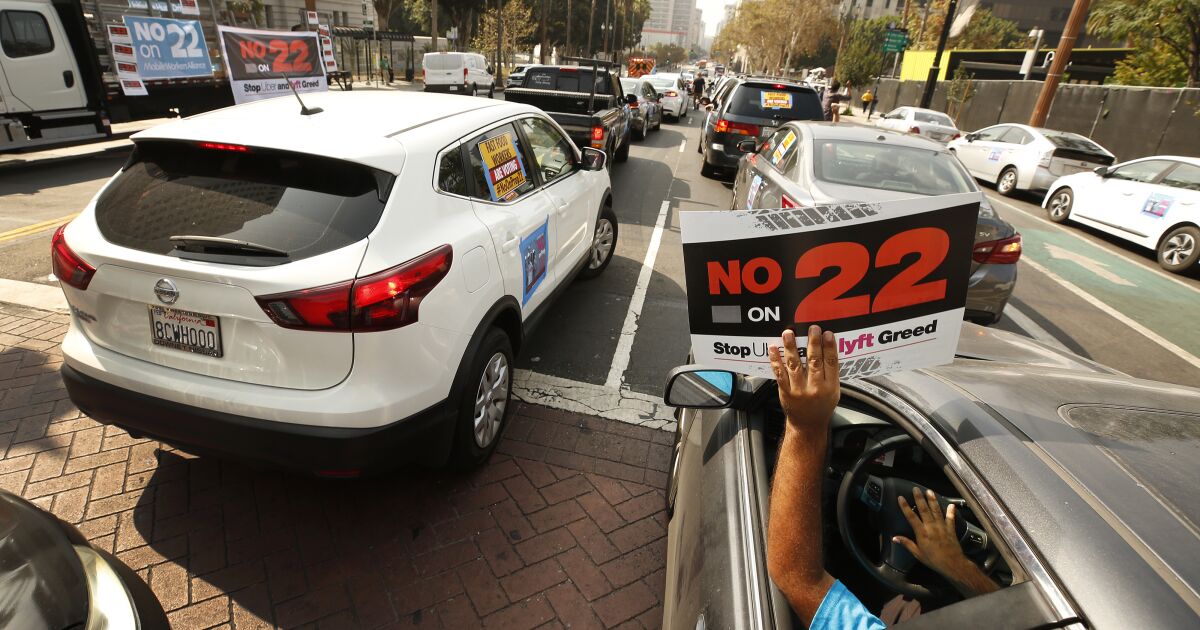


For more than a year, the California voter-approved gig-economy law known as Proposition 22 has hung in the balance after a judge invalidated the ballot initiative allowing giant ride-hailing and delivery companies to classify their workers as independent contractors rather than employees.
On Tuesday, a California appeals court will hear oral arguments in San Francisco on whether it should uphold the lower court that deemed Proposition 22 unconstitutional and unenforceable.
At stake is the business model of Uber, Lyft, DoorDash, Instacart and other app-based companies, which spent more than $200 million pushing Proposition 22 as a way to protect people who choose to work as independent contractors. The measure was approved by nearly 60% of voters in November 2020.
For hundreds of thousands of drivers, Proposition 22 allows the flexibility of remaining an independent contractor but took away protections granted by a 2019 law, AB 5, requiring gig workers across many industries to be classified as employees with stronger benefits such as a minimum wage, overtime and workers’ compensation in case of injury.
The ultimate decision on Proposition 22 will have a broad effect not only in California but across the U.S., as the gig company coalition behind the successful initiative looks to legalize its business model in other states, said Stacey Leyton, an attorney with Altshuler Berzon, the firm representing plaintiffs Service Employees International Union and several drivers who filed the original complaint against the proposition.
“Our hope is that in striking down Proposition 22, companies will not try to run another initiative,” Leyton said. “People have become more and more aware of how workers are misclassified.”
The gig company coalition, called Protect App-based Drivers & Services, on Monday urged the state’s 1st District Court of Appeal to overturn the decision.
California courts have repeatedly underscored a mandate to “guard voters initiative powers and uphold their acts wherever possible,” said Kurt Oneto, an attorney with Nielsen Merksamer, a firm representing the coalition.
Oneto described the legal challenge to Proposition 22 as a broader “attack on voters’ direct democracy powers” at a video news conference Monday.
The lower court’s ruling, made by Alameda County Superior Court Judge Frank Roesch in August 2021, found the law conflicts with the state Constitution by restricting the Legislature’s ability to regulate workers’ compensation rules. The ruling also argues that Proposition 22 violates a constitutional provision requiring initiatives to be limited to a “single subject.”
Roesch wrote that although the law claims to protect gig workers, it also “obliquely and indirectly” prevents them from bargaining collectively and thus “appears only to protect the economic interests of the network companies in having a divided, un-unionized workforce.”
At the time, ballot initiative experts described Roesch’s ruling as a bold and surprising rebuff of the aggressive effort by gig companies to rewrite the rules of gig work, as California judges are usually reluctant to strike down voter-approved measures.
The appellate court is required to issue its decision within 90 days, though attorneys involved in the case said they anticipate it being released much sooner.
Proposition 22 has remained in effect thus far through the appeals process. Gig companies have repeatedly indicated they will not comply with mandates to reclassify their workers as employees. The case will likely make its way to the California Supreme Court.



