

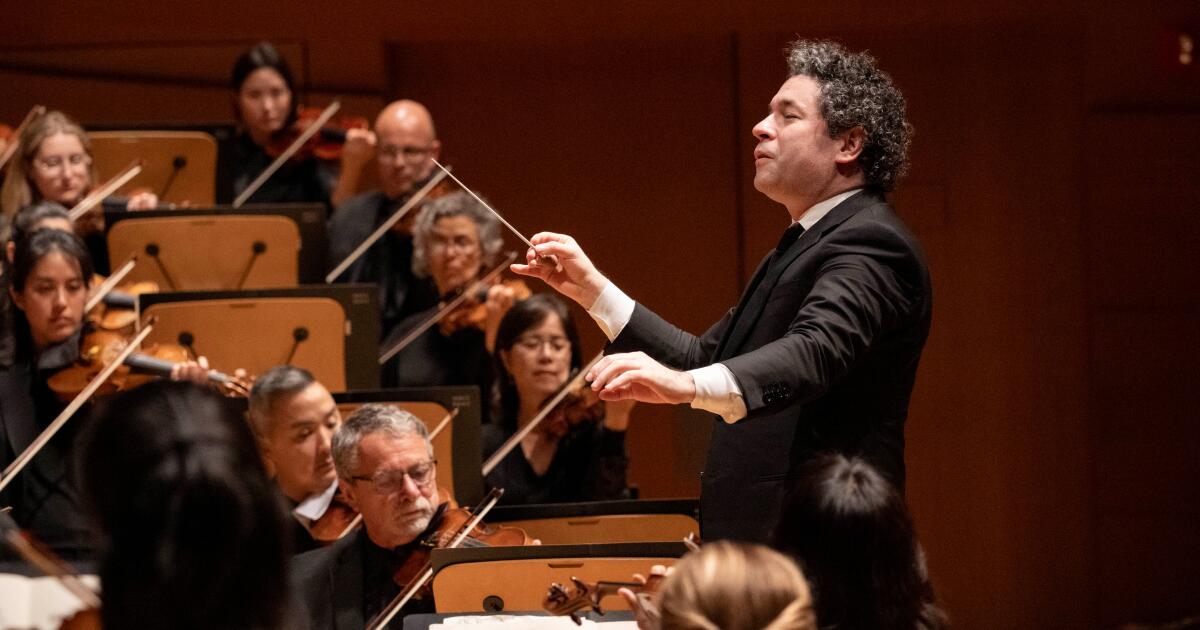


Gustavo Dudamel has begun his tale of two cities.
As Dickens prophetically reminds us, ours is hardly the first age of wisdom and of foolishness, the first epoch of belief and of incredulity. Dudamelâs great challenge is to make his 17th and final season as music director of the Los Angeles Philharmonic â and his prelude season before taking over the New York Philharmonic (in September he officially became designate music and artistic director) â the best of musical times for both cities.
The opening concerts for the two orchestras were two weeks apart, the Big Apple having come first. The main works on the New York-centric program were by two great 20th century composers, BartĂłk and Charles Ives, who were treated as outsiders by the cityâs musical establishments during their lifetimes.
The performances were impressive. An orchestra that has a reputation for being difficult was responsive. If I read the room right, there was a genuine, if somewhat guarded, sense of optimism from a welcoming crowd.
Following a tradition he started with his first season in L.A., Dudamel opened with a newly commissioned work, Leilehua Lanzilottiâs âof light and stone.â He struck instant sonic gold with this mystical evocation of Hawaii, wondrous in sound, Lanzilotti, a hopeful good start.
Dudamel has a different look these days when he walks out on stage for an L.A. Phil concert after heâs been away for a while. Thursday night at Walt Disney Concert Hall, he again seemed ever so slightly hesitant, as if not knowing what to expect now that his leaving has become manifest. But greeted by a full houseâs demonstratively embracing thankful enthusiasm, he beamed, the hesitant posture turning into ownership.
The conductor opened his farewell season with Ellen Reidâs âEarth Between Oceans,â a joint commission bridging his two orchestral families.
(Timothy Norris / Los Angeles Philharmonic)
The new work this year is Ellen Reidâs âEarth Between Oceans,â and it is Dudamelâs first effort at bringing together what he calls his two families.
Reid, who is herself bicoastal between L.A. and New York, narrates, through astonishing orchestral properties and powers, an environmental tale of her two cities. The work is a joint commission with the New York Philharmonic; Dudamel will take it east in the spring.
Earth, air, water and fire are Reidâs subject matters, which she translates into four movements that cover a New York winter, an aerial approach to Manhattanâs noise and quiet, the Altadena and Pacific Palisades conflagrations, ending on a sort of surfboard ride over crashing blue waves. With the help of a wordless Los Angeles Master Chorale, Reid tells the story through ever-surprising instrumental evocation.
Nothing, however, sounds like you might expect in Reidâs massive orchestral soundscape capable of holding a listener in tight grip for 30 minutes. Is that percussive pounding in earth the ground moving under our feet and the cello solo snowy Central Park? I donât know how she does it, but I immediately bought into weird sounds from the chorus indicating something words canât express about what those New York skyscrapers are up to. The effect of what sounded like ticking clocks going astray felt like an inviting dip in the lake.
Dudamel ended the concert with Richard Straussâ âAlpine Symphony,â 125 orchestral musicians schlepping up the mountain, finding spiritual ecstasy at the summit and getting drenched on the way down, a self-satisfied drinking in of nature with every step. It is an astonishing, so to speak, over-the-top score, which you either love or abhor for its instrumental vulgarity.
Love was in order Thursday. Dudamel first performed âAlpine Symphonyâ at Disney in 2008, a year before beginning as music director. He jogged up the mountain and back, full of beans, showing off but also sharing his enthusiasm and demonstrating a skill that gave confidence that this 20-something conductor had the chops.
Dudamelâs performance of Straussâ âAlpine Symphonyâ demonstrated the L.A. Philâs distinctive immediacy compared with his more formal European interpretations.
(Timothy Norris / Los Angeles Philharmonic)
Last summer, I heard Dudamel conduct the âAlpineâ with the Vienna Philharmonic at the Salzburg Festival. The playing was sumptuous but formal and distant. These were the Alps as seen from a comfortable gondola taking in the view, and what a view, indeed.
The L.A. Phil sound, on the other hand, reveled in being-there, huffing-and-puffing immediacy. A rainstorm was a rainstorm: wet. The pastures replete with cowbells werenât so much scenic as earthy, the real thing.
The orchestra sounded rapt and ready for ecstasy Thursday. There are two new first-chair players. A member of the orchestraâs second violin section, Melody Ye Yuan, has become her sectionâs principal. Ryan Roberts is the new principal oboe, and he had a luminous solo in the âAlpine.â
It was only after Roberts, who grew up in Santa Monica, won the L.A. Phil blind audition for principal oboe that Dudamel discovered he had just hired away a rising star in what is about to become his New York Philharmonic. But itâs all in the big new family.
Gustavo Dudamel has begun his tale of two cities.
As Dickens prophetically reminds us, ours is hardly the first age of wisdom and of foolishness, the first epoch of belief and of incredulity. Dudamelâs great challenge is to make his 17th and final season as music director of the Los Angeles Philharmonic â and his prelude season before taking over the New York Philharmonic (in September he officially became designate music and artistic director) â the best of musical times for both cities.
The opening concerts for the two orchestras were two weeks apart, the Big Apple having come first. The main works on the New York-centric program were by two great 20th century composers, BartĂłk and Charles Ives, who were treated as outsiders by the cityâs musical establishments during their lifetimes.
The performances were impressive. An orchestra that has a reputation for being difficult was responsive. If I read the room right, there was a genuine, if somewhat guarded, sense of optimism from a welcoming crowd.
Following a tradition he started with his first season in L.A., Dudamel opened with a newly commissioned work, Leilehua Lanzilottiâs âof light and stone.â He struck instant sonic gold with this mystical evocation of Hawaii, wondrous in sound, Lanzilotti, a hopeful good start.
Dudamel has a different look these days when he walks out on stage for an L.A. Phil concert after heâs been away for a while. Thursday night at Walt Disney Concert Hall, he again seemed ever so slightly hesitant, as if not knowing what to expect now that his leaving has become manifest. But greeted by a full houseâs demonstratively embracing thankful enthusiasm, he beamed, the hesitant posture turning into ownership.
The conductor opened his farewell season with Ellen Reidâs âEarth Between Oceans,â a joint commission bridging his two orchestral families.
(Timothy Norris / Los Angeles Philharmonic)
The new work this year is Ellen Reidâs âEarth Between Oceans,â and it is Dudamelâs first effort at bringing together what he calls his two families.
Reid, who is herself bicoastal between L.A. and New York, narrates, through astonishing orchestral properties and powers, an environmental tale of her two cities. The work is a joint commission with the New York Philharmonic; Dudamel will take it east in the spring.
Earth, air, water and fire are Reidâs subject matters, which she translates into four movements that cover a New York winter, an aerial approach to Manhattanâs noise and quiet, the Altadena and Pacific Palisades conflagrations, ending on a sort of surfboard ride over crashing blue waves. With the help of a wordless Los Angeles Master Chorale, Reid tells the story through ever-surprising instrumental evocation.
Nothing, however, sounds like you might expect in Reidâs massive orchestral soundscape capable of holding a listener in tight grip for 30 minutes. Is that percussive pounding in earth the ground moving under our feet and the cello solo snowy Central Park? I donât know how she does it, but I immediately bought into weird sounds from the chorus indicating something words canât express about what those New York skyscrapers are up to. The effect of what sounded like ticking clocks going astray felt like an inviting dip in the lake.
Dudamel ended the concert with Richard Straussâ âAlpine Symphony,â 125 orchestral musicians schlepping up the mountain, finding spiritual ecstasy at the summit and getting drenched on the way down, a self-satisfied drinking in of nature with every step. It is an astonishing, so to speak, over-the-top score, which you either love or abhor for its instrumental vulgarity.
Love was in order Thursday. Dudamel first performed âAlpine Symphonyâ at Disney in 2008, a year before beginning as music director. He jogged up the mountain and back, full of beans, showing off but also sharing his enthusiasm and demonstrating a skill that gave confidence that this 20-something conductor had the chops.
Dudamelâs performance of Straussâ âAlpine Symphonyâ demonstrated the L.A. Philâs distinctive immediacy compared with his more formal European interpretations.
(Timothy Norris / Los Angeles Philharmonic)
Last summer, I heard Dudamel conduct the âAlpineâ with the Vienna Philharmonic at the Salzburg Festival. The playing was sumptuous but formal and distant. These were the Alps as seen from a comfortable gondola taking in the view, and what a view, indeed.
The L.A. Phil sound, on the other hand, reveled in being-there, huffing-and-puffing immediacy. A rainstorm was a rainstorm: wet. The pastures replete with cowbells werenât so much scenic as earthy, the real thing.
The orchestra sounded rapt and ready for ecstasy Thursday. There are two new first-chair players. A member of the orchestraâs second violin section, Melody Ye Yuan, has become her sectionâs principal. Ryan Roberts is the new principal oboe, and he had a luminous solo in the âAlpine.â
It was only after Roberts, who grew up in Santa Monica, won the L.A. Phil blind audition for principal oboe that Dudamel discovered he had just hired away a rising star in what is about to become his New York Philharmonic. But itâs all in the big new family.
Gustavo Dudamel has begun his tale of two cities.
As Dickens prophetically reminds us, ours is hardly the first age of wisdom and of foolishness, the first epoch of belief and of incredulity. Dudamelâs great challenge is to make his 17th and final season as music director of the Los Angeles Philharmonic â and his prelude season before taking over the New York Philharmonic (in September he officially became designate music and artistic director) â the best of musical times for both cities.
The opening concerts for the two orchestras were two weeks apart, the Big Apple having come first. The main works on the New York-centric program were by two great 20th century composers, BartĂłk and Charles Ives, who were treated as outsiders by the cityâs musical establishments during their lifetimes.
The performances were impressive. An orchestra that has a reputation for being difficult was responsive. If I read the room right, there was a genuine, if somewhat guarded, sense of optimism from a welcoming crowd.
Following a tradition he started with his first season in L.A., Dudamel opened with a newly commissioned work, Leilehua Lanzilottiâs âof light and stone.â He struck instant sonic gold with this mystical evocation of Hawaii, wondrous in sound, Lanzilotti, a hopeful good start.
Dudamel has a different look these days when he walks out on stage for an L.A. Phil concert after heâs been away for a while. Thursday night at Walt Disney Concert Hall, he again seemed ever so slightly hesitant, as if not knowing what to expect now that his leaving has become manifest. But greeted by a full houseâs demonstratively embracing thankful enthusiasm, he beamed, the hesitant posture turning into ownership.
The conductor opened his farewell season with Ellen Reidâs âEarth Between Oceans,â a joint commission bridging his two orchestral families.
(Timothy Norris / Los Angeles Philharmonic)
The new work this year is Ellen Reidâs âEarth Between Oceans,â and it is Dudamelâs first effort at bringing together what he calls his two families.
Reid, who is herself bicoastal between L.A. and New York, narrates, through astonishing orchestral properties and powers, an environmental tale of her two cities. The work is a joint commission with the New York Philharmonic; Dudamel will take it east in the spring.
Earth, air, water and fire are Reidâs subject matters, which she translates into four movements that cover a New York winter, an aerial approach to Manhattanâs noise and quiet, the Altadena and Pacific Palisades conflagrations, ending on a sort of surfboard ride over crashing blue waves. With the help of a wordless Los Angeles Master Chorale, Reid tells the story through ever-surprising instrumental evocation.
Nothing, however, sounds like you might expect in Reidâs massive orchestral soundscape capable of holding a listener in tight grip for 30 minutes. Is that percussive pounding in earth the ground moving under our feet and the cello solo snowy Central Park? I donât know how she does it, but I immediately bought into weird sounds from the chorus indicating something words canât express about what those New York skyscrapers are up to. The effect of what sounded like ticking clocks going astray felt like an inviting dip in the lake.
Dudamel ended the concert with Richard Straussâ âAlpine Symphony,â 125 orchestral musicians schlepping up the mountain, finding spiritual ecstasy at the summit and getting drenched on the way down, a self-satisfied drinking in of nature with every step. It is an astonishing, so to speak, over-the-top score, which you either love or abhor for its instrumental vulgarity.
Love was in order Thursday. Dudamel first performed âAlpine Symphonyâ at Disney in 2008, a year before beginning as music director. He jogged up the mountain and back, full of beans, showing off but also sharing his enthusiasm and demonstrating a skill that gave confidence that this 20-something conductor had the chops.
Dudamelâs performance of Straussâ âAlpine Symphonyâ demonstrated the L.A. Philâs distinctive immediacy compared with his more formal European interpretations.
(Timothy Norris / Los Angeles Philharmonic)
Last summer, I heard Dudamel conduct the âAlpineâ with the Vienna Philharmonic at the Salzburg Festival. The playing was sumptuous but formal and distant. These were the Alps as seen from a comfortable gondola taking in the view, and what a view, indeed.
The L.A. Phil sound, on the other hand, reveled in being-there, huffing-and-puffing immediacy. A rainstorm was a rainstorm: wet. The pastures replete with cowbells werenât so much scenic as earthy, the real thing.
The orchestra sounded rapt and ready for ecstasy Thursday. There are two new first-chair players. A member of the orchestraâs second violin section, Melody Ye Yuan, has become her sectionâs principal. Ryan Roberts is the new principal oboe, and he had a luminous solo in the âAlpine.â
It was only after Roberts, who grew up in Santa Monica, won the L.A. Phil blind audition for principal oboe that Dudamel discovered he had just hired away a rising star in what is about to become his New York Philharmonic. But itâs all in the big new family.
Gustavo Dudamel has begun his tale of two cities.
As Dickens prophetically reminds us, ours is hardly the first age of wisdom and of foolishness, the first epoch of belief and of incredulity. Dudamelâs great challenge is to make his 17th and final season as music director of the Los Angeles Philharmonic â and his prelude season before taking over the New York Philharmonic (in September he officially became designate music and artistic director) â the best of musical times for both cities.
The opening concerts for the two orchestras were two weeks apart, the Big Apple having come first. The main works on the New York-centric program were by two great 20th century composers, BartĂłk and Charles Ives, who were treated as outsiders by the cityâs musical establishments during their lifetimes.
The performances were impressive. An orchestra that has a reputation for being difficult was responsive. If I read the room right, there was a genuine, if somewhat guarded, sense of optimism from a welcoming crowd.
Following a tradition he started with his first season in L.A., Dudamel opened with a newly commissioned work, Leilehua Lanzilottiâs âof light and stone.â He struck instant sonic gold with this mystical evocation of Hawaii, wondrous in sound, Lanzilotti, a hopeful good start.
Dudamel has a different look these days when he walks out on stage for an L.A. Phil concert after heâs been away for a while. Thursday night at Walt Disney Concert Hall, he again seemed ever so slightly hesitant, as if not knowing what to expect now that his leaving has become manifest. But greeted by a full houseâs demonstratively embracing thankful enthusiasm, he beamed, the hesitant posture turning into ownership.
The conductor opened his farewell season with Ellen Reidâs âEarth Between Oceans,â a joint commission bridging his two orchestral families.
(Timothy Norris / Los Angeles Philharmonic)
The new work this year is Ellen Reidâs âEarth Between Oceans,â and it is Dudamelâs first effort at bringing together what he calls his two families.
Reid, who is herself bicoastal between L.A. and New York, narrates, through astonishing orchestral properties and powers, an environmental tale of her two cities. The work is a joint commission with the New York Philharmonic; Dudamel will take it east in the spring.
Earth, air, water and fire are Reidâs subject matters, which she translates into four movements that cover a New York winter, an aerial approach to Manhattanâs noise and quiet, the Altadena and Pacific Palisades conflagrations, ending on a sort of surfboard ride over crashing blue waves. With the help of a wordless Los Angeles Master Chorale, Reid tells the story through ever-surprising instrumental evocation.
Nothing, however, sounds like you might expect in Reidâs massive orchestral soundscape capable of holding a listener in tight grip for 30 minutes. Is that percussive pounding in earth the ground moving under our feet and the cello solo snowy Central Park? I donât know how she does it, but I immediately bought into weird sounds from the chorus indicating something words canât express about what those New York skyscrapers are up to. The effect of what sounded like ticking clocks going astray felt like an inviting dip in the lake.
Dudamel ended the concert with Richard Straussâ âAlpine Symphony,â 125 orchestral musicians schlepping up the mountain, finding spiritual ecstasy at the summit and getting drenched on the way down, a self-satisfied drinking in of nature with every step. It is an astonishing, so to speak, over-the-top score, which you either love or abhor for its instrumental vulgarity.
Love was in order Thursday. Dudamel first performed âAlpine Symphonyâ at Disney in 2008, a year before beginning as music director. He jogged up the mountain and back, full of beans, showing off but also sharing his enthusiasm and demonstrating a skill that gave confidence that this 20-something conductor had the chops.
Dudamelâs performance of Straussâ âAlpine Symphonyâ demonstrated the L.A. Philâs distinctive immediacy compared with his more formal European interpretations.
(Timothy Norris / Los Angeles Philharmonic)
Last summer, I heard Dudamel conduct the âAlpineâ with the Vienna Philharmonic at the Salzburg Festival. The playing was sumptuous but formal and distant. These were the Alps as seen from a comfortable gondola taking in the view, and what a view, indeed.
The L.A. Phil sound, on the other hand, reveled in being-there, huffing-and-puffing immediacy. A rainstorm was a rainstorm: wet. The pastures replete with cowbells werenât so much scenic as earthy, the real thing.
The orchestra sounded rapt and ready for ecstasy Thursday. There are two new first-chair players. A member of the orchestraâs second violin section, Melody Ye Yuan, has become her sectionâs principal. Ryan Roberts is the new principal oboe, and he had a luminous solo in the âAlpine.â
It was only after Roberts, who grew up in Santa Monica, won the L.A. Phil blind audition for principal oboe that Dudamel discovered he had just hired away a rising star in what is about to become his New York Philharmonic. But itâs all in the big new family.
Gustavo Dudamel has begun his tale of two cities.
As Dickens prophetically reminds us, ours is hardly the first age of wisdom and of foolishness, the first epoch of belief and of incredulity. Dudamelâs great challenge is to make his 17th and final season as music director of the Los Angeles Philharmonic â and his prelude season before taking over the New York Philharmonic (in September he officially became designate music and artistic director) â the best of musical times for both cities.
The opening concerts for the two orchestras were two weeks apart, the Big Apple having come first. The main works on the New York-centric program were by two great 20th century composers, BartĂłk and Charles Ives, who were treated as outsiders by the cityâs musical establishments during their lifetimes.
The performances were impressive. An orchestra that has a reputation for being difficult was responsive. If I read the room right, there was a genuine, if somewhat guarded, sense of optimism from a welcoming crowd.
Following a tradition he started with his first season in L.A., Dudamel opened with a newly commissioned work, Leilehua Lanzilottiâs âof light and stone.â He struck instant sonic gold with this mystical evocation of Hawaii, wondrous in sound, Lanzilotti, a hopeful good start.
Dudamel has a different look these days when he walks out on stage for an L.A. Phil concert after heâs been away for a while. Thursday night at Walt Disney Concert Hall, he again seemed ever so slightly hesitant, as if not knowing what to expect now that his leaving has become manifest. But greeted by a full houseâs demonstratively embracing thankful enthusiasm, he beamed, the hesitant posture turning into ownership.
The conductor opened his farewell season with Ellen Reidâs âEarth Between Oceans,â a joint commission bridging his two orchestral families.
(Timothy Norris / Los Angeles Philharmonic)
The new work this year is Ellen Reidâs âEarth Between Oceans,â and it is Dudamelâs first effort at bringing together what he calls his two families.
Reid, who is herself bicoastal between L.A. and New York, narrates, through astonishing orchestral properties and powers, an environmental tale of her two cities. The work is a joint commission with the New York Philharmonic; Dudamel will take it east in the spring.
Earth, air, water and fire are Reidâs subject matters, which she translates into four movements that cover a New York winter, an aerial approach to Manhattanâs noise and quiet, the Altadena and Pacific Palisades conflagrations, ending on a sort of surfboard ride over crashing blue waves. With the help of a wordless Los Angeles Master Chorale, Reid tells the story through ever-surprising instrumental evocation.
Nothing, however, sounds like you might expect in Reidâs massive orchestral soundscape capable of holding a listener in tight grip for 30 minutes. Is that percussive pounding in earth the ground moving under our feet and the cello solo snowy Central Park? I donât know how she does it, but I immediately bought into weird sounds from the chorus indicating something words canât express about what those New York skyscrapers are up to. The effect of what sounded like ticking clocks going astray felt like an inviting dip in the lake.
Dudamel ended the concert with Richard Straussâ âAlpine Symphony,â 125 orchestral musicians schlepping up the mountain, finding spiritual ecstasy at the summit and getting drenched on the way down, a self-satisfied drinking in of nature with every step. It is an astonishing, so to speak, over-the-top score, which you either love or abhor for its instrumental vulgarity.
Love was in order Thursday. Dudamel first performed âAlpine Symphonyâ at Disney in 2008, a year before beginning as music director. He jogged up the mountain and back, full of beans, showing off but also sharing his enthusiasm and demonstrating a skill that gave confidence that this 20-something conductor had the chops.
Dudamelâs performance of Straussâ âAlpine Symphonyâ demonstrated the L.A. Philâs distinctive immediacy compared with his more formal European interpretations.
(Timothy Norris / Los Angeles Philharmonic)
Last summer, I heard Dudamel conduct the âAlpineâ with the Vienna Philharmonic at the Salzburg Festival. The playing was sumptuous but formal and distant. These were the Alps as seen from a comfortable gondola taking in the view, and what a view, indeed.
The L.A. Phil sound, on the other hand, reveled in being-there, huffing-and-puffing immediacy. A rainstorm was a rainstorm: wet. The pastures replete with cowbells werenât so much scenic as earthy, the real thing.
The orchestra sounded rapt and ready for ecstasy Thursday. There are two new first-chair players. A member of the orchestraâs second violin section, Melody Ye Yuan, has become her sectionâs principal. Ryan Roberts is the new principal oboe, and he had a luminous solo in the âAlpine.â
It was only after Roberts, who grew up in Santa Monica, won the L.A. Phil blind audition for principal oboe that Dudamel discovered he had just hired away a rising star in what is about to become his New York Philharmonic. But itâs all in the big new family.
Gustavo Dudamel has begun his tale of two cities.
As Dickens prophetically reminds us, ours is hardly the first age of wisdom and of foolishness, the first epoch of belief and of incredulity. Dudamelâs great challenge is to make his 17th and final season as music director of the Los Angeles Philharmonic â and his prelude season before taking over the New York Philharmonic (in September he officially became designate music and artistic director) â the best of musical times for both cities.
The opening concerts for the two orchestras were two weeks apart, the Big Apple having come first. The main works on the New York-centric program were by two great 20th century composers, BartĂłk and Charles Ives, who were treated as outsiders by the cityâs musical establishments during their lifetimes.
The performances were impressive. An orchestra that has a reputation for being difficult was responsive. If I read the room right, there was a genuine, if somewhat guarded, sense of optimism from a welcoming crowd.
Following a tradition he started with his first season in L.A., Dudamel opened with a newly commissioned work, Leilehua Lanzilottiâs âof light and stone.â He struck instant sonic gold with this mystical evocation of Hawaii, wondrous in sound, Lanzilotti, a hopeful good start.
Dudamel has a different look these days when he walks out on stage for an L.A. Phil concert after heâs been away for a while. Thursday night at Walt Disney Concert Hall, he again seemed ever so slightly hesitant, as if not knowing what to expect now that his leaving has become manifest. But greeted by a full houseâs demonstratively embracing thankful enthusiasm, he beamed, the hesitant posture turning into ownership.
The conductor opened his farewell season with Ellen Reidâs âEarth Between Oceans,â a joint commission bridging his two orchestral families.
(Timothy Norris / Los Angeles Philharmonic)
The new work this year is Ellen Reidâs âEarth Between Oceans,â and it is Dudamelâs first effort at bringing together what he calls his two families.
Reid, who is herself bicoastal between L.A. and New York, narrates, through astonishing orchestral properties and powers, an environmental tale of her two cities. The work is a joint commission with the New York Philharmonic; Dudamel will take it east in the spring.
Earth, air, water and fire are Reidâs subject matters, which she translates into four movements that cover a New York winter, an aerial approach to Manhattanâs noise and quiet, the Altadena and Pacific Palisades conflagrations, ending on a sort of surfboard ride over crashing blue waves. With the help of a wordless Los Angeles Master Chorale, Reid tells the story through ever-surprising instrumental evocation.
Nothing, however, sounds like you might expect in Reidâs massive orchestral soundscape capable of holding a listener in tight grip for 30 minutes. Is that percussive pounding in earth the ground moving under our feet and the cello solo snowy Central Park? I donât know how she does it, but I immediately bought into weird sounds from the chorus indicating something words canât express about what those New York skyscrapers are up to. The effect of what sounded like ticking clocks going astray felt like an inviting dip in the lake.
Dudamel ended the concert with Richard Straussâ âAlpine Symphony,â 125 orchestral musicians schlepping up the mountain, finding spiritual ecstasy at the summit and getting drenched on the way down, a self-satisfied drinking in of nature with every step. It is an astonishing, so to speak, over-the-top score, which you either love or abhor for its instrumental vulgarity.
Love was in order Thursday. Dudamel first performed âAlpine Symphonyâ at Disney in 2008, a year before beginning as music director. He jogged up the mountain and back, full of beans, showing off but also sharing his enthusiasm and demonstrating a skill that gave confidence that this 20-something conductor had the chops.
Dudamelâs performance of Straussâ âAlpine Symphonyâ demonstrated the L.A. Philâs distinctive immediacy compared with his more formal European interpretations.
(Timothy Norris / Los Angeles Philharmonic)
Last summer, I heard Dudamel conduct the âAlpineâ with the Vienna Philharmonic at the Salzburg Festival. The playing was sumptuous but formal and distant. These were the Alps as seen from a comfortable gondola taking in the view, and what a view, indeed.
The L.A. Phil sound, on the other hand, reveled in being-there, huffing-and-puffing immediacy. A rainstorm was a rainstorm: wet. The pastures replete with cowbells werenât so much scenic as earthy, the real thing.
The orchestra sounded rapt and ready for ecstasy Thursday. There are two new first-chair players. A member of the orchestraâs second violin section, Melody Ye Yuan, has become her sectionâs principal. Ryan Roberts is the new principal oboe, and he had a luminous solo in the âAlpine.â
It was only after Roberts, who grew up in Santa Monica, won the L.A. Phil blind audition for principal oboe that Dudamel discovered he had just hired away a rising star in what is about to become his New York Philharmonic. But itâs all in the big new family.
Gustavo Dudamel has begun his tale of two cities.
As Dickens prophetically reminds us, ours is hardly the first age of wisdom and of foolishness, the first epoch of belief and of incredulity. Dudamelâs great challenge is to make his 17th and final season as music director of the Los Angeles Philharmonic â and his prelude season before taking over the New York Philharmonic (in September he officially became designate music and artistic director) â the best of musical times for both cities.
The opening concerts for the two orchestras were two weeks apart, the Big Apple having come first. The main works on the New York-centric program were by two great 20th century composers, BartĂłk and Charles Ives, who were treated as outsiders by the cityâs musical establishments during their lifetimes.
The performances were impressive. An orchestra that has a reputation for being difficult was responsive. If I read the room right, there was a genuine, if somewhat guarded, sense of optimism from a welcoming crowd.
Following a tradition he started with his first season in L.A., Dudamel opened with a newly commissioned work, Leilehua Lanzilottiâs âof light and stone.â He struck instant sonic gold with this mystical evocation of Hawaii, wondrous in sound, Lanzilotti, a hopeful good start.
Dudamel has a different look these days when he walks out on stage for an L.A. Phil concert after heâs been away for a while. Thursday night at Walt Disney Concert Hall, he again seemed ever so slightly hesitant, as if not knowing what to expect now that his leaving has become manifest. But greeted by a full houseâs demonstratively embracing thankful enthusiasm, he beamed, the hesitant posture turning into ownership.
The conductor opened his farewell season with Ellen Reidâs âEarth Between Oceans,â a joint commission bridging his two orchestral families.
(Timothy Norris / Los Angeles Philharmonic)
The new work this year is Ellen Reidâs âEarth Between Oceans,â and it is Dudamelâs first effort at bringing together what he calls his two families.
Reid, who is herself bicoastal between L.A. and New York, narrates, through astonishing orchestral properties and powers, an environmental tale of her two cities. The work is a joint commission with the New York Philharmonic; Dudamel will take it east in the spring.
Earth, air, water and fire are Reidâs subject matters, which she translates into four movements that cover a New York winter, an aerial approach to Manhattanâs noise and quiet, the Altadena and Pacific Palisades conflagrations, ending on a sort of surfboard ride over crashing blue waves. With the help of a wordless Los Angeles Master Chorale, Reid tells the story through ever-surprising instrumental evocation.
Nothing, however, sounds like you might expect in Reidâs massive orchestral soundscape capable of holding a listener in tight grip for 30 minutes. Is that percussive pounding in earth the ground moving under our feet and the cello solo snowy Central Park? I donât know how she does it, but I immediately bought into weird sounds from the chorus indicating something words canât express about what those New York skyscrapers are up to. The effect of what sounded like ticking clocks going astray felt like an inviting dip in the lake.
Dudamel ended the concert with Richard Straussâ âAlpine Symphony,â 125 orchestral musicians schlepping up the mountain, finding spiritual ecstasy at the summit and getting drenched on the way down, a self-satisfied drinking in of nature with every step. It is an astonishing, so to speak, over-the-top score, which you either love or abhor for its instrumental vulgarity.
Love was in order Thursday. Dudamel first performed âAlpine Symphonyâ at Disney in 2008, a year before beginning as music director. He jogged up the mountain and back, full of beans, showing off but also sharing his enthusiasm and demonstrating a skill that gave confidence that this 20-something conductor had the chops.
Dudamelâs performance of Straussâ âAlpine Symphonyâ demonstrated the L.A. Philâs distinctive immediacy compared with his more formal European interpretations.
(Timothy Norris / Los Angeles Philharmonic)
Last summer, I heard Dudamel conduct the âAlpineâ with the Vienna Philharmonic at the Salzburg Festival. The playing was sumptuous but formal and distant. These were the Alps as seen from a comfortable gondola taking in the view, and what a view, indeed.
The L.A. Phil sound, on the other hand, reveled in being-there, huffing-and-puffing immediacy. A rainstorm was a rainstorm: wet. The pastures replete with cowbells werenât so much scenic as earthy, the real thing.
The orchestra sounded rapt and ready for ecstasy Thursday. There are two new first-chair players. A member of the orchestraâs second violin section, Melody Ye Yuan, has become her sectionâs principal. Ryan Roberts is the new principal oboe, and he had a luminous solo in the âAlpine.â
It was only after Roberts, who grew up in Santa Monica, won the L.A. Phil blind audition for principal oboe that Dudamel discovered he had just hired away a rising star in what is about to become his New York Philharmonic. But itâs all in the big new family.
Gustavo Dudamel has begun his tale of two cities.
As Dickens prophetically reminds us, ours is hardly the first age of wisdom and of foolishness, the first epoch of belief and of incredulity. Dudamelâs great challenge is to make his 17th and final season as music director of the Los Angeles Philharmonic â and his prelude season before taking over the New York Philharmonic (in September he officially became designate music and artistic director) â the best of musical times for both cities.
The opening concerts for the two orchestras were two weeks apart, the Big Apple having come first. The main works on the New York-centric program were by two great 20th century composers, BartĂłk and Charles Ives, who were treated as outsiders by the cityâs musical establishments during their lifetimes.
The performances were impressive. An orchestra that has a reputation for being difficult was responsive. If I read the room right, there was a genuine, if somewhat guarded, sense of optimism from a welcoming crowd.
Following a tradition he started with his first season in L.A., Dudamel opened with a newly commissioned work, Leilehua Lanzilottiâs âof light and stone.â He struck instant sonic gold with this mystical evocation of Hawaii, wondrous in sound, Lanzilotti, a hopeful good start.
Dudamel has a different look these days when he walks out on stage for an L.A. Phil concert after heâs been away for a while. Thursday night at Walt Disney Concert Hall, he again seemed ever so slightly hesitant, as if not knowing what to expect now that his leaving has become manifest. But greeted by a full houseâs demonstratively embracing thankful enthusiasm, he beamed, the hesitant posture turning into ownership.
The conductor opened his farewell season with Ellen Reidâs âEarth Between Oceans,â a joint commission bridging his two orchestral families.
(Timothy Norris / Los Angeles Philharmonic)
The new work this year is Ellen Reidâs âEarth Between Oceans,â and it is Dudamelâs first effort at bringing together what he calls his two families.
Reid, who is herself bicoastal between L.A. and New York, narrates, through astonishing orchestral properties and powers, an environmental tale of her two cities. The work is a joint commission with the New York Philharmonic; Dudamel will take it east in the spring.
Earth, air, water and fire are Reidâs subject matters, which she translates into four movements that cover a New York winter, an aerial approach to Manhattanâs noise and quiet, the Altadena and Pacific Palisades conflagrations, ending on a sort of surfboard ride over crashing blue waves. With the help of a wordless Los Angeles Master Chorale, Reid tells the story through ever-surprising instrumental evocation.
Nothing, however, sounds like you might expect in Reidâs massive orchestral soundscape capable of holding a listener in tight grip for 30 minutes. Is that percussive pounding in earth the ground moving under our feet and the cello solo snowy Central Park? I donât know how she does it, but I immediately bought into weird sounds from the chorus indicating something words canât express about what those New York skyscrapers are up to. The effect of what sounded like ticking clocks going astray felt like an inviting dip in the lake.
Dudamel ended the concert with Richard Straussâ âAlpine Symphony,â 125 orchestral musicians schlepping up the mountain, finding spiritual ecstasy at the summit and getting drenched on the way down, a self-satisfied drinking in of nature with every step. It is an astonishing, so to speak, over-the-top score, which you either love or abhor for its instrumental vulgarity.
Love was in order Thursday. Dudamel first performed âAlpine Symphonyâ at Disney in 2008, a year before beginning as music director. He jogged up the mountain and back, full of beans, showing off but also sharing his enthusiasm and demonstrating a skill that gave confidence that this 20-something conductor had the chops.
Dudamelâs performance of Straussâ âAlpine Symphonyâ demonstrated the L.A. Philâs distinctive immediacy compared with his more formal European interpretations.
(Timothy Norris / Los Angeles Philharmonic)
Last summer, I heard Dudamel conduct the âAlpineâ with the Vienna Philharmonic at the Salzburg Festival. The playing was sumptuous but formal and distant. These were the Alps as seen from a comfortable gondola taking in the view, and what a view, indeed.
The L.A. Phil sound, on the other hand, reveled in being-there, huffing-and-puffing immediacy. A rainstorm was a rainstorm: wet. The pastures replete with cowbells werenât so much scenic as earthy, the real thing.
The orchestra sounded rapt and ready for ecstasy Thursday. There are two new first-chair players. A member of the orchestraâs second violin section, Melody Ye Yuan, has become her sectionâs principal. Ryan Roberts is the new principal oboe, and he had a luminous solo in the âAlpine.â
It was only after Roberts, who grew up in Santa Monica, won the L.A. Phil blind audition for principal oboe that Dudamel discovered he had just hired away a rising star in what is about to become his New York Philharmonic. But itâs all in the big new family.
Gustavo Dudamel has begun his tale of two cities.
As Dickens prophetically reminds us, ours is hardly the first age of wisdom and of foolishness, the first epoch of belief and of incredulity. Dudamelâs great challenge is to make his 17th and final season as music director of the Los Angeles Philharmonic â and his prelude season before taking over the New York Philharmonic (in September he officially became designate music and artistic director) â the best of musical times for both cities.
The opening concerts for the two orchestras were two weeks apart, the Big Apple having come first. The main works on the New York-centric program were by two great 20th century composers, BartĂłk and Charles Ives, who were treated as outsiders by the cityâs musical establishments during their lifetimes.
The performances were impressive. An orchestra that has a reputation for being difficult was responsive. If I read the room right, there was a genuine, if somewhat guarded, sense of optimism from a welcoming crowd.
Following a tradition he started with his first season in L.A., Dudamel opened with a newly commissioned work, Leilehua Lanzilottiâs âof light and stone.â He struck instant sonic gold with this mystical evocation of Hawaii, wondrous in sound, Lanzilotti, a hopeful good start.
Dudamel has a different look these days when he walks out on stage for an L.A. Phil concert after heâs been away for a while. Thursday night at Walt Disney Concert Hall, he again seemed ever so slightly hesitant, as if not knowing what to expect now that his leaving has become manifest. But greeted by a full houseâs demonstratively embracing thankful enthusiasm, he beamed, the hesitant posture turning into ownership.
The conductor opened his farewell season with Ellen Reidâs âEarth Between Oceans,â a joint commission bridging his two orchestral families.
(Timothy Norris / Los Angeles Philharmonic)
The new work this year is Ellen Reidâs âEarth Between Oceans,â and it is Dudamelâs first effort at bringing together what he calls his two families.
Reid, who is herself bicoastal between L.A. and New York, narrates, through astonishing orchestral properties and powers, an environmental tale of her two cities. The work is a joint commission with the New York Philharmonic; Dudamel will take it east in the spring.
Earth, air, water and fire are Reidâs subject matters, which she translates into four movements that cover a New York winter, an aerial approach to Manhattanâs noise and quiet, the Altadena and Pacific Palisades conflagrations, ending on a sort of surfboard ride over crashing blue waves. With the help of a wordless Los Angeles Master Chorale, Reid tells the story through ever-surprising instrumental evocation.
Nothing, however, sounds like you might expect in Reidâs massive orchestral soundscape capable of holding a listener in tight grip for 30 minutes. Is that percussive pounding in earth the ground moving under our feet and the cello solo snowy Central Park? I donât know how she does it, but I immediately bought into weird sounds from the chorus indicating something words canât express about what those New York skyscrapers are up to. The effect of what sounded like ticking clocks going astray felt like an inviting dip in the lake.
Dudamel ended the concert with Richard Straussâ âAlpine Symphony,â 125 orchestral musicians schlepping up the mountain, finding spiritual ecstasy at the summit and getting drenched on the way down, a self-satisfied drinking in of nature with every step. It is an astonishing, so to speak, over-the-top score, which you either love or abhor for its instrumental vulgarity.
Love was in order Thursday. Dudamel first performed âAlpine Symphonyâ at Disney in 2008, a year before beginning as music director. He jogged up the mountain and back, full of beans, showing off but also sharing his enthusiasm and demonstrating a skill that gave confidence that this 20-something conductor had the chops.
Dudamelâs performance of Straussâ âAlpine Symphonyâ demonstrated the L.A. Philâs distinctive immediacy compared with his more formal European interpretations.
(Timothy Norris / Los Angeles Philharmonic)
Last summer, I heard Dudamel conduct the âAlpineâ with the Vienna Philharmonic at the Salzburg Festival. The playing was sumptuous but formal and distant. These were the Alps as seen from a comfortable gondola taking in the view, and what a view, indeed.
The L.A. Phil sound, on the other hand, reveled in being-there, huffing-and-puffing immediacy. A rainstorm was a rainstorm: wet. The pastures replete with cowbells werenât so much scenic as earthy, the real thing.
The orchestra sounded rapt and ready for ecstasy Thursday. There are two new first-chair players. A member of the orchestraâs second violin section, Melody Ye Yuan, has become her sectionâs principal. Ryan Roberts is the new principal oboe, and he had a luminous solo in the âAlpine.â
It was only after Roberts, who grew up in Santa Monica, won the L.A. Phil blind audition for principal oboe that Dudamel discovered he had just hired away a rising star in what is about to become his New York Philharmonic. But itâs all in the big new family.
Gustavo Dudamel has begun his tale of two cities.
As Dickens prophetically reminds us, ours is hardly the first age of wisdom and of foolishness, the first epoch of belief and of incredulity. Dudamelâs great challenge is to make his 17th and final season as music director of the Los Angeles Philharmonic â and his prelude season before taking over the New York Philharmonic (in September he officially became designate music and artistic director) â the best of musical times for both cities.
The opening concerts for the two orchestras were two weeks apart, the Big Apple having come first. The main works on the New York-centric program were by two great 20th century composers, BartĂłk and Charles Ives, who were treated as outsiders by the cityâs musical establishments during their lifetimes.
The performances were impressive. An orchestra that has a reputation for being difficult was responsive. If I read the room right, there was a genuine, if somewhat guarded, sense of optimism from a welcoming crowd.
Following a tradition he started with his first season in L.A., Dudamel opened with a newly commissioned work, Leilehua Lanzilottiâs âof light and stone.â He struck instant sonic gold with this mystical evocation of Hawaii, wondrous in sound, Lanzilotti, a hopeful good start.
Dudamel has a different look these days when he walks out on stage for an L.A. Phil concert after heâs been away for a while. Thursday night at Walt Disney Concert Hall, he again seemed ever so slightly hesitant, as if not knowing what to expect now that his leaving has become manifest. But greeted by a full houseâs demonstratively embracing thankful enthusiasm, he beamed, the hesitant posture turning into ownership.
The conductor opened his farewell season with Ellen Reidâs âEarth Between Oceans,â a joint commission bridging his two orchestral families.
(Timothy Norris / Los Angeles Philharmonic)
The new work this year is Ellen Reidâs âEarth Between Oceans,â and it is Dudamelâs first effort at bringing together what he calls his two families.
Reid, who is herself bicoastal between L.A. and New York, narrates, through astonishing orchestral properties and powers, an environmental tale of her two cities. The work is a joint commission with the New York Philharmonic; Dudamel will take it east in the spring.
Earth, air, water and fire are Reidâs subject matters, which she translates into four movements that cover a New York winter, an aerial approach to Manhattanâs noise and quiet, the Altadena and Pacific Palisades conflagrations, ending on a sort of surfboard ride over crashing blue waves. With the help of a wordless Los Angeles Master Chorale, Reid tells the story through ever-surprising instrumental evocation.
Nothing, however, sounds like you might expect in Reidâs massive orchestral soundscape capable of holding a listener in tight grip for 30 minutes. Is that percussive pounding in earth the ground moving under our feet and the cello solo snowy Central Park? I donât know how she does it, but I immediately bought into weird sounds from the chorus indicating something words canât express about what those New York skyscrapers are up to. The effect of what sounded like ticking clocks going astray felt like an inviting dip in the lake.
Dudamel ended the concert with Richard Straussâ âAlpine Symphony,â 125 orchestral musicians schlepping up the mountain, finding spiritual ecstasy at the summit and getting drenched on the way down, a self-satisfied drinking in of nature with every step. It is an astonishing, so to speak, over-the-top score, which you either love or abhor for its instrumental vulgarity.
Love was in order Thursday. Dudamel first performed âAlpine Symphonyâ at Disney in 2008, a year before beginning as music director. He jogged up the mountain and back, full of beans, showing off but also sharing his enthusiasm and demonstrating a skill that gave confidence that this 20-something conductor had the chops.
Dudamelâs performance of Straussâ âAlpine Symphonyâ demonstrated the L.A. Philâs distinctive immediacy compared with his more formal European interpretations.
(Timothy Norris / Los Angeles Philharmonic)
Last summer, I heard Dudamel conduct the âAlpineâ with the Vienna Philharmonic at the Salzburg Festival. The playing was sumptuous but formal and distant. These were the Alps as seen from a comfortable gondola taking in the view, and what a view, indeed.
The L.A. Phil sound, on the other hand, reveled in being-there, huffing-and-puffing immediacy. A rainstorm was a rainstorm: wet. The pastures replete with cowbells werenât so much scenic as earthy, the real thing.
The orchestra sounded rapt and ready for ecstasy Thursday. There are two new first-chair players. A member of the orchestraâs second violin section, Melody Ye Yuan, has become her sectionâs principal. Ryan Roberts is the new principal oboe, and he had a luminous solo in the âAlpine.â
It was only after Roberts, who grew up in Santa Monica, won the L.A. Phil blind audition for principal oboe that Dudamel discovered he had just hired away a rising star in what is about to become his New York Philharmonic. But itâs all in the big new family.
Gustavo Dudamel has begun his tale of two cities.
As Dickens prophetically reminds us, ours is hardly the first age of wisdom and of foolishness, the first epoch of belief and of incredulity. Dudamelâs great challenge is to make his 17th and final season as music director of the Los Angeles Philharmonic â and his prelude season before taking over the New York Philharmonic (in September he officially became designate music and artistic director) â the best of musical times for both cities.
The opening concerts for the two orchestras were two weeks apart, the Big Apple having come first. The main works on the New York-centric program were by two great 20th century composers, BartĂłk and Charles Ives, who were treated as outsiders by the cityâs musical establishments during their lifetimes.
The performances were impressive. An orchestra that has a reputation for being difficult was responsive. If I read the room right, there was a genuine, if somewhat guarded, sense of optimism from a welcoming crowd.
Following a tradition he started with his first season in L.A., Dudamel opened with a newly commissioned work, Leilehua Lanzilottiâs âof light and stone.â He struck instant sonic gold with this mystical evocation of Hawaii, wondrous in sound, Lanzilotti, a hopeful good start.
Dudamel has a different look these days when he walks out on stage for an L.A. Phil concert after heâs been away for a while. Thursday night at Walt Disney Concert Hall, he again seemed ever so slightly hesitant, as if not knowing what to expect now that his leaving has become manifest. But greeted by a full houseâs demonstratively embracing thankful enthusiasm, he beamed, the hesitant posture turning into ownership.
The conductor opened his farewell season with Ellen Reidâs âEarth Between Oceans,â a joint commission bridging his two orchestral families.
(Timothy Norris / Los Angeles Philharmonic)
The new work this year is Ellen Reidâs âEarth Between Oceans,â and it is Dudamelâs first effort at bringing together what he calls his two families.
Reid, who is herself bicoastal between L.A. and New York, narrates, through astonishing orchestral properties and powers, an environmental tale of her two cities. The work is a joint commission with the New York Philharmonic; Dudamel will take it east in the spring.
Earth, air, water and fire are Reidâs subject matters, which she translates into four movements that cover a New York winter, an aerial approach to Manhattanâs noise and quiet, the Altadena and Pacific Palisades conflagrations, ending on a sort of surfboard ride over crashing blue waves. With the help of a wordless Los Angeles Master Chorale, Reid tells the story through ever-surprising instrumental evocation.
Nothing, however, sounds like you might expect in Reidâs massive orchestral soundscape capable of holding a listener in tight grip for 30 minutes. Is that percussive pounding in earth the ground moving under our feet and the cello solo snowy Central Park? I donât know how she does it, but I immediately bought into weird sounds from the chorus indicating something words canât express about what those New York skyscrapers are up to. The effect of what sounded like ticking clocks going astray felt like an inviting dip in the lake.
Dudamel ended the concert with Richard Straussâ âAlpine Symphony,â 125 orchestral musicians schlepping up the mountain, finding spiritual ecstasy at the summit and getting drenched on the way down, a self-satisfied drinking in of nature with every step. It is an astonishing, so to speak, over-the-top score, which you either love or abhor for its instrumental vulgarity.
Love was in order Thursday. Dudamel first performed âAlpine Symphonyâ at Disney in 2008, a year before beginning as music director. He jogged up the mountain and back, full of beans, showing off but also sharing his enthusiasm and demonstrating a skill that gave confidence that this 20-something conductor had the chops.
Dudamelâs performance of Straussâ âAlpine Symphonyâ demonstrated the L.A. Philâs distinctive immediacy compared with his more formal European interpretations.
(Timothy Norris / Los Angeles Philharmonic)
Last summer, I heard Dudamel conduct the âAlpineâ with the Vienna Philharmonic at the Salzburg Festival. The playing was sumptuous but formal and distant. These were the Alps as seen from a comfortable gondola taking in the view, and what a view, indeed.
The L.A. Phil sound, on the other hand, reveled in being-there, huffing-and-puffing immediacy. A rainstorm was a rainstorm: wet. The pastures replete with cowbells werenât so much scenic as earthy, the real thing.
The orchestra sounded rapt and ready for ecstasy Thursday. There are two new first-chair players. A member of the orchestraâs second violin section, Melody Ye Yuan, has become her sectionâs principal. Ryan Roberts is the new principal oboe, and he had a luminous solo in the âAlpine.â
It was only after Roberts, who grew up in Santa Monica, won the L.A. Phil blind audition for principal oboe that Dudamel discovered he had just hired away a rising star in what is about to become his New York Philharmonic. But itâs all in the big new family.
Gustavo Dudamel has begun his tale of two cities.
As Dickens prophetically reminds us, ours is hardly the first age of wisdom and of foolishness, the first epoch of belief and of incredulity. Dudamelâs great challenge is to make his 17th and final season as music director of the Los Angeles Philharmonic â and his prelude season before taking over the New York Philharmonic (in September he officially became designate music and artistic director) â the best of musical times for both cities.
The opening concerts for the two orchestras were two weeks apart, the Big Apple having come first. The main works on the New York-centric program were by two great 20th century composers, BartĂłk and Charles Ives, who were treated as outsiders by the cityâs musical establishments during their lifetimes.
The performances were impressive. An orchestra that has a reputation for being difficult was responsive. If I read the room right, there was a genuine, if somewhat guarded, sense of optimism from a welcoming crowd.
Following a tradition he started with his first season in L.A., Dudamel opened with a newly commissioned work, Leilehua Lanzilottiâs âof light and stone.â He struck instant sonic gold with this mystical evocation of Hawaii, wondrous in sound, Lanzilotti, a hopeful good start.
Dudamel has a different look these days when he walks out on stage for an L.A. Phil concert after heâs been away for a while. Thursday night at Walt Disney Concert Hall, he again seemed ever so slightly hesitant, as if not knowing what to expect now that his leaving has become manifest. But greeted by a full houseâs demonstratively embracing thankful enthusiasm, he beamed, the hesitant posture turning into ownership.
The conductor opened his farewell season with Ellen Reidâs âEarth Between Oceans,â a joint commission bridging his two orchestral families.
(Timothy Norris / Los Angeles Philharmonic)
The new work this year is Ellen Reidâs âEarth Between Oceans,â and it is Dudamelâs first effort at bringing together what he calls his two families.
Reid, who is herself bicoastal between L.A. and New York, narrates, through astonishing orchestral properties and powers, an environmental tale of her two cities. The work is a joint commission with the New York Philharmonic; Dudamel will take it east in the spring.
Earth, air, water and fire are Reidâs subject matters, which she translates into four movements that cover a New York winter, an aerial approach to Manhattanâs noise and quiet, the Altadena and Pacific Palisades conflagrations, ending on a sort of surfboard ride over crashing blue waves. With the help of a wordless Los Angeles Master Chorale, Reid tells the story through ever-surprising instrumental evocation.
Nothing, however, sounds like you might expect in Reidâs massive orchestral soundscape capable of holding a listener in tight grip for 30 minutes. Is that percussive pounding in earth the ground moving under our feet and the cello solo snowy Central Park? I donât know how she does it, but I immediately bought into weird sounds from the chorus indicating something words canât express about what those New York skyscrapers are up to. The effect of what sounded like ticking clocks going astray felt like an inviting dip in the lake.
Dudamel ended the concert with Richard Straussâ âAlpine Symphony,â 125 orchestral musicians schlepping up the mountain, finding spiritual ecstasy at the summit and getting drenched on the way down, a self-satisfied drinking in of nature with every step. It is an astonishing, so to speak, over-the-top score, which you either love or abhor for its instrumental vulgarity.
Love was in order Thursday. Dudamel first performed âAlpine Symphonyâ at Disney in 2008, a year before beginning as music director. He jogged up the mountain and back, full of beans, showing off but also sharing his enthusiasm and demonstrating a skill that gave confidence that this 20-something conductor had the chops.
Dudamelâs performance of Straussâ âAlpine Symphonyâ demonstrated the L.A. Philâs distinctive immediacy compared with his more formal European interpretations.
(Timothy Norris / Los Angeles Philharmonic)
Last summer, I heard Dudamel conduct the âAlpineâ with the Vienna Philharmonic at the Salzburg Festival. The playing was sumptuous but formal and distant. These were the Alps as seen from a comfortable gondola taking in the view, and what a view, indeed.
The L.A. Phil sound, on the other hand, reveled in being-there, huffing-and-puffing immediacy. A rainstorm was a rainstorm: wet. The pastures replete with cowbells werenât so much scenic as earthy, the real thing.
The orchestra sounded rapt and ready for ecstasy Thursday. There are two new first-chair players. A member of the orchestraâs second violin section, Melody Ye Yuan, has become her sectionâs principal. Ryan Roberts is the new principal oboe, and he had a luminous solo in the âAlpine.â
It was only after Roberts, who grew up in Santa Monica, won the L.A. Phil blind audition for principal oboe that Dudamel discovered he had just hired away a rising star in what is about to become his New York Philharmonic. But itâs all in the big new family.
Gustavo Dudamel has begun his tale of two cities.
As Dickens prophetically reminds us, ours is hardly the first age of wisdom and of foolishness, the first epoch of belief and of incredulity. Dudamelâs great challenge is to make his 17th and final season as music director of the Los Angeles Philharmonic â and his prelude season before taking over the New York Philharmonic (in September he officially became designate music and artistic director) â the best of musical times for both cities.
The opening concerts for the two orchestras were two weeks apart, the Big Apple having come first. The main works on the New York-centric program were by two great 20th century composers, BartĂłk and Charles Ives, who were treated as outsiders by the cityâs musical establishments during their lifetimes.
The performances were impressive. An orchestra that has a reputation for being difficult was responsive. If I read the room right, there was a genuine, if somewhat guarded, sense of optimism from a welcoming crowd.
Following a tradition he started with his first season in L.A., Dudamel opened with a newly commissioned work, Leilehua Lanzilottiâs âof light and stone.â He struck instant sonic gold with this mystical evocation of Hawaii, wondrous in sound, Lanzilotti, a hopeful good start.
Dudamel has a different look these days when he walks out on stage for an L.A. Phil concert after heâs been away for a while. Thursday night at Walt Disney Concert Hall, he again seemed ever so slightly hesitant, as if not knowing what to expect now that his leaving has become manifest. But greeted by a full houseâs demonstratively embracing thankful enthusiasm, he beamed, the hesitant posture turning into ownership.
The conductor opened his farewell season with Ellen Reidâs âEarth Between Oceans,â a joint commission bridging his two orchestral families.
(Timothy Norris / Los Angeles Philharmonic)
The new work this year is Ellen Reidâs âEarth Between Oceans,â and it is Dudamelâs first effort at bringing together what he calls his two families.
Reid, who is herself bicoastal between L.A. and New York, narrates, through astonishing orchestral properties and powers, an environmental tale of her two cities. The work is a joint commission with the New York Philharmonic; Dudamel will take it east in the spring.
Earth, air, water and fire are Reidâs subject matters, which she translates into four movements that cover a New York winter, an aerial approach to Manhattanâs noise and quiet, the Altadena and Pacific Palisades conflagrations, ending on a sort of surfboard ride over crashing blue waves. With the help of a wordless Los Angeles Master Chorale, Reid tells the story through ever-surprising instrumental evocation.
Nothing, however, sounds like you might expect in Reidâs massive orchestral soundscape capable of holding a listener in tight grip for 30 minutes. Is that percussive pounding in earth the ground moving under our feet and the cello solo snowy Central Park? I donât know how she does it, but I immediately bought into weird sounds from the chorus indicating something words canât express about what those New York skyscrapers are up to. The effect of what sounded like ticking clocks going astray felt like an inviting dip in the lake.
Dudamel ended the concert with Richard Straussâ âAlpine Symphony,â 125 orchestral musicians schlepping up the mountain, finding spiritual ecstasy at the summit and getting drenched on the way down, a self-satisfied drinking in of nature with every step. It is an astonishing, so to speak, over-the-top score, which you either love or abhor for its instrumental vulgarity.
Love was in order Thursday. Dudamel first performed âAlpine Symphonyâ at Disney in 2008, a year before beginning as music director. He jogged up the mountain and back, full of beans, showing off but also sharing his enthusiasm and demonstrating a skill that gave confidence that this 20-something conductor had the chops.
Dudamelâs performance of Straussâ âAlpine Symphonyâ demonstrated the L.A. Philâs distinctive immediacy compared with his more formal European interpretations.
(Timothy Norris / Los Angeles Philharmonic)
Last summer, I heard Dudamel conduct the âAlpineâ with the Vienna Philharmonic at the Salzburg Festival. The playing was sumptuous but formal and distant. These were the Alps as seen from a comfortable gondola taking in the view, and what a view, indeed.
The L.A. Phil sound, on the other hand, reveled in being-there, huffing-and-puffing immediacy. A rainstorm was a rainstorm: wet. The pastures replete with cowbells werenât so much scenic as earthy, the real thing.
The orchestra sounded rapt and ready for ecstasy Thursday. There are two new first-chair players. A member of the orchestraâs second violin section, Melody Ye Yuan, has become her sectionâs principal. Ryan Roberts is the new principal oboe, and he had a luminous solo in the âAlpine.â
It was only after Roberts, who grew up in Santa Monica, won the L.A. Phil blind audition for principal oboe that Dudamel discovered he had just hired away a rising star in what is about to become his New York Philharmonic. But itâs all in the big new family.
Gustavo Dudamel has begun his tale of two cities.
As Dickens prophetically reminds us, ours is hardly the first age of wisdom and of foolishness, the first epoch of belief and of incredulity. Dudamelâs great challenge is to make his 17th and final season as music director of the Los Angeles Philharmonic â and his prelude season before taking over the New York Philharmonic (in September he officially became designate music and artistic director) â the best of musical times for both cities.
The opening concerts for the two orchestras were two weeks apart, the Big Apple having come first. The main works on the New York-centric program were by two great 20th century composers, BartĂłk and Charles Ives, who were treated as outsiders by the cityâs musical establishments during their lifetimes.
The performances were impressive. An orchestra that has a reputation for being difficult was responsive. If I read the room right, there was a genuine, if somewhat guarded, sense of optimism from a welcoming crowd.
Following a tradition he started with his first season in L.A., Dudamel opened with a newly commissioned work, Leilehua Lanzilottiâs âof light and stone.â He struck instant sonic gold with this mystical evocation of Hawaii, wondrous in sound, Lanzilotti, a hopeful good start.
Dudamel has a different look these days when he walks out on stage for an L.A. Phil concert after heâs been away for a while. Thursday night at Walt Disney Concert Hall, he again seemed ever so slightly hesitant, as if not knowing what to expect now that his leaving has become manifest. But greeted by a full houseâs demonstratively embracing thankful enthusiasm, he beamed, the hesitant posture turning into ownership.
The conductor opened his farewell season with Ellen Reidâs âEarth Between Oceans,â a joint commission bridging his two orchestral families.
(Timothy Norris / Los Angeles Philharmonic)
The new work this year is Ellen Reidâs âEarth Between Oceans,â and it is Dudamelâs first effort at bringing together what he calls his two families.
Reid, who is herself bicoastal between L.A. and New York, narrates, through astonishing orchestral properties and powers, an environmental tale of her two cities. The work is a joint commission with the New York Philharmonic; Dudamel will take it east in the spring.
Earth, air, water and fire are Reidâs subject matters, which she translates into four movements that cover a New York winter, an aerial approach to Manhattanâs noise and quiet, the Altadena and Pacific Palisades conflagrations, ending on a sort of surfboard ride over crashing blue waves. With the help of a wordless Los Angeles Master Chorale, Reid tells the story through ever-surprising instrumental evocation.
Nothing, however, sounds like you might expect in Reidâs massive orchestral soundscape capable of holding a listener in tight grip for 30 minutes. Is that percussive pounding in earth the ground moving under our feet and the cello solo snowy Central Park? I donât know how she does it, but I immediately bought into weird sounds from the chorus indicating something words canât express about what those New York skyscrapers are up to. The effect of what sounded like ticking clocks going astray felt like an inviting dip in the lake.
Dudamel ended the concert with Richard Straussâ âAlpine Symphony,â 125 orchestral musicians schlepping up the mountain, finding spiritual ecstasy at the summit and getting drenched on the way down, a self-satisfied drinking in of nature with every step. It is an astonishing, so to speak, over-the-top score, which you either love or abhor for its instrumental vulgarity.
Love was in order Thursday. Dudamel first performed âAlpine Symphonyâ at Disney in 2008, a year before beginning as music director. He jogged up the mountain and back, full of beans, showing off but also sharing his enthusiasm and demonstrating a skill that gave confidence that this 20-something conductor had the chops.
Dudamelâs performance of Straussâ âAlpine Symphonyâ demonstrated the L.A. Philâs distinctive immediacy compared with his more formal European interpretations.
(Timothy Norris / Los Angeles Philharmonic)
Last summer, I heard Dudamel conduct the âAlpineâ with the Vienna Philharmonic at the Salzburg Festival. The playing was sumptuous but formal and distant. These were the Alps as seen from a comfortable gondola taking in the view, and what a view, indeed.
The L.A. Phil sound, on the other hand, reveled in being-there, huffing-and-puffing immediacy. A rainstorm was a rainstorm: wet. The pastures replete with cowbells werenât so much scenic as earthy, the real thing.
The orchestra sounded rapt and ready for ecstasy Thursday. There are two new first-chair players. A member of the orchestraâs second violin section, Melody Ye Yuan, has become her sectionâs principal. Ryan Roberts is the new principal oboe, and he had a luminous solo in the âAlpine.â
It was only after Roberts, who grew up in Santa Monica, won the L.A. Phil blind audition for principal oboe that Dudamel discovered he had just hired away a rising star in what is about to become his New York Philharmonic. But itâs all in the big new family.
Gustavo Dudamel has begun his tale of two cities.
As Dickens prophetically reminds us, ours is hardly the first age of wisdom and of foolishness, the first epoch of belief and of incredulity. Dudamelâs great challenge is to make his 17th and final season as music director of the Los Angeles Philharmonic â and his prelude season before taking over the New York Philharmonic (in September he officially became designate music and artistic director) â the best of musical times for both cities.
The opening concerts for the two orchestras were two weeks apart, the Big Apple having come first. The main works on the New York-centric program were by two great 20th century composers, BartĂłk and Charles Ives, who were treated as outsiders by the cityâs musical establishments during their lifetimes.
The performances were impressive. An orchestra that has a reputation for being difficult was responsive. If I read the room right, there was a genuine, if somewhat guarded, sense of optimism from a welcoming crowd.
Following a tradition he started with his first season in L.A., Dudamel opened with a newly commissioned work, Leilehua Lanzilottiâs âof light and stone.â He struck instant sonic gold with this mystical evocation of Hawaii, wondrous in sound, Lanzilotti, a hopeful good start.
Dudamel has a different look these days when he walks out on stage for an L.A. Phil concert after heâs been away for a while. Thursday night at Walt Disney Concert Hall, he again seemed ever so slightly hesitant, as if not knowing what to expect now that his leaving has become manifest. But greeted by a full houseâs demonstratively embracing thankful enthusiasm, he beamed, the hesitant posture turning into ownership.
The conductor opened his farewell season with Ellen Reidâs âEarth Between Oceans,â a joint commission bridging his two orchestral families.
(Timothy Norris / Los Angeles Philharmonic)
The new work this year is Ellen Reidâs âEarth Between Oceans,â and it is Dudamelâs first effort at bringing together what he calls his two families.
Reid, who is herself bicoastal between L.A. and New York, narrates, through astonishing orchestral properties and powers, an environmental tale of her two cities. The work is a joint commission with the New York Philharmonic; Dudamel will take it east in the spring.
Earth, air, water and fire are Reidâs subject matters, which she translates into four movements that cover a New York winter, an aerial approach to Manhattanâs noise and quiet, the Altadena and Pacific Palisades conflagrations, ending on a sort of surfboard ride over crashing blue waves. With the help of a wordless Los Angeles Master Chorale, Reid tells the story through ever-surprising instrumental evocation.
Nothing, however, sounds like you might expect in Reidâs massive orchestral soundscape capable of holding a listener in tight grip for 30 minutes. Is that percussive pounding in earth the ground moving under our feet and the cello solo snowy Central Park? I donât know how she does it, but I immediately bought into weird sounds from the chorus indicating something words canât express about what those New York skyscrapers are up to. The effect of what sounded like ticking clocks going astray felt like an inviting dip in the lake.
Dudamel ended the concert with Richard Straussâ âAlpine Symphony,â 125 orchestral musicians schlepping up the mountain, finding spiritual ecstasy at the summit and getting drenched on the way down, a self-satisfied drinking in of nature with every step. It is an astonishing, so to speak, over-the-top score, which you either love or abhor for its instrumental vulgarity.
Love was in order Thursday. Dudamel first performed âAlpine Symphonyâ at Disney in 2008, a year before beginning as music director. He jogged up the mountain and back, full of beans, showing off but also sharing his enthusiasm and demonstrating a skill that gave confidence that this 20-something conductor had the chops.
Dudamelâs performance of Straussâ âAlpine Symphonyâ demonstrated the L.A. Philâs distinctive immediacy compared with his more formal European interpretations.
(Timothy Norris / Los Angeles Philharmonic)
Last summer, I heard Dudamel conduct the âAlpineâ with the Vienna Philharmonic at the Salzburg Festival. The playing was sumptuous but formal and distant. These were the Alps as seen from a comfortable gondola taking in the view, and what a view, indeed.
The L.A. Phil sound, on the other hand, reveled in being-there, huffing-and-puffing immediacy. A rainstorm was a rainstorm: wet. The pastures replete with cowbells werenât so much scenic as earthy, the real thing.
The orchestra sounded rapt and ready for ecstasy Thursday. There are two new first-chair players. A member of the orchestraâs second violin section, Melody Ye Yuan, has become her sectionâs principal. Ryan Roberts is the new principal oboe, and he had a luminous solo in the âAlpine.â
It was only after Roberts, who grew up in Santa Monica, won the L.A. Phil blind audition for principal oboe that Dudamel discovered he had just hired away a rising star in what is about to become his New York Philharmonic. But itâs all in the big new family.
Gustavo Dudamel has begun his tale of two cities.
As Dickens prophetically reminds us, ours is hardly the first age of wisdom and of foolishness, the first epoch of belief and of incredulity. Dudamelâs great challenge is to make his 17th and final season as music director of the Los Angeles Philharmonic â and his prelude season before taking over the New York Philharmonic (in September he officially became designate music and artistic director) â the best of musical times for both cities.
The opening concerts for the two orchestras were two weeks apart, the Big Apple having come first. The main works on the New York-centric program were by two great 20th century composers, BartĂłk and Charles Ives, who were treated as outsiders by the cityâs musical establishments during their lifetimes.
The performances were impressive. An orchestra that has a reputation for being difficult was responsive. If I read the room right, there was a genuine, if somewhat guarded, sense of optimism from a welcoming crowd.
Following a tradition he started with his first season in L.A., Dudamel opened with a newly commissioned work, Leilehua Lanzilottiâs âof light and stone.â He struck instant sonic gold with this mystical evocation of Hawaii, wondrous in sound, Lanzilotti, a hopeful good start.
Dudamel has a different look these days when he walks out on stage for an L.A. Phil concert after heâs been away for a while. Thursday night at Walt Disney Concert Hall, he again seemed ever so slightly hesitant, as if not knowing what to expect now that his leaving has become manifest. But greeted by a full houseâs demonstratively embracing thankful enthusiasm, he beamed, the hesitant posture turning into ownership.
The conductor opened his farewell season with Ellen Reidâs âEarth Between Oceans,â a joint commission bridging his two orchestral families.
(Timothy Norris / Los Angeles Philharmonic)
The new work this year is Ellen Reidâs âEarth Between Oceans,â and it is Dudamelâs first effort at bringing together what he calls his two families.
Reid, who is herself bicoastal between L.A. and New York, narrates, through astonishing orchestral properties and powers, an environmental tale of her two cities. The work is a joint commission with the New York Philharmonic; Dudamel will take it east in the spring.
Earth, air, water and fire are Reidâs subject matters, which she translates into four movements that cover a New York winter, an aerial approach to Manhattanâs noise and quiet, the Altadena and Pacific Palisades conflagrations, ending on a sort of surfboard ride over crashing blue waves. With the help of a wordless Los Angeles Master Chorale, Reid tells the story through ever-surprising instrumental evocation.
Nothing, however, sounds like you might expect in Reidâs massive orchestral soundscape capable of holding a listener in tight grip for 30 minutes. Is that percussive pounding in earth the ground moving under our feet and the cello solo snowy Central Park? I donât know how she does it, but I immediately bought into weird sounds from the chorus indicating something words canât express about what those New York skyscrapers are up to. The effect of what sounded like ticking clocks going astray felt like an inviting dip in the lake.
Dudamel ended the concert with Richard Straussâ âAlpine Symphony,â 125 orchestral musicians schlepping up the mountain, finding spiritual ecstasy at the summit and getting drenched on the way down, a self-satisfied drinking in of nature with every step. It is an astonishing, so to speak, over-the-top score, which you either love or abhor for its instrumental vulgarity.
Love was in order Thursday. Dudamel first performed âAlpine Symphonyâ at Disney in 2008, a year before beginning as music director. He jogged up the mountain and back, full of beans, showing off but also sharing his enthusiasm and demonstrating a skill that gave confidence that this 20-something conductor had the chops.
Dudamelâs performance of Straussâ âAlpine Symphonyâ demonstrated the L.A. Philâs distinctive immediacy compared with his more formal European interpretations.
(Timothy Norris / Los Angeles Philharmonic)
Last summer, I heard Dudamel conduct the âAlpineâ with the Vienna Philharmonic at the Salzburg Festival. The playing was sumptuous but formal and distant. These were the Alps as seen from a comfortable gondola taking in the view, and what a view, indeed.
The L.A. Phil sound, on the other hand, reveled in being-there, huffing-and-puffing immediacy. A rainstorm was a rainstorm: wet. The pastures replete with cowbells werenât so much scenic as earthy, the real thing.
The orchestra sounded rapt and ready for ecstasy Thursday. There are two new first-chair players. A member of the orchestraâs second violin section, Melody Ye Yuan, has become her sectionâs principal. Ryan Roberts is the new principal oboe, and he had a luminous solo in the âAlpine.â
It was only after Roberts, who grew up in Santa Monica, won the L.A. Phil blind audition for principal oboe that Dudamel discovered he had just hired away a rising star in what is about to become his New York Philharmonic. But itâs all in the big new family.



