

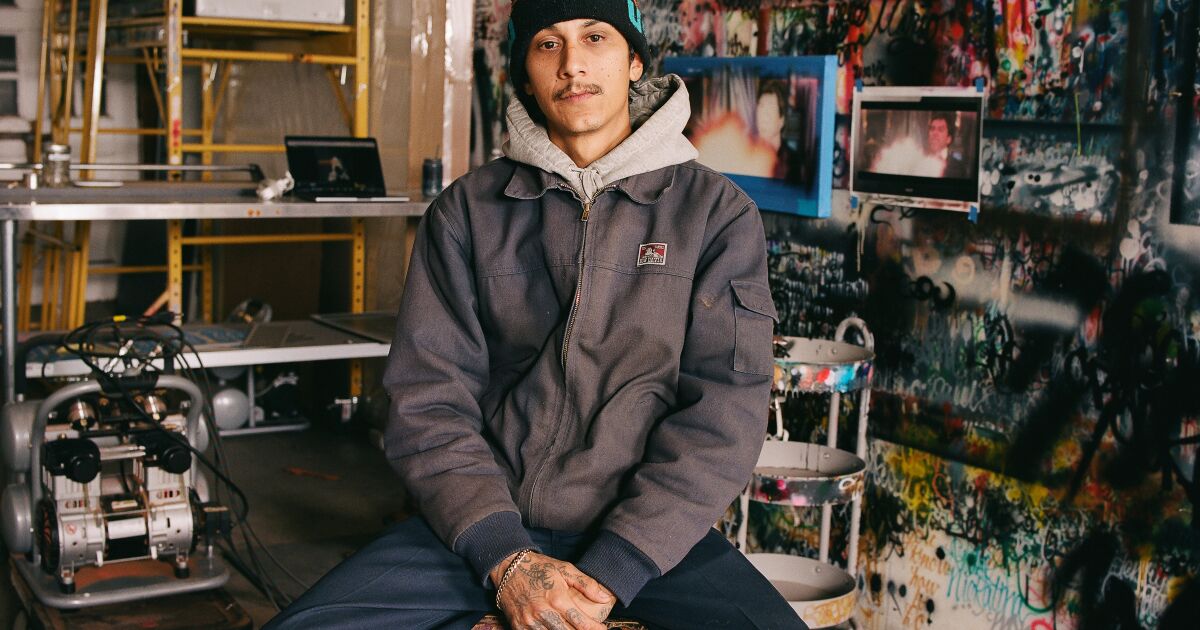
Mario Ayala in his studio
(Star Montana / For The Times)
This story is part of “Corpo RanfLA: Terra Cruiser,” a special collaboration between rafa esparza, Image magazine and Commonwealth and Council. See how the whole project came to be here.
A lot of my work is autobiographical, alludes to some of my family’s history. I’m very close to my father — he’s a truck driver, and a car fan himself, of older cars specifically. Those have become interests of mine, through him. The moments that stick out are being with my father and him showing some importance to cars, almost as sculptures. I’m similarly interested in cars through painting, form, color and imagery — all the components that come through customization.
I met rafa esparza through a friend of mine, Guadalupe Rosales. I was really intrigued by how rafa’s performances are somewhat sculptural, powerfully cleansing. Growing up with grandparents who were from Cuba, who practiced Santeria, I think traditions and celebrations have always been interesting to me. I’d been a fan of rafa’s work when, in 2018, he asked me to collaborate on the first version of the “Corpo Ranfla” project. He knew that I airbrushed and was also thinking about how the mechanics of a car machine resemble parts of the human body — are kind of extensions of them in some ways. He decided that he wanted to elaborate his project in a way where I could paint him like a car. We became better friends through that project, connecting over our fathers, interests in customization and how we create a language using a similar set of ideas.
The day I painted his body was a really intense day of having to basically make this project possible — imagining that there’d be this one day where we painted his entire body. We used a base coat of highlighter pink. The reference was from this car called Gypsy Rose, an iconic lowrider that has really bright pink base cuffs. A couple of murals were designed for his chest and his back. It was pretty laborious. It was the first time I had ever painted a body. I’m stoked that rafa asked me to be a part of his work again for Art Basel. It’s going to be a really iconic moment.
I have cars, I have lowriders. I have friends that I cruise with. It’s nothing complicated — the enjoyment of cruising or being around other cars transcends as a feeling of enjoyment of doing something outside of the studio. As much as I am enamored with the Baroque aesthetic of how some of the vehicles look, sometimes the hang is purely out of a fundamental necessity to hang out. It’s almost simple, in comparison with how heavy and technical the rest of other things in life can be.

Like rafa esparza, Mario Ayala is interested in “how the mechanics of a car machine resemble parts of the human body.”
(Star Montana / For The Times)
I feel like my friends and family and community here outshine any motif that I have in a painting. That comes through the work in some other visual way. For example, I curated this group show at this gallery called Public Access in New York. It was more about showing a group of friends, including rafa — I wanted them to have a conversation with one another. I didn’t really think too much about making something; it was more about this communal hang, if you will, that I wanted to construct and coordinate. Sometimes I feel like those are the stronger pieces — the ones that I’m responsible for, like some type of glue.

Mario Ayala in his studio
(Star Montana / For The Times)
This story is part of “Corpo RanfLA: Terra Cruiser,” a special collaboration between rafa esparza, Image magazine and Commonwealth and Council. See how the whole project came to be here.
A lot of my work is autobiographical, alludes to some of my family’s history. I’m very close to my father — he’s a truck driver, and a car fan himself, of older cars specifically. Those have become interests of mine, through him. The moments that stick out are being with my father and him showing some importance to cars, almost as sculptures. I’m similarly interested in cars through painting, form, color and imagery — all the components that come through customization.
I met rafa esparza through a friend of mine, Guadalupe Rosales. I was really intrigued by how rafa’s performances are somewhat sculptural, powerfully cleansing. Growing up with grandparents who were from Cuba, who practiced Santeria, I think traditions and celebrations have always been interesting to me. I’d been a fan of rafa’s work when, in 2018, he asked me to collaborate on the first version of the “Corpo Ranfla” project. He knew that I airbrushed and was also thinking about how the mechanics of a car machine resemble parts of the human body — are kind of extensions of them in some ways. He decided that he wanted to elaborate his project in a way where I could paint him like a car. We became better friends through that project, connecting over our fathers, interests in customization and how we create a language using a similar set of ideas.
The day I painted his body was a really intense day of having to basically make this project possible — imagining that there’d be this one day where we painted his entire body. We used a base coat of highlighter pink. The reference was from this car called Gypsy Rose, an iconic lowrider that has really bright pink base cuffs. A couple of murals were designed for his chest and his back. It was pretty laborious. It was the first time I had ever painted a body. I’m stoked that rafa asked me to be a part of his work again for Art Basel. It’s going to be a really iconic moment.
I have cars, I have lowriders. I have friends that I cruise with. It’s nothing complicated — the enjoyment of cruising or being around other cars transcends as a feeling of enjoyment of doing something outside of the studio. As much as I am enamored with the Baroque aesthetic of how some of the vehicles look, sometimes the hang is purely out of a fundamental necessity to hang out. It’s almost simple, in comparison with how heavy and technical the rest of other things in life can be.
Like rafa esparza, Mario Ayala is interested in “how the mechanics of a car machine resemble parts of the human body.”
(Star Montana / For The Times)
I feel like my friends and family and community here outshine any motif that I have in a painting. That comes through the work in some other visual way. For example, I curated this group show at this gallery called Public Access in New York. It was more about showing a group of friends, including rafa — I wanted them to have a conversation with one another. I didn’t really think too much about making something; it was more about this communal hang, if you will, that I wanted to construct and coordinate. Sometimes I feel like those are the stronger pieces — the ones that I’m responsible for, like some type of glue.

Mario Ayala in his studio
(Star Montana / For The Times)
This story is part of “Corpo RanfLA: Terra Cruiser,” a special collaboration between rafa esparza, Image magazine and Commonwealth and Council. See how the whole project came to be here.
A lot of my work is autobiographical, alludes to some of my family’s history. I’m very close to my father — he’s a truck driver, and a car fan himself, of older cars specifically. Those have become interests of mine, through him. The moments that stick out are being with my father and him showing some importance to cars, almost as sculptures. I’m similarly interested in cars through painting, form, color and imagery — all the components that come through customization.
I met rafa esparza through a friend of mine, Guadalupe Rosales. I was really intrigued by how rafa’s performances are somewhat sculptural, powerfully cleansing. Growing up with grandparents who were from Cuba, who practiced Santeria, I think traditions and celebrations have always been interesting to me. I’d been a fan of rafa’s work when, in 2018, he asked me to collaborate on the first version of the “Corpo Ranfla” project. He knew that I airbrushed and was also thinking about how the mechanics of a car machine resemble parts of the human body — are kind of extensions of them in some ways. He decided that he wanted to elaborate his project in a way where I could paint him like a car. We became better friends through that project, connecting over our fathers, interests in customization and how we create a language using a similar set of ideas.
The day I painted his body was a really intense day of having to basically make this project possible — imagining that there’d be this one day where we painted his entire body. We used a base coat of highlighter pink. The reference was from this car called Gypsy Rose, an iconic lowrider that has really bright pink base cuffs. A couple of murals were designed for his chest and his back. It was pretty laborious. It was the first time I had ever painted a body. I’m stoked that rafa asked me to be a part of his work again for Art Basel. It’s going to be a really iconic moment.
I have cars, I have lowriders. I have friends that I cruise with. It’s nothing complicated — the enjoyment of cruising or being around other cars transcends as a feeling of enjoyment of doing something outside of the studio. As much as I am enamored with the Baroque aesthetic of how some of the vehicles look, sometimes the hang is purely out of a fundamental necessity to hang out. It’s almost simple, in comparison with how heavy and technical the rest of other things in life can be.
Like rafa esparza, Mario Ayala is interested in “how the mechanics of a car machine resemble parts of the human body.”
(Star Montana / For The Times)
I feel like my friends and family and community here outshine any motif that I have in a painting. That comes through the work in some other visual way. For example, I curated this group show at this gallery called Public Access in New York. It was more about showing a group of friends, including rafa — I wanted them to have a conversation with one another. I didn’t really think too much about making something; it was more about this communal hang, if you will, that I wanted to construct and coordinate. Sometimes I feel like those are the stronger pieces — the ones that I’m responsible for, like some type of glue.
Mario Ayala in his studio
(Star Montana / For The Times)
This story is part of “Corpo RanfLA: Terra Cruiser,” a special collaboration between rafa esparza, Image magazine and Commonwealth and Council. See how the whole project came to be here.
A lot of my work is autobiographical, alludes to some of my family’s history. I’m very close to my father — he’s a truck driver, and a car fan himself, of older cars specifically. Those have become interests of mine, through him. The moments that stick out are being with my father and him showing some importance to cars, almost as sculptures. I’m similarly interested in cars through painting, form, color and imagery — all the components that come through customization.
I met rafa esparza through a friend of mine, Guadalupe Rosales. I was really intrigued by how rafa’s performances are somewhat sculptural, powerfully cleansing. Growing up with grandparents who were from Cuba, who practiced Santeria, I think traditions and celebrations have always been interesting to me. I’d been a fan of rafa’s work when, in 2018, he asked me to collaborate on the first version of the “Corpo Ranfla” project. He knew that I airbrushed and was also thinking about how the mechanics of a car machine resemble parts of the human body — are kind of extensions of them in some ways. He decided that he wanted to elaborate his project in a way where I could paint him like a car. We became better friends through that project, connecting over our fathers, interests in customization and how we create a language using a similar set of ideas.
The day I painted his body was a really intense day of having to basically make this project possible — imagining that there’d be this one day where we painted his entire body. We used a base coat of highlighter pink. The reference was from this car called Gypsy Rose, an iconic lowrider that has really bright pink base cuffs. A couple of murals were designed for his chest and his back. It was pretty laborious. It was the first time I had ever painted a body. I’m stoked that rafa asked me to be a part of his work again for Art Basel. It’s going to be a really iconic moment.
I have cars, I have lowriders. I have friends that I cruise with. It’s nothing complicated — the enjoyment of cruising or being around other cars transcends as a feeling of enjoyment of doing something outside of the studio. As much as I am enamored with the Baroque aesthetic of how some of the vehicles look, sometimes the hang is purely out of a fundamental necessity to hang out. It’s almost simple, in comparison with how heavy and technical the rest of other things in life can be.
Like rafa esparza, Mario Ayala is interested in “how the mechanics of a car machine resemble parts of the human body.”
(Star Montana / For The Times)
I feel like my friends and family and community here outshine any motif that I have in a painting. That comes through the work in some other visual way. For example, I curated this group show at this gallery called Public Access in New York. It was more about showing a group of friends, including rafa — I wanted them to have a conversation with one another. I didn’t really think too much about making something; it was more about this communal hang, if you will, that I wanted to construct and coordinate. Sometimes I feel like those are the stronger pieces — the ones that I’m responsible for, like some type of glue.

Mario Ayala in his studio
(Star Montana / For The Times)
This story is part of “Corpo RanfLA: Terra Cruiser,” a special collaboration between rafa esparza, Image magazine and Commonwealth and Council. See how the whole project came to be here.
A lot of my work is autobiographical, alludes to some of my family’s history. I’m very close to my father — he’s a truck driver, and a car fan himself, of older cars specifically. Those have become interests of mine, through him. The moments that stick out are being with my father and him showing some importance to cars, almost as sculptures. I’m similarly interested in cars through painting, form, color and imagery — all the components that come through customization.
I met rafa esparza through a friend of mine, Guadalupe Rosales. I was really intrigued by how rafa’s performances are somewhat sculptural, powerfully cleansing. Growing up with grandparents who were from Cuba, who practiced Santeria, I think traditions and celebrations have always been interesting to me. I’d been a fan of rafa’s work when, in 2018, he asked me to collaborate on the first version of the “Corpo Ranfla” project. He knew that I airbrushed and was also thinking about how the mechanics of a car machine resemble parts of the human body — are kind of extensions of them in some ways. He decided that he wanted to elaborate his project in a way where I could paint him like a car. We became better friends through that project, connecting over our fathers, interests in customization and how we create a language using a similar set of ideas.
The day I painted his body was a really intense day of having to basically make this project possible — imagining that there’d be this one day where we painted his entire body. We used a base coat of highlighter pink. The reference was from this car called Gypsy Rose, an iconic lowrider that has really bright pink base cuffs. A couple of murals were designed for his chest and his back. It was pretty laborious. It was the first time I had ever painted a body. I’m stoked that rafa asked me to be a part of his work again for Art Basel. It’s going to be a really iconic moment.
I have cars, I have lowriders. I have friends that I cruise with. It’s nothing complicated — the enjoyment of cruising or being around other cars transcends as a feeling of enjoyment of doing something outside of the studio. As much as I am enamored with the Baroque aesthetic of how some of the vehicles look, sometimes the hang is purely out of a fundamental necessity to hang out. It’s almost simple, in comparison with how heavy and technical the rest of other things in life can be.
Like rafa esparza, Mario Ayala is interested in “how the mechanics of a car machine resemble parts of the human body.”
(Star Montana / For The Times)
I feel like my friends and family and community here outshine any motif that I have in a painting. That comes through the work in some other visual way. For example, I curated this group show at this gallery called Public Access in New York. It was more about showing a group of friends, including rafa — I wanted them to have a conversation with one another. I didn’t really think too much about making something; it was more about this communal hang, if you will, that I wanted to construct and coordinate. Sometimes I feel like those are the stronger pieces — the ones that I’m responsible for, like some type of glue.
Mario Ayala in his studio
(Star Montana / For The Times)
This story is part of “Corpo RanfLA: Terra Cruiser,” a special collaboration between rafa esparza, Image magazine and Commonwealth and Council. See how the whole project came to be here.
A lot of my work is autobiographical, alludes to some of my family’s history. I’m very close to my father — he’s a truck driver, and a car fan himself, of older cars specifically. Those have become interests of mine, through him. The moments that stick out are being with my father and him showing some importance to cars, almost as sculptures. I’m similarly interested in cars through painting, form, color and imagery — all the components that come through customization.
I met rafa esparza through a friend of mine, Guadalupe Rosales. I was really intrigued by how rafa’s performances are somewhat sculptural, powerfully cleansing. Growing up with grandparents who were from Cuba, who practiced Santeria, I think traditions and celebrations have always been interesting to me. I’d been a fan of rafa’s work when, in 2018, he asked me to collaborate on the first version of the “Corpo Ranfla” project. He knew that I airbrushed and was also thinking about how the mechanics of a car machine resemble parts of the human body — are kind of extensions of them in some ways. He decided that he wanted to elaborate his project in a way where I could paint him like a car. We became better friends through that project, connecting over our fathers, interests in customization and how we create a language using a similar set of ideas.
The day I painted his body was a really intense day of having to basically make this project possible — imagining that there’d be this one day where we painted his entire body. We used a base coat of highlighter pink. The reference was from this car called Gypsy Rose, an iconic lowrider that has really bright pink base cuffs. A couple of murals were designed for his chest and his back. It was pretty laborious. It was the first time I had ever painted a body. I’m stoked that rafa asked me to be a part of his work again for Art Basel. It’s going to be a really iconic moment.
I have cars, I have lowriders. I have friends that I cruise with. It’s nothing complicated — the enjoyment of cruising or being around other cars transcends as a feeling of enjoyment of doing something outside of the studio. As much as I am enamored with the Baroque aesthetic of how some of the vehicles look, sometimes the hang is purely out of a fundamental necessity to hang out. It’s almost simple, in comparison with how heavy and technical the rest of other things in life can be.
Like rafa esparza, Mario Ayala is interested in “how the mechanics of a car machine resemble parts of the human body.”
(Star Montana / For The Times)
I feel like my friends and family and community here outshine any motif that I have in a painting. That comes through the work in some other visual way. For example, I curated this group show at this gallery called Public Access in New York. It was more about showing a group of friends, including rafa — I wanted them to have a conversation with one another. I didn’t really think too much about making something; it was more about this communal hang, if you will, that I wanted to construct and coordinate. Sometimes I feel like those are the stronger pieces — the ones that I’m responsible for, like some type of glue.
Mario Ayala in his studio
(Star Montana / For The Times)
This story is part of “Corpo RanfLA: Terra Cruiser,” a special collaboration between rafa esparza, Image magazine and Commonwealth and Council. See how the whole project came to be here.
A lot of my work is autobiographical, alludes to some of my family’s history. I’m very close to my father — he’s a truck driver, and a car fan himself, of older cars specifically. Those have become interests of mine, through him. The moments that stick out are being with my father and him showing some importance to cars, almost as sculptures. I’m similarly interested in cars through painting, form, color and imagery — all the components that come through customization.
I met rafa esparza through a friend of mine, Guadalupe Rosales. I was really intrigued by how rafa’s performances are somewhat sculptural, powerfully cleansing. Growing up with grandparents who were from Cuba, who practiced Santeria, I think traditions and celebrations have always been interesting to me. I’d been a fan of rafa’s work when, in 2018, he asked me to collaborate on the first version of the “Corpo Ranfla” project. He knew that I airbrushed and was also thinking about how the mechanics of a car machine resemble parts of the human body — are kind of extensions of them in some ways. He decided that he wanted to elaborate his project in a way where I could paint him like a car. We became better friends through that project, connecting over our fathers, interests in customization and how we create a language using a similar set of ideas.
The day I painted his body was a really intense day of having to basically make this project possible — imagining that there’d be this one day where we painted his entire body. We used a base coat of highlighter pink. The reference was from this car called Gypsy Rose, an iconic lowrider that has really bright pink base cuffs. A couple of murals were designed for his chest and his back. It was pretty laborious. It was the first time I had ever painted a body. I’m stoked that rafa asked me to be a part of his work again for Art Basel. It’s going to be a really iconic moment.
I have cars, I have lowriders. I have friends that I cruise with. It’s nothing complicated — the enjoyment of cruising or being around other cars transcends as a feeling of enjoyment of doing something outside of the studio. As much as I am enamored with the Baroque aesthetic of how some of the vehicles look, sometimes the hang is purely out of a fundamental necessity to hang out. It’s almost simple, in comparison with how heavy and technical the rest of other things in life can be.
Like rafa esparza, Mario Ayala is interested in “how the mechanics of a car machine resemble parts of the human body.”
(Star Montana / For The Times)
I feel like my friends and family and community here outshine any motif that I have in a painting. That comes through the work in some other visual way. For example, I curated this group show at this gallery called Public Access in New York. It was more about showing a group of friends, including rafa — I wanted them to have a conversation with one another. I didn’t really think too much about making something; it was more about this communal hang, if you will, that I wanted to construct and coordinate. Sometimes I feel like those are the stronger pieces — the ones that I’m responsible for, like some type of glue.
Mario Ayala in his studio
(Star Montana / For The Times)
This story is part of “Corpo RanfLA: Terra Cruiser,” a special collaboration between rafa esparza, Image magazine and Commonwealth and Council. See how the whole project came to be here.
A lot of my work is autobiographical, alludes to some of my family’s history. I’m very close to my father — he’s a truck driver, and a car fan himself, of older cars specifically. Those have become interests of mine, through him. The moments that stick out are being with my father and him showing some importance to cars, almost as sculptures. I’m similarly interested in cars through painting, form, color and imagery — all the components that come through customization.
I met rafa esparza through a friend of mine, Guadalupe Rosales. I was really intrigued by how rafa’s performances are somewhat sculptural, powerfully cleansing. Growing up with grandparents who were from Cuba, who practiced Santeria, I think traditions and celebrations have always been interesting to me. I’d been a fan of rafa’s work when, in 2018, he asked me to collaborate on the first version of the “Corpo Ranfla” project. He knew that I airbrushed and was also thinking about how the mechanics of a car machine resemble parts of the human body — are kind of extensions of them in some ways. He decided that he wanted to elaborate his project in a way where I could paint him like a car. We became better friends through that project, connecting over our fathers, interests in customization and how we create a language using a similar set of ideas.
The day I painted his body was a really intense day of having to basically make this project possible — imagining that there’d be this one day where we painted his entire body. We used a base coat of highlighter pink. The reference was from this car called Gypsy Rose, an iconic lowrider that has really bright pink base cuffs. A couple of murals were designed for his chest and his back. It was pretty laborious. It was the first time I had ever painted a body. I’m stoked that rafa asked me to be a part of his work again for Art Basel. It’s going to be a really iconic moment.
I have cars, I have lowriders. I have friends that I cruise with. It’s nothing complicated — the enjoyment of cruising or being around other cars transcends as a feeling of enjoyment of doing something outside of the studio. As much as I am enamored with the Baroque aesthetic of how some of the vehicles look, sometimes the hang is purely out of a fundamental necessity to hang out. It’s almost simple, in comparison with how heavy and technical the rest of other things in life can be.
Like rafa esparza, Mario Ayala is interested in “how the mechanics of a car machine resemble parts of the human body.”
(Star Montana / For The Times)
I feel like my friends and family and community here outshine any motif that I have in a painting. That comes through the work in some other visual way. For example, I curated this group show at this gallery called Public Access in New York. It was more about showing a group of friends, including rafa — I wanted them to have a conversation with one another. I didn’t really think too much about making something; it was more about this communal hang, if you will, that I wanted to construct and coordinate. Sometimes I feel like those are the stronger pieces — the ones that I’m responsible for, like some type of glue.

Mario Ayala in his studio
(Star Montana / For The Times)
This story is part of “Corpo RanfLA: Terra Cruiser,” a special collaboration between rafa esparza, Image magazine and Commonwealth and Council. See how the whole project came to be here.
A lot of my work is autobiographical, alludes to some of my family’s history. I’m very close to my father — he’s a truck driver, and a car fan himself, of older cars specifically. Those have become interests of mine, through him. The moments that stick out are being with my father and him showing some importance to cars, almost as sculptures. I’m similarly interested in cars through painting, form, color and imagery — all the components that come through customization.
I met rafa esparza through a friend of mine, Guadalupe Rosales. I was really intrigued by how rafa’s performances are somewhat sculptural, powerfully cleansing. Growing up with grandparents who were from Cuba, who practiced Santeria, I think traditions and celebrations have always been interesting to me. I’d been a fan of rafa’s work when, in 2018, he asked me to collaborate on the first version of the “Corpo Ranfla” project. He knew that I airbrushed and was also thinking about how the mechanics of a car machine resemble parts of the human body — are kind of extensions of them in some ways. He decided that he wanted to elaborate his project in a way where I could paint him like a car. We became better friends through that project, connecting over our fathers, interests in customization and how we create a language using a similar set of ideas.
The day I painted his body was a really intense day of having to basically make this project possible — imagining that there’d be this one day where we painted his entire body. We used a base coat of highlighter pink. The reference was from this car called Gypsy Rose, an iconic lowrider that has really bright pink base cuffs. A couple of murals were designed for his chest and his back. It was pretty laborious. It was the first time I had ever painted a body. I’m stoked that rafa asked me to be a part of his work again for Art Basel. It’s going to be a really iconic moment.
I have cars, I have lowriders. I have friends that I cruise with. It’s nothing complicated — the enjoyment of cruising or being around other cars transcends as a feeling of enjoyment of doing something outside of the studio. As much as I am enamored with the Baroque aesthetic of how some of the vehicles look, sometimes the hang is purely out of a fundamental necessity to hang out. It’s almost simple, in comparison with how heavy and technical the rest of other things in life can be.
Like rafa esparza, Mario Ayala is interested in “how the mechanics of a car machine resemble parts of the human body.”
(Star Montana / For The Times)
I feel like my friends and family and community here outshine any motif that I have in a painting. That comes through the work in some other visual way. For example, I curated this group show at this gallery called Public Access in New York. It was more about showing a group of friends, including rafa — I wanted them to have a conversation with one another. I didn’t really think too much about making something; it was more about this communal hang, if you will, that I wanted to construct and coordinate. Sometimes I feel like those are the stronger pieces — the ones that I’m responsible for, like some type of glue.
Mario Ayala in his studio
(Star Montana / For The Times)
This story is part of “Corpo RanfLA: Terra Cruiser,” a special collaboration between rafa esparza, Image magazine and Commonwealth and Council. See how the whole project came to be here.
A lot of my work is autobiographical, alludes to some of my family’s history. I’m very close to my father — he’s a truck driver, and a car fan himself, of older cars specifically. Those have become interests of mine, through him. The moments that stick out are being with my father and him showing some importance to cars, almost as sculptures. I’m similarly interested in cars through painting, form, color and imagery — all the components that come through customization.
I met rafa esparza through a friend of mine, Guadalupe Rosales. I was really intrigued by how rafa’s performances are somewhat sculptural, powerfully cleansing. Growing up with grandparents who were from Cuba, who practiced Santeria, I think traditions and celebrations have always been interesting to me. I’d been a fan of rafa’s work when, in 2018, he asked me to collaborate on the first version of the “Corpo Ranfla” project. He knew that I airbrushed and was also thinking about how the mechanics of a car machine resemble parts of the human body — are kind of extensions of them in some ways. He decided that he wanted to elaborate his project in a way where I could paint him like a car. We became better friends through that project, connecting over our fathers, interests in customization and how we create a language using a similar set of ideas.
The day I painted his body was a really intense day of having to basically make this project possible — imagining that there’d be this one day where we painted his entire body. We used a base coat of highlighter pink. The reference was from this car called Gypsy Rose, an iconic lowrider that has really bright pink base cuffs. A couple of murals were designed for his chest and his back. It was pretty laborious. It was the first time I had ever painted a body. I’m stoked that rafa asked me to be a part of his work again for Art Basel. It’s going to be a really iconic moment.
I have cars, I have lowriders. I have friends that I cruise with. It’s nothing complicated — the enjoyment of cruising or being around other cars transcends as a feeling of enjoyment of doing something outside of the studio. As much as I am enamored with the Baroque aesthetic of how some of the vehicles look, sometimes the hang is purely out of a fundamental necessity to hang out. It’s almost simple, in comparison with how heavy and technical the rest of other things in life can be.
Like rafa esparza, Mario Ayala is interested in “how the mechanics of a car machine resemble parts of the human body.”
(Star Montana / For The Times)
I feel like my friends and family and community here outshine any motif that I have in a painting. That comes through the work in some other visual way. For example, I curated this group show at this gallery called Public Access in New York. It was more about showing a group of friends, including rafa — I wanted them to have a conversation with one another. I didn’t really think too much about making something; it was more about this communal hang, if you will, that I wanted to construct and coordinate. Sometimes I feel like those are the stronger pieces — the ones that I’m responsible for, like some type of glue.
Mario Ayala in his studio
(Star Montana / For The Times)
This story is part of “Corpo RanfLA: Terra Cruiser,” a special collaboration between rafa esparza, Image magazine and Commonwealth and Council. See how the whole project came to be here.
A lot of my work is autobiographical, alludes to some of my family’s history. I’m very close to my father — he’s a truck driver, and a car fan himself, of older cars specifically. Those have become interests of mine, through him. The moments that stick out are being with my father and him showing some importance to cars, almost as sculptures. I’m similarly interested in cars through painting, form, color and imagery — all the components that come through customization.
I met rafa esparza through a friend of mine, Guadalupe Rosales. I was really intrigued by how rafa’s performances are somewhat sculptural, powerfully cleansing. Growing up with grandparents who were from Cuba, who practiced Santeria, I think traditions and celebrations have always been interesting to me. I’d been a fan of rafa’s work when, in 2018, he asked me to collaborate on the first version of the “Corpo Ranfla” project. He knew that I airbrushed and was also thinking about how the mechanics of a car machine resemble parts of the human body — are kind of extensions of them in some ways. He decided that he wanted to elaborate his project in a way where I could paint him like a car. We became better friends through that project, connecting over our fathers, interests in customization and how we create a language using a similar set of ideas.
The day I painted his body was a really intense day of having to basically make this project possible — imagining that there’d be this one day where we painted his entire body. We used a base coat of highlighter pink. The reference was from this car called Gypsy Rose, an iconic lowrider that has really bright pink base cuffs. A couple of murals were designed for his chest and his back. It was pretty laborious. It was the first time I had ever painted a body. I’m stoked that rafa asked me to be a part of his work again for Art Basel. It’s going to be a really iconic moment.
I have cars, I have lowriders. I have friends that I cruise with. It’s nothing complicated — the enjoyment of cruising or being around other cars transcends as a feeling of enjoyment of doing something outside of the studio. As much as I am enamored with the Baroque aesthetic of how some of the vehicles look, sometimes the hang is purely out of a fundamental necessity to hang out. It’s almost simple, in comparison with how heavy and technical the rest of other things in life can be.
Like rafa esparza, Mario Ayala is interested in “how the mechanics of a car machine resemble parts of the human body.”
(Star Montana / For The Times)
I feel like my friends and family and community here outshine any motif that I have in a painting. That comes through the work in some other visual way. For example, I curated this group show at this gallery called Public Access in New York. It was more about showing a group of friends, including rafa — I wanted them to have a conversation with one another. I didn’t really think too much about making something; it was more about this communal hang, if you will, that I wanted to construct and coordinate. Sometimes I feel like those are the stronger pieces — the ones that I’m responsible for, like some type of glue.
Mario Ayala in his studio
(Star Montana / For The Times)
This story is part of “Corpo RanfLA: Terra Cruiser,” a special collaboration between rafa esparza, Image magazine and Commonwealth and Council. See how the whole project came to be here.
A lot of my work is autobiographical, alludes to some of my family’s history. I’m very close to my father — he’s a truck driver, and a car fan himself, of older cars specifically. Those have become interests of mine, through him. The moments that stick out are being with my father and him showing some importance to cars, almost as sculptures. I’m similarly interested in cars through painting, form, color and imagery — all the components that come through customization.
I met rafa esparza through a friend of mine, Guadalupe Rosales. I was really intrigued by how rafa’s performances are somewhat sculptural, powerfully cleansing. Growing up with grandparents who were from Cuba, who practiced Santeria, I think traditions and celebrations have always been interesting to me. I’d been a fan of rafa’s work when, in 2018, he asked me to collaborate on the first version of the “Corpo Ranfla” project. He knew that I airbrushed and was also thinking about how the mechanics of a car machine resemble parts of the human body — are kind of extensions of them in some ways. He decided that he wanted to elaborate his project in a way where I could paint him like a car. We became better friends through that project, connecting over our fathers, interests in customization and how we create a language using a similar set of ideas.
The day I painted his body was a really intense day of having to basically make this project possible — imagining that there’d be this one day where we painted his entire body. We used a base coat of highlighter pink. The reference was from this car called Gypsy Rose, an iconic lowrider that has really bright pink base cuffs. A couple of murals were designed for his chest and his back. It was pretty laborious. It was the first time I had ever painted a body. I’m stoked that rafa asked me to be a part of his work again for Art Basel. It’s going to be a really iconic moment.
I have cars, I have lowriders. I have friends that I cruise with. It’s nothing complicated — the enjoyment of cruising or being around other cars transcends as a feeling of enjoyment of doing something outside of the studio. As much as I am enamored with the Baroque aesthetic of how some of the vehicles look, sometimes the hang is purely out of a fundamental necessity to hang out. It’s almost simple, in comparison with how heavy and technical the rest of other things in life can be.
Like rafa esparza, Mario Ayala is interested in “how the mechanics of a car machine resemble parts of the human body.”
(Star Montana / For The Times)
I feel like my friends and family and community here outshine any motif that I have in a painting. That comes through the work in some other visual way. For example, I curated this group show at this gallery called Public Access in New York. It was more about showing a group of friends, including rafa — I wanted them to have a conversation with one another. I didn’t really think too much about making something; it was more about this communal hang, if you will, that I wanted to construct and coordinate. Sometimes I feel like those are the stronger pieces — the ones that I’m responsible for, like some type of glue.
Mario Ayala in his studio
(Star Montana / For The Times)
This story is part of “Corpo RanfLA: Terra Cruiser,” a special collaboration between rafa esparza, Image magazine and Commonwealth and Council. See how the whole project came to be here.
A lot of my work is autobiographical, alludes to some of my family’s history. I’m very close to my father — he’s a truck driver, and a car fan himself, of older cars specifically. Those have become interests of mine, through him. The moments that stick out are being with my father and him showing some importance to cars, almost as sculptures. I’m similarly interested in cars through painting, form, color and imagery — all the components that come through customization.
I met rafa esparza through a friend of mine, Guadalupe Rosales. I was really intrigued by how rafa’s performances are somewhat sculptural, powerfully cleansing. Growing up with grandparents who were from Cuba, who practiced Santeria, I think traditions and celebrations have always been interesting to me. I’d been a fan of rafa’s work when, in 2018, he asked me to collaborate on the first version of the “Corpo Ranfla” project. He knew that I airbrushed and was also thinking about how the mechanics of a car machine resemble parts of the human body — are kind of extensions of them in some ways. He decided that he wanted to elaborate his project in a way where I could paint him like a car. We became better friends through that project, connecting over our fathers, interests in customization and how we create a language using a similar set of ideas.
The day I painted his body was a really intense day of having to basically make this project possible — imagining that there’d be this one day where we painted his entire body. We used a base coat of highlighter pink. The reference was from this car called Gypsy Rose, an iconic lowrider that has really bright pink base cuffs. A couple of murals were designed for his chest and his back. It was pretty laborious. It was the first time I had ever painted a body. I’m stoked that rafa asked me to be a part of his work again for Art Basel. It’s going to be a really iconic moment.
I have cars, I have lowriders. I have friends that I cruise with. It’s nothing complicated — the enjoyment of cruising or being around other cars transcends as a feeling of enjoyment of doing something outside of the studio. As much as I am enamored with the Baroque aesthetic of how some of the vehicles look, sometimes the hang is purely out of a fundamental necessity to hang out. It’s almost simple, in comparison with how heavy and technical the rest of other things in life can be.
Like rafa esparza, Mario Ayala is interested in “how the mechanics of a car machine resemble parts of the human body.”
(Star Montana / For The Times)
I feel like my friends and family and community here outshine any motif that I have in a painting. That comes through the work in some other visual way. For example, I curated this group show at this gallery called Public Access in New York. It was more about showing a group of friends, including rafa — I wanted them to have a conversation with one another. I didn’t really think too much about making something; it was more about this communal hang, if you will, that I wanted to construct and coordinate. Sometimes I feel like those are the stronger pieces — the ones that I’m responsible for, like some type of glue.
Mario Ayala in his studio
(Star Montana / For The Times)
This story is part of “Corpo RanfLA: Terra Cruiser,” a special collaboration between rafa esparza, Image magazine and Commonwealth and Council. See how the whole project came to be here.
A lot of my work is autobiographical, alludes to some of my family’s history. I’m very close to my father — he’s a truck driver, and a car fan himself, of older cars specifically. Those have become interests of mine, through him. The moments that stick out are being with my father and him showing some importance to cars, almost as sculptures. I’m similarly interested in cars through painting, form, color and imagery — all the components that come through customization.
I met rafa esparza through a friend of mine, Guadalupe Rosales. I was really intrigued by how rafa’s performances are somewhat sculptural, powerfully cleansing. Growing up with grandparents who were from Cuba, who practiced Santeria, I think traditions and celebrations have always been interesting to me. I’d been a fan of rafa’s work when, in 2018, he asked me to collaborate on the first version of the “Corpo Ranfla” project. He knew that I airbrushed and was also thinking about how the mechanics of a car machine resemble parts of the human body — are kind of extensions of them in some ways. He decided that he wanted to elaborate his project in a way where I could paint him like a car. We became better friends through that project, connecting over our fathers, interests in customization and how we create a language using a similar set of ideas.
The day I painted his body was a really intense day of having to basically make this project possible — imagining that there’d be this one day where we painted his entire body. We used a base coat of highlighter pink. The reference was from this car called Gypsy Rose, an iconic lowrider that has really bright pink base cuffs. A couple of murals were designed for his chest and his back. It was pretty laborious. It was the first time I had ever painted a body. I’m stoked that rafa asked me to be a part of his work again for Art Basel. It’s going to be a really iconic moment.
I have cars, I have lowriders. I have friends that I cruise with. It’s nothing complicated — the enjoyment of cruising or being around other cars transcends as a feeling of enjoyment of doing something outside of the studio. As much as I am enamored with the Baroque aesthetic of how some of the vehicles look, sometimes the hang is purely out of a fundamental necessity to hang out. It’s almost simple, in comparison with how heavy and technical the rest of other things in life can be.
Like rafa esparza, Mario Ayala is interested in “how the mechanics of a car machine resemble parts of the human body.”
(Star Montana / For The Times)
I feel like my friends and family and community here outshine any motif that I have in a painting. That comes through the work in some other visual way. For example, I curated this group show at this gallery called Public Access in New York. It was more about showing a group of friends, including rafa — I wanted them to have a conversation with one another. I didn’t really think too much about making something; it was more about this communal hang, if you will, that I wanted to construct and coordinate. Sometimes I feel like those are the stronger pieces — the ones that I’m responsible for, like some type of glue.
Mario Ayala in his studio
(Star Montana / For The Times)
This story is part of “Corpo RanfLA: Terra Cruiser,” a special collaboration between rafa esparza, Image magazine and Commonwealth and Council. See how the whole project came to be here.
A lot of my work is autobiographical, alludes to some of my family’s history. I’m very close to my father — he’s a truck driver, and a car fan himself, of older cars specifically. Those have become interests of mine, through him. The moments that stick out are being with my father and him showing some importance to cars, almost as sculptures. I’m similarly interested in cars through painting, form, color and imagery — all the components that come through customization.
I met rafa esparza through a friend of mine, Guadalupe Rosales. I was really intrigued by how rafa’s performances are somewhat sculptural, powerfully cleansing. Growing up with grandparents who were from Cuba, who practiced Santeria, I think traditions and celebrations have always been interesting to me. I’d been a fan of rafa’s work when, in 2018, he asked me to collaborate on the first version of the “Corpo Ranfla” project. He knew that I airbrushed and was also thinking about how the mechanics of a car machine resemble parts of the human body — are kind of extensions of them in some ways. He decided that he wanted to elaborate his project in a way where I could paint him like a car. We became better friends through that project, connecting over our fathers, interests in customization and how we create a language using a similar set of ideas.
The day I painted his body was a really intense day of having to basically make this project possible — imagining that there’d be this one day where we painted his entire body. We used a base coat of highlighter pink. The reference was from this car called Gypsy Rose, an iconic lowrider that has really bright pink base cuffs. A couple of murals were designed for his chest and his back. It was pretty laborious. It was the first time I had ever painted a body. I’m stoked that rafa asked me to be a part of his work again for Art Basel. It’s going to be a really iconic moment.
I have cars, I have lowriders. I have friends that I cruise with. It’s nothing complicated — the enjoyment of cruising or being around other cars transcends as a feeling of enjoyment of doing something outside of the studio. As much as I am enamored with the Baroque aesthetic of how some of the vehicles look, sometimes the hang is purely out of a fundamental necessity to hang out. It’s almost simple, in comparison with how heavy and technical the rest of other things in life can be.
Like rafa esparza, Mario Ayala is interested in “how the mechanics of a car machine resemble parts of the human body.”
(Star Montana / For The Times)
I feel like my friends and family and community here outshine any motif that I have in a painting. That comes through the work in some other visual way. For example, I curated this group show at this gallery called Public Access in New York. It was more about showing a group of friends, including rafa — I wanted them to have a conversation with one another. I didn’t really think too much about making something; it was more about this communal hang, if you will, that I wanted to construct and coordinate. Sometimes I feel like those are the stronger pieces — the ones that I’m responsible for, like some type of glue.
Mario Ayala in his studio
(Star Montana / For The Times)
This story is part of “Corpo RanfLA: Terra Cruiser,” a special collaboration between rafa esparza, Image magazine and Commonwealth and Council. See how the whole project came to be here.
A lot of my work is autobiographical, alludes to some of my family’s history. I’m very close to my father — he’s a truck driver, and a car fan himself, of older cars specifically. Those have become interests of mine, through him. The moments that stick out are being with my father and him showing some importance to cars, almost as sculptures. I’m similarly interested in cars through painting, form, color and imagery — all the components that come through customization.
I met rafa esparza through a friend of mine, Guadalupe Rosales. I was really intrigued by how rafa’s performances are somewhat sculptural, powerfully cleansing. Growing up with grandparents who were from Cuba, who practiced Santeria, I think traditions and celebrations have always been interesting to me. I’d been a fan of rafa’s work when, in 2018, he asked me to collaborate on the first version of the “Corpo Ranfla” project. He knew that I airbrushed and was also thinking about how the mechanics of a car machine resemble parts of the human body — are kind of extensions of them in some ways. He decided that he wanted to elaborate his project in a way where I could paint him like a car. We became better friends through that project, connecting over our fathers, interests in customization and how we create a language using a similar set of ideas.
The day I painted his body was a really intense day of having to basically make this project possible — imagining that there’d be this one day where we painted his entire body. We used a base coat of highlighter pink. The reference was from this car called Gypsy Rose, an iconic lowrider that has really bright pink base cuffs. A couple of murals were designed for his chest and his back. It was pretty laborious. It was the first time I had ever painted a body. I’m stoked that rafa asked me to be a part of his work again for Art Basel. It’s going to be a really iconic moment.
I have cars, I have lowriders. I have friends that I cruise with. It’s nothing complicated — the enjoyment of cruising or being around other cars transcends as a feeling of enjoyment of doing something outside of the studio. As much as I am enamored with the Baroque aesthetic of how some of the vehicles look, sometimes the hang is purely out of a fundamental necessity to hang out. It’s almost simple, in comparison with how heavy and technical the rest of other things in life can be.
Like rafa esparza, Mario Ayala is interested in “how the mechanics of a car machine resemble parts of the human body.”
(Star Montana / For The Times)
I feel like my friends and family and community here outshine any motif that I have in a painting. That comes through the work in some other visual way. For example, I curated this group show at this gallery called Public Access in New York. It was more about showing a group of friends, including rafa — I wanted them to have a conversation with one another. I didn’t really think too much about making something; it was more about this communal hang, if you will, that I wanted to construct and coordinate. Sometimes I feel like those are the stronger pieces — the ones that I’m responsible for, like some type of glue.

