

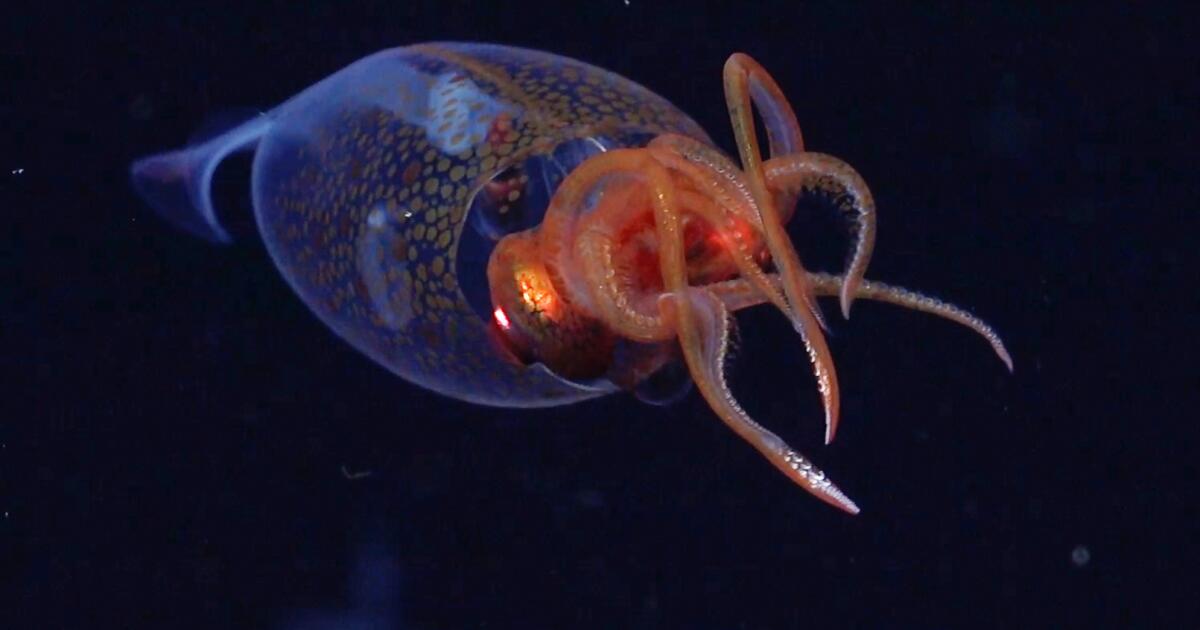

The colossal squid, the world’s largest squid species, was caught on video for the first time swimming in its natural habitat, according to a California ocean research organization.
This squid, as its name suggests, can grow to as much as 23 feet in length and 1,100 pounds — the heaviest invertebrate in the world — according to the Schmidt Ocean Institute. But the creature the institute caught on video was a footlong juvenile.
It was recorded March 9 near the South Sandwich Islands in the South Atlantic Ocean at a depth of nearly 2,000 feet, according to a news release from the nonprofit. The squid was formally named and identified in 1925 but hadn’t been recorded alive until this instance.
The squid, officially named Mesonychoteuthis hamiltoni, was recorded during a 35-day expedition that was aimed at finding new marine life, the release states. Scientists aboard the institute’s Falkor research vessel captured video of the squid with its remotely operated vehicle called SuBastian.
The squids lose their transparent bodies as they get older, and dying adults have been recorded before by fishermen, but a colossal squid hadn’t before been seen alive at such a depth.
“It’s exciting to see the first in situ footage of a juvenile colossal and humbling to think that they have no idea that humans exist,” said Kat Bolstad of the Auckland University of Technology in the release. Bolstad was consulted to verify the video, according to the institute. “For 100 years, we have mainly encountered them as prey remains in whale and seabird stomachs and as predators of harvested toothfish.”
During a January expedition, the team also captured first-time video of the glacial glass squid (called Galiteuthis glacialis), according to the institute. That creature also has never been seen alive before in its natural environment.
“The first sighting of two different squids on back-to-back expeditions is remarkable and shows how little we have seen of the magnificent inhabitants of the Southern Ocean,” Jyotika Virmani, the Schmidt Ocean Institute’s executive director, said in the release.

The colossal squid, the world’s largest squid species, was caught on video for the first time swimming in its natural habitat, according to a California ocean research organization.
This squid, as its name suggests, can grow to as much as 23 feet in length and 1,100 pounds — the heaviest invertebrate in the world — according to the Schmidt Ocean Institute. But the creature the institute caught on video was a footlong juvenile.
It was recorded March 9 near the South Sandwich Islands in the South Atlantic Ocean at a depth of nearly 2,000 feet, according to a news release from the nonprofit. The squid was formally named and identified in 1925 but hadn’t been recorded alive until this instance.
The squid, officially named Mesonychoteuthis hamiltoni, was recorded during a 35-day expedition that was aimed at finding new marine life, the release states. Scientists aboard the institute’s Falkor research vessel captured video of the squid with its remotely operated vehicle called SuBastian.
The squids lose their transparent bodies as they get older, and dying adults have been recorded before by fishermen, but a colossal squid hadn’t before been seen alive at such a depth.
“It’s exciting to see the first in situ footage of a juvenile colossal and humbling to think that they have no idea that humans exist,” said Kat Bolstad of the Auckland University of Technology in the release. Bolstad was consulted to verify the video, according to the institute. “For 100 years, we have mainly encountered them as prey remains in whale and seabird stomachs and as predators of harvested toothfish.”
During a January expedition, the team also captured first-time video of the glacial glass squid (called Galiteuthis glacialis), according to the institute. That creature also has never been seen alive before in its natural environment.
“The first sighting of two different squids on back-to-back expeditions is remarkable and shows how little we have seen of the magnificent inhabitants of the Southern Ocean,” Jyotika Virmani, the Schmidt Ocean Institute’s executive director, said in the release.

The colossal squid, the world’s largest squid species, was caught on video for the first time swimming in its natural habitat, according to a California ocean research organization.
This squid, as its name suggests, can grow to as much as 23 feet in length and 1,100 pounds — the heaviest invertebrate in the world — according to the Schmidt Ocean Institute. But the creature the institute caught on video was a footlong juvenile.
It was recorded March 9 near the South Sandwich Islands in the South Atlantic Ocean at a depth of nearly 2,000 feet, according to a news release from the nonprofit. The squid was formally named and identified in 1925 but hadn’t been recorded alive until this instance.
The squid, officially named Mesonychoteuthis hamiltoni, was recorded during a 35-day expedition that was aimed at finding new marine life, the release states. Scientists aboard the institute’s Falkor research vessel captured video of the squid with its remotely operated vehicle called SuBastian.
The squids lose their transparent bodies as they get older, and dying adults have been recorded before by fishermen, but a colossal squid hadn’t before been seen alive at such a depth.
“It’s exciting to see the first in situ footage of a juvenile colossal and humbling to think that they have no idea that humans exist,” said Kat Bolstad of the Auckland University of Technology in the release. Bolstad was consulted to verify the video, according to the institute. “For 100 years, we have mainly encountered them as prey remains in whale and seabird stomachs and as predators of harvested toothfish.”
During a January expedition, the team also captured first-time video of the glacial glass squid (called Galiteuthis glacialis), according to the institute. That creature also has never been seen alive before in its natural environment.
“The first sighting of two different squids on back-to-back expeditions is remarkable and shows how little we have seen of the magnificent inhabitants of the Southern Ocean,” Jyotika Virmani, the Schmidt Ocean Institute’s executive director, said in the release.
The colossal squid, the world’s largest squid species, was caught on video for the first time swimming in its natural habitat, according to a California ocean research organization.
This squid, as its name suggests, can grow to as much as 23 feet in length and 1,100 pounds — the heaviest invertebrate in the world — according to the Schmidt Ocean Institute. But the creature the institute caught on video was a footlong juvenile.
It was recorded March 9 near the South Sandwich Islands in the South Atlantic Ocean at a depth of nearly 2,000 feet, according to a news release from the nonprofit. The squid was formally named and identified in 1925 but hadn’t been recorded alive until this instance.
The squid, officially named Mesonychoteuthis hamiltoni, was recorded during a 35-day expedition that was aimed at finding new marine life, the release states. Scientists aboard the institute’s Falkor research vessel captured video of the squid with its remotely operated vehicle called SuBastian.
The squids lose their transparent bodies as they get older, and dying adults have been recorded before by fishermen, but a colossal squid hadn’t before been seen alive at such a depth.
“It’s exciting to see the first in situ footage of a juvenile colossal and humbling to think that they have no idea that humans exist,” said Kat Bolstad of the Auckland University of Technology in the release. Bolstad was consulted to verify the video, according to the institute. “For 100 years, we have mainly encountered them as prey remains in whale and seabird stomachs and as predators of harvested toothfish.”
During a January expedition, the team also captured first-time video of the glacial glass squid (called Galiteuthis glacialis), according to the institute. That creature also has never been seen alive before in its natural environment.
“The first sighting of two different squids on back-to-back expeditions is remarkable and shows how little we have seen of the magnificent inhabitants of the Southern Ocean,” Jyotika Virmani, the Schmidt Ocean Institute’s executive director, said in the release.

The colossal squid, the world’s largest squid species, was caught on video for the first time swimming in its natural habitat, according to a California ocean research organization.
This squid, as its name suggests, can grow to as much as 23 feet in length and 1,100 pounds — the heaviest invertebrate in the world — according to the Schmidt Ocean Institute. But the creature the institute caught on video was a footlong juvenile.
It was recorded March 9 near the South Sandwich Islands in the South Atlantic Ocean at a depth of nearly 2,000 feet, according to a news release from the nonprofit. The squid was formally named and identified in 1925 but hadn’t been recorded alive until this instance.
The squid, officially named Mesonychoteuthis hamiltoni, was recorded during a 35-day expedition that was aimed at finding new marine life, the release states. Scientists aboard the institute’s Falkor research vessel captured video of the squid with its remotely operated vehicle called SuBastian.
The squids lose their transparent bodies as they get older, and dying adults have been recorded before by fishermen, but a colossal squid hadn’t before been seen alive at such a depth.
“It’s exciting to see the first in situ footage of a juvenile colossal and humbling to think that they have no idea that humans exist,” said Kat Bolstad of the Auckland University of Technology in the release. Bolstad was consulted to verify the video, according to the institute. “For 100 years, we have mainly encountered them as prey remains in whale and seabird stomachs and as predators of harvested toothfish.”
During a January expedition, the team also captured first-time video of the glacial glass squid (called Galiteuthis glacialis), according to the institute. That creature also has never been seen alive before in its natural environment.
“The first sighting of two different squids on back-to-back expeditions is remarkable and shows how little we have seen of the magnificent inhabitants of the Southern Ocean,” Jyotika Virmani, the Schmidt Ocean Institute’s executive director, said in the release.
The colossal squid, the world’s largest squid species, was caught on video for the first time swimming in its natural habitat, according to a California ocean research organization.
This squid, as its name suggests, can grow to as much as 23 feet in length and 1,100 pounds — the heaviest invertebrate in the world — according to the Schmidt Ocean Institute. But the creature the institute caught on video was a footlong juvenile.
It was recorded March 9 near the South Sandwich Islands in the South Atlantic Ocean at a depth of nearly 2,000 feet, according to a news release from the nonprofit. The squid was formally named and identified in 1925 but hadn’t been recorded alive until this instance.
The squid, officially named Mesonychoteuthis hamiltoni, was recorded during a 35-day expedition that was aimed at finding new marine life, the release states. Scientists aboard the institute’s Falkor research vessel captured video of the squid with its remotely operated vehicle called SuBastian.
The squids lose their transparent bodies as they get older, and dying adults have been recorded before by fishermen, but a colossal squid hadn’t before been seen alive at such a depth.
“It’s exciting to see the first in situ footage of a juvenile colossal and humbling to think that they have no idea that humans exist,” said Kat Bolstad of the Auckland University of Technology in the release. Bolstad was consulted to verify the video, according to the institute. “For 100 years, we have mainly encountered them as prey remains in whale and seabird stomachs and as predators of harvested toothfish.”
During a January expedition, the team also captured first-time video of the glacial glass squid (called Galiteuthis glacialis), according to the institute. That creature also has never been seen alive before in its natural environment.
“The first sighting of two different squids on back-to-back expeditions is remarkable and shows how little we have seen of the magnificent inhabitants of the Southern Ocean,” Jyotika Virmani, the Schmidt Ocean Institute’s executive director, said in the release.
The colossal squid, the world’s largest squid species, was caught on video for the first time swimming in its natural habitat, according to a California ocean research organization.
This squid, as its name suggests, can grow to as much as 23 feet in length and 1,100 pounds — the heaviest invertebrate in the world — according to the Schmidt Ocean Institute. But the creature the institute caught on video was a footlong juvenile.
It was recorded March 9 near the South Sandwich Islands in the South Atlantic Ocean at a depth of nearly 2,000 feet, according to a news release from the nonprofit. The squid was formally named and identified in 1925 but hadn’t been recorded alive until this instance.
The squid, officially named Mesonychoteuthis hamiltoni, was recorded during a 35-day expedition that was aimed at finding new marine life, the release states. Scientists aboard the institute’s Falkor research vessel captured video of the squid with its remotely operated vehicle called SuBastian.
The squids lose their transparent bodies as they get older, and dying adults have been recorded before by fishermen, but a colossal squid hadn’t before been seen alive at such a depth.
“It’s exciting to see the first in situ footage of a juvenile colossal and humbling to think that they have no idea that humans exist,” said Kat Bolstad of the Auckland University of Technology in the release. Bolstad was consulted to verify the video, according to the institute. “For 100 years, we have mainly encountered them as prey remains in whale and seabird stomachs and as predators of harvested toothfish.”
During a January expedition, the team also captured first-time video of the glacial glass squid (called Galiteuthis glacialis), according to the institute. That creature also has never been seen alive before in its natural environment.
“The first sighting of two different squids on back-to-back expeditions is remarkable and shows how little we have seen of the magnificent inhabitants of the Southern Ocean,” Jyotika Virmani, the Schmidt Ocean Institute’s executive director, said in the release.
The colossal squid, the world’s largest squid species, was caught on video for the first time swimming in its natural habitat, according to a California ocean research organization.
This squid, as its name suggests, can grow to as much as 23 feet in length and 1,100 pounds — the heaviest invertebrate in the world — according to the Schmidt Ocean Institute. But the creature the institute caught on video was a footlong juvenile.
It was recorded March 9 near the South Sandwich Islands in the South Atlantic Ocean at a depth of nearly 2,000 feet, according to a news release from the nonprofit. The squid was formally named and identified in 1925 but hadn’t been recorded alive until this instance.
The squid, officially named Mesonychoteuthis hamiltoni, was recorded during a 35-day expedition that was aimed at finding new marine life, the release states. Scientists aboard the institute’s Falkor research vessel captured video of the squid with its remotely operated vehicle called SuBastian.
The squids lose their transparent bodies as they get older, and dying adults have been recorded before by fishermen, but a colossal squid hadn’t before been seen alive at such a depth.
“It’s exciting to see the first in situ footage of a juvenile colossal and humbling to think that they have no idea that humans exist,” said Kat Bolstad of the Auckland University of Technology in the release. Bolstad was consulted to verify the video, according to the institute. “For 100 years, we have mainly encountered them as prey remains in whale and seabird stomachs and as predators of harvested toothfish.”
During a January expedition, the team also captured first-time video of the glacial glass squid (called Galiteuthis glacialis), according to the institute. That creature also has never been seen alive before in its natural environment.
“The first sighting of two different squids on back-to-back expeditions is remarkable and shows how little we have seen of the magnificent inhabitants of the Southern Ocean,” Jyotika Virmani, the Schmidt Ocean Institute’s executive director, said in the release.

