

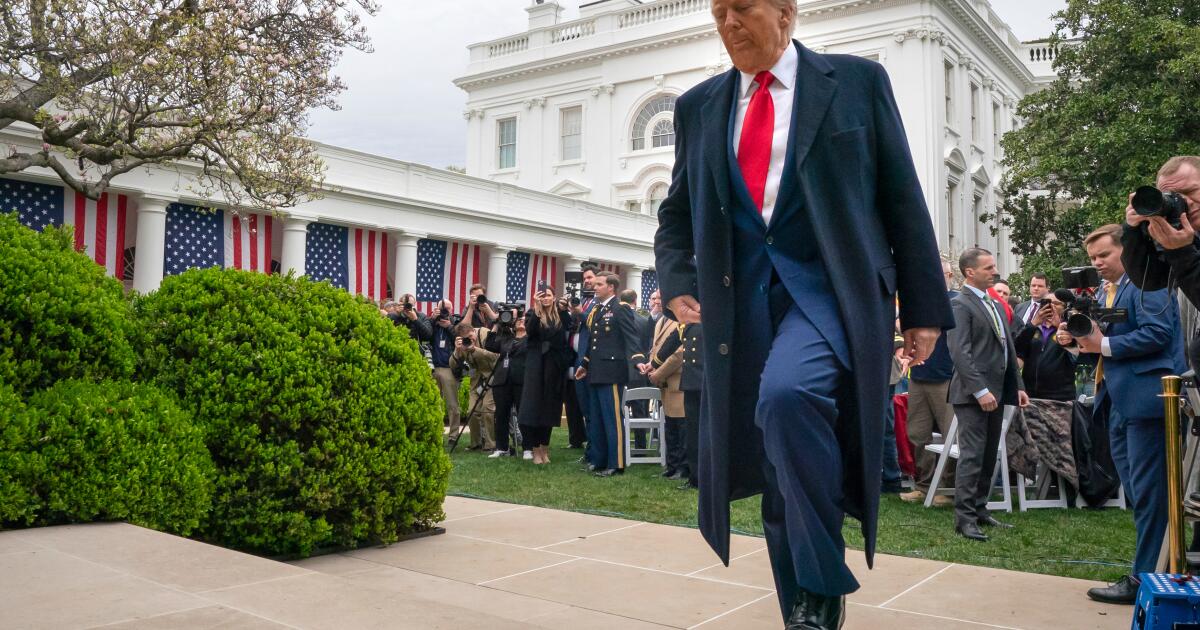

WASHINGTON — The Trump administration is facing global blowback after announcing a dramatic series of tariffs on countries around the world, with U.S. adversaries and allies alike promising crushing responses that could devastate the American economy.
Stock markets in the United States, Europe and Asia plunged in the aftermath of President Trump’s announcement, which included a 10% base rate hike on nearly all foreign imports. Still other countries and trading blocs, including China, the European Union, South Korea and Japan, were hit with higher rates.
“We’re now preparing for further countermeasures to protect our interests and our businesses if negotiations fail,” Ursula von der Leyen, president of the European Commission, said in remarks late Wednesday evening from Uzbekistan, calling Trump’s announcement “a major blow to the world economy.”
The British trade secretary said that the United Kingdom, one of America’s closest allies with strong ties to the Trump administration, would work over the next month to see whether it could negotiate an exemption from U.S. tariffs, or otherwise deliver retaliatory taxes. The government published a webpage asking businesses for input on identifying which American products the U.K. should implement tariffs on, with the most minimal impact on the British economy.
And in Paris, French officials said they were also pushing the rest of the European Union to agree on a response that would target U.S. digital businesses, particularly Big Tech firms, core to the U.S. and Californian economies.
“A two-phase European response is now underway,” a French official told The Times. By mid-April, the official said the European Union would unveil its initial response on U.S. steel and aluminum exports, followed by a more comprehensive, “sector-by-sector” response rolled out by the end of the month.
“Nothing should be off the table,” the official said, including “responses in the digital services sector.”
“That is what I see, that Donald Trump will buckle under pressure, that he will correct his announcements under pressure,” Robert Habeck, Germany’s economy minister, told reporters Thursday, “but the logical consequence is that he then also needs to feel the pressure.”
White House officials have acknowledged they expect initial turbulence from the tariffs announcements, but Trump has said the disruptions will be worth it when “jobs and factories will come roaring back into our country.”
The Trump administration initially said it was imposing “reciprocal” tariffs in direct response to each country’s taxes on imported U.S. goods: “They do it to us, and we do it to them,” Trump said. “Very simple.”
But the rates put forward by the White House show the administration actually used a calculation that has nothing to do with foreign tariffs at all. Instead, the administration took the U.S. trade deficit with individual trading partners, divided it by U.S. imports from that partner, and then divided the total in half.
Trump’s Agriculture secretary, Brooke Rollins, acknowledged that pain was coming to U.S. farmers and agricultural businesses, already strapped before the tariff announcement and now facing lower prices for their goods and higher prices for their equipment and raw materials.
“There will be a short time of uncertainty, and then we’ll move back to the prosperity that this president has envisioned,” Rollins said to reporters at the White House on Thursday.
Treasury Secretary Scott Bessent said in a CNN interview Wednesday evening that other countries should “sit back, take a deep breath, don’t immediately retaliate.”
Democrats in the U.S. have balked at the extent of the tariffs. Late Wednesday, the Senate delivered a rare rebuke to Trump’s tariffs agenda when the body passed a resolution that would end the national emergency on the fentanyl crisis, which Trump declared to substantiate his tariffs against Canada.
Four Republicans — Sens. Lisa Murkowski of Alaska, Susan Collins of Maine, Mitch McConnell of Kentucky and Rand Paul of Kentucky — joined with all Democrats to pass the resolution, which next goes to the House, where it has little chance of passing the Republican-led chamber.
“The stock market is down since the beginning of the year, the cost of everything from groceries to housing continues to rise. Americans’ retirement funds have shrunk, and the chances of a recession is up,” said Sen. Alex Padilla (D-Calif.) from the Senate floor Wednesday. “That sure doesn’t feel like a liberation to me.”

WASHINGTON — The Trump administration is facing global blowback after announcing a dramatic series of tariffs on countries around the world, with U.S. adversaries and allies alike promising crushing responses that could devastate the American economy.
Stock markets in the United States, Europe and Asia plunged in the aftermath of President Trump’s announcement, which included a 10% base rate hike on nearly all foreign imports. Still other countries and trading blocs, including China, the European Union, South Korea and Japan, were hit with higher rates.
“We’re now preparing for further countermeasures to protect our interests and our businesses if negotiations fail,” Ursula von der Leyen, president of the European Commission, said in remarks late Wednesday evening from Uzbekistan, calling Trump’s announcement “a major blow to the world economy.”
The British trade secretary said that the United Kingdom, one of America’s closest allies with strong ties to the Trump administration, would work over the next month to see whether it could negotiate an exemption from U.S. tariffs, or otherwise deliver retaliatory taxes. The government published a webpage asking businesses for input on identifying which American products the U.K. should implement tariffs on, with the most minimal impact on the British economy.
And in Paris, French officials said they were also pushing the rest of the European Union to agree on a response that would target U.S. digital businesses, particularly Big Tech firms, core to the U.S. and Californian economies.
“A two-phase European response is now underway,” a French official told The Times. By mid-April, the official said the European Union would unveil its initial response on U.S. steel and aluminum exports, followed by a more comprehensive, “sector-by-sector” response rolled out by the end of the month.
“Nothing should be off the table,” the official said, including “responses in the digital services sector.”
“That is what I see, that Donald Trump will buckle under pressure, that he will correct his announcements under pressure,” Robert Habeck, Germany’s economy minister, told reporters Thursday, “but the logical consequence is that he then also needs to feel the pressure.”
White House officials have acknowledged they expect initial turbulence from the tariffs announcements, but Trump has said the disruptions will be worth it when “jobs and factories will come roaring back into our country.”
The Trump administration initially said it was imposing “reciprocal” tariffs in direct response to each country’s taxes on imported U.S. goods: “They do it to us, and we do it to them,” Trump said. “Very simple.”
But the rates put forward by the White House show the administration actually used a calculation that has nothing to do with foreign tariffs at all. Instead, the administration took the U.S. trade deficit with individual trading partners, divided it by U.S. imports from that partner, and then divided the total in half.
Trump’s Agriculture secretary, Brooke Rollins, acknowledged that pain was coming to U.S. farmers and agricultural businesses, already strapped before the tariff announcement and now facing lower prices for their goods and higher prices for their equipment and raw materials.
“There will be a short time of uncertainty, and then we’ll move back to the prosperity that this president has envisioned,” Rollins said to reporters at the White House on Thursday.
Treasury Secretary Scott Bessent said in a CNN interview Wednesday evening that other countries should “sit back, take a deep breath, don’t immediately retaliate.”
Democrats in the U.S. have balked at the extent of the tariffs. Late Wednesday, the Senate delivered a rare rebuke to Trump’s tariffs agenda when the body passed a resolution that would end the national emergency on the fentanyl crisis, which Trump declared to substantiate his tariffs against Canada.
Four Republicans — Sens. Lisa Murkowski of Alaska, Susan Collins of Maine, Mitch McConnell of Kentucky and Rand Paul of Kentucky — joined with all Democrats to pass the resolution, which next goes to the House, where it has little chance of passing the Republican-led chamber.
“The stock market is down since the beginning of the year, the cost of everything from groceries to housing continues to rise. Americans’ retirement funds have shrunk, and the chances of a recession is up,” said Sen. Alex Padilla (D-Calif.) from the Senate floor Wednesday. “That sure doesn’t feel like a liberation to me.”

WASHINGTON — The Trump administration is facing global blowback after announcing a dramatic series of tariffs on countries around the world, with U.S. adversaries and allies alike promising crushing responses that could devastate the American economy.
Stock markets in the United States, Europe and Asia plunged in the aftermath of President Trump’s announcement, which included a 10% base rate hike on nearly all foreign imports. Still other countries and trading blocs, including China, the European Union, South Korea and Japan, were hit with higher rates.
“We’re now preparing for further countermeasures to protect our interests and our businesses if negotiations fail,” Ursula von der Leyen, president of the European Commission, said in remarks late Wednesday evening from Uzbekistan, calling Trump’s announcement “a major blow to the world economy.”
The British trade secretary said that the United Kingdom, one of America’s closest allies with strong ties to the Trump administration, would work over the next month to see whether it could negotiate an exemption from U.S. tariffs, or otherwise deliver retaliatory taxes. The government published a webpage asking businesses for input on identifying which American products the U.K. should implement tariffs on, with the most minimal impact on the British economy.
And in Paris, French officials said they were also pushing the rest of the European Union to agree on a response that would target U.S. digital businesses, particularly Big Tech firms, core to the U.S. and Californian economies.
“A two-phase European response is now underway,” a French official told The Times. By mid-April, the official said the European Union would unveil its initial response on U.S. steel and aluminum exports, followed by a more comprehensive, “sector-by-sector” response rolled out by the end of the month.
“Nothing should be off the table,” the official said, including “responses in the digital services sector.”
“That is what I see, that Donald Trump will buckle under pressure, that he will correct his announcements under pressure,” Robert Habeck, Germany’s economy minister, told reporters Thursday, “but the logical consequence is that he then also needs to feel the pressure.”
White House officials have acknowledged they expect initial turbulence from the tariffs announcements, but Trump has said the disruptions will be worth it when “jobs and factories will come roaring back into our country.”
The Trump administration initially said it was imposing “reciprocal” tariffs in direct response to each country’s taxes on imported U.S. goods: “They do it to us, and we do it to them,” Trump said. “Very simple.”
But the rates put forward by the White House show the administration actually used a calculation that has nothing to do with foreign tariffs at all. Instead, the administration took the U.S. trade deficit with individual trading partners, divided it by U.S. imports from that partner, and then divided the total in half.
Trump’s Agriculture secretary, Brooke Rollins, acknowledged that pain was coming to U.S. farmers and agricultural businesses, already strapped before the tariff announcement and now facing lower prices for their goods and higher prices for their equipment and raw materials.
“There will be a short time of uncertainty, and then we’ll move back to the prosperity that this president has envisioned,” Rollins said to reporters at the White House on Thursday.
Treasury Secretary Scott Bessent said in a CNN interview Wednesday evening that other countries should “sit back, take a deep breath, don’t immediately retaliate.”
Democrats in the U.S. have balked at the extent of the tariffs. Late Wednesday, the Senate delivered a rare rebuke to Trump’s tariffs agenda when the body passed a resolution that would end the national emergency on the fentanyl crisis, which Trump declared to substantiate his tariffs against Canada.
Four Republicans — Sens. Lisa Murkowski of Alaska, Susan Collins of Maine, Mitch McConnell of Kentucky and Rand Paul of Kentucky — joined with all Democrats to pass the resolution, which next goes to the House, where it has little chance of passing the Republican-led chamber.
“The stock market is down since the beginning of the year, the cost of everything from groceries to housing continues to rise. Americans’ retirement funds have shrunk, and the chances of a recession is up,” said Sen. Alex Padilla (D-Calif.) from the Senate floor Wednesday. “That sure doesn’t feel like a liberation to me.”
WASHINGTON — The Trump administration is facing global blowback after announcing a dramatic series of tariffs on countries around the world, with U.S. adversaries and allies alike promising crushing responses that could devastate the American economy.
Stock markets in the United States, Europe and Asia plunged in the aftermath of President Trump’s announcement, which included a 10% base rate hike on nearly all foreign imports. Still other countries and trading blocs, including China, the European Union, South Korea and Japan, were hit with higher rates.
“We’re now preparing for further countermeasures to protect our interests and our businesses if negotiations fail,” Ursula von der Leyen, president of the European Commission, said in remarks late Wednesday evening from Uzbekistan, calling Trump’s announcement “a major blow to the world economy.”
The British trade secretary said that the United Kingdom, one of America’s closest allies with strong ties to the Trump administration, would work over the next month to see whether it could negotiate an exemption from U.S. tariffs, or otherwise deliver retaliatory taxes. The government published a webpage asking businesses for input on identifying which American products the U.K. should implement tariffs on, with the most minimal impact on the British economy.
And in Paris, French officials said they were also pushing the rest of the European Union to agree on a response that would target U.S. digital businesses, particularly Big Tech firms, core to the U.S. and Californian economies.
“A two-phase European response is now underway,” a French official told The Times. By mid-April, the official said the European Union would unveil its initial response on U.S. steel and aluminum exports, followed by a more comprehensive, “sector-by-sector” response rolled out by the end of the month.
“Nothing should be off the table,” the official said, including “responses in the digital services sector.”
“That is what I see, that Donald Trump will buckle under pressure, that he will correct his announcements under pressure,” Robert Habeck, Germany’s economy minister, told reporters Thursday, “but the logical consequence is that he then also needs to feel the pressure.”
White House officials have acknowledged they expect initial turbulence from the tariffs announcements, but Trump has said the disruptions will be worth it when “jobs and factories will come roaring back into our country.”
The Trump administration initially said it was imposing “reciprocal” tariffs in direct response to each country’s taxes on imported U.S. goods: “They do it to us, and we do it to them,” Trump said. “Very simple.”
But the rates put forward by the White House show the administration actually used a calculation that has nothing to do with foreign tariffs at all. Instead, the administration took the U.S. trade deficit with individual trading partners, divided it by U.S. imports from that partner, and then divided the total in half.
Trump’s Agriculture secretary, Brooke Rollins, acknowledged that pain was coming to U.S. farmers and agricultural businesses, already strapped before the tariff announcement and now facing lower prices for their goods and higher prices for their equipment and raw materials.
“There will be a short time of uncertainty, and then we’ll move back to the prosperity that this president has envisioned,” Rollins said to reporters at the White House on Thursday.
Treasury Secretary Scott Bessent said in a CNN interview Wednesday evening that other countries should “sit back, take a deep breath, don’t immediately retaliate.”
Democrats in the U.S. have balked at the extent of the tariffs. Late Wednesday, the Senate delivered a rare rebuke to Trump’s tariffs agenda when the body passed a resolution that would end the national emergency on the fentanyl crisis, which Trump declared to substantiate his tariffs against Canada.
Four Republicans — Sens. Lisa Murkowski of Alaska, Susan Collins of Maine, Mitch McConnell of Kentucky and Rand Paul of Kentucky — joined with all Democrats to pass the resolution, which next goes to the House, where it has little chance of passing the Republican-led chamber.
“The stock market is down since the beginning of the year, the cost of everything from groceries to housing continues to rise. Americans’ retirement funds have shrunk, and the chances of a recession is up,” said Sen. Alex Padilla (D-Calif.) from the Senate floor Wednesday. “That sure doesn’t feel like a liberation to me.”

WASHINGTON — The Trump administration is facing global blowback after announcing a dramatic series of tariffs on countries around the world, with U.S. adversaries and allies alike promising crushing responses that could devastate the American economy.
Stock markets in the United States, Europe and Asia plunged in the aftermath of President Trump’s announcement, which included a 10% base rate hike on nearly all foreign imports. Still other countries and trading blocs, including China, the European Union, South Korea and Japan, were hit with higher rates.
“We’re now preparing for further countermeasures to protect our interests and our businesses if negotiations fail,” Ursula von der Leyen, president of the European Commission, said in remarks late Wednesday evening from Uzbekistan, calling Trump’s announcement “a major blow to the world economy.”
The British trade secretary said that the United Kingdom, one of America’s closest allies with strong ties to the Trump administration, would work over the next month to see whether it could negotiate an exemption from U.S. tariffs, or otherwise deliver retaliatory taxes. The government published a webpage asking businesses for input on identifying which American products the U.K. should implement tariffs on, with the most minimal impact on the British economy.
And in Paris, French officials said they were also pushing the rest of the European Union to agree on a response that would target U.S. digital businesses, particularly Big Tech firms, core to the U.S. and Californian economies.
“A two-phase European response is now underway,” a French official told The Times. By mid-April, the official said the European Union would unveil its initial response on U.S. steel and aluminum exports, followed by a more comprehensive, “sector-by-sector” response rolled out by the end of the month.
“Nothing should be off the table,” the official said, including “responses in the digital services sector.”
“That is what I see, that Donald Trump will buckle under pressure, that he will correct his announcements under pressure,” Robert Habeck, Germany’s economy minister, told reporters Thursday, “but the logical consequence is that he then also needs to feel the pressure.”
White House officials have acknowledged they expect initial turbulence from the tariffs announcements, but Trump has said the disruptions will be worth it when “jobs and factories will come roaring back into our country.”
The Trump administration initially said it was imposing “reciprocal” tariffs in direct response to each country’s taxes on imported U.S. goods: “They do it to us, and we do it to them,” Trump said. “Very simple.”
But the rates put forward by the White House show the administration actually used a calculation that has nothing to do with foreign tariffs at all. Instead, the administration took the U.S. trade deficit with individual trading partners, divided it by U.S. imports from that partner, and then divided the total in half.
Trump’s Agriculture secretary, Brooke Rollins, acknowledged that pain was coming to U.S. farmers and agricultural businesses, already strapped before the tariff announcement and now facing lower prices for their goods and higher prices for their equipment and raw materials.
“There will be a short time of uncertainty, and then we’ll move back to the prosperity that this president has envisioned,” Rollins said to reporters at the White House on Thursday.
Treasury Secretary Scott Bessent said in a CNN interview Wednesday evening that other countries should “sit back, take a deep breath, don’t immediately retaliate.”
Democrats in the U.S. have balked at the extent of the tariffs. Late Wednesday, the Senate delivered a rare rebuke to Trump’s tariffs agenda when the body passed a resolution that would end the national emergency on the fentanyl crisis, which Trump declared to substantiate his tariffs against Canada.
Four Republicans — Sens. Lisa Murkowski of Alaska, Susan Collins of Maine, Mitch McConnell of Kentucky and Rand Paul of Kentucky — joined with all Democrats to pass the resolution, which next goes to the House, where it has little chance of passing the Republican-led chamber.
“The stock market is down since the beginning of the year, the cost of everything from groceries to housing continues to rise. Americans’ retirement funds have shrunk, and the chances of a recession is up,” said Sen. Alex Padilla (D-Calif.) from the Senate floor Wednesday. “That sure doesn’t feel like a liberation to me.”
WASHINGTON — The Trump administration is facing global blowback after announcing a dramatic series of tariffs on countries around the world, with U.S. adversaries and allies alike promising crushing responses that could devastate the American economy.
Stock markets in the United States, Europe and Asia plunged in the aftermath of President Trump’s announcement, which included a 10% base rate hike on nearly all foreign imports. Still other countries and trading blocs, including China, the European Union, South Korea and Japan, were hit with higher rates.
“We’re now preparing for further countermeasures to protect our interests and our businesses if negotiations fail,” Ursula von der Leyen, president of the European Commission, said in remarks late Wednesday evening from Uzbekistan, calling Trump’s announcement “a major blow to the world economy.”
The British trade secretary said that the United Kingdom, one of America’s closest allies with strong ties to the Trump administration, would work over the next month to see whether it could negotiate an exemption from U.S. tariffs, or otherwise deliver retaliatory taxes. The government published a webpage asking businesses for input on identifying which American products the U.K. should implement tariffs on, with the most minimal impact on the British economy.
And in Paris, French officials said they were also pushing the rest of the European Union to agree on a response that would target U.S. digital businesses, particularly Big Tech firms, core to the U.S. and Californian economies.
“A two-phase European response is now underway,” a French official told The Times. By mid-April, the official said the European Union would unveil its initial response on U.S. steel and aluminum exports, followed by a more comprehensive, “sector-by-sector” response rolled out by the end of the month.
“Nothing should be off the table,” the official said, including “responses in the digital services sector.”
“That is what I see, that Donald Trump will buckle under pressure, that he will correct his announcements under pressure,” Robert Habeck, Germany’s economy minister, told reporters Thursday, “but the logical consequence is that he then also needs to feel the pressure.”
White House officials have acknowledged they expect initial turbulence from the tariffs announcements, but Trump has said the disruptions will be worth it when “jobs and factories will come roaring back into our country.”
The Trump administration initially said it was imposing “reciprocal” tariffs in direct response to each country’s taxes on imported U.S. goods: “They do it to us, and we do it to them,” Trump said. “Very simple.”
But the rates put forward by the White House show the administration actually used a calculation that has nothing to do with foreign tariffs at all. Instead, the administration took the U.S. trade deficit with individual trading partners, divided it by U.S. imports from that partner, and then divided the total in half.
Trump’s Agriculture secretary, Brooke Rollins, acknowledged that pain was coming to U.S. farmers and agricultural businesses, already strapped before the tariff announcement and now facing lower prices for their goods and higher prices for their equipment and raw materials.
“There will be a short time of uncertainty, and then we’ll move back to the prosperity that this president has envisioned,” Rollins said to reporters at the White House on Thursday.
Treasury Secretary Scott Bessent said in a CNN interview Wednesday evening that other countries should “sit back, take a deep breath, don’t immediately retaliate.”
Democrats in the U.S. have balked at the extent of the tariffs. Late Wednesday, the Senate delivered a rare rebuke to Trump’s tariffs agenda when the body passed a resolution that would end the national emergency on the fentanyl crisis, which Trump declared to substantiate his tariffs against Canada.
Four Republicans — Sens. Lisa Murkowski of Alaska, Susan Collins of Maine, Mitch McConnell of Kentucky and Rand Paul of Kentucky — joined with all Democrats to pass the resolution, which next goes to the House, where it has little chance of passing the Republican-led chamber.
“The stock market is down since the beginning of the year, the cost of everything from groceries to housing continues to rise. Americans’ retirement funds have shrunk, and the chances of a recession is up,” said Sen. Alex Padilla (D-Calif.) from the Senate floor Wednesday. “That sure doesn’t feel like a liberation to me.”
WASHINGTON — The Trump administration is facing global blowback after announcing a dramatic series of tariffs on countries around the world, with U.S. adversaries and allies alike promising crushing responses that could devastate the American economy.
Stock markets in the United States, Europe and Asia plunged in the aftermath of President Trump’s announcement, which included a 10% base rate hike on nearly all foreign imports. Still other countries and trading blocs, including China, the European Union, South Korea and Japan, were hit with higher rates.
“We’re now preparing for further countermeasures to protect our interests and our businesses if negotiations fail,” Ursula von der Leyen, president of the European Commission, said in remarks late Wednesday evening from Uzbekistan, calling Trump’s announcement “a major blow to the world economy.”
The British trade secretary said that the United Kingdom, one of America’s closest allies with strong ties to the Trump administration, would work over the next month to see whether it could negotiate an exemption from U.S. tariffs, or otherwise deliver retaliatory taxes. The government published a webpage asking businesses for input on identifying which American products the U.K. should implement tariffs on, with the most minimal impact on the British economy.
And in Paris, French officials said they were also pushing the rest of the European Union to agree on a response that would target U.S. digital businesses, particularly Big Tech firms, core to the U.S. and Californian economies.
“A two-phase European response is now underway,” a French official told The Times. By mid-April, the official said the European Union would unveil its initial response on U.S. steel and aluminum exports, followed by a more comprehensive, “sector-by-sector” response rolled out by the end of the month.
“Nothing should be off the table,” the official said, including “responses in the digital services sector.”
“That is what I see, that Donald Trump will buckle under pressure, that he will correct his announcements under pressure,” Robert Habeck, Germany’s economy minister, told reporters Thursday, “but the logical consequence is that he then also needs to feel the pressure.”
White House officials have acknowledged they expect initial turbulence from the tariffs announcements, but Trump has said the disruptions will be worth it when “jobs and factories will come roaring back into our country.”
The Trump administration initially said it was imposing “reciprocal” tariffs in direct response to each country’s taxes on imported U.S. goods: “They do it to us, and we do it to them,” Trump said. “Very simple.”
But the rates put forward by the White House show the administration actually used a calculation that has nothing to do with foreign tariffs at all. Instead, the administration took the U.S. trade deficit with individual trading partners, divided it by U.S. imports from that partner, and then divided the total in half.
Trump’s Agriculture secretary, Brooke Rollins, acknowledged that pain was coming to U.S. farmers and agricultural businesses, already strapped before the tariff announcement and now facing lower prices for their goods and higher prices for their equipment and raw materials.
“There will be a short time of uncertainty, and then we’ll move back to the prosperity that this president has envisioned,” Rollins said to reporters at the White House on Thursday.
Treasury Secretary Scott Bessent said in a CNN interview Wednesday evening that other countries should “sit back, take a deep breath, don’t immediately retaliate.”
Democrats in the U.S. have balked at the extent of the tariffs. Late Wednesday, the Senate delivered a rare rebuke to Trump’s tariffs agenda when the body passed a resolution that would end the national emergency on the fentanyl crisis, which Trump declared to substantiate his tariffs against Canada.
Four Republicans — Sens. Lisa Murkowski of Alaska, Susan Collins of Maine, Mitch McConnell of Kentucky and Rand Paul of Kentucky — joined with all Democrats to pass the resolution, which next goes to the House, where it has little chance of passing the Republican-led chamber.
“The stock market is down since the beginning of the year, the cost of everything from groceries to housing continues to rise. Americans’ retirement funds have shrunk, and the chances of a recession is up,” said Sen. Alex Padilla (D-Calif.) from the Senate floor Wednesday. “That sure doesn’t feel like a liberation to me.”
WASHINGTON — The Trump administration is facing global blowback after announcing a dramatic series of tariffs on countries around the world, with U.S. adversaries and allies alike promising crushing responses that could devastate the American economy.
Stock markets in the United States, Europe and Asia plunged in the aftermath of President Trump’s announcement, which included a 10% base rate hike on nearly all foreign imports. Still other countries and trading blocs, including China, the European Union, South Korea and Japan, were hit with higher rates.
“We’re now preparing for further countermeasures to protect our interests and our businesses if negotiations fail,” Ursula von der Leyen, president of the European Commission, said in remarks late Wednesday evening from Uzbekistan, calling Trump’s announcement “a major blow to the world economy.”
The British trade secretary said that the United Kingdom, one of America’s closest allies with strong ties to the Trump administration, would work over the next month to see whether it could negotiate an exemption from U.S. tariffs, or otherwise deliver retaliatory taxes. The government published a webpage asking businesses for input on identifying which American products the U.K. should implement tariffs on, with the most minimal impact on the British economy.
And in Paris, French officials said they were also pushing the rest of the European Union to agree on a response that would target U.S. digital businesses, particularly Big Tech firms, core to the U.S. and Californian economies.
“A two-phase European response is now underway,” a French official told The Times. By mid-April, the official said the European Union would unveil its initial response on U.S. steel and aluminum exports, followed by a more comprehensive, “sector-by-sector” response rolled out by the end of the month.
“Nothing should be off the table,” the official said, including “responses in the digital services sector.”
“That is what I see, that Donald Trump will buckle under pressure, that he will correct his announcements under pressure,” Robert Habeck, Germany’s economy minister, told reporters Thursday, “but the logical consequence is that he then also needs to feel the pressure.”
White House officials have acknowledged they expect initial turbulence from the tariffs announcements, but Trump has said the disruptions will be worth it when “jobs and factories will come roaring back into our country.”
The Trump administration initially said it was imposing “reciprocal” tariffs in direct response to each country’s taxes on imported U.S. goods: “They do it to us, and we do it to them,” Trump said. “Very simple.”
But the rates put forward by the White House show the administration actually used a calculation that has nothing to do with foreign tariffs at all. Instead, the administration took the U.S. trade deficit with individual trading partners, divided it by U.S. imports from that partner, and then divided the total in half.
Trump’s Agriculture secretary, Brooke Rollins, acknowledged that pain was coming to U.S. farmers and agricultural businesses, already strapped before the tariff announcement and now facing lower prices for their goods and higher prices for their equipment and raw materials.
“There will be a short time of uncertainty, and then we’ll move back to the prosperity that this president has envisioned,” Rollins said to reporters at the White House on Thursday.
Treasury Secretary Scott Bessent said in a CNN interview Wednesday evening that other countries should “sit back, take a deep breath, don’t immediately retaliate.”
Democrats in the U.S. have balked at the extent of the tariffs. Late Wednesday, the Senate delivered a rare rebuke to Trump’s tariffs agenda when the body passed a resolution that would end the national emergency on the fentanyl crisis, which Trump declared to substantiate his tariffs against Canada.
Four Republicans — Sens. Lisa Murkowski of Alaska, Susan Collins of Maine, Mitch McConnell of Kentucky and Rand Paul of Kentucky — joined with all Democrats to pass the resolution, which next goes to the House, where it has little chance of passing the Republican-led chamber.
“The stock market is down since the beginning of the year, the cost of everything from groceries to housing continues to rise. Americans’ retirement funds have shrunk, and the chances of a recession is up,” said Sen. Alex Padilla (D-Calif.) from the Senate floor Wednesday. “That sure doesn’t feel like a liberation to me.”

