

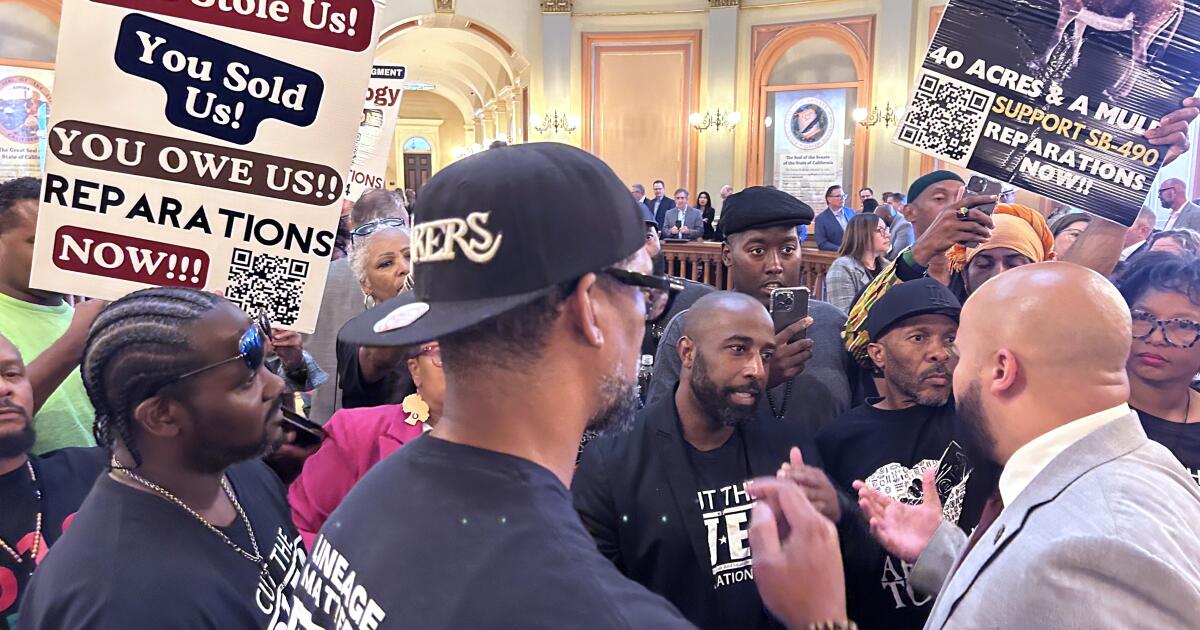

The California Legislative Black Caucus on Thursday proposed a package of reparations for the descendants of African Americans who were enslaved in the United States, proposals that include preferences for public university admissions and financial assistance for first-time home buyers.
The package contains 15 bills in what caucus members said will be a multiyear effort to repair the generational harms and discrimination suffered by the descendants of the enslaved in California.
In 2020, Gov. Gavin Newsom and California lawmakers formed a “first in the nation” state task force to study and propose remedies for the legacy of slavery. During the end of the legislative session last year, reform advocates were frustrated that the Legislature, which was limited by a tight state budget and a high-stakes election year, passed only 10 of the 14 bills prioritized by the Legislative Black Caucus.
“We are picking up where we left off last year,” said Assemblymember Lori D. Wilson (D-Suisun City) at a news conference Thursday morning. “We are challenging not only members of the Legislature but all of Californians to operate in a repair mindset.”
Wilson reintroduced a proposed constitutional amendment that would change the language in the state Constitution by banning forced labor in any form. California voters last year rejected a ballot measure that would have banned forced prison labor. Wilson’s renewed effort proposes a constitutional change that, if passed by the Legislature, could appear before voters on the 2026 ballot.
The state Constitution currently bans slavery and involuntary servitude, except as punishment for crime.
But Wilson said this time around they are “more prepared” and “more informed.”
Wilson also introduced a bill to implement a voluntary work program for prisoners, intending to allow inmates to request work assignments, which, in turn, would make time for classes and other rehabilitative activities.
Assemblymember Isaac Bryan (D-Los Angeles), vice chair of the Legislative Black Caucus, authored Assembly Bill 7 which would allow all California universities to consider preferential admissions for descendants of enslaved African Americans.
“We talk about legacy all the time and legacies of privilege have been rewarded … if you’re the relative of a donor or someone previously admitted to one of these universities you often have an admissions advantage,” Bryan said. “But we never talk about legacies of harm, the legacy of slavery, the legacy of exclusion.”
Other bills in the package include one from Assemblymember Tina McKinnor (D-Hawthorne) who seeks to allocate a portion of the Home Purchase Assistance Program funds to first-time home buyers who are descendants of the enslaved; and AB 785, written by Assemblymember LaShae Sharp-Collins (D-San Diego), which would create a grant program and fund community-driven solutions to decrease violence in neighborhoods and schools.
Sen. Akilah Weber Pierson (D-La Mesa) seeks to regulate the use of artificial intelligence in healthcare facilities through Senate Bill 503, which would limit racial biases and encourage “non-discriminatory decisions” made by healthcare providers.
“It is critical,” Weber said, “that the biases and stereotypes that Black Americans have faced are not perpetuated in future innovations.”

The California Legislative Black Caucus on Thursday proposed a package of reparations for the descendants of African Americans who were enslaved in the United States, proposals that include preferences for public university admissions and financial assistance for first-time home buyers.
The package contains 15 bills in what caucus members said will be a multiyear effort to repair the generational harms and discrimination suffered by the descendants of the enslaved in California.
In 2020, Gov. Gavin Newsom and California lawmakers formed a “first in the nation” state task force to study and propose remedies for the legacy of slavery. During the end of the legislative session last year, reform advocates were frustrated that the Legislature, which was limited by a tight state budget and a high-stakes election year, passed only 10 of the 14 bills prioritized by the Legislative Black Caucus.
“We are picking up where we left off last year,” said Assemblymember Lori D. Wilson (D-Suisun City) at a news conference Thursday morning. “We are challenging not only members of the Legislature but all of Californians to operate in a repair mindset.”
Wilson reintroduced a proposed constitutional amendment that would change the language in the state Constitution by banning forced labor in any form. California voters last year rejected a ballot measure that would have banned forced prison labor. Wilson’s renewed effort proposes a constitutional change that, if passed by the Legislature, could appear before voters on the 2026 ballot.
The state Constitution currently bans slavery and involuntary servitude, except as punishment for crime.
But Wilson said this time around they are “more prepared” and “more informed.”
Wilson also introduced a bill to implement a voluntary work program for prisoners, intending to allow inmates to request work assignments, which, in turn, would make time for classes and other rehabilitative activities.
Assemblymember Isaac Bryan (D-Los Angeles), vice chair of the Legislative Black Caucus, authored Assembly Bill 7 which would allow all California universities to consider preferential admissions for descendants of enslaved African Americans.
“We talk about legacy all the time and legacies of privilege have been rewarded … if you’re the relative of a donor or someone previously admitted to one of these universities you often have an admissions advantage,” Bryan said. “But we never talk about legacies of harm, the legacy of slavery, the legacy of exclusion.”
Other bills in the package include one from Assemblymember Tina McKinnor (D-Hawthorne) who seeks to allocate a portion of the Home Purchase Assistance Program funds to first-time home buyers who are descendants of the enslaved; and AB 785, written by Assemblymember LaShae Sharp-Collins (D-San Diego), which would create a grant program and fund community-driven solutions to decrease violence in neighborhoods and schools.
Sen. Akilah Weber Pierson (D-La Mesa) seeks to regulate the use of artificial intelligence in healthcare facilities through Senate Bill 503, which would limit racial biases and encourage “non-discriminatory decisions” made by healthcare providers.
“It is critical,” Weber said, “that the biases and stereotypes that Black Americans have faced are not perpetuated in future innovations.”

The California Legislative Black Caucus on Thursday proposed a package of reparations for the descendants of African Americans who were enslaved in the United States, proposals that include preferences for public university admissions and financial assistance for first-time home buyers.
The package contains 15 bills in what caucus members said will be a multiyear effort to repair the generational harms and discrimination suffered by the descendants of the enslaved in California.
In 2020, Gov. Gavin Newsom and California lawmakers formed a “first in the nation” state task force to study and propose remedies for the legacy of slavery. During the end of the legislative session last year, reform advocates were frustrated that the Legislature, which was limited by a tight state budget and a high-stakes election year, passed only 10 of the 14 bills prioritized by the Legislative Black Caucus.
“We are picking up where we left off last year,” said Assemblymember Lori D. Wilson (D-Suisun City) at a news conference Thursday morning. “We are challenging not only members of the Legislature but all of Californians to operate in a repair mindset.”
Wilson reintroduced a proposed constitutional amendment that would change the language in the state Constitution by banning forced labor in any form. California voters last year rejected a ballot measure that would have banned forced prison labor. Wilson’s renewed effort proposes a constitutional change that, if passed by the Legislature, could appear before voters on the 2026 ballot.
The state Constitution currently bans slavery and involuntary servitude, except as punishment for crime.
But Wilson said this time around they are “more prepared” and “more informed.”
Wilson also introduced a bill to implement a voluntary work program for prisoners, intending to allow inmates to request work assignments, which, in turn, would make time for classes and other rehabilitative activities.
Assemblymember Isaac Bryan (D-Los Angeles), vice chair of the Legislative Black Caucus, authored Assembly Bill 7 which would allow all California universities to consider preferential admissions for descendants of enslaved African Americans.
“We talk about legacy all the time and legacies of privilege have been rewarded … if you’re the relative of a donor or someone previously admitted to one of these universities you often have an admissions advantage,” Bryan said. “But we never talk about legacies of harm, the legacy of slavery, the legacy of exclusion.”
Other bills in the package include one from Assemblymember Tina McKinnor (D-Hawthorne) who seeks to allocate a portion of the Home Purchase Assistance Program funds to first-time home buyers who are descendants of the enslaved; and AB 785, written by Assemblymember LaShae Sharp-Collins (D-San Diego), which would create a grant program and fund community-driven solutions to decrease violence in neighborhoods and schools.
Sen. Akilah Weber Pierson (D-La Mesa) seeks to regulate the use of artificial intelligence in healthcare facilities through Senate Bill 503, which would limit racial biases and encourage “non-discriminatory decisions” made by healthcare providers.
“It is critical,” Weber said, “that the biases and stereotypes that Black Americans have faced are not perpetuated in future innovations.”
The California Legislative Black Caucus on Thursday proposed a package of reparations for the descendants of African Americans who were enslaved in the United States, proposals that include preferences for public university admissions and financial assistance for first-time home buyers.
The package contains 15 bills in what caucus members said will be a multiyear effort to repair the generational harms and discrimination suffered by the descendants of the enslaved in California.
In 2020, Gov. Gavin Newsom and California lawmakers formed a “first in the nation” state task force to study and propose remedies for the legacy of slavery. During the end of the legislative session last year, reform advocates were frustrated that the Legislature, which was limited by a tight state budget and a high-stakes election year, passed only 10 of the 14 bills prioritized by the Legislative Black Caucus.
“We are picking up where we left off last year,” said Assemblymember Lori D. Wilson (D-Suisun City) at a news conference Thursday morning. “We are challenging not only members of the Legislature but all of Californians to operate in a repair mindset.”
Wilson reintroduced a proposed constitutional amendment that would change the language in the state Constitution by banning forced labor in any form. California voters last year rejected a ballot measure that would have banned forced prison labor. Wilson’s renewed effort proposes a constitutional change that, if passed by the Legislature, could appear before voters on the 2026 ballot.
The state Constitution currently bans slavery and involuntary servitude, except as punishment for crime.
But Wilson said this time around they are “more prepared” and “more informed.”
Wilson also introduced a bill to implement a voluntary work program for prisoners, intending to allow inmates to request work assignments, which, in turn, would make time for classes and other rehabilitative activities.
Assemblymember Isaac Bryan (D-Los Angeles), vice chair of the Legislative Black Caucus, authored Assembly Bill 7 which would allow all California universities to consider preferential admissions for descendants of enslaved African Americans.
“We talk about legacy all the time and legacies of privilege have been rewarded … if you’re the relative of a donor or someone previously admitted to one of these universities you often have an admissions advantage,” Bryan said. “But we never talk about legacies of harm, the legacy of slavery, the legacy of exclusion.”
Other bills in the package include one from Assemblymember Tina McKinnor (D-Hawthorne) who seeks to allocate a portion of the Home Purchase Assistance Program funds to first-time home buyers who are descendants of the enslaved; and AB 785, written by Assemblymember LaShae Sharp-Collins (D-San Diego), which would create a grant program and fund community-driven solutions to decrease violence in neighborhoods and schools.
Sen. Akilah Weber Pierson (D-La Mesa) seeks to regulate the use of artificial intelligence in healthcare facilities through Senate Bill 503, which would limit racial biases and encourage “non-discriminatory decisions” made by healthcare providers.
“It is critical,” Weber said, “that the biases and stereotypes that Black Americans have faced are not perpetuated in future innovations.”

The California Legislative Black Caucus on Thursday proposed a package of reparations for the descendants of African Americans who were enslaved in the United States, proposals that include preferences for public university admissions and financial assistance for first-time home buyers.
The package contains 15 bills in what caucus members said will be a multiyear effort to repair the generational harms and discrimination suffered by the descendants of the enslaved in California.
In 2020, Gov. Gavin Newsom and California lawmakers formed a “first in the nation” state task force to study and propose remedies for the legacy of slavery. During the end of the legislative session last year, reform advocates were frustrated that the Legislature, which was limited by a tight state budget and a high-stakes election year, passed only 10 of the 14 bills prioritized by the Legislative Black Caucus.
“We are picking up where we left off last year,” said Assemblymember Lori D. Wilson (D-Suisun City) at a news conference Thursday morning. “We are challenging not only members of the Legislature but all of Californians to operate in a repair mindset.”
Wilson reintroduced a proposed constitutional amendment that would change the language in the state Constitution by banning forced labor in any form. California voters last year rejected a ballot measure that would have banned forced prison labor. Wilson’s renewed effort proposes a constitutional change that, if passed by the Legislature, could appear before voters on the 2026 ballot.
The state Constitution currently bans slavery and involuntary servitude, except as punishment for crime.
But Wilson said this time around they are “more prepared” and “more informed.”
Wilson also introduced a bill to implement a voluntary work program for prisoners, intending to allow inmates to request work assignments, which, in turn, would make time for classes and other rehabilitative activities.
Assemblymember Isaac Bryan (D-Los Angeles), vice chair of the Legislative Black Caucus, authored Assembly Bill 7 which would allow all California universities to consider preferential admissions for descendants of enslaved African Americans.
“We talk about legacy all the time and legacies of privilege have been rewarded … if you’re the relative of a donor or someone previously admitted to one of these universities you often have an admissions advantage,” Bryan said. “But we never talk about legacies of harm, the legacy of slavery, the legacy of exclusion.”
Other bills in the package include one from Assemblymember Tina McKinnor (D-Hawthorne) who seeks to allocate a portion of the Home Purchase Assistance Program funds to first-time home buyers who are descendants of the enslaved; and AB 785, written by Assemblymember LaShae Sharp-Collins (D-San Diego), which would create a grant program and fund community-driven solutions to decrease violence in neighborhoods and schools.
Sen. Akilah Weber Pierson (D-La Mesa) seeks to regulate the use of artificial intelligence in healthcare facilities through Senate Bill 503, which would limit racial biases and encourage “non-discriminatory decisions” made by healthcare providers.
“It is critical,” Weber said, “that the biases and stereotypes that Black Americans have faced are not perpetuated in future innovations.”
The California Legislative Black Caucus on Thursday proposed a package of reparations for the descendants of African Americans who were enslaved in the United States, proposals that include preferences for public university admissions and financial assistance for first-time home buyers.
The package contains 15 bills in what caucus members said will be a multiyear effort to repair the generational harms and discrimination suffered by the descendants of the enslaved in California.
In 2020, Gov. Gavin Newsom and California lawmakers formed a “first in the nation” state task force to study and propose remedies for the legacy of slavery. During the end of the legislative session last year, reform advocates were frustrated that the Legislature, which was limited by a tight state budget and a high-stakes election year, passed only 10 of the 14 bills prioritized by the Legislative Black Caucus.
“We are picking up where we left off last year,” said Assemblymember Lori D. Wilson (D-Suisun City) at a news conference Thursday morning. “We are challenging not only members of the Legislature but all of Californians to operate in a repair mindset.”
Wilson reintroduced a proposed constitutional amendment that would change the language in the state Constitution by banning forced labor in any form. California voters last year rejected a ballot measure that would have banned forced prison labor. Wilson’s renewed effort proposes a constitutional change that, if passed by the Legislature, could appear before voters on the 2026 ballot.
The state Constitution currently bans slavery and involuntary servitude, except as punishment for crime.
But Wilson said this time around they are “more prepared” and “more informed.”
Wilson also introduced a bill to implement a voluntary work program for prisoners, intending to allow inmates to request work assignments, which, in turn, would make time for classes and other rehabilitative activities.
Assemblymember Isaac Bryan (D-Los Angeles), vice chair of the Legislative Black Caucus, authored Assembly Bill 7 which would allow all California universities to consider preferential admissions for descendants of enslaved African Americans.
“We talk about legacy all the time and legacies of privilege have been rewarded … if you’re the relative of a donor or someone previously admitted to one of these universities you often have an admissions advantage,” Bryan said. “But we never talk about legacies of harm, the legacy of slavery, the legacy of exclusion.”
Other bills in the package include one from Assemblymember Tina McKinnor (D-Hawthorne) who seeks to allocate a portion of the Home Purchase Assistance Program funds to first-time home buyers who are descendants of the enslaved; and AB 785, written by Assemblymember LaShae Sharp-Collins (D-San Diego), which would create a grant program and fund community-driven solutions to decrease violence in neighborhoods and schools.
Sen. Akilah Weber Pierson (D-La Mesa) seeks to regulate the use of artificial intelligence in healthcare facilities through Senate Bill 503, which would limit racial biases and encourage “non-discriminatory decisions” made by healthcare providers.
“It is critical,” Weber said, “that the biases and stereotypes that Black Americans have faced are not perpetuated in future innovations.”
The California Legislative Black Caucus on Thursday proposed a package of reparations for the descendants of African Americans who were enslaved in the United States, proposals that include preferences for public university admissions and financial assistance for first-time home buyers.
The package contains 15 bills in what caucus members said will be a multiyear effort to repair the generational harms and discrimination suffered by the descendants of the enslaved in California.
In 2020, Gov. Gavin Newsom and California lawmakers formed a “first in the nation” state task force to study and propose remedies for the legacy of slavery. During the end of the legislative session last year, reform advocates were frustrated that the Legislature, which was limited by a tight state budget and a high-stakes election year, passed only 10 of the 14 bills prioritized by the Legislative Black Caucus.
“We are picking up where we left off last year,” said Assemblymember Lori D. Wilson (D-Suisun City) at a news conference Thursday morning. “We are challenging not only members of the Legislature but all of Californians to operate in a repair mindset.”
Wilson reintroduced a proposed constitutional amendment that would change the language in the state Constitution by banning forced labor in any form. California voters last year rejected a ballot measure that would have banned forced prison labor. Wilson’s renewed effort proposes a constitutional change that, if passed by the Legislature, could appear before voters on the 2026 ballot.
The state Constitution currently bans slavery and involuntary servitude, except as punishment for crime.
But Wilson said this time around they are “more prepared” and “more informed.”
Wilson also introduced a bill to implement a voluntary work program for prisoners, intending to allow inmates to request work assignments, which, in turn, would make time for classes and other rehabilitative activities.
Assemblymember Isaac Bryan (D-Los Angeles), vice chair of the Legislative Black Caucus, authored Assembly Bill 7 which would allow all California universities to consider preferential admissions for descendants of enslaved African Americans.
“We talk about legacy all the time and legacies of privilege have been rewarded … if you’re the relative of a donor or someone previously admitted to one of these universities you often have an admissions advantage,” Bryan said. “But we never talk about legacies of harm, the legacy of slavery, the legacy of exclusion.”
Other bills in the package include one from Assemblymember Tina McKinnor (D-Hawthorne) who seeks to allocate a portion of the Home Purchase Assistance Program funds to first-time home buyers who are descendants of the enslaved; and AB 785, written by Assemblymember LaShae Sharp-Collins (D-San Diego), which would create a grant program and fund community-driven solutions to decrease violence in neighborhoods and schools.
Sen. Akilah Weber Pierson (D-La Mesa) seeks to regulate the use of artificial intelligence in healthcare facilities through Senate Bill 503, which would limit racial biases and encourage “non-discriminatory decisions” made by healthcare providers.
“It is critical,” Weber said, “that the biases and stereotypes that Black Americans have faced are not perpetuated in future innovations.”
The California Legislative Black Caucus on Thursday proposed a package of reparations for the descendants of African Americans who were enslaved in the United States, proposals that include preferences for public university admissions and financial assistance for first-time home buyers.
The package contains 15 bills in what caucus members said will be a multiyear effort to repair the generational harms and discrimination suffered by the descendants of the enslaved in California.
In 2020, Gov. Gavin Newsom and California lawmakers formed a “first in the nation” state task force to study and propose remedies for the legacy of slavery. During the end of the legislative session last year, reform advocates were frustrated that the Legislature, which was limited by a tight state budget and a high-stakes election year, passed only 10 of the 14 bills prioritized by the Legislative Black Caucus.
“We are picking up where we left off last year,” said Assemblymember Lori D. Wilson (D-Suisun City) at a news conference Thursday morning. “We are challenging not only members of the Legislature but all of Californians to operate in a repair mindset.”
Wilson reintroduced a proposed constitutional amendment that would change the language in the state Constitution by banning forced labor in any form. California voters last year rejected a ballot measure that would have banned forced prison labor. Wilson’s renewed effort proposes a constitutional change that, if passed by the Legislature, could appear before voters on the 2026 ballot.
The state Constitution currently bans slavery and involuntary servitude, except as punishment for crime.
But Wilson said this time around they are “more prepared” and “more informed.”
Wilson also introduced a bill to implement a voluntary work program for prisoners, intending to allow inmates to request work assignments, which, in turn, would make time for classes and other rehabilitative activities.
Assemblymember Isaac Bryan (D-Los Angeles), vice chair of the Legislative Black Caucus, authored Assembly Bill 7 which would allow all California universities to consider preferential admissions for descendants of enslaved African Americans.
“We talk about legacy all the time and legacies of privilege have been rewarded … if you’re the relative of a donor or someone previously admitted to one of these universities you often have an admissions advantage,” Bryan said. “But we never talk about legacies of harm, the legacy of slavery, the legacy of exclusion.”
Other bills in the package include one from Assemblymember Tina McKinnor (D-Hawthorne) who seeks to allocate a portion of the Home Purchase Assistance Program funds to first-time home buyers who are descendants of the enslaved; and AB 785, written by Assemblymember LaShae Sharp-Collins (D-San Diego), which would create a grant program and fund community-driven solutions to decrease violence in neighborhoods and schools.
Sen. Akilah Weber Pierson (D-La Mesa) seeks to regulate the use of artificial intelligence in healthcare facilities through Senate Bill 503, which would limit racial biases and encourage “non-discriminatory decisions” made by healthcare providers.
“It is critical,” Weber said, “that the biases and stereotypes that Black Americans have faced are not perpetuated in future innovations.”

