

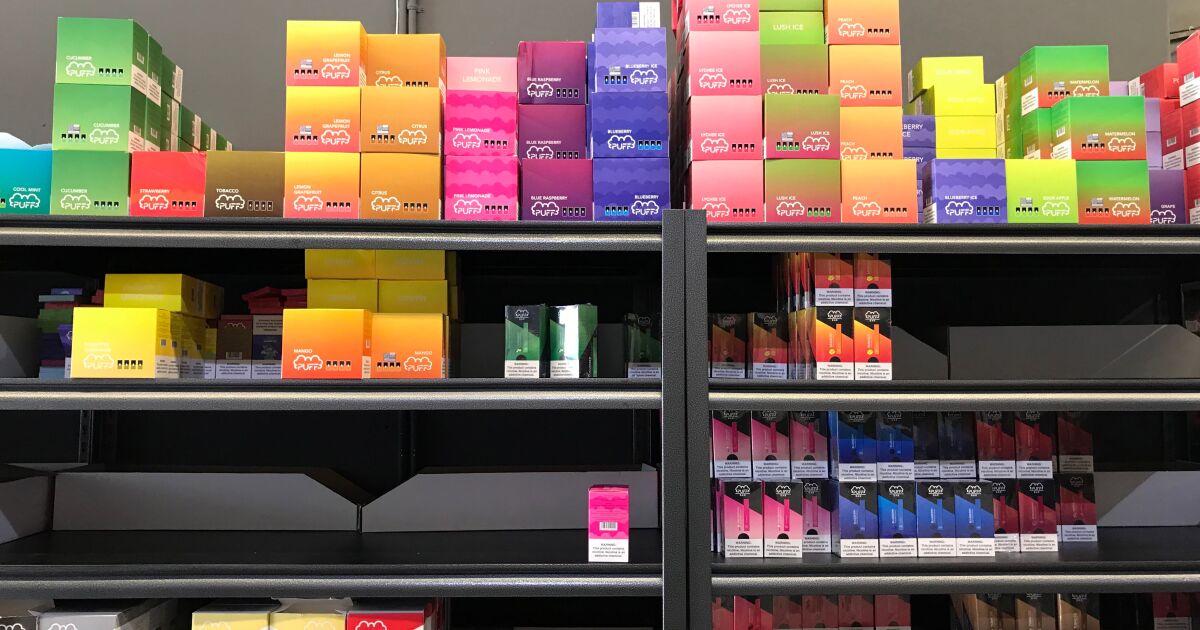

California voters on Tuesday passed a ballot measure to uphold a 2020 law that banned the sale of most flavored tobacco products, giving anti-tobacco advocates an expected victory in a multiyear fight against the industry to mitigate a youth vaping crisis.
Proposition 31 was placed on the ballot soon after Gov. Gavin Newsom signed Senate Bill 793, the Legislature’s bipartisan effort to crack down on e-cigarettes and other products popular with kids. The law banned the sale of certain flavored tobacco products in stores and vending machines, including menthol cigarettes, but with exceptions for hookah, premium cigars and loose-leaf tobacco.

The Associated Press called the race, though official results will take longer to finalize.
“In California’s battle against Big Tobacco, voters have overwhelmingly decided to protect kids from being lured into a lifetime of addiction to nicotine,” Lindsey Freitas, regional advocacy director for the Campaign for Tobacco-Free Kids, said in a statement.
The implementation of SB 793 was delayed after a referendum by the tobacco industry qualified for the November 2022 ballot, giving voters the final say on its merit. A “yes” vote meant the law would go into effect, while a “no” vote would have blocked it.
More than 100 local jurisdictions in California have passed some level of restrictions against the sale of flavored tobacco products. Lawmakers approved the statewide ban despite lobbying by the tobacco industry and other interest groups that claimed it would disproportionately affect certain communities more than others and incentivize a black market.
Advocates for Proposition 31 argued the restrictions would deter tobacco use among kids by eliminating youth-friendly flavors such as bubblegum, cotton candy and cherry. A 2020 Centers for Disease Control and Prevention youth survey found that 20% of high school and 10% of middle school students reported current e-cigarette use.

Those numbers concerned a coalition of doctors, dentists, nurses and public health professionals who campaigned in support of the initiative, along with Newsom, the California Democratic Party and the California Teachers Assn. The campaign to pass Proposition 31 had raised around $60 million, according to campaign finance records, thanks in large part to former New York City Mayor Michael Bloomberg, who has for years fought against teen smoking and funneled millions into passing the ballot measure.

The campaign against Proposition 31 raised millions of dollars with help from R.J. Reynolds Tobacco Co. and Philip Morris USA. The California Republican Party also endorsed a “no” vote against the measure.
Opponents said the ban would remove an effective tool used by smokers to quit traditional cigarettes, and that some communities were unfairly targeted by the law. Black smokers, for example, are more likely to use menthol cigarettes, largely because the tobacco industry “aggressively targets its marketing to certain populations,” according to the CDC.
The “no” campaign also claimed that the new rules would incentivize a black market that would disregard strict federal regulations against underage smokers and flavored tobacco products, and would significantly cost the state. The independent Legislative Analyst’s Office estimated that Proposition 31 could reduce state tobacco tax revenues by up to $100 million annually.
Still, Proposition 31 headed into election night with a clear advantage. A recent UC Berkeley Institute of Governmental Studies poll co-sponsored by The Times found that likely voters favored the ballot measure 58% to 32%, with strong support from Democrats and unaffiliated voters, and modest approval among Republicans.
Newsom also lent his support for the measure in the final days before the election.
“A lot on the ballot. Not to be missed — a chance to stand up to nasty tobacco companies that are willing to put our kids’ health at risk to flush their bank accounts with cash,” Newsom wrote on Twitter on Nov. 4. “It’s sick. Vote YES ON PROP 31 to ensure the ban on flavored tobacco stays put. Save lives. Vote YES.”
“This is a disappointment to the millions of adults over the age of 21 who are now prohibited from purchasing these products as well as other FDA-authorized harm-reduction alternatives,” the “no” on Proposition 31 campaign said in a statement.