

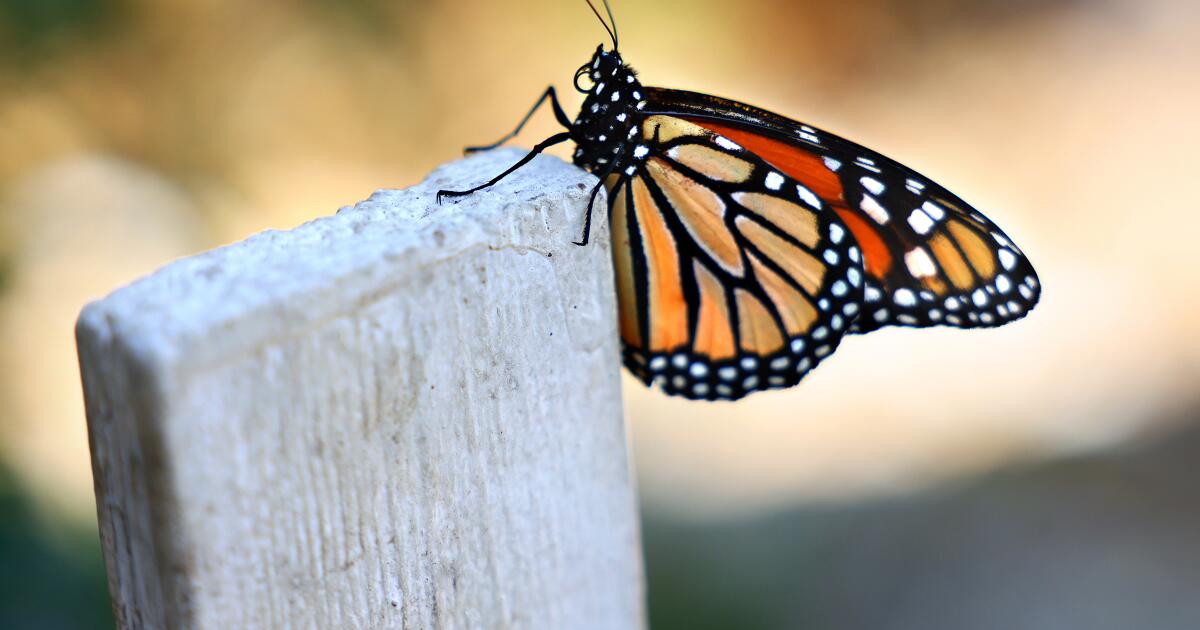
Federal wildlife officials on Tuesday moved to add the monarch butterfly to its endangered species roster, citing decades of steep population decline of the striking black-and-orange insect.
The U.S. Fish and Wildlife Service proposed listing the once-common monarch as threatened under the Endangered Species Act, and designating coastal California sites where the butterflies spend winters as critical habitat.
“Despite its fragility, it is remarkably resilient, like many things in nature when we just give them a chance,” Fish and Wildlife Service Director Martha Williams said in a statement. “Science shows that the monarch needs that chance.”
The action came a decade after advocacy groups petitioned the federal agency to protect the dazzling pollinators and kicks off a 90-day public comment period starting Dec. 12. The deadline for a determination is a year from that date.
Given the wide distribution of the species, it would affect all 48 contiguous states, officials said — making it one of the broadest species listing ever considered.
In North America, there are two long-distance migratory monarch populations: Western monarchs that primarily overwinter between the Bay Area and San Diego along California’s coastline, and the much larger Eastern population that spends the chilly season in the Transvolcanic Mountains. of central Mexico.
Since the 1980’s, Western monarchs have plummeted by more than 95%, putting them above a 99% chance of extinction by 2080, according to the agency’s most recent species status assessment. Eastern monarchs have declined by roughly 80%, with a probability of extinction from 56% to 74% by 2080.
To put the crash into perspective, more than 4.5 million Western monarchs flocked to overwintering grounds in the Golden State less than five decades ago. Last year, roughly 233,000 were logged at winter respites.
Threats to the monarchs include the loss and degradation of habitat used for breeding, migration and overwintering, including milkweed plants they rely on as a place to lay their eggs.
Other perils include exposure to insecticides and the effects of climate change, including increasing temperatures and drought, which affect resources they need to make their marathon migration.
“The synergistic effects of all that are what’s leading to the decline,” said Cat Darst, a Ventura-based wildlife biologist with the Fish and Wildlife Service.
If the butterflies are listed, they’ll earn protection across their expansive range from what’s known as take, which includes harm, harassment, possession, transport and collection. Entities seeking to undertake activity that could affect the monarchs would be required to work with federal wildlife officials to ensure they’re not harmed.
Federal wildlife officials also have proposed what’s known as a 4(d) rule, which would allow exceptions from prohibitions, including allowing activities that boost or protect monarch habitat — such as planting milkweed — and the rearing and release of small numbers of butterflies.
“What’s really cool … is that given the monarch butterflies’ general habitat use and wide distribution — I mean, they’re everywhere, right? — this means that everybody has an opportunity to participate in the broad range of conservation efforts that are needed throughout the range,” Darst said.
Officials are also floating the designation of 4,395 acres of land as critical habitat across Alameda, Marin, Monterey, San Luis Obispo, Santa Barbara, Santa Cruz and Ventura counties in California. Overwintering sites in those areas are considered essential to the conservation of the species.
“It’s good news because [the species] will get ongoing funding and a recovery plan,” Tierra Curry, a senior scientist at the Center for Biological Diversity, said of the proposed listing.
“In California, in particular, monarchs’ overwintering trees are still felled,” Curry said, adding that just last month the Bureau of Land Management chopped down some trees that were known to host the butterflies in the winter.
“Now their overwintering trees are slated to be protected,” she said.
Federal agencies are prohibited from destroying or negatively changing critical habitat. And they must consult with the Fish and Wildlife Service about actions that they carry out, fund or authorize to ensure that they will not cause such harm.
Activities by private and state landowners aren’t impacted by the designation unless they require federal funding or permits.
In 2014, the Center for Biological Diversity, along with the Center for Food Safety, Xerces Society for Invertebrate Conservation and a noted monarch biologist petitioned the Fish and Wildlife Service to protect the beloved invertebrates and their vulnerable habitat.
Six years later, the monarchs landed on the waiting list for federal protections under the Endangered Species Act.
This week marked a court-ordered deadline to make a determination as to whether the butterflies warranted listing.

Federal wildlife officials on Tuesday moved to add the monarch butterfly to its endangered species roster, citing decades of steep population decline of the striking black-and-orange insect.
The U.S. Fish and Wildlife Service proposed listing the once-common monarch as threatened under the Endangered Species Act, and designating coastal California sites where the butterflies spend winters as critical habitat.
“Despite its fragility, it is remarkably resilient, like many things in nature when we just give them a chance,” Fish and Wildlife Service Director Martha Williams said in a statement. “Science shows that the monarch needs that chance.”
The action came a decade after advocacy groups petitioned the federal agency to protect the dazzling pollinators and kicks off a 90-day public comment period starting Dec. 12. The deadline for a determination is a year from that date.
Given the wide distribution of the species, it would affect all 48 contiguous states, officials said — making it one of the broadest species listing ever considered.
In North America, there are two long-distance migratory monarch populations: Western monarchs that primarily overwinter between the Bay Area and San Diego along California’s coastline, and the much larger Eastern population that spends the chilly season in the Transvolcanic Mountains. of central Mexico.
Since the 1980’s, Western monarchs have plummeted by more than 95%, putting them above a 99% chance of extinction by 2080, according to the agency’s most recent species status assessment. Eastern monarchs have declined by roughly 80%, with a probability of extinction from 56% to 74% by 2080.
To put the crash into perspective, more than 4.5 million Western monarchs flocked to overwintering grounds in the Golden State less than five decades ago. Last year, roughly 233,000 were logged at winter respites.
Threats to the monarchs include the loss and degradation of habitat used for breeding, migration and overwintering, including milkweed plants they rely on as a place to lay their eggs.
Other perils include exposure to insecticides and the effects of climate change, including increasing temperatures and drought, which affect resources they need to make their marathon migration.
“The synergistic effects of all that are what’s leading to the decline,” said Cat Darst, a Ventura-based wildlife biologist with the Fish and Wildlife Service.
If the butterflies are listed, they’ll earn protection across their expansive range from what’s known as take, which includes harm, harassment, possession, transport and collection. Entities seeking to undertake activity that could affect the monarchs would be required to work with federal wildlife officials to ensure they’re not harmed.
Federal wildlife officials also have proposed what’s known as a 4(d) rule, which would allow exceptions from prohibitions, including allowing activities that boost or protect monarch habitat — such as planting milkweed — and the rearing and release of small numbers of butterflies.
“What’s really cool … is that given the monarch butterflies’ general habitat use and wide distribution — I mean, they’re everywhere, right? — this means that everybody has an opportunity to participate in the broad range of conservation efforts that are needed throughout the range,” Darst said.
Officials are also floating the designation of 4,395 acres of land as critical habitat across Alameda, Marin, Monterey, San Luis Obispo, Santa Barbara, Santa Cruz and Ventura counties in California. Overwintering sites in those areas are considered essential to the conservation of the species.
“It’s good news because [the species] will get ongoing funding and a recovery plan,” Tierra Curry, a senior scientist at the Center for Biological Diversity, said of the proposed listing.
“In California, in particular, monarchs’ overwintering trees are still felled,” Curry said, adding that just last month the Bureau of Land Management chopped down some trees that were known to host the butterflies in the winter.
“Now their overwintering trees are slated to be protected,” she said.
Federal agencies are prohibited from destroying or negatively changing critical habitat. And they must consult with the Fish and Wildlife Service about actions that they carry out, fund or authorize to ensure that they will not cause such harm.
Activities by private and state landowners aren’t impacted by the designation unless they require federal funding or permits.
In 2014, the Center for Biological Diversity, along with the Center for Food Safety, Xerces Society for Invertebrate Conservation and a noted monarch biologist petitioned the Fish and Wildlife Service to protect the beloved invertebrates and their vulnerable habitat.
Six years later, the monarchs landed on the waiting list for federal protections under the Endangered Species Act.
This week marked a court-ordered deadline to make a determination as to whether the butterflies warranted listing.

Federal wildlife officials on Tuesday moved to add the monarch butterfly to its endangered species roster, citing decades of steep population decline of the striking black-and-orange insect.
The U.S. Fish and Wildlife Service proposed listing the once-common monarch as threatened under the Endangered Species Act, and designating coastal California sites where the butterflies spend winters as critical habitat.
“Despite its fragility, it is remarkably resilient, like many things in nature when we just give them a chance,” Fish and Wildlife Service Director Martha Williams said in a statement. “Science shows that the monarch needs that chance.”
The action came a decade after advocacy groups petitioned the federal agency to protect the dazzling pollinators and kicks off a 90-day public comment period starting Dec. 12. The deadline for a determination is a year from that date.
Given the wide distribution of the species, it would affect all 48 contiguous states, officials said — making it one of the broadest species listing ever considered.
In North America, there are two long-distance migratory monarch populations: Western monarchs that primarily overwinter between the Bay Area and San Diego along California’s coastline, and the much larger Eastern population that spends the chilly season in the Transvolcanic Mountains. of central Mexico.
Since the 1980’s, Western monarchs have plummeted by more than 95%, putting them above a 99% chance of extinction by 2080, according to the agency’s most recent species status assessment. Eastern monarchs have declined by roughly 80%, with a probability of extinction from 56% to 74% by 2080.
To put the crash into perspective, more than 4.5 million Western monarchs flocked to overwintering grounds in the Golden State less than five decades ago. Last year, roughly 233,000 were logged at winter respites.
Threats to the monarchs include the loss and degradation of habitat used for breeding, migration and overwintering, including milkweed plants they rely on as a place to lay their eggs.
Other perils include exposure to insecticides and the effects of climate change, including increasing temperatures and drought, which affect resources they need to make their marathon migration.
“The synergistic effects of all that are what’s leading to the decline,” said Cat Darst, a Ventura-based wildlife biologist with the Fish and Wildlife Service.
If the butterflies are listed, they’ll earn protection across their expansive range from what’s known as take, which includes harm, harassment, possession, transport and collection. Entities seeking to undertake activity that could affect the monarchs would be required to work with federal wildlife officials to ensure they’re not harmed.
Federal wildlife officials also have proposed what’s known as a 4(d) rule, which would allow exceptions from prohibitions, including allowing activities that boost or protect monarch habitat — such as planting milkweed — and the rearing and release of small numbers of butterflies.
“What’s really cool … is that given the monarch butterflies’ general habitat use and wide distribution — I mean, they’re everywhere, right? — this means that everybody has an opportunity to participate in the broad range of conservation efforts that are needed throughout the range,” Darst said.
Officials are also floating the designation of 4,395 acres of land as critical habitat across Alameda, Marin, Monterey, San Luis Obispo, Santa Barbara, Santa Cruz and Ventura counties in California. Overwintering sites in those areas are considered essential to the conservation of the species.
“It’s good news because [the species] will get ongoing funding and a recovery plan,” Tierra Curry, a senior scientist at the Center for Biological Diversity, said of the proposed listing.
“In California, in particular, monarchs’ overwintering trees are still felled,” Curry said, adding that just last month the Bureau of Land Management chopped down some trees that were known to host the butterflies in the winter.
“Now their overwintering trees are slated to be protected,” she said.
Federal agencies are prohibited from destroying or negatively changing critical habitat. And they must consult with the Fish and Wildlife Service about actions that they carry out, fund or authorize to ensure that they will not cause such harm.
Activities by private and state landowners aren’t impacted by the designation unless they require federal funding or permits.
In 2014, the Center for Biological Diversity, along with the Center for Food Safety, Xerces Society for Invertebrate Conservation and a noted monarch biologist petitioned the Fish and Wildlife Service to protect the beloved invertebrates and their vulnerable habitat.
Six years later, the monarchs landed on the waiting list for federal protections under the Endangered Species Act.
This week marked a court-ordered deadline to make a determination as to whether the butterflies warranted listing.
Federal wildlife officials on Tuesday moved to add the monarch butterfly to its endangered species roster, citing decades of steep population decline of the striking black-and-orange insect.
The U.S. Fish and Wildlife Service proposed listing the once-common monarch as threatened under the Endangered Species Act, and designating coastal California sites where the butterflies spend winters as critical habitat.
“Despite its fragility, it is remarkably resilient, like many things in nature when we just give them a chance,” Fish and Wildlife Service Director Martha Williams said in a statement. “Science shows that the monarch needs that chance.”
The action came a decade after advocacy groups petitioned the federal agency to protect the dazzling pollinators and kicks off a 90-day public comment period starting Dec. 12. The deadline for a determination is a year from that date.
Given the wide distribution of the species, it would affect all 48 contiguous states, officials said — making it one of the broadest species listing ever considered.
In North America, there are two long-distance migratory monarch populations: Western monarchs that primarily overwinter between the Bay Area and San Diego along California’s coastline, and the much larger Eastern population that spends the chilly season in the Transvolcanic Mountains. of central Mexico.
Since the 1980’s, Western monarchs have plummeted by more than 95%, putting them above a 99% chance of extinction by 2080, according to the agency’s most recent species status assessment. Eastern monarchs have declined by roughly 80%, with a probability of extinction from 56% to 74% by 2080.
To put the crash into perspective, more than 4.5 million Western monarchs flocked to overwintering grounds in the Golden State less than five decades ago. Last year, roughly 233,000 were logged at winter respites.
Threats to the monarchs include the loss and degradation of habitat used for breeding, migration and overwintering, including milkweed plants they rely on as a place to lay their eggs.
Other perils include exposure to insecticides and the effects of climate change, including increasing temperatures and drought, which affect resources they need to make their marathon migration.
“The synergistic effects of all that are what’s leading to the decline,” said Cat Darst, a Ventura-based wildlife biologist with the Fish and Wildlife Service.
If the butterflies are listed, they’ll earn protection across their expansive range from what’s known as take, which includes harm, harassment, possession, transport and collection. Entities seeking to undertake activity that could affect the monarchs would be required to work with federal wildlife officials to ensure they’re not harmed.
Federal wildlife officials also have proposed what’s known as a 4(d) rule, which would allow exceptions from prohibitions, including allowing activities that boost or protect monarch habitat — such as planting milkweed — and the rearing and release of small numbers of butterflies.
“What’s really cool … is that given the monarch butterflies’ general habitat use and wide distribution — I mean, they’re everywhere, right? — this means that everybody has an opportunity to participate in the broad range of conservation efforts that are needed throughout the range,” Darst said.
Officials are also floating the designation of 4,395 acres of land as critical habitat across Alameda, Marin, Monterey, San Luis Obispo, Santa Barbara, Santa Cruz and Ventura counties in California. Overwintering sites in those areas are considered essential to the conservation of the species.
“It’s good news because [the species] will get ongoing funding and a recovery plan,” Tierra Curry, a senior scientist at the Center for Biological Diversity, said of the proposed listing.
“In California, in particular, monarchs’ overwintering trees are still felled,” Curry said, adding that just last month the Bureau of Land Management chopped down some trees that were known to host the butterflies in the winter.
“Now their overwintering trees are slated to be protected,” she said.
Federal agencies are prohibited from destroying or negatively changing critical habitat. And they must consult with the Fish and Wildlife Service about actions that they carry out, fund or authorize to ensure that they will not cause such harm.
Activities by private and state landowners aren’t impacted by the designation unless they require federal funding or permits.
In 2014, the Center for Biological Diversity, along with the Center for Food Safety, Xerces Society for Invertebrate Conservation and a noted monarch biologist petitioned the Fish and Wildlife Service to protect the beloved invertebrates and their vulnerable habitat.
Six years later, the monarchs landed on the waiting list for federal protections under the Endangered Species Act.
This week marked a court-ordered deadline to make a determination as to whether the butterflies warranted listing.

Federal wildlife officials on Tuesday moved to add the monarch butterfly to its endangered species roster, citing decades of steep population decline of the striking black-and-orange insect.
The U.S. Fish and Wildlife Service proposed listing the once-common monarch as threatened under the Endangered Species Act, and designating coastal California sites where the butterflies spend winters as critical habitat.
“Despite its fragility, it is remarkably resilient, like many things in nature when we just give them a chance,” Fish and Wildlife Service Director Martha Williams said in a statement. “Science shows that the monarch needs that chance.”
The action came a decade after advocacy groups petitioned the federal agency to protect the dazzling pollinators and kicks off a 90-day public comment period starting Dec. 12. The deadline for a determination is a year from that date.
Given the wide distribution of the species, it would affect all 48 contiguous states, officials said — making it one of the broadest species listing ever considered.
In North America, there are two long-distance migratory monarch populations: Western monarchs that primarily overwinter between the Bay Area and San Diego along California’s coastline, and the much larger Eastern population that spends the chilly season in the Transvolcanic Mountains. of central Mexico.
Since the 1980’s, Western monarchs have plummeted by more than 95%, putting them above a 99% chance of extinction by 2080, according to the agency’s most recent species status assessment. Eastern monarchs have declined by roughly 80%, with a probability of extinction from 56% to 74% by 2080.
To put the crash into perspective, more than 4.5 million Western monarchs flocked to overwintering grounds in the Golden State less than five decades ago. Last year, roughly 233,000 were logged at winter respites.
Threats to the monarchs include the loss and degradation of habitat used for breeding, migration and overwintering, including milkweed plants they rely on as a place to lay their eggs.
Other perils include exposure to insecticides and the effects of climate change, including increasing temperatures and drought, which affect resources they need to make their marathon migration.
“The synergistic effects of all that are what’s leading to the decline,” said Cat Darst, a Ventura-based wildlife biologist with the Fish and Wildlife Service.
If the butterflies are listed, they’ll earn protection across their expansive range from what’s known as take, which includes harm, harassment, possession, transport and collection. Entities seeking to undertake activity that could affect the monarchs would be required to work with federal wildlife officials to ensure they’re not harmed.
Federal wildlife officials also have proposed what’s known as a 4(d) rule, which would allow exceptions from prohibitions, including allowing activities that boost or protect monarch habitat — such as planting milkweed — and the rearing and release of small numbers of butterflies.
“What’s really cool … is that given the monarch butterflies’ general habitat use and wide distribution — I mean, they’re everywhere, right? — this means that everybody has an opportunity to participate in the broad range of conservation efforts that are needed throughout the range,” Darst said.
Officials are also floating the designation of 4,395 acres of land as critical habitat across Alameda, Marin, Monterey, San Luis Obispo, Santa Barbara, Santa Cruz and Ventura counties in California. Overwintering sites in those areas are considered essential to the conservation of the species.
“It’s good news because [the species] will get ongoing funding and a recovery plan,” Tierra Curry, a senior scientist at the Center for Biological Diversity, said of the proposed listing.
“In California, in particular, monarchs’ overwintering trees are still felled,” Curry said, adding that just last month the Bureau of Land Management chopped down some trees that were known to host the butterflies in the winter.
“Now their overwintering trees are slated to be protected,” she said.
Federal agencies are prohibited from destroying or negatively changing critical habitat. And they must consult with the Fish and Wildlife Service about actions that they carry out, fund or authorize to ensure that they will not cause such harm.
Activities by private and state landowners aren’t impacted by the designation unless they require federal funding or permits.
In 2014, the Center for Biological Diversity, along with the Center for Food Safety, Xerces Society for Invertebrate Conservation and a noted monarch biologist petitioned the Fish and Wildlife Service to protect the beloved invertebrates and their vulnerable habitat.
Six years later, the monarchs landed on the waiting list for federal protections under the Endangered Species Act.
This week marked a court-ordered deadline to make a determination as to whether the butterflies warranted listing.
Federal wildlife officials on Tuesday moved to add the monarch butterfly to its endangered species roster, citing decades of steep population decline of the striking black-and-orange insect.
The U.S. Fish and Wildlife Service proposed listing the once-common monarch as threatened under the Endangered Species Act, and designating coastal California sites where the butterflies spend winters as critical habitat.
“Despite its fragility, it is remarkably resilient, like many things in nature when we just give them a chance,” Fish and Wildlife Service Director Martha Williams said in a statement. “Science shows that the monarch needs that chance.”
The action came a decade after advocacy groups petitioned the federal agency to protect the dazzling pollinators and kicks off a 90-day public comment period starting Dec. 12. The deadline for a determination is a year from that date.
Given the wide distribution of the species, it would affect all 48 contiguous states, officials said — making it one of the broadest species listing ever considered.
In North America, there are two long-distance migratory monarch populations: Western monarchs that primarily overwinter between the Bay Area and San Diego along California’s coastline, and the much larger Eastern population that spends the chilly season in the Transvolcanic Mountains. of central Mexico.
Since the 1980’s, Western monarchs have plummeted by more than 95%, putting them above a 99% chance of extinction by 2080, according to the agency’s most recent species status assessment. Eastern monarchs have declined by roughly 80%, with a probability of extinction from 56% to 74% by 2080.
To put the crash into perspective, more than 4.5 million Western monarchs flocked to overwintering grounds in the Golden State less than five decades ago. Last year, roughly 233,000 were logged at winter respites.
Threats to the monarchs include the loss and degradation of habitat used for breeding, migration and overwintering, including milkweed plants they rely on as a place to lay their eggs.
Other perils include exposure to insecticides and the effects of climate change, including increasing temperatures and drought, which affect resources they need to make their marathon migration.
“The synergistic effects of all that are what’s leading to the decline,” said Cat Darst, a Ventura-based wildlife biologist with the Fish and Wildlife Service.
If the butterflies are listed, they’ll earn protection across their expansive range from what’s known as take, which includes harm, harassment, possession, transport and collection. Entities seeking to undertake activity that could affect the monarchs would be required to work with federal wildlife officials to ensure they’re not harmed.
Federal wildlife officials also have proposed what’s known as a 4(d) rule, which would allow exceptions from prohibitions, including allowing activities that boost or protect monarch habitat — such as planting milkweed — and the rearing and release of small numbers of butterflies.
“What’s really cool … is that given the monarch butterflies’ general habitat use and wide distribution — I mean, they’re everywhere, right? — this means that everybody has an opportunity to participate in the broad range of conservation efforts that are needed throughout the range,” Darst said.
Officials are also floating the designation of 4,395 acres of land as critical habitat across Alameda, Marin, Monterey, San Luis Obispo, Santa Barbara, Santa Cruz and Ventura counties in California. Overwintering sites in those areas are considered essential to the conservation of the species.
“It’s good news because [the species] will get ongoing funding and a recovery plan,” Tierra Curry, a senior scientist at the Center for Biological Diversity, said of the proposed listing.
“In California, in particular, monarchs’ overwintering trees are still felled,” Curry said, adding that just last month the Bureau of Land Management chopped down some trees that were known to host the butterflies in the winter.
“Now their overwintering trees are slated to be protected,” she said.
Federal agencies are prohibited from destroying or negatively changing critical habitat. And they must consult with the Fish and Wildlife Service about actions that they carry out, fund or authorize to ensure that they will not cause such harm.
Activities by private and state landowners aren’t impacted by the designation unless they require federal funding or permits.
In 2014, the Center for Biological Diversity, along with the Center for Food Safety, Xerces Society for Invertebrate Conservation and a noted monarch biologist petitioned the Fish and Wildlife Service to protect the beloved invertebrates and their vulnerable habitat.
Six years later, the monarchs landed on the waiting list for federal protections under the Endangered Species Act.
This week marked a court-ordered deadline to make a determination as to whether the butterflies warranted listing.
Federal wildlife officials on Tuesday moved to add the monarch butterfly to its endangered species roster, citing decades of steep population decline of the striking black-and-orange insect.
The U.S. Fish and Wildlife Service proposed listing the once-common monarch as threatened under the Endangered Species Act, and designating coastal California sites where the butterflies spend winters as critical habitat.
“Despite its fragility, it is remarkably resilient, like many things in nature when we just give them a chance,” Fish and Wildlife Service Director Martha Williams said in a statement. “Science shows that the monarch needs that chance.”
The action came a decade after advocacy groups petitioned the federal agency to protect the dazzling pollinators and kicks off a 90-day public comment period starting Dec. 12. The deadline for a determination is a year from that date.
Given the wide distribution of the species, it would affect all 48 contiguous states, officials said — making it one of the broadest species listing ever considered.
In North America, there are two long-distance migratory monarch populations: Western monarchs that primarily overwinter between the Bay Area and San Diego along California’s coastline, and the much larger Eastern population that spends the chilly season in the Transvolcanic Mountains. of central Mexico.
Since the 1980’s, Western monarchs have plummeted by more than 95%, putting them above a 99% chance of extinction by 2080, according to the agency’s most recent species status assessment. Eastern monarchs have declined by roughly 80%, with a probability of extinction from 56% to 74% by 2080.
To put the crash into perspective, more than 4.5 million Western monarchs flocked to overwintering grounds in the Golden State less than five decades ago. Last year, roughly 233,000 were logged at winter respites.
Threats to the monarchs include the loss and degradation of habitat used for breeding, migration and overwintering, including milkweed plants they rely on as a place to lay their eggs.
Other perils include exposure to insecticides and the effects of climate change, including increasing temperatures and drought, which affect resources they need to make their marathon migration.
“The synergistic effects of all that are what’s leading to the decline,” said Cat Darst, a Ventura-based wildlife biologist with the Fish and Wildlife Service.
If the butterflies are listed, they’ll earn protection across their expansive range from what’s known as take, which includes harm, harassment, possession, transport and collection. Entities seeking to undertake activity that could affect the monarchs would be required to work with federal wildlife officials to ensure they’re not harmed.
Federal wildlife officials also have proposed what’s known as a 4(d) rule, which would allow exceptions from prohibitions, including allowing activities that boost or protect monarch habitat — such as planting milkweed — and the rearing and release of small numbers of butterflies.
“What’s really cool … is that given the monarch butterflies’ general habitat use and wide distribution — I mean, they’re everywhere, right? — this means that everybody has an opportunity to participate in the broad range of conservation efforts that are needed throughout the range,” Darst said.
Officials are also floating the designation of 4,395 acres of land as critical habitat across Alameda, Marin, Monterey, San Luis Obispo, Santa Barbara, Santa Cruz and Ventura counties in California. Overwintering sites in those areas are considered essential to the conservation of the species.
“It’s good news because [the species] will get ongoing funding and a recovery plan,” Tierra Curry, a senior scientist at the Center for Biological Diversity, said of the proposed listing.
“In California, in particular, monarchs’ overwintering trees are still felled,” Curry said, adding that just last month the Bureau of Land Management chopped down some trees that were known to host the butterflies in the winter.
“Now their overwintering trees are slated to be protected,” she said.
Federal agencies are prohibited from destroying or negatively changing critical habitat. And they must consult with the Fish and Wildlife Service about actions that they carry out, fund or authorize to ensure that they will not cause such harm.
Activities by private and state landowners aren’t impacted by the designation unless they require federal funding or permits.
In 2014, the Center for Biological Diversity, along with the Center for Food Safety, Xerces Society for Invertebrate Conservation and a noted monarch biologist petitioned the Fish and Wildlife Service to protect the beloved invertebrates and their vulnerable habitat.
Six years later, the monarchs landed on the waiting list for federal protections under the Endangered Species Act.
This week marked a court-ordered deadline to make a determination as to whether the butterflies warranted listing.
Federal wildlife officials on Tuesday moved to add the monarch butterfly to its endangered species roster, citing decades of steep population decline of the striking black-and-orange insect.
The U.S. Fish and Wildlife Service proposed listing the once-common monarch as threatened under the Endangered Species Act, and designating coastal California sites where the butterflies spend winters as critical habitat.
“Despite its fragility, it is remarkably resilient, like many things in nature when we just give them a chance,” Fish and Wildlife Service Director Martha Williams said in a statement. “Science shows that the monarch needs that chance.”
The action came a decade after advocacy groups petitioned the federal agency to protect the dazzling pollinators and kicks off a 90-day public comment period starting Dec. 12. The deadline for a determination is a year from that date.
Given the wide distribution of the species, it would affect all 48 contiguous states, officials said — making it one of the broadest species listing ever considered.
In North America, there are two long-distance migratory monarch populations: Western monarchs that primarily overwinter between the Bay Area and San Diego along California’s coastline, and the much larger Eastern population that spends the chilly season in the Transvolcanic Mountains. of central Mexico.
Since the 1980’s, Western monarchs have plummeted by more than 95%, putting them above a 99% chance of extinction by 2080, according to the agency’s most recent species status assessment. Eastern monarchs have declined by roughly 80%, with a probability of extinction from 56% to 74% by 2080.
To put the crash into perspective, more than 4.5 million Western monarchs flocked to overwintering grounds in the Golden State less than five decades ago. Last year, roughly 233,000 were logged at winter respites.
Threats to the monarchs include the loss and degradation of habitat used for breeding, migration and overwintering, including milkweed plants they rely on as a place to lay their eggs.
Other perils include exposure to insecticides and the effects of climate change, including increasing temperatures and drought, which affect resources they need to make their marathon migration.
“The synergistic effects of all that are what’s leading to the decline,” said Cat Darst, a Ventura-based wildlife biologist with the Fish and Wildlife Service.
If the butterflies are listed, they’ll earn protection across their expansive range from what’s known as take, which includes harm, harassment, possession, transport and collection. Entities seeking to undertake activity that could affect the monarchs would be required to work with federal wildlife officials to ensure they’re not harmed.
Federal wildlife officials also have proposed what’s known as a 4(d) rule, which would allow exceptions from prohibitions, including allowing activities that boost or protect monarch habitat — such as planting milkweed — and the rearing and release of small numbers of butterflies.
“What’s really cool … is that given the monarch butterflies’ general habitat use and wide distribution — I mean, they’re everywhere, right? — this means that everybody has an opportunity to participate in the broad range of conservation efforts that are needed throughout the range,” Darst said.
Officials are also floating the designation of 4,395 acres of land as critical habitat across Alameda, Marin, Monterey, San Luis Obispo, Santa Barbara, Santa Cruz and Ventura counties in California. Overwintering sites in those areas are considered essential to the conservation of the species.
“It’s good news because [the species] will get ongoing funding and a recovery plan,” Tierra Curry, a senior scientist at the Center for Biological Diversity, said of the proposed listing.
“In California, in particular, monarchs’ overwintering trees are still felled,” Curry said, adding that just last month the Bureau of Land Management chopped down some trees that were known to host the butterflies in the winter.
“Now their overwintering trees are slated to be protected,” she said.
Federal agencies are prohibited from destroying or negatively changing critical habitat. And they must consult with the Fish and Wildlife Service about actions that they carry out, fund or authorize to ensure that they will not cause such harm.
Activities by private and state landowners aren’t impacted by the designation unless they require federal funding or permits.
In 2014, the Center for Biological Diversity, along with the Center for Food Safety, Xerces Society for Invertebrate Conservation and a noted monarch biologist petitioned the Fish and Wildlife Service to protect the beloved invertebrates and their vulnerable habitat.
Six years later, the monarchs landed on the waiting list for federal protections under the Endangered Species Act.
This week marked a court-ordered deadline to make a determination as to whether the butterflies warranted listing.

Federal wildlife officials on Tuesday moved to add the monarch butterfly to its endangered species roster, citing decades of steep population decline of the striking black-and-orange insect.
The U.S. Fish and Wildlife Service proposed listing the once-common monarch as threatened under the Endangered Species Act, and designating coastal California sites where the butterflies spend winters as critical habitat.
“Despite its fragility, it is remarkably resilient, like many things in nature when we just give them a chance,” Fish and Wildlife Service Director Martha Williams said in a statement. “Science shows that the monarch needs that chance.”
The action came a decade after advocacy groups petitioned the federal agency to protect the dazzling pollinators and kicks off a 90-day public comment period starting Dec. 12. The deadline for a determination is a year from that date.
Given the wide distribution of the species, it would affect all 48 contiguous states, officials said — making it one of the broadest species listing ever considered.
In North America, there are two long-distance migratory monarch populations: Western monarchs that primarily overwinter between the Bay Area and San Diego along California’s coastline, and the much larger Eastern population that spends the chilly season in the Transvolcanic Mountains. of central Mexico.
Since the 1980’s, Western monarchs have plummeted by more than 95%, putting them above a 99% chance of extinction by 2080, according to the agency’s most recent species status assessment. Eastern monarchs have declined by roughly 80%, with a probability of extinction from 56% to 74% by 2080.
To put the crash into perspective, more than 4.5 million Western monarchs flocked to overwintering grounds in the Golden State less than five decades ago. Last year, roughly 233,000 were logged at winter respites.
Threats to the monarchs include the loss and degradation of habitat used for breeding, migration and overwintering, including milkweed plants they rely on as a place to lay their eggs.
Other perils include exposure to insecticides and the effects of climate change, including increasing temperatures and drought, which affect resources they need to make their marathon migration.
“The synergistic effects of all that are what’s leading to the decline,” said Cat Darst, a Ventura-based wildlife biologist with the Fish and Wildlife Service.
If the butterflies are listed, they’ll earn protection across their expansive range from what’s known as take, which includes harm, harassment, possession, transport and collection. Entities seeking to undertake activity that could affect the monarchs would be required to work with federal wildlife officials to ensure they’re not harmed.
Federal wildlife officials also have proposed what’s known as a 4(d) rule, which would allow exceptions from prohibitions, including allowing activities that boost or protect monarch habitat — such as planting milkweed — and the rearing and release of small numbers of butterflies.
“What’s really cool … is that given the monarch butterflies’ general habitat use and wide distribution — I mean, they’re everywhere, right? — this means that everybody has an opportunity to participate in the broad range of conservation efforts that are needed throughout the range,” Darst said.
Officials are also floating the designation of 4,395 acres of land as critical habitat across Alameda, Marin, Monterey, San Luis Obispo, Santa Barbara, Santa Cruz and Ventura counties in California. Overwintering sites in those areas are considered essential to the conservation of the species.
“It’s good news because [the species] will get ongoing funding and a recovery plan,” Tierra Curry, a senior scientist at the Center for Biological Diversity, said of the proposed listing.
“In California, in particular, monarchs’ overwintering trees are still felled,” Curry said, adding that just last month the Bureau of Land Management chopped down some trees that were known to host the butterflies in the winter.
“Now their overwintering trees are slated to be protected,” she said.
Federal agencies are prohibited from destroying or negatively changing critical habitat. And they must consult with the Fish and Wildlife Service about actions that they carry out, fund or authorize to ensure that they will not cause such harm.
Activities by private and state landowners aren’t impacted by the designation unless they require federal funding or permits.
In 2014, the Center for Biological Diversity, along with the Center for Food Safety, Xerces Society for Invertebrate Conservation and a noted monarch biologist petitioned the Fish and Wildlife Service to protect the beloved invertebrates and their vulnerable habitat.
Six years later, the monarchs landed on the waiting list for federal protections under the Endangered Species Act.
This week marked a court-ordered deadline to make a determination as to whether the butterflies warranted listing.
Federal wildlife officials on Tuesday moved to add the monarch butterfly to its endangered species roster, citing decades of steep population decline of the striking black-and-orange insect.
The U.S. Fish and Wildlife Service proposed listing the once-common monarch as threatened under the Endangered Species Act, and designating coastal California sites where the butterflies spend winters as critical habitat.
“Despite its fragility, it is remarkably resilient, like many things in nature when we just give them a chance,” Fish and Wildlife Service Director Martha Williams said in a statement. “Science shows that the monarch needs that chance.”
The action came a decade after advocacy groups petitioned the federal agency to protect the dazzling pollinators and kicks off a 90-day public comment period starting Dec. 12. The deadline for a determination is a year from that date.
Given the wide distribution of the species, it would affect all 48 contiguous states, officials said — making it one of the broadest species listing ever considered.
In North America, there are two long-distance migratory monarch populations: Western monarchs that primarily overwinter between the Bay Area and San Diego along California’s coastline, and the much larger Eastern population that spends the chilly season in the Transvolcanic Mountains. of central Mexico.
Since the 1980’s, Western monarchs have plummeted by more than 95%, putting them above a 99% chance of extinction by 2080, according to the agency’s most recent species status assessment. Eastern monarchs have declined by roughly 80%, with a probability of extinction from 56% to 74% by 2080.
To put the crash into perspective, more than 4.5 million Western monarchs flocked to overwintering grounds in the Golden State less than five decades ago. Last year, roughly 233,000 were logged at winter respites.
Threats to the monarchs include the loss and degradation of habitat used for breeding, migration and overwintering, including milkweed plants they rely on as a place to lay their eggs.
Other perils include exposure to insecticides and the effects of climate change, including increasing temperatures and drought, which affect resources they need to make their marathon migration.
“The synergistic effects of all that are what’s leading to the decline,” said Cat Darst, a Ventura-based wildlife biologist with the Fish and Wildlife Service.
If the butterflies are listed, they’ll earn protection across their expansive range from what’s known as take, which includes harm, harassment, possession, transport and collection. Entities seeking to undertake activity that could affect the monarchs would be required to work with federal wildlife officials to ensure they’re not harmed.
Federal wildlife officials also have proposed what’s known as a 4(d) rule, which would allow exceptions from prohibitions, including allowing activities that boost or protect monarch habitat — such as planting milkweed — and the rearing and release of small numbers of butterflies.
“What’s really cool … is that given the monarch butterflies’ general habitat use and wide distribution — I mean, they’re everywhere, right? — this means that everybody has an opportunity to participate in the broad range of conservation efforts that are needed throughout the range,” Darst said.
Officials are also floating the designation of 4,395 acres of land as critical habitat across Alameda, Marin, Monterey, San Luis Obispo, Santa Barbara, Santa Cruz and Ventura counties in California. Overwintering sites in those areas are considered essential to the conservation of the species.
“It’s good news because [the species] will get ongoing funding and a recovery plan,” Tierra Curry, a senior scientist at the Center for Biological Diversity, said of the proposed listing.
“In California, in particular, monarchs’ overwintering trees are still felled,” Curry said, adding that just last month the Bureau of Land Management chopped down some trees that were known to host the butterflies in the winter.
“Now their overwintering trees are slated to be protected,” she said.
Federal agencies are prohibited from destroying or negatively changing critical habitat. And they must consult with the Fish and Wildlife Service about actions that they carry out, fund or authorize to ensure that they will not cause such harm.
Activities by private and state landowners aren’t impacted by the designation unless they require federal funding or permits.
In 2014, the Center for Biological Diversity, along with the Center for Food Safety, Xerces Society for Invertebrate Conservation and a noted monarch biologist petitioned the Fish and Wildlife Service to protect the beloved invertebrates and their vulnerable habitat.
Six years later, the monarchs landed on the waiting list for federal protections under the Endangered Species Act.
This week marked a court-ordered deadline to make a determination as to whether the butterflies warranted listing.
Federal wildlife officials on Tuesday moved to add the monarch butterfly to its endangered species roster, citing decades of steep population decline of the striking black-and-orange insect.
The U.S. Fish and Wildlife Service proposed listing the once-common monarch as threatened under the Endangered Species Act, and designating coastal California sites where the butterflies spend winters as critical habitat.
“Despite its fragility, it is remarkably resilient, like many things in nature when we just give them a chance,” Fish and Wildlife Service Director Martha Williams said in a statement. “Science shows that the monarch needs that chance.”
The action came a decade after advocacy groups petitioned the federal agency to protect the dazzling pollinators and kicks off a 90-day public comment period starting Dec. 12. The deadline for a determination is a year from that date.
Given the wide distribution of the species, it would affect all 48 contiguous states, officials said — making it one of the broadest species listing ever considered.
In North America, there are two long-distance migratory monarch populations: Western monarchs that primarily overwinter between the Bay Area and San Diego along California’s coastline, and the much larger Eastern population that spends the chilly season in the Transvolcanic Mountains. of central Mexico.
Since the 1980’s, Western monarchs have plummeted by more than 95%, putting them above a 99% chance of extinction by 2080, according to the agency’s most recent species status assessment. Eastern monarchs have declined by roughly 80%, with a probability of extinction from 56% to 74% by 2080.
To put the crash into perspective, more than 4.5 million Western monarchs flocked to overwintering grounds in the Golden State less than five decades ago. Last year, roughly 233,000 were logged at winter respites.
Threats to the monarchs include the loss and degradation of habitat used for breeding, migration and overwintering, including milkweed plants they rely on as a place to lay their eggs.
Other perils include exposure to insecticides and the effects of climate change, including increasing temperatures and drought, which affect resources they need to make their marathon migration.
“The synergistic effects of all that are what’s leading to the decline,” said Cat Darst, a Ventura-based wildlife biologist with the Fish and Wildlife Service.
If the butterflies are listed, they’ll earn protection across their expansive range from what’s known as take, which includes harm, harassment, possession, transport and collection. Entities seeking to undertake activity that could affect the monarchs would be required to work with federal wildlife officials to ensure they’re not harmed.
Federal wildlife officials also have proposed what’s known as a 4(d) rule, which would allow exceptions from prohibitions, including allowing activities that boost or protect monarch habitat — such as planting milkweed — and the rearing and release of small numbers of butterflies.
“What’s really cool … is that given the monarch butterflies’ general habitat use and wide distribution — I mean, they’re everywhere, right? — this means that everybody has an opportunity to participate in the broad range of conservation efforts that are needed throughout the range,” Darst said.
Officials are also floating the designation of 4,395 acres of land as critical habitat across Alameda, Marin, Monterey, San Luis Obispo, Santa Barbara, Santa Cruz and Ventura counties in California. Overwintering sites in those areas are considered essential to the conservation of the species.
“It’s good news because [the species] will get ongoing funding and a recovery plan,” Tierra Curry, a senior scientist at the Center for Biological Diversity, said of the proposed listing.
“In California, in particular, monarchs’ overwintering trees are still felled,” Curry said, adding that just last month the Bureau of Land Management chopped down some trees that were known to host the butterflies in the winter.
“Now their overwintering trees are slated to be protected,” she said.
Federal agencies are prohibited from destroying or negatively changing critical habitat. And they must consult with the Fish and Wildlife Service about actions that they carry out, fund or authorize to ensure that they will not cause such harm.
Activities by private and state landowners aren’t impacted by the designation unless they require federal funding or permits.
In 2014, the Center for Biological Diversity, along with the Center for Food Safety, Xerces Society for Invertebrate Conservation and a noted monarch biologist petitioned the Fish and Wildlife Service to protect the beloved invertebrates and their vulnerable habitat.
Six years later, the monarchs landed on the waiting list for federal protections under the Endangered Species Act.
This week marked a court-ordered deadline to make a determination as to whether the butterflies warranted listing.
Federal wildlife officials on Tuesday moved to add the monarch butterfly to its endangered species roster, citing decades of steep population decline of the striking black-and-orange insect.
The U.S. Fish and Wildlife Service proposed listing the once-common monarch as threatened under the Endangered Species Act, and designating coastal California sites where the butterflies spend winters as critical habitat.
“Despite its fragility, it is remarkably resilient, like many things in nature when we just give them a chance,” Fish and Wildlife Service Director Martha Williams said in a statement. “Science shows that the monarch needs that chance.”
The action came a decade after advocacy groups petitioned the federal agency to protect the dazzling pollinators and kicks off a 90-day public comment period starting Dec. 12. The deadline for a determination is a year from that date.
Given the wide distribution of the species, it would affect all 48 contiguous states, officials said — making it one of the broadest species listing ever considered.
In North America, there are two long-distance migratory monarch populations: Western monarchs that primarily overwinter between the Bay Area and San Diego along California’s coastline, and the much larger Eastern population that spends the chilly season in the Transvolcanic Mountains. of central Mexico.
Since the 1980’s, Western monarchs have plummeted by more than 95%, putting them above a 99% chance of extinction by 2080, according to the agency’s most recent species status assessment. Eastern monarchs have declined by roughly 80%, with a probability of extinction from 56% to 74% by 2080.
To put the crash into perspective, more than 4.5 million Western monarchs flocked to overwintering grounds in the Golden State less than five decades ago. Last year, roughly 233,000 were logged at winter respites.
Threats to the monarchs include the loss and degradation of habitat used for breeding, migration and overwintering, including milkweed plants they rely on as a place to lay their eggs.
Other perils include exposure to insecticides and the effects of climate change, including increasing temperatures and drought, which affect resources they need to make their marathon migration.
“The synergistic effects of all that are what’s leading to the decline,” said Cat Darst, a Ventura-based wildlife biologist with the Fish and Wildlife Service.
If the butterflies are listed, they’ll earn protection across their expansive range from what’s known as take, which includes harm, harassment, possession, transport and collection. Entities seeking to undertake activity that could affect the monarchs would be required to work with federal wildlife officials to ensure they’re not harmed.
Federal wildlife officials also have proposed what’s known as a 4(d) rule, which would allow exceptions from prohibitions, including allowing activities that boost or protect monarch habitat — such as planting milkweed — and the rearing and release of small numbers of butterflies.
“What’s really cool … is that given the monarch butterflies’ general habitat use and wide distribution — I mean, they’re everywhere, right? — this means that everybody has an opportunity to participate in the broad range of conservation efforts that are needed throughout the range,” Darst said.
Officials are also floating the designation of 4,395 acres of land as critical habitat across Alameda, Marin, Monterey, San Luis Obispo, Santa Barbara, Santa Cruz and Ventura counties in California. Overwintering sites in those areas are considered essential to the conservation of the species.
“It’s good news because [the species] will get ongoing funding and a recovery plan,” Tierra Curry, a senior scientist at the Center for Biological Diversity, said of the proposed listing.
“In California, in particular, monarchs’ overwintering trees are still felled,” Curry said, adding that just last month the Bureau of Land Management chopped down some trees that were known to host the butterflies in the winter.
“Now their overwintering trees are slated to be protected,” she said.
Federal agencies are prohibited from destroying or negatively changing critical habitat. And they must consult with the Fish and Wildlife Service about actions that they carry out, fund or authorize to ensure that they will not cause such harm.
Activities by private and state landowners aren’t impacted by the designation unless they require federal funding or permits.
In 2014, the Center for Biological Diversity, along with the Center for Food Safety, Xerces Society for Invertebrate Conservation and a noted monarch biologist petitioned the Fish and Wildlife Service to protect the beloved invertebrates and their vulnerable habitat.
Six years later, the monarchs landed on the waiting list for federal protections under the Endangered Species Act.
This week marked a court-ordered deadline to make a determination as to whether the butterflies warranted listing.
Federal wildlife officials on Tuesday moved to add the monarch butterfly to its endangered species roster, citing decades of steep population decline of the striking black-and-orange insect.
The U.S. Fish and Wildlife Service proposed listing the once-common monarch as threatened under the Endangered Species Act, and designating coastal California sites where the butterflies spend winters as critical habitat.
“Despite its fragility, it is remarkably resilient, like many things in nature when we just give them a chance,” Fish and Wildlife Service Director Martha Williams said in a statement. “Science shows that the monarch needs that chance.”
The action came a decade after advocacy groups petitioned the federal agency to protect the dazzling pollinators and kicks off a 90-day public comment period starting Dec. 12. The deadline for a determination is a year from that date.
Given the wide distribution of the species, it would affect all 48 contiguous states, officials said — making it one of the broadest species listing ever considered.
In North America, there are two long-distance migratory monarch populations: Western monarchs that primarily overwinter between the Bay Area and San Diego along California’s coastline, and the much larger Eastern population that spends the chilly season in the Transvolcanic Mountains. of central Mexico.
Since the 1980’s, Western monarchs have plummeted by more than 95%, putting them above a 99% chance of extinction by 2080, according to the agency’s most recent species status assessment. Eastern monarchs have declined by roughly 80%, with a probability of extinction from 56% to 74% by 2080.
To put the crash into perspective, more than 4.5 million Western monarchs flocked to overwintering grounds in the Golden State less than five decades ago. Last year, roughly 233,000 were logged at winter respites.
Threats to the monarchs include the loss and degradation of habitat used for breeding, migration and overwintering, including milkweed plants they rely on as a place to lay their eggs.
Other perils include exposure to insecticides and the effects of climate change, including increasing temperatures and drought, which affect resources they need to make their marathon migration.
“The synergistic effects of all that are what’s leading to the decline,” said Cat Darst, a Ventura-based wildlife biologist with the Fish and Wildlife Service.
If the butterflies are listed, they’ll earn protection across their expansive range from what’s known as take, which includes harm, harassment, possession, transport and collection. Entities seeking to undertake activity that could affect the monarchs would be required to work with federal wildlife officials to ensure they’re not harmed.
Federal wildlife officials also have proposed what’s known as a 4(d) rule, which would allow exceptions from prohibitions, including allowing activities that boost or protect monarch habitat — such as planting milkweed — and the rearing and release of small numbers of butterflies.
“What’s really cool … is that given the monarch butterflies’ general habitat use and wide distribution — I mean, they’re everywhere, right? — this means that everybody has an opportunity to participate in the broad range of conservation efforts that are needed throughout the range,” Darst said.
Officials are also floating the designation of 4,395 acres of land as critical habitat across Alameda, Marin, Monterey, San Luis Obispo, Santa Barbara, Santa Cruz and Ventura counties in California. Overwintering sites in those areas are considered essential to the conservation of the species.
“It’s good news because [the species] will get ongoing funding and a recovery plan,” Tierra Curry, a senior scientist at the Center for Biological Diversity, said of the proposed listing.
“In California, in particular, monarchs’ overwintering trees are still felled,” Curry said, adding that just last month the Bureau of Land Management chopped down some trees that were known to host the butterflies in the winter.
“Now their overwintering trees are slated to be protected,” she said.
Federal agencies are prohibited from destroying or negatively changing critical habitat. And they must consult with the Fish and Wildlife Service about actions that they carry out, fund or authorize to ensure that they will not cause such harm.
Activities by private and state landowners aren’t impacted by the designation unless they require federal funding or permits.
In 2014, the Center for Biological Diversity, along with the Center for Food Safety, Xerces Society for Invertebrate Conservation and a noted monarch biologist petitioned the Fish and Wildlife Service to protect the beloved invertebrates and their vulnerable habitat.
Six years later, the monarchs landed on the waiting list for federal protections under the Endangered Species Act.
This week marked a court-ordered deadline to make a determination as to whether the butterflies warranted listing.
Federal wildlife officials on Tuesday moved to add the monarch butterfly to its endangered species roster, citing decades of steep population decline of the striking black-and-orange insect.
The U.S. Fish and Wildlife Service proposed listing the once-common monarch as threatened under the Endangered Species Act, and designating coastal California sites where the butterflies spend winters as critical habitat.
“Despite its fragility, it is remarkably resilient, like many things in nature when we just give them a chance,” Fish and Wildlife Service Director Martha Williams said in a statement. “Science shows that the monarch needs that chance.”
The action came a decade after advocacy groups petitioned the federal agency to protect the dazzling pollinators and kicks off a 90-day public comment period starting Dec. 12. The deadline for a determination is a year from that date.
Given the wide distribution of the species, it would affect all 48 contiguous states, officials said — making it one of the broadest species listing ever considered.
In North America, there are two long-distance migratory monarch populations: Western monarchs that primarily overwinter between the Bay Area and San Diego along California’s coastline, and the much larger Eastern population that spends the chilly season in the Transvolcanic Mountains. of central Mexico.
Since the 1980’s, Western monarchs have plummeted by more than 95%, putting them above a 99% chance of extinction by 2080, according to the agency’s most recent species status assessment. Eastern monarchs have declined by roughly 80%, with a probability of extinction from 56% to 74% by 2080.
To put the crash into perspective, more than 4.5 million Western monarchs flocked to overwintering grounds in the Golden State less than five decades ago. Last year, roughly 233,000 were logged at winter respites.
Threats to the monarchs include the loss and degradation of habitat used for breeding, migration and overwintering, including milkweed plants they rely on as a place to lay their eggs.
Other perils include exposure to insecticides and the effects of climate change, including increasing temperatures and drought, which affect resources they need to make their marathon migration.
“The synergistic effects of all that are what’s leading to the decline,” said Cat Darst, a Ventura-based wildlife biologist with the Fish and Wildlife Service.
If the butterflies are listed, they’ll earn protection across their expansive range from what’s known as take, which includes harm, harassment, possession, transport and collection. Entities seeking to undertake activity that could affect the monarchs would be required to work with federal wildlife officials to ensure they’re not harmed.
Federal wildlife officials also have proposed what’s known as a 4(d) rule, which would allow exceptions from prohibitions, including allowing activities that boost or protect monarch habitat — such as planting milkweed — and the rearing and release of small numbers of butterflies.
“What’s really cool … is that given the monarch butterflies’ general habitat use and wide distribution — I mean, they’re everywhere, right? — this means that everybody has an opportunity to participate in the broad range of conservation efforts that are needed throughout the range,” Darst said.
Officials are also floating the designation of 4,395 acres of land as critical habitat across Alameda, Marin, Monterey, San Luis Obispo, Santa Barbara, Santa Cruz and Ventura counties in California. Overwintering sites in those areas are considered essential to the conservation of the species.
“It’s good news because [the species] will get ongoing funding and a recovery plan,” Tierra Curry, a senior scientist at the Center for Biological Diversity, said of the proposed listing.
“In California, in particular, monarchs’ overwintering trees are still felled,” Curry said, adding that just last month the Bureau of Land Management chopped down some trees that were known to host the butterflies in the winter.
“Now their overwintering trees are slated to be protected,” she said.
Federal agencies are prohibited from destroying or negatively changing critical habitat. And they must consult with the Fish and Wildlife Service about actions that they carry out, fund or authorize to ensure that they will not cause such harm.
Activities by private and state landowners aren’t impacted by the designation unless they require federal funding or permits.
In 2014, the Center for Biological Diversity, along with the Center for Food Safety, Xerces Society for Invertebrate Conservation and a noted monarch biologist petitioned the Fish and Wildlife Service to protect the beloved invertebrates and their vulnerable habitat.
Six years later, the monarchs landed on the waiting list for federal protections under the Endangered Species Act.
This week marked a court-ordered deadline to make a determination as to whether the butterflies warranted listing.
Federal wildlife officials on Tuesday moved to add the monarch butterfly to its endangered species roster, citing decades of steep population decline of the striking black-and-orange insect.
The U.S. Fish and Wildlife Service proposed listing the once-common monarch as threatened under the Endangered Species Act, and designating coastal California sites where the butterflies spend winters as critical habitat.
“Despite its fragility, it is remarkably resilient, like many things in nature when we just give them a chance,” Fish and Wildlife Service Director Martha Williams said in a statement. “Science shows that the monarch needs that chance.”
The action came a decade after advocacy groups petitioned the federal agency to protect the dazzling pollinators and kicks off a 90-day public comment period starting Dec. 12. The deadline for a determination is a year from that date.
Given the wide distribution of the species, it would affect all 48 contiguous states, officials said — making it one of the broadest species listing ever considered.
In North America, there are two long-distance migratory monarch populations: Western monarchs that primarily overwinter between the Bay Area and San Diego along California’s coastline, and the much larger Eastern population that spends the chilly season in the Transvolcanic Mountains. of central Mexico.
Since the 1980’s, Western monarchs have plummeted by more than 95%, putting them above a 99% chance of extinction by 2080, according to the agency’s most recent species status assessment. Eastern monarchs have declined by roughly 80%, with a probability of extinction from 56% to 74% by 2080.
To put the crash into perspective, more than 4.5 million Western monarchs flocked to overwintering grounds in the Golden State less than five decades ago. Last year, roughly 233,000 were logged at winter respites.
Threats to the monarchs include the loss and degradation of habitat used for breeding, migration and overwintering, including milkweed plants they rely on as a place to lay their eggs.
Other perils include exposure to insecticides and the effects of climate change, including increasing temperatures and drought, which affect resources they need to make their marathon migration.
“The synergistic effects of all that are what’s leading to the decline,” said Cat Darst, a Ventura-based wildlife biologist with the Fish and Wildlife Service.
If the butterflies are listed, they’ll earn protection across their expansive range from what’s known as take, which includes harm, harassment, possession, transport and collection. Entities seeking to undertake activity that could affect the monarchs would be required to work with federal wildlife officials to ensure they’re not harmed.
Federal wildlife officials also have proposed what’s known as a 4(d) rule, which would allow exceptions from prohibitions, including allowing activities that boost or protect monarch habitat — such as planting milkweed — and the rearing and release of small numbers of butterflies.
“What’s really cool … is that given the monarch butterflies’ general habitat use and wide distribution — I mean, they’re everywhere, right? — this means that everybody has an opportunity to participate in the broad range of conservation efforts that are needed throughout the range,” Darst said.
Officials are also floating the designation of 4,395 acres of land as critical habitat across Alameda, Marin, Monterey, San Luis Obispo, Santa Barbara, Santa Cruz and Ventura counties in California. Overwintering sites in those areas are considered essential to the conservation of the species.
“It’s good news because [the species] will get ongoing funding and a recovery plan,” Tierra Curry, a senior scientist at the Center for Biological Diversity, said of the proposed listing.
“In California, in particular, monarchs’ overwintering trees are still felled,” Curry said, adding that just last month the Bureau of Land Management chopped down some trees that were known to host the butterflies in the winter.
“Now their overwintering trees are slated to be protected,” she said.
Federal agencies are prohibited from destroying or negatively changing critical habitat. And they must consult with the Fish and Wildlife Service about actions that they carry out, fund or authorize to ensure that they will not cause such harm.
Activities by private and state landowners aren’t impacted by the designation unless they require federal funding or permits.
In 2014, the Center for Biological Diversity, along with the Center for Food Safety, Xerces Society for Invertebrate Conservation and a noted monarch biologist petitioned the Fish and Wildlife Service to protect the beloved invertebrates and their vulnerable habitat.
Six years later, the monarchs landed on the waiting list for federal protections under the Endangered Species Act.
This week marked a court-ordered deadline to make a determination as to whether the butterflies warranted listing.
Federal wildlife officials on Tuesday moved to add the monarch butterfly to its endangered species roster, citing decades of steep population decline of the striking black-and-orange insect.
The U.S. Fish and Wildlife Service proposed listing the once-common monarch as threatened under the Endangered Species Act, and designating coastal California sites where the butterflies spend winters as critical habitat.
“Despite its fragility, it is remarkably resilient, like many things in nature when we just give them a chance,” Fish and Wildlife Service Director Martha Williams said in a statement. “Science shows that the monarch needs that chance.”
The action came a decade after advocacy groups petitioned the federal agency to protect the dazzling pollinators and kicks off a 90-day public comment period starting Dec. 12. The deadline for a determination is a year from that date.
Given the wide distribution of the species, it would affect all 48 contiguous states, officials said — making it one of the broadest species listing ever considered.
In North America, there are two long-distance migratory monarch populations: Western monarchs that primarily overwinter between the Bay Area and San Diego along California’s coastline, and the much larger Eastern population that spends the chilly season in the Transvolcanic Mountains. of central Mexico.
Since the 1980’s, Western monarchs have plummeted by more than 95%, putting them above a 99% chance of extinction by 2080, according to the agency’s most recent species status assessment. Eastern monarchs have declined by roughly 80%, with a probability of extinction from 56% to 74% by 2080.
To put the crash into perspective, more than 4.5 million Western monarchs flocked to overwintering grounds in the Golden State less than five decades ago. Last year, roughly 233,000 were logged at winter respites.
Threats to the monarchs include the loss and degradation of habitat used for breeding, migration and overwintering, including milkweed plants they rely on as a place to lay their eggs.
Other perils include exposure to insecticides and the effects of climate change, including increasing temperatures and drought, which affect resources they need to make their marathon migration.
“The synergistic effects of all that are what’s leading to the decline,” said Cat Darst, a Ventura-based wildlife biologist with the Fish and Wildlife Service.
If the butterflies are listed, they’ll earn protection across their expansive range from what’s known as take, which includes harm, harassment, possession, transport and collection. Entities seeking to undertake activity that could affect the monarchs would be required to work with federal wildlife officials to ensure they’re not harmed.
Federal wildlife officials also have proposed what’s known as a 4(d) rule, which would allow exceptions from prohibitions, including allowing activities that boost or protect monarch habitat — such as planting milkweed — and the rearing and release of small numbers of butterflies.
“What’s really cool … is that given the monarch butterflies’ general habitat use and wide distribution — I mean, they’re everywhere, right? — this means that everybody has an opportunity to participate in the broad range of conservation efforts that are needed throughout the range,” Darst said.
Officials are also floating the designation of 4,395 acres of land as critical habitat across Alameda, Marin, Monterey, San Luis Obispo, Santa Barbara, Santa Cruz and Ventura counties in California. Overwintering sites in those areas are considered essential to the conservation of the species.
“It’s good news because [the species] will get ongoing funding and a recovery plan,” Tierra Curry, a senior scientist at the Center for Biological Diversity, said of the proposed listing.
“In California, in particular, monarchs’ overwintering trees are still felled,” Curry said, adding that just last month the Bureau of Land Management chopped down some trees that were known to host the butterflies in the winter.
“Now their overwintering trees are slated to be protected,” she said.
Federal agencies are prohibited from destroying or negatively changing critical habitat. And they must consult with the Fish and Wildlife Service about actions that they carry out, fund or authorize to ensure that they will not cause such harm.
Activities by private and state landowners aren’t impacted by the designation unless they require federal funding or permits.
In 2014, the Center for Biological Diversity, along with the Center for Food Safety, Xerces Society for Invertebrate Conservation and a noted monarch biologist petitioned the Fish and Wildlife Service to protect the beloved invertebrates and their vulnerable habitat.
Six years later, the monarchs landed on the waiting list for federal protections under the Endangered Species Act.
This week marked a court-ordered deadline to make a determination as to whether the butterflies warranted listing.

