

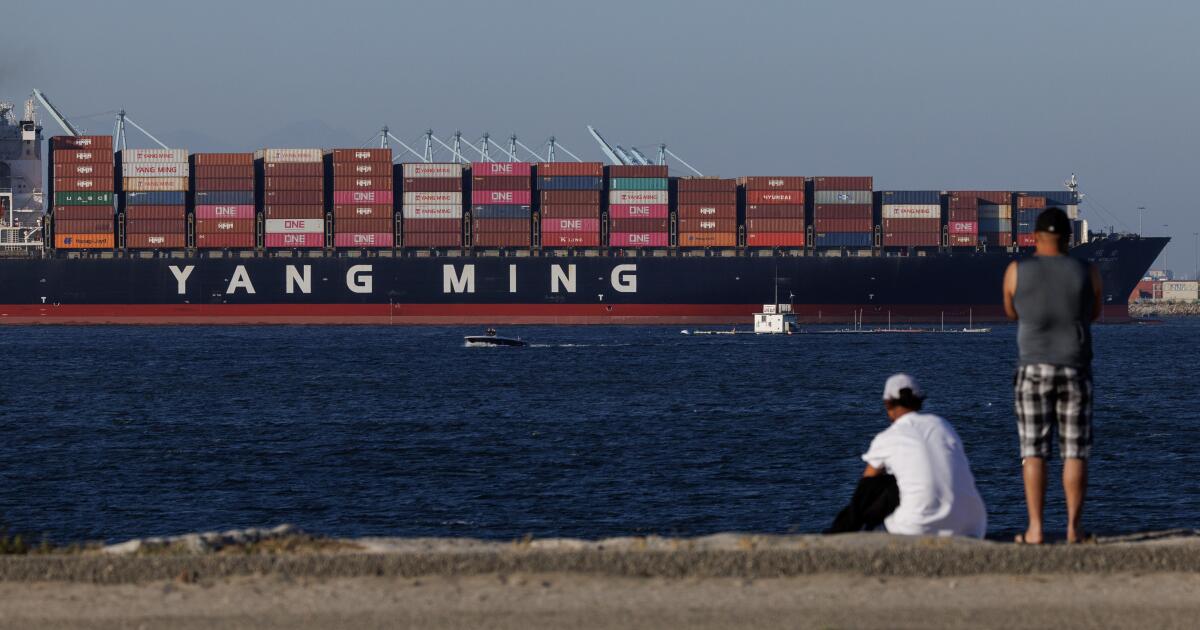

Cargo traffic at the ports of Los Angeles and Long Beach is at record highs.
The two busiest ports in the U.S., which process about a third of all U.S. cargo containers arriving in the U.S., have seen increased activity after a labor dispute shut down major ports on the East and Gulf coasts for three days in October, recently released figures show.
With the possibility of a second East Coast strike looming in the new year if dockworkers and maritime companies can’t agree on a contract, importers are diverting their goods to Southern California. President-elect Donald Trump’s promise to increase tariffs has also triggered an increase in imports ahead of his inauguration.
“We anticipate a continued influx of cargo due to robust consumer demand, concerns about potential tariffs and ongoing labor negotiations at ports on the East and Gulf coasts,” Port of Long Beach Chief Executive Mario Cordero said in a statement.
The Port of Los Angeles handled 954,706 twenty-foot equivalent units, or TEUs, in September, a 27% increase from the previous year. Total loaded imports increased 26% from last September and loaded exports decreased nearly 5%. A TEU is a unit of measurement based on the volume of a standard shipping container, and loaded imports and exports refers to cargo containers that are filled with goods.
The port processed more than 2.8 million TEUs in July, August and September, marking its busiest quarter ever. As of the end of September, the port was 18% ahead of its 2023 pace.
“Just as impressive as these new records is the fact that we managed all this cargo with skill and efficiency,” Port of Los Angeles Executive Director Gene Seroka said in a statement.
Port of Los Angeles spokesperson Phillip Sanfield said the port’s October results, which will be released next week, will be strong as well.
The Port of Long Beach moved 987,191 TEUs in October, an increase of 30% from the prior year. Loaded imports grew 34% to 487,563 TEUs and exports grew 25% to 112,845 TEUs.

Cargo traffic at the ports of Los Angeles and Long Beach is at record highs.
The two busiest ports in the U.S., which process about a third of all U.S. cargo containers arriving in the U.S., have seen increased activity after a labor dispute shut down major ports on the East and Gulf coasts for three days in October, recently released figures show.
With the possibility of a second East Coast strike looming in the new year if dockworkers and maritime companies can’t agree on a contract, importers are diverting their goods to Southern California. President-elect Donald Trump’s promise to increase tariffs has also triggered an increase in imports ahead of his inauguration.
“We anticipate a continued influx of cargo due to robust consumer demand, concerns about potential tariffs and ongoing labor negotiations at ports on the East and Gulf coasts,” Port of Long Beach Chief Executive Mario Cordero said in a statement.
The Port of Los Angeles handled 954,706 twenty-foot equivalent units, or TEUs, in September, a 27% increase from the previous year. Total loaded imports increased 26% from last September and loaded exports decreased nearly 5%. A TEU is a unit of measurement based on the volume of a standard shipping container, and loaded imports and exports refers to cargo containers that are filled with goods.
The port processed more than 2.8 million TEUs in July, August and September, marking its busiest quarter ever. As of the end of September, the port was 18% ahead of its 2023 pace.
“Just as impressive as these new records is the fact that we managed all this cargo with skill and efficiency,” Port of Los Angeles Executive Director Gene Seroka said in a statement.
Port of Los Angeles spokesperson Phillip Sanfield said the port’s October results, which will be released next week, will be strong as well.
The Port of Long Beach moved 987,191 TEUs in October, an increase of 30% from the prior year. Loaded imports grew 34% to 487,563 TEUs and exports grew 25% to 112,845 TEUs.

Cargo traffic at the ports of Los Angeles and Long Beach is at record highs.
The two busiest ports in the U.S., which process about a third of all U.S. cargo containers arriving in the U.S., have seen increased activity after a labor dispute shut down major ports on the East and Gulf coasts for three days in October, recently released figures show.
With the possibility of a second East Coast strike looming in the new year if dockworkers and maritime companies can’t agree on a contract, importers are diverting their goods to Southern California. President-elect Donald Trump’s promise to increase tariffs has also triggered an increase in imports ahead of his inauguration.
“We anticipate a continued influx of cargo due to robust consumer demand, concerns about potential tariffs and ongoing labor negotiations at ports on the East and Gulf coasts,” Port of Long Beach Chief Executive Mario Cordero said in a statement.
The Port of Los Angeles handled 954,706 twenty-foot equivalent units, or TEUs, in September, a 27% increase from the previous year. Total loaded imports increased 26% from last September and loaded exports decreased nearly 5%. A TEU is a unit of measurement based on the volume of a standard shipping container, and loaded imports and exports refers to cargo containers that are filled with goods.
The port processed more than 2.8 million TEUs in July, August and September, marking its busiest quarter ever. As of the end of September, the port was 18% ahead of its 2023 pace.
“Just as impressive as these new records is the fact that we managed all this cargo with skill and efficiency,” Port of Los Angeles Executive Director Gene Seroka said in a statement.
Port of Los Angeles spokesperson Phillip Sanfield said the port’s October results, which will be released next week, will be strong as well.
The Port of Long Beach moved 987,191 TEUs in October, an increase of 30% from the prior year. Loaded imports grew 34% to 487,563 TEUs and exports grew 25% to 112,845 TEUs.
Cargo traffic at the ports of Los Angeles and Long Beach is at record highs.
The two busiest ports in the U.S., which process about a third of all U.S. cargo containers arriving in the U.S., have seen increased activity after a labor dispute shut down major ports on the East and Gulf coasts for three days in October, recently released figures show.
With the possibility of a second East Coast strike looming in the new year if dockworkers and maritime companies can’t agree on a contract, importers are diverting their goods to Southern California. President-elect Donald Trump’s promise to increase tariffs has also triggered an increase in imports ahead of his inauguration.
“We anticipate a continued influx of cargo due to robust consumer demand, concerns about potential tariffs and ongoing labor negotiations at ports on the East and Gulf coasts,” Port of Long Beach Chief Executive Mario Cordero said in a statement.
The Port of Los Angeles handled 954,706 twenty-foot equivalent units, or TEUs, in September, a 27% increase from the previous year. Total loaded imports increased 26% from last September and loaded exports decreased nearly 5%. A TEU is a unit of measurement based on the volume of a standard shipping container, and loaded imports and exports refers to cargo containers that are filled with goods.
The port processed more than 2.8 million TEUs in July, August and September, marking its busiest quarter ever. As of the end of September, the port was 18% ahead of its 2023 pace.
“Just as impressive as these new records is the fact that we managed all this cargo with skill and efficiency,” Port of Los Angeles Executive Director Gene Seroka said in a statement.
Port of Los Angeles spokesperson Phillip Sanfield said the port’s October results, which will be released next week, will be strong as well.
The Port of Long Beach moved 987,191 TEUs in October, an increase of 30% from the prior year. Loaded imports grew 34% to 487,563 TEUs and exports grew 25% to 112,845 TEUs.

Cargo traffic at the ports of Los Angeles and Long Beach is at record highs.
The two busiest ports in the U.S., which process about a third of all U.S. cargo containers arriving in the U.S., have seen increased activity after a labor dispute shut down major ports on the East and Gulf coasts for three days in October, recently released figures show.
With the possibility of a second East Coast strike looming in the new year if dockworkers and maritime companies can’t agree on a contract, importers are diverting their goods to Southern California. President-elect Donald Trump’s promise to increase tariffs has also triggered an increase in imports ahead of his inauguration.
“We anticipate a continued influx of cargo due to robust consumer demand, concerns about potential tariffs and ongoing labor negotiations at ports on the East and Gulf coasts,” Port of Long Beach Chief Executive Mario Cordero said in a statement.
The Port of Los Angeles handled 954,706 twenty-foot equivalent units, or TEUs, in September, a 27% increase from the previous year. Total loaded imports increased 26% from last September and loaded exports decreased nearly 5%. A TEU is a unit of measurement based on the volume of a standard shipping container, and loaded imports and exports refers to cargo containers that are filled with goods.
The port processed more than 2.8 million TEUs in July, August and September, marking its busiest quarter ever. As of the end of September, the port was 18% ahead of its 2023 pace.
“Just as impressive as these new records is the fact that we managed all this cargo with skill and efficiency,” Port of Los Angeles Executive Director Gene Seroka said in a statement.
Port of Los Angeles spokesperson Phillip Sanfield said the port’s October results, which will be released next week, will be strong as well.
The Port of Long Beach moved 987,191 TEUs in October, an increase of 30% from the prior year. Loaded imports grew 34% to 487,563 TEUs and exports grew 25% to 112,845 TEUs.
Cargo traffic at the ports of Los Angeles and Long Beach is at record highs.
The two busiest ports in the U.S., which process about a third of all U.S. cargo containers arriving in the U.S., have seen increased activity after a labor dispute shut down major ports on the East and Gulf coasts for three days in October, recently released figures show.
With the possibility of a second East Coast strike looming in the new year if dockworkers and maritime companies can’t agree on a contract, importers are diverting their goods to Southern California. President-elect Donald Trump’s promise to increase tariffs has also triggered an increase in imports ahead of his inauguration.
“We anticipate a continued influx of cargo due to robust consumer demand, concerns about potential tariffs and ongoing labor negotiations at ports on the East and Gulf coasts,” Port of Long Beach Chief Executive Mario Cordero said in a statement.
The Port of Los Angeles handled 954,706 twenty-foot equivalent units, or TEUs, in September, a 27% increase from the previous year. Total loaded imports increased 26% from last September and loaded exports decreased nearly 5%. A TEU is a unit of measurement based on the volume of a standard shipping container, and loaded imports and exports refers to cargo containers that are filled with goods.
The port processed more than 2.8 million TEUs in July, August and September, marking its busiest quarter ever. As of the end of September, the port was 18% ahead of its 2023 pace.
“Just as impressive as these new records is the fact that we managed all this cargo with skill and efficiency,” Port of Los Angeles Executive Director Gene Seroka said in a statement.
Port of Los Angeles spokesperson Phillip Sanfield said the port’s October results, which will be released next week, will be strong as well.
The Port of Long Beach moved 987,191 TEUs in October, an increase of 30% from the prior year. Loaded imports grew 34% to 487,563 TEUs and exports grew 25% to 112,845 TEUs.
Cargo traffic at the ports of Los Angeles and Long Beach is at record highs.
The two busiest ports in the U.S., which process about a third of all U.S. cargo containers arriving in the U.S., have seen increased activity after a labor dispute shut down major ports on the East and Gulf coasts for three days in October, recently released figures show.
With the possibility of a second East Coast strike looming in the new year if dockworkers and maritime companies can’t agree on a contract, importers are diverting their goods to Southern California. President-elect Donald Trump’s promise to increase tariffs has also triggered an increase in imports ahead of his inauguration.
“We anticipate a continued influx of cargo due to robust consumer demand, concerns about potential tariffs and ongoing labor negotiations at ports on the East and Gulf coasts,” Port of Long Beach Chief Executive Mario Cordero said in a statement.
The Port of Los Angeles handled 954,706 twenty-foot equivalent units, or TEUs, in September, a 27% increase from the previous year. Total loaded imports increased 26% from last September and loaded exports decreased nearly 5%. A TEU is a unit of measurement based on the volume of a standard shipping container, and loaded imports and exports refers to cargo containers that are filled with goods.
The port processed more than 2.8 million TEUs in July, August and September, marking its busiest quarter ever. As of the end of September, the port was 18% ahead of its 2023 pace.
“Just as impressive as these new records is the fact that we managed all this cargo with skill and efficiency,” Port of Los Angeles Executive Director Gene Seroka said in a statement.
Port of Los Angeles spokesperson Phillip Sanfield said the port’s October results, which will be released next week, will be strong as well.
The Port of Long Beach moved 987,191 TEUs in October, an increase of 30% from the prior year. Loaded imports grew 34% to 487,563 TEUs and exports grew 25% to 112,845 TEUs.
Cargo traffic at the ports of Los Angeles and Long Beach is at record highs.
The two busiest ports in the U.S., which process about a third of all U.S. cargo containers arriving in the U.S., have seen increased activity after a labor dispute shut down major ports on the East and Gulf coasts for three days in October, recently released figures show.
With the possibility of a second East Coast strike looming in the new year if dockworkers and maritime companies can’t agree on a contract, importers are diverting their goods to Southern California. President-elect Donald Trump’s promise to increase tariffs has also triggered an increase in imports ahead of his inauguration.
“We anticipate a continued influx of cargo due to robust consumer demand, concerns about potential tariffs and ongoing labor negotiations at ports on the East and Gulf coasts,” Port of Long Beach Chief Executive Mario Cordero said in a statement.
The Port of Los Angeles handled 954,706 twenty-foot equivalent units, or TEUs, in September, a 27% increase from the previous year. Total loaded imports increased 26% from last September and loaded exports decreased nearly 5%. A TEU is a unit of measurement based on the volume of a standard shipping container, and loaded imports and exports refers to cargo containers that are filled with goods.
The port processed more than 2.8 million TEUs in July, August and September, marking its busiest quarter ever. As of the end of September, the port was 18% ahead of its 2023 pace.
“Just as impressive as these new records is the fact that we managed all this cargo with skill and efficiency,” Port of Los Angeles Executive Director Gene Seroka said in a statement.
Port of Los Angeles spokesperson Phillip Sanfield said the port’s October results, which will be released next week, will be strong as well.
The Port of Long Beach moved 987,191 TEUs in October, an increase of 30% from the prior year. Loaded imports grew 34% to 487,563 TEUs and exports grew 25% to 112,845 TEUs.

