

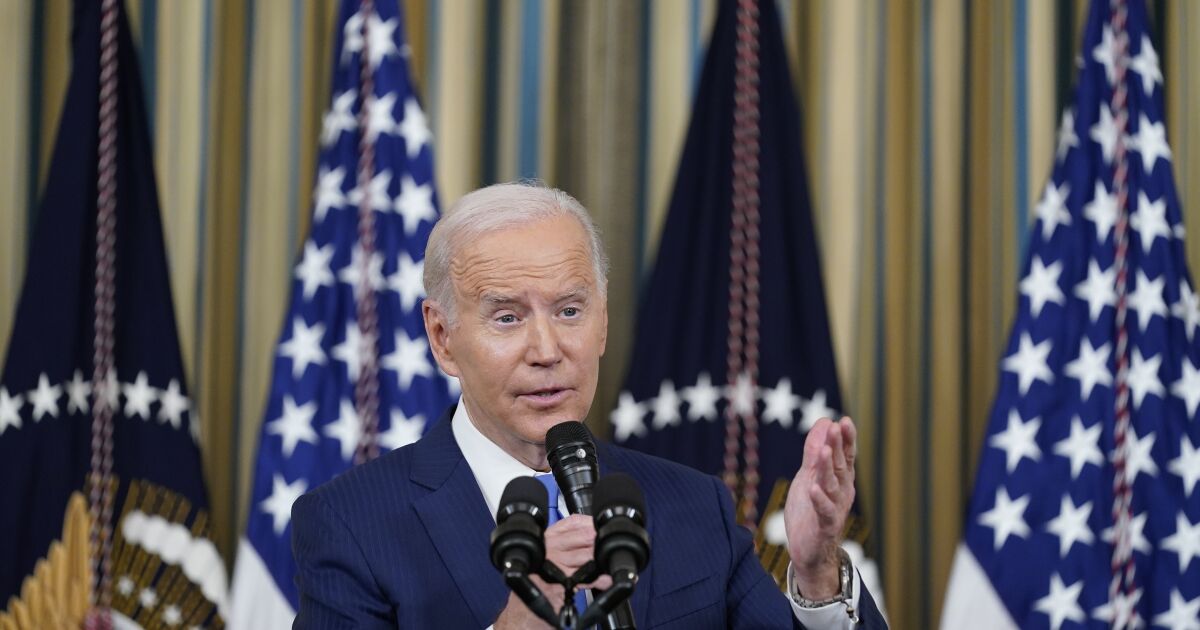

President Biden will confront some of the world’s toughest foreign policy challenges as he returns to Asia on Saturday in the hopes of convincing the region’s leaders to join U.S. efforts to counter the rise of China.
Biden’s back-to-back-to-back global summits in Asia begin on Saturday in Phnom Penh, Cambodia, for the Assn. of Southeast Asian Nations and the East Asia summits, where he’ll make the case for strengthening U.S. regional ties in an effort to blunt China’s power and influence there.
Then he heads to Bali, Indonesia, for the meeting of the Group of 20 industrialized nations. There, he is expected to meet with China’s president, Xi Jinping, amid heightened U.S.-China acrimony over new U.S. export controls on the sale of microchip technology, Taiwan’s sovereignty and Beijing’s support for Russia’s invasion of Ukraine.
The high-stakes sit-down comes as both leaders are enjoying domestic political victories — Biden’s party outperformed expectations in Tuesday’s midterm elections and Xi consolidated power last month after he was elected Communist Party leader for an unprecedented third term.
Even as Biden and other world leaders discuss other pressing topics — climate change, containing North Korea, confronting Russia over its invasion of Ukraine, global inflation and the continuing fallout from the COVID-19 pandemic — the president’s primary objective will be to convince the region’s leaders that the U.S. is following through on its decade-old promise to be a leader in the region, according to analysts and administration officials.
Among his top priorities will be touting the U.S. commitment to rules-based international order in the South China Sea, where China has been staking aggressive territorial claims, according to a senior administration official.
Biden’s visit may be heavier on symbolism than substance: His administration has yet to ditch Trump-era protectionist policies in favor of a free-trade pact. That decision has called the administration’s commitment to the region into question, analysts say.
“Simply showing up is not enough,” said Craig Singleton, senior China fellow at the Foundation for Defense of Democracies, a think tank based in Washington, D.C. “If the Biden administration is serious about reducing China’s deep economic entanglements throughout the region, it has to be willing to have a conversation about market access and more enforceable trade pacts in this region.”
The two summits will follow a stop by Biden in Sharm el-Sheikh, Egypt, on Friday to attend the annual United Nations climate conference to proclaim U.S. leadership on climate action and try to coax China to accelerate carbon-reduction plans.
Biden first visited Asia as president in May, when he met with leaders in Japan and South Korea. That trip culminated in an economic framework that failed to produce more than an open-ended strategy for 12 Indo-Pacific nations (which now includes 14 countries). Many of those countries are eager to ink a free trade deal that would open up American and Asian markets and loosen China’s economic grip on the region.
But their hopes have been dashed by successive presidential administrations, which have been buffeted by criticism over such trade deals by Democrats and Republicans.
The Obama administration had pushed to create and joint the Trans-Pacific Partnership — a free trade agreement with 11 other Pacific Rim countries — but that effort was abandoned by then-President Trump. Though the Biden has reversed several of his predecessor’s foreign policy decisions, he has taken no steps to revive it.
“There’s a lot of skepticism about whether or not there’s any substance to the agreement” reached in May that would “encourage these countries to gravitate towards the United States rather than towards China,” said Christopher Chivvis, director of the Carnegie Endowment’s American Statecraft program, of Biden’s Indo-Pacific Economic Framework for Prosperity.
White House officials point to Biden‘s and other top administration officials’ frequent trips to the Indo-Pacific and to global alliances like the Quad, a group that consists of the U.S. Australia, Japan and India as evidence of the president’s efforts to cement the relationship. Last year the U.S. drew Beijing’s ire after it announced a security alliance with the United Kingdom and Australia. The pact, known as AUKUS, will help Australia acquire nuclear-powered submarines in what was viewed as an effort to counter China.
Last year, the president spoke virtually at the ASEAN and East Asia summits (the meetings were not attended in-person due to the pandemic). In May, he hosted the U.S.-ASEAN Special Summit at the White House.
Biden’s national security strategy, released last month, describes the region as the “epicenter of 21st century geopolitics” but more pointedly paints China as “America’s most consequential geopolitical challenge.”
Despite the rhetoric, the president is unlikely to leave the summits with any substantive policy changes, analysts say, focusing instead on other issues the region is grappling with, including human rights, the conflict in Myanmar and alarm over a recent flurry of North Korean missile tests.
The president will conduct meetings on the sidelines of the summits with Cambodia’s Prime Minister Hun Sen, the ASEAN chair, as well as Japanese Prime Minister Fumio Kishida and South Korean President Yoon Suk-yeol, administration officials said.
The specter of a Chinese invasion of Taiwan is certain to be discussed at the ASEAN and G-20 meetings. Washington-Beijing relations have hit a nadir in recent months following a visit by House Speaker Nancy Pelosi (D-San Francisco) to Taiwan in August, a string of comments by Biden vowing to defend the island militarily and increased Chinese aggression in the South China Sea.
Leaders in the region will also be watching closely for the outcome of the midterms for clues to how the U.S.-Indo-Pacific relationship may unfold over the next two years. Control of Congress is still uncertain, raising questions about whether Biden will be able to back up his rhetoric when he returns from overseas.
“It’s kind of a Rorschach test for those countries or those leaders who have already decided that the U.S. is in terminal decline and they have to hitch their wagon to China, like it or not,” Greg Poling, director of the Asia Maritime Transparency Initiative at the Center for Strategic and International Studies, told The Times. “But most of the region is getting increasingly nervous about this more authoritarian China, and it’s leading them into a closer relationship with the U.S.”

President Biden will confront some of the world’s toughest foreign policy challenges as he returns to Asia on Saturday in the hopes of convincing the region’s leaders to join U.S. efforts to counter the rise of China.
Biden’s back-to-back-to-back global summits in Asia begin on Saturday in Phnom Penh, Cambodia, for the Assn. of Southeast Asian Nations and the East Asia summits, where he’ll make the case for strengthening U.S. regional ties in an effort to blunt China’s power and influence there.
Then he heads to Bali, Indonesia, for the meeting of the Group of 20 industrialized nations. There, he is expected to meet with China’s president, Xi Jinping, amid heightened U.S.-China acrimony over new U.S. export controls on the sale of microchip technology, Taiwan’s sovereignty and Beijing’s support for Russia’s invasion of Ukraine.
The high-stakes sit-down comes as both leaders are enjoying domestic political victories — Biden’s party outperformed expectations in Tuesday’s midterm elections and Xi consolidated power last month after he was elected Communist Party leader for an unprecedented third term.
Even as Biden and other world leaders discuss other pressing topics — climate change, containing North Korea, confronting Russia over its invasion of Ukraine, global inflation and the continuing fallout from the COVID-19 pandemic — the president’s primary objective will be to convince the region’s leaders that the U.S. is following through on its decade-old promise to be a leader in the region, according to analysts and administration officials.
Among his top priorities will be touting the U.S. commitment to rules-based international order in the South China Sea, where China has been staking aggressive territorial claims, according to a senior administration official.
Biden’s visit may be heavier on symbolism than substance: His administration has yet to ditch Trump-era protectionist policies in favor of a free-trade pact. That decision has called the administration’s commitment to the region into question, analysts say.
“Simply showing up is not enough,” said Craig Singleton, senior China fellow at the Foundation for Defense of Democracies, a think tank based in Washington, D.C. “If the Biden administration is serious about reducing China’s deep economic entanglements throughout the region, it has to be willing to have a conversation about market access and more enforceable trade pacts in this region.”
The two summits will follow a stop by Biden in Sharm el-Sheikh, Egypt, on Friday to attend the annual United Nations climate conference to proclaim U.S. leadership on climate action and try to coax China to accelerate carbon-reduction plans.
Biden first visited Asia as president in May, when he met with leaders in Japan and South Korea. That trip culminated in an economic framework that failed to produce more than an open-ended strategy for 12 Indo-Pacific nations (which now includes 14 countries). Many of those countries are eager to ink a free trade deal that would open up American and Asian markets and loosen China’s economic grip on the region.
But their hopes have been dashed by successive presidential administrations, which have been buffeted by criticism over such trade deals by Democrats and Republicans.
The Obama administration had pushed to create and joint the Trans-Pacific Partnership — a free trade agreement with 11 other Pacific Rim countries — but that effort was abandoned by then-President Trump. Though the Biden has reversed several of his predecessor’s foreign policy decisions, he has taken no steps to revive it.
“There’s a lot of skepticism about whether or not there’s any substance to the agreement” reached in May that would “encourage these countries to gravitate towards the United States rather than towards China,” said Christopher Chivvis, director of the Carnegie Endowment’s American Statecraft program, of Biden’s Indo-Pacific Economic Framework for Prosperity.
White House officials point to Biden‘s and other top administration officials’ frequent trips to the Indo-Pacific and to global alliances like the Quad, a group that consists of the U.S. Australia, Japan and India as evidence of the president’s efforts to cement the relationship. Last year the U.S. drew Beijing’s ire after it announced a security alliance with the United Kingdom and Australia. The pact, known as AUKUS, will help Australia acquire nuclear-powered submarines in what was viewed as an effort to counter China.
Last year, the president spoke virtually at the ASEAN and East Asia summits (the meetings were not attended in-person due to the pandemic). In May, he hosted the U.S.-ASEAN Special Summit at the White House.
Biden’s national security strategy, released last month, describes the region as the “epicenter of 21st century geopolitics” but more pointedly paints China as “America’s most consequential geopolitical challenge.”
Despite the rhetoric, the president is unlikely to leave the summits with any substantive policy changes, analysts say, focusing instead on other issues the region is grappling with, including human rights, the conflict in Myanmar and alarm over a recent flurry of North Korean missile tests.
The president will conduct meetings on the sidelines of the summits with Cambodia’s Prime Minister Hun Sen, the ASEAN chair, as well as Japanese Prime Minister Fumio Kishida and South Korean President Yoon Suk-yeol, administration officials said.
The specter of a Chinese invasion of Taiwan is certain to be discussed at the ASEAN and G-20 meetings. Washington-Beijing relations have hit a nadir in recent months following a visit by House Speaker Nancy Pelosi (D-San Francisco) to Taiwan in August, a string of comments by Biden vowing to defend the island militarily and increased Chinese aggression in the South China Sea.
Leaders in the region will also be watching closely for the outcome of the midterms for clues to how the U.S.-Indo-Pacific relationship may unfold over the next two years. Control of Congress is still uncertain, raising questions about whether Biden will be able to back up his rhetoric when he returns from overseas.
“It’s kind of a Rorschach test for those countries or those leaders who have already decided that the U.S. is in terminal decline and they have to hitch their wagon to China, like it or not,” Greg Poling, director of the Asia Maritime Transparency Initiative at the Center for Strategic and International Studies, told The Times. “But most of the region is getting increasingly nervous about this more authoritarian China, and it’s leading them into a closer relationship with the U.S.”

President Biden will confront some of the world’s toughest foreign policy challenges as he returns to Asia on Saturday in the hopes of convincing the region’s leaders to join U.S. efforts to counter the rise of China.
Biden’s back-to-back-to-back global summits in Asia begin on Saturday in Phnom Penh, Cambodia, for the Assn. of Southeast Asian Nations and the East Asia summits, where he’ll make the case for strengthening U.S. regional ties in an effort to blunt China’s power and influence there.
Then he heads to Bali, Indonesia, for the meeting of the Group of 20 industrialized nations. There, he is expected to meet with China’s president, Xi Jinping, amid heightened U.S.-China acrimony over new U.S. export controls on the sale of microchip technology, Taiwan’s sovereignty and Beijing’s support for Russia’s invasion of Ukraine.
The high-stakes sit-down comes as both leaders are enjoying domestic political victories — Biden’s party outperformed expectations in Tuesday’s midterm elections and Xi consolidated power last month after he was elected Communist Party leader for an unprecedented third term.
Even as Biden and other world leaders discuss other pressing topics — climate change, containing North Korea, confronting Russia over its invasion of Ukraine, global inflation and the continuing fallout from the COVID-19 pandemic — the president’s primary objective will be to convince the region’s leaders that the U.S. is following through on its decade-old promise to be a leader in the region, according to analysts and administration officials.
Among his top priorities will be touting the U.S. commitment to rules-based international order in the South China Sea, where China has been staking aggressive territorial claims, according to a senior administration official.
Biden’s visit may be heavier on symbolism than substance: His administration has yet to ditch Trump-era protectionist policies in favor of a free-trade pact. That decision has called the administration’s commitment to the region into question, analysts say.
“Simply showing up is not enough,” said Craig Singleton, senior China fellow at the Foundation for Defense of Democracies, a think tank based in Washington, D.C. “If the Biden administration is serious about reducing China’s deep economic entanglements throughout the region, it has to be willing to have a conversation about market access and more enforceable trade pacts in this region.”
The two summits will follow a stop by Biden in Sharm el-Sheikh, Egypt, on Friday to attend the annual United Nations climate conference to proclaim U.S. leadership on climate action and try to coax China to accelerate carbon-reduction plans.
Biden first visited Asia as president in May, when he met with leaders in Japan and South Korea. That trip culminated in an economic framework that failed to produce more than an open-ended strategy for 12 Indo-Pacific nations (which now includes 14 countries). Many of those countries are eager to ink a free trade deal that would open up American and Asian markets and loosen China’s economic grip on the region.
But their hopes have been dashed by successive presidential administrations, which have been buffeted by criticism over such trade deals by Democrats and Republicans.
The Obama administration had pushed to create and joint the Trans-Pacific Partnership — a free trade agreement with 11 other Pacific Rim countries — but that effort was abandoned by then-President Trump. Though the Biden has reversed several of his predecessor’s foreign policy decisions, he has taken no steps to revive it.
“There’s a lot of skepticism about whether or not there’s any substance to the agreement” reached in May that would “encourage these countries to gravitate towards the United States rather than towards China,” said Christopher Chivvis, director of the Carnegie Endowment’s American Statecraft program, of Biden’s Indo-Pacific Economic Framework for Prosperity.
White House officials point to Biden‘s and other top administration officials’ frequent trips to the Indo-Pacific and to global alliances like the Quad, a group that consists of the U.S. Australia, Japan and India as evidence of the president’s efforts to cement the relationship. Last year the U.S. drew Beijing’s ire after it announced a security alliance with the United Kingdom and Australia. The pact, known as AUKUS, will help Australia acquire nuclear-powered submarines in what was viewed as an effort to counter China.
Last year, the president spoke virtually at the ASEAN and East Asia summits (the meetings were not attended in-person due to the pandemic). In May, he hosted the U.S.-ASEAN Special Summit at the White House.
Biden’s national security strategy, released last month, describes the region as the “epicenter of 21st century geopolitics” but more pointedly paints China as “America’s most consequential geopolitical challenge.”
Despite the rhetoric, the president is unlikely to leave the summits with any substantive policy changes, analysts say, focusing instead on other issues the region is grappling with, including human rights, the conflict in Myanmar and alarm over a recent flurry of North Korean missile tests.
The president will conduct meetings on the sidelines of the summits with Cambodia’s Prime Minister Hun Sen, the ASEAN chair, as well as Japanese Prime Minister Fumio Kishida and South Korean President Yoon Suk-yeol, administration officials said.
The specter of a Chinese invasion of Taiwan is certain to be discussed at the ASEAN and G-20 meetings. Washington-Beijing relations have hit a nadir in recent months following a visit by House Speaker Nancy Pelosi (D-San Francisco) to Taiwan in August, a string of comments by Biden vowing to defend the island militarily and increased Chinese aggression in the South China Sea.
Leaders in the region will also be watching closely for the outcome of the midterms for clues to how the U.S.-Indo-Pacific relationship may unfold over the next two years. Control of Congress is still uncertain, raising questions about whether Biden will be able to back up his rhetoric when he returns from overseas.
“It’s kind of a Rorschach test for those countries or those leaders who have already decided that the U.S. is in terminal decline and they have to hitch their wagon to China, like it or not,” Greg Poling, director of the Asia Maritime Transparency Initiative at the Center for Strategic and International Studies, told The Times. “But most of the region is getting increasingly nervous about this more authoritarian China, and it’s leading them into a closer relationship with the U.S.”
President Biden will confront some of the world’s toughest foreign policy challenges as he returns to Asia on Saturday in the hopes of convincing the region’s leaders to join U.S. efforts to counter the rise of China.
Biden’s back-to-back-to-back global summits in Asia begin on Saturday in Phnom Penh, Cambodia, for the Assn. of Southeast Asian Nations and the East Asia summits, where he’ll make the case for strengthening U.S. regional ties in an effort to blunt China’s power and influence there.
Then he heads to Bali, Indonesia, for the meeting of the Group of 20 industrialized nations. There, he is expected to meet with China’s president, Xi Jinping, amid heightened U.S.-China acrimony over new U.S. export controls on the sale of microchip technology, Taiwan’s sovereignty and Beijing’s support for Russia’s invasion of Ukraine.
The high-stakes sit-down comes as both leaders are enjoying domestic political victories — Biden’s party outperformed expectations in Tuesday’s midterm elections and Xi consolidated power last month after he was elected Communist Party leader for an unprecedented third term.
Even as Biden and other world leaders discuss other pressing topics — climate change, containing North Korea, confronting Russia over its invasion of Ukraine, global inflation and the continuing fallout from the COVID-19 pandemic — the president’s primary objective will be to convince the region’s leaders that the U.S. is following through on its decade-old promise to be a leader in the region, according to analysts and administration officials.
Among his top priorities will be touting the U.S. commitment to rules-based international order in the South China Sea, where China has been staking aggressive territorial claims, according to a senior administration official.
Biden’s visit may be heavier on symbolism than substance: His administration has yet to ditch Trump-era protectionist policies in favor of a free-trade pact. That decision has called the administration’s commitment to the region into question, analysts say.
“Simply showing up is not enough,” said Craig Singleton, senior China fellow at the Foundation for Defense of Democracies, a think tank based in Washington, D.C. “If the Biden administration is serious about reducing China’s deep economic entanglements throughout the region, it has to be willing to have a conversation about market access and more enforceable trade pacts in this region.”
The two summits will follow a stop by Biden in Sharm el-Sheikh, Egypt, on Friday to attend the annual United Nations climate conference to proclaim U.S. leadership on climate action and try to coax China to accelerate carbon-reduction plans.
Biden first visited Asia as president in May, when he met with leaders in Japan and South Korea. That trip culminated in an economic framework that failed to produce more than an open-ended strategy for 12 Indo-Pacific nations (which now includes 14 countries). Many of those countries are eager to ink a free trade deal that would open up American and Asian markets and loosen China’s economic grip on the region.
But their hopes have been dashed by successive presidential administrations, which have been buffeted by criticism over such trade deals by Democrats and Republicans.
The Obama administration had pushed to create and joint the Trans-Pacific Partnership — a free trade agreement with 11 other Pacific Rim countries — but that effort was abandoned by then-President Trump. Though the Biden has reversed several of his predecessor’s foreign policy decisions, he has taken no steps to revive it.
“There’s a lot of skepticism about whether or not there’s any substance to the agreement” reached in May that would “encourage these countries to gravitate towards the United States rather than towards China,” said Christopher Chivvis, director of the Carnegie Endowment’s American Statecraft program, of Biden’s Indo-Pacific Economic Framework for Prosperity.
White House officials point to Biden‘s and other top administration officials’ frequent trips to the Indo-Pacific and to global alliances like the Quad, a group that consists of the U.S. Australia, Japan and India as evidence of the president’s efforts to cement the relationship. Last year the U.S. drew Beijing’s ire after it announced a security alliance with the United Kingdom and Australia. The pact, known as AUKUS, will help Australia acquire nuclear-powered submarines in what was viewed as an effort to counter China.
Last year, the president spoke virtually at the ASEAN and East Asia summits (the meetings were not attended in-person due to the pandemic). In May, he hosted the U.S.-ASEAN Special Summit at the White House.
Biden’s national security strategy, released last month, describes the region as the “epicenter of 21st century geopolitics” but more pointedly paints China as “America’s most consequential geopolitical challenge.”
Despite the rhetoric, the president is unlikely to leave the summits with any substantive policy changes, analysts say, focusing instead on other issues the region is grappling with, including human rights, the conflict in Myanmar and alarm over a recent flurry of North Korean missile tests.
The president will conduct meetings on the sidelines of the summits with Cambodia’s Prime Minister Hun Sen, the ASEAN chair, as well as Japanese Prime Minister Fumio Kishida and South Korean President Yoon Suk-yeol, administration officials said.
The specter of a Chinese invasion of Taiwan is certain to be discussed at the ASEAN and G-20 meetings. Washington-Beijing relations have hit a nadir in recent months following a visit by House Speaker Nancy Pelosi (D-San Francisco) to Taiwan in August, a string of comments by Biden vowing to defend the island militarily and increased Chinese aggression in the South China Sea.
Leaders in the region will also be watching closely for the outcome of the midterms for clues to how the U.S.-Indo-Pacific relationship may unfold over the next two years. Control of Congress is still uncertain, raising questions about whether Biden will be able to back up his rhetoric when he returns from overseas.
“It’s kind of a Rorschach test for those countries or those leaders who have already decided that the U.S. is in terminal decline and they have to hitch their wagon to China, like it or not,” Greg Poling, director of the Asia Maritime Transparency Initiative at the Center for Strategic and International Studies, told The Times. “But most of the region is getting increasingly nervous about this more authoritarian China, and it’s leading them into a closer relationship with the U.S.”

President Biden will confront some of the world’s toughest foreign policy challenges as he returns to Asia on Saturday in the hopes of convincing the region’s leaders to join U.S. efforts to counter the rise of China.
Biden’s back-to-back-to-back global summits in Asia begin on Saturday in Phnom Penh, Cambodia, for the Assn. of Southeast Asian Nations and the East Asia summits, where he’ll make the case for strengthening U.S. regional ties in an effort to blunt China’s power and influence there.
Then he heads to Bali, Indonesia, for the meeting of the Group of 20 industrialized nations. There, he is expected to meet with China’s president, Xi Jinping, amid heightened U.S.-China acrimony over new U.S. export controls on the sale of microchip technology, Taiwan’s sovereignty and Beijing’s support for Russia’s invasion of Ukraine.
The high-stakes sit-down comes as both leaders are enjoying domestic political victories — Biden’s party outperformed expectations in Tuesday’s midterm elections and Xi consolidated power last month after he was elected Communist Party leader for an unprecedented third term.
Even as Biden and other world leaders discuss other pressing topics — climate change, containing North Korea, confronting Russia over its invasion of Ukraine, global inflation and the continuing fallout from the COVID-19 pandemic — the president’s primary objective will be to convince the region’s leaders that the U.S. is following through on its decade-old promise to be a leader in the region, according to analysts and administration officials.
Among his top priorities will be touting the U.S. commitment to rules-based international order in the South China Sea, where China has been staking aggressive territorial claims, according to a senior administration official.
Biden’s visit may be heavier on symbolism than substance: His administration has yet to ditch Trump-era protectionist policies in favor of a free-trade pact. That decision has called the administration’s commitment to the region into question, analysts say.
“Simply showing up is not enough,” said Craig Singleton, senior China fellow at the Foundation for Defense of Democracies, a think tank based in Washington, D.C. “If the Biden administration is serious about reducing China’s deep economic entanglements throughout the region, it has to be willing to have a conversation about market access and more enforceable trade pacts in this region.”
The two summits will follow a stop by Biden in Sharm el-Sheikh, Egypt, on Friday to attend the annual United Nations climate conference to proclaim U.S. leadership on climate action and try to coax China to accelerate carbon-reduction plans.
Biden first visited Asia as president in May, when he met with leaders in Japan and South Korea. That trip culminated in an economic framework that failed to produce more than an open-ended strategy for 12 Indo-Pacific nations (which now includes 14 countries). Many of those countries are eager to ink a free trade deal that would open up American and Asian markets and loosen China’s economic grip on the region.
But their hopes have been dashed by successive presidential administrations, which have been buffeted by criticism over such trade deals by Democrats and Republicans.
The Obama administration had pushed to create and joint the Trans-Pacific Partnership — a free trade agreement with 11 other Pacific Rim countries — but that effort was abandoned by then-President Trump. Though the Biden has reversed several of his predecessor’s foreign policy decisions, he has taken no steps to revive it.
“There’s a lot of skepticism about whether or not there’s any substance to the agreement” reached in May that would “encourage these countries to gravitate towards the United States rather than towards China,” said Christopher Chivvis, director of the Carnegie Endowment’s American Statecraft program, of Biden’s Indo-Pacific Economic Framework for Prosperity.
White House officials point to Biden‘s and other top administration officials’ frequent trips to the Indo-Pacific and to global alliances like the Quad, a group that consists of the U.S. Australia, Japan and India as evidence of the president’s efforts to cement the relationship. Last year the U.S. drew Beijing’s ire after it announced a security alliance with the United Kingdom and Australia. The pact, known as AUKUS, will help Australia acquire nuclear-powered submarines in what was viewed as an effort to counter China.
Last year, the president spoke virtually at the ASEAN and East Asia summits (the meetings were not attended in-person due to the pandemic). In May, he hosted the U.S.-ASEAN Special Summit at the White House.
Biden’s national security strategy, released last month, describes the region as the “epicenter of 21st century geopolitics” but more pointedly paints China as “America’s most consequential geopolitical challenge.”
Despite the rhetoric, the president is unlikely to leave the summits with any substantive policy changes, analysts say, focusing instead on other issues the region is grappling with, including human rights, the conflict in Myanmar and alarm over a recent flurry of North Korean missile tests.
The president will conduct meetings on the sidelines of the summits with Cambodia’s Prime Minister Hun Sen, the ASEAN chair, as well as Japanese Prime Minister Fumio Kishida and South Korean President Yoon Suk-yeol, administration officials said.
The specter of a Chinese invasion of Taiwan is certain to be discussed at the ASEAN and G-20 meetings. Washington-Beijing relations have hit a nadir in recent months following a visit by House Speaker Nancy Pelosi (D-San Francisco) to Taiwan in August, a string of comments by Biden vowing to defend the island militarily and increased Chinese aggression in the South China Sea.
Leaders in the region will also be watching closely for the outcome of the midterms for clues to how the U.S.-Indo-Pacific relationship may unfold over the next two years. Control of Congress is still uncertain, raising questions about whether Biden will be able to back up his rhetoric when he returns from overseas.
“It’s kind of a Rorschach test for those countries or those leaders who have already decided that the U.S. is in terminal decline and they have to hitch their wagon to China, like it or not,” Greg Poling, director of the Asia Maritime Transparency Initiative at the Center for Strategic and International Studies, told The Times. “But most of the region is getting increasingly nervous about this more authoritarian China, and it’s leading them into a closer relationship with the U.S.”
President Biden will confront some of the world’s toughest foreign policy challenges as he returns to Asia on Saturday in the hopes of convincing the region’s leaders to join U.S. efforts to counter the rise of China.
Biden’s back-to-back-to-back global summits in Asia begin on Saturday in Phnom Penh, Cambodia, for the Assn. of Southeast Asian Nations and the East Asia summits, where he’ll make the case for strengthening U.S. regional ties in an effort to blunt China’s power and influence there.
Then he heads to Bali, Indonesia, for the meeting of the Group of 20 industrialized nations. There, he is expected to meet with China’s president, Xi Jinping, amid heightened U.S.-China acrimony over new U.S. export controls on the sale of microchip technology, Taiwan’s sovereignty and Beijing’s support for Russia’s invasion of Ukraine.
The high-stakes sit-down comes as both leaders are enjoying domestic political victories — Biden’s party outperformed expectations in Tuesday’s midterm elections and Xi consolidated power last month after he was elected Communist Party leader for an unprecedented third term.
Even as Biden and other world leaders discuss other pressing topics — climate change, containing North Korea, confronting Russia over its invasion of Ukraine, global inflation and the continuing fallout from the COVID-19 pandemic — the president’s primary objective will be to convince the region’s leaders that the U.S. is following through on its decade-old promise to be a leader in the region, according to analysts and administration officials.
Among his top priorities will be touting the U.S. commitment to rules-based international order in the South China Sea, where China has been staking aggressive territorial claims, according to a senior administration official.
Biden’s visit may be heavier on symbolism than substance: His administration has yet to ditch Trump-era protectionist policies in favor of a free-trade pact. That decision has called the administration’s commitment to the region into question, analysts say.
“Simply showing up is not enough,” said Craig Singleton, senior China fellow at the Foundation for Defense of Democracies, a think tank based in Washington, D.C. “If the Biden administration is serious about reducing China’s deep economic entanglements throughout the region, it has to be willing to have a conversation about market access and more enforceable trade pacts in this region.”
The two summits will follow a stop by Biden in Sharm el-Sheikh, Egypt, on Friday to attend the annual United Nations climate conference to proclaim U.S. leadership on climate action and try to coax China to accelerate carbon-reduction plans.
Biden first visited Asia as president in May, when he met with leaders in Japan and South Korea. That trip culminated in an economic framework that failed to produce more than an open-ended strategy for 12 Indo-Pacific nations (which now includes 14 countries). Many of those countries are eager to ink a free trade deal that would open up American and Asian markets and loosen China’s economic grip on the region.
But their hopes have been dashed by successive presidential administrations, which have been buffeted by criticism over such trade deals by Democrats and Republicans.
The Obama administration had pushed to create and joint the Trans-Pacific Partnership — a free trade agreement with 11 other Pacific Rim countries — but that effort was abandoned by then-President Trump. Though the Biden has reversed several of his predecessor’s foreign policy decisions, he has taken no steps to revive it.
“There’s a lot of skepticism about whether or not there’s any substance to the agreement” reached in May that would “encourage these countries to gravitate towards the United States rather than towards China,” said Christopher Chivvis, director of the Carnegie Endowment’s American Statecraft program, of Biden’s Indo-Pacific Economic Framework for Prosperity.
White House officials point to Biden‘s and other top administration officials’ frequent trips to the Indo-Pacific and to global alliances like the Quad, a group that consists of the U.S. Australia, Japan and India as evidence of the president’s efforts to cement the relationship. Last year the U.S. drew Beijing’s ire after it announced a security alliance with the United Kingdom and Australia. The pact, known as AUKUS, will help Australia acquire nuclear-powered submarines in what was viewed as an effort to counter China.
Last year, the president spoke virtually at the ASEAN and East Asia summits (the meetings were not attended in-person due to the pandemic). In May, he hosted the U.S.-ASEAN Special Summit at the White House.
Biden’s national security strategy, released last month, describes the region as the “epicenter of 21st century geopolitics” but more pointedly paints China as “America’s most consequential geopolitical challenge.”
Despite the rhetoric, the president is unlikely to leave the summits with any substantive policy changes, analysts say, focusing instead on other issues the region is grappling with, including human rights, the conflict in Myanmar and alarm over a recent flurry of North Korean missile tests.
The president will conduct meetings on the sidelines of the summits with Cambodia’s Prime Minister Hun Sen, the ASEAN chair, as well as Japanese Prime Minister Fumio Kishida and South Korean President Yoon Suk-yeol, administration officials said.
The specter of a Chinese invasion of Taiwan is certain to be discussed at the ASEAN and G-20 meetings. Washington-Beijing relations have hit a nadir in recent months following a visit by House Speaker Nancy Pelosi (D-San Francisco) to Taiwan in August, a string of comments by Biden vowing to defend the island militarily and increased Chinese aggression in the South China Sea.
Leaders in the region will also be watching closely for the outcome of the midterms for clues to how the U.S.-Indo-Pacific relationship may unfold over the next two years. Control of Congress is still uncertain, raising questions about whether Biden will be able to back up his rhetoric when he returns from overseas.
“It’s kind of a Rorschach test for those countries or those leaders who have already decided that the U.S. is in terminal decline and they have to hitch their wagon to China, like it or not,” Greg Poling, director of the Asia Maritime Transparency Initiative at the Center for Strategic and International Studies, told The Times. “But most of the region is getting increasingly nervous about this more authoritarian China, and it’s leading them into a closer relationship with the U.S.”
President Biden will confront some of the world’s toughest foreign policy challenges as he returns to Asia on Saturday in the hopes of convincing the region’s leaders to join U.S. efforts to counter the rise of China.
Biden’s back-to-back-to-back global summits in Asia begin on Saturday in Phnom Penh, Cambodia, for the Assn. of Southeast Asian Nations and the East Asia summits, where he’ll make the case for strengthening U.S. regional ties in an effort to blunt China’s power and influence there.
Then he heads to Bali, Indonesia, for the meeting of the Group of 20 industrialized nations. There, he is expected to meet with China’s president, Xi Jinping, amid heightened U.S.-China acrimony over new U.S. export controls on the sale of microchip technology, Taiwan’s sovereignty and Beijing’s support for Russia’s invasion of Ukraine.
The high-stakes sit-down comes as both leaders are enjoying domestic political victories — Biden’s party outperformed expectations in Tuesday’s midterm elections and Xi consolidated power last month after he was elected Communist Party leader for an unprecedented third term.
Even as Biden and other world leaders discuss other pressing topics — climate change, containing North Korea, confronting Russia over its invasion of Ukraine, global inflation and the continuing fallout from the COVID-19 pandemic — the president’s primary objective will be to convince the region’s leaders that the U.S. is following through on its decade-old promise to be a leader in the region, according to analysts and administration officials.
Among his top priorities will be touting the U.S. commitment to rules-based international order in the South China Sea, where China has been staking aggressive territorial claims, according to a senior administration official.
Biden’s visit may be heavier on symbolism than substance: His administration has yet to ditch Trump-era protectionist policies in favor of a free-trade pact. That decision has called the administration’s commitment to the region into question, analysts say.
“Simply showing up is not enough,” said Craig Singleton, senior China fellow at the Foundation for Defense of Democracies, a think tank based in Washington, D.C. “If the Biden administration is serious about reducing China’s deep economic entanglements throughout the region, it has to be willing to have a conversation about market access and more enforceable trade pacts in this region.”
The two summits will follow a stop by Biden in Sharm el-Sheikh, Egypt, on Friday to attend the annual United Nations climate conference to proclaim U.S. leadership on climate action and try to coax China to accelerate carbon-reduction plans.
Biden first visited Asia as president in May, when he met with leaders in Japan and South Korea. That trip culminated in an economic framework that failed to produce more than an open-ended strategy for 12 Indo-Pacific nations (which now includes 14 countries). Many of those countries are eager to ink a free trade deal that would open up American and Asian markets and loosen China’s economic grip on the region.
But their hopes have been dashed by successive presidential administrations, which have been buffeted by criticism over such trade deals by Democrats and Republicans.
The Obama administration had pushed to create and joint the Trans-Pacific Partnership — a free trade agreement with 11 other Pacific Rim countries — but that effort was abandoned by then-President Trump. Though the Biden has reversed several of his predecessor’s foreign policy decisions, he has taken no steps to revive it.
“There’s a lot of skepticism about whether or not there’s any substance to the agreement” reached in May that would “encourage these countries to gravitate towards the United States rather than towards China,” said Christopher Chivvis, director of the Carnegie Endowment’s American Statecraft program, of Biden’s Indo-Pacific Economic Framework for Prosperity.
White House officials point to Biden‘s and other top administration officials’ frequent trips to the Indo-Pacific and to global alliances like the Quad, a group that consists of the U.S. Australia, Japan and India as evidence of the president’s efforts to cement the relationship. Last year the U.S. drew Beijing’s ire after it announced a security alliance with the United Kingdom and Australia. The pact, known as AUKUS, will help Australia acquire nuclear-powered submarines in what was viewed as an effort to counter China.
Last year, the president spoke virtually at the ASEAN and East Asia summits (the meetings were not attended in-person due to the pandemic). In May, he hosted the U.S.-ASEAN Special Summit at the White House.
Biden’s national security strategy, released last month, describes the region as the “epicenter of 21st century geopolitics” but more pointedly paints China as “America’s most consequential geopolitical challenge.”
Despite the rhetoric, the president is unlikely to leave the summits with any substantive policy changes, analysts say, focusing instead on other issues the region is grappling with, including human rights, the conflict in Myanmar and alarm over a recent flurry of North Korean missile tests.
The president will conduct meetings on the sidelines of the summits with Cambodia’s Prime Minister Hun Sen, the ASEAN chair, as well as Japanese Prime Minister Fumio Kishida and South Korean President Yoon Suk-yeol, administration officials said.
The specter of a Chinese invasion of Taiwan is certain to be discussed at the ASEAN and G-20 meetings. Washington-Beijing relations have hit a nadir in recent months following a visit by House Speaker Nancy Pelosi (D-San Francisco) to Taiwan in August, a string of comments by Biden vowing to defend the island militarily and increased Chinese aggression in the South China Sea.
Leaders in the region will also be watching closely for the outcome of the midterms for clues to how the U.S.-Indo-Pacific relationship may unfold over the next two years. Control of Congress is still uncertain, raising questions about whether Biden will be able to back up his rhetoric when he returns from overseas.
“It’s kind of a Rorschach test for those countries or those leaders who have already decided that the U.S. is in terminal decline and they have to hitch their wagon to China, like it or not,” Greg Poling, director of the Asia Maritime Transparency Initiative at the Center for Strategic and International Studies, told The Times. “But most of the region is getting increasingly nervous about this more authoritarian China, and it’s leading them into a closer relationship with the U.S.”
President Biden will confront some of the world’s toughest foreign policy challenges as he returns to Asia on Saturday in the hopes of convincing the region’s leaders to join U.S. efforts to counter the rise of China.
Biden’s back-to-back-to-back global summits in Asia begin on Saturday in Phnom Penh, Cambodia, for the Assn. of Southeast Asian Nations and the East Asia summits, where he’ll make the case for strengthening U.S. regional ties in an effort to blunt China’s power and influence there.
Then he heads to Bali, Indonesia, for the meeting of the Group of 20 industrialized nations. There, he is expected to meet with China’s president, Xi Jinping, amid heightened U.S.-China acrimony over new U.S. export controls on the sale of microchip technology, Taiwan’s sovereignty and Beijing’s support for Russia’s invasion of Ukraine.
The high-stakes sit-down comes as both leaders are enjoying domestic political victories — Biden’s party outperformed expectations in Tuesday’s midterm elections and Xi consolidated power last month after he was elected Communist Party leader for an unprecedented third term.
Even as Biden and other world leaders discuss other pressing topics — climate change, containing North Korea, confronting Russia over its invasion of Ukraine, global inflation and the continuing fallout from the COVID-19 pandemic — the president’s primary objective will be to convince the region’s leaders that the U.S. is following through on its decade-old promise to be a leader in the region, according to analysts and administration officials.
Among his top priorities will be touting the U.S. commitment to rules-based international order in the South China Sea, where China has been staking aggressive territorial claims, according to a senior administration official.
Biden’s visit may be heavier on symbolism than substance: His administration has yet to ditch Trump-era protectionist policies in favor of a free-trade pact. That decision has called the administration’s commitment to the region into question, analysts say.
“Simply showing up is not enough,” said Craig Singleton, senior China fellow at the Foundation for Defense of Democracies, a think tank based in Washington, D.C. “If the Biden administration is serious about reducing China’s deep economic entanglements throughout the region, it has to be willing to have a conversation about market access and more enforceable trade pacts in this region.”
The two summits will follow a stop by Biden in Sharm el-Sheikh, Egypt, on Friday to attend the annual United Nations climate conference to proclaim U.S. leadership on climate action and try to coax China to accelerate carbon-reduction plans.
Biden first visited Asia as president in May, when he met with leaders in Japan and South Korea. That trip culminated in an economic framework that failed to produce more than an open-ended strategy for 12 Indo-Pacific nations (which now includes 14 countries). Many of those countries are eager to ink a free trade deal that would open up American and Asian markets and loosen China’s economic grip on the region.
But their hopes have been dashed by successive presidential administrations, which have been buffeted by criticism over such trade deals by Democrats and Republicans.
The Obama administration had pushed to create and joint the Trans-Pacific Partnership — a free trade agreement with 11 other Pacific Rim countries — but that effort was abandoned by then-President Trump. Though the Biden has reversed several of his predecessor’s foreign policy decisions, he has taken no steps to revive it.
“There’s a lot of skepticism about whether or not there’s any substance to the agreement” reached in May that would “encourage these countries to gravitate towards the United States rather than towards China,” said Christopher Chivvis, director of the Carnegie Endowment’s American Statecraft program, of Biden’s Indo-Pacific Economic Framework for Prosperity.
White House officials point to Biden‘s and other top administration officials’ frequent trips to the Indo-Pacific and to global alliances like the Quad, a group that consists of the U.S. Australia, Japan and India as evidence of the president’s efforts to cement the relationship. Last year the U.S. drew Beijing’s ire after it announced a security alliance with the United Kingdom and Australia. The pact, known as AUKUS, will help Australia acquire nuclear-powered submarines in what was viewed as an effort to counter China.
Last year, the president spoke virtually at the ASEAN and East Asia summits (the meetings were not attended in-person due to the pandemic). In May, he hosted the U.S.-ASEAN Special Summit at the White House.
Biden’s national security strategy, released last month, describes the region as the “epicenter of 21st century geopolitics” but more pointedly paints China as “America’s most consequential geopolitical challenge.”
Despite the rhetoric, the president is unlikely to leave the summits with any substantive policy changes, analysts say, focusing instead on other issues the region is grappling with, including human rights, the conflict in Myanmar and alarm over a recent flurry of North Korean missile tests.
The president will conduct meetings on the sidelines of the summits with Cambodia’s Prime Minister Hun Sen, the ASEAN chair, as well as Japanese Prime Minister Fumio Kishida and South Korean President Yoon Suk-yeol, administration officials said.
The specter of a Chinese invasion of Taiwan is certain to be discussed at the ASEAN and G-20 meetings. Washington-Beijing relations have hit a nadir in recent months following a visit by House Speaker Nancy Pelosi (D-San Francisco) to Taiwan in August, a string of comments by Biden vowing to defend the island militarily and increased Chinese aggression in the South China Sea.
Leaders in the region will also be watching closely for the outcome of the midterms for clues to how the U.S.-Indo-Pacific relationship may unfold over the next two years. Control of Congress is still uncertain, raising questions about whether Biden will be able to back up his rhetoric when he returns from overseas.
“It’s kind of a Rorschach test for those countries or those leaders who have already decided that the U.S. is in terminal decline and they have to hitch their wagon to China, like it or not,” Greg Poling, director of the Asia Maritime Transparency Initiative at the Center for Strategic and International Studies, told The Times. “But most of the region is getting increasingly nervous about this more authoritarian China, and it’s leading them into a closer relationship with the U.S.”

