


With the danger of a wider Middle East war looming, Israel on Friday bombarded part of the Lebanese capital, killing at least eight people and wounding 59 others, Lebanese authorities said.
The strike came just days after thousands of sabotaged electronic devices exploded across the country, killing 30 and wounding thousands, an action widely attributed to Israel.
Friday’s attack, in which Israel launched airstrikes against a crowded Beirut suburb during rush hour, appears to have targeted a senior leader of the Hezbollah militant group. His fate remained unclear.
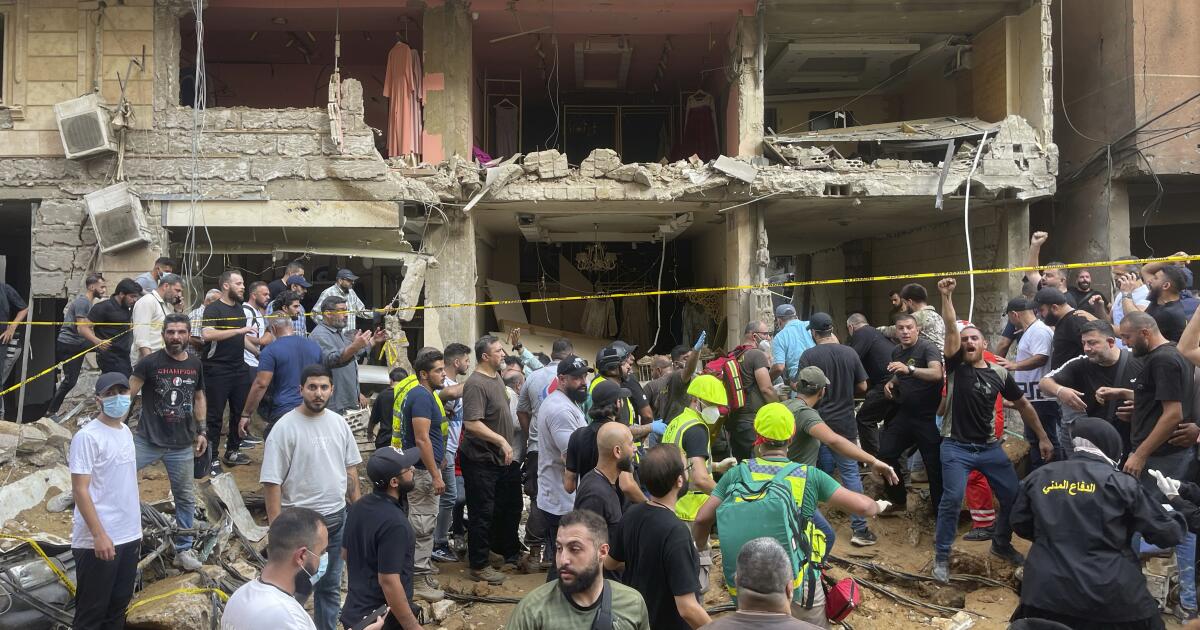
Inside the Dahieh, the southern suburbs of the capital where Hezbollah is headquartered, it was a chaotic scene. Family members rushed to the area, but were kept away by Hezbollah operatives who erected a barricade around damaged buildings.
Witnesses said the attack also hit Al-Qaim, a major mosque in the area.
For more than two hours after the strike, dozens of ambulances, bulldozers, fire trucks and even a Polaris buggy streamed in and out of the street.
“If you saw the building, you’d see why we’re all here,” said one civil defense worker who did not give his name so as to speak freely. “Three quarters of the building has collapsed.”
Residents were told to evacuate the area. Families appeared by the barricade, looking dazed as they carried duffel bags, suitcases and pet carriers.
Overnight, ahead of the Israeli strike, Hezbollah pounded northern Israel with rockets and the group’s leader, Hassan Nasrallah, vowed revenge for the spate of bombings through pagers and walkie-talkies.
In recent days, Israel has repeatedly telegraphed a more aggressive stance toward Hezbollah. On Thursday, the Israeli military said its chief of staff, Lt. Gen. Herzi Halevi, had recently approved new plans for the northern conflict zone. A day earlier, Defense Minister Yoav Gallant declared that the conflict was entering a “new phase.”
The escalation comes even as U.S. officials crisscross the region imploring leaders to avoid inflaming tensions — a plea evidently ignored. Biden administration officials were quick to insist the U.S. had nothing to do with Friday’s attack, a similar disclaimer made following the explosions of pagers and walkie-talkies.
“Our intensive diplomacy efforts continue,” White House national security spokesman John Kirby said Friday. “We believe, continue to believe, that a diplomatic solution is the best way forward. … War is not inevitable.”
Bulos reported from Beirut and Wilkinson from Washington.

With the danger of a wider Middle East war looming, Israel on Friday bombarded part of the Lebanese capital, killing at least eight people and wounding 59 others, Lebanese authorities said.
The strike came just days after thousands of sabotaged electronic devices exploded across the country, killing 30 and wounding thousands, an action widely attributed to Israel.
Friday’s attack, in which Israel launched airstrikes against a crowded Beirut suburb during rush hour, appears to have targeted a senior leader of the Hezbollah militant group. His fate remained unclear.
Inside the Dahieh, the southern suburbs of the capital where Hezbollah is headquartered, it was a chaotic scene. Family members rushed to the area, but were kept away by Hezbollah operatives who erected a barricade around damaged buildings.
Witnesses said the attack also hit Al-Qaim, a major mosque in the area.
For more than two hours after the strike, dozens of ambulances, bulldozers, fire trucks and even a Polaris buggy streamed in and out of the street.
“If you saw the building, you’d see why we’re all here,” said one civil defense worker who did not give his name so as to speak freely. “Three quarters of the building has collapsed.”
Residents were told to evacuate the area. Families appeared by the barricade, looking dazed as they carried duffel bags, suitcases and pet carriers.
Overnight, ahead of the Israeli strike, Hezbollah pounded northern Israel with rockets and the group’s leader, Hassan Nasrallah, vowed revenge for the spate of bombings through pagers and walkie-talkies.
In recent days, Israel has repeatedly telegraphed a more aggressive stance toward Hezbollah. On Thursday, the Israeli military said its chief of staff, Lt. Gen. Herzi Halevi, had recently approved new plans for the northern conflict zone. A day earlier, Defense Minister Yoav Gallant declared that the conflict was entering a “new phase.”
The escalation comes even as U.S. officials crisscross the region imploring leaders to avoid inflaming tensions — a plea evidently ignored. Biden administration officials were quick to insist the U.S. had nothing to do with Friday’s attack, a similar disclaimer made following the explosions of pagers and walkie-talkies.
“Our intensive diplomacy efforts continue,” White House national security spokesman John Kirby said Friday. “We believe, continue to believe, that a diplomatic solution is the best way forward. … War is not inevitable.”
Bulos reported from Beirut and Wilkinson from Washington.

With the danger of a wider Middle East war looming, Israel on Friday bombarded part of the Lebanese capital, killing at least eight people and wounding 59 others, Lebanese authorities said.
The strike came just days after thousands of sabotaged electronic devices exploded across the country, killing 30 and wounding thousands, an action widely attributed to Israel.
Friday’s attack, in which Israel launched airstrikes against a crowded Beirut suburb during rush hour, appears to have targeted a senior leader of the Hezbollah militant group. His fate remained unclear.
Inside the Dahieh, the southern suburbs of the capital where Hezbollah is headquartered, it was a chaotic scene. Family members rushed to the area, but were kept away by Hezbollah operatives who erected a barricade around damaged buildings.
Witnesses said the attack also hit Al-Qaim, a major mosque in the area.
For more than two hours after the strike, dozens of ambulances, bulldozers, fire trucks and even a Polaris buggy streamed in and out of the street.
“If you saw the building, you’d see why we’re all here,” said one civil defense worker who did not give his name so as to speak freely. “Three quarters of the building has collapsed.”
Residents were told to evacuate the area. Families appeared by the barricade, looking dazed as they carried duffel bags, suitcases and pet carriers.
Overnight, ahead of the Israeli strike, Hezbollah pounded northern Israel with rockets and the group’s leader, Hassan Nasrallah, vowed revenge for the spate of bombings through pagers and walkie-talkies.
In recent days, Israel has repeatedly telegraphed a more aggressive stance toward Hezbollah. On Thursday, the Israeli military said its chief of staff, Lt. Gen. Herzi Halevi, had recently approved new plans for the northern conflict zone. A day earlier, Defense Minister Yoav Gallant declared that the conflict was entering a “new phase.”
The escalation comes even as U.S. officials crisscross the region imploring leaders to avoid inflaming tensions — a plea evidently ignored. Biden administration officials were quick to insist the U.S. had nothing to do with Friday’s attack, a similar disclaimer made following the explosions of pagers and walkie-talkies.
“Our intensive diplomacy efforts continue,” White House national security spokesman John Kirby said Friday. “We believe, continue to believe, that a diplomatic solution is the best way forward. … War is not inevitable.”
Bulos reported from Beirut and Wilkinson from Washington.
With the danger of a wider Middle East war looming, Israel on Friday bombarded part of the Lebanese capital, killing at least eight people and wounding 59 others, Lebanese authorities said.
The strike came just days after thousands of sabotaged electronic devices exploded across the country, killing 30 and wounding thousands, an action widely attributed to Israel.
Friday’s attack, in which Israel launched airstrikes against a crowded Beirut suburb during rush hour, appears to have targeted a senior leader of the Hezbollah militant group. His fate remained unclear.
Inside the Dahieh, the southern suburbs of the capital where Hezbollah is headquartered, it was a chaotic scene. Family members rushed to the area, but were kept away by Hezbollah operatives who erected a barricade around damaged buildings.
Witnesses said the attack also hit Al-Qaim, a major mosque in the area.
For more than two hours after the strike, dozens of ambulances, bulldozers, fire trucks and even a Polaris buggy streamed in and out of the street.
“If you saw the building, you’d see why we’re all here,” said one civil defense worker who did not give his name so as to speak freely. “Three quarters of the building has collapsed.”
Residents were told to evacuate the area. Families appeared by the barricade, looking dazed as they carried duffel bags, suitcases and pet carriers.
Overnight, ahead of the Israeli strike, Hezbollah pounded northern Israel with rockets and the group’s leader, Hassan Nasrallah, vowed revenge for the spate of bombings through pagers and walkie-talkies.
In recent days, Israel has repeatedly telegraphed a more aggressive stance toward Hezbollah. On Thursday, the Israeli military said its chief of staff, Lt. Gen. Herzi Halevi, had recently approved new plans for the northern conflict zone. A day earlier, Defense Minister Yoav Gallant declared that the conflict was entering a “new phase.”
The escalation comes even as U.S. officials crisscross the region imploring leaders to avoid inflaming tensions — a plea evidently ignored. Biden administration officials were quick to insist the U.S. had nothing to do with Friday’s attack, a similar disclaimer made following the explosions of pagers and walkie-talkies.
“Our intensive diplomacy efforts continue,” White House national security spokesman John Kirby said Friday. “We believe, continue to believe, that a diplomatic solution is the best way forward. … War is not inevitable.”
Bulos reported from Beirut and Wilkinson from Washington.

With the danger of a wider Middle East war looming, Israel on Friday bombarded part of the Lebanese capital, killing at least eight people and wounding 59 others, Lebanese authorities said.
The strike came just days after thousands of sabotaged electronic devices exploded across the country, killing 30 and wounding thousands, an action widely attributed to Israel.
Friday’s attack, in which Israel launched airstrikes against a crowded Beirut suburb during rush hour, appears to have targeted a senior leader of the Hezbollah militant group. His fate remained unclear.
Inside the Dahieh, the southern suburbs of the capital where Hezbollah is headquartered, it was a chaotic scene. Family members rushed to the area, but were kept away by Hezbollah operatives who erected a barricade around damaged buildings.
Witnesses said the attack also hit Al-Qaim, a major mosque in the area.
For more than two hours after the strike, dozens of ambulances, bulldozers, fire trucks and even a Polaris buggy streamed in and out of the street.
“If you saw the building, you’d see why we’re all here,” said one civil defense worker who did not give his name so as to speak freely. “Three quarters of the building has collapsed.”
Residents were told to evacuate the area. Families appeared by the barricade, looking dazed as they carried duffel bags, suitcases and pet carriers.
Overnight, ahead of the Israeli strike, Hezbollah pounded northern Israel with rockets and the group’s leader, Hassan Nasrallah, vowed revenge for the spate of bombings through pagers and walkie-talkies.
In recent days, Israel has repeatedly telegraphed a more aggressive stance toward Hezbollah. On Thursday, the Israeli military said its chief of staff, Lt. Gen. Herzi Halevi, had recently approved new plans for the northern conflict zone. A day earlier, Defense Minister Yoav Gallant declared that the conflict was entering a “new phase.”
The escalation comes even as U.S. officials crisscross the region imploring leaders to avoid inflaming tensions — a plea evidently ignored. Biden administration officials were quick to insist the U.S. had nothing to do with Friday’s attack, a similar disclaimer made following the explosions of pagers and walkie-talkies.
“Our intensive diplomacy efforts continue,” White House national security spokesman John Kirby said Friday. “We believe, continue to believe, that a diplomatic solution is the best way forward. … War is not inevitable.”
Bulos reported from Beirut and Wilkinson from Washington.
With the danger of a wider Middle East war looming, Israel on Friday bombarded part of the Lebanese capital, killing at least eight people and wounding 59 others, Lebanese authorities said.
The strike came just days after thousands of sabotaged electronic devices exploded across the country, killing 30 and wounding thousands, an action widely attributed to Israel.
Friday’s attack, in which Israel launched airstrikes against a crowded Beirut suburb during rush hour, appears to have targeted a senior leader of the Hezbollah militant group. His fate remained unclear.
Inside the Dahieh, the southern suburbs of the capital where Hezbollah is headquartered, it was a chaotic scene. Family members rushed to the area, but were kept away by Hezbollah operatives who erected a barricade around damaged buildings.
Witnesses said the attack also hit Al-Qaim, a major mosque in the area.
For more than two hours after the strike, dozens of ambulances, bulldozers, fire trucks and even a Polaris buggy streamed in and out of the street.
“If you saw the building, you’d see why we’re all here,” said one civil defense worker who did not give his name so as to speak freely. “Three quarters of the building has collapsed.”
Residents were told to evacuate the area. Families appeared by the barricade, looking dazed as they carried duffel bags, suitcases and pet carriers.
Overnight, ahead of the Israeli strike, Hezbollah pounded northern Israel with rockets and the group’s leader, Hassan Nasrallah, vowed revenge for the spate of bombings through pagers and walkie-talkies.
In recent days, Israel has repeatedly telegraphed a more aggressive stance toward Hezbollah. On Thursday, the Israeli military said its chief of staff, Lt. Gen. Herzi Halevi, had recently approved new plans for the northern conflict zone. A day earlier, Defense Minister Yoav Gallant declared that the conflict was entering a “new phase.”
The escalation comes even as U.S. officials crisscross the region imploring leaders to avoid inflaming tensions — a plea evidently ignored. Biden administration officials were quick to insist the U.S. had nothing to do with Friday’s attack, a similar disclaimer made following the explosions of pagers and walkie-talkies.
“Our intensive diplomacy efforts continue,” White House national security spokesman John Kirby said Friday. “We believe, continue to believe, that a diplomatic solution is the best way forward. … War is not inevitable.”
Bulos reported from Beirut and Wilkinson from Washington.
With the danger of a wider Middle East war looming, Israel on Friday bombarded part of the Lebanese capital, killing at least eight people and wounding 59 others, Lebanese authorities said.
The strike came just days after thousands of sabotaged electronic devices exploded across the country, killing 30 and wounding thousands, an action widely attributed to Israel.
Friday’s attack, in which Israel launched airstrikes against a crowded Beirut suburb during rush hour, appears to have targeted a senior leader of the Hezbollah militant group. His fate remained unclear.
Inside the Dahieh, the southern suburbs of the capital where Hezbollah is headquartered, it was a chaotic scene. Family members rushed to the area, but were kept away by Hezbollah operatives who erected a barricade around damaged buildings.
Witnesses said the attack also hit Al-Qaim, a major mosque in the area.
For more than two hours after the strike, dozens of ambulances, bulldozers, fire trucks and even a Polaris buggy streamed in and out of the street.
“If you saw the building, you’d see why we’re all here,” said one civil defense worker who did not give his name so as to speak freely. “Three quarters of the building has collapsed.”
Residents were told to evacuate the area. Families appeared by the barricade, looking dazed as they carried duffel bags, suitcases and pet carriers.
Overnight, ahead of the Israeli strike, Hezbollah pounded northern Israel with rockets and the group’s leader, Hassan Nasrallah, vowed revenge for the spate of bombings through pagers and walkie-talkies.
In recent days, Israel has repeatedly telegraphed a more aggressive stance toward Hezbollah. On Thursday, the Israeli military said its chief of staff, Lt. Gen. Herzi Halevi, had recently approved new plans for the northern conflict zone. A day earlier, Defense Minister Yoav Gallant declared that the conflict was entering a “new phase.”
The escalation comes even as U.S. officials crisscross the region imploring leaders to avoid inflaming tensions — a plea evidently ignored. Biden administration officials were quick to insist the U.S. had nothing to do with Friday’s attack, a similar disclaimer made following the explosions of pagers and walkie-talkies.
“Our intensive diplomacy efforts continue,” White House national security spokesman John Kirby said Friday. “We believe, continue to believe, that a diplomatic solution is the best way forward. … War is not inevitable.”
Bulos reported from Beirut and Wilkinson from Washington.
With the danger of a wider Middle East war looming, Israel on Friday bombarded part of the Lebanese capital, killing at least eight people and wounding 59 others, Lebanese authorities said.
The strike came just days after thousands of sabotaged electronic devices exploded across the country, killing 30 and wounding thousands, an action widely attributed to Israel.
Friday’s attack, in which Israel launched airstrikes against a crowded Beirut suburb during rush hour, appears to have targeted a senior leader of the Hezbollah militant group. His fate remained unclear.
Inside the Dahieh, the southern suburbs of the capital where Hezbollah is headquartered, it was a chaotic scene. Family members rushed to the area, but were kept away by Hezbollah operatives who erected a barricade around damaged buildings.
Witnesses said the attack also hit Al-Qaim, a major mosque in the area.
For more than two hours after the strike, dozens of ambulances, bulldozers, fire trucks and even a Polaris buggy streamed in and out of the street.
“If you saw the building, you’d see why we’re all here,” said one civil defense worker who did not give his name so as to speak freely. “Three quarters of the building has collapsed.”
Residents were told to evacuate the area. Families appeared by the barricade, looking dazed as they carried duffel bags, suitcases and pet carriers.
Overnight, ahead of the Israeli strike, Hezbollah pounded northern Israel with rockets and the group’s leader, Hassan Nasrallah, vowed revenge for the spate of bombings through pagers and walkie-talkies.
In recent days, Israel has repeatedly telegraphed a more aggressive stance toward Hezbollah. On Thursday, the Israeli military said its chief of staff, Lt. Gen. Herzi Halevi, had recently approved new plans for the northern conflict zone. A day earlier, Defense Minister Yoav Gallant declared that the conflict was entering a “new phase.”
The escalation comes even as U.S. officials crisscross the region imploring leaders to avoid inflaming tensions — a plea evidently ignored. Biden administration officials were quick to insist the U.S. had nothing to do with Friday’s attack, a similar disclaimer made following the explosions of pagers and walkie-talkies.
“Our intensive diplomacy efforts continue,” White House national security spokesman John Kirby said Friday. “We believe, continue to believe, that a diplomatic solution is the best way forward. … War is not inevitable.”
Bulos reported from Beirut and Wilkinson from Washington.

