

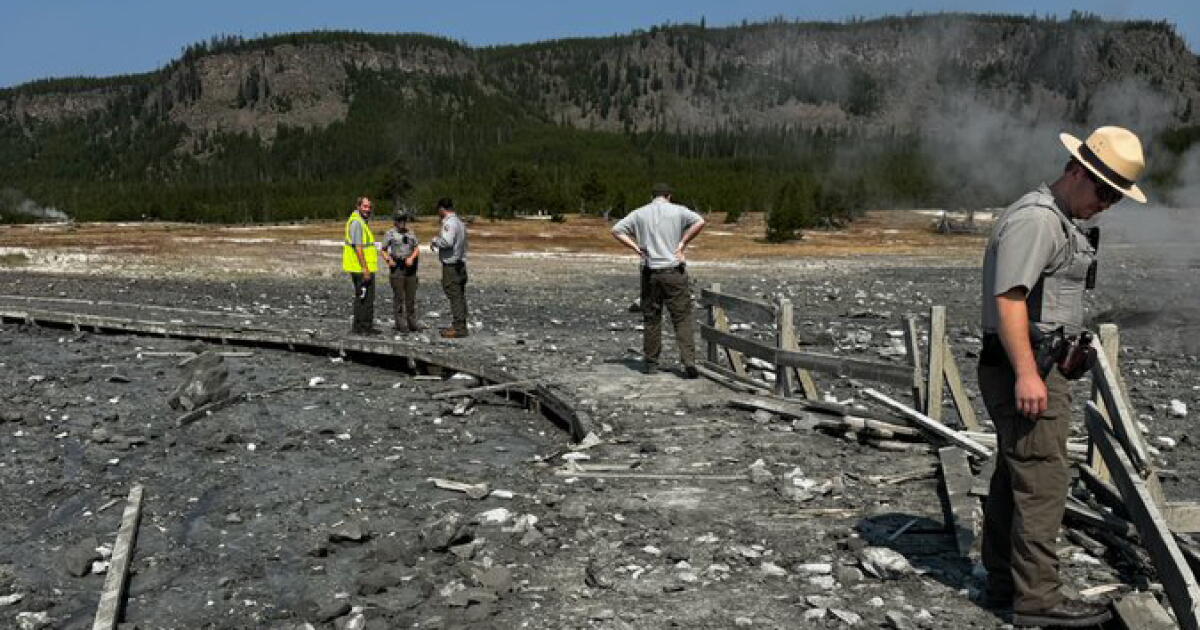
A violent hydrothermal explosion at Yellowstone National Park sent visitors fleeing Tuesday as mud and debris erupted from a geyser just north of Old Faithful, according to park rangers.
Video of the explosion showed a column of steam and dark earth launching high into the sky. “Run, run, run, run …” a woman shouted as parkgoers began running along a wooden boardwalk.
A boardwalk at Yellowstone National Park reveals the aftermath of a violent geyser explosion.
(National Park Service)
The explosion occurred around 10:19 a.m. near Sapphire Pool in Biscuit Basin, just north of the Old Faithful geyser, the park service said in a news release. No injuries have been reported, but the event is still under investigation.
Hydrothermal explosions occur when “water suddenly flashes to steam underground,” according to a statement from the U.S. Geological Survey. The agency said such explosions are “relatively common” at the park.
“This kind of event happens probably once or twice a year in Yellowstone,” said Michael Poland, the scientist-in-charge at USGS’s Yellowstone Volcano Observatory, “often in the backcountry where it will go unnoticed.”
The last explosion to occur at Biscuit Basin was May 17, 2009.
Yellowstone sits atop a labyrinth of hydrothermal plumbing, filled with heated water and steam. The explosion was possibly due to minerals clogging up one of the underground pipes, Poland said, where pressure built until it exploded.
Predicting these events is extremely difficult, said Poland. The process of water flashing to steam can happen “instantaneously.” Even with seismic sensors right on top of where an explosion occurs, “it’s unclear whether there would be any signs.”
The Park Service and USGS plan to investigate whether the explosion altered the underground system. Scientists will measure chemical makeup, temperature and other properties of nearby geysers and vents, and earthquake scientists from the University of Utah will deploy sensors to measure any residual rumbling.
Then, the park can determine whether the area is safe to reopen for visitors.
“No other monitoring data show changes in the yellowstone region,” the park service said. “Today’s explosion does not reflect a change in the volcanic system, which remains at normal background levels of activity.”
The park, which is well known for Old Faithful and other geysers, sits atop an active volcano. Lava flows last erupted from the Yellowstone Caldera, or Yellowstone Supervolcano, approximately 70,000 years ago, according to the USGS.
“If it were due to magma that was rising up underneath the ground, we would see really spectacular changes,” Poland said. “There would be earthquakes galore and ground deformation. It wouldn’t be a single feature that had an explosion — there would be changes all over the place.”
Newsletter
You’re reading Boiling Point
Sammy Roth gets you up to speed on climate change, energy and the environment. Sign up to get it in your inbox twice a week.
You may occasionally receive promotional content from the Los Angeles Times.

A violent hydrothermal explosion at Yellowstone National Park sent visitors fleeing Tuesday as mud and debris erupted from a geyser just north of Old Faithful, according to park rangers.
Video of the explosion showed a column of steam and dark earth launching high into the sky. “Run, run, run, run …” a woman shouted as parkgoers began running along a wooden boardwalk.
A boardwalk at Yellowstone National Park reveals the aftermath of a violent geyser explosion.
(National Park Service)
The explosion occurred around 10:19 a.m. near Sapphire Pool in Biscuit Basin, just north of the Old Faithful geyser, the park service said in a news release. No injuries have been reported, but the event is still under investigation.
Hydrothermal explosions occur when “water suddenly flashes to steam underground,” according to a statement from the U.S. Geological Survey. The agency said such explosions are “relatively common” at the park.
“This kind of event happens probably once or twice a year in Yellowstone,” said Michael Poland, the scientist-in-charge at USGS’s Yellowstone Volcano Observatory, “often in the backcountry where it will go unnoticed.”
The last explosion to occur at Biscuit Basin was May 17, 2009.
Yellowstone sits atop a labyrinth of hydrothermal plumbing, filled with heated water and steam. The explosion was possibly due to minerals clogging up one of the underground pipes, Poland said, where pressure built until it exploded.
Predicting these events is extremely difficult, said Poland. The process of water flashing to steam can happen “instantaneously.” Even with seismic sensors right on top of where an explosion occurs, “it’s unclear whether there would be any signs.”
The Park Service and USGS plan to investigate whether the explosion altered the underground system. Scientists will measure chemical makeup, temperature and other properties of nearby geysers and vents, and earthquake scientists from the University of Utah will deploy sensors to measure any residual rumbling.
Then, the park can determine whether the area is safe to reopen for visitors.
“No other monitoring data show changes in the yellowstone region,” the park service said. “Today’s explosion does not reflect a change in the volcanic system, which remains at normal background levels of activity.”
The park, which is well known for Old Faithful and other geysers, sits atop an active volcano. Lava flows last erupted from the Yellowstone Caldera, or Yellowstone Supervolcano, approximately 70,000 years ago, according to the USGS.
“If it were due to magma that was rising up underneath the ground, we would see really spectacular changes,” Poland said. “There would be earthquakes galore and ground deformation. It wouldn’t be a single feature that had an explosion — there would be changes all over the place.”
Newsletter
You’re reading Boiling Point
Sammy Roth gets you up to speed on climate change, energy and the environment. Sign up to get it in your inbox twice a week.
You may occasionally receive promotional content from the Los Angeles Times.

A violent hydrothermal explosion at Yellowstone National Park sent visitors fleeing Tuesday as mud and debris erupted from a geyser just north of Old Faithful, according to park rangers.
Video of the explosion showed a column of steam and dark earth launching high into the sky. “Run, run, run, run …” a woman shouted as parkgoers began running along a wooden boardwalk.
A boardwalk at Yellowstone National Park reveals the aftermath of a violent geyser explosion.
(National Park Service)
The explosion occurred around 10:19 a.m. near Sapphire Pool in Biscuit Basin, just north of the Old Faithful geyser, the park service said in a news release. No injuries have been reported, but the event is still under investigation.
Hydrothermal explosions occur when “water suddenly flashes to steam underground,” according to a statement from the U.S. Geological Survey. The agency said such explosions are “relatively common” at the park.
“This kind of event happens probably once or twice a year in Yellowstone,” said Michael Poland, the scientist-in-charge at USGS’s Yellowstone Volcano Observatory, “often in the backcountry where it will go unnoticed.”
The last explosion to occur at Biscuit Basin was May 17, 2009.
Yellowstone sits atop a labyrinth of hydrothermal plumbing, filled with heated water and steam. The explosion was possibly due to minerals clogging up one of the underground pipes, Poland said, where pressure built until it exploded.
Predicting these events is extremely difficult, said Poland. The process of water flashing to steam can happen “instantaneously.” Even with seismic sensors right on top of where an explosion occurs, “it’s unclear whether there would be any signs.”
The Park Service and USGS plan to investigate whether the explosion altered the underground system. Scientists will measure chemical makeup, temperature and other properties of nearby geysers and vents, and earthquake scientists from the University of Utah will deploy sensors to measure any residual rumbling.
Then, the park can determine whether the area is safe to reopen for visitors.
“No other monitoring data show changes in the yellowstone region,” the park service said. “Today’s explosion does not reflect a change in the volcanic system, which remains at normal background levels of activity.”
The park, which is well known for Old Faithful and other geysers, sits atop an active volcano. Lava flows last erupted from the Yellowstone Caldera, or Yellowstone Supervolcano, approximately 70,000 years ago, according to the USGS.
“If it were due to magma that was rising up underneath the ground, we would see really spectacular changes,” Poland said. “There would be earthquakes galore and ground deformation. It wouldn’t be a single feature that had an explosion — there would be changes all over the place.”
Newsletter
You’re reading Boiling Point
Sammy Roth gets you up to speed on climate change, energy and the environment. Sign up to get it in your inbox twice a week.
You may occasionally receive promotional content from the Los Angeles Times.

A violent hydrothermal explosion at Yellowstone National Park sent visitors fleeing Tuesday as mud and debris erupted from a geyser just north of Old Faithful, according to park rangers.
Video of the explosion showed a column of steam and dark earth launching high into the sky. “Run, run, run, run …” a woman shouted as parkgoers began running along a wooden boardwalk.
A boardwalk at Yellowstone National Park reveals the aftermath of a violent geyser explosion.
(National Park Service)
The explosion occurred around 10:19 a.m. near Sapphire Pool in Biscuit Basin, just north of the Old Faithful geyser, the park service said in a news release. No injuries have been reported, but the event is still under investigation.
Hydrothermal explosions occur when “water suddenly flashes to steam underground,” according to a statement from the U.S. Geological Survey. The agency said such explosions are “relatively common” at the park.
“This kind of event happens probably once or twice a year in Yellowstone,” said Michael Poland, the scientist-in-charge at USGS’s Yellowstone Volcano Observatory, “often in the backcountry where it will go unnoticed.”
The last explosion to occur at Biscuit Basin was May 17, 2009.
Yellowstone sits atop a labyrinth of hydrothermal plumbing, filled with heated water and steam. The explosion was possibly due to minerals clogging up one of the underground pipes, Poland said, where pressure built until it exploded.
Predicting these events is extremely difficult, said Poland. The process of water flashing to steam can happen “instantaneously.” Even with seismic sensors right on top of where an explosion occurs, “it’s unclear whether there would be any signs.”
The Park Service and USGS plan to investigate whether the explosion altered the underground system. Scientists will measure chemical makeup, temperature and other properties of nearby geysers and vents, and earthquake scientists from the University of Utah will deploy sensors to measure any residual rumbling.
Then, the park can determine whether the area is safe to reopen for visitors.
“No other monitoring data show changes in the yellowstone region,” the park service said. “Today’s explosion does not reflect a change in the volcanic system, which remains at normal background levels of activity.”
The park, which is well known for Old Faithful and other geysers, sits atop an active volcano. Lava flows last erupted from the Yellowstone Caldera, or Yellowstone Supervolcano, approximately 70,000 years ago, according to the USGS.
“If it were due to magma that was rising up underneath the ground, we would see really spectacular changes,” Poland said. “There would be earthquakes galore and ground deformation. It wouldn’t be a single feature that had an explosion — there would be changes all over the place.”
Newsletter
You’re reading Boiling Point
Sammy Roth gets you up to speed on climate change, energy and the environment. Sign up to get it in your inbox twice a week.
You may occasionally receive promotional content from the Los Angeles Times.

A violent hydrothermal explosion at Yellowstone National Park sent visitors fleeing Tuesday as mud and debris erupted from a geyser just north of Old Faithful, according to park rangers.
Video of the explosion showed a column of steam and dark earth launching high into the sky. “Run, run, run, run …” a woman shouted as parkgoers began running along a wooden boardwalk.
A boardwalk at Yellowstone National Park reveals the aftermath of a violent geyser explosion.
(National Park Service)
The explosion occurred around 10:19 a.m. near Sapphire Pool in Biscuit Basin, just north of the Old Faithful geyser, the park service said in a news release. No injuries have been reported, but the event is still under investigation.
Hydrothermal explosions occur when “water suddenly flashes to steam underground,” according to a statement from the U.S. Geological Survey. The agency said such explosions are “relatively common” at the park.
“This kind of event happens probably once or twice a year in Yellowstone,” said Michael Poland, the scientist-in-charge at USGS’s Yellowstone Volcano Observatory, “often in the backcountry where it will go unnoticed.”
The last explosion to occur at Biscuit Basin was May 17, 2009.
Yellowstone sits atop a labyrinth of hydrothermal plumbing, filled with heated water and steam. The explosion was possibly due to minerals clogging up one of the underground pipes, Poland said, where pressure built until it exploded.
Predicting these events is extremely difficult, said Poland. The process of water flashing to steam can happen “instantaneously.” Even with seismic sensors right on top of where an explosion occurs, “it’s unclear whether there would be any signs.”
The Park Service and USGS plan to investigate whether the explosion altered the underground system. Scientists will measure chemical makeup, temperature and other properties of nearby geysers and vents, and earthquake scientists from the University of Utah will deploy sensors to measure any residual rumbling.
Then, the park can determine whether the area is safe to reopen for visitors.
“No other monitoring data show changes in the yellowstone region,” the park service said. “Today’s explosion does not reflect a change in the volcanic system, which remains at normal background levels of activity.”
The park, which is well known for Old Faithful and other geysers, sits atop an active volcano. Lava flows last erupted from the Yellowstone Caldera, or Yellowstone Supervolcano, approximately 70,000 years ago, according to the USGS.
“If it were due to magma that was rising up underneath the ground, we would see really spectacular changes,” Poland said. “There would be earthquakes galore and ground deformation. It wouldn’t be a single feature that had an explosion — there would be changes all over the place.”
Newsletter
You’re reading Boiling Point
Sammy Roth gets you up to speed on climate change, energy and the environment. Sign up to get it in your inbox twice a week.
You may occasionally receive promotional content from the Los Angeles Times.

