

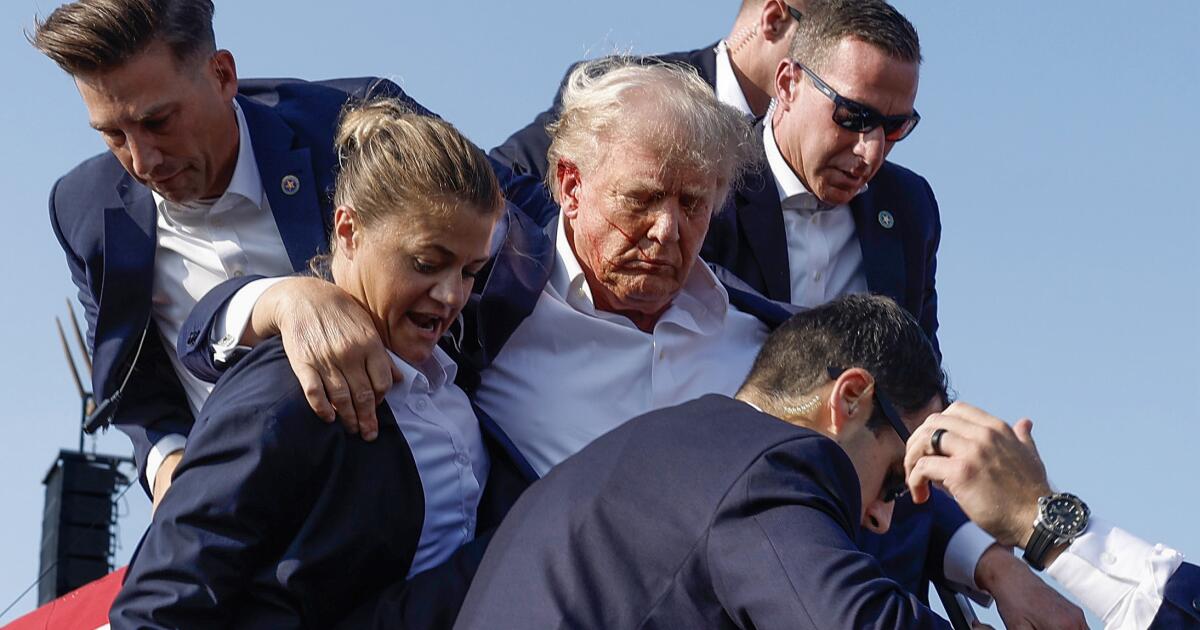
In the first detailed description of the wound former President Trump suffered from a would-be assassin’s bullet, his campaign put out a statement Saturday saying the round came “less than a quarter of an inch from entering his head.”
The description of Trump’s injury came from U.S. Rep. Ronny L. Jackson (R-Texas), who served as Trump’s White House physician.
“The bullet passed, coming less than a quarter of an inch from entering his head, and struck the top of his right ear,” Jackson, a vocal Trump supporter, wrote in the statement. “The bullet track produced a 2 cm wide wound that extended down to the cartilaginous surface of the ear. There was initially significant bleeding, followed by marked swelling of the entire upper ear.”
Jackson said the swelling has since resolved and that the wound was healing properly.
“Based on the highly vascular nature of the ear, there is still intermittent bleeding requiring a dressing to be in place,” he wrote. “Given the broad and blunt nature of the wound itself, no sutures were required.”
Trump was first treated by the staff at a Pennsylvania hospital. Jackson said he saw Trump the night of the shooting at Trump’s residence in Bedminster, N.J. “I have been with President Trump since that time, and I have evaluated and treated his wound daily. He is doing well,” Jackson wrote.
Trump, wearing a bandage over his ear, recounted the shooting for the first time publicly Thursday night, when he formally accepted the Republican Party’s nomination for president at the Republican National Convention in Milwaukee.
In a show of solidarity, many convention attendees wore bandages over their right ears.
An Arizona delegate wears a bandage on her ear at the Republican National Convention.
(Robert Gauthier / Los Angeles Times)
“You’ll never hear it from me a second time, because it’s too painful to tell,” Trump said before describing what happened at a campaign rally July 13 in Butler, Pa.
Trump said that as he turned his head to look at a chart projected on a screen, he heard “a loud whizzing sound and felt something hit me really, really hard on my right ear.”
“I said to myself, ‘Wow, what was that? It can only be a bullet.’ And moved my right hand to my ear, brought it down. My hand was covered with blood,” he said.

In the first detailed description of the wound former President Trump suffered from a would-be assassin’s bullet, his campaign put out a statement Saturday saying the round came “less than a quarter of an inch from entering his head.”
The description of Trump’s injury came from U.S. Rep. Ronny L. Jackson (R-Texas), who served as Trump’s White House physician.
“The bullet passed, coming less than a quarter of an inch from entering his head, and struck the top of his right ear,” Jackson, a vocal Trump supporter, wrote in the statement. “The bullet track produced a 2 cm wide wound that extended down to the cartilaginous surface of the ear. There was initially significant bleeding, followed by marked swelling of the entire upper ear.”
Jackson said the swelling has since resolved and that the wound was healing properly.
“Based on the highly vascular nature of the ear, there is still intermittent bleeding requiring a dressing to be in place,” he wrote. “Given the broad and blunt nature of the wound itself, no sutures were required.”
Trump was first treated by the staff at a Pennsylvania hospital. Jackson said he saw Trump the night of the shooting at Trump’s residence in Bedminster, N.J. “I have been with President Trump since that time, and I have evaluated and treated his wound daily. He is doing well,” Jackson wrote.
Trump, wearing a bandage over his ear, recounted the shooting for the first time publicly Thursday night, when he formally accepted the Republican Party’s nomination for president at the Republican National Convention in Milwaukee.
In a show of solidarity, many convention attendees wore bandages over their right ears.
An Arizona delegate wears a bandage on her ear at the Republican National Convention.
(Robert Gauthier / Los Angeles Times)
“You’ll never hear it from me a second time, because it’s too painful to tell,” Trump said before describing what happened at a campaign rally July 13 in Butler, Pa.
Trump said that as he turned his head to look at a chart projected on a screen, he heard “a loud whizzing sound and felt something hit me really, really hard on my right ear.”
“I said to myself, ‘Wow, what was that? It can only be a bullet.’ And moved my right hand to my ear, brought it down. My hand was covered with blood,” he said.

In the first detailed description of the wound former President Trump suffered from a would-be assassin’s bullet, his campaign put out a statement Saturday saying the round came “less than a quarter of an inch from entering his head.”
The description of Trump’s injury came from U.S. Rep. Ronny L. Jackson (R-Texas), who served as Trump’s White House physician.
“The bullet passed, coming less than a quarter of an inch from entering his head, and struck the top of his right ear,” Jackson, a vocal Trump supporter, wrote in the statement. “The bullet track produced a 2 cm wide wound that extended down to the cartilaginous surface of the ear. There was initially significant bleeding, followed by marked swelling of the entire upper ear.”
Jackson said the swelling has since resolved and that the wound was healing properly.
“Based on the highly vascular nature of the ear, there is still intermittent bleeding requiring a dressing to be in place,” he wrote. “Given the broad and blunt nature of the wound itself, no sutures were required.”
Trump was first treated by the staff at a Pennsylvania hospital. Jackson said he saw Trump the night of the shooting at Trump’s residence in Bedminster, N.J. “I have been with President Trump since that time, and I have evaluated and treated his wound daily. He is doing well,” Jackson wrote.
Trump, wearing a bandage over his ear, recounted the shooting for the first time publicly Thursday night, when he formally accepted the Republican Party’s nomination for president at the Republican National Convention in Milwaukee.
In a show of solidarity, many convention attendees wore bandages over their right ears.
An Arizona delegate wears a bandage on her ear at the Republican National Convention.
(Robert Gauthier / Los Angeles Times)
“You’ll never hear it from me a second time, because it’s too painful to tell,” Trump said before describing what happened at a campaign rally July 13 in Butler, Pa.
Trump said that as he turned his head to look at a chart projected on a screen, he heard “a loud whizzing sound and felt something hit me really, really hard on my right ear.”
“I said to myself, ‘Wow, what was that? It can only be a bullet.’ And moved my right hand to my ear, brought it down. My hand was covered with blood,” he said.
In the first detailed description of the wound former President Trump suffered from a would-be assassin’s bullet, his campaign put out a statement Saturday saying the round came “less than a quarter of an inch from entering his head.”
The description of Trump’s injury came from U.S. Rep. Ronny L. Jackson (R-Texas), who served as Trump’s White House physician.
“The bullet passed, coming less than a quarter of an inch from entering his head, and struck the top of his right ear,” Jackson, a vocal Trump supporter, wrote in the statement. “The bullet track produced a 2 cm wide wound that extended down to the cartilaginous surface of the ear. There was initially significant bleeding, followed by marked swelling of the entire upper ear.”
Jackson said the swelling has since resolved and that the wound was healing properly.
“Based on the highly vascular nature of the ear, there is still intermittent bleeding requiring a dressing to be in place,” he wrote. “Given the broad and blunt nature of the wound itself, no sutures were required.”
Trump was first treated by the staff at a Pennsylvania hospital. Jackson said he saw Trump the night of the shooting at Trump’s residence in Bedminster, N.J. “I have been with President Trump since that time, and I have evaluated and treated his wound daily. He is doing well,” Jackson wrote.
Trump, wearing a bandage over his ear, recounted the shooting for the first time publicly Thursday night, when he formally accepted the Republican Party’s nomination for president at the Republican National Convention in Milwaukee.
In a show of solidarity, many convention attendees wore bandages over their right ears.
An Arizona delegate wears a bandage on her ear at the Republican National Convention.
(Robert Gauthier / Los Angeles Times)
“You’ll never hear it from me a second time, because it’s too painful to tell,” Trump said before describing what happened at a campaign rally July 13 in Butler, Pa.
Trump said that as he turned his head to look at a chart projected on a screen, he heard “a loud whizzing sound and felt something hit me really, really hard on my right ear.”
“I said to myself, ‘Wow, what was that? It can only be a bullet.’ And moved my right hand to my ear, brought it down. My hand was covered with blood,” he said.

In the first detailed description of the wound former President Trump suffered from a would-be assassin’s bullet, his campaign put out a statement Saturday saying the round came “less than a quarter of an inch from entering his head.”
The description of Trump’s injury came from U.S. Rep. Ronny L. Jackson (R-Texas), who served as Trump’s White House physician.
“The bullet passed, coming less than a quarter of an inch from entering his head, and struck the top of his right ear,” Jackson, a vocal Trump supporter, wrote in the statement. “The bullet track produced a 2 cm wide wound that extended down to the cartilaginous surface of the ear. There was initially significant bleeding, followed by marked swelling of the entire upper ear.”
Jackson said the swelling has since resolved and that the wound was healing properly.
“Based on the highly vascular nature of the ear, there is still intermittent bleeding requiring a dressing to be in place,” he wrote. “Given the broad and blunt nature of the wound itself, no sutures were required.”
Trump was first treated by the staff at a Pennsylvania hospital. Jackson said he saw Trump the night of the shooting at Trump’s residence in Bedminster, N.J. “I have been with President Trump since that time, and I have evaluated and treated his wound daily. He is doing well,” Jackson wrote.
Trump, wearing a bandage over his ear, recounted the shooting for the first time publicly Thursday night, when he formally accepted the Republican Party’s nomination for president at the Republican National Convention in Milwaukee.
In a show of solidarity, many convention attendees wore bandages over their right ears.
An Arizona delegate wears a bandage on her ear at the Republican National Convention.
(Robert Gauthier / Los Angeles Times)
“You’ll never hear it from me a second time, because it’s too painful to tell,” Trump said before describing what happened at a campaign rally July 13 in Butler, Pa.
Trump said that as he turned his head to look at a chart projected on a screen, he heard “a loud whizzing sound and felt something hit me really, really hard on my right ear.”
“I said to myself, ‘Wow, what was that? It can only be a bullet.’ And moved my right hand to my ear, brought it down. My hand was covered with blood,” he said.
In the first detailed description of the wound former President Trump suffered from a would-be assassin’s bullet, his campaign put out a statement Saturday saying the round came “less than a quarter of an inch from entering his head.”
The description of Trump’s injury came from U.S. Rep. Ronny L. Jackson (R-Texas), who served as Trump’s White House physician.
“The bullet passed, coming less than a quarter of an inch from entering his head, and struck the top of his right ear,” Jackson, a vocal Trump supporter, wrote in the statement. “The bullet track produced a 2 cm wide wound that extended down to the cartilaginous surface of the ear. There was initially significant bleeding, followed by marked swelling of the entire upper ear.”
Jackson said the swelling has since resolved and that the wound was healing properly.
“Based on the highly vascular nature of the ear, there is still intermittent bleeding requiring a dressing to be in place,” he wrote. “Given the broad and blunt nature of the wound itself, no sutures were required.”
Trump was first treated by the staff at a Pennsylvania hospital. Jackson said he saw Trump the night of the shooting at Trump’s residence in Bedminster, N.J. “I have been with President Trump since that time, and I have evaluated and treated his wound daily. He is doing well,” Jackson wrote.
Trump, wearing a bandage over his ear, recounted the shooting for the first time publicly Thursday night, when he formally accepted the Republican Party’s nomination for president at the Republican National Convention in Milwaukee.
In a show of solidarity, many convention attendees wore bandages over their right ears.
An Arizona delegate wears a bandage on her ear at the Republican National Convention.
(Robert Gauthier / Los Angeles Times)
“You’ll never hear it from me a second time, because it’s too painful to tell,” Trump said before describing what happened at a campaign rally July 13 in Butler, Pa.
Trump said that as he turned his head to look at a chart projected on a screen, he heard “a loud whizzing sound and felt something hit me really, really hard on my right ear.”
“I said to myself, ‘Wow, what was that? It can only be a bullet.’ And moved my right hand to my ear, brought it down. My hand was covered with blood,” he said.
In the first detailed description of the wound former President Trump suffered from a would-be assassin’s bullet, his campaign put out a statement Saturday saying the round came “less than a quarter of an inch from entering his head.”
The description of Trump’s injury came from U.S. Rep. Ronny L. Jackson (R-Texas), who served as Trump’s White House physician.
“The bullet passed, coming less than a quarter of an inch from entering his head, and struck the top of his right ear,” Jackson, a vocal Trump supporter, wrote in the statement. “The bullet track produced a 2 cm wide wound that extended down to the cartilaginous surface of the ear. There was initially significant bleeding, followed by marked swelling of the entire upper ear.”
Jackson said the swelling has since resolved and that the wound was healing properly.
“Based on the highly vascular nature of the ear, there is still intermittent bleeding requiring a dressing to be in place,” he wrote. “Given the broad and blunt nature of the wound itself, no sutures were required.”
Trump was first treated by the staff at a Pennsylvania hospital. Jackson said he saw Trump the night of the shooting at Trump’s residence in Bedminster, N.J. “I have been with President Trump since that time, and I have evaluated and treated his wound daily. He is doing well,” Jackson wrote.
Trump, wearing a bandage over his ear, recounted the shooting for the first time publicly Thursday night, when he formally accepted the Republican Party’s nomination for president at the Republican National Convention in Milwaukee.
In a show of solidarity, many convention attendees wore bandages over their right ears.
An Arizona delegate wears a bandage on her ear at the Republican National Convention.
(Robert Gauthier / Los Angeles Times)
“You’ll never hear it from me a second time, because it’s too painful to tell,” Trump said before describing what happened at a campaign rally July 13 in Butler, Pa.
Trump said that as he turned his head to look at a chart projected on a screen, he heard “a loud whizzing sound and felt something hit me really, really hard on my right ear.”
“I said to myself, ‘Wow, what was that? It can only be a bullet.’ And moved my right hand to my ear, brought it down. My hand was covered with blood,” he said.
In the first detailed description of the wound former President Trump suffered from a would-be assassin’s bullet, his campaign put out a statement Saturday saying the round came “less than a quarter of an inch from entering his head.”
The description of Trump’s injury came from U.S. Rep. Ronny L. Jackson (R-Texas), who served as Trump’s White House physician.
“The bullet passed, coming less than a quarter of an inch from entering his head, and struck the top of his right ear,” Jackson, a vocal Trump supporter, wrote in the statement. “The bullet track produced a 2 cm wide wound that extended down to the cartilaginous surface of the ear. There was initially significant bleeding, followed by marked swelling of the entire upper ear.”
Jackson said the swelling has since resolved and that the wound was healing properly.
“Based on the highly vascular nature of the ear, there is still intermittent bleeding requiring a dressing to be in place,” he wrote. “Given the broad and blunt nature of the wound itself, no sutures were required.”
Trump was first treated by the staff at a Pennsylvania hospital. Jackson said he saw Trump the night of the shooting at Trump’s residence in Bedminster, N.J. “I have been with President Trump since that time, and I have evaluated and treated his wound daily. He is doing well,” Jackson wrote.
Trump, wearing a bandage over his ear, recounted the shooting for the first time publicly Thursday night, when he formally accepted the Republican Party’s nomination for president at the Republican National Convention in Milwaukee.
In a show of solidarity, many convention attendees wore bandages over their right ears.
An Arizona delegate wears a bandage on her ear at the Republican National Convention.
(Robert Gauthier / Los Angeles Times)
“You’ll never hear it from me a second time, because it’s too painful to tell,” Trump said before describing what happened at a campaign rally July 13 in Butler, Pa.
Trump said that as he turned his head to look at a chart projected on a screen, he heard “a loud whizzing sound and felt something hit me really, really hard on my right ear.”
“I said to myself, ‘Wow, what was that? It can only be a bullet.’ And moved my right hand to my ear, brought it down. My hand was covered with blood,” he said.

In the first detailed description of the wound former President Trump suffered from a would-be assassin’s bullet, his campaign put out a statement Saturday saying the round came “less than a quarter of an inch from entering his head.”
The description of Trump’s injury came from U.S. Rep. Ronny L. Jackson (R-Texas), who served as Trump’s White House physician.
“The bullet passed, coming less than a quarter of an inch from entering his head, and struck the top of his right ear,” Jackson, a vocal Trump supporter, wrote in the statement. “The bullet track produced a 2 cm wide wound that extended down to the cartilaginous surface of the ear. There was initially significant bleeding, followed by marked swelling of the entire upper ear.”
Jackson said the swelling has since resolved and that the wound was healing properly.
“Based on the highly vascular nature of the ear, there is still intermittent bleeding requiring a dressing to be in place,” he wrote. “Given the broad and blunt nature of the wound itself, no sutures were required.”
Trump was first treated by the staff at a Pennsylvania hospital. Jackson said he saw Trump the night of the shooting at Trump’s residence in Bedminster, N.J. “I have been with President Trump since that time, and I have evaluated and treated his wound daily. He is doing well,” Jackson wrote.
Trump, wearing a bandage over his ear, recounted the shooting for the first time publicly Thursday night, when he formally accepted the Republican Party’s nomination for president at the Republican National Convention in Milwaukee.
In a show of solidarity, many convention attendees wore bandages over their right ears.
An Arizona delegate wears a bandage on her ear at the Republican National Convention.
(Robert Gauthier / Los Angeles Times)
“You’ll never hear it from me a second time, because it’s too painful to tell,” Trump said before describing what happened at a campaign rally July 13 in Butler, Pa.
Trump said that as he turned his head to look at a chart projected on a screen, he heard “a loud whizzing sound and felt something hit me really, really hard on my right ear.”
“I said to myself, ‘Wow, what was that? It can only be a bullet.’ And moved my right hand to my ear, brought it down. My hand was covered with blood,” he said.
In the first detailed description of the wound former President Trump suffered from a would-be assassin’s bullet, his campaign put out a statement Saturday saying the round came “less than a quarter of an inch from entering his head.”
The description of Trump’s injury came from U.S. Rep. Ronny L. Jackson (R-Texas), who served as Trump’s White House physician.
“The bullet passed, coming less than a quarter of an inch from entering his head, and struck the top of his right ear,” Jackson, a vocal Trump supporter, wrote in the statement. “The bullet track produced a 2 cm wide wound that extended down to the cartilaginous surface of the ear. There was initially significant bleeding, followed by marked swelling of the entire upper ear.”
Jackson said the swelling has since resolved and that the wound was healing properly.
“Based on the highly vascular nature of the ear, there is still intermittent bleeding requiring a dressing to be in place,” he wrote. “Given the broad and blunt nature of the wound itself, no sutures were required.”
Trump was first treated by the staff at a Pennsylvania hospital. Jackson said he saw Trump the night of the shooting at Trump’s residence in Bedminster, N.J. “I have been with President Trump since that time, and I have evaluated and treated his wound daily. He is doing well,” Jackson wrote.
Trump, wearing a bandage over his ear, recounted the shooting for the first time publicly Thursday night, when he formally accepted the Republican Party’s nomination for president at the Republican National Convention in Milwaukee.
In a show of solidarity, many convention attendees wore bandages over their right ears.
An Arizona delegate wears a bandage on her ear at the Republican National Convention.
(Robert Gauthier / Los Angeles Times)
“You’ll never hear it from me a second time, because it’s too painful to tell,” Trump said before describing what happened at a campaign rally July 13 in Butler, Pa.
Trump said that as he turned his head to look at a chart projected on a screen, he heard “a loud whizzing sound and felt something hit me really, really hard on my right ear.”
“I said to myself, ‘Wow, what was that? It can only be a bullet.’ And moved my right hand to my ear, brought it down. My hand was covered with blood,” he said.
In the first detailed description of the wound former President Trump suffered from a would-be assassin’s bullet, his campaign put out a statement Saturday saying the round came “less than a quarter of an inch from entering his head.”
The description of Trump’s injury came from U.S. Rep. Ronny L. Jackson (R-Texas), who served as Trump’s White House physician.
“The bullet passed, coming less than a quarter of an inch from entering his head, and struck the top of his right ear,” Jackson, a vocal Trump supporter, wrote in the statement. “The bullet track produced a 2 cm wide wound that extended down to the cartilaginous surface of the ear. There was initially significant bleeding, followed by marked swelling of the entire upper ear.”
Jackson said the swelling has since resolved and that the wound was healing properly.
“Based on the highly vascular nature of the ear, there is still intermittent bleeding requiring a dressing to be in place,” he wrote. “Given the broad and blunt nature of the wound itself, no sutures were required.”
Trump was first treated by the staff at a Pennsylvania hospital. Jackson said he saw Trump the night of the shooting at Trump’s residence in Bedminster, N.J. “I have been with President Trump since that time, and I have evaluated and treated his wound daily. He is doing well,” Jackson wrote.
Trump, wearing a bandage over his ear, recounted the shooting for the first time publicly Thursday night, when he formally accepted the Republican Party’s nomination for president at the Republican National Convention in Milwaukee.
In a show of solidarity, many convention attendees wore bandages over their right ears.
An Arizona delegate wears a bandage on her ear at the Republican National Convention.
(Robert Gauthier / Los Angeles Times)
“You’ll never hear it from me a second time, because it’s too painful to tell,” Trump said before describing what happened at a campaign rally July 13 in Butler, Pa.
Trump said that as he turned his head to look at a chart projected on a screen, he heard “a loud whizzing sound and felt something hit me really, really hard on my right ear.”
“I said to myself, ‘Wow, what was that? It can only be a bullet.’ And moved my right hand to my ear, brought it down. My hand was covered with blood,” he said.
In the first detailed description of the wound former President Trump suffered from a would-be assassin’s bullet, his campaign put out a statement Saturday saying the round came “less than a quarter of an inch from entering his head.”
The description of Trump’s injury came from U.S. Rep. Ronny L. Jackson (R-Texas), who served as Trump’s White House physician.
“The bullet passed, coming less than a quarter of an inch from entering his head, and struck the top of his right ear,” Jackson, a vocal Trump supporter, wrote in the statement. “The bullet track produced a 2 cm wide wound that extended down to the cartilaginous surface of the ear. There was initially significant bleeding, followed by marked swelling of the entire upper ear.”
Jackson said the swelling has since resolved and that the wound was healing properly.
“Based on the highly vascular nature of the ear, there is still intermittent bleeding requiring a dressing to be in place,” he wrote. “Given the broad and blunt nature of the wound itself, no sutures were required.”
Trump was first treated by the staff at a Pennsylvania hospital. Jackson said he saw Trump the night of the shooting at Trump’s residence in Bedminster, N.J. “I have been with President Trump since that time, and I have evaluated and treated his wound daily. He is doing well,” Jackson wrote.
Trump, wearing a bandage over his ear, recounted the shooting for the first time publicly Thursday night, when he formally accepted the Republican Party’s nomination for president at the Republican National Convention in Milwaukee.
In a show of solidarity, many convention attendees wore bandages over their right ears.
An Arizona delegate wears a bandage on her ear at the Republican National Convention.
(Robert Gauthier / Los Angeles Times)
“You’ll never hear it from me a second time, because it’s too painful to tell,” Trump said before describing what happened at a campaign rally July 13 in Butler, Pa.
Trump said that as he turned his head to look at a chart projected on a screen, he heard “a loud whizzing sound and felt something hit me really, really hard on my right ear.”
“I said to myself, ‘Wow, what was that? It can only be a bullet.’ And moved my right hand to my ear, brought it down. My hand was covered with blood,” he said.
In the first detailed description of the wound former President Trump suffered from a would-be assassin’s bullet, his campaign put out a statement Saturday saying the round came “less than a quarter of an inch from entering his head.”
The description of Trump’s injury came from U.S. Rep. Ronny L. Jackson (R-Texas), who served as Trump’s White House physician.
“The bullet passed, coming less than a quarter of an inch from entering his head, and struck the top of his right ear,” Jackson, a vocal Trump supporter, wrote in the statement. “The bullet track produced a 2 cm wide wound that extended down to the cartilaginous surface of the ear. There was initially significant bleeding, followed by marked swelling of the entire upper ear.”
Jackson said the swelling has since resolved and that the wound was healing properly.
“Based on the highly vascular nature of the ear, there is still intermittent bleeding requiring a dressing to be in place,” he wrote. “Given the broad and blunt nature of the wound itself, no sutures were required.”
Trump was first treated by the staff at a Pennsylvania hospital. Jackson said he saw Trump the night of the shooting at Trump’s residence in Bedminster, N.J. “I have been with President Trump since that time, and I have evaluated and treated his wound daily. He is doing well,” Jackson wrote.
Trump, wearing a bandage over his ear, recounted the shooting for the first time publicly Thursday night, when he formally accepted the Republican Party’s nomination for president at the Republican National Convention in Milwaukee.
In a show of solidarity, many convention attendees wore bandages over their right ears.
An Arizona delegate wears a bandage on her ear at the Republican National Convention.
(Robert Gauthier / Los Angeles Times)
“You’ll never hear it from me a second time, because it’s too painful to tell,” Trump said before describing what happened at a campaign rally July 13 in Butler, Pa.
Trump said that as he turned his head to look at a chart projected on a screen, he heard “a loud whizzing sound and felt something hit me really, really hard on my right ear.”
“I said to myself, ‘Wow, what was that? It can only be a bullet.’ And moved my right hand to my ear, brought it down. My hand was covered with blood,” he said.
In the first detailed description of the wound former President Trump suffered from a would-be assassin’s bullet, his campaign put out a statement Saturday saying the round came “less than a quarter of an inch from entering his head.”
The description of Trump’s injury came from U.S. Rep. Ronny L. Jackson (R-Texas), who served as Trump’s White House physician.
“The bullet passed, coming less than a quarter of an inch from entering his head, and struck the top of his right ear,” Jackson, a vocal Trump supporter, wrote in the statement. “The bullet track produced a 2 cm wide wound that extended down to the cartilaginous surface of the ear. There was initially significant bleeding, followed by marked swelling of the entire upper ear.”
Jackson said the swelling has since resolved and that the wound was healing properly.
“Based on the highly vascular nature of the ear, there is still intermittent bleeding requiring a dressing to be in place,” he wrote. “Given the broad and blunt nature of the wound itself, no sutures were required.”
Trump was first treated by the staff at a Pennsylvania hospital. Jackson said he saw Trump the night of the shooting at Trump’s residence in Bedminster, N.J. “I have been with President Trump since that time, and I have evaluated and treated his wound daily. He is doing well,” Jackson wrote.
Trump, wearing a bandage over his ear, recounted the shooting for the first time publicly Thursday night, when he formally accepted the Republican Party’s nomination for president at the Republican National Convention in Milwaukee.
In a show of solidarity, many convention attendees wore bandages over their right ears.
An Arizona delegate wears a bandage on her ear at the Republican National Convention.
(Robert Gauthier / Los Angeles Times)
“You’ll never hear it from me a second time, because it’s too painful to tell,” Trump said before describing what happened at a campaign rally July 13 in Butler, Pa.
Trump said that as he turned his head to look at a chart projected on a screen, he heard “a loud whizzing sound and felt something hit me really, really hard on my right ear.”
“I said to myself, ‘Wow, what was that? It can only be a bullet.’ And moved my right hand to my ear, brought it down. My hand was covered with blood,” he said.
In the first detailed description of the wound former President Trump suffered from a would-be assassin’s bullet, his campaign put out a statement Saturday saying the round came “less than a quarter of an inch from entering his head.”
The description of Trump’s injury came from U.S. Rep. Ronny L. Jackson (R-Texas), who served as Trump’s White House physician.
“The bullet passed, coming less than a quarter of an inch from entering his head, and struck the top of his right ear,” Jackson, a vocal Trump supporter, wrote in the statement. “The bullet track produced a 2 cm wide wound that extended down to the cartilaginous surface of the ear. There was initially significant bleeding, followed by marked swelling of the entire upper ear.”
Jackson said the swelling has since resolved and that the wound was healing properly.
“Based on the highly vascular nature of the ear, there is still intermittent bleeding requiring a dressing to be in place,” he wrote. “Given the broad and blunt nature of the wound itself, no sutures were required.”
Trump was first treated by the staff at a Pennsylvania hospital. Jackson said he saw Trump the night of the shooting at Trump’s residence in Bedminster, N.J. “I have been with President Trump since that time, and I have evaluated and treated his wound daily. He is doing well,” Jackson wrote.
Trump, wearing a bandage over his ear, recounted the shooting for the first time publicly Thursday night, when he formally accepted the Republican Party’s nomination for president at the Republican National Convention in Milwaukee.
In a show of solidarity, many convention attendees wore bandages over their right ears.
An Arizona delegate wears a bandage on her ear at the Republican National Convention.
(Robert Gauthier / Los Angeles Times)
“You’ll never hear it from me a second time, because it’s too painful to tell,” Trump said before describing what happened at a campaign rally July 13 in Butler, Pa.
Trump said that as he turned his head to look at a chart projected on a screen, he heard “a loud whizzing sound and felt something hit me really, really hard on my right ear.”
“I said to myself, ‘Wow, what was that? It can only be a bullet.’ And moved my right hand to my ear, brought it down. My hand was covered with blood,” he said.
In the first detailed description of the wound former President Trump suffered from a would-be assassin’s bullet, his campaign put out a statement Saturday saying the round came “less than a quarter of an inch from entering his head.”
The description of Trump’s injury came from U.S. Rep. Ronny L. Jackson (R-Texas), who served as Trump’s White House physician.
“The bullet passed, coming less than a quarter of an inch from entering his head, and struck the top of his right ear,” Jackson, a vocal Trump supporter, wrote in the statement. “The bullet track produced a 2 cm wide wound that extended down to the cartilaginous surface of the ear. There was initially significant bleeding, followed by marked swelling of the entire upper ear.”
Jackson said the swelling has since resolved and that the wound was healing properly.
“Based on the highly vascular nature of the ear, there is still intermittent bleeding requiring a dressing to be in place,” he wrote. “Given the broad and blunt nature of the wound itself, no sutures were required.”
Trump was first treated by the staff at a Pennsylvania hospital. Jackson said he saw Trump the night of the shooting at Trump’s residence in Bedminster, N.J. “I have been with President Trump since that time, and I have evaluated and treated his wound daily. He is doing well,” Jackson wrote.
Trump, wearing a bandage over his ear, recounted the shooting for the first time publicly Thursday night, when he formally accepted the Republican Party’s nomination for president at the Republican National Convention in Milwaukee.
In a show of solidarity, many convention attendees wore bandages over their right ears.
An Arizona delegate wears a bandage on her ear at the Republican National Convention.
(Robert Gauthier / Los Angeles Times)
“You’ll never hear it from me a second time, because it’s too painful to tell,” Trump said before describing what happened at a campaign rally July 13 in Butler, Pa.
Trump said that as he turned his head to look at a chart projected on a screen, he heard “a loud whizzing sound and felt something hit me really, really hard on my right ear.”
“I said to myself, ‘Wow, what was that? It can only be a bullet.’ And moved my right hand to my ear, brought it down. My hand was covered with blood,” he said.

