


Flannery O’Connor’s thrillingly hard-edged tales about the unreconstructed South and its redemption-deficient malcontents will never lose their power to scratch us awake with their violence, humor and ugly truth.
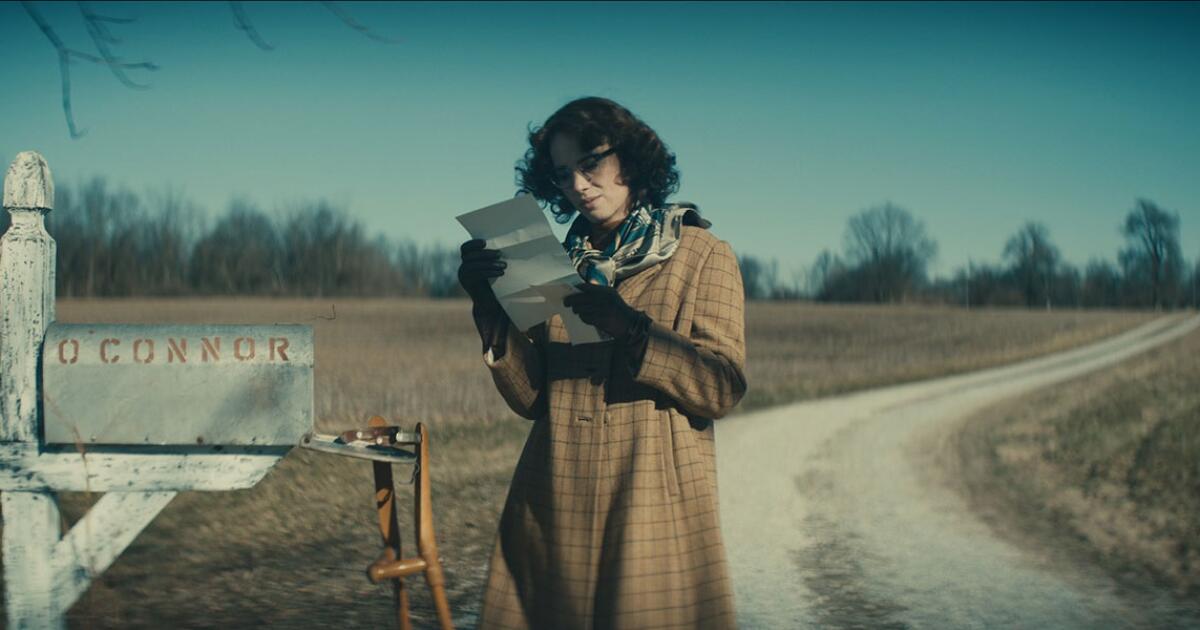
Such great, complicated artists don’t deserve the shallow cradle-to-grave treatment common to so many biopics, and thankfully, Ethan Hawke’s new film “Wildcat” isn’t that. Rather, it’s a soulful, pointed and unconventional grappling with the mysteries of the deeply Catholic, norm-shattering Georgia native’s life and work. Concentrated on a pivotal time of promise and disappointment during O’Connor’s 20s, when her writing was getting noticed (as was the lupus that would eventually consume her), it’s anchored with aching intelligence by Hawke’s daughter Maya (“Stranger Things”), unrecognizably severe in cat’s-eye glasses and a frail countenance.
The Hawkes deliver a portrait of O’Connor in all her fiercely self-aware outsiderdom, whether standing firm against a patronizing New York editor (Alessandro Nivola) who believes she wants to “pick a fight” with her readers, or sternly defending her faith against glib comments at an Iowa Writers’ Workshop party. But we also see this O’Connor in weaker moments, shrinking in the presence of her protective mother, Regina (Laura Linney), when forced back home because of her illness, and almost crumbling in the presence of a priest (a wonderful Liam Neeson). Ethan Hawke’s screenplay, co-written with Shelby Gaines, was inspired by the letters to God that O’Connor wrote at the time, published posthumously as “A Prayer Journal” in 2013.
This stretch of ambition and setback from an all-too-short life is not all that’s served up in “Wildcat.” Maya Hawke’s acting duties also involve playing an assortment of O’Connor’s characters in abridged dramatizations of short stories — “The Life You Save May Be Your Own,” “Parker’s Back,” and a few other classic pieces. In the ones where bold, brash men bring thunder and change to unsuspecting young women (all Maya), scene partners Steve Zahn, Rafael Casal and Cooper Hoffman do memorable work.
These segments diverge in tone, color and movement from the muted palette and fixed compositions with which cinematographer Steve Cosens girds the biographical narrative. But they’re expertly threaded in, suggesting how a creative loner can experience flare-ups of imagination when the world reveals itself. Movies often struggle with conveying writerly inspiration, but these swatches earnestly make good on a potent quote of O’Connor’s that Hawke opens with: “I’m always irritated by people who imply that writing fiction is an escape from reality. It is a plunge into reality and it’s very shocking to the system.”
Linney, meanwhile, at the top of her game, is another constant in multiple roles, vividly rendering a handful of O’Connor’s fictional mothers (including the self-righteous women from “Revelation” and “Everything That Rises Must Converge”). Before she even shows up as poised, old-fashioned Regina, picking up her suffering daughter at the train station, we’ve seen her in a couple of these adaptation bursts (including a clever rendering of “The Comforts of Home” as a trailer for a lurid ’60s B movie).
And yet, surprisingly, Linney’s and Hawke’s doubling duty never comes off as cheap psychologizing of the writer’s relationship with a parent who didn’t get her. It feels broader than that. (At the same time, O’Connor’s own views on race, the source of much reputational reassessment, aren’t exactly laid bare here, but neither are they ignored.) The symbolic payoff in Ethan Hawke’s brilliant use of his daughter and Linney is that we grasp both the intense narrowness of O’Connor’s subject matter as well as the rich versatility within her gothic archetypes.
Coming on the heels of director Ethan Hawke’s excellent docuseries “The Last Movie Stars,” about Paul Newman and Joanne Woodward, “Wildcat” shows that his gifts in front of the camera are being complemented behind it, too, especially when the subject is a life woven through with art, passion and pain.
‘Wildcat’
Not rated
Running time: 1 hour, 48 minutes
Playing: AMC Century City

Flannery O’Connor’s thrillingly hard-edged tales about the unreconstructed South and its redemption-deficient malcontents will never lose their power to scratch us awake with their violence, humor and ugly truth.
Such great, complicated artists don’t deserve the shallow cradle-to-grave treatment common to so many biopics, and thankfully, Ethan Hawke’s new film “Wildcat” isn’t that. Rather, it’s a soulful, pointed and unconventional grappling with the mysteries of the deeply Catholic, norm-shattering Georgia native’s life and work. Concentrated on a pivotal time of promise and disappointment during O’Connor’s 20s, when her writing was getting noticed (as was the lupus that would eventually consume her), it’s anchored with aching intelligence by Hawke’s daughter Maya (“Stranger Things”), unrecognizably severe in cat’s-eye glasses and a frail countenance.
The Hawkes deliver a portrait of O’Connor in all her fiercely self-aware outsiderdom, whether standing firm against a patronizing New York editor (Alessandro Nivola) who believes she wants to “pick a fight” with her readers, or sternly defending her faith against glib comments at an Iowa Writers’ Workshop party. But we also see this O’Connor in weaker moments, shrinking in the presence of her protective mother, Regina (Laura Linney), when forced back home because of her illness, and almost crumbling in the presence of a priest (a wonderful Liam Neeson). Ethan Hawke’s screenplay, co-written with Shelby Gaines, was inspired by the letters to God that O’Connor wrote at the time, published posthumously as “A Prayer Journal” in 2013.
This stretch of ambition and setback from an all-too-short life is not all that’s served up in “Wildcat.” Maya Hawke’s acting duties also involve playing an assortment of O’Connor’s characters in abridged dramatizations of short stories — “The Life You Save May Be Your Own,” “Parker’s Back,” and a few other classic pieces. In the ones where bold, brash men bring thunder and change to unsuspecting young women (all Maya), scene partners Steve Zahn, Rafael Casal and Cooper Hoffman do memorable work.
These segments diverge in tone, color and movement from the muted palette and fixed compositions with which cinematographer Steve Cosens girds the biographical narrative. But they’re expertly threaded in, suggesting how a creative loner can experience flare-ups of imagination when the world reveals itself. Movies often struggle with conveying writerly inspiration, but these swatches earnestly make good on a potent quote of O’Connor’s that Hawke opens with: “I’m always irritated by people who imply that writing fiction is an escape from reality. It is a plunge into reality and it’s very shocking to the system.”
Linney, meanwhile, at the top of her game, is another constant in multiple roles, vividly rendering a handful of O’Connor’s fictional mothers (including the self-righteous women from “Revelation” and “Everything That Rises Must Converge”). Before she even shows up as poised, old-fashioned Regina, picking up her suffering daughter at the train station, we’ve seen her in a couple of these adaptation bursts (including a clever rendering of “The Comforts of Home” as a trailer for a lurid ’60s B movie).
And yet, surprisingly, Linney’s and Hawke’s doubling duty never comes off as cheap psychologizing of the writer’s relationship with a parent who didn’t get her. It feels broader than that. (At the same time, O’Connor’s own views on race, the source of much reputational reassessment, aren’t exactly laid bare here, but neither are they ignored.) The symbolic payoff in Ethan Hawke’s brilliant use of his daughter and Linney is that we grasp both the intense narrowness of O’Connor’s subject matter as well as the rich versatility within her gothic archetypes.
Coming on the heels of director Ethan Hawke’s excellent docuseries “The Last Movie Stars,” about Paul Newman and Joanne Woodward, “Wildcat” shows that his gifts in front of the camera are being complemented behind it, too, especially when the subject is a life woven through with art, passion and pain.
‘Wildcat’
Not rated
Running time: 1 hour, 48 minutes
Playing: AMC Century City

Flannery O’Connor’s thrillingly hard-edged tales about the unreconstructed South and its redemption-deficient malcontents will never lose their power to scratch us awake with their violence, humor and ugly truth.
Such great, complicated artists don’t deserve the shallow cradle-to-grave treatment common to so many biopics, and thankfully, Ethan Hawke’s new film “Wildcat” isn’t that. Rather, it’s a soulful, pointed and unconventional grappling with the mysteries of the deeply Catholic, norm-shattering Georgia native’s life and work. Concentrated on a pivotal time of promise and disappointment during O’Connor’s 20s, when her writing was getting noticed (as was the lupus that would eventually consume her), it’s anchored with aching intelligence by Hawke’s daughter Maya (“Stranger Things”), unrecognizably severe in cat’s-eye glasses and a frail countenance.
The Hawkes deliver a portrait of O’Connor in all her fiercely self-aware outsiderdom, whether standing firm against a patronizing New York editor (Alessandro Nivola) who believes she wants to “pick a fight” with her readers, or sternly defending her faith against glib comments at an Iowa Writers’ Workshop party. But we also see this O’Connor in weaker moments, shrinking in the presence of her protective mother, Regina (Laura Linney), when forced back home because of her illness, and almost crumbling in the presence of a priest (a wonderful Liam Neeson). Ethan Hawke’s screenplay, co-written with Shelby Gaines, was inspired by the letters to God that O’Connor wrote at the time, published posthumously as “A Prayer Journal” in 2013.
This stretch of ambition and setback from an all-too-short life is not all that’s served up in “Wildcat.” Maya Hawke’s acting duties also involve playing an assortment of O’Connor’s characters in abridged dramatizations of short stories — “The Life You Save May Be Your Own,” “Parker’s Back,” and a few other classic pieces. In the ones where bold, brash men bring thunder and change to unsuspecting young women (all Maya), scene partners Steve Zahn, Rafael Casal and Cooper Hoffman do memorable work.
These segments diverge in tone, color and movement from the muted palette and fixed compositions with which cinematographer Steve Cosens girds the biographical narrative. But they’re expertly threaded in, suggesting how a creative loner can experience flare-ups of imagination when the world reveals itself. Movies often struggle with conveying writerly inspiration, but these swatches earnestly make good on a potent quote of O’Connor’s that Hawke opens with: “I’m always irritated by people who imply that writing fiction is an escape from reality. It is a plunge into reality and it’s very shocking to the system.”
Linney, meanwhile, at the top of her game, is another constant in multiple roles, vividly rendering a handful of O’Connor’s fictional mothers (including the self-righteous women from “Revelation” and “Everything That Rises Must Converge”). Before she even shows up as poised, old-fashioned Regina, picking up her suffering daughter at the train station, we’ve seen her in a couple of these adaptation bursts (including a clever rendering of “The Comforts of Home” as a trailer for a lurid ’60s B movie).
And yet, surprisingly, Linney’s and Hawke’s doubling duty never comes off as cheap psychologizing of the writer’s relationship with a parent who didn’t get her. It feels broader than that. (At the same time, O’Connor’s own views on race, the source of much reputational reassessment, aren’t exactly laid bare here, but neither are they ignored.) The symbolic payoff in Ethan Hawke’s brilliant use of his daughter and Linney is that we grasp both the intense narrowness of O’Connor’s subject matter as well as the rich versatility within her gothic archetypes.
Coming on the heels of director Ethan Hawke’s excellent docuseries “The Last Movie Stars,” about Paul Newman and Joanne Woodward, “Wildcat” shows that his gifts in front of the camera are being complemented behind it, too, especially when the subject is a life woven through with art, passion and pain.
‘Wildcat’
Not rated
Running time: 1 hour, 48 minutes
Playing: AMC Century City

Flannery O’Connor’s thrillingly hard-edged tales about the unreconstructed South and its redemption-deficient malcontents will never lose their power to scratch us awake with their violence, humor and ugly truth.
Such great, complicated artists don’t deserve the shallow cradle-to-grave treatment common to so many biopics, and thankfully, Ethan Hawke’s new film “Wildcat” isn’t that. Rather, it’s a soulful, pointed and unconventional grappling with the mysteries of the deeply Catholic, norm-shattering Georgia native’s life and work. Concentrated on a pivotal time of promise and disappointment during O’Connor’s 20s, when her writing was getting noticed (as was the lupus that would eventually consume her), it’s anchored with aching intelligence by Hawke’s daughter Maya (“Stranger Things”), unrecognizably severe in cat’s-eye glasses and a frail countenance.
The Hawkes deliver a portrait of O’Connor in all her fiercely self-aware outsiderdom, whether standing firm against a patronizing New York editor (Alessandro Nivola) who believes she wants to “pick a fight” with her readers, or sternly defending her faith against glib comments at an Iowa Writers’ Workshop party. But we also see this O’Connor in weaker moments, shrinking in the presence of her protective mother, Regina (Laura Linney), when forced back home because of her illness, and almost crumbling in the presence of a priest (a wonderful Liam Neeson). Ethan Hawke’s screenplay, co-written with Shelby Gaines, was inspired by the letters to God that O’Connor wrote at the time, published posthumously as “A Prayer Journal” in 2013.
This stretch of ambition and setback from an all-too-short life is not all that’s served up in “Wildcat.” Maya Hawke’s acting duties also involve playing an assortment of O’Connor’s characters in abridged dramatizations of short stories — “The Life You Save May Be Your Own,” “Parker’s Back,” and a few other classic pieces. In the ones where bold, brash men bring thunder and change to unsuspecting young women (all Maya), scene partners Steve Zahn, Rafael Casal and Cooper Hoffman do memorable work.
These segments diverge in tone, color and movement from the muted palette and fixed compositions with which cinematographer Steve Cosens girds the biographical narrative. But they’re expertly threaded in, suggesting how a creative loner can experience flare-ups of imagination when the world reveals itself. Movies often struggle with conveying writerly inspiration, but these swatches earnestly make good on a potent quote of O’Connor’s that Hawke opens with: “I’m always irritated by people who imply that writing fiction is an escape from reality. It is a plunge into reality and it’s very shocking to the system.”
Linney, meanwhile, at the top of her game, is another constant in multiple roles, vividly rendering a handful of O’Connor’s fictional mothers (including the self-righteous women from “Revelation” and “Everything That Rises Must Converge”). Before she even shows up as poised, old-fashioned Regina, picking up her suffering daughter at the train station, we’ve seen her in a couple of these adaptation bursts (including a clever rendering of “The Comforts of Home” as a trailer for a lurid ’60s B movie).
And yet, surprisingly, Linney’s and Hawke’s doubling duty never comes off as cheap psychologizing of the writer’s relationship with a parent who didn’t get her. It feels broader than that. (At the same time, O’Connor’s own views on race, the source of much reputational reassessment, aren’t exactly laid bare here, but neither are they ignored.) The symbolic payoff in Ethan Hawke’s brilliant use of his daughter and Linney is that we grasp both the intense narrowness of O’Connor’s subject matter as well as the rich versatility within her gothic archetypes.
Coming on the heels of director Ethan Hawke’s excellent docuseries “The Last Movie Stars,” about Paul Newman and Joanne Woodward, “Wildcat” shows that his gifts in front of the camera are being complemented behind it, too, especially when the subject is a life woven through with art, passion and pain.
‘Wildcat’
Not rated
Running time: 1 hour, 48 minutes
Playing: AMC Century City