


Gov. Gavin Newsom said Thursday that California continued to rapidly add the battery storage that is crucial to the transition to cleaner energy, but admitted it was still not enough to avoid blackouts during heat waves.
Standing in the middle of a solar farm in Yolo County, Newsom announced the state now had battery storage systems with the capacity of more than 10,000 megawatts — about 20% of the 52,000 megawatts the state says is needed to meet its climate goals.
“This is critical to how we achieve 100% clean energy by 2045,” Newsom said. “Batteries allow us to use clean energy captured by solar and other renewable sources at all times of the day, especially when solar generation drops after the sun goes down.”
The ultimate goal, he said, is to slow climate change.
“As the hots get hotter, the drys get drier, the wets get wetter, simultaneous droughts, and rain bombs, we have to address these issues with a ferocity that is required of us and we’re doing just that in California,” he said.
Asked by reporters if California now had enough battery storage so that residents no longer had to worry about blackouts during times of high power use, Newsom laughed.
“We have a lot of work to do still in moving this transition, with the kind of stability that’s required,” the governor said. “So no, this is not today announcing that blackouts are part of our past.”
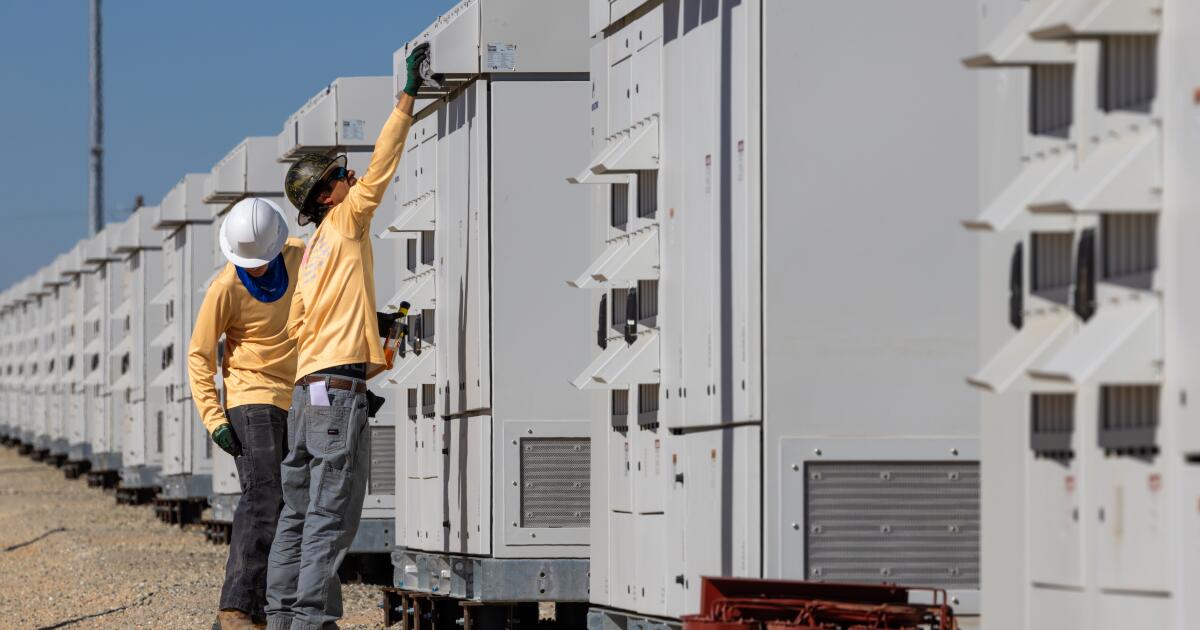
Battery storage installations work by receiving excess solar and wind power and releasing it later, especially from 4 to 9 p.m. when the state’s grid is most under stress.
Last year, Newsom appointees voted to extend the operation of the Diablo Canyon nuclear plant another five years to bolster the reliability of Calfornia’s grid and avoid rolling blackouts. The aging nuclear facility and its twin reactors had been scheduled to shut down.
In August 2020, a major heat event fueled by the climate crisis forced some of the state’s first rotating power outages in decades, as the ongoing transition to green energy lagged behind demand. Californians narrowly avoided rolling blackouts in 2022 as a record-breaking heat wave broiled almost every corner of the state for days.
Newsletter
Toward a more sustainable California
Get Boiling Point, our newsletter exploring climate change, energy and the environment, and become part of the conversation — and the solution.
You may occasionally receive promotional content from the Los Angeles Times.

Gov. Gavin Newsom said Thursday that California continued to rapidly add the battery storage that is crucial to the transition to cleaner energy, but admitted it was still not enough to avoid blackouts during heat waves.
Standing in the middle of a solar farm in Yolo County, Newsom announced the state now had battery storage systems with the capacity of more than 10,000 megawatts — about 20% of the 52,000 megawatts the state says is needed to meet its climate goals.
“This is critical to how we achieve 100% clean energy by 2045,” Newsom said. “Batteries allow us to use clean energy captured by solar and other renewable sources at all times of the day, especially when solar generation drops after the sun goes down.”
The ultimate goal, he said, is to slow climate change.
“As the hots get hotter, the drys get drier, the wets get wetter, simultaneous droughts, and rain bombs, we have to address these issues with a ferocity that is required of us and we’re doing just that in California,” he said.
Asked by reporters if California now had enough battery storage so that residents no longer had to worry about blackouts during times of high power use, Newsom laughed.
“We have a lot of work to do still in moving this transition, with the kind of stability that’s required,” the governor said. “So no, this is not today announcing that blackouts are part of our past.”
Battery storage installations work by receiving excess solar and wind power and releasing it later, especially from 4 to 9 p.m. when the state’s grid is most under stress.
Last year, Newsom appointees voted to extend the operation of the Diablo Canyon nuclear plant another five years to bolster the reliability of Calfornia’s grid and avoid rolling blackouts. The aging nuclear facility and its twin reactors had been scheduled to shut down.
In August 2020, a major heat event fueled by the climate crisis forced some of the state’s first rotating power outages in decades, as the ongoing transition to green energy lagged behind demand. Californians narrowly avoided rolling blackouts in 2022 as a record-breaking heat wave broiled almost every corner of the state for days.
Newsletter
Toward a more sustainable California
Get Boiling Point, our newsletter exploring climate change, energy and the environment, and become part of the conversation — and the solution.
You may occasionally receive promotional content from the Los Angeles Times.

Gov. Gavin Newsom said Thursday that California continued to rapidly add the battery storage that is crucial to the transition to cleaner energy, but admitted it was still not enough to avoid blackouts during heat waves.
Standing in the middle of a solar farm in Yolo County, Newsom announced the state now had battery storage systems with the capacity of more than 10,000 megawatts — about 20% of the 52,000 megawatts the state says is needed to meet its climate goals.
“This is critical to how we achieve 100% clean energy by 2045,” Newsom said. “Batteries allow us to use clean energy captured by solar and other renewable sources at all times of the day, especially when solar generation drops after the sun goes down.”
The ultimate goal, he said, is to slow climate change.
“As the hots get hotter, the drys get drier, the wets get wetter, simultaneous droughts, and rain bombs, we have to address these issues with a ferocity that is required of us and we’re doing just that in California,” he said.
Asked by reporters if California now had enough battery storage so that residents no longer had to worry about blackouts during times of high power use, Newsom laughed.
“We have a lot of work to do still in moving this transition, with the kind of stability that’s required,” the governor said. “So no, this is not today announcing that blackouts are part of our past.”
Battery storage installations work by receiving excess solar and wind power and releasing it later, especially from 4 to 9 p.m. when the state’s grid is most under stress.
Last year, Newsom appointees voted to extend the operation of the Diablo Canyon nuclear plant another five years to bolster the reliability of Calfornia’s grid and avoid rolling blackouts. The aging nuclear facility and its twin reactors had been scheduled to shut down.
In August 2020, a major heat event fueled by the climate crisis forced some of the state’s first rotating power outages in decades, as the ongoing transition to green energy lagged behind demand. Californians narrowly avoided rolling blackouts in 2022 as a record-breaking heat wave broiled almost every corner of the state for days.
Newsletter
Toward a more sustainable California
Get Boiling Point, our newsletter exploring climate change, energy and the environment, and become part of the conversation — and the solution.
You may occasionally receive promotional content from the Los Angeles Times.
Gov. Gavin Newsom said Thursday that California continued to rapidly add the battery storage that is crucial to the transition to cleaner energy, but admitted it was still not enough to avoid blackouts during heat waves.
Standing in the middle of a solar farm in Yolo County, Newsom announced the state now had battery storage systems with the capacity of more than 10,000 megawatts — about 20% of the 52,000 megawatts the state says is needed to meet its climate goals.
“This is critical to how we achieve 100% clean energy by 2045,” Newsom said. “Batteries allow us to use clean energy captured by solar and other renewable sources at all times of the day, especially when solar generation drops after the sun goes down.”
The ultimate goal, he said, is to slow climate change.
“As the hots get hotter, the drys get drier, the wets get wetter, simultaneous droughts, and rain bombs, we have to address these issues with a ferocity that is required of us and we’re doing just that in California,” he said.
Asked by reporters if California now had enough battery storage so that residents no longer had to worry about blackouts during times of high power use, Newsom laughed.
“We have a lot of work to do still in moving this transition, with the kind of stability that’s required,” the governor said. “So no, this is not today announcing that blackouts are part of our past.”
Battery storage installations work by receiving excess solar and wind power and releasing it later, especially from 4 to 9 p.m. when the state’s grid is most under stress.
Last year, Newsom appointees voted to extend the operation of the Diablo Canyon nuclear plant another five years to bolster the reliability of Calfornia’s grid and avoid rolling blackouts. The aging nuclear facility and its twin reactors had been scheduled to shut down.
In August 2020, a major heat event fueled by the climate crisis forced some of the state’s first rotating power outages in decades, as the ongoing transition to green energy lagged behind demand. Californians narrowly avoided rolling blackouts in 2022 as a record-breaking heat wave broiled almost every corner of the state for days.
Newsletter
Toward a more sustainable California
Get Boiling Point, our newsletter exploring climate change, energy and the environment, and become part of the conversation — and the solution.
You may occasionally receive promotional content from the Los Angeles Times.

Gov. Gavin Newsom said Thursday that California continued to rapidly add the battery storage that is crucial to the transition to cleaner energy, but admitted it was still not enough to avoid blackouts during heat waves.
Standing in the middle of a solar farm in Yolo County, Newsom announced the state now had battery storage systems with the capacity of more than 10,000 megawatts — about 20% of the 52,000 megawatts the state says is needed to meet its climate goals.
“This is critical to how we achieve 100% clean energy by 2045,” Newsom said. “Batteries allow us to use clean energy captured by solar and other renewable sources at all times of the day, especially when solar generation drops after the sun goes down.”
The ultimate goal, he said, is to slow climate change.
“As the hots get hotter, the drys get drier, the wets get wetter, simultaneous droughts, and rain bombs, we have to address these issues with a ferocity that is required of us and we’re doing just that in California,” he said.
Asked by reporters if California now had enough battery storage so that residents no longer had to worry about blackouts during times of high power use, Newsom laughed.
“We have a lot of work to do still in moving this transition, with the kind of stability that’s required,” the governor said. “So no, this is not today announcing that blackouts are part of our past.”
Battery storage installations work by receiving excess solar and wind power and releasing it later, especially from 4 to 9 p.m. when the state’s grid is most under stress.
Last year, Newsom appointees voted to extend the operation of the Diablo Canyon nuclear plant another five years to bolster the reliability of Calfornia’s grid and avoid rolling blackouts. The aging nuclear facility and its twin reactors had been scheduled to shut down.
In August 2020, a major heat event fueled by the climate crisis forced some of the state’s first rotating power outages in decades, as the ongoing transition to green energy lagged behind demand. Californians narrowly avoided rolling blackouts in 2022 as a record-breaking heat wave broiled almost every corner of the state for days.
Newsletter
Toward a more sustainable California
Get Boiling Point, our newsletter exploring climate change, energy and the environment, and become part of the conversation — and the solution.
You may occasionally receive promotional content from the Los Angeles Times.
Gov. Gavin Newsom said Thursday that California continued to rapidly add the battery storage that is crucial to the transition to cleaner energy, but admitted it was still not enough to avoid blackouts during heat waves.
Standing in the middle of a solar farm in Yolo County, Newsom announced the state now had battery storage systems with the capacity of more than 10,000 megawatts — about 20% of the 52,000 megawatts the state says is needed to meet its climate goals.
“This is critical to how we achieve 100% clean energy by 2045,” Newsom said. “Batteries allow us to use clean energy captured by solar and other renewable sources at all times of the day, especially when solar generation drops after the sun goes down.”
The ultimate goal, he said, is to slow climate change.
“As the hots get hotter, the drys get drier, the wets get wetter, simultaneous droughts, and rain bombs, we have to address these issues with a ferocity that is required of us and we’re doing just that in California,” he said.
Asked by reporters if California now had enough battery storage so that residents no longer had to worry about blackouts during times of high power use, Newsom laughed.
“We have a lot of work to do still in moving this transition, with the kind of stability that’s required,” the governor said. “So no, this is not today announcing that blackouts are part of our past.”
Battery storage installations work by receiving excess solar and wind power and releasing it later, especially from 4 to 9 p.m. when the state’s grid is most under stress.
Last year, Newsom appointees voted to extend the operation of the Diablo Canyon nuclear plant another five years to bolster the reliability of Calfornia’s grid and avoid rolling blackouts. The aging nuclear facility and its twin reactors had been scheduled to shut down.
In August 2020, a major heat event fueled by the climate crisis forced some of the state’s first rotating power outages in decades, as the ongoing transition to green energy lagged behind demand. Californians narrowly avoided rolling blackouts in 2022 as a record-breaking heat wave broiled almost every corner of the state for days.
Newsletter
Toward a more sustainable California
Get Boiling Point, our newsletter exploring climate change, energy and the environment, and become part of the conversation — and the solution.
You may occasionally receive promotional content from the Los Angeles Times.
Gov. Gavin Newsom said Thursday that California continued to rapidly add the battery storage that is crucial to the transition to cleaner energy, but admitted it was still not enough to avoid blackouts during heat waves.
Standing in the middle of a solar farm in Yolo County, Newsom announced the state now had battery storage systems with the capacity of more than 10,000 megawatts — about 20% of the 52,000 megawatts the state says is needed to meet its climate goals.
“This is critical to how we achieve 100% clean energy by 2045,” Newsom said. “Batteries allow us to use clean energy captured by solar and other renewable sources at all times of the day, especially when solar generation drops after the sun goes down.”
The ultimate goal, he said, is to slow climate change.
“As the hots get hotter, the drys get drier, the wets get wetter, simultaneous droughts, and rain bombs, we have to address these issues with a ferocity that is required of us and we’re doing just that in California,” he said.
Asked by reporters if California now had enough battery storage so that residents no longer had to worry about blackouts during times of high power use, Newsom laughed.
“We have a lot of work to do still in moving this transition, with the kind of stability that’s required,” the governor said. “So no, this is not today announcing that blackouts are part of our past.”
Battery storage installations work by receiving excess solar and wind power and releasing it later, especially from 4 to 9 p.m. when the state’s grid is most under stress.
Last year, Newsom appointees voted to extend the operation of the Diablo Canyon nuclear plant another five years to bolster the reliability of Calfornia’s grid and avoid rolling blackouts. The aging nuclear facility and its twin reactors had been scheduled to shut down.
In August 2020, a major heat event fueled by the climate crisis forced some of the state’s first rotating power outages in decades, as the ongoing transition to green energy lagged behind demand. Californians narrowly avoided rolling blackouts in 2022 as a record-breaking heat wave broiled almost every corner of the state for days.
Newsletter
Toward a more sustainable California
Get Boiling Point, our newsletter exploring climate change, energy and the environment, and become part of the conversation — and the solution.
You may occasionally receive promotional content from the Los Angeles Times.
Gov. Gavin Newsom said Thursday that California continued to rapidly add the battery storage that is crucial to the transition to cleaner energy, but admitted it was still not enough to avoid blackouts during heat waves.
Standing in the middle of a solar farm in Yolo County, Newsom announced the state now had battery storage systems with the capacity of more than 10,000 megawatts — about 20% of the 52,000 megawatts the state says is needed to meet its climate goals.
“This is critical to how we achieve 100% clean energy by 2045,” Newsom said. “Batteries allow us to use clean energy captured by solar and other renewable sources at all times of the day, especially when solar generation drops after the sun goes down.”
The ultimate goal, he said, is to slow climate change.
“As the hots get hotter, the drys get drier, the wets get wetter, simultaneous droughts, and rain bombs, we have to address these issues with a ferocity that is required of us and we’re doing just that in California,” he said.
Asked by reporters if California now had enough battery storage so that residents no longer had to worry about blackouts during times of high power use, Newsom laughed.
“We have a lot of work to do still in moving this transition, with the kind of stability that’s required,” the governor said. “So no, this is not today announcing that blackouts are part of our past.”
Battery storage installations work by receiving excess solar and wind power and releasing it later, especially from 4 to 9 p.m. when the state’s grid is most under stress.
Last year, Newsom appointees voted to extend the operation of the Diablo Canyon nuclear plant another five years to bolster the reliability of Calfornia’s grid and avoid rolling blackouts. The aging nuclear facility and its twin reactors had been scheduled to shut down.
In August 2020, a major heat event fueled by the climate crisis forced some of the state’s first rotating power outages in decades, as the ongoing transition to green energy lagged behind demand. Californians narrowly avoided rolling blackouts in 2022 as a record-breaking heat wave broiled almost every corner of the state for days.
Newsletter
Toward a more sustainable California
Get Boiling Point, our newsletter exploring climate change, energy and the environment, and become part of the conversation — and the solution.
You may occasionally receive promotional content from the Los Angeles Times.

