

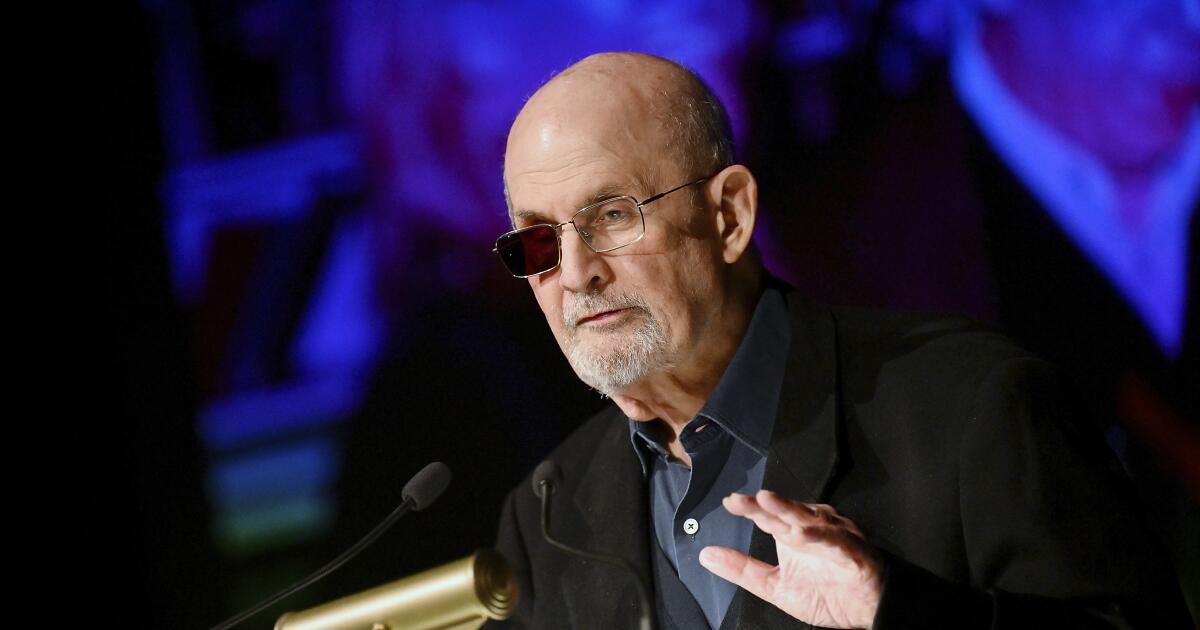
Salman Rushdie isn’t limiting himself to just his new memoir to recount the 2022 stabbing attack that nearly killed him.
Ahead of the release of his newest memoir, “Knife,” the “Satanic Verses” author has returned to the media spotlight, recounting some gruesome details of his near-death experience and how he seeks to take “the power back.”
On Aug. 12, 2022, Rushdie appeared at the Chautauqua Institution in New York, where he was supposed to deliver a lecture. While he prepared, a man — later identified as Hadi Matar — rushed the stage and allegedly stabbed the author multiple times in the neck and body. “I actually thought he’d punched me very hard, I didn’t realize there was a knife in his hand,” the author, 76, told the BBC in a video interview published Monday.
Rushdie was swiftly hospitalized with serious injuries and underwent surgery. In the attack, the Booker Prize winner suffered severed nerves in his hand and right eye, among other injuries. For the BBC, he recalled how his eye “was kind of hanging out of my face.”
He added in the video interview: “[The eye was] sitting on my cheek like a soft-boiled egg. And now I’m blind.
The BBC reported that Rushdie said losing vision in his eye “upsets me every day” and that he needs to take more caution when performing daily activities like walking or pouring himself water. Rushdie added that he was grateful not to have sustained any brain damage in the attack, telling the BBC, “It meant I was actually still able to be myself.”
The 2022 stabbing and its aftermath may be at the core of “Knife,” but Rushdie told the New York Times in a recent interview that he sees his memoir as being about “both love and hatred — one overcoming the other.”
Rushdie established a decades-long career by putting his beliefs and experiences with religion and politics on the page. Decades prior to the 2022 stabbing, he notably faced threats of violence for his work. In 1989, Iran’s then-Ayatollah Ruhollah Khomeini delivered a fatwa, a religious decree, calling for Rushdie’s death after the publication of “The Satanic Verses,” which some Muslims consider blasphemous.
Despite the reverence and ire his work has inspired, Rushdie told the NYT, “I never felt symbolic.”
“I’m just Ken,” he said, referring to the Ryan Gosling musical spectacular from Greta Gerwig‘s “Barbie” movie. “I’m just me. I’m just somebody who’s trying to be a writer, trying to do his best. And that’s all I’ve ever wanted to be.”
When “Knife” was announced last October, Rushdie said his memoir was “necessary” to help him “take charge of what happened, and to answer violence with art.” However, speaking on “Good Morning America” on Monday, Rushdie admitted that at first he hesitated to write the forthcoming book.
“First off I didn’t want to do it, then I discovered I kind of had to do it, and then I really got into it and wanted to do it,” he said. “Anything else seemed dumb to do, when there was this huge subject sitting right in my face.”
He added: “It became my way of controlling the narrative, fighting back. … That’s what it felt like. Taking the power back.”
“Knife,” which hits shelves on Tuesday, is described in materials from the publisher as “a gripping, intimate, and ultimately life-affirming meditation on life, loss, love, art — and finding the strength to stand up again.”
A New York judge ruled in January that Matar and his defense team are entitled by law to see Rushdie’s manuscript and related material before he stands trial.
“It’s not just the book,” Matar’s attorney Nathaniel Barone said in January. “Every little note Rushdie wrote down, I get, I’m entitled to. Every discussion, every recording, anything he did in regard to this book.”
As a result, the trial was delayed and is expected to begin in the fall, BBC reported. New Jersey resident Matar, 26, has been held without bail since his alleged attack on Rushdie. No motive for the attack has been disclosed.

Salman Rushdie isn’t limiting himself to just his new memoir to recount the 2022 stabbing attack that nearly killed him.
Ahead of the release of his newest memoir, “Knife,” the “Satanic Verses” author has returned to the media spotlight, recounting some gruesome details of his near-death experience and how he seeks to take “the power back.”
On Aug. 12, 2022, Rushdie appeared at the Chautauqua Institution in New York, where he was supposed to deliver a lecture. While he prepared, a man — later identified as Hadi Matar — rushed the stage and allegedly stabbed the author multiple times in the neck and body. “I actually thought he’d punched me very hard, I didn’t realize there was a knife in his hand,” the author, 76, told the BBC in a video interview published Monday.
Rushdie was swiftly hospitalized with serious injuries and underwent surgery. In the attack, the Booker Prize winner suffered severed nerves in his hand and right eye, among other injuries. For the BBC, he recalled how his eye “was kind of hanging out of my face.”
He added in the video interview: “[The eye was] sitting on my cheek like a soft-boiled egg. And now I’m blind.
The BBC reported that Rushdie said losing vision in his eye “upsets me every day” and that he needs to take more caution when performing daily activities like walking or pouring himself water. Rushdie added that he was grateful not to have sustained any brain damage in the attack, telling the BBC, “It meant I was actually still able to be myself.”
The 2022 stabbing and its aftermath may be at the core of “Knife,” but Rushdie told the New York Times in a recent interview that he sees his memoir as being about “both love and hatred — one overcoming the other.”
Rushdie established a decades-long career by putting his beliefs and experiences with religion and politics on the page. Decades prior to the 2022 stabbing, he notably faced threats of violence for his work. In 1989, Iran’s then-Ayatollah Ruhollah Khomeini delivered a fatwa, a religious decree, calling for Rushdie’s death after the publication of “The Satanic Verses,” which some Muslims consider blasphemous.
Despite the reverence and ire his work has inspired, Rushdie told the NYT, “I never felt symbolic.”
“I’m just Ken,” he said, referring to the Ryan Gosling musical spectacular from Greta Gerwig‘s “Barbie” movie. “I’m just me. I’m just somebody who’s trying to be a writer, trying to do his best. And that’s all I’ve ever wanted to be.”
When “Knife” was announced last October, Rushdie said his memoir was “necessary” to help him “take charge of what happened, and to answer violence with art.” However, speaking on “Good Morning America” on Monday, Rushdie admitted that at first he hesitated to write the forthcoming book.
“First off I didn’t want to do it, then I discovered I kind of had to do it, and then I really got into it and wanted to do it,” he said. “Anything else seemed dumb to do, when there was this huge subject sitting right in my face.”
He added: “It became my way of controlling the narrative, fighting back. … That’s what it felt like. Taking the power back.”
“Knife,” which hits shelves on Tuesday, is described in materials from the publisher as “a gripping, intimate, and ultimately life-affirming meditation on life, loss, love, art — and finding the strength to stand up again.”
A New York judge ruled in January that Matar and his defense team are entitled by law to see Rushdie’s manuscript and related material before he stands trial.
“It’s not just the book,” Matar’s attorney Nathaniel Barone said in January. “Every little note Rushdie wrote down, I get, I’m entitled to. Every discussion, every recording, anything he did in regard to this book.”
As a result, the trial was delayed and is expected to begin in the fall, BBC reported. New Jersey resident Matar, 26, has been held without bail since his alleged attack on Rushdie. No motive for the attack has been disclosed.

Salman Rushdie isn’t limiting himself to just his new memoir to recount the 2022 stabbing attack that nearly killed him.
Ahead of the release of his newest memoir, “Knife,” the “Satanic Verses” author has returned to the media spotlight, recounting some gruesome details of his near-death experience and how he seeks to take “the power back.”
On Aug. 12, 2022, Rushdie appeared at the Chautauqua Institution in New York, where he was supposed to deliver a lecture. While he prepared, a man — later identified as Hadi Matar — rushed the stage and allegedly stabbed the author multiple times in the neck and body. “I actually thought he’d punched me very hard, I didn’t realize there was a knife in his hand,” the author, 76, told the BBC in a video interview published Monday.
Rushdie was swiftly hospitalized with serious injuries and underwent surgery. In the attack, the Booker Prize winner suffered severed nerves in his hand and right eye, among other injuries. For the BBC, he recalled how his eye “was kind of hanging out of my face.”
He added in the video interview: “[The eye was] sitting on my cheek like a soft-boiled egg. And now I’m blind.
The BBC reported that Rushdie said losing vision in his eye “upsets me every day” and that he needs to take more caution when performing daily activities like walking or pouring himself water. Rushdie added that he was grateful not to have sustained any brain damage in the attack, telling the BBC, “It meant I was actually still able to be myself.”
The 2022 stabbing and its aftermath may be at the core of “Knife,” but Rushdie told the New York Times in a recent interview that he sees his memoir as being about “both love and hatred — one overcoming the other.”
Rushdie established a decades-long career by putting his beliefs and experiences with religion and politics on the page. Decades prior to the 2022 stabbing, he notably faced threats of violence for his work. In 1989, Iran’s then-Ayatollah Ruhollah Khomeini delivered a fatwa, a religious decree, calling for Rushdie’s death after the publication of “The Satanic Verses,” which some Muslims consider blasphemous.
Despite the reverence and ire his work has inspired, Rushdie told the NYT, “I never felt symbolic.”
“I’m just Ken,” he said, referring to the Ryan Gosling musical spectacular from Greta Gerwig‘s “Barbie” movie. “I’m just me. I’m just somebody who’s trying to be a writer, trying to do his best. And that’s all I’ve ever wanted to be.”
When “Knife” was announced last October, Rushdie said his memoir was “necessary” to help him “take charge of what happened, and to answer violence with art.” However, speaking on “Good Morning America” on Monday, Rushdie admitted that at first he hesitated to write the forthcoming book.
“First off I didn’t want to do it, then I discovered I kind of had to do it, and then I really got into it and wanted to do it,” he said. “Anything else seemed dumb to do, when there was this huge subject sitting right in my face.”
He added: “It became my way of controlling the narrative, fighting back. … That’s what it felt like. Taking the power back.”
“Knife,” which hits shelves on Tuesday, is described in materials from the publisher as “a gripping, intimate, and ultimately life-affirming meditation on life, loss, love, art — and finding the strength to stand up again.”
A New York judge ruled in January that Matar and his defense team are entitled by law to see Rushdie’s manuscript and related material before he stands trial.
“It’s not just the book,” Matar’s attorney Nathaniel Barone said in January. “Every little note Rushdie wrote down, I get, I’m entitled to. Every discussion, every recording, anything he did in regard to this book.”
As a result, the trial was delayed and is expected to begin in the fall, BBC reported. New Jersey resident Matar, 26, has been held without bail since his alleged attack on Rushdie. No motive for the attack has been disclosed.
Salman Rushdie isn’t limiting himself to just his new memoir to recount the 2022 stabbing attack that nearly killed him.
Ahead of the release of his newest memoir, “Knife,” the “Satanic Verses” author has returned to the media spotlight, recounting some gruesome details of his near-death experience and how he seeks to take “the power back.”
On Aug. 12, 2022, Rushdie appeared at the Chautauqua Institution in New York, where he was supposed to deliver a lecture. While he prepared, a man — later identified as Hadi Matar — rushed the stage and allegedly stabbed the author multiple times in the neck and body. “I actually thought he’d punched me very hard, I didn’t realize there was a knife in his hand,” the author, 76, told the BBC in a video interview published Monday.
Rushdie was swiftly hospitalized with serious injuries and underwent surgery. In the attack, the Booker Prize winner suffered severed nerves in his hand and right eye, among other injuries. For the BBC, he recalled how his eye “was kind of hanging out of my face.”
He added in the video interview: “[The eye was] sitting on my cheek like a soft-boiled egg. And now I’m blind.
The BBC reported that Rushdie said losing vision in his eye “upsets me every day” and that he needs to take more caution when performing daily activities like walking or pouring himself water. Rushdie added that he was grateful not to have sustained any brain damage in the attack, telling the BBC, “It meant I was actually still able to be myself.”
The 2022 stabbing and its aftermath may be at the core of “Knife,” but Rushdie told the New York Times in a recent interview that he sees his memoir as being about “both love and hatred — one overcoming the other.”
Rushdie established a decades-long career by putting his beliefs and experiences with religion and politics on the page. Decades prior to the 2022 stabbing, he notably faced threats of violence for his work. In 1989, Iran’s then-Ayatollah Ruhollah Khomeini delivered a fatwa, a religious decree, calling for Rushdie’s death after the publication of “The Satanic Verses,” which some Muslims consider blasphemous.
Despite the reverence and ire his work has inspired, Rushdie told the NYT, “I never felt symbolic.”
“I’m just Ken,” he said, referring to the Ryan Gosling musical spectacular from Greta Gerwig‘s “Barbie” movie. “I’m just me. I’m just somebody who’s trying to be a writer, trying to do his best. And that’s all I’ve ever wanted to be.”
When “Knife” was announced last October, Rushdie said his memoir was “necessary” to help him “take charge of what happened, and to answer violence with art.” However, speaking on “Good Morning America” on Monday, Rushdie admitted that at first he hesitated to write the forthcoming book.
“First off I didn’t want to do it, then I discovered I kind of had to do it, and then I really got into it and wanted to do it,” he said. “Anything else seemed dumb to do, when there was this huge subject sitting right in my face.”
He added: “It became my way of controlling the narrative, fighting back. … That’s what it felt like. Taking the power back.”
“Knife,” which hits shelves on Tuesday, is described in materials from the publisher as “a gripping, intimate, and ultimately life-affirming meditation on life, loss, love, art — and finding the strength to stand up again.”
A New York judge ruled in January that Matar and his defense team are entitled by law to see Rushdie’s manuscript and related material before he stands trial.
“It’s not just the book,” Matar’s attorney Nathaniel Barone said in January. “Every little note Rushdie wrote down, I get, I’m entitled to. Every discussion, every recording, anything he did in regard to this book.”
As a result, the trial was delayed and is expected to begin in the fall, BBC reported. New Jersey resident Matar, 26, has been held without bail since his alleged attack on Rushdie. No motive for the attack has been disclosed.

Salman Rushdie isn’t limiting himself to just his new memoir to recount the 2022 stabbing attack that nearly killed him.
Ahead of the release of his newest memoir, “Knife,” the “Satanic Verses” author has returned to the media spotlight, recounting some gruesome details of his near-death experience and how he seeks to take “the power back.”
On Aug. 12, 2022, Rushdie appeared at the Chautauqua Institution in New York, where he was supposed to deliver a lecture. While he prepared, a man — later identified as Hadi Matar — rushed the stage and allegedly stabbed the author multiple times in the neck and body. “I actually thought he’d punched me very hard, I didn’t realize there was a knife in his hand,” the author, 76, told the BBC in a video interview published Monday.
Rushdie was swiftly hospitalized with serious injuries and underwent surgery. In the attack, the Booker Prize winner suffered severed nerves in his hand and right eye, among other injuries. For the BBC, he recalled how his eye “was kind of hanging out of my face.”
He added in the video interview: “[The eye was] sitting on my cheek like a soft-boiled egg. And now I’m blind.
The BBC reported that Rushdie said losing vision in his eye “upsets me every day” and that he needs to take more caution when performing daily activities like walking or pouring himself water. Rushdie added that he was grateful not to have sustained any brain damage in the attack, telling the BBC, “It meant I was actually still able to be myself.”
The 2022 stabbing and its aftermath may be at the core of “Knife,” but Rushdie told the New York Times in a recent interview that he sees his memoir as being about “both love and hatred — one overcoming the other.”
Rushdie established a decades-long career by putting his beliefs and experiences with religion and politics on the page. Decades prior to the 2022 stabbing, he notably faced threats of violence for his work. In 1989, Iran’s then-Ayatollah Ruhollah Khomeini delivered a fatwa, a religious decree, calling for Rushdie’s death after the publication of “The Satanic Verses,” which some Muslims consider blasphemous.
Despite the reverence and ire his work has inspired, Rushdie told the NYT, “I never felt symbolic.”
“I’m just Ken,” he said, referring to the Ryan Gosling musical spectacular from Greta Gerwig‘s “Barbie” movie. “I’m just me. I’m just somebody who’s trying to be a writer, trying to do his best. And that’s all I’ve ever wanted to be.”
When “Knife” was announced last October, Rushdie said his memoir was “necessary” to help him “take charge of what happened, and to answer violence with art.” However, speaking on “Good Morning America” on Monday, Rushdie admitted that at first he hesitated to write the forthcoming book.
“First off I didn’t want to do it, then I discovered I kind of had to do it, and then I really got into it and wanted to do it,” he said. “Anything else seemed dumb to do, when there was this huge subject sitting right in my face.”
He added: “It became my way of controlling the narrative, fighting back. … That’s what it felt like. Taking the power back.”
“Knife,” which hits shelves on Tuesday, is described in materials from the publisher as “a gripping, intimate, and ultimately life-affirming meditation on life, loss, love, art — and finding the strength to stand up again.”
A New York judge ruled in January that Matar and his defense team are entitled by law to see Rushdie’s manuscript and related material before he stands trial.
“It’s not just the book,” Matar’s attorney Nathaniel Barone said in January. “Every little note Rushdie wrote down, I get, I’m entitled to. Every discussion, every recording, anything he did in regard to this book.”
As a result, the trial was delayed and is expected to begin in the fall, BBC reported. New Jersey resident Matar, 26, has been held without bail since his alleged attack on Rushdie. No motive for the attack has been disclosed.
Salman Rushdie isn’t limiting himself to just his new memoir to recount the 2022 stabbing attack that nearly killed him.
Ahead of the release of his newest memoir, “Knife,” the “Satanic Verses” author has returned to the media spotlight, recounting some gruesome details of his near-death experience and how he seeks to take “the power back.”
On Aug. 12, 2022, Rushdie appeared at the Chautauqua Institution in New York, where he was supposed to deliver a lecture. While he prepared, a man — later identified as Hadi Matar — rushed the stage and allegedly stabbed the author multiple times in the neck and body. “I actually thought he’d punched me very hard, I didn’t realize there was a knife in his hand,” the author, 76, told the BBC in a video interview published Monday.
Rushdie was swiftly hospitalized with serious injuries and underwent surgery. In the attack, the Booker Prize winner suffered severed nerves in his hand and right eye, among other injuries. For the BBC, he recalled how his eye “was kind of hanging out of my face.”
He added in the video interview: “[The eye was] sitting on my cheek like a soft-boiled egg. And now I’m blind.
The BBC reported that Rushdie said losing vision in his eye “upsets me every day” and that he needs to take more caution when performing daily activities like walking or pouring himself water. Rushdie added that he was grateful not to have sustained any brain damage in the attack, telling the BBC, “It meant I was actually still able to be myself.”
The 2022 stabbing and its aftermath may be at the core of “Knife,” but Rushdie told the New York Times in a recent interview that he sees his memoir as being about “both love and hatred — one overcoming the other.”
Rushdie established a decades-long career by putting his beliefs and experiences with religion and politics on the page. Decades prior to the 2022 stabbing, he notably faced threats of violence for his work. In 1989, Iran’s then-Ayatollah Ruhollah Khomeini delivered a fatwa, a religious decree, calling for Rushdie’s death after the publication of “The Satanic Verses,” which some Muslims consider blasphemous.
Despite the reverence and ire his work has inspired, Rushdie told the NYT, “I never felt symbolic.”
“I’m just Ken,” he said, referring to the Ryan Gosling musical spectacular from Greta Gerwig‘s “Barbie” movie. “I’m just me. I’m just somebody who’s trying to be a writer, trying to do his best. And that’s all I’ve ever wanted to be.”
When “Knife” was announced last October, Rushdie said his memoir was “necessary” to help him “take charge of what happened, and to answer violence with art.” However, speaking on “Good Morning America” on Monday, Rushdie admitted that at first he hesitated to write the forthcoming book.
“First off I didn’t want to do it, then I discovered I kind of had to do it, and then I really got into it and wanted to do it,” he said. “Anything else seemed dumb to do, when there was this huge subject sitting right in my face.”
He added: “It became my way of controlling the narrative, fighting back. … That’s what it felt like. Taking the power back.”
“Knife,” which hits shelves on Tuesday, is described in materials from the publisher as “a gripping, intimate, and ultimately life-affirming meditation on life, loss, love, art — and finding the strength to stand up again.”
A New York judge ruled in January that Matar and his defense team are entitled by law to see Rushdie’s manuscript and related material before he stands trial.
“It’s not just the book,” Matar’s attorney Nathaniel Barone said in January. “Every little note Rushdie wrote down, I get, I’m entitled to. Every discussion, every recording, anything he did in regard to this book.”
As a result, the trial was delayed and is expected to begin in the fall, BBC reported. New Jersey resident Matar, 26, has been held without bail since his alleged attack on Rushdie. No motive for the attack has been disclosed.
Salman Rushdie isn’t limiting himself to just his new memoir to recount the 2022 stabbing attack that nearly killed him.
Ahead of the release of his newest memoir, “Knife,” the “Satanic Verses” author has returned to the media spotlight, recounting some gruesome details of his near-death experience and how he seeks to take “the power back.”
On Aug. 12, 2022, Rushdie appeared at the Chautauqua Institution in New York, where he was supposed to deliver a lecture. While he prepared, a man — later identified as Hadi Matar — rushed the stage and allegedly stabbed the author multiple times in the neck and body. “I actually thought he’d punched me very hard, I didn’t realize there was a knife in his hand,” the author, 76, told the BBC in a video interview published Monday.
Rushdie was swiftly hospitalized with serious injuries and underwent surgery. In the attack, the Booker Prize winner suffered severed nerves in his hand and right eye, among other injuries. For the BBC, he recalled how his eye “was kind of hanging out of my face.”
He added in the video interview: “[The eye was] sitting on my cheek like a soft-boiled egg. And now I’m blind.
The BBC reported that Rushdie said losing vision in his eye “upsets me every day” and that he needs to take more caution when performing daily activities like walking or pouring himself water. Rushdie added that he was grateful not to have sustained any brain damage in the attack, telling the BBC, “It meant I was actually still able to be myself.”
The 2022 stabbing and its aftermath may be at the core of “Knife,” but Rushdie told the New York Times in a recent interview that he sees his memoir as being about “both love and hatred — one overcoming the other.”
Rushdie established a decades-long career by putting his beliefs and experiences with religion and politics on the page. Decades prior to the 2022 stabbing, he notably faced threats of violence for his work. In 1989, Iran’s then-Ayatollah Ruhollah Khomeini delivered a fatwa, a religious decree, calling for Rushdie’s death after the publication of “The Satanic Verses,” which some Muslims consider blasphemous.
Despite the reverence and ire his work has inspired, Rushdie told the NYT, “I never felt symbolic.”
“I’m just Ken,” he said, referring to the Ryan Gosling musical spectacular from Greta Gerwig‘s “Barbie” movie. “I’m just me. I’m just somebody who’s trying to be a writer, trying to do his best. And that’s all I’ve ever wanted to be.”
When “Knife” was announced last October, Rushdie said his memoir was “necessary” to help him “take charge of what happened, and to answer violence with art.” However, speaking on “Good Morning America” on Monday, Rushdie admitted that at first he hesitated to write the forthcoming book.
“First off I didn’t want to do it, then I discovered I kind of had to do it, and then I really got into it and wanted to do it,” he said. “Anything else seemed dumb to do, when there was this huge subject sitting right in my face.”
He added: “It became my way of controlling the narrative, fighting back. … That’s what it felt like. Taking the power back.”
“Knife,” which hits shelves on Tuesday, is described in materials from the publisher as “a gripping, intimate, and ultimately life-affirming meditation on life, loss, love, art — and finding the strength to stand up again.”
A New York judge ruled in January that Matar and his defense team are entitled by law to see Rushdie’s manuscript and related material before he stands trial.
“It’s not just the book,” Matar’s attorney Nathaniel Barone said in January. “Every little note Rushdie wrote down, I get, I’m entitled to. Every discussion, every recording, anything he did in regard to this book.”
As a result, the trial was delayed and is expected to begin in the fall, BBC reported. New Jersey resident Matar, 26, has been held without bail since his alleged attack on Rushdie. No motive for the attack has been disclosed.
Salman Rushdie isn’t limiting himself to just his new memoir to recount the 2022 stabbing attack that nearly killed him.
Ahead of the release of his newest memoir, “Knife,” the “Satanic Verses” author has returned to the media spotlight, recounting some gruesome details of his near-death experience and how he seeks to take “the power back.”
On Aug. 12, 2022, Rushdie appeared at the Chautauqua Institution in New York, where he was supposed to deliver a lecture. While he prepared, a man — later identified as Hadi Matar — rushed the stage and allegedly stabbed the author multiple times in the neck and body. “I actually thought he’d punched me very hard, I didn’t realize there was a knife in his hand,” the author, 76, told the BBC in a video interview published Monday.
Rushdie was swiftly hospitalized with serious injuries and underwent surgery. In the attack, the Booker Prize winner suffered severed nerves in his hand and right eye, among other injuries. For the BBC, he recalled how his eye “was kind of hanging out of my face.”
He added in the video interview: “[The eye was] sitting on my cheek like a soft-boiled egg. And now I’m blind.
The BBC reported that Rushdie said losing vision in his eye “upsets me every day” and that he needs to take more caution when performing daily activities like walking or pouring himself water. Rushdie added that he was grateful not to have sustained any brain damage in the attack, telling the BBC, “It meant I was actually still able to be myself.”
The 2022 stabbing and its aftermath may be at the core of “Knife,” but Rushdie told the New York Times in a recent interview that he sees his memoir as being about “both love and hatred — one overcoming the other.”
Rushdie established a decades-long career by putting his beliefs and experiences with religion and politics on the page. Decades prior to the 2022 stabbing, he notably faced threats of violence for his work. In 1989, Iran’s then-Ayatollah Ruhollah Khomeini delivered a fatwa, a religious decree, calling for Rushdie’s death after the publication of “The Satanic Verses,” which some Muslims consider blasphemous.
Despite the reverence and ire his work has inspired, Rushdie told the NYT, “I never felt symbolic.”
“I’m just Ken,” he said, referring to the Ryan Gosling musical spectacular from Greta Gerwig‘s “Barbie” movie. “I’m just me. I’m just somebody who’s trying to be a writer, trying to do his best. And that’s all I’ve ever wanted to be.”
When “Knife” was announced last October, Rushdie said his memoir was “necessary” to help him “take charge of what happened, and to answer violence with art.” However, speaking on “Good Morning America” on Monday, Rushdie admitted that at first he hesitated to write the forthcoming book.
“First off I didn’t want to do it, then I discovered I kind of had to do it, and then I really got into it and wanted to do it,” he said. “Anything else seemed dumb to do, when there was this huge subject sitting right in my face.”
He added: “It became my way of controlling the narrative, fighting back. … That’s what it felt like. Taking the power back.”
“Knife,” which hits shelves on Tuesday, is described in materials from the publisher as “a gripping, intimate, and ultimately life-affirming meditation on life, loss, love, art — and finding the strength to stand up again.”
A New York judge ruled in January that Matar and his defense team are entitled by law to see Rushdie’s manuscript and related material before he stands trial.
“It’s not just the book,” Matar’s attorney Nathaniel Barone said in January. “Every little note Rushdie wrote down, I get, I’m entitled to. Every discussion, every recording, anything he did in regard to this book.”
As a result, the trial was delayed and is expected to begin in the fall, BBC reported. New Jersey resident Matar, 26, has been held without bail since his alleged attack on Rushdie. No motive for the attack has been disclosed.

Salman Rushdie isn’t limiting himself to just his new memoir to recount the 2022 stabbing attack that nearly killed him.
Ahead of the release of his newest memoir, “Knife,” the “Satanic Verses” author has returned to the media spotlight, recounting some gruesome details of his near-death experience and how he seeks to take “the power back.”
On Aug. 12, 2022, Rushdie appeared at the Chautauqua Institution in New York, where he was supposed to deliver a lecture. While he prepared, a man — later identified as Hadi Matar — rushed the stage and allegedly stabbed the author multiple times in the neck and body. “I actually thought he’d punched me very hard, I didn’t realize there was a knife in his hand,” the author, 76, told the BBC in a video interview published Monday.
Rushdie was swiftly hospitalized with serious injuries and underwent surgery. In the attack, the Booker Prize winner suffered severed nerves in his hand and right eye, among other injuries. For the BBC, he recalled how his eye “was kind of hanging out of my face.”
He added in the video interview: “[The eye was] sitting on my cheek like a soft-boiled egg. And now I’m blind.
The BBC reported that Rushdie said losing vision in his eye “upsets me every day” and that he needs to take more caution when performing daily activities like walking or pouring himself water. Rushdie added that he was grateful not to have sustained any brain damage in the attack, telling the BBC, “It meant I was actually still able to be myself.”
The 2022 stabbing and its aftermath may be at the core of “Knife,” but Rushdie told the New York Times in a recent interview that he sees his memoir as being about “both love and hatred — one overcoming the other.”
Rushdie established a decades-long career by putting his beliefs and experiences with religion and politics on the page. Decades prior to the 2022 stabbing, he notably faced threats of violence for his work. In 1989, Iran’s then-Ayatollah Ruhollah Khomeini delivered a fatwa, a religious decree, calling for Rushdie’s death after the publication of “The Satanic Verses,” which some Muslims consider blasphemous.
Despite the reverence and ire his work has inspired, Rushdie told the NYT, “I never felt symbolic.”
“I’m just Ken,” he said, referring to the Ryan Gosling musical spectacular from Greta Gerwig‘s “Barbie” movie. “I’m just me. I’m just somebody who’s trying to be a writer, trying to do his best. And that’s all I’ve ever wanted to be.”
When “Knife” was announced last October, Rushdie said his memoir was “necessary” to help him “take charge of what happened, and to answer violence with art.” However, speaking on “Good Morning America” on Monday, Rushdie admitted that at first he hesitated to write the forthcoming book.
“First off I didn’t want to do it, then I discovered I kind of had to do it, and then I really got into it and wanted to do it,” he said. “Anything else seemed dumb to do, when there was this huge subject sitting right in my face.”
He added: “It became my way of controlling the narrative, fighting back. … That’s what it felt like. Taking the power back.”
“Knife,” which hits shelves on Tuesday, is described in materials from the publisher as “a gripping, intimate, and ultimately life-affirming meditation on life, loss, love, art — and finding the strength to stand up again.”
A New York judge ruled in January that Matar and his defense team are entitled by law to see Rushdie’s manuscript and related material before he stands trial.
“It’s not just the book,” Matar’s attorney Nathaniel Barone said in January. “Every little note Rushdie wrote down, I get, I’m entitled to. Every discussion, every recording, anything he did in regard to this book.”
As a result, the trial was delayed and is expected to begin in the fall, BBC reported. New Jersey resident Matar, 26, has been held without bail since his alleged attack on Rushdie. No motive for the attack has been disclosed.
Salman Rushdie isn’t limiting himself to just his new memoir to recount the 2022 stabbing attack that nearly killed him.
Ahead of the release of his newest memoir, “Knife,” the “Satanic Verses” author has returned to the media spotlight, recounting some gruesome details of his near-death experience and how he seeks to take “the power back.”
On Aug. 12, 2022, Rushdie appeared at the Chautauqua Institution in New York, where he was supposed to deliver a lecture. While he prepared, a man — later identified as Hadi Matar — rushed the stage and allegedly stabbed the author multiple times in the neck and body. “I actually thought he’d punched me very hard, I didn’t realize there was a knife in his hand,” the author, 76, told the BBC in a video interview published Monday.
Rushdie was swiftly hospitalized with serious injuries and underwent surgery. In the attack, the Booker Prize winner suffered severed nerves in his hand and right eye, among other injuries. For the BBC, he recalled how his eye “was kind of hanging out of my face.”
He added in the video interview: “[The eye was] sitting on my cheek like a soft-boiled egg. And now I’m blind.
The BBC reported that Rushdie said losing vision in his eye “upsets me every day” and that he needs to take more caution when performing daily activities like walking or pouring himself water. Rushdie added that he was grateful not to have sustained any brain damage in the attack, telling the BBC, “It meant I was actually still able to be myself.”
The 2022 stabbing and its aftermath may be at the core of “Knife,” but Rushdie told the New York Times in a recent interview that he sees his memoir as being about “both love and hatred — one overcoming the other.”
Rushdie established a decades-long career by putting his beliefs and experiences with religion and politics on the page. Decades prior to the 2022 stabbing, he notably faced threats of violence for his work. In 1989, Iran’s then-Ayatollah Ruhollah Khomeini delivered a fatwa, a religious decree, calling for Rushdie’s death after the publication of “The Satanic Verses,” which some Muslims consider blasphemous.
Despite the reverence and ire his work has inspired, Rushdie told the NYT, “I never felt symbolic.”
“I’m just Ken,” he said, referring to the Ryan Gosling musical spectacular from Greta Gerwig‘s “Barbie” movie. “I’m just me. I’m just somebody who’s trying to be a writer, trying to do his best. And that’s all I’ve ever wanted to be.”
When “Knife” was announced last October, Rushdie said his memoir was “necessary” to help him “take charge of what happened, and to answer violence with art.” However, speaking on “Good Morning America” on Monday, Rushdie admitted that at first he hesitated to write the forthcoming book.
“First off I didn’t want to do it, then I discovered I kind of had to do it, and then I really got into it and wanted to do it,” he said. “Anything else seemed dumb to do, when there was this huge subject sitting right in my face.”
He added: “It became my way of controlling the narrative, fighting back. … That’s what it felt like. Taking the power back.”
“Knife,” which hits shelves on Tuesday, is described in materials from the publisher as “a gripping, intimate, and ultimately life-affirming meditation on life, loss, love, art — and finding the strength to stand up again.”
A New York judge ruled in January that Matar and his defense team are entitled by law to see Rushdie’s manuscript and related material before he stands trial.
“It’s not just the book,” Matar’s attorney Nathaniel Barone said in January. “Every little note Rushdie wrote down, I get, I’m entitled to. Every discussion, every recording, anything he did in regard to this book.”
As a result, the trial was delayed and is expected to begin in the fall, BBC reported. New Jersey resident Matar, 26, has been held without bail since his alleged attack on Rushdie. No motive for the attack has been disclosed.
Salman Rushdie isn’t limiting himself to just his new memoir to recount the 2022 stabbing attack that nearly killed him.
Ahead of the release of his newest memoir, “Knife,” the “Satanic Verses” author has returned to the media spotlight, recounting some gruesome details of his near-death experience and how he seeks to take “the power back.”
On Aug. 12, 2022, Rushdie appeared at the Chautauqua Institution in New York, where he was supposed to deliver a lecture. While he prepared, a man — later identified as Hadi Matar — rushed the stage and allegedly stabbed the author multiple times in the neck and body. “I actually thought he’d punched me very hard, I didn’t realize there was a knife in his hand,” the author, 76, told the BBC in a video interview published Monday.
Rushdie was swiftly hospitalized with serious injuries and underwent surgery. In the attack, the Booker Prize winner suffered severed nerves in his hand and right eye, among other injuries. For the BBC, he recalled how his eye “was kind of hanging out of my face.”
He added in the video interview: “[The eye was] sitting on my cheek like a soft-boiled egg. And now I’m blind.
The BBC reported that Rushdie said losing vision in his eye “upsets me every day” and that he needs to take more caution when performing daily activities like walking or pouring himself water. Rushdie added that he was grateful not to have sustained any brain damage in the attack, telling the BBC, “It meant I was actually still able to be myself.”
The 2022 stabbing and its aftermath may be at the core of “Knife,” but Rushdie told the New York Times in a recent interview that he sees his memoir as being about “both love and hatred — one overcoming the other.”
Rushdie established a decades-long career by putting his beliefs and experiences with religion and politics on the page. Decades prior to the 2022 stabbing, he notably faced threats of violence for his work. In 1989, Iran’s then-Ayatollah Ruhollah Khomeini delivered a fatwa, a religious decree, calling for Rushdie’s death after the publication of “The Satanic Verses,” which some Muslims consider blasphemous.
Despite the reverence and ire his work has inspired, Rushdie told the NYT, “I never felt symbolic.”
“I’m just Ken,” he said, referring to the Ryan Gosling musical spectacular from Greta Gerwig‘s “Barbie” movie. “I’m just me. I’m just somebody who’s trying to be a writer, trying to do his best. And that’s all I’ve ever wanted to be.”
When “Knife” was announced last October, Rushdie said his memoir was “necessary” to help him “take charge of what happened, and to answer violence with art.” However, speaking on “Good Morning America” on Monday, Rushdie admitted that at first he hesitated to write the forthcoming book.
“First off I didn’t want to do it, then I discovered I kind of had to do it, and then I really got into it and wanted to do it,” he said. “Anything else seemed dumb to do, when there was this huge subject sitting right in my face.”
He added: “It became my way of controlling the narrative, fighting back. … That’s what it felt like. Taking the power back.”
“Knife,” which hits shelves on Tuesday, is described in materials from the publisher as “a gripping, intimate, and ultimately life-affirming meditation on life, loss, love, art — and finding the strength to stand up again.”
A New York judge ruled in January that Matar and his defense team are entitled by law to see Rushdie’s manuscript and related material before he stands trial.
“It’s not just the book,” Matar’s attorney Nathaniel Barone said in January. “Every little note Rushdie wrote down, I get, I’m entitled to. Every discussion, every recording, anything he did in regard to this book.”
As a result, the trial was delayed and is expected to begin in the fall, BBC reported. New Jersey resident Matar, 26, has been held without bail since his alleged attack on Rushdie. No motive for the attack has been disclosed.
Salman Rushdie isn’t limiting himself to just his new memoir to recount the 2022 stabbing attack that nearly killed him.
Ahead of the release of his newest memoir, “Knife,” the “Satanic Verses” author has returned to the media spotlight, recounting some gruesome details of his near-death experience and how he seeks to take “the power back.”
On Aug. 12, 2022, Rushdie appeared at the Chautauqua Institution in New York, where he was supposed to deliver a lecture. While he prepared, a man — later identified as Hadi Matar — rushed the stage and allegedly stabbed the author multiple times in the neck and body. “I actually thought he’d punched me very hard, I didn’t realize there was a knife in his hand,” the author, 76, told the BBC in a video interview published Monday.
Rushdie was swiftly hospitalized with serious injuries and underwent surgery. In the attack, the Booker Prize winner suffered severed nerves in his hand and right eye, among other injuries. For the BBC, he recalled how his eye “was kind of hanging out of my face.”
He added in the video interview: “[The eye was] sitting on my cheek like a soft-boiled egg. And now I’m blind.
The BBC reported that Rushdie said losing vision in his eye “upsets me every day” and that he needs to take more caution when performing daily activities like walking or pouring himself water. Rushdie added that he was grateful not to have sustained any brain damage in the attack, telling the BBC, “It meant I was actually still able to be myself.”
The 2022 stabbing and its aftermath may be at the core of “Knife,” but Rushdie told the New York Times in a recent interview that he sees his memoir as being about “both love and hatred — one overcoming the other.”
Rushdie established a decades-long career by putting his beliefs and experiences with religion and politics on the page. Decades prior to the 2022 stabbing, he notably faced threats of violence for his work. In 1989, Iran’s then-Ayatollah Ruhollah Khomeini delivered a fatwa, a religious decree, calling for Rushdie’s death after the publication of “The Satanic Verses,” which some Muslims consider blasphemous.
Despite the reverence and ire his work has inspired, Rushdie told the NYT, “I never felt symbolic.”
“I’m just Ken,” he said, referring to the Ryan Gosling musical spectacular from Greta Gerwig‘s “Barbie” movie. “I’m just me. I’m just somebody who’s trying to be a writer, trying to do his best. And that’s all I’ve ever wanted to be.”
When “Knife” was announced last October, Rushdie said his memoir was “necessary” to help him “take charge of what happened, and to answer violence with art.” However, speaking on “Good Morning America” on Monday, Rushdie admitted that at first he hesitated to write the forthcoming book.
“First off I didn’t want to do it, then I discovered I kind of had to do it, and then I really got into it and wanted to do it,” he said. “Anything else seemed dumb to do, when there was this huge subject sitting right in my face.”
He added: “It became my way of controlling the narrative, fighting back. … That’s what it felt like. Taking the power back.”
“Knife,” which hits shelves on Tuesday, is described in materials from the publisher as “a gripping, intimate, and ultimately life-affirming meditation on life, loss, love, art — and finding the strength to stand up again.”
A New York judge ruled in January that Matar and his defense team are entitled by law to see Rushdie’s manuscript and related material before he stands trial.
“It’s not just the book,” Matar’s attorney Nathaniel Barone said in January. “Every little note Rushdie wrote down, I get, I’m entitled to. Every discussion, every recording, anything he did in regard to this book.”
As a result, the trial was delayed and is expected to begin in the fall, BBC reported. New Jersey resident Matar, 26, has been held without bail since his alleged attack on Rushdie. No motive for the attack has been disclosed.
Salman Rushdie isn’t limiting himself to just his new memoir to recount the 2022 stabbing attack that nearly killed him.
Ahead of the release of his newest memoir, “Knife,” the “Satanic Verses” author has returned to the media spotlight, recounting some gruesome details of his near-death experience and how he seeks to take “the power back.”
On Aug. 12, 2022, Rushdie appeared at the Chautauqua Institution in New York, where he was supposed to deliver a lecture. While he prepared, a man — later identified as Hadi Matar — rushed the stage and allegedly stabbed the author multiple times in the neck and body. “I actually thought he’d punched me very hard, I didn’t realize there was a knife in his hand,” the author, 76, told the BBC in a video interview published Monday.
Rushdie was swiftly hospitalized with serious injuries and underwent surgery. In the attack, the Booker Prize winner suffered severed nerves in his hand and right eye, among other injuries. For the BBC, he recalled how his eye “was kind of hanging out of my face.”
He added in the video interview: “[The eye was] sitting on my cheek like a soft-boiled egg. And now I’m blind.
The BBC reported that Rushdie said losing vision in his eye “upsets me every day” and that he needs to take more caution when performing daily activities like walking or pouring himself water. Rushdie added that he was grateful not to have sustained any brain damage in the attack, telling the BBC, “It meant I was actually still able to be myself.”
The 2022 stabbing and its aftermath may be at the core of “Knife,” but Rushdie told the New York Times in a recent interview that he sees his memoir as being about “both love and hatred — one overcoming the other.”
Rushdie established a decades-long career by putting his beliefs and experiences with religion and politics on the page. Decades prior to the 2022 stabbing, he notably faced threats of violence for his work. In 1989, Iran’s then-Ayatollah Ruhollah Khomeini delivered a fatwa, a religious decree, calling for Rushdie’s death after the publication of “The Satanic Verses,” which some Muslims consider blasphemous.
Despite the reverence and ire his work has inspired, Rushdie told the NYT, “I never felt symbolic.”
“I’m just Ken,” he said, referring to the Ryan Gosling musical spectacular from Greta Gerwig‘s “Barbie” movie. “I’m just me. I’m just somebody who’s trying to be a writer, trying to do his best. And that’s all I’ve ever wanted to be.”
When “Knife” was announced last October, Rushdie said his memoir was “necessary” to help him “take charge of what happened, and to answer violence with art.” However, speaking on “Good Morning America” on Monday, Rushdie admitted that at first he hesitated to write the forthcoming book.
“First off I didn’t want to do it, then I discovered I kind of had to do it, and then I really got into it and wanted to do it,” he said. “Anything else seemed dumb to do, when there was this huge subject sitting right in my face.”
He added: “It became my way of controlling the narrative, fighting back. … That’s what it felt like. Taking the power back.”
“Knife,” which hits shelves on Tuesday, is described in materials from the publisher as “a gripping, intimate, and ultimately life-affirming meditation on life, loss, love, art — and finding the strength to stand up again.”
A New York judge ruled in January that Matar and his defense team are entitled by law to see Rushdie’s manuscript and related material before he stands trial.
“It’s not just the book,” Matar’s attorney Nathaniel Barone said in January. “Every little note Rushdie wrote down, I get, I’m entitled to. Every discussion, every recording, anything he did in regard to this book.”
As a result, the trial was delayed and is expected to begin in the fall, BBC reported. New Jersey resident Matar, 26, has been held without bail since his alleged attack on Rushdie. No motive for the attack has been disclosed.
Salman Rushdie isn’t limiting himself to just his new memoir to recount the 2022 stabbing attack that nearly killed him.
Ahead of the release of his newest memoir, “Knife,” the “Satanic Verses” author has returned to the media spotlight, recounting some gruesome details of his near-death experience and how he seeks to take “the power back.”
On Aug. 12, 2022, Rushdie appeared at the Chautauqua Institution in New York, where he was supposed to deliver a lecture. While he prepared, a man — later identified as Hadi Matar — rushed the stage and allegedly stabbed the author multiple times in the neck and body. “I actually thought he’d punched me very hard, I didn’t realize there was a knife in his hand,” the author, 76, told the BBC in a video interview published Monday.
Rushdie was swiftly hospitalized with serious injuries and underwent surgery. In the attack, the Booker Prize winner suffered severed nerves in his hand and right eye, among other injuries. For the BBC, he recalled how his eye “was kind of hanging out of my face.”
He added in the video interview: “[The eye was] sitting on my cheek like a soft-boiled egg. And now I’m blind.
The BBC reported that Rushdie said losing vision in his eye “upsets me every day” and that he needs to take more caution when performing daily activities like walking or pouring himself water. Rushdie added that he was grateful not to have sustained any brain damage in the attack, telling the BBC, “It meant I was actually still able to be myself.”
The 2022 stabbing and its aftermath may be at the core of “Knife,” but Rushdie told the New York Times in a recent interview that he sees his memoir as being about “both love and hatred — one overcoming the other.”
Rushdie established a decades-long career by putting his beliefs and experiences with religion and politics on the page. Decades prior to the 2022 stabbing, he notably faced threats of violence for his work. In 1989, Iran’s then-Ayatollah Ruhollah Khomeini delivered a fatwa, a religious decree, calling for Rushdie’s death after the publication of “The Satanic Verses,” which some Muslims consider blasphemous.
Despite the reverence and ire his work has inspired, Rushdie told the NYT, “I never felt symbolic.”
“I’m just Ken,” he said, referring to the Ryan Gosling musical spectacular from Greta Gerwig‘s “Barbie” movie. “I’m just me. I’m just somebody who’s trying to be a writer, trying to do his best. And that’s all I’ve ever wanted to be.”
When “Knife” was announced last October, Rushdie said his memoir was “necessary” to help him “take charge of what happened, and to answer violence with art.” However, speaking on “Good Morning America” on Monday, Rushdie admitted that at first he hesitated to write the forthcoming book.
“First off I didn’t want to do it, then I discovered I kind of had to do it, and then I really got into it and wanted to do it,” he said. “Anything else seemed dumb to do, when there was this huge subject sitting right in my face.”
He added: “It became my way of controlling the narrative, fighting back. … That’s what it felt like. Taking the power back.”
“Knife,” which hits shelves on Tuesday, is described in materials from the publisher as “a gripping, intimate, and ultimately life-affirming meditation on life, loss, love, art — and finding the strength to stand up again.”
A New York judge ruled in January that Matar and his defense team are entitled by law to see Rushdie’s manuscript and related material before he stands trial.
“It’s not just the book,” Matar’s attorney Nathaniel Barone said in January. “Every little note Rushdie wrote down, I get, I’m entitled to. Every discussion, every recording, anything he did in regard to this book.”
As a result, the trial was delayed and is expected to begin in the fall, BBC reported. New Jersey resident Matar, 26, has been held without bail since his alleged attack on Rushdie. No motive for the attack has been disclosed.
Salman Rushdie isn’t limiting himself to just his new memoir to recount the 2022 stabbing attack that nearly killed him.
Ahead of the release of his newest memoir, “Knife,” the “Satanic Verses” author has returned to the media spotlight, recounting some gruesome details of his near-death experience and how he seeks to take “the power back.”
On Aug. 12, 2022, Rushdie appeared at the Chautauqua Institution in New York, where he was supposed to deliver a lecture. While he prepared, a man — later identified as Hadi Matar — rushed the stage and allegedly stabbed the author multiple times in the neck and body. “I actually thought he’d punched me very hard, I didn’t realize there was a knife in his hand,” the author, 76, told the BBC in a video interview published Monday.
Rushdie was swiftly hospitalized with serious injuries and underwent surgery. In the attack, the Booker Prize winner suffered severed nerves in his hand and right eye, among other injuries. For the BBC, he recalled how his eye “was kind of hanging out of my face.”
He added in the video interview: “[The eye was] sitting on my cheek like a soft-boiled egg. And now I’m blind.
The BBC reported that Rushdie said losing vision in his eye “upsets me every day” and that he needs to take more caution when performing daily activities like walking or pouring himself water. Rushdie added that he was grateful not to have sustained any brain damage in the attack, telling the BBC, “It meant I was actually still able to be myself.”
The 2022 stabbing and its aftermath may be at the core of “Knife,” but Rushdie told the New York Times in a recent interview that he sees his memoir as being about “both love and hatred — one overcoming the other.”
Rushdie established a decades-long career by putting his beliefs and experiences with religion and politics on the page. Decades prior to the 2022 stabbing, he notably faced threats of violence for his work. In 1989, Iran’s then-Ayatollah Ruhollah Khomeini delivered a fatwa, a religious decree, calling for Rushdie’s death after the publication of “The Satanic Verses,” which some Muslims consider blasphemous.
Despite the reverence and ire his work has inspired, Rushdie told the NYT, “I never felt symbolic.”
“I’m just Ken,” he said, referring to the Ryan Gosling musical spectacular from Greta Gerwig‘s “Barbie” movie. “I’m just me. I’m just somebody who’s trying to be a writer, trying to do his best. And that’s all I’ve ever wanted to be.”
When “Knife” was announced last October, Rushdie said his memoir was “necessary” to help him “take charge of what happened, and to answer violence with art.” However, speaking on “Good Morning America” on Monday, Rushdie admitted that at first he hesitated to write the forthcoming book.
“First off I didn’t want to do it, then I discovered I kind of had to do it, and then I really got into it and wanted to do it,” he said. “Anything else seemed dumb to do, when there was this huge subject sitting right in my face.”
He added: “It became my way of controlling the narrative, fighting back. … That’s what it felt like. Taking the power back.”
“Knife,” which hits shelves on Tuesday, is described in materials from the publisher as “a gripping, intimate, and ultimately life-affirming meditation on life, loss, love, art — and finding the strength to stand up again.”
A New York judge ruled in January that Matar and his defense team are entitled by law to see Rushdie’s manuscript and related material before he stands trial.
“It’s not just the book,” Matar’s attorney Nathaniel Barone said in January. “Every little note Rushdie wrote down, I get, I’m entitled to. Every discussion, every recording, anything he did in regard to this book.”
As a result, the trial was delayed and is expected to begin in the fall, BBC reported. New Jersey resident Matar, 26, has been held without bail since his alleged attack on Rushdie. No motive for the attack has been disclosed.
Salman Rushdie isn’t limiting himself to just his new memoir to recount the 2022 stabbing attack that nearly killed him.
Ahead of the release of his newest memoir, “Knife,” the “Satanic Verses” author has returned to the media spotlight, recounting some gruesome details of his near-death experience and how he seeks to take “the power back.”
On Aug. 12, 2022, Rushdie appeared at the Chautauqua Institution in New York, where he was supposed to deliver a lecture. While he prepared, a man — later identified as Hadi Matar — rushed the stage and allegedly stabbed the author multiple times in the neck and body. “I actually thought he’d punched me very hard, I didn’t realize there was a knife in his hand,” the author, 76, told the BBC in a video interview published Monday.
Rushdie was swiftly hospitalized with serious injuries and underwent surgery. In the attack, the Booker Prize winner suffered severed nerves in his hand and right eye, among other injuries. For the BBC, he recalled how his eye “was kind of hanging out of my face.”
He added in the video interview: “[The eye was] sitting on my cheek like a soft-boiled egg. And now I’m blind.
The BBC reported that Rushdie said losing vision in his eye “upsets me every day” and that he needs to take more caution when performing daily activities like walking or pouring himself water. Rushdie added that he was grateful not to have sustained any brain damage in the attack, telling the BBC, “It meant I was actually still able to be myself.”
The 2022 stabbing and its aftermath may be at the core of “Knife,” but Rushdie told the New York Times in a recent interview that he sees his memoir as being about “both love and hatred — one overcoming the other.”
Rushdie established a decades-long career by putting his beliefs and experiences with religion and politics on the page. Decades prior to the 2022 stabbing, he notably faced threats of violence for his work. In 1989, Iran’s then-Ayatollah Ruhollah Khomeini delivered a fatwa, a religious decree, calling for Rushdie’s death after the publication of “The Satanic Verses,” which some Muslims consider blasphemous.
Despite the reverence and ire his work has inspired, Rushdie told the NYT, “I never felt symbolic.”
“I’m just Ken,” he said, referring to the Ryan Gosling musical spectacular from Greta Gerwig‘s “Barbie” movie. “I’m just me. I’m just somebody who’s trying to be a writer, trying to do his best. And that’s all I’ve ever wanted to be.”
When “Knife” was announced last October, Rushdie said his memoir was “necessary” to help him “take charge of what happened, and to answer violence with art.” However, speaking on “Good Morning America” on Monday, Rushdie admitted that at first he hesitated to write the forthcoming book.
“First off I didn’t want to do it, then I discovered I kind of had to do it, and then I really got into it and wanted to do it,” he said. “Anything else seemed dumb to do, when there was this huge subject sitting right in my face.”
He added: “It became my way of controlling the narrative, fighting back. … That’s what it felt like. Taking the power back.”
“Knife,” which hits shelves on Tuesday, is described in materials from the publisher as “a gripping, intimate, and ultimately life-affirming meditation on life, loss, love, art — and finding the strength to stand up again.”
A New York judge ruled in January that Matar and his defense team are entitled by law to see Rushdie’s manuscript and related material before he stands trial.
“It’s not just the book,” Matar’s attorney Nathaniel Barone said in January. “Every little note Rushdie wrote down, I get, I’m entitled to. Every discussion, every recording, anything he did in regard to this book.”
As a result, the trial was delayed and is expected to begin in the fall, BBC reported. New Jersey resident Matar, 26, has been held without bail since his alleged attack on Rushdie. No motive for the attack has been disclosed.

