

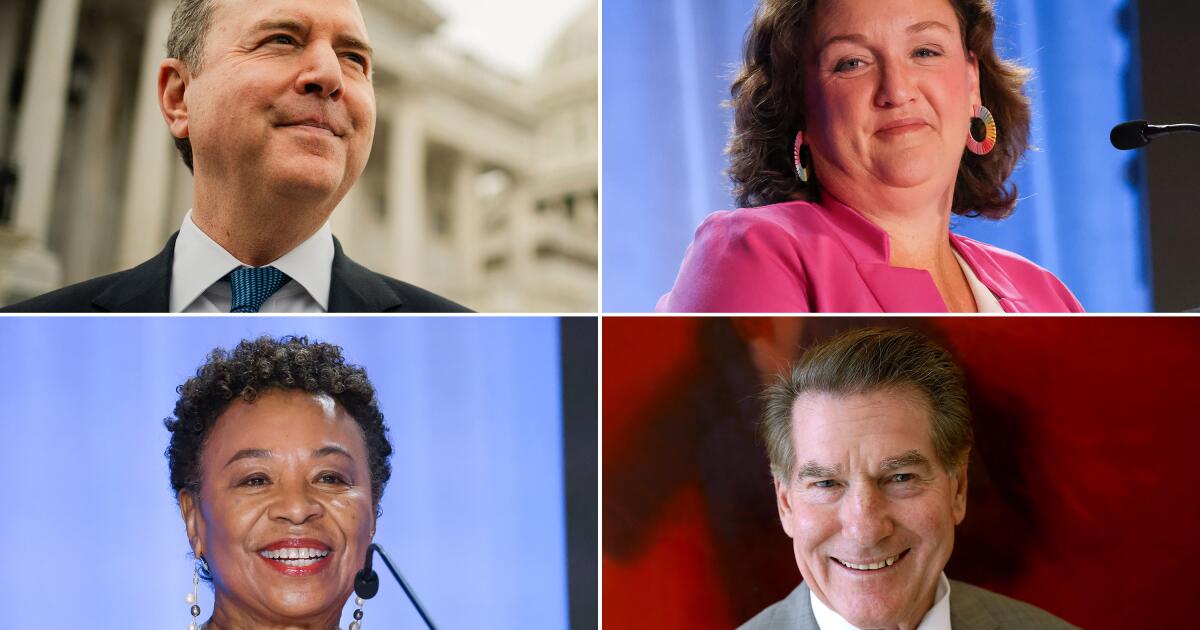

In California’s battle for a rare open seat in the U.S. Senate, former baseball player and Republican candidate Steve Garvey has raised far less money than his Democratic rivals, federal filings show.
Campaign finance reports made public Wednesday by the Federal Election Commission show that Garvey, who played first base for the Los Angeles Dodgers and the San Diego Padres, raised about $610,000 last year from about 4,500 donors and political action committees.
The numbers are the first glimpse into the scale of Garvey’s campaign, which launched in October — much later than his top Democratic rivals in the race.
Garvey brought in less cash than the “substantial funds raised through the Washington D.C. establishment over the course of years by the career politicians in this race,” said campaign spokesman Matt Shupe. But, he said, things seem to be picking up: In January, Garvey’s campaign raised more than in all of 2023.
Fundraising numbers are used as a proxy for a candidate’s viability for statewide office in California, home to some of the most expensive media markets in the nation.
A statewide advertising campaign is vital for any candidate who hopes to win over a sizable number of California’s 22 million registered voters. Airing an effective television advertising campaign can cost millions of dollars per week in the Los Angeles media market alone.
Rep. Adam B. Schiff (D-Burbank) entered 2024 with almost $35 million on hand, more than all his opponents combined, filings show. Between Oct. 1 and Dec. 31, Schiff’s campaign raised almost $5.7 million from individual donors and more than $136,000 from political action committees.
Schiff invested his sizable war chest, adding $371,000 to his fundraising total through interest payments alone, filings show. His campaign said that 95% of contributions were less than $100, with an average donation of $32.
Campaign manager Brad Elkins said Schiff’s fundraising numbers show that Californians “recognize Adam as the champion they need in the U.S. Senate to address the cost of living, defend our democracy, and fight for an economy that works for everyone.”
Rep. Katie Porter (D-Irvine) closed out 2023 with $13.2 million on hand, and raised almost $3 million in the final quarter of the year, about half of Schiff’s total, her filings show. She reported spending $1.7 million from October to December.
Schiff came into the Senate race with a major advantage: Although he and Porter are among the House’s most successful fundraisers, Porter spent $29 million to defend her House seat in Orange County last year, while Schiff cruised to re-election in his Los Angeles and Burbank district. He banked much of the cash he raised and put it toward his Senate campaign.
Rep. Barbara Lee (D-Oakland) raised just over $1 million in the final quarter of the year, her campaign’s filings show. The campaign reported $1 million in contributions from individual donors, and $1.5 million in expenses over the same period. The campaign ended the year with about $816,000 on hand.
Republican attorney Eric Early reported raising more than $115,000 from individual donors from October to December. He contributed $12,100 of his own money, and $137,200 in personal loans, and ended 2023 with about $140,000 on hand.
Christina Pascucci, a Los Angeles TV journalist who is running as a Democrat, reported raising more than $375,000 from October to December, and entered 2024 with $154,000 on hand.
California’s “jungle” primary system means the two candidates who receive the most votes in the March 5 primary will advance to the Nov. 5 general election, regardless of political party.
If the top two vote-getters are both Democrats, the race will likely be competitive — and expensive — through November. That is less likely to be the case if a Republican finishes in the top two, because California’s progressive politics will give a strong edge to their Democratic challenger. No Republican has won a statewide election since 2006.

In California’s battle for a rare open seat in the U.S. Senate, former baseball player and Republican candidate Steve Garvey has raised far less money than his Democratic rivals, federal filings show.
Campaign finance reports made public Wednesday by the Federal Election Commission show that Garvey, who played first base for the Los Angeles Dodgers and the San Diego Padres, raised about $610,000 last year from about 4,500 donors and political action committees.
The numbers are the first glimpse into the scale of Garvey’s campaign, which launched in October — much later than his top Democratic rivals in the race.
Garvey brought in less cash than the “substantial funds raised through the Washington D.C. establishment over the course of years by the career politicians in this race,” said campaign spokesman Matt Shupe. But, he said, things seem to be picking up: In January, Garvey’s campaign raised more than in all of 2023.
Fundraising numbers are used as a proxy for a candidate’s viability for statewide office in California, home to some of the most expensive media markets in the nation.
A statewide advertising campaign is vital for any candidate who hopes to win over a sizable number of California’s 22 million registered voters. Airing an effective television advertising campaign can cost millions of dollars per week in the Los Angeles media market alone.
Rep. Adam B. Schiff (D-Burbank) entered 2024 with almost $35 million on hand, more than all his opponents combined, filings show. Between Oct. 1 and Dec. 31, Schiff’s campaign raised almost $5.7 million from individual donors and more than $136,000 from political action committees.
Schiff invested his sizable war chest, adding $371,000 to his fundraising total through interest payments alone, filings show. His campaign said that 95% of contributions were less than $100, with an average donation of $32.
Campaign manager Brad Elkins said Schiff’s fundraising numbers show that Californians “recognize Adam as the champion they need in the U.S. Senate to address the cost of living, defend our democracy, and fight for an economy that works for everyone.”
Rep. Katie Porter (D-Irvine) closed out 2023 with $13.2 million on hand, and raised almost $3 million in the final quarter of the year, about half of Schiff’s total, her filings show. She reported spending $1.7 million from October to December.
Schiff came into the Senate race with a major advantage: Although he and Porter are among the House’s most successful fundraisers, Porter spent $29 million to defend her House seat in Orange County last year, while Schiff cruised to re-election in his Los Angeles and Burbank district. He banked much of the cash he raised and put it toward his Senate campaign.
Rep. Barbara Lee (D-Oakland) raised just over $1 million in the final quarter of the year, her campaign’s filings show. The campaign reported $1 million in contributions from individual donors, and $1.5 million in expenses over the same period. The campaign ended the year with about $816,000 on hand.
Republican attorney Eric Early reported raising more than $115,000 from individual donors from October to December. He contributed $12,100 of his own money, and $137,200 in personal loans, and ended 2023 with about $140,000 on hand.
Christina Pascucci, a Los Angeles TV journalist who is running as a Democrat, reported raising more than $375,000 from October to December, and entered 2024 with $154,000 on hand.
California’s “jungle” primary system means the two candidates who receive the most votes in the March 5 primary will advance to the Nov. 5 general election, regardless of political party.
If the top two vote-getters are both Democrats, the race will likely be competitive — and expensive — through November. That is less likely to be the case if a Republican finishes in the top two, because California’s progressive politics will give a strong edge to their Democratic challenger. No Republican has won a statewide election since 2006.

In California’s battle for a rare open seat in the U.S. Senate, former baseball player and Republican candidate Steve Garvey has raised far less money than his Democratic rivals, federal filings show.
Campaign finance reports made public Wednesday by the Federal Election Commission show that Garvey, who played first base for the Los Angeles Dodgers and the San Diego Padres, raised about $610,000 last year from about 4,500 donors and political action committees.
The numbers are the first glimpse into the scale of Garvey’s campaign, which launched in October — much later than his top Democratic rivals in the race.
Garvey brought in less cash than the “substantial funds raised through the Washington D.C. establishment over the course of years by the career politicians in this race,” said campaign spokesman Matt Shupe. But, he said, things seem to be picking up: In January, Garvey’s campaign raised more than in all of 2023.
Fundraising numbers are used as a proxy for a candidate’s viability for statewide office in California, home to some of the most expensive media markets in the nation.
A statewide advertising campaign is vital for any candidate who hopes to win over a sizable number of California’s 22 million registered voters. Airing an effective television advertising campaign can cost millions of dollars per week in the Los Angeles media market alone.
Rep. Adam B. Schiff (D-Burbank) entered 2024 with almost $35 million on hand, more than all his opponents combined, filings show. Between Oct. 1 and Dec. 31, Schiff’s campaign raised almost $5.7 million from individual donors and more than $136,000 from political action committees.
Schiff invested his sizable war chest, adding $371,000 to his fundraising total through interest payments alone, filings show. His campaign said that 95% of contributions were less than $100, with an average donation of $32.
Campaign manager Brad Elkins said Schiff’s fundraising numbers show that Californians “recognize Adam as the champion they need in the U.S. Senate to address the cost of living, defend our democracy, and fight for an economy that works for everyone.”
Rep. Katie Porter (D-Irvine) closed out 2023 with $13.2 million on hand, and raised almost $3 million in the final quarter of the year, about half of Schiff’s total, her filings show. She reported spending $1.7 million from October to December.
Schiff came into the Senate race with a major advantage: Although he and Porter are among the House’s most successful fundraisers, Porter spent $29 million to defend her House seat in Orange County last year, while Schiff cruised to re-election in his Los Angeles and Burbank district. He banked much of the cash he raised and put it toward his Senate campaign.
Rep. Barbara Lee (D-Oakland) raised just over $1 million in the final quarter of the year, her campaign’s filings show. The campaign reported $1 million in contributions from individual donors, and $1.5 million in expenses over the same period. The campaign ended the year with about $816,000 on hand.
Republican attorney Eric Early reported raising more than $115,000 from individual donors from October to December. He contributed $12,100 of his own money, and $137,200 in personal loans, and ended 2023 with about $140,000 on hand.
Christina Pascucci, a Los Angeles TV journalist who is running as a Democrat, reported raising more than $375,000 from October to December, and entered 2024 with $154,000 on hand.
California’s “jungle” primary system means the two candidates who receive the most votes in the March 5 primary will advance to the Nov. 5 general election, regardless of political party.
If the top two vote-getters are both Democrats, the race will likely be competitive — and expensive — through November. That is less likely to be the case if a Republican finishes in the top two, because California’s progressive politics will give a strong edge to their Democratic challenger. No Republican has won a statewide election since 2006.
In California’s battle for a rare open seat in the U.S. Senate, former baseball player and Republican candidate Steve Garvey has raised far less money than his Democratic rivals, federal filings show.
Campaign finance reports made public Wednesday by the Federal Election Commission show that Garvey, who played first base for the Los Angeles Dodgers and the San Diego Padres, raised about $610,000 last year from about 4,500 donors and political action committees.
The numbers are the first glimpse into the scale of Garvey’s campaign, which launched in October — much later than his top Democratic rivals in the race.
Garvey brought in less cash than the “substantial funds raised through the Washington D.C. establishment over the course of years by the career politicians in this race,” said campaign spokesman Matt Shupe. But, he said, things seem to be picking up: In January, Garvey’s campaign raised more than in all of 2023.
Fundraising numbers are used as a proxy for a candidate’s viability for statewide office in California, home to some of the most expensive media markets in the nation.
A statewide advertising campaign is vital for any candidate who hopes to win over a sizable number of California’s 22 million registered voters. Airing an effective television advertising campaign can cost millions of dollars per week in the Los Angeles media market alone.
Rep. Adam B. Schiff (D-Burbank) entered 2024 with almost $35 million on hand, more than all his opponents combined, filings show. Between Oct. 1 and Dec. 31, Schiff’s campaign raised almost $5.7 million from individual donors and more than $136,000 from political action committees.
Schiff invested his sizable war chest, adding $371,000 to his fundraising total through interest payments alone, filings show. His campaign said that 95% of contributions were less than $100, with an average donation of $32.
Campaign manager Brad Elkins said Schiff’s fundraising numbers show that Californians “recognize Adam as the champion they need in the U.S. Senate to address the cost of living, defend our democracy, and fight for an economy that works for everyone.”
Rep. Katie Porter (D-Irvine) closed out 2023 with $13.2 million on hand, and raised almost $3 million in the final quarter of the year, about half of Schiff’s total, her filings show. She reported spending $1.7 million from October to December.
Schiff came into the Senate race with a major advantage: Although he and Porter are among the House’s most successful fundraisers, Porter spent $29 million to defend her House seat in Orange County last year, while Schiff cruised to re-election in his Los Angeles and Burbank district. He banked much of the cash he raised and put it toward his Senate campaign.
Rep. Barbara Lee (D-Oakland) raised just over $1 million in the final quarter of the year, her campaign’s filings show. The campaign reported $1 million in contributions from individual donors, and $1.5 million in expenses over the same period. The campaign ended the year with about $816,000 on hand.
Republican attorney Eric Early reported raising more than $115,000 from individual donors from October to December. He contributed $12,100 of his own money, and $137,200 in personal loans, and ended 2023 with about $140,000 on hand.
Christina Pascucci, a Los Angeles TV journalist who is running as a Democrat, reported raising more than $375,000 from October to December, and entered 2024 with $154,000 on hand.
California’s “jungle” primary system means the two candidates who receive the most votes in the March 5 primary will advance to the Nov. 5 general election, regardless of political party.
If the top two vote-getters are both Democrats, the race will likely be competitive — and expensive — through November. That is less likely to be the case if a Republican finishes in the top two, because California’s progressive politics will give a strong edge to their Democratic challenger. No Republican has won a statewide election since 2006.

In California’s battle for a rare open seat in the U.S. Senate, former baseball player and Republican candidate Steve Garvey has raised far less money than his Democratic rivals, federal filings show.
Campaign finance reports made public Wednesday by the Federal Election Commission show that Garvey, who played first base for the Los Angeles Dodgers and the San Diego Padres, raised about $610,000 last year from about 4,500 donors and political action committees.
The numbers are the first glimpse into the scale of Garvey’s campaign, which launched in October — much later than his top Democratic rivals in the race.
Garvey brought in less cash than the “substantial funds raised through the Washington D.C. establishment over the course of years by the career politicians in this race,” said campaign spokesman Matt Shupe. But, he said, things seem to be picking up: In January, Garvey’s campaign raised more than in all of 2023.
Fundraising numbers are used as a proxy for a candidate’s viability for statewide office in California, home to some of the most expensive media markets in the nation.
A statewide advertising campaign is vital for any candidate who hopes to win over a sizable number of California’s 22 million registered voters. Airing an effective television advertising campaign can cost millions of dollars per week in the Los Angeles media market alone.
Rep. Adam B. Schiff (D-Burbank) entered 2024 with almost $35 million on hand, more than all his opponents combined, filings show. Between Oct. 1 and Dec. 31, Schiff’s campaign raised almost $5.7 million from individual donors and more than $136,000 from political action committees.
Schiff invested his sizable war chest, adding $371,000 to his fundraising total through interest payments alone, filings show. His campaign said that 95% of contributions were less than $100, with an average donation of $32.
Campaign manager Brad Elkins said Schiff’s fundraising numbers show that Californians “recognize Adam as the champion they need in the U.S. Senate to address the cost of living, defend our democracy, and fight for an economy that works for everyone.”
Rep. Katie Porter (D-Irvine) closed out 2023 with $13.2 million on hand, and raised almost $3 million in the final quarter of the year, about half of Schiff’s total, her filings show. She reported spending $1.7 million from October to December.
Schiff came into the Senate race with a major advantage: Although he and Porter are among the House’s most successful fundraisers, Porter spent $29 million to defend her House seat in Orange County last year, while Schiff cruised to re-election in his Los Angeles and Burbank district. He banked much of the cash he raised and put it toward his Senate campaign.
Rep. Barbara Lee (D-Oakland) raised just over $1 million in the final quarter of the year, her campaign’s filings show. The campaign reported $1 million in contributions from individual donors, and $1.5 million in expenses over the same period. The campaign ended the year with about $816,000 on hand.
Republican attorney Eric Early reported raising more than $115,000 from individual donors from October to December. He contributed $12,100 of his own money, and $137,200 in personal loans, and ended 2023 with about $140,000 on hand.
Christina Pascucci, a Los Angeles TV journalist who is running as a Democrat, reported raising more than $375,000 from October to December, and entered 2024 with $154,000 on hand.
California’s “jungle” primary system means the two candidates who receive the most votes in the March 5 primary will advance to the Nov. 5 general election, regardless of political party.
If the top two vote-getters are both Democrats, the race will likely be competitive — and expensive — through November. That is less likely to be the case if a Republican finishes in the top two, because California’s progressive politics will give a strong edge to their Democratic challenger. No Republican has won a statewide election since 2006.
In California’s battle for a rare open seat in the U.S. Senate, former baseball player and Republican candidate Steve Garvey has raised far less money than his Democratic rivals, federal filings show.
Campaign finance reports made public Wednesday by the Federal Election Commission show that Garvey, who played first base for the Los Angeles Dodgers and the San Diego Padres, raised about $610,000 last year from about 4,500 donors and political action committees.
The numbers are the first glimpse into the scale of Garvey’s campaign, which launched in October — much later than his top Democratic rivals in the race.
Garvey brought in less cash than the “substantial funds raised through the Washington D.C. establishment over the course of years by the career politicians in this race,” said campaign spokesman Matt Shupe. But, he said, things seem to be picking up: In January, Garvey’s campaign raised more than in all of 2023.
Fundraising numbers are used as a proxy for a candidate’s viability for statewide office in California, home to some of the most expensive media markets in the nation.
A statewide advertising campaign is vital for any candidate who hopes to win over a sizable number of California’s 22 million registered voters. Airing an effective television advertising campaign can cost millions of dollars per week in the Los Angeles media market alone.
Rep. Adam B. Schiff (D-Burbank) entered 2024 with almost $35 million on hand, more than all his opponents combined, filings show. Between Oct. 1 and Dec. 31, Schiff’s campaign raised almost $5.7 million from individual donors and more than $136,000 from political action committees.
Schiff invested his sizable war chest, adding $371,000 to his fundraising total through interest payments alone, filings show. His campaign said that 95% of contributions were less than $100, with an average donation of $32.
Campaign manager Brad Elkins said Schiff’s fundraising numbers show that Californians “recognize Adam as the champion they need in the U.S. Senate to address the cost of living, defend our democracy, and fight for an economy that works for everyone.”
Rep. Katie Porter (D-Irvine) closed out 2023 with $13.2 million on hand, and raised almost $3 million in the final quarter of the year, about half of Schiff’s total, her filings show. She reported spending $1.7 million from October to December.
Schiff came into the Senate race with a major advantage: Although he and Porter are among the House’s most successful fundraisers, Porter spent $29 million to defend her House seat in Orange County last year, while Schiff cruised to re-election in his Los Angeles and Burbank district. He banked much of the cash he raised and put it toward his Senate campaign.
Rep. Barbara Lee (D-Oakland) raised just over $1 million in the final quarter of the year, her campaign’s filings show. The campaign reported $1 million in contributions from individual donors, and $1.5 million in expenses over the same period. The campaign ended the year with about $816,000 on hand.
Republican attorney Eric Early reported raising more than $115,000 from individual donors from October to December. He contributed $12,100 of his own money, and $137,200 in personal loans, and ended 2023 with about $140,000 on hand.
Christina Pascucci, a Los Angeles TV journalist who is running as a Democrat, reported raising more than $375,000 from October to December, and entered 2024 with $154,000 on hand.
California’s “jungle” primary system means the two candidates who receive the most votes in the March 5 primary will advance to the Nov. 5 general election, regardless of political party.
If the top two vote-getters are both Democrats, the race will likely be competitive — and expensive — through November. That is less likely to be the case if a Republican finishes in the top two, because California’s progressive politics will give a strong edge to their Democratic challenger. No Republican has won a statewide election since 2006.
In California’s battle for a rare open seat in the U.S. Senate, former baseball player and Republican candidate Steve Garvey has raised far less money than his Democratic rivals, federal filings show.
Campaign finance reports made public Wednesday by the Federal Election Commission show that Garvey, who played first base for the Los Angeles Dodgers and the San Diego Padres, raised about $610,000 last year from about 4,500 donors and political action committees.
The numbers are the first glimpse into the scale of Garvey’s campaign, which launched in October — much later than his top Democratic rivals in the race.
Garvey brought in less cash than the “substantial funds raised through the Washington D.C. establishment over the course of years by the career politicians in this race,” said campaign spokesman Matt Shupe. But, he said, things seem to be picking up: In January, Garvey’s campaign raised more than in all of 2023.
Fundraising numbers are used as a proxy for a candidate’s viability for statewide office in California, home to some of the most expensive media markets in the nation.
A statewide advertising campaign is vital for any candidate who hopes to win over a sizable number of California’s 22 million registered voters. Airing an effective television advertising campaign can cost millions of dollars per week in the Los Angeles media market alone.
Rep. Adam B. Schiff (D-Burbank) entered 2024 with almost $35 million on hand, more than all his opponents combined, filings show. Between Oct. 1 and Dec. 31, Schiff’s campaign raised almost $5.7 million from individual donors and more than $136,000 from political action committees.
Schiff invested his sizable war chest, adding $371,000 to his fundraising total through interest payments alone, filings show. His campaign said that 95% of contributions were less than $100, with an average donation of $32.
Campaign manager Brad Elkins said Schiff’s fundraising numbers show that Californians “recognize Adam as the champion they need in the U.S. Senate to address the cost of living, defend our democracy, and fight for an economy that works for everyone.”
Rep. Katie Porter (D-Irvine) closed out 2023 with $13.2 million on hand, and raised almost $3 million in the final quarter of the year, about half of Schiff’s total, her filings show. She reported spending $1.7 million from October to December.
Schiff came into the Senate race with a major advantage: Although he and Porter are among the House’s most successful fundraisers, Porter spent $29 million to defend her House seat in Orange County last year, while Schiff cruised to re-election in his Los Angeles and Burbank district. He banked much of the cash he raised and put it toward his Senate campaign.
Rep. Barbara Lee (D-Oakland) raised just over $1 million in the final quarter of the year, her campaign’s filings show. The campaign reported $1 million in contributions from individual donors, and $1.5 million in expenses over the same period. The campaign ended the year with about $816,000 on hand.
Republican attorney Eric Early reported raising more than $115,000 from individual donors from October to December. He contributed $12,100 of his own money, and $137,200 in personal loans, and ended 2023 with about $140,000 on hand.
Christina Pascucci, a Los Angeles TV journalist who is running as a Democrat, reported raising more than $375,000 from October to December, and entered 2024 with $154,000 on hand.
California’s “jungle” primary system means the two candidates who receive the most votes in the March 5 primary will advance to the Nov. 5 general election, regardless of political party.
If the top two vote-getters are both Democrats, the race will likely be competitive — and expensive — through November. That is less likely to be the case if a Republican finishes in the top two, because California’s progressive politics will give a strong edge to their Democratic challenger. No Republican has won a statewide election since 2006.
In California’s battle for a rare open seat in the U.S. Senate, former baseball player and Republican candidate Steve Garvey has raised far less money than his Democratic rivals, federal filings show.
Campaign finance reports made public Wednesday by the Federal Election Commission show that Garvey, who played first base for the Los Angeles Dodgers and the San Diego Padres, raised about $610,000 last year from about 4,500 donors and political action committees.
The numbers are the first glimpse into the scale of Garvey’s campaign, which launched in October — much later than his top Democratic rivals in the race.
Garvey brought in less cash than the “substantial funds raised through the Washington D.C. establishment over the course of years by the career politicians in this race,” said campaign spokesman Matt Shupe. But, he said, things seem to be picking up: In January, Garvey’s campaign raised more than in all of 2023.
Fundraising numbers are used as a proxy for a candidate’s viability for statewide office in California, home to some of the most expensive media markets in the nation.
A statewide advertising campaign is vital for any candidate who hopes to win over a sizable number of California’s 22 million registered voters. Airing an effective television advertising campaign can cost millions of dollars per week in the Los Angeles media market alone.
Rep. Adam B. Schiff (D-Burbank) entered 2024 with almost $35 million on hand, more than all his opponents combined, filings show. Between Oct. 1 and Dec. 31, Schiff’s campaign raised almost $5.7 million from individual donors and more than $136,000 from political action committees.
Schiff invested his sizable war chest, adding $371,000 to his fundraising total through interest payments alone, filings show. His campaign said that 95% of contributions were less than $100, with an average donation of $32.
Campaign manager Brad Elkins said Schiff’s fundraising numbers show that Californians “recognize Adam as the champion they need in the U.S. Senate to address the cost of living, defend our democracy, and fight for an economy that works for everyone.”
Rep. Katie Porter (D-Irvine) closed out 2023 with $13.2 million on hand, and raised almost $3 million in the final quarter of the year, about half of Schiff’s total, her filings show. She reported spending $1.7 million from October to December.
Schiff came into the Senate race with a major advantage: Although he and Porter are among the House’s most successful fundraisers, Porter spent $29 million to defend her House seat in Orange County last year, while Schiff cruised to re-election in his Los Angeles and Burbank district. He banked much of the cash he raised and put it toward his Senate campaign.
Rep. Barbara Lee (D-Oakland) raised just over $1 million in the final quarter of the year, her campaign’s filings show. The campaign reported $1 million in contributions from individual donors, and $1.5 million in expenses over the same period. The campaign ended the year with about $816,000 on hand.
Republican attorney Eric Early reported raising more than $115,000 from individual donors from October to December. He contributed $12,100 of his own money, and $137,200 in personal loans, and ended 2023 with about $140,000 on hand.
Christina Pascucci, a Los Angeles TV journalist who is running as a Democrat, reported raising more than $375,000 from October to December, and entered 2024 with $154,000 on hand.
California’s “jungle” primary system means the two candidates who receive the most votes in the March 5 primary will advance to the Nov. 5 general election, regardless of political party.
If the top two vote-getters are both Democrats, the race will likely be competitive — and expensive — through November. That is less likely to be the case if a Republican finishes in the top two, because California’s progressive politics will give a strong edge to their Democratic challenger. No Republican has won a statewide election since 2006.

