

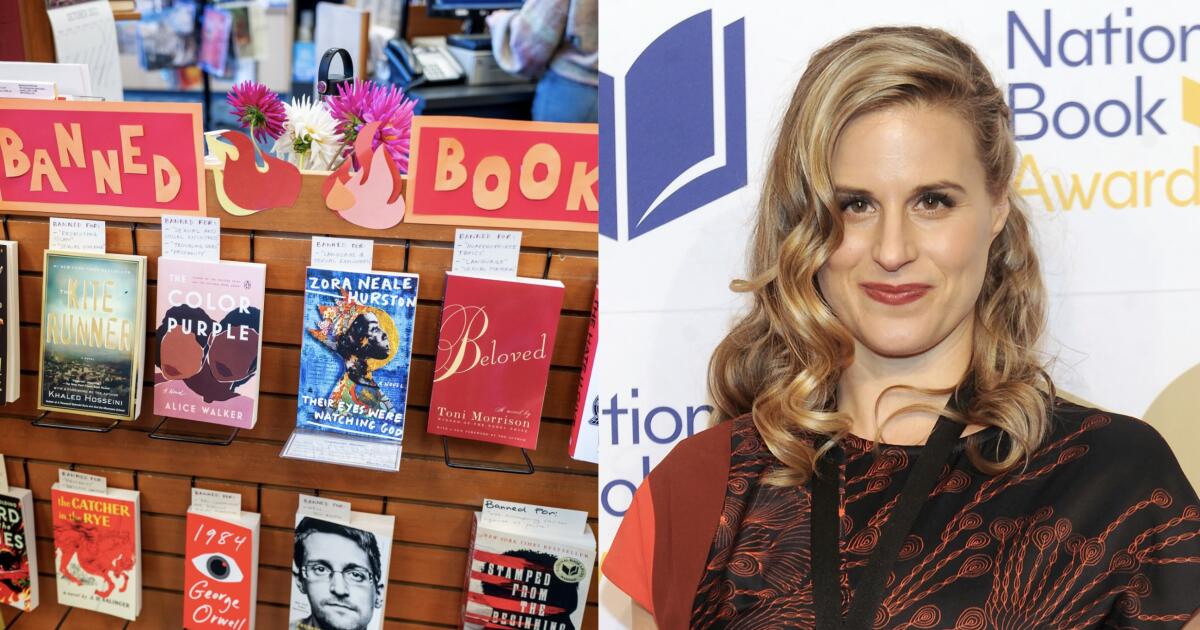

As a new report from PEN America aggregates two years of data on book bans to show how they tar specific authors with a “Scarlet Letter,” Lauren Groff — author of “Florida,” “Matrix” and the recent novel “The Vaster Wilds” — has just announced plans to open a bookstore selling frequently banned books in the epicenter of challenged literature.
PEN America released its latest report on book bans Thursday morning, reflecting on the 5,894 book bans in U.S. public schools documented from July 2021 to June 2023. Their findings illustrated the way copycat bans have become a driving force in the campaign to scrub library shelves. The free-speech advocacy organization also defined what it called the “Scarlet Letter” effect — the stigma attached to authors of challenged books who subsequently found themselves targeted for all their work. As of September 2023, according to PEN, more than 40% of book restrictions occurred in Florida.
Over the 2021-22 and 2022-23 school years, according to PEN, book challenges in public schools impacted 247 school districts across 41 states, affecting millions of students. Many of them have recently taken a stand against restricting their literary pursuits.
“Literature is vital to educate young people,” said Sabrina Baeta, of PEN America’s Freedom to Read program, in a statement accompanying the report. “Without literary works, students are left without context for their own experiences, without empathy for the experiences of others, and without a full understanding of the world we live in and the past. We are continually alarmed to see how the movement to ban books has intensified since 2021 and puts at risk the freedoms to read and learn, all the while threatening core principles of education.”
Although the definition of a “book ban” has been disputed, with some arguing that restricting a book’s library access is not tantamount to a ban, PEN America defines a ban as any action taken against a book based on its content. This applies to literature challenged as a result of parent or community actions, administrative decisions, or in response to direct or threatened action by lawmakers or other governmental officials.
PEN America’s report highlighted the “copycat” bans, using the work of Sarah J. Maas as an example. In the 2021-22 school year, the author’s work was banned 18 times across 10 districts, but in 2022-23, that exploded to 158 bans across 36 districts — a 778% increase. Parent- or community-led advocacy groups, such as Moms for Liberty, Parents’ Rights in Education and Citizens Defending Freedom, campaign for book removal through school board meetings and challenge forms, organizing on social media platforms and empowering individual “serial book challengers” who sometimes question more than 100 books.
The report also found that several authors had experienced a “Scarlet Letter” effect, using Maas again as an example: In the 2021-22 school year, eight of her titles were banned. That doubled to 16 titles in 2022-23. According to PEN America, the works of bestselling authors Ellen Hopkins, Jodi Picoult, Alice Oseman, Laurie Halse Anderson and Rupi Kaur have experienced the “Scarlet Letter” of book-banning campaigns.
Groff, a bestselling author and three-time National Book Award finalist, along with her husband, Clay Kallman, are not among those directly affected — but as Floridians they consider themselves to be on the front lines. Together they plan to open a new bookshop, the Lynx, in downtown Gainesville next spring. The store will sell books for all ages, specifically focusing on titles currently banned in Florida.
“We have such a rich and varied literary history that no one knows about,” Groff told Shelf Awareness on Wednesday, adding that now that Florida’s “authoritarian government has education in a choke hold,” there is a pressing need to promote the work of LGBTQ+ and BIOPIC authors — those disproportionately targeted by book restrictions.
Through the Lynx, Groff and Kallman say they aim to platform the ideas of these authors during an era in which the state is actively working to suppress them.
Groff told the outlet that Florida authors she planned to highlight included Zora Neale Hurston, Edwidge Danticat, Jeff VanderMeer, Karen Russell, Kelly Link, Laura van den Berg and Marjorie Kinnan Rawlings.
Groff and Kallman are searching for a general manager for the Lynx. Groff told Shelf Awareness she expected to do much of the heavy lifting in the shop’s first year but envisioned a future when the store’s booksellers would have a stake in the financial success and could benefit from a profit-sharing model.

As a new report from PEN America aggregates two years of data on book bans to show how they tar specific authors with a “Scarlet Letter,” Lauren Groff — author of “Florida,” “Matrix” and the recent novel “The Vaster Wilds” — has just announced plans to open a bookstore selling frequently banned books in the epicenter of challenged literature.
PEN America released its latest report on book bans Thursday morning, reflecting on the 5,894 book bans in U.S. public schools documented from July 2021 to June 2023. Their findings illustrated the way copycat bans have become a driving force in the campaign to scrub library shelves. The free-speech advocacy organization also defined what it called the “Scarlet Letter” effect — the stigma attached to authors of challenged books who subsequently found themselves targeted for all their work. As of September 2023, according to PEN, more than 40% of book restrictions occurred in Florida.
Over the 2021-22 and 2022-23 school years, according to PEN, book challenges in public schools impacted 247 school districts across 41 states, affecting millions of students. Many of them have recently taken a stand against restricting their literary pursuits.
“Literature is vital to educate young people,” said Sabrina Baeta, of PEN America’s Freedom to Read program, in a statement accompanying the report. “Without literary works, students are left without context for their own experiences, without empathy for the experiences of others, and without a full understanding of the world we live in and the past. We are continually alarmed to see how the movement to ban books has intensified since 2021 and puts at risk the freedoms to read and learn, all the while threatening core principles of education.”
Although the definition of a “book ban” has been disputed, with some arguing that restricting a book’s library access is not tantamount to a ban, PEN America defines a ban as any action taken against a book based on its content. This applies to literature challenged as a result of parent or community actions, administrative decisions, or in response to direct or threatened action by lawmakers or other governmental officials.
PEN America’s report highlighted the “copycat” bans, using the work of Sarah J. Maas as an example. In the 2021-22 school year, the author’s work was banned 18 times across 10 districts, but in 2022-23, that exploded to 158 bans across 36 districts — a 778% increase. Parent- or community-led advocacy groups, such as Moms for Liberty, Parents’ Rights in Education and Citizens Defending Freedom, campaign for book removal through school board meetings and challenge forms, organizing on social media platforms and empowering individual “serial book challengers” who sometimes question more than 100 books.
The report also found that several authors had experienced a “Scarlet Letter” effect, using Maas again as an example: In the 2021-22 school year, eight of her titles were banned. That doubled to 16 titles in 2022-23. According to PEN America, the works of bestselling authors Ellen Hopkins, Jodi Picoult, Alice Oseman, Laurie Halse Anderson and Rupi Kaur have experienced the “Scarlet Letter” of book-banning campaigns.
Groff, a bestselling author and three-time National Book Award finalist, along with her husband, Clay Kallman, are not among those directly affected — but as Floridians they consider themselves to be on the front lines. Together they plan to open a new bookshop, the Lynx, in downtown Gainesville next spring. The store will sell books for all ages, specifically focusing on titles currently banned in Florida.
“We have such a rich and varied literary history that no one knows about,” Groff told Shelf Awareness on Wednesday, adding that now that Florida’s “authoritarian government has education in a choke hold,” there is a pressing need to promote the work of LGBTQ+ and BIOPIC authors — those disproportionately targeted by book restrictions.
Through the Lynx, Groff and Kallman say they aim to platform the ideas of these authors during an era in which the state is actively working to suppress them.
Groff told the outlet that Florida authors she planned to highlight included Zora Neale Hurston, Edwidge Danticat, Jeff VanderMeer, Karen Russell, Kelly Link, Laura van den Berg and Marjorie Kinnan Rawlings.
Groff and Kallman are searching for a general manager for the Lynx. Groff told Shelf Awareness she expected to do much of the heavy lifting in the shop’s first year but envisioned a future when the store’s booksellers would have a stake in the financial success and could benefit from a profit-sharing model.

As a new report from PEN America aggregates two years of data on book bans to show how they tar specific authors with a “Scarlet Letter,” Lauren Groff — author of “Florida,” “Matrix” and the recent novel “The Vaster Wilds” — has just announced plans to open a bookstore selling frequently banned books in the epicenter of challenged literature.
PEN America released its latest report on book bans Thursday morning, reflecting on the 5,894 book bans in U.S. public schools documented from July 2021 to June 2023. Their findings illustrated the way copycat bans have become a driving force in the campaign to scrub library shelves. The free-speech advocacy organization also defined what it called the “Scarlet Letter” effect — the stigma attached to authors of challenged books who subsequently found themselves targeted for all their work. As of September 2023, according to PEN, more than 40% of book restrictions occurred in Florida.
Over the 2021-22 and 2022-23 school years, according to PEN, book challenges in public schools impacted 247 school districts across 41 states, affecting millions of students. Many of them have recently taken a stand against restricting their literary pursuits.
“Literature is vital to educate young people,” said Sabrina Baeta, of PEN America’s Freedom to Read program, in a statement accompanying the report. “Without literary works, students are left without context for their own experiences, without empathy for the experiences of others, and without a full understanding of the world we live in and the past. We are continually alarmed to see how the movement to ban books has intensified since 2021 and puts at risk the freedoms to read and learn, all the while threatening core principles of education.”
Although the definition of a “book ban” has been disputed, with some arguing that restricting a book’s library access is not tantamount to a ban, PEN America defines a ban as any action taken against a book based on its content. This applies to literature challenged as a result of parent or community actions, administrative decisions, or in response to direct or threatened action by lawmakers or other governmental officials.
PEN America’s report highlighted the “copycat” bans, using the work of Sarah J. Maas as an example. In the 2021-22 school year, the author’s work was banned 18 times across 10 districts, but in 2022-23, that exploded to 158 bans across 36 districts — a 778% increase. Parent- or community-led advocacy groups, such as Moms for Liberty, Parents’ Rights in Education and Citizens Defending Freedom, campaign for book removal through school board meetings and challenge forms, organizing on social media platforms and empowering individual “serial book challengers” who sometimes question more than 100 books.
The report also found that several authors had experienced a “Scarlet Letter” effect, using Maas again as an example: In the 2021-22 school year, eight of her titles were banned. That doubled to 16 titles in 2022-23. According to PEN America, the works of bestselling authors Ellen Hopkins, Jodi Picoult, Alice Oseman, Laurie Halse Anderson and Rupi Kaur have experienced the “Scarlet Letter” of book-banning campaigns.
Groff, a bestselling author and three-time National Book Award finalist, along with her husband, Clay Kallman, are not among those directly affected — but as Floridians they consider themselves to be on the front lines. Together they plan to open a new bookshop, the Lynx, in downtown Gainesville next spring. The store will sell books for all ages, specifically focusing on titles currently banned in Florida.
“We have such a rich and varied literary history that no one knows about,” Groff told Shelf Awareness on Wednesday, adding that now that Florida’s “authoritarian government has education in a choke hold,” there is a pressing need to promote the work of LGBTQ+ and BIOPIC authors — those disproportionately targeted by book restrictions.
Through the Lynx, Groff and Kallman say they aim to platform the ideas of these authors during an era in which the state is actively working to suppress them.
Groff told the outlet that Florida authors she planned to highlight included Zora Neale Hurston, Edwidge Danticat, Jeff VanderMeer, Karen Russell, Kelly Link, Laura van den Berg and Marjorie Kinnan Rawlings.
Groff and Kallman are searching for a general manager for the Lynx. Groff told Shelf Awareness she expected to do much of the heavy lifting in the shop’s first year but envisioned a future when the store’s booksellers would have a stake in the financial success and could benefit from a profit-sharing model.
As a new report from PEN America aggregates two years of data on book bans to show how they tar specific authors with a “Scarlet Letter,” Lauren Groff — author of “Florida,” “Matrix” and the recent novel “The Vaster Wilds” — has just announced plans to open a bookstore selling frequently banned books in the epicenter of challenged literature.
PEN America released its latest report on book bans Thursday morning, reflecting on the 5,894 book bans in U.S. public schools documented from July 2021 to June 2023. Their findings illustrated the way copycat bans have become a driving force in the campaign to scrub library shelves. The free-speech advocacy organization also defined what it called the “Scarlet Letter” effect — the stigma attached to authors of challenged books who subsequently found themselves targeted for all their work. As of September 2023, according to PEN, more than 40% of book restrictions occurred in Florida.
Over the 2021-22 and 2022-23 school years, according to PEN, book challenges in public schools impacted 247 school districts across 41 states, affecting millions of students. Many of them have recently taken a stand against restricting their literary pursuits.
“Literature is vital to educate young people,” said Sabrina Baeta, of PEN America’s Freedom to Read program, in a statement accompanying the report. “Without literary works, students are left without context for their own experiences, without empathy for the experiences of others, and without a full understanding of the world we live in and the past. We are continually alarmed to see how the movement to ban books has intensified since 2021 and puts at risk the freedoms to read and learn, all the while threatening core principles of education.”
Although the definition of a “book ban” has been disputed, with some arguing that restricting a book’s library access is not tantamount to a ban, PEN America defines a ban as any action taken against a book based on its content. This applies to literature challenged as a result of parent or community actions, administrative decisions, or in response to direct or threatened action by lawmakers or other governmental officials.
PEN America’s report highlighted the “copycat” bans, using the work of Sarah J. Maas as an example. In the 2021-22 school year, the author’s work was banned 18 times across 10 districts, but in 2022-23, that exploded to 158 bans across 36 districts — a 778% increase. Parent- or community-led advocacy groups, such as Moms for Liberty, Parents’ Rights in Education and Citizens Defending Freedom, campaign for book removal through school board meetings and challenge forms, organizing on social media platforms and empowering individual “serial book challengers” who sometimes question more than 100 books.
The report also found that several authors had experienced a “Scarlet Letter” effect, using Maas again as an example: In the 2021-22 school year, eight of her titles were banned. That doubled to 16 titles in 2022-23. According to PEN America, the works of bestselling authors Ellen Hopkins, Jodi Picoult, Alice Oseman, Laurie Halse Anderson and Rupi Kaur have experienced the “Scarlet Letter” of book-banning campaigns.
Groff, a bestselling author and three-time National Book Award finalist, along with her husband, Clay Kallman, are not among those directly affected — but as Floridians they consider themselves to be on the front lines. Together they plan to open a new bookshop, the Lynx, in downtown Gainesville next spring. The store will sell books for all ages, specifically focusing on titles currently banned in Florida.
“We have such a rich and varied literary history that no one knows about,” Groff told Shelf Awareness on Wednesday, adding that now that Florida’s “authoritarian government has education in a choke hold,” there is a pressing need to promote the work of LGBTQ+ and BIOPIC authors — those disproportionately targeted by book restrictions.
Through the Lynx, Groff and Kallman say they aim to platform the ideas of these authors during an era in which the state is actively working to suppress them.
Groff told the outlet that Florida authors she planned to highlight included Zora Neale Hurston, Edwidge Danticat, Jeff VanderMeer, Karen Russell, Kelly Link, Laura van den Berg and Marjorie Kinnan Rawlings.
Groff and Kallman are searching for a general manager for the Lynx. Groff told Shelf Awareness she expected to do much of the heavy lifting in the shop’s first year but envisioned a future when the store’s booksellers would have a stake in the financial success and could benefit from a profit-sharing model.

As a new report from PEN America aggregates two years of data on book bans to show how they tar specific authors with a “Scarlet Letter,” Lauren Groff — author of “Florida,” “Matrix” and the recent novel “The Vaster Wilds” — has just announced plans to open a bookstore selling frequently banned books in the epicenter of challenged literature.
PEN America released its latest report on book bans Thursday morning, reflecting on the 5,894 book bans in U.S. public schools documented from July 2021 to June 2023. Their findings illustrated the way copycat bans have become a driving force in the campaign to scrub library shelves. The free-speech advocacy organization also defined what it called the “Scarlet Letter” effect — the stigma attached to authors of challenged books who subsequently found themselves targeted for all their work. As of September 2023, according to PEN, more than 40% of book restrictions occurred in Florida.
Over the 2021-22 and 2022-23 school years, according to PEN, book challenges in public schools impacted 247 school districts across 41 states, affecting millions of students. Many of them have recently taken a stand against restricting their literary pursuits.
“Literature is vital to educate young people,” said Sabrina Baeta, of PEN America’s Freedom to Read program, in a statement accompanying the report. “Without literary works, students are left without context for their own experiences, without empathy for the experiences of others, and without a full understanding of the world we live in and the past. We are continually alarmed to see how the movement to ban books has intensified since 2021 and puts at risk the freedoms to read and learn, all the while threatening core principles of education.”
Although the definition of a “book ban” has been disputed, with some arguing that restricting a book’s library access is not tantamount to a ban, PEN America defines a ban as any action taken against a book based on its content. This applies to literature challenged as a result of parent or community actions, administrative decisions, or in response to direct or threatened action by lawmakers or other governmental officials.
PEN America’s report highlighted the “copycat” bans, using the work of Sarah J. Maas as an example. In the 2021-22 school year, the author’s work was banned 18 times across 10 districts, but in 2022-23, that exploded to 158 bans across 36 districts — a 778% increase. Parent- or community-led advocacy groups, such as Moms for Liberty, Parents’ Rights in Education and Citizens Defending Freedom, campaign for book removal through school board meetings and challenge forms, organizing on social media platforms and empowering individual “serial book challengers” who sometimes question more than 100 books.
The report also found that several authors had experienced a “Scarlet Letter” effect, using Maas again as an example: In the 2021-22 school year, eight of her titles were banned. That doubled to 16 titles in 2022-23. According to PEN America, the works of bestselling authors Ellen Hopkins, Jodi Picoult, Alice Oseman, Laurie Halse Anderson and Rupi Kaur have experienced the “Scarlet Letter” of book-banning campaigns.
Groff, a bestselling author and three-time National Book Award finalist, along with her husband, Clay Kallman, are not among those directly affected — but as Floridians they consider themselves to be on the front lines. Together they plan to open a new bookshop, the Lynx, in downtown Gainesville next spring. The store will sell books for all ages, specifically focusing on titles currently banned in Florida.
“We have such a rich and varied literary history that no one knows about,” Groff told Shelf Awareness on Wednesday, adding that now that Florida’s “authoritarian government has education in a choke hold,” there is a pressing need to promote the work of LGBTQ+ and BIOPIC authors — those disproportionately targeted by book restrictions.
Through the Lynx, Groff and Kallman say they aim to platform the ideas of these authors during an era in which the state is actively working to suppress them.
Groff told the outlet that Florida authors she planned to highlight included Zora Neale Hurston, Edwidge Danticat, Jeff VanderMeer, Karen Russell, Kelly Link, Laura van den Berg and Marjorie Kinnan Rawlings.
Groff and Kallman are searching for a general manager for the Lynx. Groff told Shelf Awareness she expected to do much of the heavy lifting in the shop’s first year but envisioned a future when the store’s booksellers would have a stake in the financial success and could benefit from a profit-sharing model.
As a new report from PEN America aggregates two years of data on book bans to show how they tar specific authors with a “Scarlet Letter,” Lauren Groff — author of “Florida,” “Matrix” and the recent novel “The Vaster Wilds” — has just announced plans to open a bookstore selling frequently banned books in the epicenter of challenged literature.
PEN America released its latest report on book bans Thursday morning, reflecting on the 5,894 book bans in U.S. public schools documented from July 2021 to June 2023. Their findings illustrated the way copycat bans have become a driving force in the campaign to scrub library shelves. The free-speech advocacy organization also defined what it called the “Scarlet Letter” effect — the stigma attached to authors of challenged books who subsequently found themselves targeted for all their work. As of September 2023, according to PEN, more than 40% of book restrictions occurred in Florida.
Over the 2021-22 and 2022-23 school years, according to PEN, book challenges in public schools impacted 247 school districts across 41 states, affecting millions of students. Many of them have recently taken a stand against restricting their literary pursuits.
“Literature is vital to educate young people,” said Sabrina Baeta, of PEN America’s Freedom to Read program, in a statement accompanying the report. “Without literary works, students are left without context for their own experiences, without empathy for the experiences of others, and without a full understanding of the world we live in and the past. We are continually alarmed to see how the movement to ban books has intensified since 2021 and puts at risk the freedoms to read and learn, all the while threatening core principles of education.”
Although the definition of a “book ban” has been disputed, with some arguing that restricting a book’s library access is not tantamount to a ban, PEN America defines a ban as any action taken against a book based on its content. This applies to literature challenged as a result of parent or community actions, administrative decisions, or in response to direct or threatened action by lawmakers or other governmental officials.
PEN America’s report highlighted the “copycat” bans, using the work of Sarah J. Maas as an example. In the 2021-22 school year, the author’s work was banned 18 times across 10 districts, but in 2022-23, that exploded to 158 bans across 36 districts — a 778% increase. Parent- or community-led advocacy groups, such as Moms for Liberty, Parents’ Rights in Education and Citizens Defending Freedom, campaign for book removal through school board meetings and challenge forms, organizing on social media platforms and empowering individual “serial book challengers” who sometimes question more than 100 books.
The report also found that several authors had experienced a “Scarlet Letter” effect, using Maas again as an example: In the 2021-22 school year, eight of her titles were banned. That doubled to 16 titles in 2022-23. According to PEN America, the works of bestselling authors Ellen Hopkins, Jodi Picoult, Alice Oseman, Laurie Halse Anderson and Rupi Kaur have experienced the “Scarlet Letter” of book-banning campaigns.
Groff, a bestselling author and three-time National Book Award finalist, along with her husband, Clay Kallman, are not among those directly affected — but as Floridians they consider themselves to be on the front lines. Together they plan to open a new bookshop, the Lynx, in downtown Gainesville next spring. The store will sell books for all ages, specifically focusing on titles currently banned in Florida.
“We have such a rich and varied literary history that no one knows about,” Groff told Shelf Awareness on Wednesday, adding that now that Florida’s “authoritarian government has education in a choke hold,” there is a pressing need to promote the work of LGBTQ+ and BIOPIC authors — those disproportionately targeted by book restrictions.
Through the Lynx, Groff and Kallman say they aim to platform the ideas of these authors during an era in which the state is actively working to suppress them.
Groff told the outlet that Florida authors she planned to highlight included Zora Neale Hurston, Edwidge Danticat, Jeff VanderMeer, Karen Russell, Kelly Link, Laura van den Berg and Marjorie Kinnan Rawlings.
Groff and Kallman are searching for a general manager for the Lynx. Groff told Shelf Awareness she expected to do much of the heavy lifting in the shop’s first year but envisioned a future when the store’s booksellers would have a stake in the financial success and could benefit from a profit-sharing model.
As a new report from PEN America aggregates two years of data on book bans to show how they tar specific authors with a “Scarlet Letter,” Lauren Groff — author of “Florida,” “Matrix” and the recent novel “The Vaster Wilds” — has just announced plans to open a bookstore selling frequently banned books in the epicenter of challenged literature.
PEN America released its latest report on book bans Thursday morning, reflecting on the 5,894 book bans in U.S. public schools documented from July 2021 to June 2023. Their findings illustrated the way copycat bans have become a driving force in the campaign to scrub library shelves. The free-speech advocacy organization also defined what it called the “Scarlet Letter” effect — the stigma attached to authors of challenged books who subsequently found themselves targeted for all their work. As of September 2023, according to PEN, more than 40% of book restrictions occurred in Florida.
Over the 2021-22 and 2022-23 school years, according to PEN, book challenges in public schools impacted 247 school districts across 41 states, affecting millions of students. Many of them have recently taken a stand against restricting their literary pursuits.
“Literature is vital to educate young people,” said Sabrina Baeta, of PEN America’s Freedom to Read program, in a statement accompanying the report. “Without literary works, students are left without context for their own experiences, without empathy for the experiences of others, and without a full understanding of the world we live in and the past. We are continually alarmed to see how the movement to ban books has intensified since 2021 and puts at risk the freedoms to read and learn, all the while threatening core principles of education.”
Although the definition of a “book ban” has been disputed, with some arguing that restricting a book’s library access is not tantamount to a ban, PEN America defines a ban as any action taken against a book based on its content. This applies to literature challenged as a result of parent or community actions, administrative decisions, or in response to direct or threatened action by lawmakers or other governmental officials.
PEN America’s report highlighted the “copycat” bans, using the work of Sarah J. Maas as an example. In the 2021-22 school year, the author’s work was banned 18 times across 10 districts, but in 2022-23, that exploded to 158 bans across 36 districts — a 778% increase. Parent- or community-led advocacy groups, such as Moms for Liberty, Parents’ Rights in Education and Citizens Defending Freedom, campaign for book removal through school board meetings and challenge forms, organizing on social media platforms and empowering individual “serial book challengers” who sometimes question more than 100 books.
The report also found that several authors had experienced a “Scarlet Letter” effect, using Maas again as an example: In the 2021-22 school year, eight of her titles were banned. That doubled to 16 titles in 2022-23. According to PEN America, the works of bestselling authors Ellen Hopkins, Jodi Picoult, Alice Oseman, Laurie Halse Anderson and Rupi Kaur have experienced the “Scarlet Letter” of book-banning campaigns.
Groff, a bestselling author and three-time National Book Award finalist, along with her husband, Clay Kallman, are not among those directly affected — but as Floridians they consider themselves to be on the front lines. Together they plan to open a new bookshop, the Lynx, in downtown Gainesville next spring. The store will sell books for all ages, specifically focusing on titles currently banned in Florida.
“We have such a rich and varied literary history that no one knows about,” Groff told Shelf Awareness on Wednesday, adding that now that Florida’s “authoritarian government has education in a choke hold,” there is a pressing need to promote the work of LGBTQ+ and BIOPIC authors — those disproportionately targeted by book restrictions.
Through the Lynx, Groff and Kallman say they aim to platform the ideas of these authors during an era in which the state is actively working to suppress them.
Groff told the outlet that Florida authors she planned to highlight included Zora Neale Hurston, Edwidge Danticat, Jeff VanderMeer, Karen Russell, Kelly Link, Laura van den Berg and Marjorie Kinnan Rawlings.
Groff and Kallman are searching for a general manager for the Lynx. Groff told Shelf Awareness she expected to do much of the heavy lifting in the shop’s first year but envisioned a future when the store’s booksellers would have a stake in the financial success and could benefit from a profit-sharing model.
As a new report from PEN America aggregates two years of data on book bans to show how they tar specific authors with a “Scarlet Letter,” Lauren Groff — author of “Florida,” “Matrix” and the recent novel “The Vaster Wilds” — has just announced plans to open a bookstore selling frequently banned books in the epicenter of challenged literature.
PEN America released its latest report on book bans Thursday morning, reflecting on the 5,894 book bans in U.S. public schools documented from July 2021 to June 2023. Their findings illustrated the way copycat bans have become a driving force in the campaign to scrub library shelves. The free-speech advocacy organization also defined what it called the “Scarlet Letter” effect — the stigma attached to authors of challenged books who subsequently found themselves targeted for all their work. As of September 2023, according to PEN, more than 40% of book restrictions occurred in Florida.
Over the 2021-22 and 2022-23 school years, according to PEN, book challenges in public schools impacted 247 school districts across 41 states, affecting millions of students. Many of them have recently taken a stand against restricting their literary pursuits.
“Literature is vital to educate young people,” said Sabrina Baeta, of PEN America’s Freedom to Read program, in a statement accompanying the report. “Without literary works, students are left without context for their own experiences, without empathy for the experiences of others, and without a full understanding of the world we live in and the past. We are continually alarmed to see how the movement to ban books has intensified since 2021 and puts at risk the freedoms to read and learn, all the while threatening core principles of education.”
Although the definition of a “book ban” has been disputed, with some arguing that restricting a book’s library access is not tantamount to a ban, PEN America defines a ban as any action taken against a book based on its content. This applies to literature challenged as a result of parent or community actions, administrative decisions, or in response to direct or threatened action by lawmakers or other governmental officials.
PEN America’s report highlighted the “copycat” bans, using the work of Sarah J. Maas as an example. In the 2021-22 school year, the author’s work was banned 18 times across 10 districts, but in 2022-23, that exploded to 158 bans across 36 districts — a 778% increase. Parent- or community-led advocacy groups, such as Moms for Liberty, Parents’ Rights in Education and Citizens Defending Freedom, campaign for book removal through school board meetings and challenge forms, organizing on social media platforms and empowering individual “serial book challengers” who sometimes question more than 100 books.
The report also found that several authors had experienced a “Scarlet Letter” effect, using Maas again as an example: In the 2021-22 school year, eight of her titles were banned. That doubled to 16 titles in 2022-23. According to PEN America, the works of bestselling authors Ellen Hopkins, Jodi Picoult, Alice Oseman, Laurie Halse Anderson and Rupi Kaur have experienced the “Scarlet Letter” of book-banning campaigns.
Groff, a bestselling author and three-time National Book Award finalist, along with her husband, Clay Kallman, are not among those directly affected — but as Floridians they consider themselves to be on the front lines. Together they plan to open a new bookshop, the Lynx, in downtown Gainesville next spring. The store will sell books for all ages, specifically focusing on titles currently banned in Florida.
“We have such a rich and varied literary history that no one knows about,” Groff told Shelf Awareness on Wednesday, adding that now that Florida’s “authoritarian government has education in a choke hold,” there is a pressing need to promote the work of LGBTQ+ and BIOPIC authors — those disproportionately targeted by book restrictions.
Through the Lynx, Groff and Kallman say they aim to platform the ideas of these authors during an era in which the state is actively working to suppress them.
Groff told the outlet that Florida authors she planned to highlight included Zora Neale Hurston, Edwidge Danticat, Jeff VanderMeer, Karen Russell, Kelly Link, Laura van den Berg and Marjorie Kinnan Rawlings.
Groff and Kallman are searching for a general manager for the Lynx. Groff told Shelf Awareness she expected to do much of the heavy lifting in the shop’s first year but envisioned a future when the store’s booksellers would have a stake in the financial success and could benefit from a profit-sharing model.

