

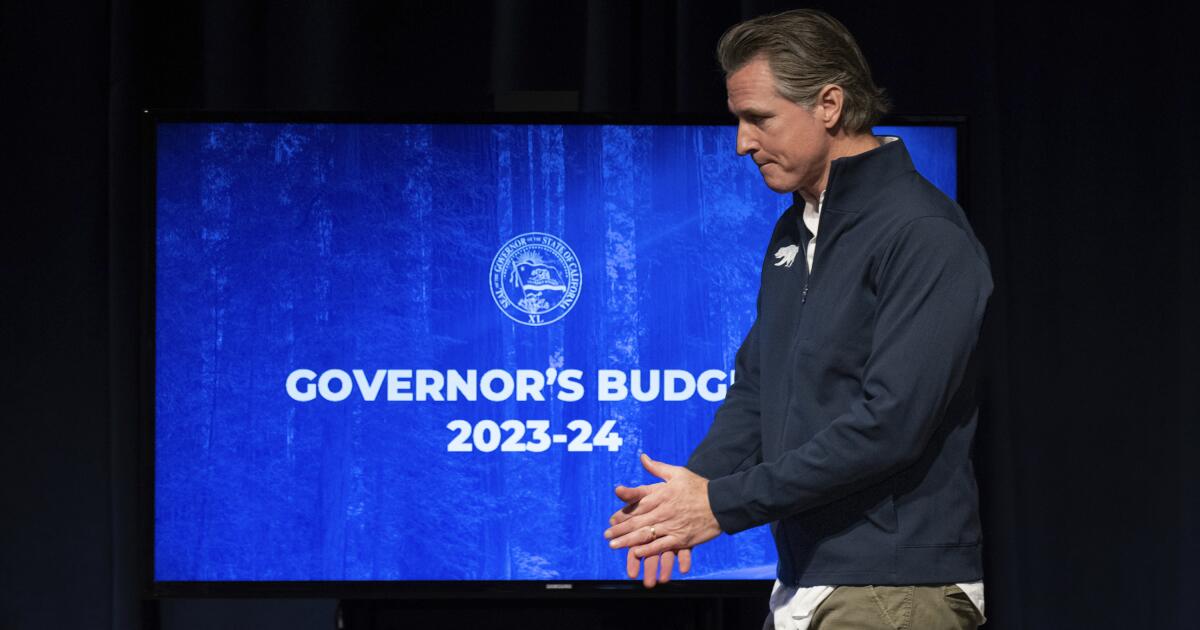
With California facing an expected $68-billion budget deficit through the next fiscal year, Gov. Gavin Newsom is seeking “major reforms” to pull funding from a costly plan next year to begin raising the statewide minimum wage for healthcare workers to $25 an hour.
Newsom told The Times last week that his staff has “been working behind the scenes” with Democratic leaders in the Legislature on how to move forward with the minimum wage law in light of state budget concerns. The changes, which would have to be approved by state lawmakers next year, were “all part of an understanding” with labor leaders before he signed the bill, Newsom said.
“We knew exactly where we are on the finances. We were very upfront with these guys. I said ‘no way in hell,’ and we worked on something, and that will reveal itself in a matter of weeks,” Newsom said last week, recalling conversations leading up to passage of the bill.
It’s unclear if Newsom is suggesting he would like to narrow the higher minimum wage to fewer workers, or if he’s seeking to delay or pause implementation of the increase.
Newsom discussed the healthcare wage a week before a report was released Thursday by the Legislative Analyst’s Office, a nonpartisan government body that assesses policy for the state Legislature The report estimates that the state could experience a $68-billion budget deficit through fiscal year 2024-25. The state budget is enacted on an annual fiscal calendar that begins July 1 and ends June 30.
The gloomy financial picture was revealed later than usual this year because of the extensions of federal and state deadlines to file 2022 income tax returns from April to November, which forced lawmakers and the governor to enact the current state budget in July without a clear understanding of state tax revenues.
With tax collections now in hand, the LAO reported a severe decline in revenues and estimates that California had a $26-billion shortfall in the fiscal year that ended June 30, with similar deficits expected this year and next. Analysts anticipate an additional shortfall of $30 billion per year from 2025-26 through 2027-28, for a potential deficit of $155 billion over a six-year period.
Gabriel Petek, chief deputy legislative analyst with the LAO, said the report lays out a “serious budget problem.”
California’s progressive tax structure already makes the state budget disproportionately dependent on its wealthiest residents, including tax windfalls created when companies seek investors through initial public offerings and the ups and downs of the stock market.
The LAO said some of the decline in revenues is an expected fall-off from abnormally strong revenue growth in prior years when federal COVID-19 stimulus funding artificially boosted income tax revenues, resulting in a record state surplus.
Analysts also blamed the Federal Reserve for raising interest rates, some of the effects of which “have an outsized importance to California,” the report stated. Investments in California startups and the tech industry dropped significantly, with 80% fewer companies going public in 2022 and 2023 compared to 2021, for example.
California entered an economic downturn in 2022, with the number of unemployed workers rising nearly 200,000 since the summer of last year, according to the LAO report.
The LAO said conditions exist for Newsom to declare a fiscal emergency to dip into budget reserves to cover some of the shortfall. Analysts laid out other maneuvers that could be used to reduce the deficit, including saving $16.7 billion by reducing education funding under Proposition 98 to the constitutional minimum.
“Both the governor and the Legislature face a significant challenge with the 2024 budget,” said H.D. Palmer, a spokesperson for the California Department of Finance, in a statement. “The Administration will present its plan to close the budget gap when the Governor sends his proposal to the Legislature next month.”
After cutting more than $30 billion from the state budget this summer, Newsom and lawmakers anticipated additional revenue declines. Newsom, in particular, tried to exercise caution and vetoed dozens of bills this fall that he said would have cost the state nearly $19 billion in unaccounted-for costs, including $11 billion in ongoing spending.
Senate Bill 525, the healthcare minimum wage law, was among the last bills to receive the governor’s signature and, according to recently released Department of Finance estimates, the most expensive.
Under the law, workers at large healthcare facilities will earn $23 an hour starting in June 2024, $24 an hour in 2025 and $25 in 2026. That applies to all staff, including launderers and hospital gift shop workers.
Employees at independent rural hospitals and facilities that serve high rates of Medicare and Medi-Cal patients will see a minimum wage of $18 an hour next year, which will gradually increase to $25 an hour in 2033.
The bill saw significant amendments in the final hours of the legislative session, a reflection of contentious dealmaking between lobbyists for hospitals and unions. The late agreement gave the Legislature and the Newsom administration little time to conduct a detailed financial analysis before final votes were taken.
The California Department of Finance said publicly in November, after Newsom signed the legislation, that the wage hike for healthcare workers would cost $4 billion in 2024-25, the first full fiscal year after implementation begins.
The law does not currently include any mechanism that allows the state to delay wage hikes during economic downturns.
The Finance Department said that half of the money to pay for the wage increase would come directly from the state’s general fund, while the other half would be paid for by federal funds designated for providers of Medi-Cal, California’s Medicaid program.
Laurel Lucia, director of the healthcare program at the UC Berkeley Labor Center, said a yet-to-be-published estimate by the university suggests the cost is closer to $300 million from the general fund in the first year — lower than the state’s prediction. The labor center developed the estimate based on the final law to help inform policymakers, she said.
Newsom said he was “resolved” that he couldn’t sign the bill into law without promises from key players that changes would be made in the legislative session that begins in January.
Tia Orr, executive director of Service Employees International Union California, said the financial health of the state is consistent with raising wages for 500,000 healthcare workers, nearly half of whom are on some form of public assistance.
Orr said SEIU California committed to working with the administration and the Legislature “to ensure safeguards are in place to guarantee that this critical measure is taken in a way that preserves California’s fiscal health, just as we did when negotiating the last statewide minimum wage increase.”
Unions agreed to work with the governor’s office to develop a methodology for implementation if California falls into a recession, though that criteria has not been determined, Orr said.
Newsom said once the January budget is unveiled, “tradeoffs” will be considered, foretelling “a serious conversation about what the risks are or the rewards are.”
Newsom is expected to unveil his budget plan for the upcoming fiscal year on Jan. 10.

With California facing an expected $68-billion budget deficit through the next fiscal year, Gov. Gavin Newsom is seeking “major reforms” to pull funding from a costly plan next year to begin raising the statewide minimum wage for healthcare workers to $25 an hour.
Newsom told The Times last week that his staff has “been working behind the scenes” with Democratic leaders in the Legislature on how to move forward with the minimum wage law in light of state budget concerns. The changes, which would have to be approved by state lawmakers next year, were “all part of an understanding” with labor leaders before he signed the bill, Newsom said.
“We knew exactly where we are on the finances. We were very upfront with these guys. I said ‘no way in hell,’ and we worked on something, and that will reveal itself in a matter of weeks,” Newsom said last week, recalling conversations leading up to passage of the bill.
It’s unclear if Newsom is suggesting he would like to narrow the higher minimum wage to fewer workers, or if he’s seeking to delay or pause implementation of the increase.
Newsom discussed the healthcare wage a week before a report was released Thursday by the Legislative Analyst’s Office, a nonpartisan government body that assesses policy for the state Legislature The report estimates that the state could experience a $68-billion budget deficit through fiscal year 2024-25. The state budget is enacted on an annual fiscal calendar that begins July 1 and ends June 30.
The gloomy financial picture was revealed later than usual this year because of the extensions of federal and state deadlines to file 2022 income tax returns from April to November, which forced lawmakers and the governor to enact the current state budget in July without a clear understanding of state tax revenues.
With tax collections now in hand, the LAO reported a severe decline in revenues and estimates that California had a $26-billion shortfall in the fiscal year that ended June 30, with similar deficits expected this year and next. Analysts anticipate an additional shortfall of $30 billion per year from 2025-26 through 2027-28, for a potential deficit of $155 billion over a six-year period.
Gabriel Petek, chief deputy legislative analyst with the LAO, said the report lays out a “serious budget problem.”
California’s progressive tax structure already makes the state budget disproportionately dependent on its wealthiest residents, including tax windfalls created when companies seek investors through initial public offerings and the ups and downs of the stock market.
The LAO said some of the decline in revenues is an expected fall-off from abnormally strong revenue growth in prior years when federal COVID-19 stimulus funding artificially boosted income tax revenues, resulting in a record state surplus.
Analysts also blamed the Federal Reserve for raising interest rates, some of the effects of which “have an outsized importance to California,” the report stated. Investments in California startups and the tech industry dropped significantly, with 80% fewer companies going public in 2022 and 2023 compared to 2021, for example.
California entered an economic downturn in 2022, with the number of unemployed workers rising nearly 200,000 since the summer of last year, according to the LAO report.
The LAO said conditions exist for Newsom to declare a fiscal emergency to dip into budget reserves to cover some of the shortfall. Analysts laid out other maneuvers that could be used to reduce the deficit, including saving $16.7 billion by reducing education funding under Proposition 98 to the constitutional minimum.
“Both the governor and the Legislature face a significant challenge with the 2024 budget,” said H.D. Palmer, a spokesperson for the California Department of Finance, in a statement. “The Administration will present its plan to close the budget gap when the Governor sends his proposal to the Legislature next month.”
After cutting more than $30 billion from the state budget this summer, Newsom and lawmakers anticipated additional revenue declines. Newsom, in particular, tried to exercise caution and vetoed dozens of bills this fall that he said would have cost the state nearly $19 billion in unaccounted-for costs, including $11 billion in ongoing spending.
Senate Bill 525, the healthcare minimum wage law, was among the last bills to receive the governor’s signature and, according to recently released Department of Finance estimates, the most expensive.
Under the law, workers at large healthcare facilities will earn $23 an hour starting in June 2024, $24 an hour in 2025 and $25 in 2026. That applies to all staff, including launderers and hospital gift shop workers.
Employees at independent rural hospitals and facilities that serve high rates of Medicare and Medi-Cal patients will see a minimum wage of $18 an hour next year, which will gradually increase to $25 an hour in 2033.
The bill saw significant amendments in the final hours of the legislative session, a reflection of contentious dealmaking between lobbyists for hospitals and unions. The late agreement gave the Legislature and the Newsom administration little time to conduct a detailed financial analysis before final votes were taken.
The California Department of Finance said publicly in November, after Newsom signed the legislation, that the wage hike for healthcare workers would cost $4 billion in 2024-25, the first full fiscal year after implementation begins.
The law does not currently include any mechanism that allows the state to delay wage hikes during economic downturns.
The Finance Department said that half of the money to pay for the wage increase would come directly from the state’s general fund, while the other half would be paid for by federal funds designated for providers of Medi-Cal, California’s Medicaid program.
Laurel Lucia, director of the healthcare program at the UC Berkeley Labor Center, said a yet-to-be-published estimate by the university suggests the cost is closer to $300 million from the general fund in the first year — lower than the state’s prediction. The labor center developed the estimate based on the final law to help inform policymakers, she said.
Newsom said he was “resolved” that he couldn’t sign the bill into law without promises from key players that changes would be made in the legislative session that begins in January.
Tia Orr, executive director of Service Employees International Union California, said the financial health of the state is consistent with raising wages for 500,000 healthcare workers, nearly half of whom are on some form of public assistance.
Orr said SEIU California committed to working with the administration and the Legislature “to ensure safeguards are in place to guarantee that this critical measure is taken in a way that preserves California’s fiscal health, just as we did when negotiating the last statewide minimum wage increase.”
Unions agreed to work with the governor’s office to develop a methodology for implementation if California falls into a recession, though that criteria has not been determined, Orr said.
Newsom said once the January budget is unveiled, “tradeoffs” will be considered, foretelling “a serious conversation about what the risks are or the rewards are.”
Newsom is expected to unveil his budget plan for the upcoming fiscal year on Jan. 10.

With California facing an expected $68-billion budget deficit through the next fiscal year, Gov. Gavin Newsom is seeking “major reforms” to pull funding from a costly plan next year to begin raising the statewide minimum wage for healthcare workers to $25 an hour.
Newsom told The Times last week that his staff has “been working behind the scenes” with Democratic leaders in the Legislature on how to move forward with the minimum wage law in light of state budget concerns. The changes, which would have to be approved by state lawmakers next year, were “all part of an understanding” with labor leaders before he signed the bill, Newsom said.
“We knew exactly where we are on the finances. We were very upfront with these guys. I said ‘no way in hell,’ and we worked on something, and that will reveal itself in a matter of weeks,” Newsom said last week, recalling conversations leading up to passage of the bill.
It’s unclear if Newsom is suggesting he would like to narrow the higher minimum wage to fewer workers, or if he’s seeking to delay or pause implementation of the increase.
Newsom discussed the healthcare wage a week before a report was released Thursday by the Legislative Analyst’s Office, a nonpartisan government body that assesses policy for the state Legislature The report estimates that the state could experience a $68-billion budget deficit through fiscal year 2024-25. The state budget is enacted on an annual fiscal calendar that begins July 1 and ends June 30.
The gloomy financial picture was revealed later than usual this year because of the extensions of federal and state deadlines to file 2022 income tax returns from April to November, which forced lawmakers and the governor to enact the current state budget in July without a clear understanding of state tax revenues.
With tax collections now in hand, the LAO reported a severe decline in revenues and estimates that California had a $26-billion shortfall in the fiscal year that ended June 30, with similar deficits expected this year and next. Analysts anticipate an additional shortfall of $30 billion per year from 2025-26 through 2027-28, for a potential deficit of $155 billion over a six-year period.
Gabriel Petek, chief deputy legislative analyst with the LAO, said the report lays out a “serious budget problem.”
California’s progressive tax structure already makes the state budget disproportionately dependent on its wealthiest residents, including tax windfalls created when companies seek investors through initial public offerings and the ups and downs of the stock market.
The LAO said some of the decline in revenues is an expected fall-off from abnormally strong revenue growth in prior years when federal COVID-19 stimulus funding artificially boosted income tax revenues, resulting in a record state surplus.
Analysts also blamed the Federal Reserve for raising interest rates, some of the effects of which “have an outsized importance to California,” the report stated. Investments in California startups and the tech industry dropped significantly, with 80% fewer companies going public in 2022 and 2023 compared to 2021, for example.
California entered an economic downturn in 2022, with the number of unemployed workers rising nearly 200,000 since the summer of last year, according to the LAO report.
The LAO said conditions exist for Newsom to declare a fiscal emergency to dip into budget reserves to cover some of the shortfall. Analysts laid out other maneuvers that could be used to reduce the deficit, including saving $16.7 billion by reducing education funding under Proposition 98 to the constitutional minimum.
“Both the governor and the Legislature face a significant challenge with the 2024 budget,” said H.D. Palmer, a spokesperson for the California Department of Finance, in a statement. “The Administration will present its plan to close the budget gap when the Governor sends his proposal to the Legislature next month.”
After cutting more than $30 billion from the state budget this summer, Newsom and lawmakers anticipated additional revenue declines. Newsom, in particular, tried to exercise caution and vetoed dozens of bills this fall that he said would have cost the state nearly $19 billion in unaccounted-for costs, including $11 billion in ongoing spending.
Senate Bill 525, the healthcare minimum wage law, was among the last bills to receive the governor’s signature and, according to recently released Department of Finance estimates, the most expensive.
Under the law, workers at large healthcare facilities will earn $23 an hour starting in June 2024, $24 an hour in 2025 and $25 in 2026. That applies to all staff, including launderers and hospital gift shop workers.
Employees at independent rural hospitals and facilities that serve high rates of Medicare and Medi-Cal patients will see a minimum wage of $18 an hour next year, which will gradually increase to $25 an hour in 2033.
The bill saw significant amendments in the final hours of the legislative session, a reflection of contentious dealmaking between lobbyists for hospitals and unions. The late agreement gave the Legislature and the Newsom administration little time to conduct a detailed financial analysis before final votes were taken.
The California Department of Finance said publicly in November, after Newsom signed the legislation, that the wage hike for healthcare workers would cost $4 billion in 2024-25, the first full fiscal year after implementation begins.
The law does not currently include any mechanism that allows the state to delay wage hikes during economic downturns.
The Finance Department said that half of the money to pay for the wage increase would come directly from the state’s general fund, while the other half would be paid for by federal funds designated for providers of Medi-Cal, California’s Medicaid program.
Laurel Lucia, director of the healthcare program at the UC Berkeley Labor Center, said a yet-to-be-published estimate by the university suggests the cost is closer to $300 million from the general fund in the first year — lower than the state’s prediction. The labor center developed the estimate based on the final law to help inform policymakers, she said.
Newsom said he was “resolved” that he couldn’t sign the bill into law without promises from key players that changes would be made in the legislative session that begins in January.
Tia Orr, executive director of Service Employees International Union California, said the financial health of the state is consistent with raising wages for 500,000 healthcare workers, nearly half of whom are on some form of public assistance.
Orr said SEIU California committed to working with the administration and the Legislature “to ensure safeguards are in place to guarantee that this critical measure is taken in a way that preserves California’s fiscal health, just as we did when negotiating the last statewide minimum wage increase.”
Unions agreed to work with the governor’s office to develop a methodology for implementation if California falls into a recession, though that criteria has not been determined, Orr said.
Newsom said once the January budget is unveiled, “tradeoffs” will be considered, foretelling “a serious conversation about what the risks are or the rewards are.”
Newsom is expected to unveil his budget plan for the upcoming fiscal year on Jan. 10.

With California facing an expected $68-billion budget deficit through the next fiscal year, Gov. Gavin Newsom is seeking “major reforms” to pull funding from a costly plan next year to begin raising the statewide minimum wage for healthcare workers to $25 an hour.
Newsom told The Times last week that his staff has “been working behind the scenes” with Democratic leaders in the Legislature on how to move forward with the minimum wage law in light of state budget concerns. The changes, which would have to be approved by state lawmakers next year, were “all part of an understanding” with labor leaders before he signed the bill, Newsom said.
“We knew exactly where we are on the finances. We were very upfront with these guys. I said ‘no way in hell,’ and we worked on something, and that will reveal itself in a matter of weeks,” Newsom said last week, recalling conversations leading up to passage of the bill.
It’s unclear if Newsom is suggesting he would like to narrow the higher minimum wage to fewer workers, or if he’s seeking to delay or pause implementation of the increase.
Newsom discussed the healthcare wage a week before a report was released Thursday by the Legislative Analyst’s Office, a nonpartisan government body that assesses policy for the state Legislature The report estimates that the state could experience a $68-billion budget deficit through fiscal year 2024-25. The state budget is enacted on an annual fiscal calendar that begins July 1 and ends June 30.
The gloomy financial picture was revealed later than usual this year because of the extensions of federal and state deadlines to file 2022 income tax returns from April to November, which forced lawmakers and the governor to enact the current state budget in July without a clear understanding of state tax revenues.
With tax collections now in hand, the LAO reported a severe decline in revenues and estimates that California had a $26-billion shortfall in the fiscal year that ended June 30, with similar deficits expected this year and next. Analysts anticipate an additional shortfall of $30 billion per year from 2025-26 through 2027-28, for a potential deficit of $155 billion over a six-year period.
Gabriel Petek, chief deputy legislative analyst with the LAO, said the report lays out a “serious budget problem.”
California’s progressive tax structure already makes the state budget disproportionately dependent on its wealthiest residents, including tax windfalls created when companies seek investors through initial public offerings and the ups and downs of the stock market.
The LAO said some of the decline in revenues is an expected fall-off from abnormally strong revenue growth in prior years when federal COVID-19 stimulus funding artificially boosted income tax revenues, resulting in a record state surplus.
Analysts also blamed the Federal Reserve for raising interest rates, some of the effects of which “have an outsized importance to California,” the report stated. Investments in California startups and the tech industry dropped significantly, with 80% fewer companies going public in 2022 and 2023 compared to 2021, for example.
California entered an economic downturn in 2022, with the number of unemployed workers rising nearly 200,000 since the summer of last year, according to the LAO report.
The LAO said conditions exist for Newsom to declare a fiscal emergency to dip into budget reserves to cover some of the shortfall. Analysts laid out other maneuvers that could be used to reduce the deficit, including saving $16.7 billion by reducing education funding under Proposition 98 to the constitutional minimum.
“Both the governor and the Legislature face a significant challenge with the 2024 budget,” said H.D. Palmer, a spokesperson for the California Department of Finance, in a statement. “The Administration will present its plan to close the budget gap when the Governor sends his proposal to the Legislature next month.”
After cutting more than $30 billion from the state budget this summer, Newsom and lawmakers anticipated additional revenue declines. Newsom, in particular, tried to exercise caution and vetoed dozens of bills this fall that he said would have cost the state nearly $19 billion in unaccounted-for costs, including $11 billion in ongoing spending.
Senate Bill 525, the healthcare minimum wage law, was among the last bills to receive the governor’s signature and, according to recently released Department of Finance estimates, the most expensive.
Under the law, workers at large healthcare facilities will earn $23 an hour starting in June 2024, $24 an hour in 2025 and $25 in 2026. That applies to all staff, including launderers and hospital gift shop workers.
Employees at independent rural hospitals and facilities that serve high rates of Medicare and Medi-Cal patients will see a minimum wage of $18 an hour next year, which will gradually increase to $25 an hour in 2033.
The bill saw significant amendments in the final hours of the legislative session, a reflection of contentious dealmaking between lobbyists for hospitals and unions. The late agreement gave the Legislature and the Newsom administration little time to conduct a detailed financial analysis before final votes were taken.
The California Department of Finance said publicly in November, after Newsom signed the legislation, that the wage hike for healthcare workers would cost $4 billion in 2024-25, the first full fiscal year after implementation begins.
The law does not currently include any mechanism that allows the state to delay wage hikes during economic downturns.
The Finance Department said that half of the money to pay for the wage increase would come directly from the state’s general fund, while the other half would be paid for by federal funds designated for providers of Medi-Cal, California’s Medicaid program.
Laurel Lucia, director of the healthcare program at the UC Berkeley Labor Center, said a yet-to-be-published estimate by the university suggests the cost is closer to $300 million from the general fund in the first year — lower than the state’s prediction. The labor center developed the estimate based on the final law to help inform policymakers, she said.
Newsom said he was “resolved” that he couldn’t sign the bill into law without promises from key players that changes would be made in the legislative session that begins in January.
Tia Orr, executive director of Service Employees International Union California, said the financial health of the state is consistent with raising wages for 500,000 healthcare workers, nearly half of whom are on some form of public assistance.
Orr said SEIU California committed to working with the administration and the Legislature “to ensure safeguards are in place to guarantee that this critical measure is taken in a way that preserves California’s fiscal health, just as we did when negotiating the last statewide minimum wage increase.”
Unions agreed to work with the governor’s office to develop a methodology for implementation if California falls into a recession, though that criteria has not been determined, Orr said.
Newsom said once the January budget is unveiled, “tradeoffs” will be considered, foretelling “a serious conversation about what the risks are or the rewards are.”
Newsom is expected to unveil his budget plan for the upcoming fiscal year on Jan. 10.

With California facing an expected $68-billion budget deficit through the next fiscal year, Gov. Gavin Newsom is seeking “major reforms” to pull funding from a costly plan next year to begin raising the statewide minimum wage for healthcare workers to $25 an hour.
Newsom told The Times last week that his staff has “been working behind the scenes” with Democratic leaders in the Legislature on how to move forward with the minimum wage law in light of state budget concerns. The changes, which would have to be approved by state lawmakers next year, were “all part of an understanding” with labor leaders before he signed the bill, Newsom said.
“We knew exactly where we are on the finances. We were very upfront with these guys. I said ‘no way in hell,’ and we worked on something, and that will reveal itself in a matter of weeks,” Newsom said last week, recalling conversations leading up to passage of the bill.
It’s unclear if Newsom is suggesting he would like to narrow the higher minimum wage to fewer workers, or if he’s seeking to delay or pause implementation of the increase.
Newsom discussed the healthcare wage a week before a report was released Thursday by the Legislative Analyst’s Office, a nonpartisan government body that assesses policy for the state Legislature The report estimates that the state could experience a $68-billion budget deficit through fiscal year 2024-25. The state budget is enacted on an annual fiscal calendar that begins July 1 and ends June 30.
The gloomy financial picture was revealed later than usual this year because of the extensions of federal and state deadlines to file 2022 income tax returns from April to November, which forced lawmakers and the governor to enact the current state budget in July without a clear understanding of state tax revenues.
With tax collections now in hand, the LAO reported a severe decline in revenues and estimates that California had a $26-billion shortfall in the fiscal year that ended June 30, with similar deficits expected this year and next. Analysts anticipate an additional shortfall of $30 billion per year from 2025-26 through 2027-28, for a potential deficit of $155 billion over a six-year period.
Gabriel Petek, chief deputy legislative analyst with the LAO, said the report lays out a “serious budget problem.”
California’s progressive tax structure already makes the state budget disproportionately dependent on its wealthiest residents, including tax windfalls created when companies seek investors through initial public offerings and the ups and downs of the stock market.
The LAO said some of the decline in revenues is an expected fall-off from abnormally strong revenue growth in prior years when federal COVID-19 stimulus funding artificially boosted income tax revenues, resulting in a record state surplus.
Analysts also blamed the Federal Reserve for raising interest rates, some of the effects of which “have an outsized importance to California,” the report stated. Investments in California startups and the tech industry dropped significantly, with 80% fewer companies going public in 2022 and 2023 compared to 2021, for example.
California entered an economic downturn in 2022, with the number of unemployed workers rising nearly 200,000 since the summer of last year, according to the LAO report.
The LAO said conditions exist for Newsom to declare a fiscal emergency to dip into budget reserves to cover some of the shortfall. Analysts laid out other maneuvers that could be used to reduce the deficit, including saving $16.7 billion by reducing education funding under Proposition 98 to the constitutional minimum.
“Both the governor and the Legislature face a significant challenge with the 2024 budget,” said H.D. Palmer, a spokesperson for the California Department of Finance, in a statement. “The Administration will present its plan to close the budget gap when the Governor sends his proposal to the Legislature next month.”
After cutting more than $30 billion from the state budget this summer, Newsom and lawmakers anticipated additional revenue declines. Newsom, in particular, tried to exercise caution and vetoed dozens of bills this fall that he said would have cost the state nearly $19 billion in unaccounted-for costs, including $11 billion in ongoing spending.
Senate Bill 525, the healthcare minimum wage law, was among the last bills to receive the governor’s signature and, according to recently released Department of Finance estimates, the most expensive.
Under the law, workers at large healthcare facilities will earn $23 an hour starting in June 2024, $24 an hour in 2025 and $25 in 2026. That applies to all staff, including launderers and hospital gift shop workers.
Employees at independent rural hospitals and facilities that serve high rates of Medicare and Medi-Cal patients will see a minimum wage of $18 an hour next year, which will gradually increase to $25 an hour in 2033.
The bill saw significant amendments in the final hours of the legislative session, a reflection of contentious dealmaking between lobbyists for hospitals and unions. The late agreement gave the Legislature and the Newsom administration little time to conduct a detailed financial analysis before final votes were taken.
The California Department of Finance said publicly in November, after Newsom signed the legislation, that the wage hike for healthcare workers would cost $4 billion in 2024-25, the first full fiscal year after implementation begins.
The law does not currently include any mechanism that allows the state to delay wage hikes during economic downturns.
The Finance Department said that half of the money to pay for the wage increase would come directly from the state’s general fund, while the other half would be paid for by federal funds designated for providers of Medi-Cal, California’s Medicaid program.
Laurel Lucia, director of the healthcare program at the UC Berkeley Labor Center, said a yet-to-be-published estimate by the university suggests the cost is closer to $300 million from the general fund in the first year — lower than the state’s prediction. The labor center developed the estimate based on the final law to help inform policymakers, she said.
Newsom said he was “resolved” that he couldn’t sign the bill into law without promises from key players that changes would be made in the legislative session that begins in January.
Tia Orr, executive director of Service Employees International Union California, said the financial health of the state is consistent with raising wages for 500,000 healthcare workers, nearly half of whom are on some form of public assistance.
Orr said SEIU California committed to working with the administration and the Legislature “to ensure safeguards are in place to guarantee that this critical measure is taken in a way that preserves California’s fiscal health, just as we did when negotiating the last statewide minimum wage increase.”
Unions agreed to work with the governor’s office to develop a methodology for implementation if California falls into a recession, though that criteria has not been determined, Orr said.
Newsom said once the January budget is unveiled, “tradeoffs” will be considered, foretelling “a serious conversation about what the risks are or the rewards are.”
Newsom is expected to unveil his budget plan for the upcoming fiscal year on Jan. 10.