


Up to their elbows in suds and thick foam, families tidy up and decorate graves at cemeteries everywhere in Mexico as they prepare to celebrate Día de Muertos. I can hear the swooshing and the scrubbing of the crypts as they get ready to honor their departed ones.
The celebration has its origins in Indigenous cultures dating back thousands of years and is derived from the rituals of pre-Hispanic people in Mexico. In Aztec culture, death was transitory, and the souls of the dead could return to visit the living.
My abuelo Beto is on my altar every year. Altars are structures for Día de Muertos that honor ancestors and departed loved ones, with offerings of photographs, food, beverages, flowers and other symbolic objects that represent their most treasured memories. They are said to invite the spirits of the dead back into the world of the living, welcoming them with an ofrenda.
Tropical fruits like guava, papaya and guanábana filled my abuelo’s patio. My offering to him is a reflection of the things he loved: the cold tortillas, the membrillo paste, the queso fresco, the bright red jamaica (hibiscus flowers) and tropical fruits.
This year, I’ll have a big pot of mole de guayaba for his ofrenda, inspired by his bustling garden in his paradise.
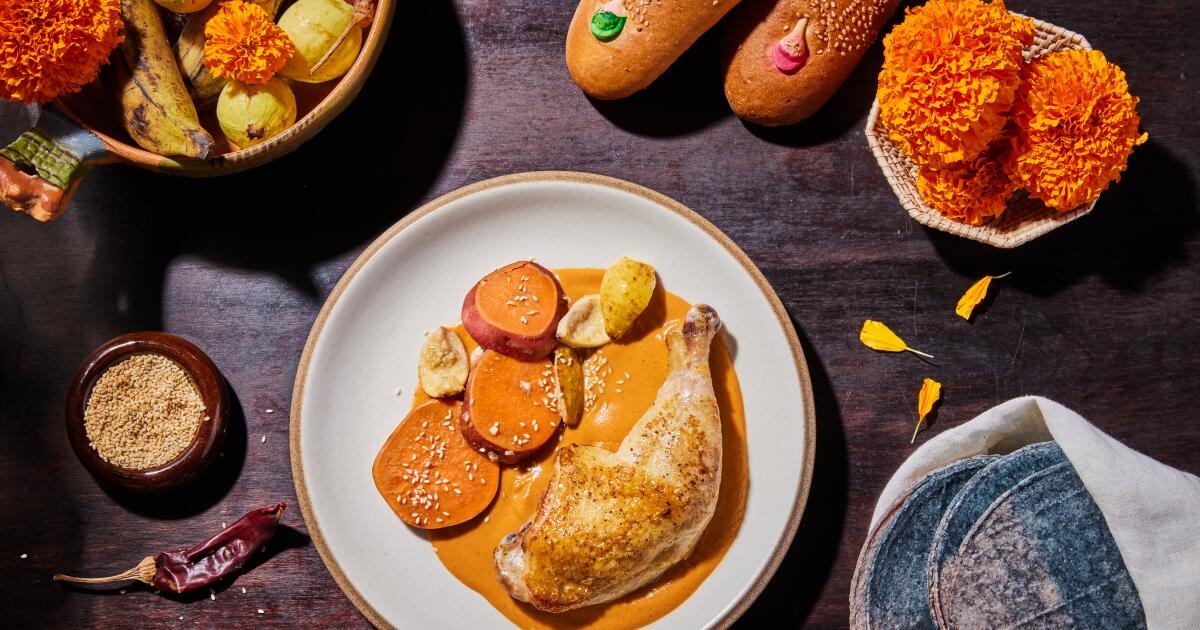
A light, fragrant, vibrant sauce, mole de guayaba is made with fruity guajillo chiles, blistered tomato, poached guavas, oregano, cinnamon, crushed cloves, onions and garlic, sesame seeds and plantain.
(Andrea D’Agosto / For The Times; Styling by Jennifer Sacks / For The Times)
Mole, from Náhuatl mōlli, means sauce. The term is used interchangeably for mole negro, rojo, amarillo and manchamanteles, to name a few of the famous Oaxacan styles. There is pipián, a mole verde common in Zacatecas and Jalisco, bursting with brightness because it is made with tomatillos and thickened with ground pepitas. Or the more casual mole de olla, a mole for everyday meals made with dried chiles and chock-full of vegetables like green beans, corn, squash, xoconostle (sour prickly pear) and chunks of tender beef. You eat it like a stew.
Mole de frutas are regional moles that use seasonal fruits as the main flavor profile. They are lighter and fragrant. The mole de guayaba that I make for my ofrenda starts with fruity guajillo chiles that are toasted and then rehydrated. The jammy guajillos are combined with blistered tomato, onions and garlic. The mixture is thickened with sesame seeds and perfumed with poached guavas, oregano, cinnamon and crushed cloves. Overripe plantain is added to create the silkiest of textures, when you pour it, the mole looks like melted ice cream.
It is said that the scent of marigolds, often called cempasúchil or flor de muerto (flowers of the dead), is believed to attract souls to the altar. They represent the sun and act as a guide for the souls of the dead to return home.
I hope that the scent of this mole de guayaba guides my abuelo home to Mexico. But not before making a stop in El Norte to visit me, so I can finally tell him that his death taught me how to live.

Up to their elbows in suds and thick foam, families tidy up and decorate graves at cemeteries everywhere in Mexico as they prepare to celebrate Día de Muertos. I can hear the swooshing and the scrubbing of the crypts as they get ready to honor their departed ones.
The celebration has its origins in Indigenous cultures dating back thousands of years and is derived from the rituals of pre-Hispanic people in Mexico. In Aztec culture, death was transitory, and the souls of the dead could return to visit the living.
My abuelo Beto is on my altar every year. Altars are structures for Día de Muertos that honor ancestors and departed loved ones, with offerings of photographs, food, beverages, flowers and other symbolic objects that represent their most treasured memories. They are said to invite the spirits of the dead back into the world of the living, welcoming them with an ofrenda.
Tropical fruits like guava, papaya and guanábana filled my abuelo’s patio. My offering to him is a reflection of the things he loved: the cold tortillas, the membrillo paste, the queso fresco, the bright red jamaica (hibiscus flowers) and tropical fruits.
This year, I’ll have a big pot of mole de guayaba for his ofrenda, inspired by his bustling garden in his paradise.
A light, fragrant, vibrant sauce, mole de guayaba is made with fruity guajillo chiles, blistered tomato, poached guavas, oregano, cinnamon, crushed cloves, onions and garlic, sesame seeds and plantain.
(Andrea D’Agosto / For The Times; Styling by Jennifer Sacks / For The Times)
Mole, from Náhuatl mōlli, means sauce. The term is used interchangeably for mole negro, rojo, amarillo and manchamanteles, to name a few of the famous Oaxacan styles. There is pipián, a mole verde common in Zacatecas and Jalisco, bursting with brightness because it is made with tomatillos and thickened with ground pepitas. Or the more casual mole de olla, a mole for everyday meals made with dried chiles and chock-full of vegetables like green beans, corn, squash, xoconostle (sour prickly pear) and chunks of tender beef. You eat it like a stew.
Mole de frutas are regional moles that use seasonal fruits as the main flavor profile. They are lighter and fragrant. The mole de guayaba that I make for my ofrenda starts with fruity guajillo chiles that are toasted and then rehydrated. The jammy guajillos are combined with blistered tomato, onions and garlic. The mixture is thickened with sesame seeds and perfumed with poached guavas, oregano, cinnamon and crushed cloves. Overripe plantain is added to create the silkiest of textures, when you pour it, the mole looks like melted ice cream.
It is said that the scent of marigolds, often called cempasúchil or flor de muerto (flowers of the dead), is believed to attract souls to the altar. They represent the sun and act as a guide for the souls of the dead to return home.
I hope that the scent of this mole de guayaba guides my abuelo home to Mexico. But not before making a stop in El Norte to visit me, so I can finally tell him that his death taught me how to live.

Up to their elbows in suds and thick foam, families tidy up and decorate graves at cemeteries everywhere in Mexico as they prepare to celebrate Día de Muertos. I can hear the swooshing and the scrubbing of the crypts as they get ready to honor their departed ones.
The celebration has its origins in Indigenous cultures dating back thousands of years and is derived from the rituals of pre-Hispanic people in Mexico. In Aztec culture, death was transitory, and the souls of the dead could return to visit the living.
My abuelo Beto is on my altar every year. Altars are structures for Día de Muertos that honor ancestors and departed loved ones, with offerings of photographs, food, beverages, flowers and other symbolic objects that represent their most treasured memories. They are said to invite the spirits of the dead back into the world of the living, welcoming them with an ofrenda.
Tropical fruits like guava, papaya and guanábana filled my abuelo’s patio. My offering to him is a reflection of the things he loved: the cold tortillas, the membrillo paste, the queso fresco, the bright red jamaica (hibiscus flowers) and tropical fruits.
This year, I’ll have a big pot of mole de guayaba for his ofrenda, inspired by his bustling garden in his paradise.
A light, fragrant, vibrant sauce, mole de guayaba is made with fruity guajillo chiles, blistered tomato, poached guavas, oregano, cinnamon, crushed cloves, onions and garlic, sesame seeds and plantain.
(Andrea D’Agosto / For The Times; Styling by Jennifer Sacks / For The Times)
Mole, from Náhuatl mōlli, means sauce. The term is used interchangeably for mole negro, rojo, amarillo and manchamanteles, to name a few of the famous Oaxacan styles. There is pipián, a mole verde common in Zacatecas and Jalisco, bursting with brightness because it is made with tomatillos and thickened with ground pepitas. Or the more casual mole de olla, a mole for everyday meals made with dried chiles and chock-full of vegetables like green beans, corn, squash, xoconostle (sour prickly pear) and chunks of tender beef. You eat it like a stew.
Mole de frutas are regional moles that use seasonal fruits as the main flavor profile. They are lighter and fragrant. The mole de guayaba that I make for my ofrenda starts with fruity guajillo chiles that are toasted and then rehydrated. The jammy guajillos are combined with blistered tomato, onions and garlic. The mixture is thickened with sesame seeds and perfumed with poached guavas, oregano, cinnamon and crushed cloves. Overripe plantain is added to create the silkiest of textures, when you pour it, the mole looks like melted ice cream.
It is said that the scent of marigolds, often called cempasúchil or flor de muerto (flowers of the dead), is believed to attract souls to the altar. They represent the sun and act as a guide for the souls of the dead to return home.
I hope that the scent of this mole de guayaba guides my abuelo home to Mexico. But not before making a stop in El Norte to visit me, so I can finally tell him that his death taught me how to live.
Up to their elbows in suds and thick foam, families tidy up and decorate graves at cemeteries everywhere in Mexico as they prepare to celebrate Día de Muertos. I can hear the swooshing and the scrubbing of the crypts as they get ready to honor their departed ones.
The celebration has its origins in Indigenous cultures dating back thousands of years and is derived from the rituals of pre-Hispanic people in Mexico. In Aztec culture, death was transitory, and the souls of the dead could return to visit the living.
My abuelo Beto is on my altar every year. Altars are structures for Día de Muertos that honor ancestors and departed loved ones, with offerings of photographs, food, beverages, flowers and other symbolic objects that represent their most treasured memories. They are said to invite the spirits of the dead back into the world of the living, welcoming them with an ofrenda.
Tropical fruits like guava, papaya and guanábana filled my abuelo’s patio. My offering to him is a reflection of the things he loved: the cold tortillas, the membrillo paste, the queso fresco, the bright red jamaica (hibiscus flowers) and tropical fruits.
This year, I’ll have a big pot of mole de guayaba for his ofrenda, inspired by his bustling garden in his paradise.
A light, fragrant, vibrant sauce, mole de guayaba is made with fruity guajillo chiles, blistered tomato, poached guavas, oregano, cinnamon, crushed cloves, onions and garlic, sesame seeds and plantain.
(Andrea D’Agosto / For The Times; Styling by Jennifer Sacks / For The Times)
Mole, from Náhuatl mōlli, means sauce. The term is used interchangeably for mole negro, rojo, amarillo and manchamanteles, to name a few of the famous Oaxacan styles. There is pipián, a mole verde common in Zacatecas and Jalisco, bursting with brightness because it is made with tomatillos and thickened with ground pepitas. Or the more casual mole de olla, a mole for everyday meals made with dried chiles and chock-full of vegetables like green beans, corn, squash, xoconostle (sour prickly pear) and chunks of tender beef. You eat it like a stew.
Mole de frutas are regional moles that use seasonal fruits as the main flavor profile. They are lighter and fragrant. The mole de guayaba that I make for my ofrenda starts with fruity guajillo chiles that are toasted and then rehydrated. The jammy guajillos are combined with blistered tomato, onions and garlic. The mixture is thickened with sesame seeds and perfumed with poached guavas, oregano, cinnamon and crushed cloves. Overripe plantain is added to create the silkiest of textures, when you pour it, the mole looks like melted ice cream.
It is said that the scent of marigolds, often called cempasúchil or flor de muerto (flowers of the dead), is believed to attract souls to the altar. They represent the sun and act as a guide for the souls of the dead to return home.
I hope that the scent of this mole de guayaba guides my abuelo home to Mexico. But not before making a stop in El Norte to visit me, so I can finally tell him that his death taught me how to live.

Up to their elbows in suds and thick foam, families tidy up and decorate graves at cemeteries everywhere in Mexico as they prepare to celebrate Día de Muertos. I can hear the swooshing and the scrubbing of the crypts as they get ready to honor their departed ones.
The celebration has its origins in Indigenous cultures dating back thousands of years and is derived from the rituals of pre-Hispanic people in Mexico. In Aztec culture, death was transitory, and the souls of the dead could return to visit the living.
My abuelo Beto is on my altar every year. Altars are structures for Día de Muertos that honor ancestors and departed loved ones, with offerings of photographs, food, beverages, flowers and other symbolic objects that represent their most treasured memories. They are said to invite the spirits of the dead back into the world of the living, welcoming them with an ofrenda.
Tropical fruits like guava, papaya and guanábana filled my abuelo’s patio. My offering to him is a reflection of the things he loved: the cold tortillas, the membrillo paste, the queso fresco, the bright red jamaica (hibiscus flowers) and tropical fruits.
This year, I’ll have a big pot of mole de guayaba for his ofrenda, inspired by his bustling garden in his paradise.
A light, fragrant, vibrant sauce, mole de guayaba is made with fruity guajillo chiles, blistered tomato, poached guavas, oregano, cinnamon, crushed cloves, onions and garlic, sesame seeds and plantain.
(Andrea D’Agosto / For The Times; Styling by Jennifer Sacks / For The Times)
Mole, from Náhuatl mōlli, means sauce. The term is used interchangeably for mole negro, rojo, amarillo and manchamanteles, to name a few of the famous Oaxacan styles. There is pipián, a mole verde common in Zacatecas and Jalisco, bursting with brightness because it is made with tomatillos and thickened with ground pepitas. Or the more casual mole de olla, a mole for everyday meals made with dried chiles and chock-full of vegetables like green beans, corn, squash, xoconostle (sour prickly pear) and chunks of tender beef. You eat it like a stew.
Mole de frutas are regional moles that use seasonal fruits as the main flavor profile. They are lighter and fragrant. The mole de guayaba that I make for my ofrenda starts with fruity guajillo chiles that are toasted and then rehydrated. The jammy guajillos are combined with blistered tomato, onions and garlic. The mixture is thickened with sesame seeds and perfumed with poached guavas, oregano, cinnamon and crushed cloves. Overripe plantain is added to create the silkiest of textures, when you pour it, the mole looks like melted ice cream.
It is said that the scent of marigolds, often called cempasúchil or flor de muerto (flowers of the dead), is believed to attract souls to the altar. They represent the sun and act as a guide for the souls of the dead to return home.
I hope that the scent of this mole de guayaba guides my abuelo home to Mexico. But not before making a stop in El Norte to visit me, so I can finally tell him that his death taught me how to live.
Up to their elbows in suds and thick foam, families tidy up and decorate graves at cemeteries everywhere in Mexico as they prepare to celebrate Día de Muertos. I can hear the swooshing and the scrubbing of the crypts as they get ready to honor their departed ones.
The celebration has its origins in Indigenous cultures dating back thousands of years and is derived from the rituals of pre-Hispanic people in Mexico. In Aztec culture, death was transitory, and the souls of the dead could return to visit the living.
My abuelo Beto is on my altar every year. Altars are structures for Día de Muertos that honor ancestors and departed loved ones, with offerings of photographs, food, beverages, flowers and other symbolic objects that represent their most treasured memories. They are said to invite the spirits of the dead back into the world of the living, welcoming them with an ofrenda.
Tropical fruits like guava, papaya and guanábana filled my abuelo’s patio. My offering to him is a reflection of the things he loved: the cold tortillas, the membrillo paste, the queso fresco, the bright red jamaica (hibiscus flowers) and tropical fruits.
This year, I’ll have a big pot of mole de guayaba for his ofrenda, inspired by his bustling garden in his paradise.
A light, fragrant, vibrant sauce, mole de guayaba is made with fruity guajillo chiles, blistered tomato, poached guavas, oregano, cinnamon, crushed cloves, onions and garlic, sesame seeds and plantain.
(Andrea D’Agosto / For The Times; Styling by Jennifer Sacks / For The Times)
Mole, from Náhuatl mōlli, means sauce. The term is used interchangeably for mole negro, rojo, amarillo and manchamanteles, to name a few of the famous Oaxacan styles. There is pipián, a mole verde common in Zacatecas and Jalisco, bursting with brightness because it is made with tomatillos and thickened with ground pepitas. Or the more casual mole de olla, a mole for everyday meals made with dried chiles and chock-full of vegetables like green beans, corn, squash, xoconostle (sour prickly pear) and chunks of tender beef. You eat it like a stew.
Mole de frutas are regional moles that use seasonal fruits as the main flavor profile. They are lighter and fragrant. The mole de guayaba that I make for my ofrenda starts with fruity guajillo chiles that are toasted and then rehydrated. The jammy guajillos are combined with blistered tomato, onions and garlic. The mixture is thickened with sesame seeds and perfumed with poached guavas, oregano, cinnamon and crushed cloves. Overripe plantain is added to create the silkiest of textures, when you pour it, the mole looks like melted ice cream.
It is said that the scent of marigolds, often called cempasúchil or flor de muerto (flowers of the dead), is believed to attract souls to the altar. They represent the sun and act as a guide for the souls of the dead to return home.
I hope that the scent of this mole de guayaba guides my abuelo home to Mexico. But not before making a stop in El Norte to visit me, so I can finally tell him that his death taught me how to live.
Up to their elbows in suds and thick foam, families tidy up and decorate graves at cemeteries everywhere in Mexico as they prepare to celebrate Día de Muertos. I can hear the swooshing and the scrubbing of the crypts as they get ready to honor their departed ones.
The celebration has its origins in Indigenous cultures dating back thousands of years and is derived from the rituals of pre-Hispanic people in Mexico. In Aztec culture, death was transitory, and the souls of the dead could return to visit the living.
My abuelo Beto is on my altar every year. Altars are structures for Día de Muertos that honor ancestors and departed loved ones, with offerings of photographs, food, beverages, flowers and other symbolic objects that represent their most treasured memories. They are said to invite the spirits of the dead back into the world of the living, welcoming them with an ofrenda.
Tropical fruits like guava, papaya and guanábana filled my abuelo’s patio. My offering to him is a reflection of the things he loved: the cold tortillas, the membrillo paste, the queso fresco, the bright red jamaica (hibiscus flowers) and tropical fruits.
This year, I’ll have a big pot of mole de guayaba for his ofrenda, inspired by his bustling garden in his paradise.
A light, fragrant, vibrant sauce, mole de guayaba is made with fruity guajillo chiles, blistered tomato, poached guavas, oregano, cinnamon, crushed cloves, onions and garlic, sesame seeds and plantain.
(Andrea D’Agosto / For The Times; Styling by Jennifer Sacks / For The Times)
Mole, from Náhuatl mōlli, means sauce. The term is used interchangeably for mole negro, rojo, amarillo and manchamanteles, to name a few of the famous Oaxacan styles. There is pipián, a mole verde common in Zacatecas and Jalisco, bursting with brightness because it is made with tomatillos and thickened with ground pepitas. Or the more casual mole de olla, a mole for everyday meals made with dried chiles and chock-full of vegetables like green beans, corn, squash, xoconostle (sour prickly pear) and chunks of tender beef. You eat it like a stew.
Mole de frutas are regional moles that use seasonal fruits as the main flavor profile. They are lighter and fragrant. The mole de guayaba that I make for my ofrenda starts with fruity guajillo chiles that are toasted and then rehydrated. The jammy guajillos are combined with blistered tomato, onions and garlic. The mixture is thickened with sesame seeds and perfumed with poached guavas, oregano, cinnamon and crushed cloves. Overripe plantain is added to create the silkiest of textures, when you pour it, the mole looks like melted ice cream.
It is said that the scent of marigolds, often called cempasúchil or flor de muerto (flowers of the dead), is believed to attract souls to the altar. They represent the sun and act as a guide for the souls of the dead to return home.
I hope that the scent of this mole de guayaba guides my abuelo home to Mexico. But not before making a stop in El Norte to visit me, so I can finally tell him that his death taught me how to live.
Up to their elbows in suds and thick foam, families tidy up and decorate graves at cemeteries everywhere in Mexico as they prepare to celebrate Día de Muertos. I can hear the swooshing and the scrubbing of the crypts as they get ready to honor their departed ones.
The celebration has its origins in Indigenous cultures dating back thousands of years and is derived from the rituals of pre-Hispanic people in Mexico. In Aztec culture, death was transitory, and the souls of the dead could return to visit the living.
My abuelo Beto is on my altar every year. Altars are structures for Día de Muertos that honor ancestors and departed loved ones, with offerings of photographs, food, beverages, flowers and other symbolic objects that represent their most treasured memories. They are said to invite the spirits of the dead back into the world of the living, welcoming them with an ofrenda.
Tropical fruits like guava, papaya and guanábana filled my abuelo’s patio. My offering to him is a reflection of the things he loved: the cold tortillas, the membrillo paste, the queso fresco, the bright red jamaica (hibiscus flowers) and tropical fruits.
This year, I’ll have a big pot of mole de guayaba for his ofrenda, inspired by his bustling garden in his paradise.
A light, fragrant, vibrant sauce, mole de guayaba is made with fruity guajillo chiles, blistered tomato, poached guavas, oregano, cinnamon, crushed cloves, onions and garlic, sesame seeds and plantain.
(Andrea D’Agosto / For The Times; Styling by Jennifer Sacks / For The Times)
Mole, from Náhuatl mōlli, means sauce. The term is used interchangeably for mole negro, rojo, amarillo and manchamanteles, to name a few of the famous Oaxacan styles. There is pipián, a mole verde common in Zacatecas and Jalisco, bursting with brightness because it is made with tomatillos and thickened with ground pepitas. Or the more casual mole de olla, a mole for everyday meals made with dried chiles and chock-full of vegetables like green beans, corn, squash, xoconostle (sour prickly pear) and chunks of tender beef. You eat it like a stew.
Mole de frutas are regional moles that use seasonal fruits as the main flavor profile. They are lighter and fragrant. The mole de guayaba that I make for my ofrenda starts with fruity guajillo chiles that are toasted and then rehydrated. The jammy guajillos are combined with blistered tomato, onions and garlic. The mixture is thickened with sesame seeds and perfumed with poached guavas, oregano, cinnamon and crushed cloves. Overripe plantain is added to create the silkiest of textures, when you pour it, the mole looks like melted ice cream.
It is said that the scent of marigolds, often called cempasúchil or flor de muerto (flowers of the dead), is believed to attract souls to the altar. They represent the sun and act as a guide for the souls of the dead to return home.
I hope that the scent of this mole de guayaba guides my abuelo home to Mexico. But not before making a stop in El Norte to visit me, so I can finally tell him that his death taught me how to live.

