

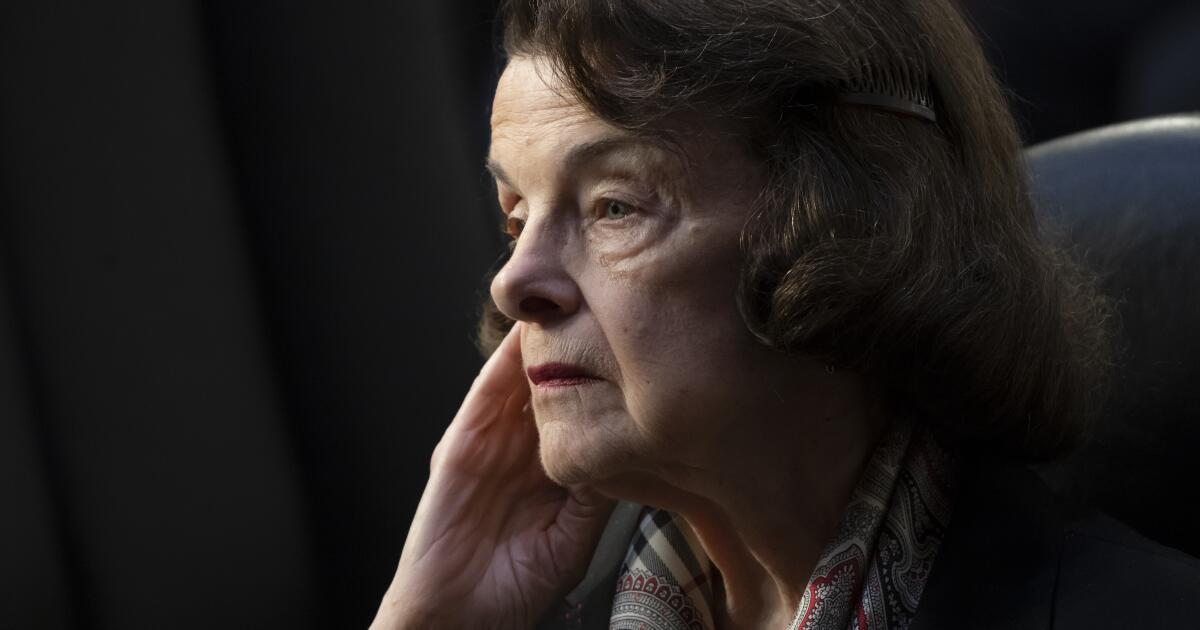
No cause of death has been disclosed for Dianne Feinstein, the longtime California senator who struggled with evident health problems in her final years before her death Thursday night.
She was absent from the U.S. Senate for nearly three months earlier this year while recovering from a case of shingles that led to encephalitis, a rare complication that causes inflammation and swelling in the brain. She was briefly hospitalized in August after falling at her home and was often seen in a wheelchair in public.
Indications that Feinstein, 90, was struggling with memory problems have persisted for years, even before the acknowledged health crises in the last year of her life.
Several of Feinstein’s colleagues and former staffers confided to reporters that she was often unable to recognize longtime colleagues and repeated herself frequently. In July she appeared confused during a Senate Appropriations Committee vote and began to read a prepared statement before the committee chair prompted her to “just say aye.”
Feinstein maintained that she was cognitively fit to continue her fifth full term, and neither her office nor her family has ever confirmed if she had any neurological condition.
Even if the senator’s apparent memory lapses were the result of dementia, the disease would almost certainly not have been her cause of death, doctors said Friday.
“In general, older adults often have a confluence of several different medical problems, and to say which one, ‘caused the death’ can be very difficult,” said Dr. Laura Mosqueda, a professor of geriatrics and family medicine at USC Keck School of Medicine. “We don’t need to look for a simple answer to an actually complicated question.”
The most common cause of dementia is Alzheimer’s disease, a progressive and incurable condition. Alzheimer’s can be a direct cause of death in its latest stages, when the disease begins to damage parts of the brain that control essential biological functions like breathing and swallowing.
A common cause of death for people with late-stage Alzheimer’s is aspiration pneumonia, an infection in the lungs triggered by food or other foreign substance that goes down the windpipe instead of the esophagus. This becomes a bigger risk as the muscles that control swallowing and chewing weaken in the late stages of the disease.
By then, it is no longer possible for patients to keep up even a semblance of their previous activities.
“You would typically not see someone functioning, walking, talking. Usually people are bedridden at that point,” said Dr. Mark Mapstone, a neuropsychologist at UC Irvine.
Doctors were quick to note that without knowing Feinstein’s health history, it was impossible to know for certain whether she suffered from any neurological condition.
Yet even though her appearance in the Senate in her final years was a shock to those familiar with her during her long career, she was not as ill as a person with advanced Alzheimer’s.
“Dianne Feinstein was looking pretty frail and seemed a little confused sometimes in public appearances,” said Dr. Michael Weiner of UC San Francisco, the principal investigator of the Alzheimer’s Disease Neuroimaging Initiative. Yet if she did have dementia, he said, “she was definitely not in an advanced stage. It wasn’t even clear if you can say she was in a moderate stage. You can only judge from these outside appearances.”

No cause of death has been disclosed for Dianne Feinstein, the longtime California senator who struggled with evident health problems in her final years before her death Thursday night.
She was absent from the U.S. Senate for nearly three months earlier this year while recovering from a case of shingles that led to encephalitis, a rare complication that causes inflammation and swelling in the brain. She was briefly hospitalized in August after falling at her home and was often seen in a wheelchair in public.
Indications that Feinstein, 90, was struggling with memory problems have persisted for years, even before the acknowledged health crises in the last year of her life.
Several of Feinstein’s colleagues and former staffers confided to reporters that she was often unable to recognize longtime colleagues and repeated herself frequently. In July she appeared confused during a Senate Appropriations Committee vote and began to read a prepared statement before the committee chair prompted her to “just say aye.”
Feinstein maintained that she was cognitively fit to continue her fifth full term, and neither her office nor her family has ever confirmed if she had any neurological condition.
Even if the senator’s apparent memory lapses were the result of dementia, the disease would almost certainly not have been her cause of death, doctors said Friday.
“In general, older adults often have a confluence of several different medical problems, and to say which one, ‘caused the death’ can be very difficult,” said Dr. Laura Mosqueda, a professor of geriatrics and family medicine at USC Keck School of Medicine. “We don’t need to look for a simple answer to an actually complicated question.”
The most common cause of dementia is Alzheimer’s disease, a progressive and incurable condition. Alzheimer’s can be a direct cause of death in its latest stages, when the disease begins to damage parts of the brain that control essential biological functions like breathing and swallowing.
A common cause of death for people with late-stage Alzheimer’s is aspiration pneumonia, an infection in the lungs triggered by food or other foreign substance that goes down the windpipe instead of the esophagus. This becomes a bigger risk as the muscles that control swallowing and chewing weaken in the late stages of the disease.
By then, it is no longer possible for patients to keep up even a semblance of their previous activities.
“You would typically not see someone functioning, walking, talking. Usually people are bedridden at that point,” said Dr. Mark Mapstone, a neuropsychologist at UC Irvine.
Doctors were quick to note that without knowing Feinstein’s health history, it was impossible to know for certain whether she suffered from any neurological condition.
Yet even though her appearance in the Senate in her final years was a shock to those familiar with her during her long career, she was not as ill as a person with advanced Alzheimer’s.
“Dianne Feinstein was looking pretty frail and seemed a little confused sometimes in public appearances,” said Dr. Michael Weiner of UC San Francisco, the principal investigator of the Alzheimer’s Disease Neuroimaging Initiative. Yet if she did have dementia, he said, “she was definitely not in an advanced stage. It wasn’t even clear if you can say she was in a moderate stage. You can only judge from these outside appearances.”

No cause of death has been disclosed for Dianne Feinstein, the longtime California senator who struggled with evident health problems in her final years before her death Thursday night.
She was absent from the U.S. Senate for nearly three months earlier this year while recovering from a case of shingles that led to encephalitis, a rare complication that causes inflammation and swelling in the brain. She was briefly hospitalized in August after falling at her home and was often seen in a wheelchair in public.
Indications that Feinstein, 90, was struggling with memory problems have persisted for years, even before the acknowledged health crises in the last year of her life.
Several of Feinstein’s colleagues and former staffers confided to reporters that she was often unable to recognize longtime colleagues and repeated herself frequently. In July she appeared confused during a Senate Appropriations Committee vote and began to read a prepared statement before the committee chair prompted her to “just say aye.”
Feinstein maintained that she was cognitively fit to continue her fifth full term, and neither her office nor her family has ever confirmed if she had any neurological condition.
Even if the senator’s apparent memory lapses were the result of dementia, the disease would almost certainly not have been her cause of death, doctors said Friday.
“In general, older adults often have a confluence of several different medical problems, and to say which one, ‘caused the death’ can be very difficult,” said Dr. Laura Mosqueda, a professor of geriatrics and family medicine at USC Keck School of Medicine. “We don’t need to look for a simple answer to an actually complicated question.”
The most common cause of dementia is Alzheimer’s disease, a progressive and incurable condition. Alzheimer’s can be a direct cause of death in its latest stages, when the disease begins to damage parts of the brain that control essential biological functions like breathing and swallowing.
A common cause of death for people with late-stage Alzheimer’s is aspiration pneumonia, an infection in the lungs triggered by food or other foreign substance that goes down the windpipe instead of the esophagus. This becomes a bigger risk as the muscles that control swallowing and chewing weaken in the late stages of the disease.
By then, it is no longer possible for patients to keep up even a semblance of their previous activities.
“You would typically not see someone functioning, walking, talking. Usually people are bedridden at that point,” said Dr. Mark Mapstone, a neuropsychologist at UC Irvine.
Doctors were quick to note that without knowing Feinstein’s health history, it was impossible to know for certain whether she suffered from any neurological condition.
Yet even though her appearance in the Senate in her final years was a shock to those familiar with her during her long career, she was not as ill as a person with advanced Alzheimer’s.
“Dianne Feinstein was looking pretty frail and seemed a little confused sometimes in public appearances,” said Dr. Michael Weiner of UC San Francisco, the principal investigator of the Alzheimer’s Disease Neuroimaging Initiative. Yet if she did have dementia, he said, “she was definitely not in an advanced stage. It wasn’t even clear if you can say she was in a moderate stage. You can only judge from these outside appearances.”
No cause of death has been disclosed for Dianne Feinstein, the longtime California senator who struggled with evident health problems in her final years before her death Thursday night.
She was absent from the U.S. Senate for nearly three months earlier this year while recovering from a case of shingles that led to encephalitis, a rare complication that causes inflammation and swelling in the brain. She was briefly hospitalized in August after falling at her home and was often seen in a wheelchair in public.
Indications that Feinstein, 90, was struggling with memory problems have persisted for years, even before the acknowledged health crises in the last year of her life.
Several of Feinstein’s colleagues and former staffers confided to reporters that she was often unable to recognize longtime colleagues and repeated herself frequently. In July she appeared confused during a Senate Appropriations Committee vote and began to read a prepared statement before the committee chair prompted her to “just say aye.”
Feinstein maintained that she was cognitively fit to continue her fifth full term, and neither her office nor her family has ever confirmed if she had any neurological condition.
Even if the senator’s apparent memory lapses were the result of dementia, the disease would almost certainly not have been her cause of death, doctors said Friday.
“In general, older adults often have a confluence of several different medical problems, and to say which one, ‘caused the death’ can be very difficult,” said Dr. Laura Mosqueda, a professor of geriatrics and family medicine at USC Keck School of Medicine. “We don’t need to look for a simple answer to an actually complicated question.”
The most common cause of dementia is Alzheimer’s disease, a progressive and incurable condition. Alzheimer’s can be a direct cause of death in its latest stages, when the disease begins to damage parts of the brain that control essential biological functions like breathing and swallowing.
A common cause of death for people with late-stage Alzheimer’s is aspiration pneumonia, an infection in the lungs triggered by food or other foreign substance that goes down the windpipe instead of the esophagus. This becomes a bigger risk as the muscles that control swallowing and chewing weaken in the late stages of the disease.
By then, it is no longer possible for patients to keep up even a semblance of their previous activities.
“You would typically not see someone functioning, walking, talking. Usually people are bedridden at that point,” said Dr. Mark Mapstone, a neuropsychologist at UC Irvine.
Doctors were quick to note that without knowing Feinstein’s health history, it was impossible to know for certain whether she suffered from any neurological condition.
Yet even though her appearance in the Senate in her final years was a shock to those familiar with her during her long career, she was not as ill as a person with advanced Alzheimer’s.
“Dianne Feinstein was looking pretty frail and seemed a little confused sometimes in public appearances,” said Dr. Michael Weiner of UC San Francisco, the principal investigator of the Alzheimer’s Disease Neuroimaging Initiative. Yet if she did have dementia, he said, “she was definitely not in an advanced stage. It wasn’t even clear if you can say she was in a moderate stage. You can only judge from these outside appearances.”

No cause of death has been disclosed for Dianne Feinstein, the longtime California senator who struggled with evident health problems in her final years before her death Thursday night.
She was absent from the U.S. Senate for nearly three months earlier this year while recovering from a case of shingles that led to encephalitis, a rare complication that causes inflammation and swelling in the brain. She was briefly hospitalized in August after falling at her home and was often seen in a wheelchair in public.
Indications that Feinstein, 90, was struggling with memory problems have persisted for years, even before the acknowledged health crises in the last year of her life.
Several of Feinstein’s colleagues and former staffers confided to reporters that she was often unable to recognize longtime colleagues and repeated herself frequently. In July she appeared confused during a Senate Appropriations Committee vote and began to read a prepared statement before the committee chair prompted her to “just say aye.”
Feinstein maintained that she was cognitively fit to continue her fifth full term, and neither her office nor her family has ever confirmed if she had any neurological condition.
Even if the senator’s apparent memory lapses were the result of dementia, the disease would almost certainly not have been her cause of death, doctors said Friday.
“In general, older adults often have a confluence of several different medical problems, and to say which one, ‘caused the death’ can be very difficult,” said Dr. Laura Mosqueda, a professor of geriatrics and family medicine at USC Keck School of Medicine. “We don’t need to look for a simple answer to an actually complicated question.”
The most common cause of dementia is Alzheimer’s disease, a progressive and incurable condition. Alzheimer’s can be a direct cause of death in its latest stages, when the disease begins to damage parts of the brain that control essential biological functions like breathing and swallowing.
A common cause of death for people with late-stage Alzheimer’s is aspiration pneumonia, an infection in the lungs triggered by food or other foreign substance that goes down the windpipe instead of the esophagus. This becomes a bigger risk as the muscles that control swallowing and chewing weaken in the late stages of the disease.
By then, it is no longer possible for patients to keep up even a semblance of their previous activities.
“You would typically not see someone functioning, walking, talking. Usually people are bedridden at that point,” said Dr. Mark Mapstone, a neuropsychologist at UC Irvine.
Doctors were quick to note that without knowing Feinstein’s health history, it was impossible to know for certain whether she suffered from any neurological condition.
Yet even though her appearance in the Senate in her final years was a shock to those familiar with her during her long career, she was not as ill as a person with advanced Alzheimer’s.
“Dianne Feinstein was looking pretty frail and seemed a little confused sometimes in public appearances,” said Dr. Michael Weiner of UC San Francisco, the principal investigator of the Alzheimer’s Disease Neuroimaging Initiative. Yet if she did have dementia, he said, “she was definitely not in an advanced stage. It wasn’t even clear if you can say she was in a moderate stage. You can only judge from these outside appearances.”
No cause of death has been disclosed for Dianne Feinstein, the longtime California senator who struggled with evident health problems in her final years before her death Thursday night.
She was absent from the U.S. Senate for nearly three months earlier this year while recovering from a case of shingles that led to encephalitis, a rare complication that causes inflammation and swelling in the brain. She was briefly hospitalized in August after falling at her home and was often seen in a wheelchair in public.
Indications that Feinstein, 90, was struggling with memory problems have persisted for years, even before the acknowledged health crises in the last year of her life.
Several of Feinstein’s colleagues and former staffers confided to reporters that she was often unable to recognize longtime colleagues and repeated herself frequently. In July she appeared confused during a Senate Appropriations Committee vote and began to read a prepared statement before the committee chair prompted her to “just say aye.”
Feinstein maintained that she was cognitively fit to continue her fifth full term, and neither her office nor her family has ever confirmed if she had any neurological condition.
Even if the senator’s apparent memory lapses were the result of dementia, the disease would almost certainly not have been her cause of death, doctors said Friday.
“In general, older adults often have a confluence of several different medical problems, and to say which one, ‘caused the death’ can be very difficult,” said Dr. Laura Mosqueda, a professor of geriatrics and family medicine at USC Keck School of Medicine. “We don’t need to look for a simple answer to an actually complicated question.”
The most common cause of dementia is Alzheimer’s disease, a progressive and incurable condition. Alzheimer’s can be a direct cause of death in its latest stages, when the disease begins to damage parts of the brain that control essential biological functions like breathing and swallowing.
A common cause of death for people with late-stage Alzheimer’s is aspiration pneumonia, an infection in the lungs triggered by food or other foreign substance that goes down the windpipe instead of the esophagus. This becomes a bigger risk as the muscles that control swallowing and chewing weaken in the late stages of the disease.
By then, it is no longer possible for patients to keep up even a semblance of their previous activities.
“You would typically not see someone functioning, walking, talking. Usually people are bedridden at that point,” said Dr. Mark Mapstone, a neuropsychologist at UC Irvine.
Doctors were quick to note that without knowing Feinstein’s health history, it was impossible to know for certain whether she suffered from any neurological condition.
Yet even though her appearance in the Senate in her final years was a shock to those familiar with her during her long career, she was not as ill as a person with advanced Alzheimer’s.
“Dianne Feinstein was looking pretty frail and seemed a little confused sometimes in public appearances,” said Dr. Michael Weiner of UC San Francisco, the principal investigator of the Alzheimer’s Disease Neuroimaging Initiative. Yet if she did have dementia, he said, “she was definitely not in an advanced stage. It wasn’t even clear if you can say she was in a moderate stage. You can only judge from these outside appearances.”
No cause of death has been disclosed for Dianne Feinstein, the longtime California senator who struggled with evident health problems in her final years before her death Thursday night.
She was absent from the U.S. Senate for nearly three months earlier this year while recovering from a case of shingles that led to encephalitis, a rare complication that causes inflammation and swelling in the brain. She was briefly hospitalized in August after falling at her home and was often seen in a wheelchair in public.
Indications that Feinstein, 90, was struggling with memory problems have persisted for years, even before the acknowledged health crises in the last year of her life.
Several of Feinstein’s colleagues and former staffers confided to reporters that she was often unable to recognize longtime colleagues and repeated herself frequently. In July she appeared confused during a Senate Appropriations Committee vote and began to read a prepared statement before the committee chair prompted her to “just say aye.”
Feinstein maintained that she was cognitively fit to continue her fifth full term, and neither her office nor her family has ever confirmed if she had any neurological condition.
Even if the senator’s apparent memory lapses were the result of dementia, the disease would almost certainly not have been her cause of death, doctors said Friday.
“In general, older adults often have a confluence of several different medical problems, and to say which one, ‘caused the death’ can be very difficult,” said Dr. Laura Mosqueda, a professor of geriatrics and family medicine at USC Keck School of Medicine. “We don’t need to look for a simple answer to an actually complicated question.”
The most common cause of dementia is Alzheimer’s disease, a progressive and incurable condition. Alzheimer’s can be a direct cause of death in its latest stages, when the disease begins to damage parts of the brain that control essential biological functions like breathing and swallowing.
A common cause of death for people with late-stage Alzheimer’s is aspiration pneumonia, an infection in the lungs triggered by food or other foreign substance that goes down the windpipe instead of the esophagus. This becomes a bigger risk as the muscles that control swallowing and chewing weaken in the late stages of the disease.
By then, it is no longer possible for patients to keep up even a semblance of their previous activities.
“You would typically not see someone functioning, walking, talking. Usually people are bedridden at that point,” said Dr. Mark Mapstone, a neuropsychologist at UC Irvine.
Doctors were quick to note that without knowing Feinstein’s health history, it was impossible to know for certain whether she suffered from any neurological condition.
Yet even though her appearance in the Senate in her final years was a shock to those familiar with her during her long career, she was not as ill as a person with advanced Alzheimer’s.
“Dianne Feinstein was looking pretty frail and seemed a little confused sometimes in public appearances,” said Dr. Michael Weiner of UC San Francisco, the principal investigator of the Alzheimer’s Disease Neuroimaging Initiative. Yet if she did have dementia, he said, “she was definitely not in an advanced stage. It wasn’t even clear if you can say she was in a moderate stage. You can only judge from these outside appearances.”
No cause of death has been disclosed for Dianne Feinstein, the longtime California senator who struggled with evident health problems in her final years before her death Thursday night.
She was absent from the U.S. Senate for nearly three months earlier this year while recovering from a case of shingles that led to encephalitis, a rare complication that causes inflammation and swelling in the brain. She was briefly hospitalized in August after falling at her home and was often seen in a wheelchair in public.
Indications that Feinstein, 90, was struggling with memory problems have persisted for years, even before the acknowledged health crises in the last year of her life.
Several of Feinstein’s colleagues and former staffers confided to reporters that she was often unable to recognize longtime colleagues and repeated herself frequently. In July she appeared confused during a Senate Appropriations Committee vote and began to read a prepared statement before the committee chair prompted her to “just say aye.”
Feinstein maintained that she was cognitively fit to continue her fifth full term, and neither her office nor her family has ever confirmed if she had any neurological condition.
Even if the senator’s apparent memory lapses were the result of dementia, the disease would almost certainly not have been her cause of death, doctors said Friday.
“In general, older adults often have a confluence of several different medical problems, and to say which one, ‘caused the death’ can be very difficult,” said Dr. Laura Mosqueda, a professor of geriatrics and family medicine at USC Keck School of Medicine. “We don’t need to look for a simple answer to an actually complicated question.”
The most common cause of dementia is Alzheimer’s disease, a progressive and incurable condition. Alzheimer’s can be a direct cause of death in its latest stages, when the disease begins to damage parts of the brain that control essential biological functions like breathing and swallowing.
A common cause of death for people with late-stage Alzheimer’s is aspiration pneumonia, an infection in the lungs triggered by food or other foreign substance that goes down the windpipe instead of the esophagus. This becomes a bigger risk as the muscles that control swallowing and chewing weaken in the late stages of the disease.
By then, it is no longer possible for patients to keep up even a semblance of their previous activities.
“You would typically not see someone functioning, walking, talking. Usually people are bedridden at that point,” said Dr. Mark Mapstone, a neuropsychologist at UC Irvine.
Doctors were quick to note that without knowing Feinstein’s health history, it was impossible to know for certain whether she suffered from any neurological condition.
Yet even though her appearance in the Senate in her final years was a shock to those familiar with her during her long career, she was not as ill as a person with advanced Alzheimer’s.
“Dianne Feinstein was looking pretty frail and seemed a little confused sometimes in public appearances,” said Dr. Michael Weiner of UC San Francisco, the principal investigator of the Alzheimer’s Disease Neuroimaging Initiative. Yet if she did have dementia, he said, “she was definitely not in an advanced stage. It wasn’t even clear if you can say she was in a moderate stage. You can only judge from these outside appearances.”

No cause of death has been disclosed for Dianne Feinstein, the longtime California senator who struggled with evident health problems in her final years before her death Thursday night.
She was absent from the U.S. Senate for nearly three months earlier this year while recovering from a case of shingles that led to encephalitis, a rare complication that causes inflammation and swelling in the brain. She was briefly hospitalized in August after falling at her home and was often seen in a wheelchair in public.
Indications that Feinstein, 90, was struggling with memory problems have persisted for years, even before the acknowledged health crises in the last year of her life.
Several of Feinstein’s colleagues and former staffers confided to reporters that she was often unable to recognize longtime colleagues and repeated herself frequently. In July she appeared confused during a Senate Appropriations Committee vote and began to read a prepared statement before the committee chair prompted her to “just say aye.”
Feinstein maintained that she was cognitively fit to continue her fifth full term, and neither her office nor her family has ever confirmed if she had any neurological condition.
Even if the senator’s apparent memory lapses were the result of dementia, the disease would almost certainly not have been her cause of death, doctors said Friday.
“In general, older adults often have a confluence of several different medical problems, and to say which one, ‘caused the death’ can be very difficult,” said Dr. Laura Mosqueda, a professor of geriatrics and family medicine at USC Keck School of Medicine. “We don’t need to look for a simple answer to an actually complicated question.”
The most common cause of dementia is Alzheimer’s disease, a progressive and incurable condition. Alzheimer’s can be a direct cause of death in its latest stages, when the disease begins to damage parts of the brain that control essential biological functions like breathing and swallowing.
A common cause of death for people with late-stage Alzheimer’s is aspiration pneumonia, an infection in the lungs triggered by food or other foreign substance that goes down the windpipe instead of the esophagus. This becomes a bigger risk as the muscles that control swallowing and chewing weaken in the late stages of the disease.
By then, it is no longer possible for patients to keep up even a semblance of their previous activities.
“You would typically not see someone functioning, walking, talking. Usually people are bedridden at that point,” said Dr. Mark Mapstone, a neuropsychologist at UC Irvine.
Doctors were quick to note that without knowing Feinstein’s health history, it was impossible to know for certain whether she suffered from any neurological condition.
Yet even though her appearance in the Senate in her final years was a shock to those familiar with her during her long career, she was not as ill as a person with advanced Alzheimer’s.
“Dianne Feinstein was looking pretty frail and seemed a little confused sometimes in public appearances,” said Dr. Michael Weiner of UC San Francisco, the principal investigator of the Alzheimer’s Disease Neuroimaging Initiative. Yet if she did have dementia, he said, “she was definitely not in an advanced stage. It wasn’t even clear if you can say she was in a moderate stage. You can only judge from these outside appearances.”
No cause of death has been disclosed for Dianne Feinstein, the longtime California senator who struggled with evident health problems in her final years before her death Thursday night.
She was absent from the U.S. Senate for nearly three months earlier this year while recovering from a case of shingles that led to encephalitis, a rare complication that causes inflammation and swelling in the brain. She was briefly hospitalized in August after falling at her home and was often seen in a wheelchair in public.
Indications that Feinstein, 90, was struggling with memory problems have persisted for years, even before the acknowledged health crises in the last year of her life.
Several of Feinstein’s colleagues and former staffers confided to reporters that she was often unable to recognize longtime colleagues and repeated herself frequently. In July she appeared confused during a Senate Appropriations Committee vote and began to read a prepared statement before the committee chair prompted her to “just say aye.”
Feinstein maintained that she was cognitively fit to continue her fifth full term, and neither her office nor her family has ever confirmed if she had any neurological condition.
Even if the senator’s apparent memory lapses were the result of dementia, the disease would almost certainly not have been her cause of death, doctors said Friday.
“In general, older adults often have a confluence of several different medical problems, and to say which one, ‘caused the death’ can be very difficult,” said Dr. Laura Mosqueda, a professor of geriatrics and family medicine at USC Keck School of Medicine. “We don’t need to look for a simple answer to an actually complicated question.”
The most common cause of dementia is Alzheimer’s disease, a progressive and incurable condition. Alzheimer’s can be a direct cause of death in its latest stages, when the disease begins to damage parts of the brain that control essential biological functions like breathing and swallowing.
A common cause of death for people with late-stage Alzheimer’s is aspiration pneumonia, an infection in the lungs triggered by food or other foreign substance that goes down the windpipe instead of the esophagus. This becomes a bigger risk as the muscles that control swallowing and chewing weaken in the late stages of the disease.
By then, it is no longer possible for patients to keep up even a semblance of their previous activities.
“You would typically not see someone functioning, walking, talking. Usually people are bedridden at that point,” said Dr. Mark Mapstone, a neuropsychologist at UC Irvine.
Doctors were quick to note that without knowing Feinstein’s health history, it was impossible to know for certain whether she suffered from any neurological condition.
Yet even though her appearance in the Senate in her final years was a shock to those familiar with her during her long career, she was not as ill as a person with advanced Alzheimer’s.
“Dianne Feinstein was looking pretty frail and seemed a little confused sometimes in public appearances,” said Dr. Michael Weiner of UC San Francisco, the principal investigator of the Alzheimer’s Disease Neuroimaging Initiative. Yet if she did have dementia, he said, “she was definitely not in an advanced stage. It wasn’t even clear if you can say she was in a moderate stage. You can only judge from these outside appearances.”
No cause of death has been disclosed for Dianne Feinstein, the longtime California senator who struggled with evident health problems in her final years before her death Thursday night.
She was absent from the U.S. Senate for nearly three months earlier this year while recovering from a case of shingles that led to encephalitis, a rare complication that causes inflammation and swelling in the brain. She was briefly hospitalized in August after falling at her home and was often seen in a wheelchair in public.
Indications that Feinstein, 90, was struggling with memory problems have persisted for years, even before the acknowledged health crises in the last year of her life.
Several of Feinstein’s colleagues and former staffers confided to reporters that she was often unable to recognize longtime colleagues and repeated herself frequently. In July she appeared confused during a Senate Appropriations Committee vote and began to read a prepared statement before the committee chair prompted her to “just say aye.”
Feinstein maintained that she was cognitively fit to continue her fifth full term, and neither her office nor her family has ever confirmed if she had any neurological condition.
Even if the senator’s apparent memory lapses were the result of dementia, the disease would almost certainly not have been her cause of death, doctors said Friday.
“In general, older adults often have a confluence of several different medical problems, and to say which one, ‘caused the death’ can be very difficult,” said Dr. Laura Mosqueda, a professor of geriatrics and family medicine at USC Keck School of Medicine. “We don’t need to look for a simple answer to an actually complicated question.”
The most common cause of dementia is Alzheimer’s disease, a progressive and incurable condition. Alzheimer’s can be a direct cause of death in its latest stages, when the disease begins to damage parts of the brain that control essential biological functions like breathing and swallowing.
A common cause of death for people with late-stage Alzheimer’s is aspiration pneumonia, an infection in the lungs triggered by food or other foreign substance that goes down the windpipe instead of the esophagus. This becomes a bigger risk as the muscles that control swallowing and chewing weaken in the late stages of the disease.
By then, it is no longer possible for patients to keep up even a semblance of their previous activities.
“You would typically not see someone functioning, walking, talking. Usually people are bedridden at that point,” said Dr. Mark Mapstone, a neuropsychologist at UC Irvine.
Doctors were quick to note that without knowing Feinstein’s health history, it was impossible to know for certain whether she suffered from any neurological condition.
Yet even though her appearance in the Senate in her final years was a shock to those familiar with her during her long career, she was not as ill as a person with advanced Alzheimer’s.
“Dianne Feinstein was looking pretty frail and seemed a little confused sometimes in public appearances,” said Dr. Michael Weiner of UC San Francisco, the principal investigator of the Alzheimer’s Disease Neuroimaging Initiative. Yet if she did have dementia, he said, “she was definitely not in an advanced stage. It wasn’t even clear if you can say she was in a moderate stage. You can only judge from these outside appearances.”
No cause of death has been disclosed for Dianne Feinstein, the longtime California senator who struggled with evident health problems in her final years before her death Thursday night.
She was absent from the U.S. Senate for nearly three months earlier this year while recovering from a case of shingles that led to encephalitis, a rare complication that causes inflammation and swelling in the brain. She was briefly hospitalized in August after falling at her home and was often seen in a wheelchair in public.
Indications that Feinstein, 90, was struggling with memory problems have persisted for years, even before the acknowledged health crises in the last year of her life.
Several of Feinstein’s colleagues and former staffers confided to reporters that she was often unable to recognize longtime colleagues and repeated herself frequently. In July she appeared confused during a Senate Appropriations Committee vote and began to read a prepared statement before the committee chair prompted her to “just say aye.”
Feinstein maintained that she was cognitively fit to continue her fifth full term, and neither her office nor her family has ever confirmed if she had any neurological condition.
Even if the senator’s apparent memory lapses were the result of dementia, the disease would almost certainly not have been her cause of death, doctors said Friday.
“In general, older adults often have a confluence of several different medical problems, and to say which one, ‘caused the death’ can be very difficult,” said Dr. Laura Mosqueda, a professor of geriatrics and family medicine at USC Keck School of Medicine. “We don’t need to look for a simple answer to an actually complicated question.”
The most common cause of dementia is Alzheimer’s disease, a progressive and incurable condition. Alzheimer’s can be a direct cause of death in its latest stages, when the disease begins to damage parts of the brain that control essential biological functions like breathing and swallowing.
A common cause of death for people with late-stage Alzheimer’s is aspiration pneumonia, an infection in the lungs triggered by food or other foreign substance that goes down the windpipe instead of the esophagus. This becomes a bigger risk as the muscles that control swallowing and chewing weaken in the late stages of the disease.
By then, it is no longer possible for patients to keep up even a semblance of their previous activities.
“You would typically not see someone functioning, walking, talking. Usually people are bedridden at that point,” said Dr. Mark Mapstone, a neuropsychologist at UC Irvine.
Doctors were quick to note that without knowing Feinstein’s health history, it was impossible to know for certain whether she suffered from any neurological condition.
Yet even though her appearance in the Senate in her final years was a shock to those familiar with her during her long career, she was not as ill as a person with advanced Alzheimer’s.
“Dianne Feinstein was looking pretty frail and seemed a little confused sometimes in public appearances,” said Dr. Michael Weiner of UC San Francisco, the principal investigator of the Alzheimer’s Disease Neuroimaging Initiative. Yet if she did have dementia, he said, “she was definitely not in an advanced stage. It wasn’t even clear if you can say she was in a moderate stage. You can only judge from these outside appearances.”
No cause of death has been disclosed for Dianne Feinstein, the longtime California senator who struggled with evident health problems in her final years before her death Thursday night.
She was absent from the U.S. Senate for nearly three months earlier this year while recovering from a case of shingles that led to encephalitis, a rare complication that causes inflammation and swelling in the brain. She was briefly hospitalized in August after falling at her home and was often seen in a wheelchair in public.
Indications that Feinstein, 90, was struggling with memory problems have persisted for years, even before the acknowledged health crises in the last year of her life.
Several of Feinstein’s colleagues and former staffers confided to reporters that she was often unable to recognize longtime colleagues and repeated herself frequently. In July she appeared confused during a Senate Appropriations Committee vote and began to read a prepared statement before the committee chair prompted her to “just say aye.”
Feinstein maintained that she was cognitively fit to continue her fifth full term, and neither her office nor her family has ever confirmed if she had any neurological condition.
Even if the senator’s apparent memory lapses were the result of dementia, the disease would almost certainly not have been her cause of death, doctors said Friday.
“In general, older adults often have a confluence of several different medical problems, and to say which one, ‘caused the death’ can be very difficult,” said Dr. Laura Mosqueda, a professor of geriatrics and family medicine at USC Keck School of Medicine. “We don’t need to look for a simple answer to an actually complicated question.”
The most common cause of dementia is Alzheimer’s disease, a progressive and incurable condition. Alzheimer’s can be a direct cause of death in its latest stages, when the disease begins to damage parts of the brain that control essential biological functions like breathing and swallowing.
A common cause of death for people with late-stage Alzheimer’s is aspiration pneumonia, an infection in the lungs triggered by food or other foreign substance that goes down the windpipe instead of the esophagus. This becomes a bigger risk as the muscles that control swallowing and chewing weaken in the late stages of the disease.
By then, it is no longer possible for patients to keep up even a semblance of their previous activities.
“You would typically not see someone functioning, walking, talking. Usually people are bedridden at that point,” said Dr. Mark Mapstone, a neuropsychologist at UC Irvine.
Doctors were quick to note that without knowing Feinstein’s health history, it was impossible to know for certain whether she suffered from any neurological condition.
Yet even though her appearance in the Senate in her final years was a shock to those familiar with her during her long career, she was not as ill as a person with advanced Alzheimer’s.
“Dianne Feinstein was looking pretty frail and seemed a little confused sometimes in public appearances,” said Dr. Michael Weiner of UC San Francisco, the principal investigator of the Alzheimer’s Disease Neuroimaging Initiative. Yet if she did have dementia, he said, “she was definitely not in an advanced stage. It wasn’t even clear if you can say she was in a moderate stage. You can only judge from these outside appearances.”
No cause of death has been disclosed for Dianne Feinstein, the longtime California senator who struggled with evident health problems in her final years before her death Thursday night.
She was absent from the U.S. Senate for nearly three months earlier this year while recovering from a case of shingles that led to encephalitis, a rare complication that causes inflammation and swelling in the brain. She was briefly hospitalized in August after falling at her home and was often seen in a wheelchair in public.
Indications that Feinstein, 90, was struggling with memory problems have persisted for years, even before the acknowledged health crises in the last year of her life.
Several of Feinstein’s colleagues and former staffers confided to reporters that she was often unable to recognize longtime colleagues and repeated herself frequently. In July she appeared confused during a Senate Appropriations Committee vote and began to read a prepared statement before the committee chair prompted her to “just say aye.”
Feinstein maintained that she was cognitively fit to continue her fifth full term, and neither her office nor her family has ever confirmed if she had any neurological condition.
Even if the senator’s apparent memory lapses were the result of dementia, the disease would almost certainly not have been her cause of death, doctors said Friday.
“In general, older adults often have a confluence of several different medical problems, and to say which one, ‘caused the death’ can be very difficult,” said Dr. Laura Mosqueda, a professor of geriatrics and family medicine at USC Keck School of Medicine. “We don’t need to look for a simple answer to an actually complicated question.”
The most common cause of dementia is Alzheimer’s disease, a progressive and incurable condition. Alzheimer’s can be a direct cause of death in its latest stages, when the disease begins to damage parts of the brain that control essential biological functions like breathing and swallowing.
A common cause of death for people with late-stage Alzheimer’s is aspiration pneumonia, an infection in the lungs triggered by food or other foreign substance that goes down the windpipe instead of the esophagus. This becomes a bigger risk as the muscles that control swallowing and chewing weaken in the late stages of the disease.
By then, it is no longer possible for patients to keep up even a semblance of their previous activities.
“You would typically not see someone functioning, walking, talking. Usually people are bedridden at that point,” said Dr. Mark Mapstone, a neuropsychologist at UC Irvine.
Doctors were quick to note that without knowing Feinstein’s health history, it was impossible to know for certain whether she suffered from any neurological condition.
Yet even though her appearance in the Senate in her final years was a shock to those familiar with her during her long career, she was not as ill as a person with advanced Alzheimer’s.
“Dianne Feinstein was looking pretty frail and seemed a little confused sometimes in public appearances,” said Dr. Michael Weiner of UC San Francisco, the principal investigator of the Alzheimer’s Disease Neuroimaging Initiative. Yet if she did have dementia, he said, “she was definitely not in an advanced stage. It wasn’t even clear if you can say she was in a moderate stage. You can only judge from these outside appearances.”
No cause of death has been disclosed for Dianne Feinstein, the longtime California senator who struggled with evident health problems in her final years before her death Thursday night.
She was absent from the U.S. Senate for nearly three months earlier this year while recovering from a case of shingles that led to encephalitis, a rare complication that causes inflammation and swelling in the brain. She was briefly hospitalized in August after falling at her home and was often seen in a wheelchair in public.
Indications that Feinstein, 90, was struggling with memory problems have persisted for years, even before the acknowledged health crises in the last year of her life.
Several of Feinstein’s colleagues and former staffers confided to reporters that she was often unable to recognize longtime colleagues and repeated herself frequently. In July she appeared confused during a Senate Appropriations Committee vote and began to read a prepared statement before the committee chair prompted her to “just say aye.”
Feinstein maintained that she was cognitively fit to continue her fifth full term, and neither her office nor her family has ever confirmed if she had any neurological condition.
Even if the senator’s apparent memory lapses were the result of dementia, the disease would almost certainly not have been her cause of death, doctors said Friday.
“In general, older adults often have a confluence of several different medical problems, and to say which one, ‘caused the death’ can be very difficult,” said Dr. Laura Mosqueda, a professor of geriatrics and family medicine at USC Keck School of Medicine. “We don’t need to look for a simple answer to an actually complicated question.”
The most common cause of dementia is Alzheimer’s disease, a progressive and incurable condition. Alzheimer’s can be a direct cause of death in its latest stages, when the disease begins to damage parts of the brain that control essential biological functions like breathing and swallowing.
A common cause of death for people with late-stage Alzheimer’s is aspiration pneumonia, an infection in the lungs triggered by food or other foreign substance that goes down the windpipe instead of the esophagus. This becomes a bigger risk as the muscles that control swallowing and chewing weaken in the late stages of the disease.
By then, it is no longer possible for patients to keep up even a semblance of their previous activities.
“You would typically not see someone functioning, walking, talking. Usually people are bedridden at that point,” said Dr. Mark Mapstone, a neuropsychologist at UC Irvine.
Doctors were quick to note that without knowing Feinstein’s health history, it was impossible to know for certain whether she suffered from any neurological condition.
Yet even though her appearance in the Senate in her final years was a shock to those familiar with her during her long career, she was not as ill as a person with advanced Alzheimer’s.
“Dianne Feinstein was looking pretty frail and seemed a little confused sometimes in public appearances,” said Dr. Michael Weiner of UC San Francisco, the principal investigator of the Alzheimer’s Disease Neuroimaging Initiative. Yet if she did have dementia, he said, “she was definitely not in an advanced stage. It wasn’t even clear if you can say she was in a moderate stage. You can only judge from these outside appearances.”
No cause of death has been disclosed for Dianne Feinstein, the longtime California senator who struggled with evident health problems in her final years before her death Thursday night.
She was absent from the U.S. Senate for nearly three months earlier this year while recovering from a case of shingles that led to encephalitis, a rare complication that causes inflammation and swelling in the brain. She was briefly hospitalized in August after falling at her home and was often seen in a wheelchair in public.
Indications that Feinstein, 90, was struggling with memory problems have persisted for years, even before the acknowledged health crises in the last year of her life.
Several of Feinstein’s colleagues and former staffers confided to reporters that she was often unable to recognize longtime colleagues and repeated herself frequently. In July she appeared confused during a Senate Appropriations Committee vote and began to read a prepared statement before the committee chair prompted her to “just say aye.”
Feinstein maintained that she was cognitively fit to continue her fifth full term, and neither her office nor her family has ever confirmed if she had any neurological condition.
Even if the senator’s apparent memory lapses were the result of dementia, the disease would almost certainly not have been her cause of death, doctors said Friday.
“In general, older adults often have a confluence of several different medical problems, and to say which one, ‘caused the death’ can be very difficult,” said Dr. Laura Mosqueda, a professor of geriatrics and family medicine at USC Keck School of Medicine. “We don’t need to look for a simple answer to an actually complicated question.”
The most common cause of dementia is Alzheimer’s disease, a progressive and incurable condition. Alzheimer’s can be a direct cause of death in its latest stages, when the disease begins to damage parts of the brain that control essential biological functions like breathing and swallowing.
A common cause of death for people with late-stage Alzheimer’s is aspiration pneumonia, an infection in the lungs triggered by food or other foreign substance that goes down the windpipe instead of the esophagus. This becomes a bigger risk as the muscles that control swallowing and chewing weaken in the late stages of the disease.
By then, it is no longer possible for patients to keep up even a semblance of their previous activities.
“You would typically not see someone functioning, walking, talking. Usually people are bedridden at that point,” said Dr. Mark Mapstone, a neuropsychologist at UC Irvine.
Doctors were quick to note that without knowing Feinstein’s health history, it was impossible to know for certain whether she suffered from any neurological condition.
Yet even though her appearance in the Senate in her final years was a shock to those familiar with her during her long career, she was not as ill as a person with advanced Alzheimer’s.
“Dianne Feinstein was looking pretty frail and seemed a little confused sometimes in public appearances,” said Dr. Michael Weiner of UC San Francisco, the principal investigator of the Alzheimer’s Disease Neuroimaging Initiative. Yet if she did have dementia, he said, “she was definitely not in an advanced stage. It wasn’t even clear if you can say she was in a moderate stage. You can only judge from these outside appearances.”

