

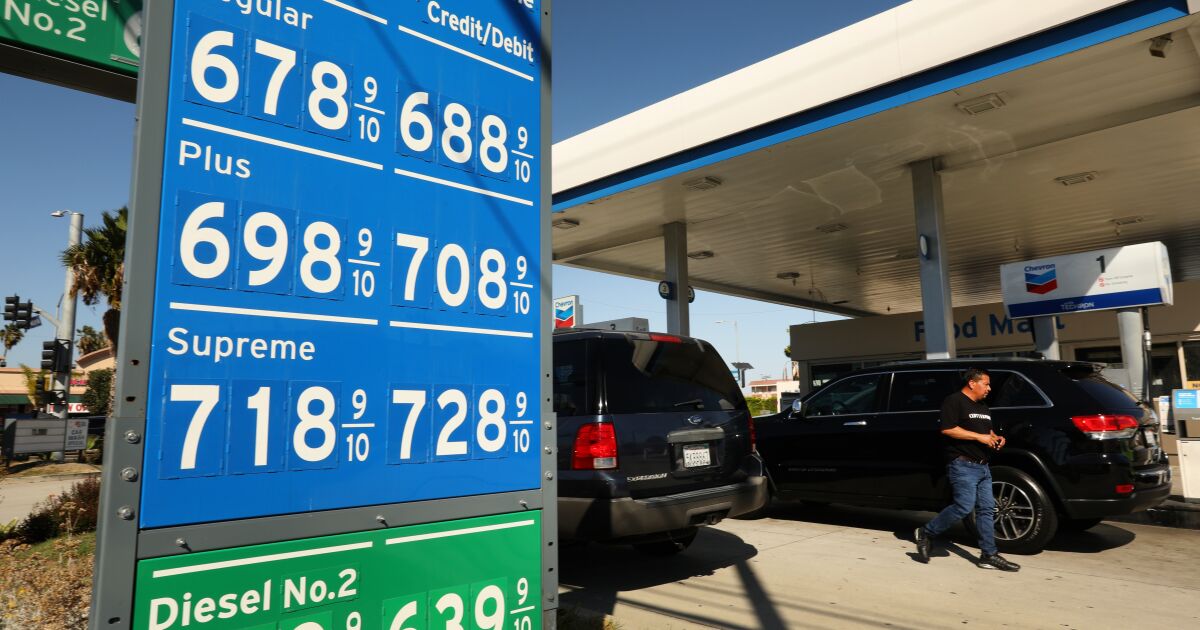

When gas prices rise, it instantly fuels political rhetoric about price gouging and the need to help motorists pay at the pump. It’s as automatic as pushing the starter button and hearing the engine crank up.
As California prices surged in recent days, Gov. Gavin Newsom proclaimed that he wanted to retaliate against oil moguls by imposing a windfall profits tax and returning the money to drivers.
“Crude oil prices are down. Oil industry profits are up. Yet gas prices in CA have increased by record amounts. It doesn’t add up,” the governor tweeted.
“We’re not going to stand by while greedy oil companies fleece Californians.”
It caught the recessed Legislature by surprise. But leaders reacted instinctively.
“Californians are still being gouged by oil companies’ indefensible nonstop price increases,” Senate leader Toni Atkins (D-San Diego) and Assembly Speaker Anthony Rendon (D-Lakewood) responded in a joint statement.
They pledged “to take a hard look at any proposal to go after windfall profits that oil companies are raking in by bilking consumers. In fact, we’ll look at every option to end the oil industry profiteering off the backs of hard-working Californians.”
UC Berkeley energy economist Severin Borenstein put it quite well in a May blog. “Politicians and the media have been obsessed with ‘doing something’ about high gasoline prices,” he wrote.
“On the left, leaders express outrage that oil companies are making so much money and not sharing it with consumers…. Like that’s a thing. Apple is going to lower its iPhone price because it’s making too much money?”
“From politicians on the right, comes the ‘drill, baby, drill’ policy response….
“It’s frustrating when straightforward economic analysis takes a back seat to political rhetoric and ideology.”
Borenstein is faculty director of the UC Berkeley Energy Institute.
I asked him about Newsom’s proposed windfall profits tax.
“It wouldn’t do anything to lower gas prices,” the professor said. “It would just recover some of the money.
“We should tax oil extraction” — tax the goo as it’s pumped from the ground. “We’re the only major oil producing state that doesn’t. The oil industry fights like hell against that.”
The Legislature passed an oil severance tax in 2009, but then-Gov. Arnold Schwarzenegger vetoed it. In 2006, the oil industry spent $95 million to defeat a severance ballot measure.
That would raise at least $1 billion a year, but it won’t happen in the foreseeable future. Democratic lawmakers are skittish about taxes, and Republicans are protective of the oil industry.
In my imagination, I could see Democratic legislators rolling their eyes as Newsom unveiled his tax proposal by posting a few characters on Twitter, rather than spelling out details in a carefully crafted policy paper. They’re thinking, “There he goes again.”
The rhetoric comes easy for this governor. He promised the details in a week or two. They’ll be much tougher. How do you determine what’s a windfall profit?
And is this an oil industry political ploy? An old-fashioned “October surprise” designed to hurt the party in power — Democrats — with untenable gas prices as the election nears?
If Democrats think that, Newsom should call the Legislature back into special session immediately to deal with the mischief.
The governor would have to work closely with legislative dealers to round up the necessary two-thirds majority vote. That’s not his style. It’s possible but very difficult in an election year. It would require flexing all the governor’s and leaders’ muscles.
Or is it the natural result of too many oil refineries simultaneously being shut down for repairs — a coincidence, rather than collusion?
Only a few people really know that. And they sit in corporate suites, not the governor’s office or Legislature.
If the Legislature doesn’t convene before the Nov. 8 election, it probably won’t consider the matter until new members take office in early December. It probably would be at least January before the new Legislature acted.
Meanwhile, the state is beginning to send Californians $9.5 billion in so-called rebates inspired by last winter’s gas price hike. You don’t have to be a car owner to benefit. The reimbursements will range from $200 per individual income taxpayer to $1,050 per family, with lower-income people receiving the most. If your income exceeds $250,000 for an individual or $500,000 for a couple, you get nothing.
This relief package won’t cost oil companies. It’ll cost the state.
Newsom thankfully did take some meaningful action that should lower pump prices — maybe by 50 cents a gallon in a week or two. He asked the California Air Resources Board to allow refineries to begin producing cheaper winter-blend gasoline.
That could make Los Angeles smoggier. But costly summer-blend gas is one reason California’s fuel prices are so much higher than in other states.
Other reasons are very high state taxes, environmental regulations and extra refining costs. California is also isolated: There isn’t a pipeline that brings gas into the state. We import by ship. And our own oil production has fallen over the decades, largely because wells have been pumped out.
It’s probably going to get worse as we move away from gas engines. Less demand will mean fewer refineries and less supply. Higher prices.
But fewer climate-changing greenhouse gas emissions.
It’s going to be a bumpy road for motorists, no matter the merits of an unlikely windfall profits tax.

When gas prices rise, it instantly fuels political rhetoric about price gouging and the need to help motorists pay at the pump. It’s as automatic as pushing the starter button and hearing the engine crank up.
As California prices surged in recent days, Gov. Gavin Newsom proclaimed that he wanted to retaliate against oil moguls by imposing a windfall profits tax and returning the money to drivers.
“Crude oil prices are down. Oil industry profits are up. Yet gas prices in CA have increased by record amounts. It doesn’t add up,” the governor tweeted.
“We’re not going to stand by while greedy oil companies fleece Californians.”
It caught the recessed Legislature by surprise. But leaders reacted instinctively.
“Californians are still being gouged by oil companies’ indefensible nonstop price increases,” Senate leader Toni Atkins (D-San Diego) and Assembly Speaker Anthony Rendon (D-Lakewood) responded in a joint statement.
They pledged “to take a hard look at any proposal to go after windfall profits that oil companies are raking in by bilking consumers. In fact, we’ll look at every option to end the oil industry profiteering off the backs of hard-working Californians.”
UC Berkeley energy economist Severin Borenstein put it quite well in a May blog. “Politicians and the media have been obsessed with ‘doing something’ about high gasoline prices,” he wrote.
“On the left, leaders express outrage that oil companies are making so much money and not sharing it with consumers…. Like that’s a thing. Apple is going to lower its iPhone price because it’s making too much money?”
“From politicians on the right, comes the ‘drill, baby, drill’ policy response….
“It’s frustrating when straightforward economic analysis takes a back seat to political rhetoric and ideology.”
Borenstein is faculty director of the UC Berkeley Energy Institute.
I asked him about Newsom’s proposed windfall profits tax.
“It wouldn’t do anything to lower gas prices,” the professor said. “It would just recover some of the money.
“We should tax oil extraction” — tax the goo as it’s pumped from the ground. “We’re the only major oil producing state that doesn’t. The oil industry fights like hell against that.”
The Legislature passed an oil severance tax in 2009, but then-Gov. Arnold Schwarzenegger vetoed it. In 2006, the oil industry spent $95 million to defeat a severance ballot measure.
That would raise at least $1 billion a year, but it won’t happen in the foreseeable future. Democratic lawmakers are skittish about taxes, and Republicans are protective of the oil industry.
In my imagination, I could see Democratic legislators rolling their eyes as Newsom unveiled his tax proposal by posting a few characters on Twitter, rather than spelling out details in a carefully crafted policy paper. They’re thinking, “There he goes again.”
The rhetoric comes easy for this governor. He promised the details in a week or two. They’ll be much tougher. How do you determine what’s a windfall profit?
And is this an oil industry political ploy? An old-fashioned “October surprise” designed to hurt the party in power — Democrats — with untenable gas prices as the election nears?
If Democrats think that, Newsom should call the Legislature back into special session immediately to deal with the mischief.
The governor would have to work closely with legislative dealers to round up the necessary two-thirds majority vote. That’s not his style. It’s possible but very difficult in an election year. It would require flexing all the governor’s and leaders’ muscles.
Or is it the natural result of too many oil refineries simultaneously being shut down for repairs — a coincidence, rather than collusion?
Only a few people really know that. And they sit in corporate suites, not the governor’s office or Legislature.
If the Legislature doesn’t convene before the Nov. 8 election, it probably won’t consider the matter until new members take office in early December. It probably would be at least January before the new Legislature acted.
Meanwhile, the state is beginning to send Californians $9.5 billion in so-called rebates inspired by last winter’s gas price hike. You don’t have to be a car owner to benefit. The reimbursements will range from $200 per individual income taxpayer to $1,050 per family, with lower-income people receiving the most. If your income exceeds $250,000 for an individual or $500,000 for a couple, you get nothing.
This relief package won’t cost oil companies. It’ll cost the state.
Newsom thankfully did take some meaningful action that should lower pump prices — maybe by 50 cents a gallon in a week or two. He asked the California Air Resources Board to allow refineries to begin producing cheaper winter-blend gasoline.
That could make Los Angeles smoggier. But costly summer-blend gas is one reason California’s fuel prices are so much higher than in other states.
Other reasons are very high state taxes, environmental regulations and extra refining costs. California is also isolated: There isn’t a pipeline that brings gas into the state. We import by ship. And our own oil production has fallen over the decades, largely because wells have been pumped out.
It’s probably going to get worse as we move away from gas engines. Less demand will mean fewer refineries and less supply. Higher prices.
But fewer climate-changing greenhouse gas emissions.
It’s going to be a bumpy road for motorists, no matter the merits of an unlikely windfall profits tax.

When gas prices rise, it instantly fuels political rhetoric about price gouging and the need to help motorists pay at the pump. It’s as automatic as pushing the starter button and hearing the engine crank up.
As California prices surged in recent days, Gov. Gavin Newsom proclaimed that he wanted to retaliate against oil moguls by imposing a windfall profits tax and returning the money to drivers.
“Crude oil prices are down. Oil industry profits are up. Yet gas prices in CA have increased by record amounts. It doesn’t add up,” the governor tweeted.
“We’re not going to stand by while greedy oil companies fleece Californians.”
It caught the recessed Legislature by surprise. But leaders reacted instinctively.
“Californians are still being gouged by oil companies’ indefensible nonstop price increases,” Senate leader Toni Atkins (D-San Diego) and Assembly Speaker Anthony Rendon (D-Lakewood) responded in a joint statement.
They pledged “to take a hard look at any proposal to go after windfall profits that oil companies are raking in by bilking consumers. In fact, we’ll look at every option to end the oil industry profiteering off the backs of hard-working Californians.”
UC Berkeley energy economist Severin Borenstein put it quite well in a May blog. “Politicians and the media have been obsessed with ‘doing something’ about high gasoline prices,” he wrote.
“On the left, leaders express outrage that oil companies are making so much money and not sharing it with consumers…. Like that’s a thing. Apple is going to lower its iPhone price because it’s making too much money?”
“From politicians on the right, comes the ‘drill, baby, drill’ policy response….
“It’s frustrating when straightforward economic analysis takes a back seat to political rhetoric and ideology.”
Borenstein is faculty director of the UC Berkeley Energy Institute.
I asked him about Newsom’s proposed windfall profits tax.
“It wouldn’t do anything to lower gas prices,” the professor said. “It would just recover some of the money.
“We should tax oil extraction” — tax the goo as it’s pumped from the ground. “We’re the only major oil producing state that doesn’t. The oil industry fights like hell against that.”
The Legislature passed an oil severance tax in 2009, but then-Gov. Arnold Schwarzenegger vetoed it. In 2006, the oil industry spent $95 million to defeat a severance ballot measure.
That would raise at least $1 billion a year, but it won’t happen in the foreseeable future. Democratic lawmakers are skittish about taxes, and Republicans are protective of the oil industry.
In my imagination, I could see Democratic legislators rolling their eyes as Newsom unveiled his tax proposal by posting a few characters on Twitter, rather than spelling out details in a carefully crafted policy paper. They’re thinking, “There he goes again.”
The rhetoric comes easy for this governor. He promised the details in a week or two. They’ll be much tougher. How do you determine what’s a windfall profit?
And is this an oil industry political ploy? An old-fashioned “October surprise” designed to hurt the party in power — Democrats — with untenable gas prices as the election nears?
If Democrats think that, Newsom should call the Legislature back into special session immediately to deal with the mischief.
The governor would have to work closely with legislative dealers to round up the necessary two-thirds majority vote. That’s not his style. It’s possible but very difficult in an election year. It would require flexing all the governor’s and leaders’ muscles.
Or is it the natural result of too many oil refineries simultaneously being shut down for repairs — a coincidence, rather than collusion?
Only a few people really know that. And they sit in corporate suites, not the governor’s office or Legislature.
If the Legislature doesn’t convene before the Nov. 8 election, it probably won’t consider the matter until new members take office in early December. It probably would be at least January before the new Legislature acted.
Meanwhile, the state is beginning to send Californians $9.5 billion in so-called rebates inspired by last winter’s gas price hike. You don’t have to be a car owner to benefit. The reimbursements will range from $200 per individual income taxpayer to $1,050 per family, with lower-income people receiving the most. If your income exceeds $250,000 for an individual or $500,000 for a couple, you get nothing.
This relief package won’t cost oil companies. It’ll cost the state.
Newsom thankfully did take some meaningful action that should lower pump prices — maybe by 50 cents a gallon in a week or two. He asked the California Air Resources Board to allow refineries to begin producing cheaper winter-blend gasoline.
That could make Los Angeles smoggier. But costly summer-blend gas is one reason California’s fuel prices are so much higher than in other states.
Other reasons are very high state taxes, environmental regulations and extra refining costs. California is also isolated: There isn’t a pipeline that brings gas into the state. We import by ship. And our own oil production has fallen over the decades, largely because wells have been pumped out.
It’s probably going to get worse as we move away from gas engines. Less demand will mean fewer refineries and less supply. Higher prices.
But fewer climate-changing greenhouse gas emissions.
It’s going to be a bumpy road for motorists, no matter the merits of an unlikely windfall profits tax.
When gas prices rise, it instantly fuels political rhetoric about price gouging and the need to help motorists pay at the pump. It’s as automatic as pushing the starter button and hearing the engine crank up.
As California prices surged in recent days, Gov. Gavin Newsom proclaimed that he wanted to retaliate against oil moguls by imposing a windfall profits tax and returning the money to drivers.
“Crude oil prices are down. Oil industry profits are up. Yet gas prices in CA have increased by record amounts. It doesn’t add up,” the governor tweeted.
“We’re not going to stand by while greedy oil companies fleece Californians.”
It caught the recessed Legislature by surprise. But leaders reacted instinctively.
“Californians are still being gouged by oil companies’ indefensible nonstop price increases,” Senate leader Toni Atkins (D-San Diego) and Assembly Speaker Anthony Rendon (D-Lakewood) responded in a joint statement.
They pledged “to take a hard look at any proposal to go after windfall profits that oil companies are raking in by bilking consumers. In fact, we’ll look at every option to end the oil industry profiteering off the backs of hard-working Californians.”
UC Berkeley energy economist Severin Borenstein put it quite well in a May blog. “Politicians and the media have been obsessed with ‘doing something’ about high gasoline prices,” he wrote.
“On the left, leaders express outrage that oil companies are making so much money and not sharing it with consumers…. Like that’s a thing. Apple is going to lower its iPhone price because it’s making too much money?”
“From politicians on the right, comes the ‘drill, baby, drill’ policy response….
“It’s frustrating when straightforward economic analysis takes a back seat to political rhetoric and ideology.”
Borenstein is faculty director of the UC Berkeley Energy Institute.
I asked him about Newsom’s proposed windfall profits tax.
“It wouldn’t do anything to lower gas prices,” the professor said. “It would just recover some of the money.
“We should tax oil extraction” — tax the goo as it’s pumped from the ground. “We’re the only major oil producing state that doesn’t. The oil industry fights like hell against that.”
The Legislature passed an oil severance tax in 2009, but then-Gov. Arnold Schwarzenegger vetoed it. In 2006, the oil industry spent $95 million to defeat a severance ballot measure.
That would raise at least $1 billion a year, but it won’t happen in the foreseeable future. Democratic lawmakers are skittish about taxes, and Republicans are protective of the oil industry.
In my imagination, I could see Democratic legislators rolling their eyes as Newsom unveiled his tax proposal by posting a few characters on Twitter, rather than spelling out details in a carefully crafted policy paper. They’re thinking, “There he goes again.”
The rhetoric comes easy for this governor. He promised the details in a week or two. They’ll be much tougher. How do you determine what’s a windfall profit?
And is this an oil industry political ploy? An old-fashioned “October surprise” designed to hurt the party in power — Democrats — with untenable gas prices as the election nears?
If Democrats think that, Newsom should call the Legislature back into special session immediately to deal with the mischief.
The governor would have to work closely with legislative dealers to round up the necessary two-thirds majority vote. That’s not his style. It’s possible but very difficult in an election year. It would require flexing all the governor’s and leaders’ muscles.
Or is it the natural result of too many oil refineries simultaneously being shut down for repairs — a coincidence, rather than collusion?
Only a few people really know that. And they sit in corporate suites, not the governor’s office or Legislature.
If the Legislature doesn’t convene before the Nov. 8 election, it probably won’t consider the matter until new members take office in early December. It probably would be at least January before the new Legislature acted.
Meanwhile, the state is beginning to send Californians $9.5 billion in so-called rebates inspired by last winter’s gas price hike. You don’t have to be a car owner to benefit. The reimbursements will range from $200 per individual income taxpayer to $1,050 per family, with lower-income people receiving the most. If your income exceeds $250,000 for an individual or $500,000 for a couple, you get nothing.
This relief package won’t cost oil companies. It’ll cost the state.
Newsom thankfully did take some meaningful action that should lower pump prices — maybe by 50 cents a gallon in a week or two. He asked the California Air Resources Board to allow refineries to begin producing cheaper winter-blend gasoline.
That could make Los Angeles smoggier. But costly summer-blend gas is one reason California’s fuel prices are so much higher than in other states.
Other reasons are very high state taxes, environmental regulations and extra refining costs. California is also isolated: There isn’t a pipeline that brings gas into the state. We import by ship. And our own oil production has fallen over the decades, largely because wells have been pumped out.
It’s probably going to get worse as we move away from gas engines. Less demand will mean fewer refineries and less supply. Higher prices.
But fewer climate-changing greenhouse gas emissions.
It’s going to be a bumpy road for motorists, no matter the merits of an unlikely windfall profits tax.

When gas prices rise, it instantly fuels political rhetoric about price gouging and the need to help motorists pay at the pump. It’s as automatic as pushing the starter button and hearing the engine crank up.
As California prices surged in recent days, Gov. Gavin Newsom proclaimed that he wanted to retaliate against oil moguls by imposing a windfall profits tax and returning the money to drivers.
“Crude oil prices are down. Oil industry profits are up. Yet gas prices in CA have increased by record amounts. It doesn’t add up,” the governor tweeted.
“We’re not going to stand by while greedy oil companies fleece Californians.”
It caught the recessed Legislature by surprise. But leaders reacted instinctively.
“Californians are still being gouged by oil companies’ indefensible nonstop price increases,” Senate leader Toni Atkins (D-San Diego) and Assembly Speaker Anthony Rendon (D-Lakewood) responded in a joint statement.
They pledged “to take a hard look at any proposal to go after windfall profits that oil companies are raking in by bilking consumers. In fact, we’ll look at every option to end the oil industry profiteering off the backs of hard-working Californians.”
UC Berkeley energy economist Severin Borenstein put it quite well in a May blog. “Politicians and the media have been obsessed with ‘doing something’ about high gasoline prices,” he wrote.
“On the left, leaders express outrage that oil companies are making so much money and not sharing it with consumers…. Like that’s a thing. Apple is going to lower its iPhone price because it’s making too much money?”
“From politicians on the right, comes the ‘drill, baby, drill’ policy response….
“It’s frustrating when straightforward economic analysis takes a back seat to political rhetoric and ideology.”
Borenstein is faculty director of the UC Berkeley Energy Institute.
I asked him about Newsom’s proposed windfall profits tax.
“It wouldn’t do anything to lower gas prices,” the professor said. “It would just recover some of the money.
“We should tax oil extraction” — tax the goo as it’s pumped from the ground. “We’re the only major oil producing state that doesn’t. The oil industry fights like hell against that.”
The Legislature passed an oil severance tax in 2009, but then-Gov. Arnold Schwarzenegger vetoed it. In 2006, the oil industry spent $95 million to defeat a severance ballot measure.
That would raise at least $1 billion a year, but it won’t happen in the foreseeable future. Democratic lawmakers are skittish about taxes, and Republicans are protective of the oil industry.
In my imagination, I could see Democratic legislators rolling their eyes as Newsom unveiled his tax proposal by posting a few characters on Twitter, rather than spelling out details in a carefully crafted policy paper. They’re thinking, “There he goes again.”
The rhetoric comes easy for this governor. He promised the details in a week or two. They’ll be much tougher. How do you determine what’s a windfall profit?
And is this an oil industry political ploy? An old-fashioned “October surprise” designed to hurt the party in power — Democrats — with untenable gas prices as the election nears?
If Democrats think that, Newsom should call the Legislature back into special session immediately to deal with the mischief.
The governor would have to work closely with legislative dealers to round up the necessary two-thirds majority vote. That’s not his style. It’s possible but very difficult in an election year. It would require flexing all the governor’s and leaders’ muscles.
Or is it the natural result of too many oil refineries simultaneously being shut down for repairs — a coincidence, rather than collusion?
Only a few people really know that. And they sit in corporate suites, not the governor’s office or Legislature.
If the Legislature doesn’t convene before the Nov. 8 election, it probably won’t consider the matter until new members take office in early December. It probably would be at least January before the new Legislature acted.
Meanwhile, the state is beginning to send Californians $9.5 billion in so-called rebates inspired by last winter’s gas price hike. You don’t have to be a car owner to benefit. The reimbursements will range from $200 per individual income taxpayer to $1,050 per family, with lower-income people receiving the most. If your income exceeds $250,000 for an individual or $500,000 for a couple, you get nothing.
This relief package won’t cost oil companies. It’ll cost the state.
Newsom thankfully did take some meaningful action that should lower pump prices — maybe by 50 cents a gallon in a week or two. He asked the California Air Resources Board to allow refineries to begin producing cheaper winter-blend gasoline.
That could make Los Angeles smoggier. But costly summer-blend gas is one reason California’s fuel prices are so much higher than in other states.
Other reasons are very high state taxes, environmental regulations and extra refining costs. California is also isolated: There isn’t a pipeline that brings gas into the state. We import by ship. And our own oil production has fallen over the decades, largely because wells have been pumped out.
It’s probably going to get worse as we move away from gas engines. Less demand will mean fewer refineries and less supply. Higher prices.
But fewer climate-changing greenhouse gas emissions.
It’s going to be a bumpy road for motorists, no matter the merits of an unlikely windfall profits tax.
When gas prices rise, it instantly fuels political rhetoric about price gouging and the need to help motorists pay at the pump. It’s as automatic as pushing the starter button and hearing the engine crank up.
As California prices surged in recent days, Gov. Gavin Newsom proclaimed that he wanted to retaliate against oil moguls by imposing a windfall profits tax and returning the money to drivers.
“Crude oil prices are down. Oil industry profits are up. Yet gas prices in CA have increased by record amounts. It doesn’t add up,” the governor tweeted.
“We’re not going to stand by while greedy oil companies fleece Californians.”
It caught the recessed Legislature by surprise. But leaders reacted instinctively.
“Californians are still being gouged by oil companies’ indefensible nonstop price increases,” Senate leader Toni Atkins (D-San Diego) and Assembly Speaker Anthony Rendon (D-Lakewood) responded in a joint statement.
They pledged “to take a hard look at any proposal to go after windfall profits that oil companies are raking in by bilking consumers. In fact, we’ll look at every option to end the oil industry profiteering off the backs of hard-working Californians.”
UC Berkeley energy economist Severin Borenstein put it quite well in a May blog. “Politicians and the media have been obsessed with ‘doing something’ about high gasoline prices,” he wrote.
“On the left, leaders express outrage that oil companies are making so much money and not sharing it with consumers…. Like that’s a thing. Apple is going to lower its iPhone price because it’s making too much money?”
“From politicians on the right, comes the ‘drill, baby, drill’ policy response….
“It’s frustrating when straightforward economic analysis takes a back seat to political rhetoric and ideology.”
Borenstein is faculty director of the UC Berkeley Energy Institute.
I asked him about Newsom’s proposed windfall profits tax.
“It wouldn’t do anything to lower gas prices,” the professor said. “It would just recover some of the money.
“We should tax oil extraction” — tax the goo as it’s pumped from the ground. “We’re the only major oil producing state that doesn’t. The oil industry fights like hell against that.”
The Legislature passed an oil severance tax in 2009, but then-Gov. Arnold Schwarzenegger vetoed it. In 2006, the oil industry spent $95 million to defeat a severance ballot measure.
That would raise at least $1 billion a year, but it won’t happen in the foreseeable future. Democratic lawmakers are skittish about taxes, and Republicans are protective of the oil industry.
In my imagination, I could see Democratic legislators rolling their eyes as Newsom unveiled his tax proposal by posting a few characters on Twitter, rather than spelling out details in a carefully crafted policy paper. They’re thinking, “There he goes again.”
The rhetoric comes easy for this governor. He promised the details in a week or two. They’ll be much tougher. How do you determine what’s a windfall profit?
And is this an oil industry political ploy? An old-fashioned “October surprise” designed to hurt the party in power — Democrats — with untenable gas prices as the election nears?
If Democrats think that, Newsom should call the Legislature back into special session immediately to deal with the mischief.
The governor would have to work closely with legislative dealers to round up the necessary two-thirds majority vote. That’s not his style. It’s possible but very difficult in an election year. It would require flexing all the governor’s and leaders’ muscles.
Or is it the natural result of too many oil refineries simultaneously being shut down for repairs — a coincidence, rather than collusion?
Only a few people really know that. And they sit in corporate suites, not the governor’s office or Legislature.
If the Legislature doesn’t convene before the Nov. 8 election, it probably won’t consider the matter until new members take office in early December. It probably would be at least January before the new Legislature acted.
Meanwhile, the state is beginning to send Californians $9.5 billion in so-called rebates inspired by last winter’s gas price hike. You don’t have to be a car owner to benefit. The reimbursements will range from $200 per individual income taxpayer to $1,050 per family, with lower-income people receiving the most. If your income exceeds $250,000 for an individual or $500,000 for a couple, you get nothing.
This relief package won’t cost oil companies. It’ll cost the state.
Newsom thankfully did take some meaningful action that should lower pump prices — maybe by 50 cents a gallon in a week or two. He asked the California Air Resources Board to allow refineries to begin producing cheaper winter-blend gasoline.
That could make Los Angeles smoggier. But costly summer-blend gas is one reason California’s fuel prices are so much higher than in other states.
Other reasons are very high state taxes, environmental regulations and extra refining costs. California is also isolated: There isn’t a pipeline that brings gas into the state. We import by ship. And our own oil production has fallen over the decades, largely because wells have been pumped out.
It’s probably going to get worse as we move away from gas engines. Less demand will mean fewer refineries and less supply. Higher prices.
But fewer climate-changing greenhouse gas emissions.
It’s going to be a bumpy road for motorists, no matter the merits of an unlikely windfall profits tax.
When gas prices rise, it instantly fuels political rhetoric about price gouging and the need to help motorists pay at the pump. It’s as automatic as pushing the starter button and hearing the engine crank up.
As California prices surged in recent days, Gov. Gavin Newsom proclaimed that he wanted to retaliate against oil moguls by imposing a windfall profits tax and returning the money to drivers.
“Crude oil prices are down. Oil industry profits are up. Yet gas prices in CA have increased by record amounts. It doesn’t add up,” the governor tweeted.
“We’re not going to stand by while greedy oil companies fleece Californians.”
It caught the recessed Legislature by surprise. But leaders reacted instinctively.
“Californians are still being gouged by oil companies’ indefensible nonstop price increases,” Senate leader Toni Atkins (D-San Diego) and Assembly Speaker Anthony Rendon (D-Lakewood) responded in a joint statement.
They pledged “to take a hard look at any proposal to go after windfall profits that oil companies are raking in by bilking consumers. In fact, we’ll look at every option to end the oil industry profiteering off the backs of hard-working Californians.”
UC Berkeley energy economist Severin Borenstein put it quite well in a May blog. “Politicians and the media have been obsessed with ‘doing something’ about high gasoline prices,” he wrote.
“On the left, leaders express outrage that oil companies are making so much money and not sharing it with consumers…. Like that’s a thing. Apple is going to lower its iPhone price because it’s making too much money?”
“From politicians on the right, comes the ‘drill, baby, drill’ policy response….
“It’s frustrating when straightforward economic analysis takes a back seat to political rhetoric and ideology.”
Borenstein is faculty director of the UC Berkeley Energy Institute.
I asked him about Newsom’s proposed windfall profits tax.
“It wouldn’t do anything to lower gas prices,” the professor said. “It would just recover some of the money.
“We should tax oil extraction” — tax the goo as it’s pumped from the ground. “We’re the only major oil producing state that doesn’t. The oil industry fights like hell against that.”
The Legislature passed an oil severance tax in 2009, but then-Gov. Arnold Schwarzenegger vetoed it. In 2006, the oil industry spent $95 million to defeat a severance ballot measure.
That would raise at least $1 billion a year, but it won’t happen in the foreseeable future. Democratic lawmakers are skittish about taxes, and Republicans are protective of the oil industry.
In my imagination, I could see Democratic legislators rolling their eyes as Newsom unveiled his tax proposal by posting a few characters on Twitter, rather than spelling out details in a carefully crafted policy paper. They’re thinking, “There he goes again.”
The rhetoric comes easy for this governor. He promised the details in a week or two. They’ll be much tougher. How do you determine what’s a windfall profit?
And is this an oil industry political ploy? An old-fashioned “October surprise” designed to hurt the party in power — Democrats — with untenable gas prices as the election nears?
If Democrats think that, Newsom should call the Legislature back into special session immediately to deal with the mischief.
The governor would have to work closely with legislative dealers to round up the necessary two-thirds majority vote. That’s not his style. It’s possible but very difficult in an election year. It would require flexing all the governor’s and leaders’ muscles.
Or is it the natural result of too many oil refineries simultaneously being shut down for repairs — a coincidence, rather than collusion?
Only a few people really know that. And they sit in corporate suites, not the governor’s office or Legislature.
If the Legislature doesn’t convene before the Nov. 8 election, it probably won’t consider the matter until new members take office in early December. It probably would be at least January before the new Legislature acted.
Meanwhile, the state is beginning to send Californians $9.5 billion in so-called rebates inspired by last winter’s gas price hike. You don’t have to be a car owner to benefit. The reimbursements will range from $200 per individual income taxpayer to $1,050 per family, with lower-income people receiving the most. If your income exceeds $250,000 for an individual or $500,000 for a couple, you get nothing.
This relief package won’t cost oil companies. It’ll cost the state.
Newsom thankfully did take some meaningful action that should lower pump prices — maybe by 50 cents a gallon in a week or two. He asked the California Air Resources Board to allow refineries to begin producing cheaper winter-blend gasoline.
That could make Los Angeles smoggier. But costly summer-blend gas is one reason California’s fuel prices are so much higher than in other states.
Other reasons are very high state taxes, environmental regulations and extra refining costs. California is also isolated: There isn’t a pipeline that brings gas into the state. We import by ship. And our own oil production has fallen over the decades, largely because wells have been pumped out.
It’s probably going to get worse as we move away from gas engines. Less demand will mean fewer refineries and less supply. Higher prices.
But fewer climate-changing greenhouse gas emissions.
It’s going to be a bumpy road for motorists, no matter the merits of an unlikely windfall profits tax.
When gas prices rise, it instantly fuels political rhetoric about price gouging and the need to help motorists pay at the pump. It’s as automatic as pushing the starter button and hearing the engine crank up.
As California prices surged in recent days, Gov. Gavin Newsom proclaimed that he wanted to retaliate against oil moguls by imposing a windfall profits tax and returning the money to drivers.
“Crude oil prices are down. Oil industry profits are up. Yet gas prices in CA have increased by record amounts. It doesn’t add up,” the governor tweeted.
“We’re not going to stand by while greedy oil companies fleece Californians.”
It caught the recessed Legislature by surprise. But leaders reacted instinctively.
“Californians are still being gouged by oil companies’ indefensible nonstop price increases,” Senate leader Toni Atkins (D-San Diego) and Assembly Speaker Anthony Rendon (D-Lakewood) responded in a joint statement.
They pledged “to take a hard look at any proposal to go after windfall profits that oil companies are raking in by bilking consumers. In fact, we’ll look at every option to end the oil industry profiteering off the backs of hard-working Californians.”
UC Berkeley energy economist Severin Borenstein put it quite well in a May blog. “Politicians and the media have been obsessed with ‘doing something’ about high gasoline prices,” he wrote.
“On the left, leaders express outrage that oil companies are making so much money and not sharing it with consumers…. Like that’s a thing. Apple is going to lower its iPhone price because it’s making too much money?”
“From politicians on the right, comes the ‘drill, baby, drill’ policy response….
“It’s frustrating when straightforward economic analysis takes a back seat to political rhetoric and ideology.”
Borenstein is faculty director of the UC Berkeley Energy Institute.
I asked him about Newsom’s proposed windfall profits tax.
“It wouldn’t do anything to lower gas prices,” the professor said. “It would just recover some of the money.
“We should tax oil extraction” — tax the goo as it’s pumped from the ground. “We’re the only major oil producing state that doesn’t. The oil industry fights like hell against that.”
The Legislature passed an oil severance tax in 2009, but then-Gov. Arnold Schwarzenegger vetoed it. In 2006, the oil industry spent $95 million to defeat a severance ballot measure.
That would raise at least $1 billion a year, but it won’t happen in the foreseeable future. Democratic lawmakers are skittish about taxes, and Republicans are protective of the oil industry.
In my imagination, I could see Democratic legislators rolling their eyes as Newsom unveiled his tax proposal by posting a few characters on Twitter, rather than spelling out details in a carefully crafted policy paper. They’re thinking, “There he goes again.”
The rhetoric comes easy for this governor. He promised the details in a week or two. They’ll be much tougher. How do you determine what’s a windfall profit?
And is this an oil industry political ploy? An old-fashioned “October surprise” designed to hurt the party in power — Democrats — with untenable gas prices as the election nears?
If Democrats think that, Newsom should call the Legislature back into special session immediately to deal with the mischief.
The governor would have to work closely with legislative dealers to round up the necessary two-thirds majority vote. That’s not his style. It’s possible but very difficult in an election year. It would require flexing all the governor’s and leaders’ muscles.
Or is it the natural result of too many oil refineries simultaneously being shut down for repairs — a coincidence, rather than collusion?
Only a few people really know that. And they sit in corporate suites, not the governor’s office or Legislature.
If the Legislature doesn’t convene before the Nov. 8 election, it probably won’t consider the matter until new members take office in early December. It probably would be at least January before the new Legislature acted.
Meanwhile, the state is beginning to send Californians $9.5 billion in so-called rebates inspired by last winter’s gas price hike. You don’t have to be a car owner to benefit. The reimbursements will range from $200 per individual income taxpayer to $1,050 per family, with lower-income people receiving the most. If your income exceeds $250,000 for an individual or $500,000 for a couple, you get nothing.
This relief package won’t cost oil companies. It’ll cost the state.
Newsom thankfully did take some meaningful action that should lower pump prices — maybe by 50 cents a gallon in a week or two. He asked the California Air Resources Board to allow refineries to begin producing cheaper winter-blend gasoline.
That could make Los Angeles smoggier. But costly summer-blend gas is one reason California’s fuel prices are so much higher than in other states.
Other reasons are very high state taxes, environmental regulations and extra refining costs. California is also isolated: There isn’t a pipeline that brings gas into the state. We import by ship. And our own oil production has fallen over the decades, largely because wells have been pumped out.
It’s probably going to get worse as we move away from gas engines. Less demand will mean fewer refineries and less supply. Higher prices.
But fewer climate-changing greenhouse gas emissions.
It’s going to be a bumpy road for motorists, no matter the merits of an unlikely windfall profits tax.

