

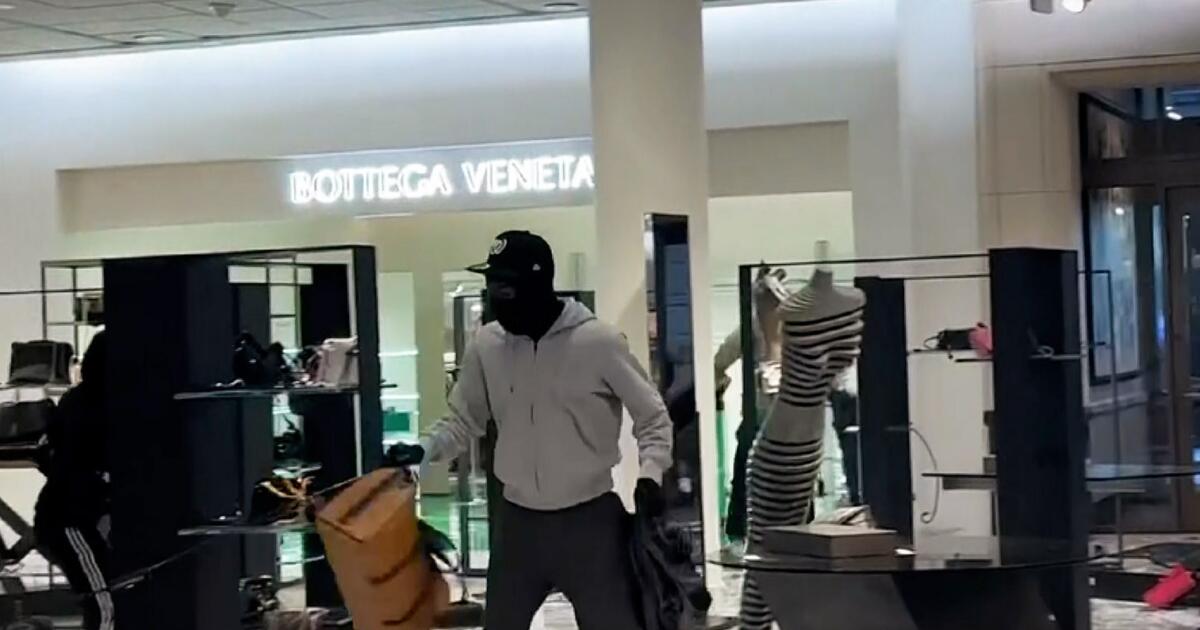

Retail crime is having a moment. It’s become a buzzword on retail earnings calls. Videos of people walking out of stores with armfuls of goods they didn’t pay for have captured attention on social media. And sensational crimes such as the recent mob robberies at malls in Canoga Park and Glendale have grabbed news headlines.
We are, it seems, living through an epidemic of retail crime. Or are we?
Top-line figures generally support the view that retail crime has increased. Total retail “shrink” — usually cast as a proxy for theft — was $94.5 billion in 2021, up from $90.8 billion in 2020, according to the National Retail Federation. Target’s shrink is on course to pass the $1-billion mark this year, up from $763 billion last year. Dick’s Sporting Goods, Ulta Beauty, Dollar Tree, Foot Locker, Home Depot, Walmart and other retailers also identified crime as a growing problem this earnings season. Walgreens and other retailers have blamed store closures on high theft rates and are testing new concepts to combat crime.
It is clear that shrink is on the rise and is starting to have more of a material impact on business performance. On the other hand, retailers have been known to make excuses for poor performance, and understanding the nuances of crime data and trends can be complicated.
Shrink is a general term that describes the difference between the value of inventory retailers think they should have and what they actually have, with the latter almost always being lower. The differences have a negative impact on financial results and must be accounted for.
Having less stock than is on the books could be a function of many factors, though. If something gets lost at the back of a warehouse or buried in a stockroom, it’s shrink. If a product is broken or damaged and not written off properly, it’s shrink. Lost in transit — shrink. Scanned incorrectly at the register — shrink.
The upshot is that not all shrink comes from crime. Around 26% of it can be attributed to operational failures on the part of retailers.
It’s also worth noting that the portion of shrink that can be blamed on crime isn’t entirely due to shoplifters or the sort of brazen robberies that attract public attention. Retail theft is often committed by a store’s own employees, for example, or by customers at self-checkout.
Unfortunately, however, few retailers go into much depth about the composition of their shrink. So increasing shrink rates could be due to deteriorating internal processes as much as or more than theft. This lack of transparency is an issue both for investors and for informed public discourse on the matter.
This problem is particularly acute when retailers speak generally about the effect of crime on profits, as Dick’s — whose net earnings just dropped 23% — did in its latest update. Dick’s blamed much of the decline on theft but did not quantify the impact, so it’s impossible to know the true scale of the problem. Profits are affected by an enormous number of factors, and it’s all too easy to hide other issues behind crime.
None of this is to suggest that retailers are being completely untruthful or that theft isn’t an issue. We know that the majority of shrink is composed of theft, by both outside parties and retail employees. Crime statistics, National Retail Federation surveys and other data also show that theft has increased. Worryingly, violent incidents, which sometimes involve theft, have risen too, putting workers in danger.
That makes transparency about retail crime more important. Retail theft has become a cudgel used to attack policies such as California’s Proposition 47, which reclassified some lower-value felony theft offenses as misdemeanors. But it’s only by looking at real data that we can make an informed judgment.
Retail theft can endanger workers and consumers, hurt companies and their shareholders, and, if left unchecked, contribute to the decay of cities and towns as retailers shut up shop. In short, it’s a problem worth tackling, and more transparency on the part of retailers can only help us do so.
Neil Saunders is a managing director and retail analyst at GlobalData Retail.

Retail crime is having a moment. It’s become a buzzword on retail earnings calls. Videos of people walking out of stores with armfuls of goods they didn’t pay for have captured attention on social media. And sensational crimes such as the recent mob robberies at malls in Canoga Park and Glendale have grabbed news headlines.
We are, it seems, living through an epidemic of retail crime. Or are we?
Top-line figures generally support the view that retail crime has increased. Total retail “shrink” — usually cast as a proxy for theft — was $94.5 billion in 2021, up from $90.8 billion in 2020, according to the National Retail Federation. Target’s shrink is on course to pass the $1-billion mark this year, up from $763 billion last year. Dick’s Sporting Goods, Ulta Beauty, Dollar Tree, Foot Locker, Home Depot, Walmart and other retailers also identified crime as a growing problem this earnings season. Walgreens and other retailers have blamed store closures on high theft rates and are testing new concepts to combat crime.
It is clear that shrink is on the rise and is starting to have more of a material impact on business performance. On the other hand, retailers have been known to make excuses for poor performance, and understanding the nuances of crime data and trends can be complicated.
Shrink is a general term that describes the difference between the value of inventory retailers think they should have and what they actually have, with the latter almost always being lower. The differences have a negative impact on financial results and must be accounted for.
Having less stock than is on the books could be a function of many factors, though. If something gets lost at the back of a warehouse or buried in a stockroom, it’s shrink. If a product is broken or damaged and not written off properly, it’s shrink. Lost in transit — shrink. Scanned incorrectly at the register — shrink.
The upshot is that not all shrink comes from crime. Around 26% of it can be attributed to operational failures on the part of retailers.
It’s also worth noting that the portion of shrink that can be blamed on crime isn’t entirely due to shoplifters or the sort of brazen robberies that attract public attention. Retail theft is often committed by a store’s own employees, for example, or by customers at self-checkout.
Unfortunately, however, few retailers go into much depth about the composition of their shrink. So increasing shrink rates could be due to deteriorating internal processes as much as or more than theft. This lack of transparency is an issue both for investors and for informed public discourse on the matter.
This problem is particularly acute when retailers speak generally about the effect of crime on profits, as Dick’s — whose net earnings just dropped 23% — did in its latest update. Dick’s blamed much of the decline on theft but did not quantify the impact, so it’s impossible to know the true scale of the problem. Profits are affected by an enormous number of factors, and it’s all too easy to hide other issues behind crime.
None of this is to suggest that retailers are being completely untruthful or that theft isn’t an issue. We know that the majority of shrink is composed of theft, by both outside parties and retail employees. Crime statistics, National Retail Federation surveys and other data also show that theft has increased. Worryingly, violent incidents, which sometimes involve theft, have risen too, putting workers in danger.
That makes transparency about retail crime more important. Retail theft has become a cudgel used to attack policies such as California’s Proposition 47, which reclassified some lower-value felony theft offenses as misdemeanors. But it’s only by looking at real data that we can make an informed judgment.
Retail theft can endanger workers and consumers, hurt companies and their shareholders, and, if left unchecked, contribute to the decay of cities and towns as retailers shut up shop. In short, it’s a problem worth tackling, and more transparency on the part of retailers can only help us do so.
Neil Saunders is a managing director and retail analyst at GlobalData Retail.

Retail crime is having a moment. It’s become a buzzword on retail earnings calls. Videos of people walking out of stores with armfuls of goods they didn’t pay for have captured attention on social media. And sensational crimes such as the recent mob robberies at malls in Canoga Park and Glendale have grabbed news headlines.
We are, it seems, living through an epidemic of retail crime. Or are we?
Top-line figures generally support the view that retail crime has increased. Total retail “shrink” — usually cast as a proxy for theft — was $94.5 billion in 2021, up from $90.8 billion in 2020, according to the National Retail Federation. Target’s shrink is on course to pass the $1-billion mark this year, up from $763 billion last year. Dick’s Sporting Goods, Ulta Beauty, Dollar Tree, Foot Locker, Home Depot, Walmart and other retailers also identified crime as a growing problem this earnings season. Walgreens and other retailers have blamed store closures on high theft rates and are testing new concepts to combat crime.
It is clear that shrink is on the rise and is starting to have more of a material impact on business performance. On the other hand, retailers have been known to make excuses for poor performance, and understanding the nuances of crime data and trends can be complicated.
Shrink is a general term that describes the difference between the value of inventory retailers think they should have and what they actually have, with the latter almost always being lower. The differences have a negative impact on financial results and must be accounted for.
Having less stock than is on the books could be a function of many factors, though. If something gets lost at the back of a warehouse or buried in a stockroom, it’s shrink. If a product is broken or damaged and not written off properly, it’s shrink. Lost in transit — shrink. Scanned incorrectly at the register — shrink.
The upshot is that not all shrink comes from crime. Around 26% of it can be attributed to operational failures on the part of retailers.
It’s also worth noting that the portion of shrink that can be blamed on crime isn’t entirely due to shoplifters or the sort of brazen robberies that attract public attention. Retail theft is often committed by a store’s own employees, for example, or by customers at self-checkout.
Unfortunately, however, few retailers go into much depth about the composition of their shrink. So increasing shrink rates could be due to deteriorating internal processes as much as or more than theft. This lack of transparency is an issue both for investors and for informed public discourse on the matter.
This problem is particularly acute when retailers speak generally about the effect of crime on profits, as Dick’s — whose net earnings just dropped 23% — did in its latest update. Dick’s blamed much of the decline on theft but did not quantify the impact, so it’s impossible to know the true scale of the problem. Profits are affected by an enormous number of factors, and it’s all too easy to hide other issues behind crime.
None of this is to suggest that retailers are being completely untruthful or that theft isn’t an issue. We know that the majority of shrink is composed of theft, by both outside parties and retail employees. Crime statistics, National Retail Federation surveys and other data also show that theft has increased. Worryingly, violent incidents, which sometimes involve theft, have risen too, putting workers in danger.
That makes transparency about retail crime more important. Retail theft has become a cudgel used to attack policies such as California’s Proposition 47, which reclassified some lower-value felony theft offenses as misdemeanors. But it’s only by looking at real data that we can make an informed judgment.
Retail theft can endanger workers and consumers, hurt companies and their shareholders, and, if left unchecked, contribute to the decay of cities and towns as retailers shut up shop. In short, it’s a problem worth tackling, and more transparency on the part of retailers can only help us do so.
Neil Saunders is a managing director and retail analyst at GlobalData Retail.
Retail crime is having a moment. It’s become a buzzword on retail earnings calls. Videos of people walking out of stores with armfuls of goods they didn’t pay for have captured attention on social media. And sensational crimes such as the recent mob robberies at malls in Canoga Park and Glendale have grabbed news headlines.
We are, it seems, living through an epidemic of retail crime. Or are we?
Top-line figures generally support the view that retail crime has increased. Total retail “shrink” — usually cast as a proxy for theft — was $94.5 billion in 2021, up from $90.8 billion in 2020, according to the National Retail Federation. Target’s shrink is on course to pass the $1-billion mark this year, up from $763 billion last year. Dick’s Sporting Goods, Ulta Beauty, Dollar Tree, Foot Locker, Home Depot, Walmart and other retailers also identified crime as a growing problem this earnings season. Walgreens and other retailers have blamed store closures on high theft rates and are testing new concepts to combat crime.
It is clear that shrink is on the rise and is starting to have more of a material impact on business performance. On the other hand, retailers have been known to make excuses for poor performance, and understanding the nuances of crime data and trends can be complicated.
Shrink is a general term that describes the difference between the value of inventory retailers think they should have and what they actually have, with the latter almost always being lower. The differences have a negative impact on financial results and must be accounted for.
Having less stock than is on the books could be a function of many factors, though. If something gets lost at the back of a warehouse or buried in a stockroom, it’s shrink. If a product is broken or damaged and not written off properly, it’s shrink. Lost in transit — shrink. Scanned incorrectly at the register — shrink.
The upshot is that not all shrink comes from crime. Around 26% of it can be attributed to operational failures on the part of retailers.
It’s also worth noting that the portion of shrink that can be blamed on crime isn’t entirely due to shoplifters or the sort of brazen robberies that attract public attention. Retail theft is often committed by a store’s own employees, for example, or by customers at self-checkout.
Unfortunately, however, few retailers go into much depth about the composition of their shrink. So increasing shrink rates could be due to deteriorating internal processes as much as or more than theft. This lack of transparency is an issue both for investors and for informed public discourse on the matter.
This problem is particularly acute when retailers speak generally about the effect of crime on profits, as Dick’s — whose net earnings just dropped 23% — did in its latest update. Dick’s blamed much of the decline on theft but did not quantify the impact, so it’s impossible to know the true scale of the problem. Profits are affected by an enormous number of factors, and it’s all too easy to hide other issues behind crime.
None of this is to suggest that retailers are being completely untruthful or that theft isn’t an issue. We know that the majority of shrink is composed of theft, by both outside parties and retail employees. Crime statistics, National Retail Federation surveys and other data also show that theft has increased. Worryingly, violent incidents, which sometimes involve theft, have risen too, putting workers in danger.
That makes transparency about retail crime more important. Retail theft has become a cudgel used to attack policies such as California’s Proposition 47, which reclassified some lower-value felony theft offenses as misdemeanors. But it’s only by looking at real data that we can make an informed judgment.
Retail theft can endanger workers and consumers, hurt companies and their shareholders, and, if left unchecked, contribute to the decay of cities and towns as retailers shut up shop. In short, it’s a problem worth tackling, and more transparency on the part of retailers can only help us do so.
Neil Saunders is a managing director and retail analyst at GlobalData Retail.

Retail crime is having a moment. It’s become a buzzword on retail earnings calls. Videos of people walking out of stores with armfuls of goods they didn’t pay for have captured attention on social media. And sensational crimes such as the recent mob robberies at malls in Canoga Park and Glendale have grabbed news headlines.
We are, it seems, living through an epidemic of retail crime. Or are we?
Top-line figures generally support the view that retail crime has increased. Total retail “shrink” — usually cast as a proxy for theft — was $94.5 billion in 2021, up from $90.8 billion in 2020, according to the National Retail Federation. Target’s shrink is on course to pass the $1-billion mark this year, up from $763 billion last year. Dick’s Sporting Goods, Ulta Beauty, Dollar Tree, Foot Locker, Home Depot, Walmart and other retailers also identified crime as a growing problem this earnings season. Walgreens and other retailers have blamed store closures on high theft rates and are testing new concepts to combat crime.
It is clear that shrink is on the rise and is starting to have more of a material impact on business performance. On the other hand, retailers have been known to make excuses for poor performance, and understanding the nuances of crime data and trends can be complicated.
Shrink is a general term that describes the difference between the value of inventory retailers think they should have and what they actually have, with the latter almost always being lower. The differences have a negative impact on financial results and must be accounted for.
Having less stock than is on the books could be a function of many factors, though. If something gets lost at the back of a warehouse or buried in a stockroom, it’s shrink. If a product is broken or damaged and not written off properly, it’s shrink. Lost in transit — shrink. Scanned incorrectly at the register — shrink.
The upshot is that not all shrink comes from crime. Around 26% of it can be attributed to operational failures on the part of retailers.
It’s also worth noting that the portion of shrink that can be blamed on crime isn’t entirely due to shoplifters or the sort of brazen robberies that attract public attention. Retail theft is often committed by a store’s own employees, for example, or by customers at self-checkout.
Unfortunately, however, few retailers go into much depth about the composition of their shrink. So increasing shrink rates could be due to deteriorating internal processes as much as or more than theft. This lack of transparency is an issue both for investors and for informed public discourse on the matter.
This problem is particularly acute when retailers speak generally about the effect of crime on profits, as Dick’s — whose net earnings just dropped 23% — did in its latest update. Dick’s blamed much of the decline on theft but did not quantify the impact, so it’s impossible to know the true scale of the problem. Profits are affected by an enormous number of factors, and it’s all too easy to hide other issues behind crime.
None of this is to suggest that retailers are being completely untruthful or that theft isn’t an issue. We know that the majority of shrink is composed of theft, by both outside parties and retail employees. Crime statistics, National Retail Federation surveys and other data also show that theft has increased. Worryingly, violent incidents, which sometimes involve theft, have risen too, putting workers in danger.
That makes transparency about retail crime more important. Retail theft has become a cudgel used to attack policies such as California’s Proposition 47, which reclassified some lower-value felony theft offenses as misdemeanors. But it’s only by looking at real data that we can make an informed judgment.
Retail theft can endanger workers and consumers, hurt companies and their shareholders, and, if left unchecked, contribute to the decay of cities and towns as retailers shut up shop. In short, it’s a problem worth tackling, and more transparency on the part of retailers can only help us do so.
Neil Saunders is a managing director and retail analyst at GlobalData Retail.
Retail crime is having a moment. It’s become a buzzword on retail earnings calls. Videos of people walking out of stores with armfuls of goods they didn’t pay for have captured attention on social media. And sensational crimes such as the recent mob robberies at malls in Canoga Park and Glendale have grabbed news headlines.
We are, it seems, living through an epidemic of retail crime. Or are we?
Top-line figures generally support the view that retail crime has increased. Total retail “shrink” — usually cast as a proxy for theft — was $94.5 billion in 2021, up from $90.8 billion in 2020, according to the National Retail Federation. Target’s shrink is on course to pass the $1-billion mark this year, up from $763 billion last year. Dick’s Sporting Goods, Ulta Beauty, Dollar Tree, Foot Locker, Home Depot, Walmart and other retailers also identified crime as a growing problem this earnings season. Walgreens and other retailers have blamed store closures on high theft rates and are testing new concepts to combat crime.
It is clear that shrink is on the rise and is starting to have more of a material impact on business performance. On the other hand, retailers have been known to make excuses for poor performance, and understanding the nuances of crime data and trends can be complicated.
Shrink is a general term that describes the difference between the value of inventory retailers think they should have and what they actually have, with the latter almost always being lower. The differences have a negative impact on financial results and must be accounted for.
Having less stock than is on the books could be a function of many factors, though. If something gets lost at the back of a warehouse or buried in a stockroom, it’s shrink. If a product is broken or damaged and not written off properly, it’s shrink. Lost in transit — shrink. Scanned incorrectly at the register — shrink.
The upshot is that not all shrink comes from crime. Around 26% of it can be attributed to operational failures on the part of retailers.
It’s also worth noting that the portion of shrink that can be blamed on crime isn’t entirely due to shoplifters or the sort of brazen robberies that attract public attention. Retail theft is often committed by a store’s own employees, for example, or by customers at self-checkout.
Unfortunately, however, few retailers go into much depth about the composition of their shrink. So increasing shrink rates could be due to deteriorating internal processes as much as or more than theft. This lack of transparency is an issue both for investors and for informed public discourse on the matter.
This problem is particularly acute when retailers speak generally about the effect of crime on profits, as Dick’s — whose net earnings just dropped 23% — did in its latest update. Dick’s blamed much of the decline on theft but did not quantify the impact, so it’s impossible to know the true scale of the problem. Profits are affected by an enormous number of factors, and it’s all too easy to hide other issues behind crime.
None of this is to suggest that retailers are being completely untruthful or that theft isn’t an issue. We know that the majority of shrink is composed of theft, by both outside parties and retail employees. Crime statistics, National Retail Federation surveys and other data also show that theft has increased. Worryingly, violent incidents, which sometimes involve theft, have risen too, putting workers in danger.
That makes transparency about retail crime more important. Retail theft has become a cudgel used to attack policies such as California’s Proposition 47, which reclassified some lower-value felony theft offenses as misdemeanors. But it’s only by looking at real data that we can make an informed judgment.
Retail theft can endanger workers and consumers, hurt companies and their shareholders, and, if left unchecked, contribute to the decay of cities and towns as retailers shut up shop. In short, it’s a problem worth tackling, and more transparency on the part of retailers can only help us do so.
Neil Saunders is a managing director and retail analyst at GlobalData Retail.
Retail crime is having a moment. It’s become a buzzword on retail earnings calls. Videos of people walking out of stores with armfuls of goods they didn’t pay for have captured attention on social media. And sensational crimes such as the recent mob robberies at malls in Canoga Park and Glendale have grabbed news headlines.
We are, it seems, living through an epidemic of retail crime. Or are we?
Top-line figures generally support the view that retail crime has increased. Total retail “shrink” — usually cast as a proxy for theft — was $94.5 billion in 2021, up from $90.8 billion in 2020, according to the National Retail Federation. Target’s shrink is on course to pass the $1-billion mark this year, up from $763 billion last year. Dick’s Sporting Goods, Ulta Beauty, Dollar Tree, Foot Locker, Home Depot, Walmart and other retailers also identified crime as a growing problem this earnings season. Walgreens and other retailers have blamed store closures on high theft rates and are testing new concepts to combat crime.
It is clear that shrink is on the rise and is starting to have more of a material impact on business performance. On the other hand, retailers have been known to make excuses for poor performance, and understanding the nuances of crime data and trends can be complicated.
Shrink is a general term that describes the difference between the value of inventory retailers think they should have and what they actually have, with the latter almost always being lower. The differences have a negative impact on financial results and must be accounted for.
Having less stock than is on the books could be a function of many factors, though. If something gets lost at the back of a warehouse or buried in a stockroom, it’s shrink. If a product is broken or damaged and not written off properly, it’s shrink. Lost in transit — shrink. Scanned incorrectly at the register — shrink.
The upshot is that not all shrink comes from crime. Around 26% of it can be attributed to operational failures on the part of retailers.
It’s also worth noting that the portion of shrink that can be blamed on crime isn’t entirely due to shoplifters or the sort of brazen robberies that attract public attention. Retail theft is often committed by a store’s own employees, for example, or by customers at self-checkout.
Unfortunately, however, few retailers go into much depth about the composition of their shrink. So increasing shrink rates could be due to deteriorating internal processes as much as or more than theft. This lack of transparency is an issue both for investors and for informed public discourse on the matter.
This problem is particularly acute when retailers speak generally about the effect of crime on profits, as Dick’s — whose net earnings just dropped 23% — did in its latest update. Dick’s blamed much of the decline on theft but did not quantify the impact, so it’s impossible to know the true scale of the problem. Profits are affected by an enormous number of factors, and it’s all too easy to hide other issues behind crime.
None of this is to suggest that retailers are being completely untruthful or that theft isn’t an issue. We know that the majority of shrink is composed of theft, by both outside parties and retail employees. Crime statistics, National Retail Federation surveys and other data also show that theft has increased. Worryingly, violent incidents, which sometimes involve theft, have risen too, putting workers in danger.
That makes transparency about retail crime more important. Retail theft has become a cudgel used to attack policies such as California’s Proposition 47, which reclassified some lower-value felony theft offenses as misdemeanors. But it’s only by looking at real data that we can make an informed judgment.
Retail theft can endanger workers and consumers, hurt companies and their shareholders, and, if left unchecked, contribute to the decay of cities and towns as retailers shut up shop. In short, it’s a problem worth tackling, and more transparency on the part of retailers can only help us do so.
Neil Saunders is a managing director and retail analyst at GlobalData Retail.
Retail crime is having a moment. It’s become a buzzword on retail earnings calls. Videos of people walking out of stores with armfuls of goods they didn’t pay for have captured attention on social media. And sensational crimes such as the recent mob robberies at malls in Canoga Park and Glendale have grabbed news headlines.
We are, it seems, living through an epidemic of retail crime. Or are we?
Top-line figures generally support the view that retail crime has increased. Total retail “shrink” — usually cast as a proxy for theft — was $94.5 billion in 2021, up from $90.8 billion in 2020, according to the National Retail Federation. Target’s shrink is on course to pass the $1-billion mark this year, up from $763 billion last year. Dick’s Sporting Goods, Ulta Beauty, Dollar Tree, Foot Locker, Home Depot, Walmart and other retailers also identified crime as a growing problem this earnings season. Walgreens and other retailers have blamed store closures on high theft rates and are testing new concepts to combat crime.
It is clear that shrink is on the rise and is starting to have more of a material impact on business performance. On the other hand, retailers have been known to make excuses for poor performance, and understanding the nuances of crime data and trends can be complicated.
Shrink is a general term that describes the difference between the value of inventory retailers think they should have and what they actually have, with the latter almost always being lower. The differences have a negative impact on financial results and must be accounted for.
Having less stock than is on the books could be a function of many factors, though. If something gets lost at the back of a warehouse or buried in a stockroom, it’s shrink. If a product is broken or damaged and not written off properly, it’s shrink. Lost in transit — shrink. Scanned incorrectly at the register — shrink.
The upshot is that not all shrink comes from crime. Around 26% of it can be attributed to operational failures on the part of retailers.
It’s also worth noting that the portion of shrink that can be blamed on crime isn’t entirely due to shoplifters or the sort of brazen robberies that attract public attention. Retail theft is often committed by a store’s own employees, for example, or by customers at self-checkout.
Unfortunately, however, few retailers go into much depth about the composition of their shrink. So increasing shrink rates could be due to deteriorating internal processes as much as or more than theft. This lack of transparency is an issue both for investors and for informed public discourse on the matter.
This problem is particularly acute when retailers speak generally about the effect of crime on profits, as Dick’s — whose net earnings just dropped 23% — did in its latest update. Dick’s blamed much of the decline on theft but did not quantify the impact, so it’s impossible to know the true scale of the problem. Profits are affected by an enormous number of factors, and it’s all too easy to hide other issues behind crime.
None of this is to suggest that retailers are being completely untruthful or that theft isn’t an issue. We know that the majority of shrink is composed of theft, by both outside parties and retail employees. Crime statistics, National Retail Federation surveys and other data also show that theft has increased. Worryingly, violent incidents, which sometimes involve theft, have risen too, putting workers in danger.
That makes transparency about retail crime more important. Retail theft has become a cudgel used to attack policies such as California’s Proposition 47, which reclassified some lower-value felony theft offenses as misdemeanors. But it’s only by looking at real data that we can make an informed judgment.
Retail theft can endanger workers and consumers, hurt companies and their shareholders, and, if left unchecked, contribute to the decay of cities and towns as retailers shut up shop. In short, it’s a problem worth tackling, and more transparency on the part of retailers can only help us do so.
Neil Saunders is a managing director and retail analyst at GlobalData Retail.

