

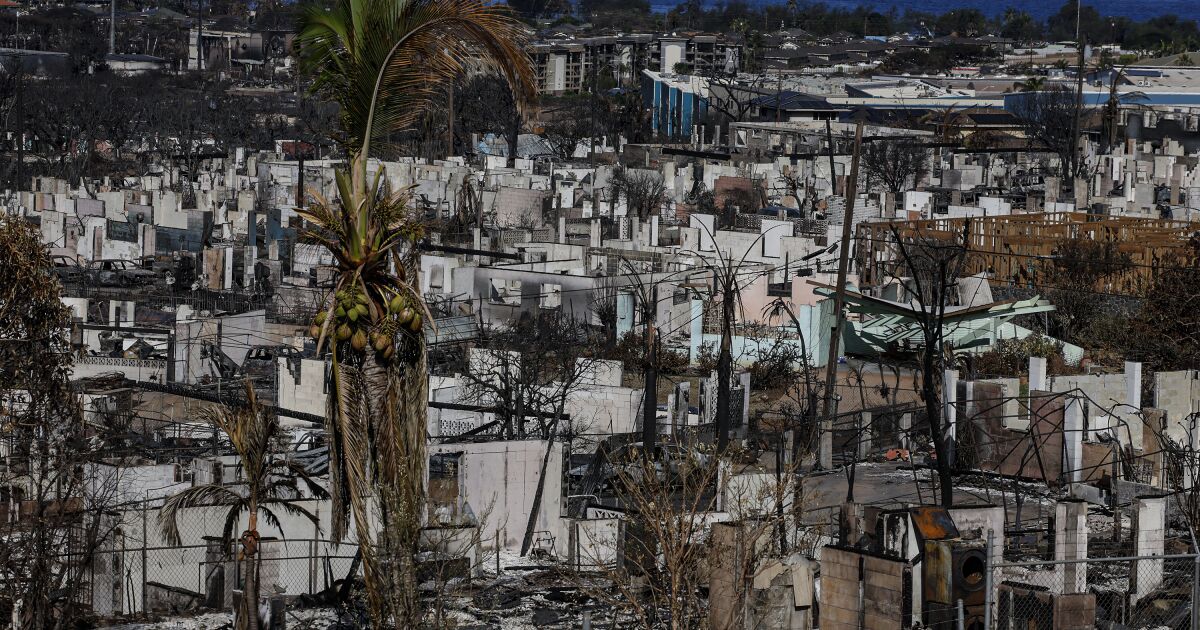
As officials review the emergency response to the Lahaina fire and what could have been done differently, one question continues to pop up: Why weren’t there sirens?
Herman Andaya, who leads Maui’s Emergency Management Agency, addressed the issue during a Wednesday afternoon news conference that grew tense at times as reporters asserted that the decision not to use sirens could have led to loss of life.
“Do you regret not sounding the sirens?” asked a reporter with CBS News.
“I do not,” Andaya responded.
The island’s outdoor siren system was designed for tsunamis, not wildfires, he said, and is not part of the agency’s standard response protocol.
“The public is trained to seek higher ground in the event that the siren has sounded,” he said.
Instead, Andaya explained, the agency used several other types of emergency notifications to alert people to the fire. Some of the systems used were wireless emergency alerts, which send text messages to residents, and the emergency alert system, which broadcasts emergency notifications via television and radio. Other local alert systems, such as MEMA alerts, have also been used in the past.
“It is our practice to use the most effective means of conveying an emergency message to the public during a wildland fire,” Andaya said.
Andaya also noted many of the sirens are along the coastline, not on the mountain side of Lahaina, which is where the fire ignited.
Hawaii Gov. Josh Green backed Andaya at the news conference, recounting his own experience when he came to the state to practice medicine.
“When I first moved to Hawaii, people told me if you hear a siren, it’s a tsunami and go to high ground,” Green said.
Andaya is facing criticism on topics besides the decision on sounding the sirens. Honolulu Civil Beat, a nonprofit news organization, published an article Wednesday calling out Andaya’s lack of professional experience in emergency management leadership prior to his selection to lead the EMA.
When a reporter mentioned the article, Andaya defended his experience, saying he’d gained expertise during 11 years working as the Maui County mayor’s chief of staff and later as the deputy director of the county’s Department of Housing and Human Concerns. During that time, he said he went through “numerous trainings” and often reported to the emergency operations center. He also had to complete a civil service exam and was vetted by emergency managers before he was selected for the role.
“So to say that I am not qualified I think is incorrect,” Andaya said.
Andaya and other Hawaii officials have continued to work the emergency response in the aftermath of the Lahaina fire, which remained 85% contained Wednesday.
The death toll from the fire rose to 110 people as of Wednesday, with 38% of the area searched, according to authorities. The first group of names of the deceased was announced Tuesday, and more are set to be released pending the notification of family. Search efforts have expanded, with 40 cadaver dogs, and 225 additional disaster-relief personnel are set to arrive on Maui.
With one of the two major highways into Lahaina reopened Wednesday, survivors have begun returning to their homes for the first time since the blaze swept through eight days ago. Information about how to help those affected by the fire can be found at MauiNuiStrong.info.

As officials review the emergency response to the Lahaina fire and what could have been done differently, one question continues to pop up: Why weren’t there sirens?
Herman Andaya, who leads Maui’s Emergency Management Agency, addressed the issue during a Wednesday afternoon news conference that grew tense at times as reporters asserted that the decision not to use sirens could have led to loss of life.
“Do you regret not sounding the sirens?” asked a reporter with CBS News.
“I do not,” Andaya responded.
The island’s outdoor siren system was designed for tsunamis, not wildfires, he said, and is not part of the agency’s standard response protocol.
“The public is trained to seek higher ground in the event that the siren has sounded,” he said.
Instead, Andaya explained, the agency used several other types of emergency notifications to alert people to the fire. Some of the systems used were wireless emergency alerts, which send text messages to residents, and the emergency alert system, which broadcasts emergency notifications via television and radio. Other local alert systems, such as MEMA alerts, have also been used in the past.
“It is our practice to use the most effective means of conveying an emergency message to the public during a wildland fire,” Andaya said.
Andaya also noted many of the sirens are along the coastline, not on the mountain side of Lahaina, which is where the fire ignited.
Hawaii Gov. Josh Green backed Andaya at the news conference, recounting his own experience when he came to the state to practice medicine.
“When I first moved to Hawaii, people told me if you hear a siren, it’s a tsunami and go to high ground,” Green said.
Andaya is facing criticism on topics besides the decision on sounding the sirens. Honolulu Civil Beat, a nonprofit news organization, published an article Wednesday calling out Andaya’s lack of professional experience in emergency management leadership prior to his selection to lead the EMA.
When a reporter mentioned the article, Andaya defended his experience, saying he’d gained expertise during 11 years working as the Maui County mayor’s chief of staff and later as the deputy director of the county’s Department of Housing and Human Concerns. During that time, he said he went through “numerous trainings” and often reported to the emergency operations center. He also had to complete a civil service exam and was vetted by emergency managers before he was selected for the role.
“So to say that I am not qualified I think is incorrect,” Andaya said.
Andaya and other Hawaii officials have continued to work the emergency response in the aftermath of the Lahaina fire, which remained 85% contained Wednesday.
The death toll from the fire rose to 110 people as of Wednesday, with 38% of the area searched, according to authorities. The first group of names of the deceased was announced Tuesday, and more are set to be released pending the notification of family. Search efforts have expanded, with 40 cadaver dogs, and 225 additional disaster-relief personnel are set to arrive on Maui.
With one of the two major highways into Lahaina reopened Wednesday, survivors have begun returning to their homes for the first time since the blaze swept through eight days ago. Information about how to help those affected by the fire can be found at MauiNuiStrong.info.

As officials review the emergency response to the Lahaina fire and what could have been done differently, one question continues to pop up: Why weren’t there sirens?
Herman Andaya, who leads Maui’s Emergency Management Agency, addressed the issue during a Wednesday afternoon news conference that grew tense at times as reporters asserted that the decision not to use sirens could have led to loss of life.
“Do you regret not sounding the sirens?” asked a reporter with CBS News.
“I do not,” Andaya responded.
The island’s outdoor siren system was designed for tsunamis, not wildfires, he said, and is not part of the agency’s standard response protocol.
“The public is trained to seek higher ground in the event that the siren has sounded,” he said.
Instead, Andaya explained, the agency used several other types of emergency notifications to alert people to the fire. Some of the systems used were wireless emergency alerts, which send text messages to residents, and the emergency alert system, which broadcasts emergency notifications via television and radio. Other local alert systems, such as MEMA alerts, have also been used in the past.
“It is our practice to use the most effective means of conveying an emergency message to the public during a wildland fire,” Andaya said.
Andaya also noted many of the sirens are along the coastline, not on the mountain side of Lahaina, which is where the fire ignited.
Hawaii Gov. Josh Green backed Andaya at the news conference, recounting his own experience when he came to the state to practice medicine.
“When I first moved to Hawaii, people told me if you hear a siren, it’s a tsunami and go to high ground,” Green said.
Andaya is facing criticism on topics besides the decision on sounding the sirens. Honolulu Civil Beat, a nonprofit news organization, published an article Wednesday calling out Andaya’s lack of professional experience in emergency management leadership prior to his selection to lead the EMA.
When a reporter mentioned the article, Andaya defended his experience, saying he’d gained expertise during 11 years working as the Maui County mayor’s chief of staff and later as the deputy director of the county’s Department of Housing and Human Concerns. During that time, he said he went through “numerous trainings” and often reported to the emergency operations center. He also had to complete a civil service exam and was vetted by emergency managers before he was selected for the role.
“So to say that I am not qualified I think is incorrect,” Andaya said.
Andaya and other Hawaii officials have continued to work the emergency response in the aftermath of the Lahaina fire, which remained 85% contained Wednesday.
The death toll from the fire rose to 110 people as of Wednesday, with 38% of the area searched, according to authorities. The first group of names of the deceased was announced Tuesday, and more are set to be released pending the notification of family. Search efforts have expanded, with 40 cadaver dogs, and 225 additional disaster-relief personnel are set to arrive on Maui.
With one of the two major highways into Lahaina reopened Wednesday, survivors have begun returning to their homes for the first time since the blaze swept through eight days ago. Information about how to help those affected by the fire can be found at MauiNuiStrong.info.
As officials review the emergency response to the Lahaina fire and what could have been done differently, one question continues to pop up: Why weren’t there sirens?
Herman Andaya, who leads Maui’s Emergency Management Agency, addressed the issue during a Wednesday afternoon news conference that grew tense at times as reporters asserted that the decision not to use sirens could have led to loss of life.
“Do you regret not sounding the sirens?” asked a reporter with CBS News.
“I do not,” Andaya responded.
The island’s outdoor siren system was designed for tsunamis, not wildfires, he said, and is not part of the agency’s standard response protocol.
“The public is trained to seek higher ground in the event that the siren has sounded,” he said.
Instead, Andaya explained, the agency used several other types of emergency notifications to alert people to the fire. Some of the systems used were wireless emergency alerts, which send text messages to residents, and the emergency alert system, which broadcasts emergency notifications via television and radio. Other local alert systems, such as MEMA alerts, have also been used in the past.
“It is our practice to use the most effective means of conveying an emergency message to the public during a wildland fire,” Andaya said.
Andaya also noted many of the sirens are along the coastline, not on the mountain side of Lahaina, which is where the fire ignited.
Hawaii Gov. Josh Green backed Andaya at the news conference, recounting his own experience when he came to the state to practice medicine.
“When I first moved to Hawaii, people told me if you hear a siren, it’s a tsunami and go to high ground,” Green said.
Andaya is facing criticism on topics besides the decision on sounding the sirens. Honolulu Civil Beat, a nonprofit news organization, published an article Wednesday calling out Andaya’s lack of professional experience in emergency management leadership prior to his selection to lead the EMA.
When a reporter mentioned the article, Andaya defended his experience, saying he’d gained expertise during 11 years working as the Maui County mayor’s chief of staff and later as the deputy director of the county’s Department of Housing and Human Concerns. During that time, he said he went through “numerous trainings” and often reported to the emergency operations center. He also had to complete a civil service exam and was vetted by emergency managers before he was selected for the role.
“So to say that I am not qualified I think is incorrect,” Andaya said.
Andaya and other Hawaii officials have continued to work the emergency response in the aftermath of the Lahaina fire, which remained 85% contained Wednesday.
The death toll from the fire rose to 110 people as of Wednesday, with 38% of the area searched, according to authorities. The first group of names of the deceased was announced Tuesday, and more are set to be released pending the notification of family. Search efforts have expanded, with 40 cadaver dogs, and 225 additional disaster-relief personnel are set to arrive on Maui.
With one of the two major highways into Lahaina reopened Wednesday, survivors have begun returning to their homes for the first time since the blaze swept through eight days ago. Information about how to help those affected by the fire can be found at MauiNuiStrong.info.

As officials review the emergency response to the Lahaina fire and what could have been done differently, one question continues to pop up: Why weren’t there sirens?
Herman Andaya, who leads Maui’s Emergency Management Agency, addressed the issue during a Wednesday afternoon news conference that grew tense at times as reporters asserted that the decision not to use sirens could have led to loss of life.
“Do you regret not sounding the sirens?” asked a reporter with CBS News.
“I do not,” Andaya responded.
The island’s outdoor siren system was designed for tsunamis, not wildfires, he said, and is not part of the agency’s standard response protocol.
“The public is trained to seek higher ground in the event that the siren has sounded,” he said.
Instead, Andaya explained, the agency used several other types of emergency notifications to alert people to the fire. Some of the systems used were wireless emergency alerts, which send text messages to residents, and the emergency alert system, which broadcasts emergency notifications via television and radio. Other local alert systems, such as MEMA alerts, have also been used in the past.
“It is our practice to use the most effective means of conveying an emergency message to the public during a wildland fire,” Andaya said.
Andaya also noted many of the sirens are along the coastline, not on the mountain side of Lahaina, which is where the fire ignited.
Hawaii Gov. Josh Green backed Andaya at the news conference, recounting his own experience when he came to the state to practice medicine.
“When I first moved to Hawaii, people told me if you hear a siren, it’s a tsunami and go to high ground,” Green said.
Andaya is facing criticism on topics besides the decision on sounding the sirens. Honolulu Civil Beat, a nonprofit news organization, published an article Wednesday calling out Andaya’s lack of professional experience in emergency management leadership prior to his selection to lead the EMA.
When a reporter mentioned the article, Andaya defended his experience, saying he’d gained expertise during 11 years working as the Maui County mayor’s chief of staff and later as the deputy director of the county’s Department of Housing and Human Concerns. During that time, he said he went through “numerous trainings” and often reported to the emergency operations center. He also had to complete a civil service exam and was vetted by emergency managers before he was selected for the role.
“So to say that I am not qualified I think is incorrect,” Andaya said.
Andaya and other Hawaii officials have continued to work the emergency response in the aftermath of the Lahaina fire, which remained 85% contained Wednesday.
The death toll from the fire rose to 110 people as of Wednesday, with 38% of the area searched, according to authorities. The first group of names of the deceased was announced Tuesday, and more are set to be released pending the notification of family. Search efforts have expanded, with 40 cadaver dogs, and 225 additional disaster-relief personnel are set to arrive on Maui.
With one of the two major highways into Lahaina reopened Wednesday, survivors have begun returning to their homes for the first time since the blaze swept through eight days ago. Information about how to help those affected by the fire can be found at MauiNuiStrong.info.
As officials review the emergency response to the Lahaina fire and what could have been done differently, one question continues to pop up: Why weren’t there sirens?
Herman Andaya, who leads Maui’s Emergency Management Agency, addressed the issue during a Wednesday afternoon news conference that grew tense at times as reporters asserted that the decision not to use sirens could have led to loss of life.
“Do you regret not sounding the sirens?” asked a reporter with CBS News.
“I do not,” Andaya responded.
The island’s outdoor siren system was designed for tsunamis, not wildfires, he said, and is not part of the agency’s standard response protocol.
“The public is trained to seek higher ground in the event that the siren has sounded,” he said.
Instead, Andaya explained, the agency used several other types of emergency notifications to alert people to the fire. Some of the systems used were wireless emergency alerts, which send text messages to residents, and the emergency alert system, which broadcasts emergency notifications via television and radio. Other local alert systems, such as MEMA alerts, have also been used in the past.
“It is our practice to use the most effective means of conveying an emergency message to the public during a wildland fire,” Andaya said.
Andaya also noted many of the sirens are along the coastline, not on the mountain side of Lahaina, which is where the fire ignited.
Hawaii Gov. Josh Green backed Andaya at the news conference, recounting his own experience when he came to the state to practice medicine.
“When I first moved to Hawaii, people told me if you hear a siren, it’s a tsunami and go to high ground,” Green said.
Andaya is facing criticism on topics besides the decision on sounding the sirens. Honolulu Civil Beat, a nonprofit news organization, published an article Wednesday calling out Andaya’s lack of professional experience in emergency management leadership prior to his selection to lead the EMA.
When a reporter mentioned the article, Andaya defended his experience, saying he’d gained expertise during 11 years working as the Maui County mayor’s chief of staff and later as the deputy director of the county’s Department of Housing and Human Concerns. During that time, he said he went through “numerous trainings” and often reported to the emergency operations center. He also had to complete a civil service exam and was vetted by emergency managers before he was selected for the role.
“So to say that I am not qualified I think is incorrect,” Andaya said.
Andaya and other Hawaii officials have continued to work the emergency response in the aftermath of the Lahaina fire, which remained 85% contained Wednesday.
The death toll from the fire rose to 110 people as of Wednesday, with 38% of the area searched, according to authorities. The first group of names of the deceased was announced Tuesday, and more are set to be released pending the notification of family. Search efforts have expanded, with 40 cadaver dogs, and 225 additional disaster-relief personnel are set to arrive on Maui.
With one of the two major highways into Lahaina reopened Wednesday, survivors have begun returning to their homes for the first time since the blaze swept through eight days ago. Information about how to help those affected by the fire can be found at MauiNuiStrong.info.
As officials review the emergency response to the Lahaina fire and what could have been done differently, one question continues to pop up: Why weren’t there sirens?
Herman Andaya, who leads Maui’s Emergency Management Agency, addressed the issue during a Wednesday afternoon news conference that grew tense at times as reporters asserted that the decision not to use sirens could have led to loss of life.
“Do you regret not sounding the sirens?” asked a reporter with CBS News.
“I do not,” Andaya responded.
The island’s outdoor siren system was designed for tsunamis, not wildfires, he said, and is not part of the agency’s standard response protocol.
“The public is trained to seek higher ground in the event that the siren has sounded,” he said.
Instead, Andaya explained, the agency used several other types of emergency notifications to alert people to the fire. Some of the systems used were wireless emergency alerts, which send text messages to residents, and the emergency alert system, which broadcasts emergency notifications via television and radio. Other local alert systems, such as MEMA alerts, have also been used in the past.
“It is our practice to use the most effective means of conveying an emergency message to the public during a wildland fire,” Andaya said.
Andaya also noted many of the sirens are along the coastline, not on the mountain side of Lahaina, which is where the fire ignited.
Hawaii Gov. Josh Green backed Andaya at the news conference, recounting his own experience when he came to the state to practice medicine.
“When I first moved to Hawaii, people told me if you hear a siren, it’s a tsunami and go to high ground,” Green said.
Andaya is facing criticism on topics besides the decision on sounding the sirens. Honolulu Civil Beat, a nonprofit news organization, published an article Wednesday calling out Andaya’s lack of professional experience in emergency management leadership prior to his selection to lead the EMA.
When a reporter mentioned the article, Andaya defended his experience, saying he’d gained expertise during 11 years working as the Maui County mayor’s chief of staff and later as the deputy director of the county’s Department of Housing and Human Concerns. During that time, he said he went through “numerous trainings” and often reported to the emergency operations center. He also had to complete a civil service exam and was vetted by emergency managers before he was selected for the role.
“So to say that I am not qualified I think is incorrect,” Andaya said.
Andaya and other Hawaii officials have continued to work the emergency response in the aftermath of the Lahaina fire, which remained 85% contained Wednesday.
The death toll from the fire rose to 110 people as of Wednesday, with 38% of the area searched, according to authorities. The first group of names of the deceased was announced Tuesday, and more are set to be released pending the notification of family. Search efforts have expanded, with 40 cadaver dogs, and 225 additional disaster-relief personnel are set to arrive on Maui.
With one of the two major highways into Lahaina reopened Wednesday, survivors have begun returning to their homes for the first time since the blaze swept through eight days ago. Information about how to help those affected by the fire can be found at MauiNuiStrong.info.
As officials review the emergency response to the Lahaina fire and what could have been done differently, one question continues to pop up: Why weren’t there sirens?
Herman Andaya, who leads Maui’s Emergency Management Agency, addressed the issue during a Wednesday afternoon news conference that grew tense at times as reporters asserted that the decision not to use sirens could have led to loss of life.
“Do you regret not sounding the sirens?” asked a reporter with CBS News.
“I do not,” Andaya responded.
The island’s outdoor siren system was designed for tsunamis, not wildfires, he said, and is not part of the agency’s standard response protocol.
“The public is trained to seek higher ground in the event that the siren has sounded,” he said.
Instead, Andaya explained, the agency used several other types of emergency notifications to alert people to the fire. Some of the systems used were wireless emergency alerts, which send text messages to residents, and the emergency alert system, which broadcasts emergency notifications via television and radio. Other local alert systems, such as MEMA alerts, have also been used in the past.
“It is our practice to use the most effective means of conveying an emergency message to the public during a wildland fire,” Andaya said.
Andaya also noted many of the sirens are along the coastline, not on the mountain side of Lahaina, which is where the fire ignited.
Hawaii Gov. Josh Green backed Andaya at the news conference, recounting his own experience when he came to the state to practice medicine.
“When I first moved to Hawaii, people told me if you hear a siren, it’s a tsunami and go to high ground,” Green said.
Andaya is facing criticism on topics besides the decision on sounding the sirens. Honolulu Civil Beat, a nonprofit news organization, published an article Wednesday calling out Andaya’s lack of professional experience in emergency management leadership prior to his selection to lead the EMA.
When a reporter mentioned the article, Andaya defended his experience, saying he’d gained expertise during 11 years working as the Maui County mayor’s chief of staff and later as the deputy director of the county’s Department of Housing and Human Concerns. During that time, he said he went through “numerous trainings” and often reported to the emergency operations center. He also had to complete a civil service exam and was vetted by emergency managers before he was selected for the role.
“So to say that I am not qualified I think is incorrect,” Andaya said.
Andaya and other Hawaii officials have continued to work the emergency response in the aftermath of the Lahaina fire, which remained 85% contained Wednesday.
The death toll from the fire rose to 110 people as of Wednesday, with 38% of the area searched, according to authorities. The first group of names of the deceased was announced Tuesday, and more are set to be released pending the notification of family. Search efforts have expanded, with 40 cadaver dogs, and 225 additional disaster-relief personnel are set to arrive on Maui.
With one of the two major highways into Lahaina reopened Wednesday, survivors have begun returning to their homes for the first time since the blaze swept through eight days ago. Information about how to help those affected by the fire can be found at MauiNuiStrong.info.

As officials review the emergency response to the Lahaina fire and what could have been done differently, one question continues to pop up: Why weren’t there sirens?
Herman Andaya, who leads Maui’s Emergency Management Agency, addressed the issue during a Wednesday afternoon news conference that grew tense at times as reporters asserted that the decision not to use sirens could have led to loss of life.
“Do you regret not sounding the sirens?” asked a reporter with CBS News.
“I do not,” Andaya responded.
The island’s outdoor siren system was designed for tsunamis, not wildfires, he said, and is not part of the agency’s standard response protocol.
“The public is trained to seek higher ground in the event that the siren has sounded,” he said.
Instead, Andaya explained, the agency used several other types of emergency notifications to alert people to the fire. Some of the systems used were wireless emergency alerts, which send text messages to residents, and the emergency alert system, which broadcasts emergency notifications via television and radio. Other local alert systems, such as MEMA alerts, have also been used in the past.
“It is our practice to use the most effective means of conveying an emergency message to the public during a wildland fire,” Andaya said.
Andaya also noted many of the sirens are along the coastline, not on the mountain side of Lahaina, which is where the fire ignited.
Hawaii Gov. Josh Green backed Andaya at the news conference, recounting his own experience when he came to the state to practice medicine.
“When I first moved to Hawaii, people told me if you hear a siren, it’s a tsunami and go to high ground,” Green said.
Andaya is facing criticism on topics besides the decision on sounding the sirens. Honolulu Civil Beat, a nonprofit news organization, published an article Wednesday calling out Andaya’s lack of professional experience in emergency management leadership prior to his selection to lead the EMA.
When a reporter mentioned the article, Andaya defended his experience, saying he’d gained expertise during 11 years working as the Maui County mayor’s chief of staff and later as the deputy director of the county’s Department of Housing and Human Concerns. During that time, he said he went through “numerous trainings” and often reported to the emergency operations center. He also had to complete a civil service exam and was vetted by emergency managers before he was selected for the role.
“So to say that I am not qualified I think is incorrect,” Andaya said.
Andaya and other Hawaii officials have continued to work the emergency response in the aftermath of the Lahaina fire, which remained 85% contained Wednesday.
The death toll from the fire rose to 110 people as of Wednesday, with 38% of the area searched, according to authorities. The first group of names of the deceased was announced Tuesday, and more are set to be released pending the notification of family. Search efforts have expanded, with 40 cadaver dogs, and 225 additional disaster-relief personnel are set to arrive on Maui.
With one of the two major highways into Lahaina reopened Wednesday, survivors have begun returning to their homes for the first time since the blaze swept through eight days ago. Information about how to help those affected by the fire can be found at MauiNuiStrong.info.
As officials review the emergency response to the Lahaina fire and what could have been done differently, one question continues to pop up: Why weren’t there sirens?
Herman Andaya, who leads Maui’s Emergency Management Agency, addressed the issue during a Wednesday afternoon news conference that grew tense at times as reporters asserted that the decision not to use sirens could have led to loss of life.
“Do you regret not sounding the sirens?” asked a reporter with CBS News.
“I do not,” Andaya responded.
The island’s outdoor siren system was designed for tsunamis, not wildfires, he said, and is not part of the agency’s standard response protocol.
“The public is trained to seek higher ground in the event that the siren has sounded,” he said.
Instead, Andaya explained, the agency used several other types of emergency notifications to alert people to the fire. Some of the systems used were wireless emergency alerts, which send text messages to residents, and the emergency alert system, which broadcasts emergency notifications via television and radio. Other local alert systems, such as MEMA alerts, have also been used in the past.
“It is our practice to use the most effective means of conveying an emergency message to the public during a wildland fire,” Andaya said.
Andaya also noted many of the sirens are along the coastline, not on the mountain side of Lahaina, which is where the fire ignited.
Hawaii Gov. Josh Green backed Andaya at the news conference, recounting his own experience when he came to the state to practice medicine.
“When I first moved to Hawaii, people told me if you hear a siren, it’s a tsunami and go to high ground,” Green said.
Andaya is facing criticism on topics besides the decision on sounding the sirens. Honolulu Civil Beat, a nonprofit news organization, published an article Wednesday calling out Andaya’s lack of professional experience in emergency management leadership prior to his selection to lead the EMA.
When a reporter mentioned the article, Andaya defended his experience, saying he’d gained expertise during 11 years working as the Maui County mayor’s chief of staff and later as the deputy director of the county’s Department of Housing and Human Concerns. During that time, he said he went through “numerous trainings” and often reported to the emergency operations center. He also had to complete a civil service exam and was vetted by emergency managers before he was selected for the role.
“So to say that I am not qualified I think is incorrect,” Andaya said.
Andaya and other Hawaii officials have continued to work the emergency response in the aftermath of the Lahaina fire, which remained 85% contained Wednesday.
The death toll from the fire rose to 110 people as of Wednesday, with 38% of the area searched, according to authorities. The first group of names of the deceased was announced Tuesday, and more are set to be released pending the notification of family. Search efforts have expanded, with 40 cadaver dogs, and 225 additional disaster-relief personnel are set to arrive on Maui.
With one of the two major highways into Lahaina reopened Wednesday, survivors have begun returning to their homes for the first time since the blaze swept through eight days ago. Information about how to help those affected by the fire can be found at MauiNuiStrong.info.
As officials review the emergency response to the Lahaina fire and what could have been done differently, one question continues to pop up: Why weren’t there sirens?
Herman Andaya, who leads Maui’s Emergency Management Agency, addressed the issue during a Wednesday afternoon news conference that grew tense at times as reporters asserted that the decision not to use sirens could have led to loss of life.
“Do you regret not sounding the sirens?” asked a reporter with CBS News.
“I do not,” Andaya responded.
The island’s outdoor siren system was designed for tsunamis, not wildfires, he said, and is not part of the agency’s standard response protocol.
“The public is trained to seek higher ground in the event that the siren has sounded,” he said.
Instead, Andaya explained, the agency used several other types of emergency notifications to alert people to the fire. Some of the systems used were wireless emergency alerts, which send text messages to residents, and the emergency alert system, which broadcasts emergency notifications via television and radio. Other local alert systems, such as MEMA alerts, have also been used in the past.
“It is our practice to use the most effective means of conveying an emergency message to the public during a wildland fire,” Andaya said.
Andaya also noted many of the sirens are along the coastline, not on the mountain side of Lahaina, which is where the fire ignited.
Hawaii Gov. Josh Green backed Andaya at the news conference, recounting his own experience when he came to the state to practice medicine.
“When I first moved to Hawaii, people told me if you hear a siren, it’s a tsunami and go to high ground,” Green said.
Andaya is facing criticism on topics besides the decision on sounding the sirens. Honolulu Civil Beat, a nonprofit news organization, published an article Wednesday calling out Andaya’s lack of professional experience in emergency management leadership prior to his selection to lead the EMA.
When a reporter mentioned the article, Andaya defended his experience, saying he’d gained expertise during 11 years working as the Maui County mayor’s chief of staff and later as the deputy director of the county’s Department of Housing and Human Concerns. During that time, he said he went through “numerous trainings” and often reported to the emergency operations center. He also had to complete a civil service exam and was vetted by emergency managers before he was selected for the role.
“So to say that I am not qualified I think is incorrect,” Andaya said.
Andaya and other Hawaii officials have continued to work the emergency response in the aftermath of the Lahaina fire, which remained 85% contained Wednesday.
The death toll from the fire rose to 110 people as of Wednesday, with 38% of the area searched, according to authorities. The first group of names of the deceased was announced Tuesday, and more are set to be released pending the notification of family. Search efforts have expanded, with 40 cadaver dogs, and 225 additional disaster-relief personnel are set to arrive on Maui.
With one of the two major highways into Lahaina reopened Wednesday, survivors have begun returning to their homes for the first time since the blaze swept through eight days ago. Information about how to help those affected by the fire can be found at MauiNuiStrong.info.
As officials review the emergency response to the Lahaina fire and what could have been done differently, one question continues to pop up: Why weren’t there sirens?
Herman Andaya, who leads Maui’s Emergency Management Agency, addressed the issue during a Wednesday afternoon news conference that grew tense at times as reporters asserted that the decision not to use sirens could have led to loss of life.
“Do you regret not sounding the sirens?” asked a reporter with CBS News.
“I do not,” Andaya responded.
The island’s outdoor siren system was designed for tsunamis, not wildfires, he said, and is not part of the agency’s standard response protocol.
“The public is trained to seek higher ground in the event that the siren has sounded,” he said.
Instead, Andaya explained, the agency used several other types of emergency notifications to alert people to the fire. Some of the systems used were wireless emergency alerts, which send text messages to residents, and the emergency alert system, which broadcasts emergency notifications via television and radio. Other local alert systems, such as MEMA alerts, have also been used in the past.
“It is our practice to use the most effective means of conveying an emergency message to the public during a wildland fire,” Andaya said.
Andaya also noted many of the sirens are along the coastline, not on the mountain side of Lahaina, which is where the fire ignited.
Hawaii Gov. Josh Green backed Andaya at the news conference, recounting his own experience when he came to the state to practice medicine.
“When I first moved to Hawaii, people told me if you hear a siren, it’s a tsunami and go to high ground,” Green said.
Andaya is facing criticism on topics besides the decision on sounding the sirens. Honolulu Civil Beat, a nonprofit news organization, published an article Wednesday calling out Andaya’s lack of professional experience in emergency management leadership prior to his selection to lead the EMA.
When a reporter mentioned the article, Andaya defended his experience, saying he’d gained expertise during 11 years working as the Maui County mayor’s chief of staff and later as the deputy director of the county’s Department of Housing and Human Concerns. During that time, he said he went through “numerous trainings” and often reported to the emergency operations center. He also had to complete a civil service exam and was vetted by emergency managers before he was selected for the role.
“So to say that I am not qualified I think is incorrect,” Andaya said.
Andaya and other Hawaii officials have continued to work the emergency response in the aftermath of the Lahaina fire, which remained 85% contained Wednesday.
The death toll from the fire rose to 110 people as of Wednesday, with 38% of the area searched, according to authorities. The first group of names of the deceased was announced Tuesday, and more are set to be released pending the notification of family. Search efforts have expanded, with 40 cadaver dogs, and 225 additional disaster-relief personnel are set to arrive on Maui.
With one of the two major highways into Lahaina reopened Wednesday, survivors have begun returning to their homes for the first time since the blaze swept through eight days ago. Information about how to help those affected by the fire can be found at MauiNuiStrong.info.
As officials review the emergency response to the Lahaina fire and what could have been done differently, one question continues to pop up: Why weren’t there sirens?
Herman Andaya, who leads Maui’s Emergency Management Agency, addressed the issue during a Wednesday afternoon news conference that grew tense at times as reporters asserted that the decision not to use sirens could have led to loss of life.
“Do you regret not sounding the sirens?” asked a reporter with CBS News.
“I do not,” Andaya responded.
The island’s outdoor siren system was designed for tsunamis, not wildfires, he said, and is not part of the agency’s standard response protocol.
“The public is trained to seek higher ground in the event that the siren has sounded,” he said.
Instead, Andaya explained, the agency used several other types of emergency notifications to alert people to the fire. Some of the systems used were wireless emergency alerts, which send text messages to residents, and the emergency alert system, which broadcasts emergency notifications via television and radio. Other local alert systems, such as MEMA alerts, have also been used in the past.
“It is our practice to use the most effective means of conveying an emergency message to the public during a wildland fire,” Andaya said.
Andaya also noted many of the sirens are along the coastline, not on the mountain side of Lahaina, which is where the fire ignited.
Hawaii Gov. Josh Green backed Andaya at the news conference, recounting his own experience when he came to the state to practice medicine.
“When I first moved to Hawaii, people told me if you hear a siren, it’s a tsunami and go to high ground,” Green said.
Andaya is facing criticism on topics besides the decision on sounding the sirens. Honolulu Civil Beat, a nonprofit news organization, published an article Wednesday calling out Andaya’s lack of professional experience in emergency management leadership prior to his selection to lead the EMA.
When a reporter mentioned the article, Andaya defended his experience, saying he’d gained expertise during 11 years working as the Maui County mayor’s chief of staff and later as the deputy director of the county’s Department of Housing and Human Concerns. During that time, he said he went through “numerous trainings” and often reported to the emergency operations center. He also had to complete a civil service exam and was vetted by emergency managers before he was selected for the role.
“So to say that I am not qualified I think is incorrect,” Andaya said.
Andaya and other Hawaii officials have continued to work the emergency response in the aftermath of the Lahaina fire, which remained 85% contained Wednesday.
The death toll from the fire rose to 110 people as of Wednesday, with 38% of the area searched, according to authorities. The first group of names of the deceased was announced Tuesday, and more are set to be released pending the notification of family. Search efforts have expanded, with 40 cadaver dogs, and 225 additional disaster-relief personnel are set to arrive on Maui.
With one of the two major highways into Lahaina reopened Wednesday, survivors have begun returning to their homes for the first time since the blaze swept through eight days ago. Information about how to help those affected by the fire can be found at MauiNuiStrong.info.
As officials review the emergency response to the Lahaina fire and what could have been done differently, one question continues to pop up: Why weren’t there sirens?
Herman Andaya, who leads Maui’s Emergency Management Agency, addressed the issue during a Wednesday afternoon news conference that grew tense at times as reporters asserted that the decision not to use sirens could have led to loss of life.
“Do you regret not sounding the sirens?” asked a reporter with CBS News.
“I do not,” Andaya responded.
The island’s outdoor siren system was designed for tsunamis, not wildfires, he said, and is not part of the agency’s standard response protocol.
“The public is trained to seek higher ground in the event that the siren has sounded,” he said.
Instead, Andaya explained, the agency used several other types of emergency notifications to alert people to the fire. Some of the systems used were wireless emergency alerts, which send text messages to residents, and the emergency alert system, which broadcasts emergency notifications via television and radio. Other local alert systems, such as MEMA alerts, have also been used in the past.
“It is our practice to use the most effective means of conveying an emergency message to the public during a wildland fire,” Andaya said.
Andaya also noted many of the sirens are along the coastline, not on the mountain side of Lahaina, which is where the fire ignited.
Hawaii Gov. Josh Green backed Andaya at the news conference, recounting his own experience when he came to the state to practice medicine.
“When I first moved to Hawaii, people told me if you hear a siren, it’s a tsunami and go to high ground,” Green said.
Andaya is facing criticism on topics besides the decision on sounding the sirens. Honolulu Civil Beat, a nonprofit news organization, published an article Wednesday calling out Andaya’s lack of professional experience in emergency management leadership prior to his selection to lead the EMA.
When a reporter mentioned the article, Andaya defended his experience, saying he’d gained expertise during 11 years working as the Maui County mayor’s chief of staff and later as the deputy director of the county’s Department of Housing and Human Concerns. During that time, he said he went through “numerous trainings” and often reported to the emergency operations center. He also had to complete a civil service exam and was vetted by emergency managers before he was selected for the role.
“So to say that I am not qualified I think is incorrect,” Andaya said.
Andaya and other Hawaii officials have continued to work the emergency response in the aftermath of the Lahaina fire, which remained 85% contained Wednesday.
The death toll from the fire rose to 110 people as of Wednesday, with 38% of the area searched, according to authorities. The first group of names of the deceased was announced Tuesday, and more are set to be released pending the notification of family. Search efforts have expanded, with 40 cadaver dogs, and 225 additional disaster-relief personnel are set to arrive on Maui.
With one of the two major highways into Lahaina reopened Wednesday, survivors have begun returning to their homes for the first time since the blaze swept through eight days ago. Information about how to help those affected by the fire can be found at MauiNuiStrong.info.
As officials review the emergency response to the Lahaina fire and what could have been done differently, one question continues to pop up: Why weren’t there sirens?
Herman Andaya, who leads Maui’s Emergency Management Agency, addressed the issue during a Wednesday afternoon news conference that grew tense at times as reporters asserted that the decision not to use sirens could have led to loss of life.
“Do you regret not sounding the sirens?” asked a reporter with CBS News.
“I do not,” Andaya responded.
The island’s outdoor siren system was designed for tsunamis, not wildfires, he said, and is not part of the agency’s standard response protocol.
“The public is trained to seek higher ground in the event that the siren has sounded,” he said.
Instead, Andaya explained, the agency used several other types of emergency notifications to alert people to the fire. Some of the systems used were wireless emergency alerts, which send text messages to residents, and the emergency alert system, which broadcasts emergency notifications via television and radio. Other local alert systems, such as MEMA alerts, have also been used in the past.
“It is our practice to use the most effective means of conveying an emergency message to the public during a wildland fire,” Andaya said.
Andaya also noted many of the sirens are along the coastline, not on the mountain side of Lahaina, which is where the fire ignited.
Hawaii Gov. Josh Green backed Andaya at the news conference, recounting his own experience when he came to the state to practice medicine.
“When I first moved to Hawaii, people told me if you hear a siren, it’s a tsunami and go to high ground,” Green said.
Andaya is facing criticism on topics besides the decision on sounding the sirens. Honolulu Civil Beat, a nonprofit news organization, published an article Wednesday calling out Andaya’s lack of professional experience in emergency management leadership prior to his selection to lead the EMA.
When a reporter mentioned the article, Andaya defended his experience, saying he’d gained expertise during 11 years working as the Maui County mayor’s chief of staff and later as the deputy director of the county’s Department of Housing and Human Concerns. During that time, he said he went through “numerous trainings” and often reported to the emergency operations center. He also had to complete a civil service exam and was vetted by emergency managers before he was selected for the role.
“So to say that I am not qualified I think is incorrect,” Andaya said.
Andaya and other Hawaii officials have continued to work the emergency response in the aftermath of the Lahaina fire, which remained 85% contained Wednesday.
The death toll from the fire rose to 110 people as of Wednesday, with 38% of the area searched, according to authorities. The first group of names of the deceased was announced Tuesday, and more are set to be released pending the notification of family. Search efforts have expanded, with 40 cadaver dogs, and 225 additional disaster-relief personnel are set to arrive on Maui.
With one of the two major highways into Lahaina reopened Wednesday, survivors have begun returning to their homes for the first time since the blaze swept through eight days ago. Information about how to help those affected by the fire can be found at MauiNuiStrong.info.
As officials review the emergency response to the Lahaina fire and what could have been done differently, one question continues to pop up: Why weren’t there sirens?
Herman Andaya, who leads Maui’s Emergency Management Agency, addressed the issue during a Wednesday afternoon news conference that grew tense at times as reporters asserted that the decision not to use sirens could have led to loss of life.
“Do you regret not sounding the sirens?” asked a reporter with CBS News.
“I do not,” Andaya responded.
The island’s outdoor siren system was designed for tsunamis, not wildfires, he said, and is not part of the agency’s standard response protocol.
“The public is trained to seek higher ground in the event that the siren has sounded,” he said.
Instead, Andaya explained, the agency used several other types of emergency notifications to alert people to the fire. Some of the systems used were wireless emergency alerts, which send text messages to residents, and the emergency alert system, which broadcasts emergency notifications via television and radio. Other local alert systems, such as MEMA alerts, have also been used in the past.
“It is our practice to use the most effective means of conveying an emergency message to the public during a wildland fire,” Andaya said.
Andaya also noted many of the sirens are along the coastline, not on the mountain side of Lahaina, which is where the fire ignited.
Hawaii Gov. Josh Green backed Andaya at the news conference, recounting his own experience when he came to the state to practice medicine.
“When I first moved to Hawaii, people told me if you hear a siren, it’s a tsunami and go to high ground,” Green said.
Andaya is facing criticism on topics besides the decision on sounding the sirens. Honolulu Civil Beat, a nonprofit news organization, published an article Wednesday calling out Andaya’s lack of professional experience in emergency management leadership prior to his selection to lead the EMA.
When a reporter mentioned the article, Andaya defended his experience, saying he’d gained expertise during 11 years working as the Maui County mayor’s chief of staff and later as the deputy director of the county’s Department of Housing and Human Concerns. During that time, he said he went through “numerous trainings” and often reported to the emergency operations center. He also had to complete a civil service exam and was vetted by emergency managers before he was selected for the role.
“So to say that I am not qualified I think is incorrect,” Andaya said.
Andaya and other Hawaii officials have continued to work the emergency response in the aftermath of the Lahaina fire, which remained 85% contained Wednesday.
The death toll from the fire rose to 110 people as of Wednesday, with 38% of the area searched, according to authorities. The first group of names of the deceased was announced Tuesday, and more are set to be released pending the notification of family. Search efforts have expanded, with 40 cadaver dogs, and 225 additional disaster-relief personnel are set to arrive on Maui.
With one of the two major highways into Lahaina reopened Wednesday, survivors have begun returning to their homes for the first time since the blaze swept through eight days ago. Information about how to help those affected by the fire can be found at MauiNuiStrong.info.

