

An electric car isn’t the only passenger vehicle out there that generates zero tailpipe emissions. You’ve probably heard of fuel cell cars. They use hydrogen gas to make electricity to power a motor that drives the car. The waste product: water vapor.
The technology is clean, legitimately cool and already available. But it’s not for everyone.
It’s perfect for, say, my 90-year-old father-in-law, a retired physicist and technology geek, who loves to experiment with new technology and — most importantly — has plenty of time on his hands. He needs it because the refueling infrastructure right now is even more measly and unreliable than public electric chargers, which have their own set of issues.
There are two fuel cell car models available in the U.S. today, the Hyundai Nexo and the Toyota Mirai. They’re both attractive and comfortable and engineered for a smooth but sporty drive. No problems there. They cost in the vicinity of $58,000 to buy or $385 a month to lease, and often come with free hydrogen fueling.
A great choice — if you can find the fuel.
California is the only state with a long-distance hydrogen network, courtesy of you and your fellow taxpayers. The network is growing, but tiny nonetheless. There are now 59 stations, clustered in Los Angeles and the Bay Area, with an essential fill-up spot at Harris Ranch on Interstate 5 to make a trip between the two possible.
Fuel station reliability remains a big problem. Not so much the mechanics, but the supply. Stations are often completely out of fuel, and sometimes sit that way for days. My father-in-law monitors the nearest stations to his Walnut Creek home and has the time and flexibility to run out to fill up when fuel is available. State officials and the hydrogen industry say they’re working toward the goal of steady supply.
This is not to dump on fuel cells. They may well be the future of motor vehicle transportation. Technically, they can make hydrogen out of water with solar or wind energy, for no to very low greenhouse gas emissions. (Much of the hydrogen being created today requires electricity that depends in part on fossil fuels.)


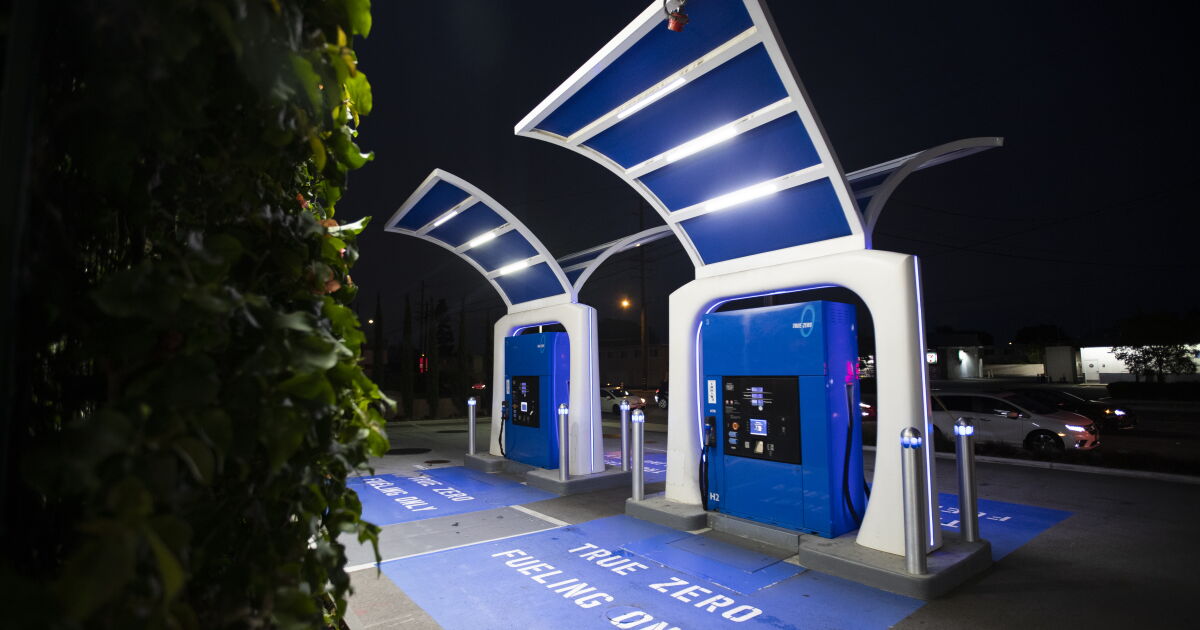
California is the only state with a long-distance hydrogen network. But fuel station reliability remains a big problem because of supply.
(Allen J. Schaben / Los Angeles Times)
Theoretically, there will be enough emissions-free energy sources in the future to supply fuel cell vehicles, and the cost of making the hydrogen plants and building now-expensive fuel cells will decline enough so that car companies can make money on them. Right now, Hyundai and Toyota are absorbing losses as they develop the business. Through June this year, Toyota has sold 1,722 Mirais, and Hyundai only 105 Nexos.
If they live up to their potential, they could be far more convenient on road trips than electric cars. That’s because refueling with hydrogen doesn’t take much longer than refueling with gasoline, and offers a dependable range of 300 to 400 miles. You can’t fill up at home, though.
For now, though, fuel cell cars only work for those willing to suffer inconvenience for the satisfaction of living at the cutting edge of motor vehicle technology.

An electric car isn’t the only passenger vehicle out there that generates zero tailpipe emissions. You’ve probably heard of fuel cell cars. They use hydrogen gas to make electricity to power a motor that drives the car. The waste product: water vapor.
The technology is clean, legitimately cool and already available. But it’s not for everyone.
It’s perfect for, say, my 90-year-old father-in-law, a retired physicist and technology geek, who loves to experiment with new technology and — most importantly — has plenty of time on his hands. He needs it because the refueling infrastructure right now is even more measly and unreliable than public electric chargers, which have their own set of issues.
There are two fuel cell car models available in the U.S. today, the Hyundai Nexo and the Toyota Mirai. They’re both attractive and comfortable and engineered for a smooth but sporty drive. No problems there. They cost in the vicinity of $58,000 to buy or $385 a month to lease, and often come with free hydrogen fueling.
A great choice — if you can find the fuel.
California is the only state with a long-distance hydrogen network, courtesy of you and your fellow taxpayers. The network is growing, but tiny nonetheless. There are now 59 stations, clustered in Los Angeles and the Bay Area, with an essential fill-up spot at Harris Ranch on Interstate 5 to make a trip between the two possible.
Fuel station reliability remains a big problem. Not so much the mechanics, but the supply. Stations are often completely out of fuel, and sometimes sit that way for days. My father-in-law monitors the nearest stations to his Walnut Creek home and has the time and flexibility to run out to fill up when fuel is available. State officials and the hydrogen industry say they’re working toward the goal of steady supply.
This is not to dump on fuel cells. They may well be the future of motor vehicle transportation. Technically, they can make hydrogen out of water with solar or wind energy, for no to very low greenhouse gas emissions. (Much of the hydrogen being created today requires electricity that depends in part on fossil fuels.)
California is the only state with a long-distance hydrogen network. But fuel station reliability remains a big problem because of supply.
(Allen J. Schaben / Los Angeles Times)
Theoretically, there will be enough emissions-free energy sources in the future to supply fuel cell vehicles, and the cost of making the hydrogen plants and building now-expensive fuel cells will decline enough so that car companies can make money on them. Right now, Hyundai and Toyota are absorbing losses as they develop the business. Through June this year, Toyota has sold 1,722 Mirais, and Hyundai only 105 Nexos.
If they live up to their potential, they could be far more convenient on road trips than electric cars. That’s because refueling with hydrogen doesn’t take much longer than refueling with gasoline, and offers a dependable range of 300 to 400 miles. You can’t fill up at home, though.
For now, though, fuel cell cars only work for those willing to suffer inconvenience for the satisfaction of living at the cutting edge of motor vehicle technology.

An electric car isn’t the only passenger vehicle out there that generates zero tailpipe emissions. You’ve probably heard of fuel cell cars. They use hydrogen gas to make electricity to power a motor that drives the car. The waste product: water vapor.
The technology is clean, legitimately cool and already available. But it’s not for everyone.
It’s perfect for, say, my 90-year-old father-in-law, a retired physicist and technology geek, who loves to experiment with new technology and — most importantly — has plenty of time on his hands. He needs it because the refueling infrastructure right now is even more measly and unreliable than public electric chargers, which have their own set of issues.
There are two fuel cell car models available in the U.S. today, the Hyundai Nexo and the Toyota Mirai. They’re both attractive and comfortable and engineered for a smooth but sporty drive. No problems there. They cost in the vicinity of $58,000 to buy or $385 a month to lease, and often come with free hydrogen fueling.
A great choice — if you can find the fuel.
California is the only state with a long-distance hydrogen network, courtesy of you and your fellow taxpayers. The network is growing, but tiny nonetheless. There are now 59 stations, clustered in Los Angeles and the Bay Area, with an essential fill-up spot at Harris Ranch on Interstate 5 to make a trip between the two possible.
Fuel station reliability remains a big problem. Not so much the mechanics, but the supply. Stations are often completely out of fuel, and sometimes sit that way for days. My father-in-law monitors the nearest stations to his Walnut Creek home and has the time and flexibility to run out to fill up when fuel is available. State officials and the hydrogen industry say they’re working toward the goal of steady supply.
This is not to dump on fuel cells. They may well be the future of motor vehicle transportation. Technically, they can make hydrogen out of water with solar or wind energy, for no to very low greenhouse gas emissions. (Much of the hydrogen being created today requires electricity that depends in part on fossil fuels.)
California is the only state with a long-distance hydrogen network. But fuel station reliability remains a big problem because of supply.
(Allen J. Schaben / Los Angeles Times)
Theoretically, there will be enough emissions-free energy sources in the future to supply fuel cell vehicles, and the cost of making the hydrogen plants and building now-expensive fuel cells will decline enough so that car companies can make money on them. Right now, Hyundai and Toyota are absorbing losses as they develop the business. Through June this year, Toyota has sold 1,722 Mirais, and Hyundai only 105 Nexos.
If they live up to their potential, they could be far more convenient on road trips than electric cars. That’s because refueling with hydrogen doesn’t take much longer than refueling with gasoline, and offers a dependable range of 300 to 400 miles. You can’t fill up at home, though.
For now, though, fuel cell cars only work for those willing to suffer inconvenience for the satisfaction of living at the cutting edge of motor vehicle technology.

An electric car isn’t the only passenger vehicle out there that generates zero tailpipe emissions. You’ve probably heard of fuel cell cars. They use hydrogen gas to make electricity to power a motor that drives the car. The waste product: water vapor.
The technology is clean, legitimately cool and already available. But it’s not for everyone.
It’s perfect for, say, my 90-year-old father-in-law, a retired physicist and technology geek, who loves to experiment with new technology and — most importantly — has plenty of time on his hands. He needs it because the refueling infrastructure right now is even more measly and unreliable than public electric chargers, which have their own set of issues.
There are two fuel cell car models available in the U.S. today, the Hyundai Nexo and the Toyota Mirai. They’re both attractive and comfortable and engineered for a smooth but sporty drive. No problems there. They cost in the vicinity of $58,000 to buy or $385 a month to lease, and often come with free hydrogen fueling.
A great choice — if you can find the fuel.
California is the only state with a long-distance hydrogen network, courtesy of you and your fellow taxpayers. The network is growing, but tiny nonetheless. There are now 59 stations, clustered in Los Angeles and the Bay Area, with an essential fill-up spot at Harris Ranch on Interstate 5 to make a trip between the two possible.
Fuel station reliability remains a big problem. Not so much the mechanics, but the supply. Stations are often completely out of fuel, and sometimes sit that way for days. My father-in-law monitors the nearest stations to his Walnut Creek home and has the time and flexibility to run out to fill up when fuel is available. State officials and the hydrogen industry say they’re working toward the goal of steady supply.
This is not to dump on fuel cells. They may well be the future of motor vehicle transportation. Technically, they can make hydrogen out of water with solar or wind energy, for no to very low greenhouse gas emissions. (Much of the hydrogen being created today requires electricity that depends in part on fossil fuels.)
California is the only state with a long-distance hydrogen network. But fuel station reliability remains a big problem because of supply.
(Allen J. Schaben / Los Angeles Times)
Theoretically, there will be enough emissions-free energy sources in the future to supply fuel cell vehicles, and the cost of making the hydrogen plants and building now-expensive fuel cells will decline enough so that car companies can make money on them. Right now, Hyundai and Toyota are absorbing losses as they develop the business. Through June this year, Toyota has sold 1,722 Mirais, and Hyundai only 105 Nexos.
If they live up to their potential, they could be far more convenient on road trips than electric cars. That’s because refueling with hydrogen doesn’t take much longer than refueling with gasoline, and offers a dependable range of 300 to 400 miles. You can’t fill up at home, though.
For now, though, fuel cell cars only work for those willing to suffer inconvenience for the satisfaction of living at the cutting edge of motor vehicle technology.

An electric car isn’t the only passenger vehicle out there that generates zero tailpipe emissions. You’ve probably heard of fuel cell cars. They use hydrogen gas to make electricity to power a motor that drives the car. The waste product: water vapor.
The technology is clean, legitimately cool and already available. But it’s not for everyone.
It’s perfect for, say, my 90-year-old father-in-law, a retired physicist and technology geek, who loves to experiment with new technology and — most importantly — has plenty of time on his hands. He needs it because the refueling infrastructure right now is even more measly and unreliable than public electric chargers, which have their own set of issues.
There are two fuel cell car models available in the U.S. today, the Hyundai Nexo and the Toyota Mirai. They’re both attractive and comfortable and engineered for a smooth but sporty drive. No problems there. They cost in the vicinity of $58,000 to buy or $385 a month to lease, and often come with free hydrogen fueling.
A great choice — if you can find the fuel.
California is the only state with a long-distance hydrogen network, courtesy of you and your fellow taxpayers. The network is growing, but tiny nonetheless. There are now 59 stations, clustered in Los Angeles and the Bay Area, with an essential fill-up spot at Harris Ranch on Interstate 5 to make a trip between the two possible.
Fuel station reliability remains a big problem. Not so much the mechanics, but the supply. Stations are often completely out of fuel, and sometimes sit that way for days. My father-in-law monitors the nearest stations to his Walnut Creek home and has the time and flexibility to run out to fill up when fuel is available. State officials and the hydrogen industry say they’re working toward the goal of steady supply.
This is not to dump on fuel cells. They may well be the future of motor vehicle transportation. Technically, they can make hydrogen out of water with solar or wind energy, for no to very low greenhouse gas emissions. (Much of the hydrogen being created today requires electricity that depends in part on fossil fuels.)
California is the only state with a long-distance hydrogen network. But fuel station reliability remains a big problem because of supply.
(Allen J. Schaben / Los Angeles Times)
Theoretically, there will be enough emissions-free energy sources in the future to supply fuel cell vehicles, and the cost of making the hydrogen plants and building now-expensive fuel cells will decline enough so that car companies can make money on them. Right now, Hyundai and Toyota are absorbing losses as they develop the business. Through June this year, Toyota has sold 1,722 Mirais, and Hyundai only 105 Nexos.
If they live up to their potential, they could be far more convenient on road trips than electric cars. That’s because refueling with hydrogen doesn’t take much longer than refueling with gasoline, and offers a dependable range of 300 to 400 miles. You can’t fill up at home, though.
For now, though, fuel cell cars only work for those willing to suffer inconvenience for the satisfaction of living at the cutting edge of motor vehicle technology.

