

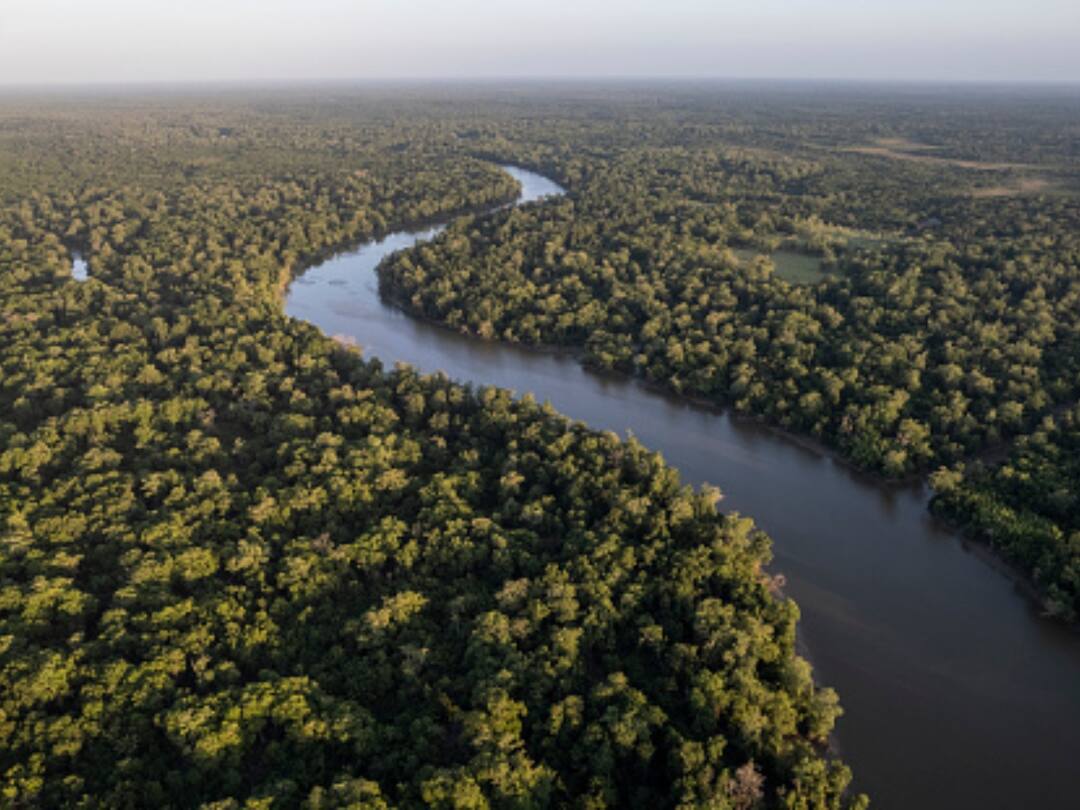

At a major rainforest summit in Brazil, eight South American countries agreed on August 8 to form an alliance to adopt measures that will boost regional cooperation and fight deforestation in the Amazon. However, they failed to agree to a common goal that will help end deforestation, media reports said. The nations vowed at the two-day summit in Belém that they will help stop the Amazon, the biggest rainforest in the world, from reaching “a point of no return”.
While the eight nations formed an alliance to combat deforestation, the joint declaration lacks an agreed goal, which means that each country will pursue its own conservation goals, BBC reported. According to climate activists, the deal lacked concrete measures, a BBC report said.
MUST READ | There Could Be New Particles, We Need To Have An All-Encompassing Theory: CERN Scientist Archana Sharma
Quoting Márcio Astrini of the Climate Observatory group, media reports said the fact that the eight presidents of the Amazon nations cannot include a line in the declaration stating that deforestation needs to be zero “won’t be tolerated any more”.
The eight Amazon countries represented at the gathering are Brazil, Bolivia, Colombia, Ecuador, Guyana, Peru, Suriname, and Venezuela. Together, these countries are known as the Amazon Cooperation Treaty Organization (ACTO).
Brazil called the declaration adopted by ACTO a “new and ambitious shared agenda” to save the Amazon rainforest, an AFP report said.
The declaration consists of a roadmap to promote sustainable development and fight the organised crime that fuels deforestation.
MUST READ | EXCLUSIVE: India Has A Very Long Tradition Of Particle Physics, Says CERN Physicist Archana Sharma
Before the summit began, Luiz Inácio Lula da Silva, the President of Brazil, had urged for a common goal to end deforestation by 2030.
While Brazil has pledged to end illegal deforestation by 2030, and Colombia has promised to stop new oil exploration, the other member countries did not adopt these goals. Due to the lack of a common goal, Astrini said there is no concrete decision, just a lot of promises, according to media reports.
MUST READ | Why Did Eastern Parts Of India Receive Less Rainfall Than Other Regions This Year? Experts Give Reasons
The alliance only aims to combat forest destruction, but all the countries are left to set their own deforestation goals.
The only Amazonian countries which did not sign onto the COP26 agreement among more than 100 countries to work toward ending deforestation by 2030 are Bolivia and Venezuela.
The summit held in Belém brought together the ACTO for the first time in 14 years.
August 9 is the last day of the summit.
ALSO READ | The Science Of Health: How Hormonal Changes Affect Asthmatic Women, And Ways To Avoid Exacerbation

At a major rainforest summit in Brazil, eight South American countries agreed on August 8 to form an alliance to adopt measures that will boost regional cooperation and fight deforestation in the Amazon. However, they failed to agree to a common goal that will help end deforestation, media reports said. The nations vowed at the two-day summit in Belém that they will help stop the Amazon, the biggest rainforest in the world, from reaching “a point of no return”.
While the eight nations formed an alliance to combat deforestation, the joint declaration lacks an agreed goal, which means that each country will pursue its own conservation goals, BBC reported. According to climate activists, the deal lacked concrete measures, a BBC report said.
MUST READ | There Could Be New Particles, We Need To Have An All-Encompassing Theory: CERN Scientist Archana Sharma
Quoting Márcio Astrini of the Climate Observatory group, media reports said the fact that the eight presidents of the Amazon nations cannot include a line in the declaration stating that deforestation needs to be zero “won’t be tolerated any more”.
The eight Amazon countries represented at the gathering are Brazil, Bolivia, Colombia, Ecuador, Guyana, Peru, Suriname, and Venezuela. Together, these countries are known as the Amazon Cooperation Treaty Organization (ACTO).
Brazil called the declaration adopted by ACTO a “new and ambitious shared agenda” to save the Amazon rainforest, an AFP report said.
The declaration consists of a roadmap to promote sustainable development and fight the organised crime that fuels deforestation.
MUST READ | EXCLUSIVE: India Has A Very Long Tradition Of Particle Physics, Says CERN Physicist Archana Sharma
Before the summit began, Luiz Inácio Lula da Silva, the President of Brazil, had urged for a common goal to end deforestation by 2030.
While Brazil has pledged to end illegal deforestation by 2030, and Colombia has promised to stop new oil exploration, the other member countries did not adopt these goals. Due to the lack of a common goal, Astrini said there is no concrete decision, just a lot of promises, according to media reports.
MUST READ | Why Did Eastern Parts Of India Receive Less Rainfall Than Other Regions This Year? Experts Give Reasons
The alliance only aims to combat forest destruction, but all the countries are left to set their own deforestation goals.
The only Amazonian countries which did not sign onto the COP26 agreement among more than 100 countries to work toward ending deforestation by 2030 are Bolivia and Venezuela.
The summit held in Belém brought together the ACTO for the first time in 14 years.
August 9 is the last day of the summit.
ALSO READ | The Science Of Health: How Hormonal Changes Affect Asthmatic Women, And Ways To Avoid Exacerbation

At a major rainforest summit in Brazil, eight South American countries agreed on August 8 to form an alliance to adopt measures that will boost regional cooperation and fight deforestation in the Amazon. However, they failed to agree to a common goal that will help end deforestation, media reports said. The nations vowed at the two-day summit in Belém that they will help stop the Amazon, the biggest rainforest in the world, from reaching “a point of no return”.
While the eight nations formed an alliance to combat deforestation, the joint declaration lacks an agreed goal, which means that each country will pursue its own conservation goals, BBC reported. According to climate activists, the deal lacked concrete measures, a BBC report said.
MUST READ | There Could Be New Particles, We Need To Have An All-Encompassing Theory: CERN Scientist Archana Sharma
Quoting Márcio Astrini of the Climate Observatory group, media reports said the fact that the eight presidents of the Amazon nations cannot include a line in the declaration stating that deforestation needs to be zero “won’t be tolerated any more”.
The eight Amazon countries represented at the gathering are Brazil, Bolivia, Colombia, Ecuador, Guyana, Peru, Suriname, and Venezuela. Together, these countries are known as the Amazon Cooperation Treaty Organization (ACTO).
Brazil called the declaration adopted by ACTO a “new and ambitious shared agenda” to save the Amazon rainforest, an AFP report said.
The declaration consists of a roadmap to promote sustainable development and fight the organised crime that fuels deforestation.
MUST READ | EXCLUSIVE: India Has A Very Long Tradition Of Particle Physics, Says CERN Physicist Archana Sharma
Before the summit began, Luiz Inácio Lula da Silva, the President of Brazil, had urged for a common goal to end deforestation by 2030.
While Brazil has pledged to end illegal deforestation by 2030, and Colombia has promised to stop new oil exploration, the other member countries did not adopt these goals. Due to the lack of a common goal, Astrini said there is no concrete decision, just a lot of promises, according to media reports.
MUST READ | Why Did Eastern Parts Of India Receive Less Rainfall Than Other Regions This Year? Experts Give Reasons
The alliance only aims to combat forest destruction, but all the countries are left to set their own deforestation goals.
The only Amazonian countries which did not sign onto the COP26 agreement among more than 100 countries to work toward ending deforestation by 2030 are Bolivia and Venezuela.
The summit held in Belém brought together the ACTO for the first time in 14 years.
August 9 is the last day of the summit.
ALSO READ | The Science Of Health: How Hormonal Changes Affect Asthmatic Women, And Ways To Avoid Exacerbation
At a major rainforest summit in Brazil, eight South American countries agreed on August 8 to form an alliance to adopt measures that will boost regional cooperation and fight deforestation in the Amazon. However, they failed to agree to a common goal that will help end deforestation, media reports said. The nations vowed at the two-day summit in Belém that they will help stop the Amazon, the biggest rainforest in the world, from reaching “a point of no return”.
While the eight nations formed an alliance to combat deforestation, the joint declaration lacks an agreed goal, which means that each country will pursue its own conservation goals, BBC reported. According to climate activists, the deal lacked concrete measures, a BBC report said.
MUST READ | There Could Be New Particles, We Need To Have An All-Encompassing Theory: CERN Scientist Archana Sharma
Quoting Márcio Astrini of the Climate Observatory group, media reports said the fact that the eight presidents of the Amazon nations cannot include a line in the declaration stating that deforestation needs to be zero “won’t be tolerated any more”.
The eight Amazon countries represented at the gathering are Brazil, Bolivia, Colombia, Ecuador, Guyana, Peru, Suriname, and Venezuela. Together, these countries are known as the Amazon Cooperation Treaty Organization (ACTO).
Brazil called the declaration adopted by ACTO a “new and ambitious shared agenda” to save the Amazon rainforest, an AFP report said.
The declaration consists of a roadmap to promote sustainable development and fight the organised crime that fuels deforestation.
MUST READ | EXCLUSIVE: India Has A Very Long Tradition Of Particle Physics, Says CERN Physicist Archana Sharma
Before the summit began, Luiz Inácio Lula da Silva, the President of Brazil, had urged for a common goal to end deforestation by 2030.
While Brazil has pledged to end illegal deforestation by 2030, and Colombia has promised to stop new oil exploration, the other member countries did not adopt these goals. Due to the lack of a common goal, Astrini said there is no concrete decision, just a lot of promises, according to media reports.
MUST READ | Why Did Eastern Parts Of India Receive Less Rainfall Than Other Regions This Year? Experts Give Reasons
The alliance only aims to combat forest destruction, but all the countries are left to set their own deforestation goals.
The only Amazonian countries which did not sign onto the COP26 agreement among more than 100 countries to work toward ending deforestation by 2030 are Bolivia and Venezuela.
The summit held in Belém brought together the ACTO for the first time in 14 years.
August 9 is the last day of the summit.
ALSO READ | The Science Of Health: How Hormonal Changes Affect Asthmatic Women, And Ways To Avoid Exacerbation

At a major rainforest summit in Brazil, eight South American countries agreed on August 8 to form an alliance to adopt measures that will boost regional cooperation and fight deforestation in the Amazon. However, they failed to agree to a common goal that will help end deforestation, media reports said. The nations vowed at the two-day summit in Belém that they will help stop the Amazon, the biggest rainforest in the world, from reaching “a point of no return”.
While the eight nations formed an alliance to combat deforestation, the joint declaration lacks an agreed goal, which means that each country will pursue its own conservation goals, BBC reported. According to climate activists, the deal lacked concrete measures, a BBC report said.
MUST READ | There Could Be New Particles, We Need To Have An All-Encompassing Theory: CERN Scientist Archana Sharma
Quoting Márcio Astrini of the Climate Observatory group, media reports said the fact that the eight presidents of the Amazon nations cannot include a line in the declaration stating that deforestation needs to be zero “won’t be tolerated any more”.
The eight Amazon countries represented at the gathering are Brazil, Bolivia, Colombia, Ecuador, Guyana, Peru, Suriname, and Venezuela. Together, these countries are known as the Amazon Cooperation Treaty Organization (ACTO).
Brazil called the declaration adopted by ACTO a “new and ambitious shared agenda” to save the Amazon rainforest, an AFP report said.
The declaration consists of a roadmap to promote sustainable development and fight the organised crime that fuels deforestation.
MUST READ | EXCLUSIVE: India Has A Very Long Tradition Of Particle Physics, Says CERN Physicist Archana Sharma
Before the summit began, Luiz Inácio Lula da Silva, the President of Brazil, had urged for a common goal to end deforestation by 2030.
While Brazil has pledged to end illegal deforestation by 2030, and Colombia has promised to stop new oil exploration, the other member countries did not adopt these goals. Due to the lack of a common goal, Astrini said there is no concrete decision, just a lot of promises, according to media reports.
MUST READ | Why Did Eastern Parts Of India Receive Less Rainfall Than Other Regions This Year? Experts Give Reasons
The alliance only aims to combat forest destruction, but all the countries are left to set their own deforestation goals.
The only Amazonian countries which did not sign onto the COP26 agreement among more than 100 countries to work toward ending deforestation by 2030 are Bolivia and Venezuela.
The summit held in Belém brought together the ACTO for the first time in 14 years.
August 9 is the last day of the summit.
ALSO READ | The Science Of Health: How Hormonal Changes Affect Asthmatic Women, And Ways To Avoid Exacerbation
At a major rainforest summit in Brazil, eight South American countries agreed on August 8 to form an alliance to adopt measures that will boost regional cooperation and fight deforestation in the Amazon. However, they failed to agree to a common goal that will help end deforestation, media reports said. The nations vowed at the two-day summit in Belém that they will help stop the Amazon, the biggest rainforest in the world, from reaching “a point of no return”.
While the eight nations formed an alliance to combat deforestation, the joint declaration lacks an agreed goal, which means that each country will pursue its own conservation goals, BBC reported. According to climate activists, the deal lacked concrete measures, a BBC report said.
MUST READ | There Could Be New Particles, We Need To Have An All-Encompassing Theory: CERN Scientist Archana Sharma
Quoting Márcio Astrini of the Climate Observatory group, media reports said the fact that the eight presidents of the Amazon nations cannot include a line in the declaration stating that deforestation needs to be zero “won’t be tolerated any more”.
The eight Amazon countries represented at the gathering are Brazil, Bolivia, Colombia, Ecuador, Guyana, Peru, Suriname, and Venezuela. Together, these countries are known as the Amazon Cooperation Treaty Organization (ACTO).
Brazil called the declaration adopted by ACTO a “new and ambitious shared agenda” to save the Amazon rainforest, an AFP report said.
The declaration consists of a roadmap to promote sustainable development and fight the organised crime that fuels deforestation.
MUST READ | EXCLUSIVE: India Has A Very Long Tradition Of Particle Physics, Says CERN Physicist Archana Sharma
Before the summit began, Luiz Inácio Lula da Silva, the President of Brazil, had urged for a common goal to end deforestation by 2030.
While Brazil has pledged to end illegal deforestation by 2030, and Colombia has promised to stop new oil exploration, the other member countries did not adopt these goals. Due to the lack of a common goal, Astrini said there is no concrete decision, just a lot of promises, according to media reports.
MUST READ | Why Did Eastern Parts Of India Receive Less Rainfall Than Other Regions This Year? Experts Give Reasons
The alliance only aims to combat forest destruction, but all the countries are left to set their own deforestation goals.
The only Amazonian countries which did not sign onto the COP26 agreement among more than 100 countries to work toward ending deforestation by 2030 are Bolivia and Venezuela.
The summit held in Belém brought together the ACTO for the first time in 14 years.
August 9 is the last day of the summit.
ALSO READ | The Science Of Health: How Hormonal Changes Affect Asthmatic Women, And Ways To Avoid Exacerbation
At a major rainforest summit in Brazil, eight South American countries agreed on August 8 to form an alliance to adopt measures that will boost regional cooperation and fight deforestation in the Amazon. However, they failed to agree to a common goal that will help end deforestation, media reports said. The nations vowed at the two-day summit in Belém that they will help stop the Amazon, the biggest rainforest in the world, from reaching “a point of no return”.
While the eight nations formed an alliance to combat deforestation, the joint declaration lacks an agreed goal, which means that each country will pursue its own conservation goals, BBC reported. According to climate activists, the deal lacked concrete measures, a BBC report said.
MUST READ | There Could Be New Particles, We Need To Have An All-Encompassing Theory: CERN Scientist Archana Sharma
Quoting Márcio Astrini of the Climate Observatory group, media reports said the fact that the eight presidents of the Amazon nations cannot include a line in the declaration stating that deforestation needs to be zero “won’t be tolerated any more”.
The eight Amazon countries represented at the gathering are Brazil, Bolivia, Colombia, Ecuador, Guyana, Peru, Suriname, and Venezuela. Together, these countries are known as the Amazon Cooperation Treaty Organization (ACTO).
Brazil called the declaration adopted by ACTO a “new and ambitious shared agenda” to save the Amazon rainforest, an AFP report said.
The declaration consists of a roadmap to promote sustainable development and fight the organised crime that fuels deforestation.
MUST READ | EXCLUSIVE: India Has A Very Long Tradition Of Particle Physics, Says CERN Physicist Archana Sharma
Before the summit began, Luiz Inácio Lula da Silva, the President of Brazil, had urged for a common goal to end deforestation by 2030.
While Brazil has pledged to end illegal deforestation by 2030, and Colombia has promised to stop new oil exploration, the other member countries did not adopt these goals. Due to the lack of a common goal, Astrini said there is no concrete decision, just a lot of promises, according to media reports.
MUST READ | Why Did Eastern Parts Of India Receive Less Rainfall Than Other Regions This Year? Experts Give Reasons
The alliance only aims to combat forest destruction, but all the countries are left to set their own deforestation goals.
The only Amazonian countries which did not sign onto the COP26 agreement among more than 100 countries to work toward ending deforestation by 2030 are Bolivia and Venezuela.
The summit held in Belém brought together the ACTO for the first time in 14 years.
August 9 is the last day of the summit.
ALSO READ | The Science Of Health: How Hormonal Changes Affect Asthmatic Women, And Ways To Avoid Exacerbation
At a major rainforest summit in Brazil, eight South American countries agreed on August 8 to form an alliance to adopt measures that will boost regional cooperation and fight deforestation in the Amazon. However, they failed to agree to a common goal that will help end deforestation, media reports said. The nations vowed at the two-day summit in Belém that they will help stop the Amazon, the biggest rainforest in the world, from reaching “a point of no return”.
While the eight nations formed an alliance to combat deforestation, the joint declaration lacks an agreed goal, which means that each country will pursue its own conservation goals, BBC reported. According to climate activists, the deal lacked concrete measures, a BBC report said.
MUST READ | There Could Be New Particles, We Need To Have An All-Encompassing Theory: CERN Scientist Archana Sharma
Quoting Márcio Astrini of the Climate Observatory group, media reports said the fact that the eight presidents of the Amazon nations cannot include a line in the declaration stating that deforestation needs to be zero “won’t be tolerated any more”.
The eight Amazon countries represented at the gathering are Brazil, Bolivia, Colombia, Ecuador, Guyana, Peru, Suriname, and Venezuela. Together, these countries are known as the Amazon Cooperation Treaty Organization (ACTO).
Brazil called the declaration adopted by ACTO a “new and ambitious shared agenda” to save the Amazon rainforest, an AFP report said.
The declaration consists of a roadmap to promote sustainable development and fight the organised crime that fuels deforestation.
MUST READ | EXCLUSIVE: India Has A Very Long Tradition Of Particle Physics, Says CERN Physicist Archana Sharma
Before the summit began, Luiz Inácio Lula da Silva, the President of Brazil, had urged for a common goal to end deforestation by 2030.
While Brazil has pledged to end illegal deforestation by 2030, and Colombia has promised to stop new oil exploration, the other member countries did not adopt these goals. Due to the lack of a common goal, Astrini said there is no concrete decision, just a lot of promises, according to media reports.
MUST READ | Why Did Eastern Parts Of India Receive Less Rainfall Than Other Regions This Year? Experts Give Reasons
The alliance only aims to combat forest destruction, but all the countries are left to set their own deforestation goals.
The only Amazonian countries which did not sign onto the COP26 agreement among more than 100 countries to work toward ending deforestation by 2030 are Bolivia and Venezuela.
The summit held in Belém brought together the ACTO for the first time in 14 years.
August 9 is the last day of the summit.
ALSO READ | The Science Of Health: How Hormonal Changes Affect Asthmatic Women, And Ways To Avoid Exacerbation

