

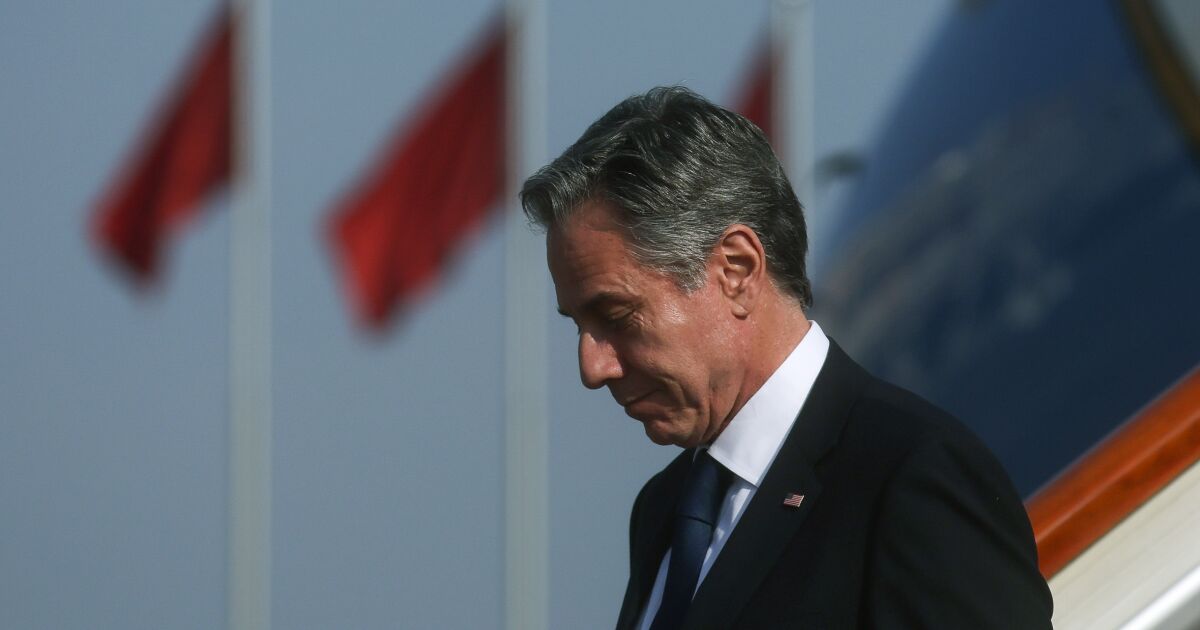
A handful of senators is blocking the confirmation of dozens of highly regarded Biden administration ambassadorial appointments over largely partisan issues having nothing to do with the nominees’ qualifications, Secretary of State Antony J. Blinken said Monday.
In an unusual head-on confrontation with Congress, Blinken complained that action by some senators is crippling the ability of the United States to project its influence on the global stage, stifling the U.S. voice in critical countries in the Middle East and Europe during the raging war in Ukraine and undermining national security.
The diplomatic delays come as hundreds of U.S. military promotions — including the appointment of the commander of the Marine Corps, leaving an acting leader in charge for the first time in more than 100 years — blocked by a single Republican senator from Alabama, former football coach Tommy Tuberville. He objects to the Defense Department’s efforts to provide reproductive and gender-affirming care to service members.
“By failing to confirm these nominees, a handful of senators are keeping our best players on the sidelines,” Blinken said.
In comments Monday to journalists and in a letter to senators, Blinken said that while the appointment of career foreign service officers to key diplomatic posts is usually all but pro forma, and that 170 were confirmed in the first two years of the Biden administration, only five ambassadorial assignments have survived this year, leaving 38 languishing. More than another 20 lower-level appointments have also stalled.
“Vacant posts have long-term negative impact on U.S. national security, including our ability to reassure allies and partners and counter diplomatic efforts by our allies,” Blinken said in the letter, citing aggressive campaigns by China to post large diplomatic missions throughout Africa and Latin America, where Beijing’s economic influence is expanding exponentially. China and Russia have benefited most from the Senate stalling, Blinken said.
Blinken pinned most of the blame on Sen. Rand Paul (R-Ky.), who issued a blanket hold on appointees over his demands for documents involving the origins of the COVID-19 pandemic. While Paul is entitled to seek documents, “what we object to is him holding hostage nominees,” State Department spokesman Matthew Miller said.
At the current pace, Blinken said, top postings as crucial as those in Israel and Egypt may sit vacant by the end of the summer.
“No one is questioning the qualifications of these career diplomats,” Blinken said in a media briefing at the State Department. “They’re being blocked from leverage on other unrelated issues. It’s irresponsible, and it’s doing harm to our national security.”
Congressional Republicans want to subpoena Blinken to force him to turn over internal cables dealing with Afghanistan. A so-called dissent cable, wherein diplomats voice differences with U.S. policy, exists in relation to the disastrous U.S. withdrawal from Afghanistan. The State Department has offered its contents to congressional investigators, but some lawmakers want to see the original document.
Meanwhile, Tuberville has been blocking important promotions in the U.S military for weeks over the Defense Department’s progressive health policies, including reimbursement for service members who have to travel for abortions, as well as for gender-affirming healthcare. It is estimated that by the end of the year, he will have blocked more than 600 appointments.
The military sees these steps as ways to maintain an inclusive armed services. But opponents like Tuberville and his GOP allies say U.S. taxpayers should not pay for the programs.
“[The military] should be buying the weapons that we need to defend our nation and to support our troops,” Tuberville ally Sen. Tom Cotton (R-Ark.) told Fox News over the weekend.

A handful of senators is blocking the confirmation of dozens of highly regarded Biden administration ambassadorial appointments over largely partisan issues having nothing to do with the nominees’ qualifications, Secretary of State Antony J. Blinken said Monday.
In an unusual head-on confrontation with Congress, Blinken complained that action by some senators is crippling the ability of the United States to project its influence on the global stage, stifling the U.S. voice in critical countries in the Middle East and Europe during the raging war in Ukraine and undermining national security.
The diplomatic delays come as hundreds of U.S. military promotions — including the appointment of the commander of the Marine Corps, leaving an acting leader in charge for the first time in more than 100 years — blocked by a single Republican senator from Alabama, former football coach Tommy Tuberville. He objects to the Defense Department’s efforts to provide reproductive and gender-affirming care to service members.
“By failing to confirm these nominees, a handful of senators are keeping our best players on the sidelines,” Blinken said.
In comments Monday to journalists and in a letter to senators, Blinken said that while the appointment of career foreign service officers to key diplomatic posts is usually all but pro forma, and that 170 were confirmed in the first two years of the Biden administration, only five ambassadorial assignments have survived this year, leaving 38 languishing. More than another 20 lower-level appointments have also stalled.
“Vacant posts have long-term negative impact on U.S. national security, including our ability to reassure allies and partners and counter diplomatic efforts by our allies,” Blinken said in the letter, citing aggressive campaigns by China to post large diplomatic missions throughout Africa and Latin America, where Beijing’s economic influence is expanding exponentially. China and Russia have benefited most from the Senate stalling, Blinken said.
Blinken pinned most of the blame on Sen. Rand Paul (R-Ky.), who issued a blanket hold on appointees over his demands for documents involving the origins of the COVID-19 pandemic. While Paul is entitled to seek documents, “what we object to is him holding hostage nominees,” State Department spokesman Matthew Miller said.
At the current pace, Blinken said, top postings as crucial as those in Israel and Egypt may sit vacant by the end of the summer.
“No one is questioning the qualifications of these career diplomats,” Blinken said in a media briefing at the State Department. “They’re being blocked from leverage on other unrelated issues. It’s irresponsible, and it’s doing harm to our national security.”
Congressional Republicans want to subpoena Blinken to force him to turn over internal cables dealing with Afghanistan. A so-called dissent cable, wherein diplomats voice differences with U.S. policy, exists in relation to the disastrous U.S. withdrawal from Afghanistan. The State Department has offered its contents to congressional investigators, but some lawmakers want to see the original document.
Meanwhile, Tuberville has been blocking important promotions in the U.S military for weeks over the Defense Department’s progressive health policies, including reimbursement for service members who have to travel for abortions, as well as for gender-affirming healthcare. It is estimated that by the end of the year, he will have blocked more than 600 appointments.
The military sees these steps as ways to maintain an inclusive armed services. But opponents like Tuberville and his GOP allies say U.S. taxpayers should not pay for the programs.
“[The military] should be buying the weapons that we need to defend our nation and to support our troops,” Tuberville ally Sen. Tom Cotton (R-Ark.) told Fox News over the weekend.

A handful of senators is blocking the confirmation of dozens of highly regarded Biden administration ambassadorial appointments over largely partisan issues having nothing to do with the nominees’ qualifications, Secretary of State Antony J. Blinken said Monday.
In an unusual head-on confrontation with Congress, Blinken complained that action by some senators is crippling the ability of the United States to project its influence on the global stage, stifling the U.S. voice in critical countries in the Middle East and Europe during the raging war in Ukraine and undermining national security.
The diplomatic delays come as hundreds of U.S. military promotions — including the appointment of the commander of the Marine Corps, leaving an acting leader in charge for the first time in more than 100 years — blocked by a single Republican senator from Alabama, former football coach Tommy Tuberville. He objects to the Defense Department’s efforts to provide reproductive and gender-affirming care to service members.
“By failing to confirm these nominees, a handful of senators are keeping our best players on the sidelines,” Blinken said.
In comments Monday to journalists and in a letter to senators, Blinken said that while the appointment of career foreign service officers to key diplomatic posts is usually all but pro forma, and that 170 were confirmed in the first two years of the Biden administration, only five ambassadorial assignments have survived this year, leaving 38 languishing. More than another 20 lower-level appointments have also stalled.
“Vacant posts have long-term negative impact on U.S. national security, including our ability to reassure allies and partners and counter diplomatic efforts by our allies,” Blinken said in the letter, citing aggressive campaigns by China to post large diplomatic missions throughout Africa and Latin America, where Beijing’s economic influence is expanding exponentially. China and Russia have benefited most from the Senate stalling, Blinken said.
Blinken pinned most of the blame on Sen. Rand Paul (R-Ky.), who issued a blanket hold on appointees over his demands for documents involving the origins of the COVID-19 pandemic. While Paul is entitled to seek documents, “what we object to is him holding hostage nominees,” State Department spokesman Matthew Miller said.
At the current pace, Blinken said, top postings as crucial as those in Israel and Egypt may sit vacant by the end of the summer.
“No one is questioning the qualifications of these career diplomats,” Blinken said in a media briefing at the State Department. “They’re being blocked from leverage on other unrelated issues. It’s irresponsible, and it’s doing harm to our national security.”
Congressional Republicans want to subpoena Blinken to force him to turn over internal cables dealing with Afghanistan. A so-called dissent cable, wherein diplomats voice differences with U.S. policy, exists in relation to the disastrous U.S. withdrawal from Afghanistan. The State Department has offered its contents to congressional investigators, but some lawmakers want to see the original document.
Meanwhile, Tuberville has been blocking important promotions in the U.S military for weeks over the Defense Department’s progressive health policies, including reimbursement for service members who have to travel for abortions, as well as for gender-affirming healthcare. It is estimated that by the end of the year, he will have blocked more than 600 appointments.
The military sees these steps as ways to maintain an inclusive armed services. But opponents like Tuberville and his GOP allies say U.S. taxpayers should not pay for the programs.
“[The military] should be buying the weapons that we need to defend our nation and to support our troops,” Tuberville ally Sen. Tom Cotton (R-Ark.) told Fox News over the weekend.
A handful of senators is blocking the confirmation of dozens of highly regarded Biden administration ambassadorial appointments over largely partisan issues having nothing to do with the nominees’ qualifications, Secretary of State Antony J. Blinken said Monday.
In an unusual head-on confrontation with Congress, Blinken complained that action by some senators is crippling the ability of the United States to project its influence on the global stage, stifling the U.S. voice in critical countries in the Middle East and Europe during the raging war in Ukraine and undermining national security.
The diplomatic delays come as hundreds of U.S. military promotions — including the appointment of the commander of the Marine Corps, leaving an acting leader in charge for the first time in more than 100 years — blocked by a single Republican senator from Alabama, former football coach Tommy Tuberville. He objects to the Defense Department’s efforts to provide reproductive and gender-affirming care to service members.
“By failing to confirm these nominees, a handful of senators are keeping our best players on the sidelines,” Blinken said.
In comments Monday to journalists and in a letter to senators, Blinken said that while the appointment of career foreign service officers to key diplomatic posts is usually all but pro forma, and that 170 were confirmed in the first two years of the Biden administration, only five ambassadorial assignments have survived this year, leaving 38 languishing. More than another 20 lower-level appointments have also stalled.
“Vacant posts have long-term negative impact on U.S. national security, including our ability to reassure allies and partners and counter diplomatic efforts by our allies,” Blinken said in the letter, citing aggressive campaigns by China to post large diplomatic missions throughout Africa and Latin America, where Beijing’s economic influence is expanding exponentially. China and Russia have benefited most from the Senate stalling, Blinken said.
Blinken pinned most of the blame on Sen. Rand Paul (R-Ky.), who issued a blanket hold on appointees over his demands for documents involving the origins of the COVID-19 pandemic. While Paul is entitled to seek documents, “what we object to is him holding hostage nominees,” State Department spokesman Matthew Miller said.
At the current pace, Blinken said, top postings as crucial as those in Israel and Egypt may sit vacant by the end of the summer.
“No one is questioning the qualifications of these career diplomats,” Blinken said in a media briefing at the State Department. “They’re being blocked from leverage on other unrelated issues. It’s irresponsible, and it’s doing harm to our national security.”
Congressional Republicans want to subpoena Blinken to force him to turn over internal cables dealing with Afghanistan. A so-called dissent cable, wherein diplomats voice differences with U.S. policy, exists in relation to the disastrous U.S. withdrawal from Afghanistan. The State Department has offered its contents to congressional investigators, but some lawmakers want to see the original document.
Meanwhile, Tuberville has been blocking important promotions in the U.S military for weeks over the Defense Department’s progressive health policies, including reimbursement for service members who have to travel for abortions, as well as for gender-affirming healthcare. It is estimated that by the end of the year, he will have blocked more than 600 appointments.
The military sees these steps as ways to maintain an inclusive armed services. But opponents like Tuberville and his GOP allies say U.S. taxpayers should not pay for the programs.
“[The military] should be buying the weapons that we need to defend our nation and to support our troops,” Tuberville ally Sen. Tom Cotton (R-Ark.) told Fox News over the weekend.

A handful of senators is blocking the confirmation of dozens of highly regarded Biden administration ambassadorial appointments over largely partisan issues having nothing to do with the nominees’ qualifications, Secretary of State Antony J. Blinken said Monday.
In an unusual head-on confrontation with Congress, Blinken complained that action by some senators is crippling the ability of the United States to project its influence on the global stage, stifling the U.S. voice in critical countries in the Middle East and Europe during the raging war in Ukraine and undermining national security.
The diplomatic delays come as hundreds of U.S. military promotions — including the appointment of the commander of the Marine Corps, leaving an acting leader in charge for the first time in more than 100 years — blocked by a single Republican senator from Alabama, former football coach Tommy Tuberville. He objects to the Defense Department’s efforts to provide reproductive and gender-affirming care to service members.
“By failing to confirm these nominees, a handful of senators are keeping our best players on the sidelines,” Blinken said.
In comments Monday to journalists and in a letter to senators, Blinken said that while the appointment of career foreign service officers to key diplomatic posts is usually all but pro forma, and that 170 were confirmed in the first two years of the Biden administration, only five ambassadorial assignments have survived this year, leaving 38 languishing. More than another 20 lower-level appointments have also stalled.
“Vacant posts have long-term negative impact on U.S. national security, including our ability to reassure allies and partners and counter diplomatic efforts by our allies,” Blinken said in the letter, citing aggressive campaigns by China to post large diplomatic missions throughout Africa and Latin America, where Beijing’s economic influence is expanding exponentially. China and Russia have benefited most from the Senate stalling, Blinken said.
Blinken pinned most of the blame on Sen. Rand Paul (R-Ky.), who issued a blanket hold on appointees over his demands for documents involving the origins of the COVID-19 pandemic. While Paul is entitled to seek documents, “what we object to is him holding hostage nominees,” State Department spokesman Matthew Miller said.
At the current pace, Blinken said, top postings as crucial as those in Israel and Egypt may sit vacant by the end of the summer.
“No one is questioning the qualifications of these career diplomats,” Blinken said in a media briefing at the State Department. “They’re being blocked from leverage on other unrelated issues. It’s irresponsible, and it’s doing harm to our national security.”
Congressional Republicans want to subpoena Blinken to force him to turn over internal cables dealing with Afghanistan. A so-called dissent cable, wherein diplomats voice differences with U.S. policy, exists in relation to the disastrous U.S. withdrawal from Afghanistan. The State Department has offered its contents to congressional investigators, but some lawmakers want to see the original document.
Meanwhile, Tuberville has been blocking important promotions in the U.S military for weeks over the Defense Department’s progressive health policies, including reimbursement for service members who have to travel for abortions, as well as for gender-affirming healthcare. It is estimated that by the end of the year, he will have blocked more than 600 appointments.
The military sees these steps as ways to maintain an inclusive armed services. But opponents like Tuberville and his GOP allies say U.S. taxpayers should not pay for the programs.
“[The military] should be buying the weapons that we need to defend our nation and to support our troops,” Tuberville ally Sen. Tom Cotton (R-Ark.) told Fox News over the weekend.
A handful of senators is blocking the confirmation of dozens of highly regarded Biden administration ambassadorial appointments over largely partisan issues having nothing to do with the nominees’ qualifications, Secretary of State Antony J. Blinken said Monday.
In an unusual head-on confrontation with Congress, Blinken complained that action by some senators is crippling the ability of the United States to project its influence on the global stage, stifling the U.S. voice in critical countries in the Middle East and Europe during the raging war in Ukraine and undermining national security.
The diplomatic delays come as hundreds of U.S. military promotions — including the appointment of the commander of the Marine Corps, leaving an acting leader in charge for the first time in more than 100 years — blocked by a single Republican senator from Alabama, former football coach Tommy Tuberville. He objects to the Defense Department’s efforts to provide reproductive and gender-affirming care to service members.
“By failing to confirm these nominees, a handful of senators are keeping our best players on the sidelines,” Blinken said.
In comments Monday to journalists and in a letter to senators, Blinken said that while the appointment of career foreign service officers to key diplomatic posts is usually all but pro forma, and that 170 were confirmed in the first two years of the Biden administration, only five ambassadorial assignments have survived this year, leaving 38 languishing. More than another 20 lower-level appointments have also stalled.
“Vacant posts have long-term negative impact on U.S. national security, including our ability to reassure allies and partners and counter diplomatic efforts by our allies,” Blinken said in the letter, citing aggressive campaigns by China to post large diplomatic missions throughout Africa and Latin America, where Beijing’s economic influence is expanding exponentially. China and Russia have benefited most from the Senate stalling, Blinken said.
Blinken pinned most of the blame on Sen. Rand Paul (R-Ky.), who issued a blanket hold on appointees over his demands for documents involving the origins of the COVID-19 pandemic. While Paul is entitled to seek documents, “what we object to is him holding hostage nominees,” State Department spokesman Matthew Miller said.
At the current pace, Blinken said, top postings as crucial as those in Israel and Egypt may sit vacant by the end of the summer.
“No one is questioning the qualifications of these career diplomats,” Blinken said in a media briefing at the State Department. “They’re being blocked from leverage on other unrelated issues. It’s irresponsible, and it’s doing harm to our national security.”
Congressional Republicans want to subpoena Blinken to force him to turn over internal cables dealing with Afghanistan. A so-called dissent cable, wherein diplomats voice differences with U.S. policy, exists in relation to the disastrous U.S. withdrawal from Afghanistan. The State Department has offered its contents to congressional investigators, but some lawmakers want to see the original document.
Meanwhile, Tuberville has been blocking important promotions in the U.S military for weeks over the Defense Department’s progressive health policies, including reimbursement for service members who have to travel for abortions, as well as for gender-affirming healthcare. It is estimated that by the end of the year, he will have blocked more than 600 appointments.
The military sees these steps as ways to maintain an inclusive armed services. But opponents like Tuberville and his GOP allies say U.S. taxpayers should not pay for the programs.
“[The military] should be buying the weapons that we need to defend our nation and to support our troops,” Tuberville ally Sen. Tom Cotton (R-Ark.) told Fox News over the weekend.
A handful of senators is blocking the confirmation of dozens of highly regarded Biden administration ambassadorial appointments over largely partisan issues having nothing to do with the nominees’ qualifications, Secretary of State Antony J. Blinken said Monday.
In an unusual head-on confrontation with Congress, Blinken complained that action by some senators is crippling the ability of the United States to project its influence on the global stage, stifling the U.S. voice in critical countries in the Middle East and Europe during the raging war in Ukraine and undermining national security.
The diplomatic delays come as hundreds of U.S. military promotions — including the appointment of the commander of the Marine Corps, leaving an acting leader in charge for the first time in more than 100 years — blocked by a single Republican senator from Alabama, former football coach Tommy Tuberville. He objects to the Defense Department’s efforts to provide reproductive and gender-affirming care to service members.
“By failing to confirm these nominees, a handful of senators are keeping our best players on the sidelines,” Blinken said.
In comments Monday to journalists and in a letter to senators, Blinken said that while the appointment of career foreign service officers to key diplomatic posts is usually all but pro forma, and that 170 were confirmed in the first two years of the Biden administration, only five ambassadorial assignments have survived this year, leaving 38 languishing. More than another 20 lower-level appointments have also stalled.
“Vacant posts have long-term negative impact on U.S. national security, including our ability to reassure allies and partners and counter diplomatic efforts by our allies,” Blinken said in the letter, citing aggressive campaigns by China to post large diplomatic missions throughout Africa and Latin America, where Beijing’s economic influence is expanding exponentially. China and Russia have benefited most from the Senate stalling, Blinken said.
Blinken pinned most of the blame on Sen. Rand Paul (R-Ky.), who issued a blanket hold on appointees over his demands for documents involving the origins of the COVID-19 pandemic. While Paul is entitled to seek documents, “what we object to is him holding hostage nominees,” State Department spokesman Matthew Miller said.
At the current pace, Blinken said, top postings as crucial as those in Israel and Egypt may sit vacant by the end of the summer.
“No one is questioning the qualifications of these career diplomats,” Blinken said in a media briefing at the State Department. “They’re being blocked from leverage on other unrelated issues. It’s irresponsible, and it’s doing harm to our national security.”
Congressional Republicans want to subpoena Blinken to force him to turn over internal cables dealing with Afghanistan. A so-called dissent cable, wherein diplomats voice differences with U.S. policy, exists in relation to the disastrous U.S. withdrawal from Afghanistan. The State Department has offered its contents to congressional investigators, but some lawmakers want to see the original document.
Meanwhile, Tuberville has been blocking important promotions in the U.S military for weeks over the Defense Department’s progressive health policies, including reimbursement for service members who have to travel for abortions, as well as for gender-affirming healthcare. It is estimated that by the end of the year, he will have blocked more than 600 appointments.
The military sees these steps as ways to maintain an inclusive armed services. But opponents like Tuberville and his GOP allies say U.S. taxpayers should not pay for the programs.
“[The military] should be buying the weapons that we need to defend our nation and to support our troops,” Tuberville ally Sen. Tom Cotton (R-Ark.) told Fox News over the weekend.
A handful of senators is blocking the confirmation of dozens of highly regarded Biden administration ambassadorial appointments over largely partisan issues having nothing to do with the nominees’ qualifications, Secretary of State Antony J. Blinken said Monday.
In an unusual head-on confrontation with Congress, Blinken complained that action by some senators is crippling the ability of the United States to project its influence on the global stage, stifling the U.S. voice in critical countries in the Middle East and Europe during the raging war in Ukraine and undermining national security.
The diplomatic delays come as hundreds of U.S. military promotions — including the appointment of the commander of the Marine Corps, leaving an acting leader in charge for the first time in more than 100 years — blocked by a single Republican senator from Alabama, former football coach Tommy Tuberville. He objects to the Defense Department’s efforts to provide reproductive and gender-affirming care to service members.
“By failing to confirm these nominees, a handful of senators are keeping our best players on the sidelines,” Blinken said.
In comments Monday to journalists and in a letter to senators, Blinken said that while the appointment of career foreign service officers to key diplomatic posts is usually all but pro forma, and that 170 were confirmed in the first two years of the Biden administration, only five ambassadorial assignments have survived this year, leaving 38 languishing. More than another 20 lower-level appointments have also stalled.
“Vacant posts have long-term negative impact on U.S. national security, including our ability to reassure allies and partners and counter diplomatic efforts by our allies,” Blinken said in the letter, citing aggressive campaigns by China to post large diplomatic missions throughout Africa and Latin America, where Beijing’s economic influence is expanding exponentially. China and Russia have benefited most from the Senate stalling, Blinken said.
Blinken pinned most of the blame on Sen. Rand Paul (R-Ky.), who issued a blanket hold on appointees over his demands for documents involving the origins of the COVID-19 pandemic. While Paul is entitled to seek documents, “what we object to is him holding hostage nominees,” State Department spokesman Matthew Miller said.
At the current pace, Blinken said, top postings as crucial as those in Israel and Egypt may sit vacant by the end of the summer.
“No one is questioning the qualifications of these career diplomats,” Blinken said in a media briefing at the State Department. “They’re being blocked from leverage on other unrelated issues. It’s irresponsible, and it’s doing harm to our national security.”
Congressional Republicans want to subpoena Blinken to force him to turn over internal cables dealing with Afghanistan. A so-called dissent cable, wherein diplomats voice differences with U.S. policy, exists in relation to the disastrous U.S. withdrawal from Afghanistan. The State Department has offered its contents to congressional investigators, but some lawmakers want to see the original document.
Meanwhile, Tuberville has been blocking important promotions in the U.S military for weeks over the Defense Department’s progressive health policies, including reimbursement for service members who have to travel for abortions, as well as for gender-affirming healthcare. It is estimated that by the end of the year, he will have blocked more than 600 appointments.
The military sees these steps as ways to maintain an inclusive armed services. But opponents like Tuberville and his GOP allies say U.S. taxpayers should not pay for the programs.
“[The military] should be buying the weapons that we need to defend our nation and to support our troops,” Tuberville ally Sen. Tom Cotton (R-Ark.) told Fox News over the weekend.

A handful of senators is blocking the confirmation of dozens of highly regarded Biden administration ambassadorial appointments over largely partisan issues having nothing to do with the nominees’ qualifications, Secretary of State Antony J. Blinken said Monday.
In an unusual head-on confrontation with Congress, Blinken complained that action by some senators is crippling the ability of the United States to project its influence on the global stage, stifling the U.S. voice in critical countries in the Middle East and Europe during the raging war in Ukraine and undermining national security.
The diplomatic delays come as hundreds of U.S. military promotions — including the appointment of the commander of the Marine Corps, leaving an acting leader in charge for the first time in more than 100 years — blocked by a single Republican senator from Alabama, former football coach Tommy Tuberville. He objects to the Defense Department’s efforts to provide reproductive and gender-affirming care to service members.
“By failing to confirm these nominees, a handful of senators are keeping our best players on the sidelines,” Blinken said.
In comments Monday to journalists and in a letter to senators, Blinken said that while the appointment of career foreign service officers to key diplomatic posts is usually all but pro forma, and that 170 were confirmed in the first two years of the Biden administration, only five ambassadorial assignments have survived this year, leaving 38 languishing. More than another 20 lower-level appointments have also stalled.
“Vacant posts have long-term negative impact on U.S. national security, including our ability to reassure allies and partners and counter diplomatic efforts by our allies,” Blinken said in the letter, citing aggressive campaigns by China to post large diplomatic missions throughout Africa and Latin America, where Beijing’s economic influence is expanding exponentially. China and Russia have benefited most from the Senate stalling, Blinken said.
Blinken pinned most of the blame on Sen. Rand Paul (R-Ky.), who issued a blanket hold on appointees over his demands for documents involving the origins of the COVID-19 pandemic. While Paul is entitled to seek documents, “what we object to is him holding hostage nominees,” State Department spokesman Matthew Miller said.
At the current pace, Blinken said, top postings as crucial as those in Israel and Egypt may sit vacant by the end of the summer.
“No one is questioning the qualifications of these career diplomats,” Blinken said in a media briefing at the State Department. “They’re being blocked from leverage on other unrelated issues. It’s irresponsible, and it’s doing harm to our national security.”
Congressional Republicans want to subpoena Blinken to force him to turn over internal cables dealing with Afghanistan. A so-called dissent cable, wherein diplomats voice differences with U.S. policy, exists in relation to the disastrous U.S. withdrawal from Afghanistan. The State Department has offered its contents to congressional investigators, but some lawmakers want to see the original document.
Meanwhile, Tuberville has been blocking important promotions in the U.S military for weeks over the Defense Department’s progressive health policies, including reimbursement for service members who have to travel for abortions, as well as for gender-affirming healthcare. It is estimated that by the end of the year, he will have blocked more than 600 appointments.
The military sees these steps as ways to maintain an inclusive armed services. But opponents like Tuberville and his GOP allies say U.S. taxpayers should not pay for the programs.
“[The military] should be buying the weapons that we need to defend our nation and to support our troops,” Tuberville ally Sen. Tom Cotton (R-Ark.) told Fox News over the weekend.
A handful of senators is blocking the confirmation of dozens of highly regarded Biden administration ambassadorial appointments over largely partisan issues having nothing to do with the nominees’ qualifications, Secretary of State Antony J. Blinken said Monday.
In an unusual head-on confrontation with Congress, Blinken complained that action by some senators is crippling the ability of the United States to project its influence on the global stage, stifling the U.S. voice in critical countries in the Middle East and Europe during the raging war in Ukraine and undermining national security.
The diplomatic delays come as hundreds of U.S. military promotions — including the appointment of the commander of the Marine Corps, leaving an acting leader in charge for the first time in more than 100 years — blocked by a single Republican senator from Alabama, former football coach Tommy Tuberville. He objects to the Defense Department’s efforts to provide reproductive and gender-affirming care to service members.
“By failing to confirm these nominees, a handful of senators are keeping our best players on the sidelines,” Blinken said.
In comments Monday to journalists and in a letter to senators, Blinken said that while the appointment of career foreign service officers to key diplomatic posts is usually all but pro forma, and that 170 were confirmed in the first two years of the Biden administration, only five ambassadorial assignments have survived this year, leaving 38 languishing. More than another 20 lower-level appointments have also stalled.
“Vacant posts have long-term negative impact on U.S. national security, including our ability to reassure allies and partners and counter diplomatic efforts by our allies,” Blinken said in the letter, citing aggressive campaigns by China to post large diplomatic missions throughout Africa and Latin America, where Beijing’s economic influence is expanding exponentially. China and Russia have benefited most from the Senate stalling, Blinken said.
Blinken pinned most of the blame on Sen. Rand Paul (R-Ky.), who issued a blanket hold on appointees over his demands for documents involving the origins of the COVID-19 pandemic. While Paul is entitled to seek documents, “what we object to is him holding hostage nominees,” State Department spokesman Matthew Miller said.
At the current pace, Blinken said, top postings as crucial as those in Israel and Egypt may sit vacant by the end of the summer.
“No one is questioning the qualifications of these career diplomats,” Blinken said in a media briefing at the State Department. “They’re being blocked from leverage on other unrelated issues. It’s irresponsible, and it’s doing harm to our national security.”
Congressional Republicans want to subpoena Blinken to force him to turn over internal cables dealing with Afghanistan. A so-called dissent cable, wherein diplomats voice differences with U.S. policy, exists in relation to the disastrous U.S. withdrawal from Afghanistan. The State Department has offered its contents to congressional investigators, but some lawmakers want to see the original document.
Meanwhile, Tuberville has been blocking important promotions in the U.S military for weeks over the Defense Department’s progressive health policies, including reimbursement for service members who have to travel for abortions, as well as for gender-affirming healthcare. It is estimated that by the end of the year, he will have blocked more than 600 appointments.
The military sees these steps as ways to maintain an inclusive armed services. But opponents like Tuberville and his GOP allies say U.S. taxpayers should not pay for the programs.
“[The military] should be buying the weapons that we need to defend our nation and to support our troops,” Tuberville ally Sen. Tom Cotton (R-Ark.) told Fox News over the weekend.
A handful of senators is blocking the confirmation of dozens of highly regarded Biden administration ambassadorial appointments over largely partisan issues having nothing to do with the nominees’ qualifications, Secretary of State Antony J. Blinken said Monday.
In an unusual head-on confrontation with Congress, Blinken complained that action by some senators is crippling the ability of the United States to project its influence on the global stage, stifling the U.S. voice in critical countries in the Middle East and Europe during the raging war in Ukraine and undermining national security.
The diplomatic delays come as hundreds of U.S. military promotions — including the appointment of the commander of the Marine Corps, leaving an acting leader in charge for the first time in more than 100 years — blocked by a single Republican senator from Alabama, former football coach Tommy Tuberville. He objects to the Defense Department’s efforts to provide reproductive and gender-affirming care to service members.
“By failing to confirm these nominees, a handful of senators are keeping our best players on the sidelines,” Blinken said.
In comments Monday to journalists and in a letter to senators, Blinken said that while the appointment of career foreign service officers to key diplomatic posts is usually all but pro forma, and that 170 were confirmed in the first two years of the Biden administration, only five ambassadorial assignments have survived this year, leaving 38 languishing. More than another 20 lower-level appointments have also stalled.
“Vacant posts have long-term negative impact on U.S. national security, including our ability to reassure allies and partners and counter diplomatic efforts by our allies,” Blinken said in the letter, citing aggressive campaigns by China to post large diplomatic missions throughout Africa and Latin America, where Beijing’s economic influence is expanding exponentially. China and Russia have benefited most from the Senate stalling, Blinken said.
Blinken pinned most of the blame on Sen. Rand Paul (R-Ky.), who issued a blanket hold on appointees over his demands for documents involving the origins of the COVID-19 pandemic. While Paul is entitled to seek documents, “what we object to is him holding hostage nominees,” State Department spokesman Matthew Miller said.
At the current pace, Blinken said, top postings as crucial as those in Israel and Egypt may sit vacant by the end of the summer.
“No one is questioning the qualifications of these career diplomats,” Blinken said in a media briefing at the State Department. “They’re being blocked from leverage on other unrelated issues. It’s irresponsible, and it’s doing harm to our national security.”
Congressional Republicans want to subpoena Blinken to force him to turn over internal cables dealing with Afghanistan. A so-called dissent cable, wherein diplomats voice differences with U.S. policy, exists in relation to the disastrous U.S. withdrawal from Afghanistan. The State Department has offered its contents to congressional investigators, but some lawmakers want to see the original document.
Meanwhile, Tuberville has been blocking important promotions in the U.S military for weeks over the Defense Department’s progressive health policies, including reimbursement for service members who have to travel for abortions, as well as for gender-affirming healthcare. It is estimated that by the end of the year, he will have blocked more than 600 appointments.
The military sees these steps as ways to maintain an inclusive armed services. But opponents like Tuberville and his GOP allies say U.S. taxpayers should not pay for the programs.
“[The military] should be buying the weapons that we need to defend our nation and to support our troops,” Tuberville ally Sen. Tom Cotton (R-Ark.) told Fox News over the weekend.
A handful of senators is blocking the confirmation of dozens of highly regarded Biden administration ambassadorial appointments over largely partisan issues having nothing to do with the nominees’ qualifications, Secretary of State Antony J. Blinken said Monday.
In an unusual head-on confrontation with Congress, Blinken complained that action by some senators is crippling the ability of the United States to project its influence on the global stage, stifling the U.S. voice in critical countries in the Middle East and Europe during the raging war in Ukraine and undermining national security.
The diplomatic delays come as hundreds of U.S. military promotions — including the appointment of the commander of the Marine Corps, leaving an acting leader in charge for the first time in more than 100 years — blocked by a single Republican senator from Alabama, former football coach Tommy Tuberville. He objects to the Defense Department’s efforts to provide reproductive and gender-affirming care to service members.
“By failing to confirm these nominees, a handful of senators are keeping our best players on the sidelines,” Blinken said.
In comments Monday to journalists and in a letter to senators, Blinken said that while the appointment of career foreign service officers to key diplomatic posts is usually all but pro forma, and that 170 were confirmed in the first two years of the Biden administration, only five ambassadorial assignments have survived this year, leaving 38 languishing. More than another 20 lower-level appointments have also stalled.
“Vacant posts have long-term negative impact on U.S. national security, including our ability to reassure allies and partners and counter diplomatic efforts by our allies,” Blinken said in the letter, citing aggressive campaigns by China to post large diplomatic missions throughout Africa and Latin America, where Beijing’s economic influence is expanding exponentially. China and Russia have benefited most from the Senate stalling, Blinken said.
Blinken pinned most of the blame on Sen. Rand Paul (R-Ky.), who issued a blanket hold on appointees over his demands for documents involving the origins of the COVID-19 pandemic. While Paul is entitled to seek documents, “what we object to is him holding hostage nominees,” State Department spokesman Matthew Miller said.
At the current pace, Blinken said, top postings as crucial as those in Israel and Egypt may sit vacant by the end of the summer.
“No one is questioning the qualifications of these career diplomats,” Blinken said in a media briefing at the State Department. “They’re being blocked from leverage on other unrelated issues. It’s irresponsible, and it’s doing harm to our national security.”
Congressional Republicans want to subpoena Blinken to force him to turn over internal cables dealing with Afghanistan. A so-called dissent cable, wherein diplomats voice differences with U.S. policy, exists in relation to the disastrous U.S. withdrawal from Afghanistan. The State Department has offered its contents to congressional investigators, but some lawmakers want to see the original document.
Meanwhile, Tuberville has been blocking important promotions in the U.S military for weeks over the Defense Department’s progressive health policies, including reimbursement for service members who have to travel for abortions, as well as for gender-affirming healthcare. It is estimated that by the end of the year, he will have blocked more than 600 appointments.
The military sees these steps as ways to maintain an inclusive armed services. But opponents like Tuberville and his GOP allies say U.S. taxpayers should not pay for the programs.
“[The military] should be buying the weapons that we need to defend our nation and to support our troops,” Tuberville ally Sen. Tom Cotton (R-Ark.) told Fox News over the weekend.
A handful of senators is blocking the confirmation of dozens of highly regarded Biden administration ambassadorial appointments over largely partisan issues having nothing to do with the nominees’ qualifications, Secretary of State Antony J. Blinken said Monday.
In an unusual head-on confrontation with Congress, Blinken complained that action by some senators is crippling the ability of the United States to project its influence on the global stage, stifling the U.S. voice in critical countries in the Middle East and Europe during the raging war in Ukraine and undermining national security.
The diplomatic delays come as hundreds of U.S. military promotions — including the appointment of the commander of the Marine Corps, leaving an acting leader in charge for the first time in more than 100 years — blocked by a single Republican senator from Alabama, former football coach Tommy Tuberville. He objects to the Defense Department’s efforts to provide reproductive and gender-affirming care to service members.
“By failing to confirm these nominees, a handful of senators are keeping our best players on the sidelines,” Blinken said.
In comments Monday to journalists and in a letter to senators, Blinken said that while the appointment of career foreign service officers to key diplomatic posts is usually all but pro forma, and that 170 were confirmed in the first two years of the Biden administration, only five ambassadorial assignments have survived this year, leaving 38 languishing. More than another 20 lower-level appointments have also stalled.
“Vacant posts have long-term negative impact on U.S. national security, including our ability to reassure allies and partners and counter diplomatic efforts by our allies,” Blinken said in the letter, citing aggressive campaigns by China to post large diplomatic missions throughout Africa and Latin America, where Beijing’s economic influence is expanding exponentially. China and Russia have benefited most from the Senate stalling, Blinken said.
Blinken pinned most of the blame on Sen. Rand Paul (R-Ky.), who issued a blanket hold on appointees over his demands for documents involving the origins of the COVID-19 pandemic. While Paul is entitled to seek documents, “what we object to is him holding hostage nominees,” State Department spokesman Matthew Miller said.
At the current pace, Blinken said, top postings as crucial as those in Israel and Egypt may sit vacant by the end of the summer.
“No one is questioning the qualifications of these career diplomats,” Blinken said in a media briefing at the State Department. “They’re being blocked from leverage on other unrelated issues. It’s irresponsible, and it’s doing harm to our national security.”
Congressional Republicans want to subpoena Blinken to force him to turn over internal cables dealing with Afghanistan. A so-called dissent cable, wherein diplomats voice differences with U.S. policy, exists in relation to the disastrous U.S. withdrawal from Afghanistan. The State Department has offered its contents to congressional investigators, but some lawmakers want to see the original document.
Meanwhile, Tuberville has been blocking important promotions in the U.S military for weeks over the Defense Department’s progressive health policies, including reimbursement for service members who have to travel for abortions, as well as for gender-affirming healthcare. It is estimated that by the end of the year, he will have blocked more than 600 appointments.
The military sees these steps as ways to maintain an inclusive armed services. But opponents like Tuberville and his GOP allies say U.S. taxpayers should not pay for the programs.
“[The military] should be buying the weapons that we need to defend our nation and to support our troops,” Tuberville ally Sen. Tom Cotton (R-Ark.) told Fox News over the weekend.
A handful of senators is blocking the confirmation of dozens of highly regarded Biden administration ambassadorial appointments over largely partisan issues having nothing to do with the nominees’ qualifications, Secretary of State Antony J. Blinken said Monday.
In an unusual head-on confrontation with Congress, Blinken complained that action by some senators is crippling the ability of the United States to project its influence on the global stage, stifling the U.S. voice in critical countries in the Middle East and Europe during the raging war in Ukraine and undermining national security.
The diplomatic delays come as hundreds of U.S. military promotions — including the appointment of the commander of the Marine Corps, leaving an acting leader in charge for the first time in more than 100 years — blocked by a single Republican senator from Alabama, former football coach Tommy Tuberville. He objects to the Defense Department’s efforts to provide reproductive and gender-affirming care to service members.
“By failing to confirm these nominees, a handful of senators are keeping our best players on the sidelines,” Blinken said.
In comments Monday to journalists and in a letter to senators, Blinken said that while the appointment of career foreign service officers to key diplomatic posts is usually all but pro forma, and that 170 were confirmed in the first two years of the Biden administration, only five ambassadorial assignments have survived this year, leaving 38 languishing. More than another 20 lower-level appointments have also stalled.
“Vacant posts have long-term negative impact on U.S. national security, including our ability to reassure allies and partners and counter diplomatic efforts by our allies,” Blinken said in the letter, citing aggressive campaigns by China to post large diplomatic missions throughout Africa and Latin America, where Beijing’s economic influence is expanding exponentially. China and Russia have benefited most from the Senate stalling, Blinken said.
Blinken pinned most of the blame on Sen. Rand Paul (R-Ky.), who issued a blanket hold on appointees over his demands for documents involving the origins of the COVID-19 pandemic. While Paul is entitled to seek documents, “what we object to is him holding hostage nominees,” State Department spokesman Matthew Miller said.
At the current pace, Blinken said, top postings as crucial as those in Israel and Egypt may sit vacant by the end of the summer.
“No one is questioning the qualifications of these career diplomats,” Blinken said in a media briefing at the State Department. “They’re being blocked from leverage on other unrelated issues. It’s irresponsible, and it’s doing harm to our national security.”
Congressional Republicans want to subpoena Blinken to force him to turn over internal cables dealing with Afghanistan. A so-called dissent cable, wherein diplomats voice differences with U.S. policy, exists in relation to the disastrous U.S. withdrawal from Afghanistan. The State Department has offered its contents to congressional investigators, but some lawmakers want to see the original document.
Meanwhile, Tuberville has been blocking important promotions in the U.S military for weeks over the Defense Department’s progressive health policies, including reimbursement for service members who have to travel for abortions, as well as for gender-affirming healthcare. It is estimated that by the end of the year, he will have blocked more than 600 appointments.
The military sees these steps as ways to maintain an inclusive armed services. But opponents like Tuberville and his GOP allies say U.S. taxpayers should not pay for the programs.
“[The military] should be buying the weapons that we need to defend our nation and to support our troops,” Tuberville ally Sen. Tom Cotton (R-Ark.) told Fox News over the weekend.
A handful of senators is blocking the confirmation of dozens of highly regarded Biden administration ambassadorial appointments over largely partisan issues having nothing to do with the nominees’ qualifications, Secretary of State Antony J. Blinken said Monday.
In an unusual head-on confrontation with Congress, Blinken complained that action by some senators is crippling the ability of the United States to project its influence on the global stage, stifling the U.S. voice in critical countries in the Middle East and Europe during the raging war in Ukraine and undermining national security.
The diplomatic delays come as hundreds of U.S. military promotions — including the appointment of the commander of the Marine Corps, leaving an acting leader in charge for the first time in more than 100 years — blocked by a single Republican senator from Alabama, former football coach Tommy Tuberville. He objects to the Defense Department’s efforts to provide reproductive and gender-affirming care to service members.
“By failing to confirm these nominees, a handful of senators are keeping our best players on the sidelines,” Blinken said.
In comments Monday to journalists and in a letter to senators, Blinken said that while the appointment of career foreign service officers to key diplomatic posts is usually all but pro forma, and that 170 were confirmed in the first two years of the Biden administration, only five ambassadorial assignments have survived this year, leaving 38 languishing. More than another 20 lower-level appointments have also stalled.
“Vacant posts have long-term negative impact on U.S. national security, including our ability to reassure allies and partners and counter diplomatic efforts by our allies,” Blinken said in the letter, citing aggressive campaigns by China to post large diplomatic missions throughout Africa and Latin America, where Beijing’s economic influence is expanding exponentially. China and Russia have benefited most from the Senate stalling, Blinken said.
Blinken pinned most of the blame on Sen. Rand Paul (R-Ky.), who issued a blanket hold on appointees over his demands for documents involving the origins of the COVID-19 pandemic. While Paul is entitled to seek documents, “what we object to is him holding hostage nominees,” State Department spokesman Matthew Miller said.
At the current pace, Blinken said, top postings as crucial as those in Israel and Egypt may sit vacant by the end of the summer.
“No one is questioning the qualifications of these career diplomats,” Blinken said in a media briefing at the State Department. “They’re being blocked from leverage on other unrelated issues. It’s irresponsible, and it’s doing harm to our national security.”
Congressional Republicans want to subpoena Blinken to force him to turn over internal cables dealing with Afghanistan. A so-called dissent cable, wherein diplomats voice differences with U.S. policy, exists in relation to the disastrous U.S. withdrawal from Afghanistan. The State Department has offered its contents to congressional investigators, but some lawmakers want to see the original document.
Meanwhile, Tuberville has been blocking important promotions in the U.S military for weeks over the Defense Department’s progressive health policies, including reimbursement for service members who have to travel for abortions, as well as for gender-affirming healthcare. It is estimated that by the end of the year, he will have blocked more than 600 appointments.
The military sees these steps as ways to maintain an inclusive armed services. But opponents like Tuberville and his GOP allies say U.S. taxpayers should not pay for the programs.
“[The military] should be buying the weapons that we need to defend our nation and to support our troops,” Tuberville ally Sen. Tom Cotton (R-Ark.) told Fox News over the weekend.
A handful of senators is blocking the confirmation of dozens of highly regarded Biden administration ambassadorial appointments over largely partisan issues having nothing to do with the nominees’ qualifications, Secretary of State Antony J. Blinken said Monday.
In an unusual head-on confrontation with Congress, Blinken complained that action by some senators is crippling the ability of the United States to project its influence on the global stage, stifling the U.S. voice in critical countries in the Middle East and Europe during the raging war in Ukraine and undermining national security.
The diplomatic delays come as hundreds of U.S. military promotions — including the appointment of the commander of the Marine Corps, leaving an acting leader in charge for the first time in more than 100 years — blocked by a single Republican senator from Alabama, former football coach Tommy Tuberville. He objects to the Defense Department’s efforts to provide reproductive and gender-affirming care to service members.
“By failing to confirm these nominees, a handful of senators are keeping our best players on the sidelines,” Blinken said.
In comments Monday to journalists and in a letter to senators, Blinken said that while the appointment of career foreign service officers to key diplomatic posts is usually all but pro forma, and that 170 were confirmed in the first two years of the Biden administration, only five ambassadorial assignments have survived this year, leaving 38 languishing. More than another 20 lower-level appointments have also stalled.
“Vacant posts have long-term negative impact on U.S. national security, including our ability to reassure allies and partners and counter diplomatic efforts by our allies,” Blinken said in the letter, citing aggressive campaigns by China to post large diplomatic missions throughout Africa and Latin America, where Beijing’s economic influence is expanding exponentially. China and Russia have benefited most from the Senate stalling, Blinken said.
Blinken pinned most of the blame on Sen. Rand Paul (R-Ky.), who issued a blanket hold on appointees over his demands for documents involving the origins of the COVID-19 pandemic. While Paul is entitled to seek documents, “what we object to is him holding hostage nominees,” State Department spokesman Matthew Miller said.
At the current pace, Blinken said, top postings as crucial as those in Israel and Egypt may sit vacant by the end of the summer.
“No one is questioning the qualifications of these career diplomats,” Blinken said in a media briefing at the State Department. “They’re being blocked from leverage on other unrelated issues. It’s irresponsible, and it’s doing harm to our national security.”
Congressional Republicans want to subpoena Blinken to force him to turn over internal cables dealing with Afghanistan. A so-called dissent cable, wherein diplomats voice differences with U.S. policy, exists in relation to the disastrous U.S. withdrawal from Afghanistan. The State Department has offered its contents to congressional investigators, but some lawmakers want to see the original document.
Meanwhile, Tuberville has been blocking important promotions in the U.S military for weeks over the Defense Department’s progressive health policies, including reimbursement for service members who have to travel for abortions, as well as for gender-affirming healthcare. It is estimated that by the end of the year, he will have blocked more than 600 appointments.
The military sees these steps as ways to maintain an inclusive armed services. But opponents like Tuberville and his GOP allies say U.S. taxpayers should not pay for the programs.
“[The military] should be buying the weapons that we need to defend our nation and to support our troops,” Tuberville ally Sen. Tom Cotton (R-Ark.) told Fox News over the weekend.

