

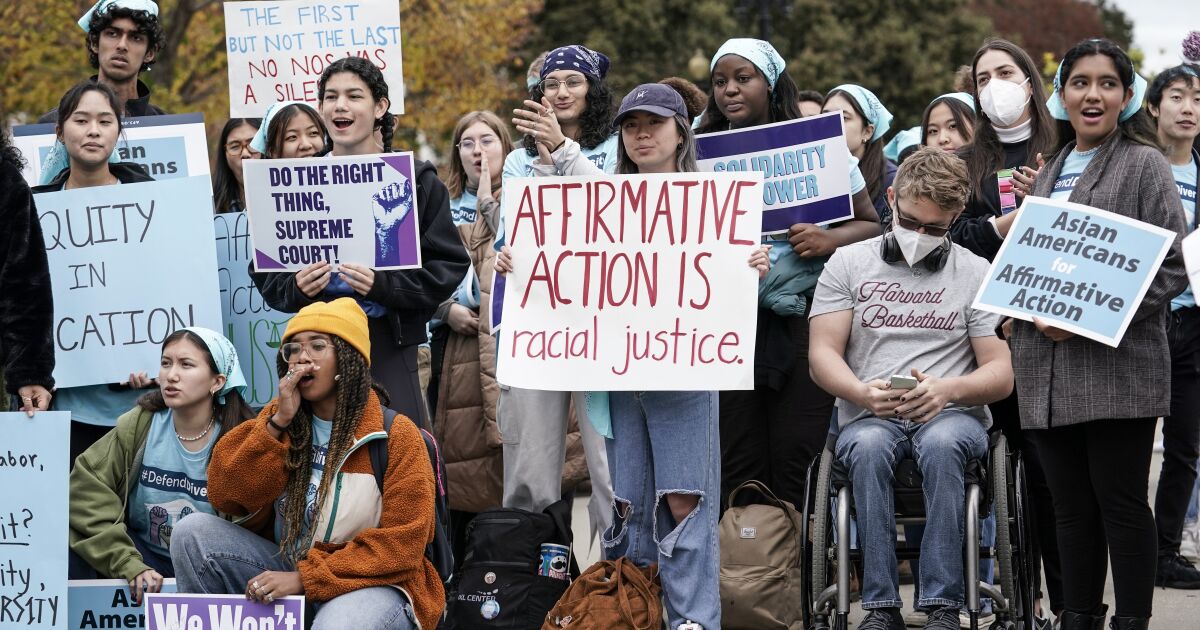
In another major reversal, the Supreme Court on Thursday struck down affirmative action policies at colleges and universities that use race as a factor in deciding who is admitted.
In a pair of decisions, the six conservative justices ruled that Harvard, the nation’s oldest private college, and the University of North Carolina at Chapel Hill, the oldest state university, were illegally discriminating based on race and violating the 14th Amendment of the Constitution.
“Eliminating racial discrimination means eliminating all of it,” wrote Chief Justice John G. Roberts Jr. in his majority decision. “And the Equal Protection Clause, we have accordingly held, applies ‘without regard to any differences of race, of color, or of nationality’ — it is ‘universal in [its] application.’”
The vote was 6-3 in the North Carolina case and 6-2 in the Harvard case, from which Justice Ketanji Jackson Brown, a former member of Harvard’s Board of Overseers, recused herself.
The high court overturned rulings dating back to 1978 that held that universities had a compelling interest in seeking racial diversity on campus and could consider the race of Black and Latino students as a plus factor when choosing among well-qualified applicants.
Those precedents had remained under challenge from conservatives, who argued that the Constitution and the civil rights law prohibited discrimination based on race, even where the consideration of race was intended to increase diversity and correct past injustices.
A group called Students for Fair Admissions, created by financier Edward Blum, accused Harvard of discriminating against Asian American applicants in favor of Black and Latino applicants.
Affirmative action, like abortion, has been a target of the conservative legal movement for decades, and the court’s liberal precedents on these two major issues were put in danger when President Trump and Senate Republicans succeeded in appointing three new justices.
The impact of the rulings is likely to be limited in California, however. The University of California is already prohibited from using race as an admissions factor under ballot measures approved by voters in 1996 and 2020. Eight other states have followed California’s lead in forbidding race-conscious admissions policies at state universities, including Michigan, Florida and Washington.
But the ruling in the Harvard case extends that prohibition to private universities, including Stanford and USC.

In another major reversal, the Supreme Court on Thursday struck down affirmative action policies at colleges and universities that use race as a factor in deciding who is admitted.
In a pair of decisions, the six conservative justices ruled that Harvard, the nation’s oldest private college, and the University of North Carolina at Chapel Hill, the oldest state university, were illegally discriminating based on race and violating the 14th Amendment of the Constitution.
“Eliminating racial discrimination means eliminating all of it,” wrote Chief Justice John G. Roberts Jr. in his majority decision. “And the Equal Protection Clause, we have accordingly held, applies ‘without regard to any differences of race, of color, or of nationality’ — it is ‘universal in [its] application.’”
The vote was 6-3 in the North Carolina case and 6-2 in the Harvard case, from which Justice Ketanji Jackson Brown, a former member of Harvard’s Board of Overseers, recused herself.
The high court overturned rulings dating back to 1978 that held that universities had a compelling interest in seeking racial diversity on campus and could consider the race of Black and Latino students as a plus factor when choosing among well-qualified applicants.
Those precedents had remained under challenge from conservatives, who argued that the Constitution and the civil rights law prohibited discrimination based on race, even where the consideration of race was intended to increase diversity and correct past injustices.
A group called Students for Fair Admissions, created by financier Edward Blum, accused Harvard of discriminating against Asian American applicants in favor of Black and Latino applicants.
Affirmative action, like abortion, has been a target of the conservative legal movement for decades, and the court’s liberal precedents on these two major issues were put in danger when President Trump and Senate Republicans succeeded in appointing three new justices.
The impact of the rulings is likely to be limited in California, however. The University of California is already prohibited from using race as an admissions factor under ballot measures approved by voters in 1996 and 2020. Eight other states have followed California’s lead in forbidding race-conscious admissions policies at state universities, including Michigan, Florida and Washington.
But the ruling in the Harvard case extends that prohibition to private universities, including Stanford and USC.

In another major reversal, the Supreme Court on Thursday struck down affirmative action policies at colleges and universities that use race as a factor in deciding who is admitted.
In a pair of decisions, the six conservative justices ruled that Harvard, the nation’s oldest private college, and the University of North Carolina at Chapel Hill, the oldest state university, were illegally discriminating based on race and violating the 14th Amendment of the Constitution.
“Eliminating racial discrimination means eliminating all of it,” wrote Chief Justice John G. Roberts Jr. in his majority decision. “And the Equal Protection Clause, we have accordingly held, applies ‘without regard to any differences of race, of color, or of nationality’ — it is ‘universal in [its] application.’”
The vote was 6-3 in the North Carolina case and 6-2 in the Harvard case, from which Justice Ketanji Jackson Brown, a former member of Harvard’s Board of Overseers, recused herself.
The high court overturned rulings dating back to 1978 that held that universities had a compelling interest in seeking racial diversity on campus and could consider the race of Black and Latino students as a plus factor when choosing among well-qualified applicants.
Those precedents had remained under challenge from conservatives, who argued that the Constitution and the civil rights law prohibited discrimination based on race, even where the consideration of race was intended to increase diversity and correct past injustices.
A group called Students for Fair Admissions, created by financier Edward Blum, accused Harvard of discriminating against Asian American applicants in favor of Black and Latino applicants.
Affirmative action, like abortion, has been a target of the conservative legal movement for decades, and the court’s liberal precedents on these two major issues were put in danger when President Trump and Senate Republicans succeeded in appointing three new justices.
The impact of the rulings is likely to be limited in California, however. The University of California is already prohibited from using race as an admissions factor under ballot measures approved by voters in 1996 and 2020. Eight other states have followed California’s lead in forbidding race-conscious admissions policies at state universities, including Michigan, Florida and Washington.
But the ruling in the Harvard case extends that prohibition to private universities, including Stanford and USC.
In another major reversal, the Supreme Court on Thursday struck down affirmative action policies at colleges and universities that use race as a factor in deciding who is admitted.
In a pair of decisions, the six conservative justices ruled that Harvard, the nation’s oldest private college, and the University of North Carolina at Chapel Hill, the oldest state university, were illegally discriminating based on race and violating the 14th Amendment of the Constitution.
“Eliminating racial discrimination means eliminating all of it,” wrote Chief Justice John G. Roberts Jr. in his majority decision. “And the Equal Protection Clause, we have accordingly held, applies ‘without regard to any differences of race, of color, or of nationality’ — it is ‘universal in [its] application.’”
The vote was 6-3 in the North Carolina case and 6-2 in the Harvard case, from which Justice Ketanji Jackson Brown, a former member of Harvard’s Board of Overseers, recused herself.
The high court overturned rulings dating back to 1978 that held that universities had a compelling interest in seeking racial diversity on campus and could consider the race of Black and Latino students as a plus factor when choosing among well-qualified applicants.
Those precedents had remained under challenge from conservatives, who argued that the Constitution and the civil rights law prohibited discrimination based on race, even where the consideration of race was intended to increase diversity and correct past injustices.
A group called Students for Fair Admissions, created by financier Edward Blum, accused Harvard of discriminating against Asian American applicants in favor of Black and Latino applicants.
Affirmative action, like abortion, has been a target of the conservative legal movement for decades, and the court’s liberal precedents on these two major issues were put in danger when President Trump and Senate Republicans succeeded in appointing three new justices.
The impact of the rulings is likely to be limited in California, however. The University of California is already prohibited from using race as an admissions factor under ballot measures approved by voters in 1996 and 2020. Eight other states have followed California’s lead in forbidding race-conscious admissions policies at state universities, including Michigan, Florida and Washington.
But the ruling in the Harvard case extends that prohibition to private universities, including Stanford and USC.

In another major reversal, the Supreme Court on Thursday struck down affirmative action policies at colleges and universities that use race as a factor in deciding who is admitted.
In a pair of decisions, the six conservative justices ruled that Harvard, the nation’s oldest private college, and the University of North Carolina at Chapel Hill, the oldest state university, were illegally discriminating based on race and violating the 14th Amendment of the Constitution.
“Eliminating racial discrimination means eliminating all of it,” wrote Chief Justice John G. Roberts Jr. in his majority decision. “And the Equal Protection Clause, we have accordingly held, applies ‘without regard to any differences of race, of color, or of nationality’ — it is ‘universal in [its] application.’”
The vote was 6-3 in the North Carolina case and 6-2 in the Harvard case, from which Justice Ketanji Jackson Brown, a former member of Harvard’s Board of Overseers, recused herself.
The high court overturned rulings dating back to 1978 that held that universities had a compelling interest in seeking racial diversity on campus and could consider the race of Black and Latino students as a plus factor when choosing among well-qualified applicants.
Those precedents had remained under challenge from conservatives, who argued that the Constitution and the civil rights law prohibited discrimination based on race, even where the consideration of race was intended to increase diversity and correct past injustices.
A group called Students for Fair Admissions, created by financier Edward Blum, accused Harvard of discriminating against Asian American applicants in favor of Black and Latino applicants.
Affirmative action, like abortion, has been a target of the conservative legal movement for decades, and the court’s liberal precedents on these two major issues were put in danger when President Trump and Senate Republicans succeeded in appointing three new justices.
The impact of the rulings is likely to be limited in California, however. The University of California is already prohibited from using race as an admissions factor under ballot measures approved by voters in 1996 and 2020. Eight other states have followed California’s lead in forbidding race-conscious admissions policies at state universities, including Michigan, Florida and Washington.
But the ruling in the Harvard case extends that prohibition to private universities, including Stanford and USC.
In another major reversal, the Supreme Court on Thursday struck down affirmative action policies at colleges and universities that use race as a factor in deciding who is admitted.
In a pair of decisions, the six conservative justices ruled that Harvard, the nation’s oldest private college, and the University of North Carolina at Chapel Hill, the oldest state university, were illegally discriminating based on race and violating the 14th Amendment of the Constitution.
“Eliminating racial discrimination means eliminating all of it,” wrote Chief Justice John G. Roberts Jr. in his majority decision. “And the Equal Protection Clause, we have accordingly held, applies ‘without regard to any differences of race, of color, or of nationality’ — it is ‘universal in [its] application.’”
The vote was 6-3 in the North Carolina case and 6-2 in the Harvard case, from which Justice Ketanji Jackson Brown, a former member of Harvard’s Board of Overseers, recused herself.
The high court overturned rulings dating back to 1978 that held that universities had a compelling interest in seeking racial diversity on campus and could consider the race of Black and Latino students as a plus factor when choosing among well-qualified applicants.
Those precedents had remained under challenge from conservatives, who argued that the Constitution and the civil rights law prohibited discrimination based on race, even where the consideration of race was intended to increase diversity and correct past injustices.
A group called Students for Fair Admissions, created by financier Edward Blum, accused Harvard of discriminating against Asian American applicants in favor of Black and Latino applicants.
Affirmative action, like abortion, has been a target of the conservative legal movement for decades, and the court’s liberal precedents on these two major issues were put in danger when President Trump and Senate Republicans succeeded in appointing three new justices.
The impact of the rulings is likely to be limited in California, however. The University of California is already prohibited from using race as an admissions factor under ballot measures approved by voters in 1996 and 2020. Eight other states have followed California’s lead in forbidding race-conscious admissions policies at state universities, including Michigan, Florida and Washington.
But the ruling in the Harvard case extends that prohibition to private universities, including Stanford and USC.
In another major reversal, the Supreme Court on Thursday struck down affirmative action policies at colleges and universities that use race as a factor in deciding who is admitted.
In a pair of decisions, the six conservative justices ruled that Harvard, the nation’s oldest private college, and the University of North Carolina at Chapel Hill, the oldest state university, were illegally discriminating based on race and violating the 14th Amendment of the Constitution.
“Eliminating racial discrimination means eliminating all of it,” wrote Chief Justice John G. Roberts Jr. in his majority decision. “And the Equal Protection Clause, we have accordingly held, applies ‘without regard to any differences of race, of color, or of nationality’ — it is ‘universal in [its] application.’”
The vote was 6-3 in the North Carolina case and 6-2 in the Harvard case, from which Justice Ketanji Jackson Brown, a former member of Harvard’s Board of Overseers, recused herself.
The high court overturned rulings dating back to 1978 that held that universities had a compelling interest in seeking racial diversity on campus and could consider the race of Black and Latino students as a plus factor when choosing among well-qualified applicants.
Those precedents had remained under challenge from conservatives, who argued that the Constitution and the civil rights law prohibited discrimination based on race, even where the consideration of race was intended to increase diversity and correct past injustices.
A group called Students for Fair Admissions, created by financier Edward Blum, accused Harvard of discriminating against Asian American applicants in favor of Black and Latino applicants.
Affirmative action, like abortion, has been a target of the conservative legal movement for decades, and the court’s liberal precedents on these two major issues were put in danger when President Trump and Senate Republicans succeeded in appointing three new justices.
The impact of the rulings is likely to be limited in California, however. The University of California is already prohibited from using race as an admissions factor under ballot measures approved by voters in 1996 and 2020. Eight other states have followed California’s lead in forbidding race-conscious admissions policies at state universities, including Michigan, Florida and Washington.
But the ruling in the Harvard case extends that prohibition to private universities, including Stanford and USC.
In another major reversal, the Supreme Court on Thursday struck down affirmative action policies at colleges and universities that use race as a factor in deciding who is admitted.
In a pair of decisions, the six conservative justices ruled that Harvard, the nation’s oldest private college, and the University of North Carolina at Chapel Hill, the oldest state university, were illegally discriminating based on race and violating the 14th Amendment of the Constitution.
“Eliminating racial discrimination means eliminating all of it,” wrote Chief Justice John G. Roberts Jr. in his majority decision. “And the Equal Protection Clause, we have accordingly held, applies ‘without regard to any differences of race, of color, or of nationality’ — it is ‘universal in [its] application.’”
The vote was 6-3 in the North Carolina case and 6-2 in the Harvard case, from which Justice Ketanji Jackson Brown, a former member of Harvard’s Board of Overseers, recused herself.
The high court overturned rulings dating back to 1978 that held that universities had a compelling interest in seeking racial diversity on campus and could consider the race of Black and Latino students as a plus factor when choosing among well-qualified applicants.
Those precedents had remained under challenge from conservatives, who argued that the Constitution and the civil rights law prohibited discrimination based on race, even where the consideration of race was intended to increase diversity and correct past injustices.
A group called Students for Fair Admissions, created by financier Edward Blum, accused Harvard of discriminating against Asian American applicants in favor of Black and Latino applicants.
Affirmative action, like abortion, has been a target of the conservative legal movement for decades, and the court’s liberal precedents on these two major issues were put in danger when President Trump and Senate Republicans succeeded in appointing three new justices.
The impact of the rulings is likely to be limited in California, however. The University of California is already prohibited from using race as an admissions factor under ballot measures approved by voters in 1996 and 2020. Eight other states have followed California’s lead in forbidding race-conscious admissions policies at state universities, including Michigan, Florida and Washington.
But the ruling in the Harvard case extends that prohibition to private universities, including Stanford and USC.

In another major reversal, the Supreme Court on Thursday struck down affirmative action policies at colleges and universities that use race as a factor in deciding who is admitted.
In a pair of decisions, the six conservative justices ruled that Harvard, the nation’s oldest private college, and the University of North Carolina at Chapel Hill, the oldest state university, were illegally discriminating based on race and violating the 14th Amendment of the Constitution.
“Eliminating racial discrimination means eliminating all of it,” wrote Chief Justice John G. Roberts Jr. in his majority decision. “And the Equal Protection Clause, we have accordingly held, applies ‘without regard to any differences of race, of color, or of nationality’ — it is ‘universal in [its] application.’”
The vote was 6-3 in the North Carolina case and 6-2 in the Harvard case, from which Justice Ketanji Jackson Brown, a former member of Harvard’s Board of Overseers, recused herself.
The high court overturned rulings dating back to 1978 that held that universities had a compelling interest in seeking racial diversity on campus and could consider the race of Black and Latino students as a plus factor when choosing among well-qualified applicants.
Those precedents had remained under challenge from conservatives, who argued that the Constitution and the civil rights law prohibited discrimination based on race, even where the consideration of race was intended to increase diversity and correct past injustices.
A group called Students for Fair Admissions, created by financier Edward Blum, accused Harvard of discriminating against Asian American applicants in favor of Black and Latino applicants.
Affirmative action, like abortion, has been a target of the conservative legal movement for decades, and the court’s liberal precedents on these two major issues were put in danger when President Trump and Senate Republicans succeeded in appointing three new justices.
The impact of the rulings is likely to be limited in California, however. The University of California is already prohibited from using race as an admissions factor under ballot measures approved by voters in 1996 and 2020. Eight other states have followed California’s lead in forbidding race-conscious admissions policies at state universities, including Michigan, Florida and Washington.
But the ruling in the Harvard case extends that prohibition to private universities, including Stanford and USC.
In another major reversal, the Supreme Court on Thursday struck down affirmative action policies at colleges and universities that use race as a factor in deciding who is admitted.
In a pair of decisions, the six conservative justices ruled that Harvard, the nation’s oldest private college, and the University of North Carolina at Chapel Hill, the oldest state university, were illegally discriminating based on race and violating the 14th Amendment of the Constitution.
“Eliminating racial discrimination means eliminating all of it,” wrote Chief Justice John G. Roberts Jr. in his majority decision. “And the Equal Protection Clause, we have accordingly held, applies ‘without regard to any differences of race, of color, or of nationality’ — it is ‘universal in [its] application.’”
The vote was 6-3 in the North Carolina case and 6-2 in the Harvard case, from which Justice Ketanji Jackson Brown, a former member of Harvard’s Board of Overseers, recused herself.
The high court overturned rulings dating back to 1978 that held that universities had a compelling interest in seeking racial diversity on campus and could consider the race of Black and Latino students as a plus factor when choosing among well-qualified applicants.
Those precedents had remained under challenge from conservatives, who argued that the Constitution and the civil rights law prohibited discrimination based on race, even where the consideration of race was intended to increase diversity and correct past injustices.
A group called Students for Fair Admissions, created by financier Edward Blum, accused Harvard of discriminating against Asian American applicants in favor of Black and Latino applicants.
Affirmative action, like abortion, has been a target of the conservative legal movement for decades, and the court’s liberal precedents on these two major issues were put in danger when President Trump and Senate Republicans succeeded in appointing three new justices.
The impact of the rulings is likely to be limited in California, however. The University of California is already prohibited from using race as an admissions factor under ballot measures approved by voters in 1996 and 2020. Eight other states have followed California’s lead in forbidding race-conscious admissions policies at state universities, including Michigan, Florida and Washington.
But the ruling in the Harvard case extends that prohibition to private universities, including Stanford and USC.
In another major reversal, the Supreme Court on Thursday struck down affirmative action policies at colleges and universities that use race as a factor in deciding who is admitted.
In a pair of decisions, the six conservative justices ruled that Harvard, the nation’s oldest private college, and the University of North Carolina at Chapel Hill, the oldest state university, were illegally discriminating based on race and violating the 14th Amendment of the Constitution.
“Eliminating racial discrimination means eliminating all of it,” wrote Chief Justice John G. Roberts Jr. in his majority decision. “And the Equal Protection Clause, we have accordingly held, applies ‘without regard to any differences of race, of color, or of nationality’ — it is ‘universal in [its] application.’”
The vote was 6-3 in the North Carolina case and 6-2 in the Harvard case, from which Justice Ketanji Jackson Brown, a former member of Harvard’s Board of Overseers, recused herself.
The high court overturned rulings dating back to 1978 that held that universities had a compelling interest in seeking racial diversity on campus and could consider the race of Black and Latino students as a plus factor when choosing among well-qualified applicants.
Those precedents had remained under challenge from conservatives, who argued that the Constitution and the civil rights law prohibited discrimination based on race, even where the consideration of race was intended to increase diversity and correct past injustices.
A group called Students for Fair Admissions, created by financier Edward Blum, accused Harvard of discriminating against Asian American applicants in favor of Black and Latino applicants.
Affirmative action, like abortion, has been a target of the conservative legal movement for decades, and the court’s liberal precedents on these two major issues were put in danger when President Trump and Senate Republicans succeeded in appointing three new justices.
The impact of the rulings is likely to be limited in California, however. The University of California is already prohibited from using race as an admissions factor under ballot measures approved by voters in 1996 and 2020. Eight other states have followed California’s lead in forbidding race-conscious admissions policies at state universities, including Michigan, Florida and Washington.
But the ruling in the Harvard case extends that prohibition to private universities, including Stanford and USC.
In another major reversal, the Supreme Court on Thursday struck down affirmative action policies at colleges and universities that use race as a factor in deciding who is admitted.
In a pair of decisions, the six conservative justices ruled that Harvard, the nation’s oldest private college, and the University of North Carolina at Chapel Hill, the oldest state university, were illegally discriminating based on race and violating the 14th Amendment of the Constitution.
“Eliminating racial discrimination means eliminating all of it,” wrote Chief Justice John G. Roberts Jr. in his majority decision. “And the Equal Protection Clause, we have accordingly held, applies ‘without regard to any differences of race, of color, or of nationality’ — it is ‘universal in [its] application.’”
The vote was 6-3 in the North Carolina case and 6-2 in the Harvard case, from which Justice Ketanji Jackson Brown, a former member of Harvard’s Board of Overseers, recused herself.
The high court overturned rulings dating back to 1978 that held that universities had a compelling interest in seeking racial diversity on campus and could consider the race of Black and Latino students as a plus factor when choosing among well-qualified applicants.
Those precedents had remained under challenge from conservatives, who argued that the Constitution and the civil rights law prohibited discrimination based on race, even where the consideration of race was intended to increase diversity and correct past injustices.
A group called Students for Fair Admissions, created by financier Edward Blum, accused Harvard of discriminating against Asian American applicants in favor of Black and Latino applicants.
Affirmative action, like abortion, has been a target of the conservative legal movement for decades, and the court’s liberal precedents on these two major issues were put in danger when President Trump and Senate Republicans succeeded in appointing three new justices.
The impact of the rulings is likely to be limited in California, however. The University of California is already prohibited from using race as an admissions factor under ballot measures approved by voters in 1996 and 2020. Eight other states have followed California’s lead in forbidding race-conscious admissions policies at state universities, including Michigan, Florida and Washington.
But the ruling in the Harvard case extends that prohibition to private universities, including Stanford and USC.
In another major reversal, the Supreme Court on Thursday struck down affirmative action policies at colleges and universities that use race as a factor in deciding who is admitted.
In a pair of decisions, the six conservative justices ruled that Harvard, the nation’s oldest private college, and the University of North Carolina at Chapel Hill, the oldest state university, were illegally discriminating based on race and violating the 14th Amendment of the Constitution.
“Eliminating racial discrimination means eliminating all of it,” wrote Chief Justice John G. Roberts Jr. in his majority decision. “And the Equal Protection Clause, we have accordingly held, applies ‘without regard to any differences of race, of color, or of nationality’ — it is ‘universal in [its] application.’”
The vote was 6-3 in the North Carolina case and 6-2 in the Harvard case, from which Justice Ketanji Jackson Brown, a former member of Harvard’s Board of Overseers, recused herself.
The high court overturned rulings dating back to 1978 that held that universities had a compelling interest in seeking racial diversity on campus and could consider the race of Black and Latino students as a plus factor when choosing among well-qualified applicants.
Those precedents had remained under challenge from conservatives, who argued that the Constitution and the civil rights law prohibited discrimination based on race, even where the consideration of race was intended to increase diversity and correct past injustices.
A group called Students for Fair Admissions, created by financier Edward Blum, accused Harvard of discriminating against Asian American applicants in favor of Black and Latino applicants.
Affirmative action, like abortion, has been a target of the conservative legal movement for decades, and the court’s liberal precedents on these two major issues were put in danger when President Trump and Senate Republicans succeeded in appointing three new justices.
The impact of the rulings is likely to be limited in California, however. The University of California is already prohibited from using race as an admissions factor under ballot measures approved by voters in 1996 and 2020. Eight other states have followed California’s lead in forbidding race-conscious admissions policies at state universities, including Michigan, Florida and Washington.
But the ruling in the Harvard case extends that prohibition to private universities, including Stanford and USC.
In another major reversal, the Supreme Court on Thursday struck down affirmative action policies at colleges and universities that use race as a factor in deciding who is admitted.
In a pair of decisions, the six conservative justices ruled that Harvard, the nation’s oldest private college, and the University of North Carolina at Chapel Hill, the oldest state university, were illegally discriminating based on race and violating the 14th Amendment of the Constitution.
“Eliminating racial discrimination means eliminating all of it,” wrote Chief Justice John G. Roberts Jr. in his majority decision. “And the Equal Protection Clause, we have accordingly held, applies ‘without regard to any differences of race, of color, or of nationality’ — it is ‘universal in [its] application.’”
The vote was 6-3 in the North Carolina case and 6-2 in the Harvard case, from which Justice Ketanji Jackson Brown, a former member of Harvard’s Board of Overseers, recused herself.
The high court overturned rulings dating back to 1978 that held that universities had a compelling interest in seeking racial diversity on campus and could consider the race of Black and Latino students as a plus factor when choosing among well-qualified applicants.
Those precedents had remained under challenge from conservatives, who argued that the Constitution and the civil rights law prohibited discrimination based on race, even where the consideration of race was intended to increase diversity and correct past injustices.
A group called Students for Fair Admissions, created by financier Edward Blum, accused Harvard of discriminating against Asian American applicants in favor of Black and Latino applicants.
Affirmative action, like abortion, has been a target of the conservative legal movement for decades, and the court’s liberal precedents on these two major issues were put in danger when President Trump and Senate Republicans succeeded in appointing three new justices.
The impact of the rulings is likely to be limited in California, however. The University of California is already prohibited from using race as an admissions factor under ballot measures approved by voters in 1996 and 2020. Eight other states have followed California’s lead in forbidding race-conscious admissions policies at state universities, including Michigan, Florida and Washington.
But the ruling in the Harvard case extends that prohibition to private universities, including Stanford and USC.
In another major reversal, the Supreme Court on Thursday struck down affirmative action policies at colleges and universities that use race as a factor in deciding who is admitted.
In a pair of decisions, the six conservative justices ruled that Harvard, the nation’s oldest private college, and the University of North Carolina at Chapel Hill, the oldest state university, were illegally discriminating based on race and violating the 14th Amendment of the Constitution.
“Eliminating racial discrimination means eliminating all of it,” wrote Chief Justice John G. Roberts Jr. in his majority decision. “And the Equal Protection Clause, we have accordingly held, applies ‘without regard to any differences of race, of color, or of nationality’ — it is ‘universal in [its] application.’”
The vote was 6-3 in the North Carolina case and 6-2 in the Harvard case, from which Justice Ketanji Jackson Brown, a former member of Harvard’s Board of Overseers, recused herself.
The high court overturned rulings dating back to 1978 that held that universities had a compelling interest in seeking racial diversity on campus and could consider the race of Black and Latino students as a plus factor when choosing among well-qualified applicants.
Those precedents had remained under challenge from conservatives, who argued that the Constitution and the civil rights law prohibited discrimination based on race, even where the consideration of race was intended to increase diversity and correct past injustices.
A group called Students for Fair Admissions, created by financier Edward Blum, accused Harvard of discriminating against Asian American applicants in favor of Black and Latino applicants.
Affirmative action, like abortion, has been a target of the conservative legal movement for decades, and the court’s liberal precedents on these two major issues were put in danger when President Trump and Senate Republicans succeeded in appointing three new justices.
The impact of the rulings is likely to be limited in California, however. The University of California is already prohibited from using race as an admissions factor under ballot measures approved by voters in 1996 and 2020. Eight other states have followed California’s lead in forbidding race-conscious admissions policies at state universities, including Michigan, Florida and Washington.
But the ruling in the Harvard case extends that prohibition to private universities, including Stanford and USC.
In another major reversal, the Supreme Court on Thursday struck down affirmative action policies at colleges and universities that use race as a factor in deciding who is admitted.
In a pair of decisions, the six conservative justices ruled that Harvard, the nation’s oldest private college, and the University of North Carolina at Chapel Hill, the oldest state university, were illegally discriminating based on race and violating the 14th Amendment of the Constitution.
“Eliminating racial discrimination means eliminating all of it,” wrote Chief Justice John G. Roberts Jr. in his majority decision. “And the Equal Protection Clause, we have accordingly held, applies ‘without regard to any differences of race, of color, or of nationality’ — it is ‘universal in [its] application.’”
The vote was 6-3 in the North Carolina case and 6-2 in the Harvard case, from which Justice Ketanji Jackson Brown, a former member of Harvard’s Board of Overseers, recused herself.
The high court overturned rulings dating back to 1978 that held that universities had a compelling interest in seeking racial diversity on campus and could consider the race of Black and Latino students as a plus factor when choosing among well-qualified applicants.
Those precedents had remained under challenge from conservatives, who argued that the Constitution and the civil rights law prohibited discrimination based on race, even where the consideration of race was intended to increase diversity and correct past injustices.
A group called Students for Fair Admissions, created by financier Edward Blum, accused Harvard of discriminating against Asian American applicants in favor of Black and Latino applicants.
Affirmative action, like abortion, has been a target of the conservative legal movement for decades, and the court’s liberal precedents on these two major issues were put in danger when President Trump and Senate Republicans succeeded in appointing three new justices.
The impact of the rulings is likely to be limited in California, however. The University of California is already prohibited from using race as an admissions factor under ballot measures approved by voters in 1996 and 2020. Eight other states have followed California’s lead in forbidding race-conscious admissions policies at state universities, including Michigan, Florida and Washington.
But the ruling in the Harvard case extends that prohibition to private universities, including Stanford and USC.

