

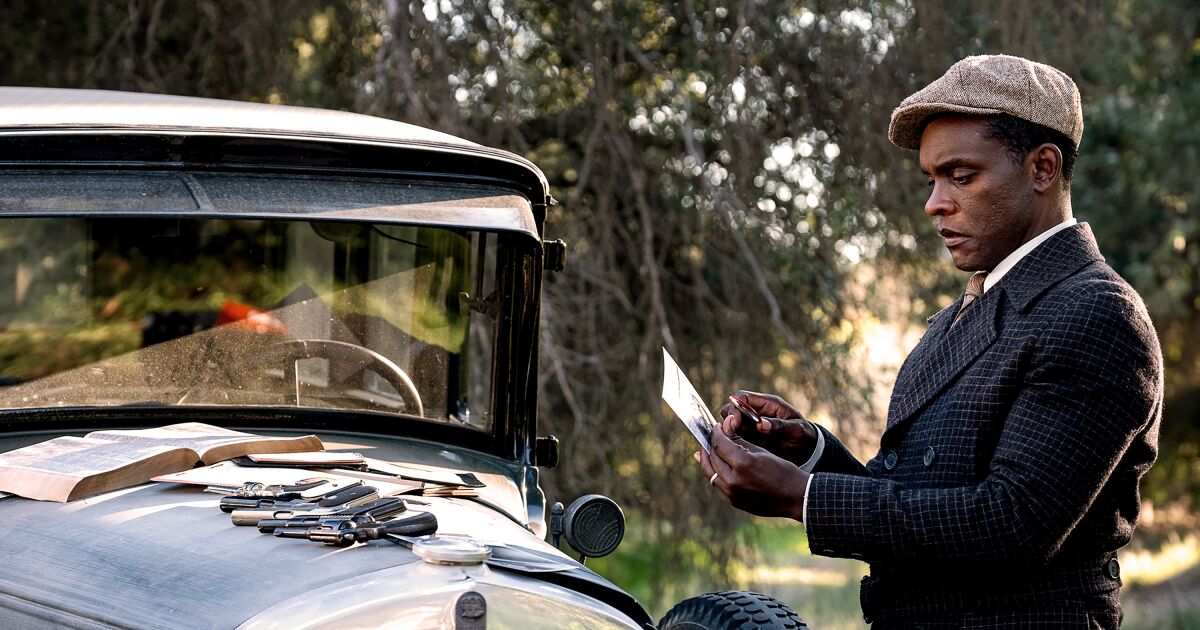

Chris Chalk had no illusions about being cast as Paul Drake in a 1930s-set “Perry Mason.” “I’m used to a media where Black people get kind of submerged in white stories,” said Chalk.
But talking to the producers quickly dispelled his fears of tokenism in a splashy period reboot. “I was like, ‘Oh, you’re going all the way with this.’ We’re getting deep into the realities of Central Avenue in the ‘30s, what it is to be a Black guy who was a cop. It’s never been good. Either the community hates you or the cops hate you. And Paul has pissed them both off.”
Perry Mason’s belief in Paul’s abilities changes everything for him. “Perry unknowingly unlocked Paul’s secret to becoming himself. Perry can see his skill set. And everybody wants to be seen.”
In Season 2, Paul’s crackerjack private-eye work complicates things further, first when he’s duped by a client into undermining a beloved godfather figure in his neighborhood, then when he finds a key piece of evidence that makes it even more difficult for Mason to defend two poor Chicano men in a racist justice system. “Paul wants to do the right thing,” Chalk said. “But what is the right thing when everybody on the other side is wrong? What is it to be a good Black citizen, but trying to figure out what a good PI is?”
Chalk added, “Paul is in this racial trauma of behavior, like, ‘I will behave how I have to to survive.’ But survival is not a state of existence. It’s a state of stress.”
For Chalk, who grew up poor, brainy and insular in North Carolina, acting was at first the hobby his single mom gave him “because I needed to be somewhere,” that later became a way out of his circumstances. “For some reason, my brain can understand the musicality of that language — Ibsen, Chekhov, Shakespeare — and that gave me a certain confidence,” said Chalk, who found that studying acting more deeply and playing more characters gave him a route to emotional maturity. “I’m learning other worlds, other realities, other tactics to survive. It was feeding my growth as a person.”
Now, with plenty of heft to his resume — from Broadway opposite Denzel Washington (“Fences”) to countless film and television roles — Chalk is relishing what this new Paul Drake offers him: the chance to play a Black person in the 1930s “just living a life.” That includes advocating for how Paul’s marriage to Clara (Diarra Kilpatrick) — loving and supportive, but strained by the danger of his job — is portrayed as well. “Let’s just make sure we’re honoring the people we talk about because they’re people, not props for Perry’s story,” said Chalk. “And I think [the showrunners] really embraced that. Everyone they hire really is coming in to make an impact. One of the great benefits of the team behind this story is their willingness to dig into what was real, and tell a story based on actual truth.”

Chris Chalk had no illusions about being cast as Paul Drake in a 1930s-set “Perry Mason.” “I’m used to a media where Black people get kind of submerged in white stories,” said Chalk.
But talking to the producers quickly dispelled his fears of tokenism in a splashy period reboot. “I was like, ‘Oh, you’re going all the way with this.’ We’re getting deep into the realities of Central Avenue in the ‘30s, what it is to be a Black guy who was a cop. It’s never been good. Either the community hates you or the cops hate you. And Paul has pissed them both off.”
Perry Mason’s belief in Paul’s abilities changes everything for him. “Perry unknowingly unlocked Paul’s secret to becoming himself. Perry can see his skill set. And everybody wants to be seen.”
In Season 2, Paul’s crackerjack private-eye work complicates things further, first when he’s duped by a client into undermining a beloved godfather figure in his neighborhood, then when he finds a key piece of evidence that makes it even more difficult for Mason to defend two poor Chicano men in a racist justice system. “Paul wants to do the right thing,” Chalk said. “But what is the right thing when everybody on the other side is wrong? What is it to be a good Black citizen, but trying to figure out what a good PI is?”
Chalk added, “Paul is in this racial trauma of behavior, like, ‘I will behave how I have to to survive.’ But survival is not a state of existence. It’s a state of stress.”
For Chalk, who grew up poor, brainy and insular in North Carolina, acting was at first the hobby his single mom gave him “because I needed to be somewhere,” that later became a way out of his circumstances. “For some reason, my brain can understand the musicality of that language — Ibsen, Chekhov, Shakespeare — and that gave me a certain confidence,” said Chalk, who found that studying acting more deeply and playing more characters gave him a route to emotional maturity. “I’m learning other worlds, other realities, other tactics to survive. It was feeding my growth as a person.”
Now, with plenty of heft to his resume — from Broadway opposite Denzel Washington (“Fences”) to countless film and television roles — Chalk is relishing what this new Paul Drake offers him: the chance to play a Black person in the 1930s “just living a life.” That includes advocating for how Paul’s marriage to Clara (Diarra Kilpatrick) — loving and supportive, but strained by the danger of his job — is portrayed as well. “Let’s just make sure we’re honoring the people we talk about because they’re people, not props for Perry’s story,” said Chalk. “And I think [the showrunners] really embraced that. Everyone they hire really is coming in to make an impact. One of the great benefits of the team behind this story is their willingness to dig into what was real, and tell a story based on actual truth.”

Chris Chalk had no illusions about being cast as Paul Drake in a 1930s-set “Perry Mason.” “I’m used to a media where Black people get kind of submerged in white stories,” said Chalk.
But talking to the producers quickly dispelled his fears of tokenism in a splashy period reboot. “I was like, ‘Oh, you’re going all the way with this.’ We’re getting deep into the realities of Central Avenue in the ‘30s, what it is to be a Black guy who was a cop. It’s never been good. Either the community hates you or the cops hate you. And Paul has pissed them both off.”
Perry Mason’s belief in Paul’s abilities changes everything for him. “Perry unknowingly unlocked Paul’s secret to becoming himself. Perry can see his skill set. And everybody wants to be seen.”
In Season 2, Paul’s crackerjack private-eye work complicates things further, first when he’s duped by a client into undermining a beloved godfather figure in his neighborhood, then when he finds a key piece of evidence that makes it even more difficult for Mason to defend two poor Chicano men in a racist justice system. “Paul wants to do the right thing,” Chalk said. “But what is the right thing when everybody on the other side is wrong? What is it to be a good Black citizen, but trying to figure out what a good PI is?”
Chalk added, “Paul is in this racial trauma of behavior, like, ‘I will behave how I have to to survive.’ But survival is not a state of existence. It’s a state of stress.”
For Chalk, who grew up poor, brainy and insular in North Carolina, acting was at first the hobby his single mom gave him “because I needed to be somewhere,” that later became a way out of his circumstances. “For some reason, my brain can understand the musicality of that language — Ibsen, Chekhov, Shakespeare — and that gave me a certain confidence,” said Chalk, who found that studying acting more deeply and playing more characters gave him a route to emotional maturity. “I’m learning other worlds, other realities, other tactics to survive. It was feeding my growth as a person.”
Now, with plenty of heft to his resume — from Broadway opposite Denzel Washington (“Fences”) to countless film and television roles — Chalk is relishing what this new Paul Drake offers him: the chance to play a Black person in the 1930s “just living a life.” That includes advocating for how Paul’s marriage to Clara (Diarra Kilpatrick) — loving and supportive, but strained by the danger of his job — is portrayed as well. “Let’s just make sure we’re honoring the people we talk about because they’re people, not props for Perry’s story,” said Chalk. “And I think [the showrunners] really embraced that. Everyone they hire really is coming in to make an impact. One of the great benefits of the team behind this story is their willingness to dig into what was real, and tell a story based on actual truth.”
Chris Chalk had no illusions about being cast as Paul Drake in a 1930s-set “Perry Mason.” “I’m used to a media where Black people get kind of submerged in white stories,” said Chalk.
But talking to the producers quickly dispelled his fears of tokenism in a splashy period reboot. “I was like, ‘Oh, you’re going all the way with this.’ We’re getting deep into the realities of Central Avenue in the ‘30s, what it is to be a Black guy who was a cop. It’s never been good. Either the community hates you or the cops hate you. And Paul has pissed them both off.”
Perry Mason’s belief in Paul’s abilities changes everything for him. “Perry unknowingly unlocked Paul’s secret to becoming himself. Perry can see his skill set. And everybody wants to be seen.”
In Season 2, Paul’s crackerjack private-eye work complicates things further, first when he’s duped by a client into undermining a beloved godfather figure in his neighborhood, then when he finds a key piece of evidence that makes it even more difficult for Mason to defend two poor Chicano men in a racist justice system. “Paul wants to do the right thing,” Chalk said. “But what is the right thing when everybody on the other side is wrong? What is it to be a good Black citizen, but trying to figure out what a good PI is?”
Chalk added, “Paul is in this racial trauma of behavior, like, ‘I will behave how I have to to survive.’ But survival is not a state of existence. It’s a state of stress.”
For Chalk, who grew up poor, brainy and insular in North Carolina, acting was at first the hobby his single mom gave him “because I needed to be somewhere,” that later became a way out of his circumstances. “For some reason, my brain can understand the musicality of that language — Ibsen, Chekhov, Shakespeare — and that gave me a certain confidence,” said Chalk, who found that studying acting more deeply and playing more characters gave him a route to emotional maturity. “I’m learning other worlds, other realities, other tactics to survive. It was feeding my growth as a person.”
Now, with plenty of heft to his resume — from Broadway opposite Denzel Washington (“Fences”) to countless film and television roles — Chalk is relishing what this new Paul Drake offers him: the chance to play a Black person in the 1930s “just living a life.” That includes advocating for how Paul’s marriage to Clara (Diarra Kilpatrick) — loving and supportive, but strained by the danger of his job — is portrayed as well. “Let’s just make sure we’re honoring the people we talk about because they’re people, not props for Perry’s story,” said Chalk. “And I think [the showrunners] really embraced that. Everyone they hire really is coming in to make an impact. One of the great benefits of the team behind this story is their willingness to dig into what was real, and tell a story based on actual truth.”

Chris Chalk had no illusions about being cast as Paul Drake in a 1930s-set “Perry Mason.” “I’m used to a media where Black people get kind of submerged in white stories,” said Chalk.
But talking to the producers quickly dispelled his fears of tokenism in a splashy period reboot. “I was like, ‘Oh, you’re going all the way with this.’ We’re getting deep into the realities of Central Avenue in the ‘30s, what it is to be a Black guy who was a cop. It’s never been good. Either the community hates you or the cops hate you. And Paul has pissed them both off.”
Perry Mason’s belief in Paul’s abilities changes everything for him. “Perry unknowingly unlocked Paul’s secret to becoming himself. Perry can see his skill set. And everybody wants to be seen.”
In Season 2, Paul’s crackerjack private-eye work complicates things further, first when he’s duped by a client into undermining a beloved godfather figure in his neighborhood, then when he finds a key piece of evidence that makes it even more difficult for Mason to defend two poor Chicano men in a racist justice system. “Paul wants to do the right thing,” Chalk said. “But what is the right thing when everybody on the other side is wrong? What is it to be a good Black citizen, but trying to figure out what a good PI is?”
Chalk added, “Paul is in this racial trauma of behavior, like, ‘I will behave how I have to to survive.’ But survival is not a state of existence. It’s a state of stress.”
For Chalk, who grew up poor, brainy and insular in North Carolina, acting was at first the hobby his single mom gave him “because I needed to be somewhere,” that later became a way out of his circumstances. “For some reason, my brain can understand the musicality of that language — Ibsen, Chekhov, Shakespeare — and that gave me a certain confidence,” said Chalk, who found that studying acting more deeply and playing more characters gave him a route to emotional maturity. “I’m learning other worlds, other realities, other tactics to survive. It was feeding my growth as a person.”
Now, with plenty of heft to his resume — from Broadway opposite Denzel Washington (“Fences”) to countless film and television roles — Chalk is relishing what this new Paul Drake offers him: the chance to play a Black person in the 1930s “just living a life.” That includes advocating for how Paul’s marriage to Clara (Diarra Kilpatrick) — loving and supportive, but strained by the danger of his job — is portrayed as well. “Let’s just make sure we’re honoring the people we talk about because they’re people, not props for Perry’s story,” said Chalk. “And I think [the showrunners] really embraced that. Everyone they hire really is coming in to make an impact. One of the great benefits of the team behind this story is their willingness to dig into what was real, and tell a story based on actual truth.”
Chris Chalk had no illusions about being cast as Paul Drake in a 1930s-set “Perry Mason.” “I’m used to a media where Black people get kind of submerged in white stories,” said Chalk.
But talking to the producers quickly dispelled his fears of tokenism in a splashy period reboot. “I was like, ‘Oh, you’re going all the way with this.’ We’re getting deep into the realities of Central Avenue in the ‘30s, what it is to be a Black guy who was a cop. It’s never been good. Either the community hates you or the cops hate you. And Paul has pissed them both off.”
Perry Mason’s belief in Paul’s abilities changes everything for him. “Perry unknowingly unlocked Paul’s secret to becoming himself. Perry can see his skill set. And everybody wants to be seen.”
In Season 2, Paul’s crackerjack private-eye work complicates things further, first when he’s duped by a client into undermining a beloved godfather figure in his neighborhood, then when he finds a key piece of evidence that makes it even more difficult for Mason to defend two poor Chicano men in a racist justice system. “Paul wants to do the right thing,” Chalk said. “But what is the right thing when everybody on the other side is wrong? What is it to be a good Black citizen, but trying to figure out what a good PI is?”
Chalk added, “Paul is in this racial trauma of behavior, like, ‘I will behave how I have to to survive.’ But survival is not a state of existence. It’s a state of stress.”
For Chalk, who grew up poor, brainy and insular in North Carolina, acting was at first the hobby his single mom gave him “because I needed to be somewhere,” that later became a way out of his circumstances. “For some reason, my brain can understand the musicality of that language — Ibsen, Chekhov, Shakespeare — and that gave me a certain confidence,” said Chalk, who found that studying acting more deeply and playing more characters gave him a route to emotional maturity. “I’m learning other worlds, other realities, other tactics to survive. It was feeding my growth as a person.”
Now, with plenty of heft to his resume — from Broadway opposite Denzel Washington (“Fences”) to countless film and television roles — Chalk is relishing what this new Paul Drake offers him: the chance to play a Black person in the 1930s “just living a life.” That includes advocating for how Paul’s marriage to Clara (Diarra Kilpatrick) — loving and supportive, but strained by the danger of his job — is portrayed as well. “Let’s just make sure we’re honoring the people we talk about because they’re people, not props for Perry’s story,” said Chalk. “And I think [the showrunners] really embraced that. Everyone they hire really is coming in to make an impact. One of the great benefits of the team behind this story is their willingness to dig into what was real, and tell a story based on actual truth.”
Chris Chalk had no illusions about being cast as Paul Drake in a 1930s-set “Perry Mason.” “I’m used to a media where Black people get kind of submerged in white stories,” said Chalk.
But talking to the producers quickly dispelled his fears of tokenism in a splashy period reboot. “I was like, ‘Oh, you’re going all the way with this.’ We’re getting deep into the realities of Central Avenue in the ‘30s, what it is to be a Black guy who was a cop. It’s never been good. Either the community hates you or the cops hate you. And Paul has pissed them both off.”
Perry Mason’s belief in Paul’s abilities changes everything for him. “Perry unknowingly unlocked Paul’s secret to becoming himself. Perry can see his skill set. And everybody wants to be seen.”
In Season 2, Paul’s crackerjack private-eye work complicates things further, first when he’s duped by a client into undermining a beloved godfather figure in his neighborhood, then when he finds a key piece of evidence that makes it even more difficult for Mason to defend two poor Chicano men in a racist justice system. “Paul wants to do the right thing,” Chalk said. “But what is the right thing when everybody on the other side is wrong? What is it to be a good Black citizen, but trying to figure out what a good PI is?”
Chalk added, “Paul is in this racial trauma of behavior, like, ‘I will behave how I have to to survive.’ But survival is not a state of existence. It’s a state of stress.”
For Chalk, who grew up poor, brainy and insular in North Carolina, acting was at first the hobby his single mom gave him “because I needed to be somewhere,” that later became a way out of his circumstances. “For some reason, my brain can understand the musicality of that language — Ibsen, Chekhov, Shakespeare — and that gave me a certain confidence,” said Chalk, who found that studying acting more deeply and playing more characters gave him a route to emotional maturity. “I’m learning other worlds, other realities, other tactics to survive. It was feeding my growth as a person.”
Now, with plenty of heft to his resume — from Broadway opposite Denzel Washington (“Fences”) to countless film and television roles — Chalk is relishing what this new Paul Drake offers him: the chance to play a Black person in the 1930s “just living a life.” That includes advocating for how Paul’s marriage to Clara (Diarra Kilpatrick) — loving and supportive, but strained by the danger of his job — is portrayed as well. “Let’s just make sure we’re honoring the people we talk about because they’re people, not props for Perry’s story,” said Chalk. “And I think [the showrunners] really embraced that. Everyone they hire really is coming in to make an impact. One of the great benefits of the team behind this story is their willingness to dig into what was real, and tell a story based on actual truth.”
Chris Chalk had no illusions about being cast as Paul Drake in a 1930s-set “Perry Mason.” “I’m used to a media where Black people get kind of submerged in white stories,” said Chalk.
But talking to the producers quickly dispelled his fears of tokenism in a splashy period reboot. “I was like, ‘Oh, you’re going all the way with this.’ We’re getting deep into the realities of Central Avenue in the ‘30s, what it is to be a Black guy who was a cop. It’s never been good. Either the community hates you or the cops hate you. And Paul has pissed them both off.”
Perry Mason’s belief in Paul’s abilities changes everything for him. “Perry unknowingly unlocked Paul’s secret to becoming himself. Perry can see his skill set. And everybody wants to be seen.”
In Season 2, Paul’s crackerjack private-eye work complicates things further, first when he’s duped by a client into undermining a beloved godfather figure in his neighborhood, then when he finds a key piece of evidence that makes it even more difficult for Mason to defend two poor Chicano men in a racist justice system. “Paul wants to do the right thing,” Chalk said. “But what is the right thing when everybody on the other side is wrong? What is it to be a good Black citizen, but trying to figure out what a good PI is?”
Chalk added, “Paul is in this racial trauma of behavior, like, ‘I will behave how I have to to survive.’ But survival is not a state of existence. It’s a state of stress.”
For Chalk, who grew up poor, brainy and insular in North Carolina, acting was at first the hobby his single mom gave him “because I needed to be somewhere,” that later became a way out of his circumstances. “For some reason, my brain can understand the musicality of that language — Ibsen, Chekhov, Shakespeare — and that gave me a certain confidence,” said Chalk, who found that studying acting more deeply and playing more characters gave him a route to emotional maturity. “I’m learning other worlds, other realities, other tactics to survive. It was feeding my growth as a person.”
Now, with plenty of heft to his resume — from Broadway opposite Denzel Washington (“Fences”) to countless film and television roles — Chalk is relishing what this new Paul Drake offers him: the chance to play a Black person in the 1930s “just living a life.” That includes advocating for how Paul’s marriage to Clara (Diarra Kilpatrick) — loving and supportive, but strained by the danger of his job — is portrayed as well. “Let’s just make sure we’re honoring the people we talk about because they’re people, not props for Perry’s story,” said Chalk. “And I think [the showrunners] really embraced that. Everyone they hire really is coming in to make an impact. One of the great benefits of the team behind this story is their willingness to dig into what was real, and tell a story based on actual truth.”

