


As Walt Disney Co. continues to pitch its 30-year theme park expansion plan to Anaheim, the company released new data on just what’s in it for the city.
For every $1 billion Disney invests to redevelop and update Disneyland Resort, the project will generate $253 million annually in economic output, $15 million in tax revenue, and 2,292 jobs, according to an economic analysis the company commissioned from the Woods Center for Economic Analysis & Forecasting at Cal State Fullerton. The analysis also laid out additional economic benefits from the four-year construction phase.
To proceed with its plan to redevelop areas of the existing resort, Disney must receive approval for mixed-use land development from Anaheim. But what exactly Disney plans to construct is still not clear.
Disney unveiled the analysis Wednesday at an OC Forum event for city and business leaders at Disney’s Grand Californian Hotel, part of a broader months-long pitch process for its DisneylandForward initiative that also includes a series of pop-up “community coffees” with residents at local public parks.
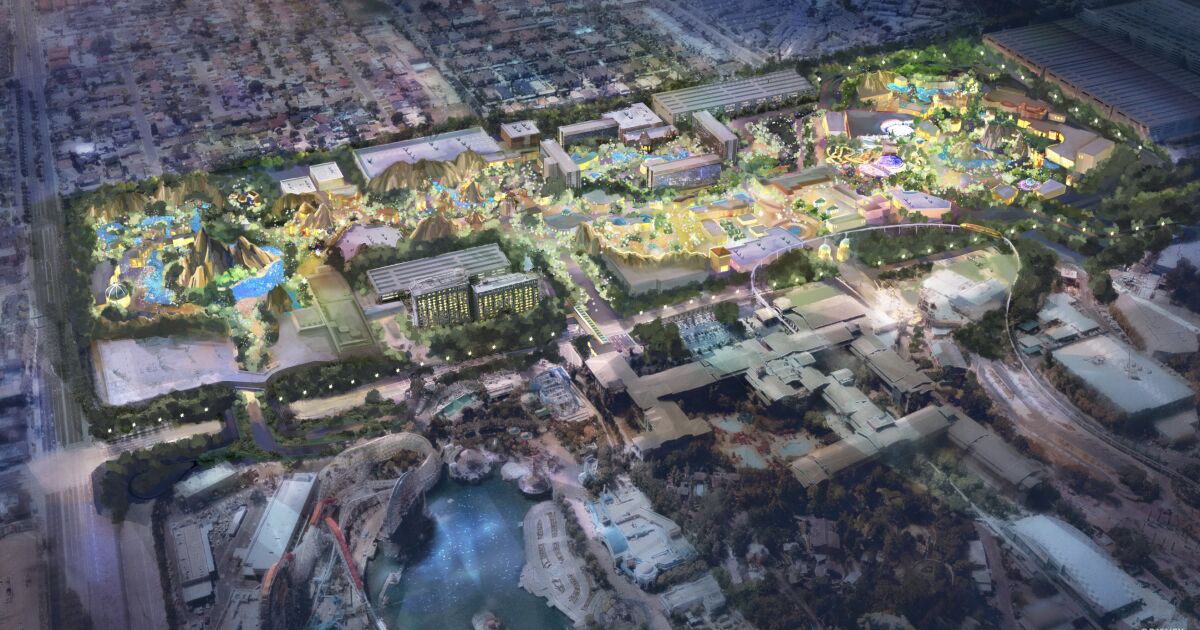
Proposed in 2021, DisneylandForward seeks to build new attractions, shops and eateries onto what the company considers underdeveloped areas of the existing resort, specifically around two Disney hotels west of the theme parks and on the site of a parking lot east of the resort. The proposal does not expand any square footage of the park. According to panelist Joe Haupt, the chief executive of real estate development firm Spectrum Development Group, only 46% of the park’s approved 6.8 million square footage from 1990 has been used.
The current challenge for the “Happiest Place on Earth” remains zoning restrictions.
Existing zoning laws, drafted in 1990, specify which areas of the park may be designated for hotel, retail, dining and theme park attractions. Disney claims that for a more diverse and integrative experience that caters to the next generation of consumers, a portion of its land ought to be rezoned for mixed use.
“When approved, [DisneylandForward] will provide us greater flexibility to optimize land development and add more capacity that would lead to more visitation, increase tax revenue to the city and create more jobs,” Ken Potrock, the president of Disneyland Resort, told attendees.
While Disney offered a robust economic pitch for the redevelopment plans, it did not outline specifically what it aims to do within the existing Anaheim footprint, which is the most urban of the company’s resorts. Instead, representatives mentioned existing “immersive” experiences as examples. Vice President of Development for Disney Resorts Rachel Alde cited Tokyo Disneyland’s Fantasy Springs’ Frozen Kingdom and Shanghai Disneyland’s Zootopia-inspired expansion.
Disney has not yet confirmed when it will submit more detailed plans. Disney Chief Executive Bob Iger announced in March that an Avatar-themed experience will be coming to Disneyland Resort.
In the past, Anaheim’s City Council and Disney have run into rough waters when the company changed the location of a luxury hotel project disqualifying it from a $267-million tax subsidy. Disney withdrew the hotel development.
According to Ted White, the planning and building director for Anaheim, the public can expect an environmental impact report for DisneylandForward by the end of July. Public hearings will take place at the end of this year and the proposal will go to the Anaheim Planning Commission before it goes to a vote by the City Council in the first quarter in 2024.
“There certainly are appropriate questions, traffic and parking and things like that,” said Councilmember Stephen Faessel, who represents District 5 in east-central Anaheim. “Standing here today, these are wonderful opportunities and we hope that they eventually come to fruition. But where we stand today and everything that happens in between, that’s a long, long way.”
The overall visitor economy makes up 50% to 60% of Anaheim’s annual tax revenue through occupancy, sales and property taxes. Disneyland Resort is the biggest draw for visitors and tax revenue generator in the city. And the resort supports more than 35,000 direct jobs in and 44,000 indirect jobs in Anaheim and neighboring areas, according to Mike Lyster, chief communications officer for the city.

As Walt Disney Co. continues to pitch its 30-year theme park expansion plan to Anaheim, the company released new data on just what’s in it for the city.
For every $1 billion Disney invests to redevelop and update Disneyland Resort, the project will generate $253 million annually in economic output, $15 million in tax revenue, and 2,292 jobs, according to an economic analysis the company commissioned from the Woods Center for Economic Analysis & Forecasting at Cal State Fullerton. The analysis also laid out additional economic benefits from the four-year construction phase.
To proceed with its plan to redevelop areas of the existing resort, Disney must receive approval for mixed-use land development from Anaheim. But what exactly Disney plans to construct is still not clear.
Disney unveiled the analysis Wednesday at an OC Forum event for city and business leaders at Disney’s Grand Californian Hotel, part of a broader months-long pitch process for its DisneylandForward initiative that also includes a series of pop-up “community coffees” with residents at local public parks.
Proposed in 2021, DisneylandForward seeks to build new attractions, shops and eateries onto what the company considers underdeveloped areas of the existing resort, specifically around two Disney hotels west of the theme parks and on the site of a parking lot east of the resort. The proposal does not expand any square footage of the park. According to panelist Joe Haupt, the chief executive of real estate development firm Spectrum Development Group, only 46% of the park’s approved 6.8 million square footage from 1990 has been used.
The current challenge for the “Happiest Place on Earth” remains zoning restrictions.
Existing zoning laws, drafted in 1990, specify which areas of the park may be designated for hotel, retail, dining and theme park attractions. Disney claims that for a more diverse and integrative experience that caters to the next generation of consumers, a portion of its land ought to be rezoned for mixed use.
“When approved, [DisneylandForward] will provide us greater flexibility to optimize land development and add more capacity that would lead to more visitation, increase tax revenue to the city and create more jobs,” Ken Potrock, the president of Disneyland Resort, told attendees.
While Disney offered a robust economic pitch for the redevelopment plans, it did not outline specifically what it aims to do within the existing Anaheim footprint, which is the most urban of the company’s resorts. Instead, representatives mentioned existing “immersive” experiences as examples. Vice President of Development for Disney Resorts Rachel Alde cited Tokyo Disneyland’s Fantasy Springs’ Frozen Kingdom and Shanghai Disneyland’s Zootopia-inspired expansion.
Disney has not yet confirmed when it will submit more detailed plans. Disney Chief Executive Bob Iger announced in March that an Avatar-themed experience will be coming to Disneyland Resort.
In the past, Anaheim’s City Council and Disney have run into rough waters when the company changed the location of a luxury hotel project disqualifying it from a $267-million tax subsidy. Disney withdrew the hotel development.
According to Ted White, the planning and building director for Anaheim, the public can expect an environmental impact report for DisneylandForward by the end of July. Public hearings will take place at the end of this year and the proposal will go to the Anaheim Planning Commission before it goes to a vote by the City Council in the first quarter in 2024.
“There certainly are appropriate questions, traffic and parking and things like that,” said Councilmember Stephen Faessel, who represents District 5 in east-central Anaheim. “Standing here today, these are wonderful opportunities and we hope that they eventually come to fruition. But where we stand today and everything that happens in between, that’s a long, long way.”
The overall visitor economy makes up 50% to 60% of Anaheim’s annual tax revenue through occupancy, sales and property taxes. Disneyland Resort is the biggest draw for visitors and tax revenue generator in the city. And the resort supports more than 35,000 direct jobs in and 44,000 indirect jobs in Anaheim and neighboring areas, according to Mike Lyster, chief communications officer for the city.

As Walt Disney Co. continues to pitch its 30-year theme park expansion plan to Anaheim, the company released new data on just what’s in it for the city.
For every $1 billion Disney invests to redevelop and update Disneyland Resort, the project will generate $253 million annually in economic output, $15 million in tax revenue, and 2,292 jobs, according to an economic analysis the company commissioned from the Woods Center for Economic Analysis & Forecasting at Cal State Fullerton. The analysis also laid out additional economic benefits from the four-year construction phase.
To proceed with its plan to redevelop areas of the existing resort, Disney must receive approval for mixed-use land development from Anaheim. But what exactly Disney plans to construct is still not clear.
Disney unveiled the analysis Wednesday at an OC Forum event for city and business leaders at Disney’s Grand Californian Hotel, part of a broader months-long pitch process for its DisneylandForward initiative that also includes a series of pop-up “community coffees” with residents at local public parks.
Proposed in 2021, DisneylandForward seeks to build new attractions, shops and eateries onto what the company considers underdeveloped areas of the existing resort, specifically around two Disney hotels west of the theme parks and on the site of a parking lot east of the resort. The proposal does not expand any square footage of the park. According to panelist Joe Haupt, the chief executive of real estate development firm Spectrum Development Group, only 46% of the park’s approved 6.8 million square footage from 1990 has been used.
The current challenge for the “Happiest Place on Earth” remains zoning restrictions.
Existing zoning laws, drafted in 1990, specify which areas of the park may be designated for hotel, retail, dining and theme park attractions. Disney claims that for a more diverse and integrative experience that caters to the next generation of consumers, a portion of its land ought to be rezoned for mixed use.
“When approved, [DisneylandForward] will provide us greater flexibility to optimize land development and add more capacity that would lead to more visitation, increase tax revenue to the city and create more jobs,” Ken Potrock, the president of Disneyland Resort, told attendees.
While Disney offered a robust economic pitch for the redevelopment plans, it did not outline specifically what it aims to do within the existing Anaheim footprint, which is the most urban of the company’s resorts. Instead, representatives mentioned existing “immersive” experiences as examples. Vice President of Development for Disney Resorts Rachel Alde cited Tokyo Disneyland’s Fantasy Springs’ Frozen Kingdom and Shanghai Disneyland’s Zootopia-inspired expansion.
Disney has not yet confirmed when it will submit more detailed plans. Disney Chief Executive Bob Iger announced in March that an Avatar-themed experience will be coming to Disneyland Resort.
In the past, Anaheim’s City Council and Disney have run into rough waters when the company changed the location of a luxury hotel project disqualifying it from a $267-million tax subsidy. Disney withdrew the hotel development.
According to Ted White, the planning and building director for Anaheim, the public can expect an environmental impact report for DisneylandForward by the end of July. Public hearings will take place at the end of this year and the proposal will go to the Anaheim Planning Commission before it goes to a vote by the City Council in the first quarter in 2024.
“There certainly are appropriate questions, traffic and parking and things like that,” said Councilmember Stephen Faessel, who represents District 5 in east-central Anaheim. “Standing here today, these are wonderful opportunities and we hope that they eventually come to fruition. But where we stand today and everything that happens in between, that’s a long, long way.”
The overall visitor economy makes up 50% to 60% of Anaheim’s annual tax revenue through occupancy, sales and property taxes. Disneyland Resort is the biggest draw for visitors and tax revenue generator in the city. And the resort supports more than 35,000 direct jobs in and 44,000 indirect jobs in Anaheim and neighboring areas, according to Mike Lyster, chief communications officer for the city.
As Walt Disney Co. continues to pitch its 30-year theme park expansion plan to Anaheim, the company released new data on just what’s in it for the city.
For every $1 billion Disney invests to redevelop and update Disneyland Resort, the project will generate $253 million annually in economic output, $15 million in tax revenue, and 2,292 jobs, according to an economic analysis the company commissioned from the Woods Center for Economic Analysis & Forecasting at Cal State Fullerton. The analysis also laid out additional economic benefits from the four-year construction phase.
To proceed with its plan to redevelop areas of the existing resort, Disney must receive approval for mixed-use land development from Anaheim. But what exactly Disney plans to construct is still not clear.
Disney unveiled the analysis Wednesday at an OC Forum event for city and business leaders at Disney’s Grand Californian Hotel, part of a broader months-long pitch process for its DisneylandForward initiative that also includes a series of pop-up “community coffees” with residents at local public parks.
Proposed in 2021, DisneylandForward seeks to build new attractions, shops and eateries onto what the company considers underdeveloped areas of the existing resort, specifically around two Disney hotels west of the theme parks and on the site of a parking lot east of the resort. The proposal does not expand any square footage of the park. According to panelist Joe Haupt, the chief executive of real estate development firm Spectrum Development Group, only 46% of the park’s approved 6.8 million square footage from 1990 has been used.
The current challenge for the “Happiest Place on Earth” remains zoning restrictions.
Existing zoning laws, drafted in 1990, specify which areas of the park may be designated for hotel, retail, dining and theme park attractions. Disney claims that for a more diverse and integrative experience that caters to the next generation of consumers, a portion of its land ought to be rezoned for mixed use.
“When approved, [DisneylandForward] will provide us greater flexibility to optimize land development and add more capacity that would lead to more visitation, increase tax revenue to the city and create more jobs,” Ken Potrock, the president of Disneyland Resort, told attendees.
While Disney offered a robust economic pitch for the redevelopment plans, it did not outline specifically what it aims to do within the existing Anaheim footprint, which is the most urban of the company’s resorts. Instead, representatives mentioned existing “immersive” experiences as examples. Vice President of Development for Disney Resorts Rachel Alde cited Tokyo Disneyland’s Fantasy Springs’ Frozen Kingdom and Shanghai Disneyland’s Zootopia-inspired expansion.
Disney has not yet confirmed when it will submit more detailed plans. Disney Chief Executive Bob Iger announced in March that an Avatar-themed experience will be coming to Disneyland Resort.
In the past, Anaheim’s City Council and Disney have run into rough waters when the company changed the location of a luxury hotel project disqualifying it from a $267-million tax subsidy. Disney withdrew the hotel development.
According to Ted White, the planning and building director for Anaheim, the public can expect an environmental impact report for DisneylandForward by the end of July. Public hearings will take place at the end of this year and the proposal will go to the Anaheim Planning Commission before it goes to a vote by the City Council in the first quarter in 2024.
“There certainly are appropriate questions, traffic and parking and things like that,” said Councilmember Stephen Faessel, who represents District 5 in east-central Anaheim. “Standing here today, these are wonderful opportunities and we hope that they eventually come to fruition. But where we stand today and everything that happens in between, that’s a long, long way.”
The overall visitor economy makes up 50% to 60% of Anaheim’s annual tax revenue through occupancy, sales and property taxes. Disneyland Resort is the biggest draw for visitors and tax revenue generator in the city. And the resort supports more than 35,000 direct jobs in and 44,000 indirect jobs in Anaheim and neighboring areas, according to Mike Lyster, chief communications officer for the city.

As Walt Disney Co. continues to pitch its 30-year theme park expansion plan to Anaheim, the company released new data on just what’s in it for the city.
For every $1 billion Disney invests to redevelop and update Disneyland Resort, the project will generate $253 million annually in economic output, $15 million in tax revenue, and 2,292 jobs, according to an economic analysis the company commissioned from the Woods Center for Economic Analysis & Forecasting at Cal State Fullerton. The analysis also laid out additional economic benefits from the four-year construction phase.
To proceed with its plan to redevelop areas of the existing resort, Disney must receive approval for mixed-use land development from Anaheim. But what exactly Disney plans to construct is still not clear.
Disney unveiled the analysis Wednesday at an OC Forum event for city and business leaders at Disney’s Grand Californian Hotel, part of a broader months-long pitch process for its DisneylandForward initiative that also includes a series of pop-up “community coffees” with residents at local public parks.
Proposed in 2021, DisneylandForward seeks to build new attractions, shops and eateries onto what the company considers underdeveloped areas of the existing resort, specifically around two Disney hotels west of the theme parks and on the site of a parking lot east of the resort. The proposal does not expand any square footage of the park. According to panelist Joe Haupt, the chief executive of real estate development firm Spectrum Development Group, only 46% of the park’s approved 6.8 million square footage from 1990 has been used.
The current challenge for the “Happiest Place on Earth” remains zoning restrictions.
Existing zoning laws, drafted in 1990, specify which areas of the park may be designated for hotel, retail, dining and theme park attractions. Disney claims that for a more diverse and integrative experience that caters to the next generation of consumers, a portion of its land ought to be rezoned for mixed use.
“When approved, [DisneylandForward] will provide us greater flexibility to optimize land development and add more capacity that would lead to more visitation, increase tax revenue to the city and create more jobs,” Ken Potrock, the president of Disneyland Resort, told attendees.
While Disney offered a robust economic pitch for the redevelopment plans, it did not outline specifically what it aims to do within the existing Anaheim footprint, which is the most urban of the company’s resorts. Instead, representatives mentioned existing “immersive” experiences as examples. Vice President of Development for Disney Resorts Rachel Alde cited Tokyo Disneyland’s Fantasy Springs’ Frozen Kingdom and Shanghai Disneyland’s Zootopia-inspired expansion.
Disney has not yet confirmed when it will submit more detailed plans. Disney Chief Executive Bob Iger announced in March that an Avatar-themed experience will be coming to Disneyland Resort.
In the past, Anaheim’s City Council and Disney have run into rough waters when the company changed the location of a luxury hotel project disqualifying it from a $267-million tax subsidy. Disney withdrew the hotel development.
According to Ted White, the planning and building director for Anaheim, the public can expect an environmental impact report for DisneylandForward by the end of July. Public hearings will take place at the end of this year and the proposal will go to the Anaheim Planning Commission before it goes to a vote by the City Council in the first quarter in 2024.
“There certainly are appropriate questions, traffic and parking and things like that,” said Councilmember Stephen Faessel, who represents District 5 in east-central Anaheim. “Standing here today, these are wonderful opportunities and we hope that they eventually come to fruition. But where we stand today and everything that happens in between, that’s a long, long way.”
The overall visitor economy makes up 50% to 60% of Anaheim’s annual tax revenue through occupancy, sales and property taxes. Disneyland Resort is the biggest draw for visitors and tax revenue generator in the city. And the resort supports more than 35,000 direct jobs in and 44,000 indirect jobs in Anaheim and neighboring areas, according to Mike Lyster, chief communications officer for the city.
As Walt Disney Co. continues to pitch its 30-year theme park expansion plan to Anaheim, the company released new data on just what’s in it for the city.
For every $1 billion Disney invests to redevelop and update Disneyland Resort, the project will generate $253 million annually in economic output, $15 million in tax revenue, and 2,292 jobs, according to an economic analysis the company commissioned from the Woods Center for Economic Analysis & Forecasting at Cal State Fullerton. The analysis also laid out additional economic benefits from the four-year construction phase.
To proceed with its plan to redevelop areas of the existing resort, Disney must receive approval for mixed-use land development from Anaheim. But what exactly Disney plans to construct is still not clear.
Disney unveiled the analysis Wednesday at an OC Forum event for city and business leaders at Disney’s Grand Californian Hotel, part of a broader months-long pitch process for its DisneylandForward initiative that also includes a series of pop-up “community coffees” with residents at local public parks.
Proposed in 2021, DisneylandForward seeks to build new attractions, shops and eateries onto what the company considers underdeveloped areas of the existing resort, specifically around two Disney hotels west of the theme parks and on the site of a parking lot east of the resort. The proposal does not expand any square footage of the park. According to panelist Joe Haupt, the chief executive of real estate development firm Spectrum Development Group, only 46% of the park’s approved 6.8 million square footage from 1990 has been used.
The current challenge for the “Happiest Place on Earth” remains zoning restrictions.
Existing zoning laws, drafted in 1990, specify which areas of the park may be designated for hotel, retail, dining and theme park attractions. Disney claims that for a more diverse and integrative experience that caters to the next generation of consumers, a portion of its land ought to be rezoned for mixed use.
“When approved, [DisneylandForward] will provide us greater flexibility to optimize land development and add more capacity that would lead to more visitation, increase tax revenue to the city and create more jobs,” Ken Potrock, the president of Disneyland Resort, told attendees.
While Disney offered a robust economic pitch for the redevelopment plans, it did not outline specifically what it aims to do within the existing Anaheim footprint, which is the most urban of the company’s resorts. Instead, representatives mentioned existing “immersive” experiences as examples. Vice President of Development for Disney Resorts Rachel Alde cited Tokyo Disneyland’s Fantasy Springs’ Frozen Kingdom and Shanghai Disneyland’s Zootopia-inspired expansion.
Disney has not yet confirmed when it will submit more detailed plans. Disney Chief Executive Bob Iger announced in March that an Avatar-themed experience will be coming to Disneyland Resort.
In the past, Anaheim’s City Council and Disney have run into rough waters when the company changed the location of a luxury hotel project disqualifying it from a $267-million tax subsidy. Disney withdrew the hotel development.
According to Ted White, the planning and building director for Anaheim, the public can expect an environmental impact report for DisneylandForward by the end of July. Public hearings will take place at the end of this year and the proposal will go to the Anaheim Planning Commission before it goes to a vote by the City Council in the first quarter in 2024.
“There certainly are appropriate questions, traffic and parking and things like that,” said Councilmember Stephen Faessel, who represents District 5 in east-central Anaheim. “Standing here today, these are wonderful opportunities and we hope that they eventually come to fruition. But where we stand today and everything that happens in between, that’s a long, long way.”
The overall visitor economy makes up 50% to 60% of Anaheim’s annual tax revenue through occupancy, sales and property taxes. Disneyland Resort is the biggest draw for visitors and tax revenue generator in the city. And the resort supports more than 35,000 direct jobs in and 44,000 indirect jobs in Anaheim and neighboring areas, according to Mike Lyster, chief communications officer for the city.
As Walt Disney Co. continues to pitch its 30-year theme park expansion plan to Anaheim, the company released new data on just what’s in it for the city.
For every $1 billion Disney invests to redevelop and update Disneyland Resort, the project will generate $253 million annually in economic output, $15 million in tax revenue, and 2,292 jobs, according to an economic analysis the company commissioned from the Woods Center for Economic Analysis & Forecasting at Cal State Fullerton. The analysis also laid out additional economic benefits from the four-year construction phase.
To proceed with its plan to redevelop areas of the existing resort, Disney must receive approval for mixed-use land development from Anaheim. But what exactly Disney plans to construct is still not clear.
Disney unveiled the analysis Wednesday at an OC Forum event for city and business leaders at Disney’s Grand Californian Hotel, part of a broader months-long pitch process for its DisneylandForward initiative that also includes a series of pop-up “community coffees” with residents at local public parks.
Proposed in 2021, DisneylandForward seeks to build new attractions, shops and eateries onto what the company considers underdeveloped areas of the existing resort, specifically around two Disney hotels west of the theme parks and on the site of a parking lot east of the resort. The proposal does not expand any square footage of the park. According to panelist Joe Haupt, the chief executive of real estate development firm Spectrum Development Group, only 46% of the park’s approved 6.8 million square footage from 1990 has been used.
The current challenge for the “Happiest Place on Earth” remains zoning restrictions.
Existing zoning laws, drafted in 1990, specify which areas of the park may be designated for hotel, retail, dining and theme park attractions. Disney claims that for a more diverse and integrative experience that caters to the next generation of consumers, a portion of its land ought to be rezoned for mixed use.
“When approved, [DisneylandForward] will provide us greater flexibility to optimize land development and add more capacity that would lead to more visitation, increase tax revenue to the city and create more jobs,” Ken Potrock, the president of Disneyland Resort, told attendees.
While Disney offered a robust economic pitch for the redevelopment plans, it did not outline specifically what it aims to do within the existing Anaheim footprint, which is the most urban of the company’s resorts. Instead, representatives mentioned existing “immersive” experiences as examples. Vice President of Development for Disney Resorts Rachel Alde cited Tokyo Disneyland’s Fantasy Springs’ Frozen Kingdom and Shanghai Disneyland’s Zootopia-inspired expansion.
Disney has not yet confirmed when it will submit more detailed plans. Disney Chief Executive Bob Iger announced in March that an Avatar-themed experience will be coming to Disneyland Resort.
In the past, Anaheim’s City Council and Disney have run into rough waters when the company changed the location of a luxury hotel project disqualifying it from a $267-million tax subsidy. Disney withdrew the hotel development.
According to Ted White, the planning and building director for Anaheim, the public can expect an environmental impact report for DisneylandForward by the end of July. Public hearings will take place at the end of this year and the proposal will go to the Anaheim Planning Commission before it goes to a vote by the City Council in the first quarter in 2024.
“There certainly are appropriate questions, traffic and parking and things like that,” said Councilmember Stephen Faessel, who represents District 5 in east-central Anaheim. “Standing here today, these are wonderful opportunities and we hope that they eventually come to fruition. But where we stand today and everything that happens in between, that’s a long, long way.”
The overall visitor economy makes up 50% to 60% of Anaheim’s annual tax revenue through occupancy, sales and property taxes. Disneyland Resort is the biggest draw for visitors and tax revenue generator in the city. And the resort supports more than 35,000 direct jobs in and 44,000 indirect jobs in Anaheim and neighboring areas, according to Mike Lyster, chief communications officer for the city.
As Walt Disney Co. continues to pitch its 30-year theme park expansion plan to Anaheim, the company released new data on just what’s in it for the city.
For every $1 billion Disney invests to redevelop and update Disneyland Resort, the project will generate $253 million annually in economic output, $15 million in tax revenue, and 2,292 jobs, according to an economic analysis the company commissioned from the Woods Center for Economic Analysis & Forecasting at Cal State Fullerton. The analysis also laid out additional economic benefits from the four-year construction phase.
To proceed with its plan to redevelop areas of the existing resort, Disney must receive approval for mixed-use land development from Anaheim. But what exactly Disney plans to construct is still not clear.
Disney unveiled the analysis Wednesday at an OC Forum event for city and business leaders at Disney’s Grand Californian Hotel, part of a broader months-long pitch process for its DisneylandForward initiative that also includes a series of pop-up “community coffees” with residents at local public parks.
Proposed in 2021, DisneylandForward seeks to build new attractions, shops and eateries onto what the company considers underdeveloped areas of the existing resort, specifically around two Disney hotels west of the theme parks and on the site of a parking lot east of the resort. The proposal does not expand any square footage of the park. According to panelist Joe Haupt, the chief executive of real estate development firm Spectrum Development Group, only 46% of the park’s approved 6.8 million square footage from 1990 has been used.
The current challenge for the “Happiest Place on Earth” remains zoning restrictions.
Existing zoning laws, drafted in 1990, specify which areas of the park may be designated for hotel, retail, dining and theme park attractions. Disney claims that for a more diverse and integrative experience that caters to the next generation of consumers, a portion of its land ought to be rezoned for mixed use.
“When approved, [DisneylandForward] will provide us greater flexibility to optimize land development and add more capacity that would lead to more visitation, increase tax revenue to the city and create more jobs,” Ken Potrock, the president of Disneyland Resort, told attendees.
While Disney offered a robust economic pitch for the redevelopment plans, it did not outline specifically what it aims to do within the existing Anaheim footprint, which is the most urban of the company’s resorts. Instead, representatives mentioned existing “immersive” experiences as examples. Vice President of Development for Disney Resorts Rachel Alde cited Tokyo Disneyland’s Fantasy Springs’ Frozen Kingdom and Shanghai Disneyland’s Zootopia-inspired expansion.
Disney has not yet confirmed when it will submit more detailed plans. Disney Chief Executive Bob Iger announced in March that an Avatar-themed experience will be coming to Disneyland Resort.
In the past, Anaheim’s City Council and Disney have run into rough waters when the company changed the location of a luxury hotel project disqualifying it from a $267-million tax subsidy. Disney withdrew the hotel development.
According to Ted White, the planning and building director for Anaheim, the public can expect an environmental impact report for DisneylandForward by the end of July. Public hearings will take place at the end of this year and the proposal will go to the Anaheim Planning Commission before it goes to a vote by the City Council in the first quarter in 2024.
“There certainly are appropriate questions, traffic and parking and things like that,” said Councilmember Stephen Faessel, who represents District 5 in east-central Anaheim. “Standing here today, these are wonderful opportunities and we hope that they eventually come to fruition. But where we stand today and everything that happens in between, that’s a long, long way.”
The overall visitor economy makes up 50% to 60% of Anaheim’s annual tax revenue through occupancy, sales and property taxes. Disneyland Resort is the biggest draw for visitors and tax revenue generator in the city. And the resort supports more than 35,000 direct jobs in and 44,000 indirect jobs in Anaheim and neighboring areas, according to Mike Lyster, chief communications officer for the city.

