

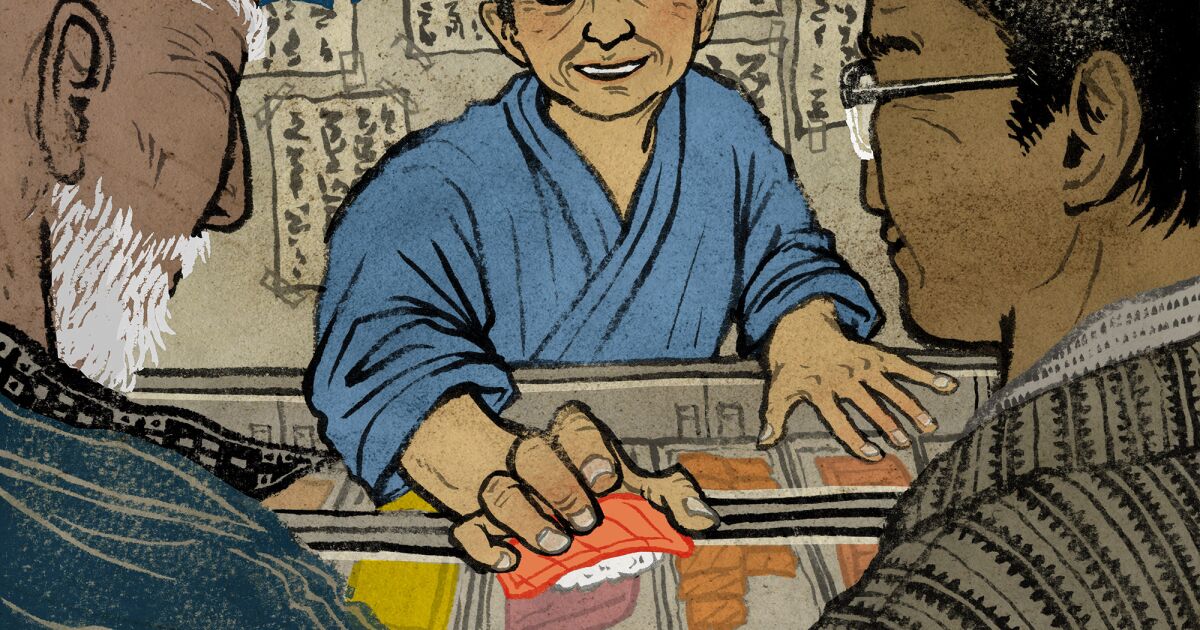

Los Angeles is a sushi city — home to countless restaurants that treat raw fish with the sort of reverence usually reserved for religious rites. But this wasn’t always the case. It took an unlikely alliance to make it happen.
It started in Tokyo in 1965, with a meal shared by two friends in the food import business who made an unplanned stop at a sushi house. It was Harry Wolff’s first encounter with the cuisine, and it sparked an idea that he shared with Noritoshi Kanai: If sushi could find purchase on the menus of L.A.’s Japanese restaurants, Kanai’s Mutual Trading Co. stood to benefit. It would import the items needed to serve sushi — from the nori to the knives.
The dream was to create the Southland’s sushi ecosystem. But for the plan to work, L.A. restaurants needed to give sushi a shot. When the owner of Kawafuku agreed to open a sushi bar at his Little Tokyo haunt, the effort got a major boost. By the 1980s, sushi was ubiquitous, both as a cuisine and a cultural touchstone.
Kanai and Wolff — two friends bound by a love of food — sparked L.A.’s sushi obsession. And they changed the way Angelenos eat.

Los Angeles is a sushi city — home to countless restaurants that treat raw fish with the sort of reverence usually reserved for religious rites. But this wasn’t always the case. It took an unlikely alliance to make it happen.
It started in Tokyo in 1965, with a meal shared by two friends in the food import business who made an unplanned stop at a sushi house. It was Harry Wolff’s first encounter with the cuisine, and it sparked an idea that he shared with Noritoshi Kanai: If sushi could find purchase on the menus of L.A.’s Japanese restaurants, Kanai’s Mutual Trading Co. stood to benefit. It would import the items needed to serve sushi — from the nori to the knives.
The dream was to create the Southland’s sushi ecosystem. But for the plan to work, L.A. restaurants needed to give sushi a shot. When the owner of Kawafuku agreed to open a sushi bar at his Little Tokyo haunt, the effort got a major boost. By the 1980s, sushi was ubiquitous, both as a cuisine and a cultural touchstone.
Kanai and Wolff — two friends bound by a love of food — sparked L.A.’s sushi obsession. And they changed the way Angelenos eat.

Los Angeles is a sushi city — home to countless restaurants that treat raw fish with the sort of reverence usually reserved for religious rites. But this wasn’t always the case. It took an unlikely alliance to make it happen.
It started in Tokyo in 1965, with a meal shared by two friends in the food import business who made an unplanned stop at a sushi house. It was Harry Wolff’s first encounter with the cuisine, and it sparked an idea that he shared with Noritoshi Kanai: If sushi could find purchase on the menus of L.A.’s Japanese restaurants, Kanai’s Mutual Trading Co. stood to benefit. It would import the items needed to serve sushi — from the nori to the knives.
The dream was to create the Southland’s sushi ecosystem. But for the plan to work, L.A. restaurants needed to give sushi a shot. When the owner of Kawafuku agreed to open a sushi bar at his Little Tokyo haunt, the effort got a major boost. By the 1980s, sushi was ubiquitous, both as a cuisine and a cultural touchstone.
Kanai and Wolff — two friends bound by a love of food — sparked L.A.’s sushi obsession. And they changed the way Angelenos eat.

Los Angeles is a sushi city — home to countless restaurants that treat raw fish with the sort of reverence usually reserved for religious rites. But this wasn’t always the case. It took an unlikely alliance to make it happen.
It started in Tokyo in 1965, with a meal shared by two friends in the food import business who made an unplanned stop at a sushi house. It was Harry Wolff’s first encounter with the cuisine, and it sparked an idea that he shared with Noritoshi Kanai: If sushi could find purchase on the menus of L.A.’s Japanese restaurants, Kanai’s Mutual Trading Co. stood to benefit. It would import the items needed to serve sushi — from the nori to the knives.
The dream was to create the Southland’s sushi ecosystem. But for the plan to work, L.A. restaurants needed to give sushi a shot. When the owner of Kawafuku agreed to open a sushi bar at his Little Tokyo haunt, the effort got a major boost. By the 1980s, sushi was ubiquitous, both as a cuisine and a cultural touchstone.
Kanai and Wolff — two friends bound by a love of food — sparked L.A.’s sushi obsession. And they changed the way Angelenos eat.