

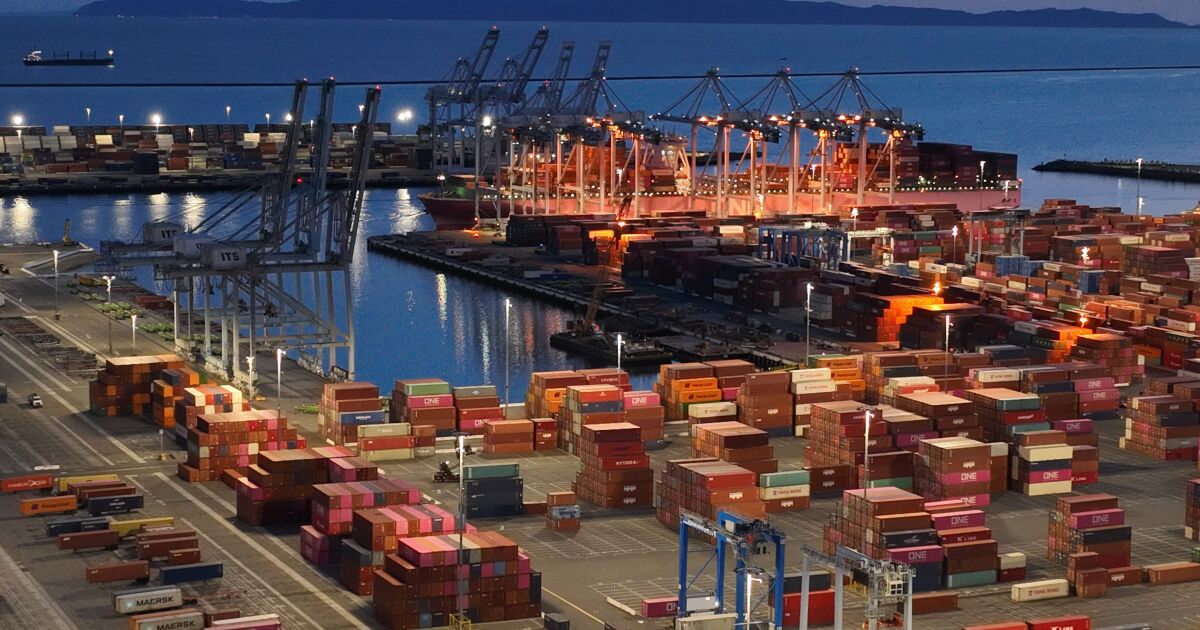

A dockworker shortage at the Los Angeles and Long Beach ports stretched into its second day on Friday, halting cargo traffic at the massive shipping complex while disrupting the local economy and the global supply chain.
The shortage comes several months into protracted labor negotiations between the union that represents West Coast dockworkers and the industry group representing maritime shippers, which are hashing out a new contract focused, in part, on wages and the role of automation. The old contract expired July 1.
The Pacific Maritime Assn., the industry group representing shippers at the negotiating table, said in a statement Friday that the International Longshore and Warehouse Union had taken a “concerted action to withhold labor.”
“A majority of the jobs for last night’s shift went unfilled, including all jobs for cargo-handling equipment operators needed to load and unload cargo,” the statement read. “The workers who did show up were released because there was not a full complement of ILWU members to operate the terminals.”
ILWU officials didn’t immediately respond to calls for comment.
The L.A. and Long Beach ports combine to handle nearly 40% of U.S. imports from Asia, which arrive in giant metal containers aboard vessels that stretch to nearly the length of the Empire State Building. But goods movement has fallen sharply in recent months, allowing the combined ports of New York and New Jersey to intermittently grab No. 1 bragging rights away from Los Angeles.
The local downward trend is worrisome not just to officials at the twin ports but also for 175,000 Southern California workers — employed at the harbors themselves as well as in related businesses — moving freight valued at $469 billion a year, port data show. At stake are jobs all along the supply chain, including truckers, warehouse workers and people employed by logistics specialists.
In a statement Friday, Port of Los Angeles officials said they were talking with both the union and the Pacific Maritime Assn., as well as local, state and federal officials, about returning to normal operations.
“Resuming cargo operations at America’s busiest port complex is critical,” the statement read, “to maintaining confidence to our customers and supply chain stakeholders.”

A dockworker shortage at the Los Angeles and Long Beach ports stretched into its second day on Friday, halting cargo traffic at the massive shipping complex while disrupting the local economy and the global supply chain.
The shortage comes several months into protracted labor negotiations between the union that represents West Coast dockworkers and the industry group representing maritime shippers, which are hashing out a new contract focused, in part, on wages and the role of automation. The old contract expired July 1.
The Pacific Maritime Assn., the industry group representing shippers at the negotiating table, said in a statement Friday that the International Longshore and Warehouse Union had taken a “concerted action to withhold labor.”
“A majority of the jobs for last night’s shift went unfilled, including all jobs for cargo-handling equipment operators needed to load and unload cargo,” the statement read. “The workers who did show up were released because there was not a full complement of ILWU members to operate the terminals.”
ILWU officials didn’t immediately respond to calls for comment.
The L.A. and Long Beach ports combine to handle nearly 40% of U.S. imports from Asia, which arrive in giant metal containers aboard vessels that stretch to nearly the length of the Empire State Building. But goods movement has fallen sharply in recent months, allowing the combined ports of New York and New Jersey to intermittently grab No. 1 bragging rights away from Los Angeles.
The local downward trend is worrisome not just to officials at the twin ports but also for 175,000 Southern California workers — employed at the harbors themselves as well as in related businesses — moving freight valued at $469 billion a year, port data show. At stake are jobs all along the supply chain, including truckers, warehouse workers and people employed by logistics specialists.
In a statement Friday, Port of Los Angeles officials said they were talking with both the union and the Pacific Maritime Assn., as well as local, state and federal officials, about returning to normal operations.
“Resuming cargo operations at America’s busiest port complex is critical,” the statement read, “to maintaining confidence to our customers and supply chain stakeholders.”

A dockworker shortage at the Los Angeles and Long Beach ports stretched into its second day on Friday, halting cargo traffic at the massive shipping complex while disrupting the local economy and the global supply chain.
The shortage comes several months into protracted labor negotiations between the union that represents West Coast dockworkers and the industry group representing maritime shippers, which are hashing out a new contract focused, in part, on wages and the role of automation. The old contract expired July 1.
The Pacific Maritime Assn., the industry group representing shippers at the negotiating table, said in a statement Friday that the International Longshore and Warehouse Union had taken a “concerted action to withhold labor.”
“A majority of the jobs for last night’s shift went unfilled, including all jobs for cargo-handling equipment operators needed to load and unload cargo,” the statement read. “The workers who did show up were released because there was not a full complement of ILWU members to operate the terminals.”
ILWU officials didn’t immediately respond to calls for comment.
The L.A. and Long Beach ports combine to handle nearly 40% of U.S. imports from Asia, which arrive in giant metal containers aboard vessels that stretch to nearly the length of the Empire State Building. But goods movement has fallen sharply in recent months, allowing the combined ports of New York and New Jersey to intermittently grab No. 1 bragging rights away from Los Angeles.
The local downward trend is worrisome not just to officials at the twin ports but also for 175,000 Southern California workers — employed at the harbors themselves as well as in related businesses — moving freight valued at $469 billion a year, port data show. At stake are jobs all along the supply chain, including truckers, warehouse workers and people employed by logistics specialists.
In a statement Friday, Port of Los Angeles officials said they were talking with both the union and the Pacific Maritime Assn., as well as local, state and federal officials, about returning to normal operations.
“Resuming cargo operations at America’s busiest port complex is critical,” the statement read, “to maintaining confidence to our customers and supply chain stakeholders.”
A dockworker shortage at the Los Angeles and Long Beach ports stretched into its second day on Friday, halting cargo traffic at the massive shipping complex while disrupting the local economy and the global supply chain.
The shortage comes several months into protracted labor negotiations between the union that represents West Coast dockworkers and the industry group representing maritime shippers, which are hashing out a new contract focused, in part, on wages and the role of automation. The old contract expired July 1.
The Pacific Maritime Assn., the industry group representing shippers at the negotiating table, said in a statement Friday that the International Longshore and Warehouse Union had taken a “concerted action to withhold labor.”
“A majority of the jobs for last night’s shift went unfilled, including all jobs for cargo-handling equipment operators needed to load and unload cargo,” the statement read. “The workers who did show up were released because there was not a full complement of ILWU members to operate the terminals.”
ILWU officials didn’t immediately respond to calls for comment.
The L.A. and Long Beach ports combine to handle nearly 40% of U.S. imports from Asia, which arrive in giant metal containers aboard vessels that stretch to nearly the length of the Empire State Building. But goods movement has fallen sharply in recent months, allowing the combined ports of New York and New Jersey to intermittently grab No. 1 bragging rights away from Los Angeles.
The local downward trend is worrisome not just to officials at the twin ports but also for 175,000 Southern California workers — employed at the harbors themselves as well as in related businesses — moving freight valued at $469 billion a year, port data show. At stake are jobs all along the supply chain, including truckers, warehouse workers and people employed by logistics specialists.
In a statement Friday, Port of Los Angeles officials said they were talking with both the union and the Pacific Maritime Assn., as well as local, state and federal officials, about returning to normal operations.
“Resuming cargo operations at America’s busiest port complex is critical,” the statement read, “to maintaining confidence to our customers and supply chain stakeholders.”

A dockworker shortage at the Los Angeles and Long Beach ports stretched into its second day on Friday, halting cargo traffic at the massive shipping complex while disrupting the local economy and the global supply chain.
The shortage comes several months into protracted labor negotiations between the union that represents West Coast dockworkers and the industry group representing maritime shippers, which are hashing out a new contract focused, in part, on wages and the role of automation. The old contract expired July 1.
The Pacific Maritime Assn., the industry group representing shippers at the negotiating table, said in a statement Friday that the International Longshore and Warehouse Union had taken a “concerted action to withhold labor.”
“A majority of the jobs for last night’s shift went unfilled, including all jobs for cargo-handling equipment operators needed to load and unload cargo,” the statement read. “The workers who did show up were released because there was not a full complement of ILWU members to operate the terminals.”
ILWU officials didn’t immediately respond to calls for comment.
The L.A. and Long Beach ports combine to handle nearly 40% of U.S. imports from Asia, which arrive in giant metal containers aboard vessels that stretch to nearly the length of the Empire State Building. But goods movement has fallen sharply in recent months, allowing the combined ports of New York and New Jersey to intermittently grab No. 1 bragging rights away from Los Angeles.
The local downward trend is worrisome not just to officials at the twin ports but also for 175,000 Southern California workers — employed at the harbors themselves as well as in related businesses — moving freight valued at $469 billion a year, port data show. At stake are jobs all along the supply chain, including truckers, warehouse workers and people employed by logistics specialists.
In a statement Friday, Port of Los Angeles officials said they were talking with both the union and the Pacific Maritime Assn., as well as local, state and federal officials, about returning to normal operations.
“Resuming cargo operations at America’s busiest port complex is critical,” the statement read, “to maintaining confidence to our customers and supply chain stakeholders.”
A dockworker shortage at the Los Angeles and Long Beach ports stretched into its second day on Friday, halting cargo traffic at the massive shipping complex while disrupting the local economy and the global supply chain.
The shortage comes several months into protracted labor negotiations between the union that represents West Coast dockworkers and the industry group representing maritime shippers, which are hashing out a new contract focused, in part, on wages and the role of automation. The old contract expired July 1.
The Pacific Maritime Assn., the industry group representing shippers at the negotiating table, said in a statement Friday that the International Longshore and Warehouse Union had taken a “concerted action to withhold labor.”
“A majority of the jobs for last night’s shift went unfilled, including all jobs for cargo-handling equipment operators needed to load and unload cargo,” the statement read. “The workers who did show up were released because there was not a full complement of ILWU members to operate the terminals.”
ILWU officials didn’t immediately respond to calls for comment.
The L.A. and Long Beach ports combine to handle nearly 40% of U.S. imports from Asia, which arrive in giant metal containers aboard vessels that stretch to nearly the length of the Empire State Building. But goods movement has fallen sharply in recent months, allowing the combined ports of New York and New Jersey to intermittently grab No. 1 bragging rights away from Los Angeles.
The local downward trend is worrisome not just to officials at the twin ports but also for 175,000 Southern California workers — employed at the harbors themselves as well as in related businesses — moving freight valued at $469 billion a year, port data show. At stake are jobs all along the supply chain, including truckers, warehouse workers and people employed by logistics specialists.
In a statement Friday, Port of Los Angeles officials said they were talking with both the union and the Pacific Maritime Assn., as well as local, state and federal officials, about returning to normal operations.
“Resuming cargo operations at America’s busiest port complex is critical,” the statement read, “to maintaining confidence to our customers and supply chain stakeholders.”
A dockworker shortage at the Los Angeles and Long Beach ports stretched into its second day on Friday, halting cargo traffic at the massive shipping complex while disrupting the local economy and the global supply chain.
The shortage comes several months into protracted labor negotiations between the union that represents West Coast dockworkers and the industry group representing maritime shippers, which are hashing out a new contract focused, in part, on wages and the role of automation. The old contract expired July 1.
The Pacific Maritime Assn., the industry group representing shippers at the negotiating table, said in a statement Friday that the International Longshore and Warehouse Union had taken a “concerted action to withhold labor.”
“A majority of the jobs for last night’s shift went unfilled, including all jobs for cargo-handling equipment operators needed to load and unload cargo,” the statement read. “The workers who did show up were released because there was not a full complement of ILWU members to operate the terminals.”
ILWU officials didn’t immediately respond to calls for comment.
The L.A. and Long Beach ports combine to handle nearly 40% of U.S. imports from Asia, which arrive in giant metal containers aboard vessels that stretch to nearly the length of the Empire State Building. But goods movement has fallen sharply in recent months, allowing the combined ports of New York and New Jersey to intermittently grab No. 1 bragging rights away from Los Angeles.
The local downward trend is worrisome not just to officials at the twin ports but also for 175,000 Southern California workers — employed at the harbors themselves as well as in related businesses — moving freight valued at $469 billion a year, port data show. At stake are jobs all along the supply chain, including truckers, warehouse workers and people employed by logistics specialists.
In a statement Friday, Port of Los Angeles officials said they were talking with both the union and the Pacific Maritime Assn., as well as local, state and federal officials, about returning to normal operations.
“Resuming cargo operations at America’s busiest port complex is critical,” the statement read, “to maintaining confidence to our customers and supply chain stakeholders.”
A dockworker shortage at the Los Angeles and Long Beach ports stretched into its second day on Friday, halting cargo traffic at the massive shipping complex while disrupting the local economy and the global supply chain.
The shortage comes several months into protracted labor negotiations between the union that represents West Coast dockworkers and the industry group representing maritime shippers, which are hashing out a new contract focused, in part, on wages and the role of automation. The old contract expired July 1.
The Pacific Maritime Assn., the industry group representing shippers at the negotiating table, said in a statement Friday that the International Longshore and Warehouse Union had taken a “concerted action to withhold labor.”
“A majority of the jobs for last night’s shift went unfilled, including all jobs for cargo-handling equipment operators needed to load and unload cargo,” the statement read. “The workers who did show up were released because there was not a full complement of ILWU members to operate the terminals.”
ILWU officials didn’t immediately respond to calls for comment.
The L.A. and Long Beach ports combine to handle nearly 40% of U.S. imports from Asia, which arrive in giant metal containers aboard vessels that stretch to nearly the length of the Empire State Building. But goods movement has fallen sharply in recent months, allowing the combined ports of New York and New Jersey to intermittently grab No. 1 bragging rights away from Los Angeles.
The local downward trend is worrisome not just to officials at the twin ports but also for 175,000 Southern California workers — employed at the harbors themselves as well as in related businesses — moving freight valued at $469 billion a year, port data show. At stake are jobs all along the supply chain, including truckers, warehouse workers and people employed by logistics specialists.
In a statement Friday, Port of Los Angeles officials said they were talking with both the union and the Pacific Maritime Assn., as well as local, state and federal officials, about returning to normal operations.
“Resuming cargo operations at America’s busiest port complex is critical,” the statement read, “to maintaining confidence to our customers and supply chain stakeholders.”

