

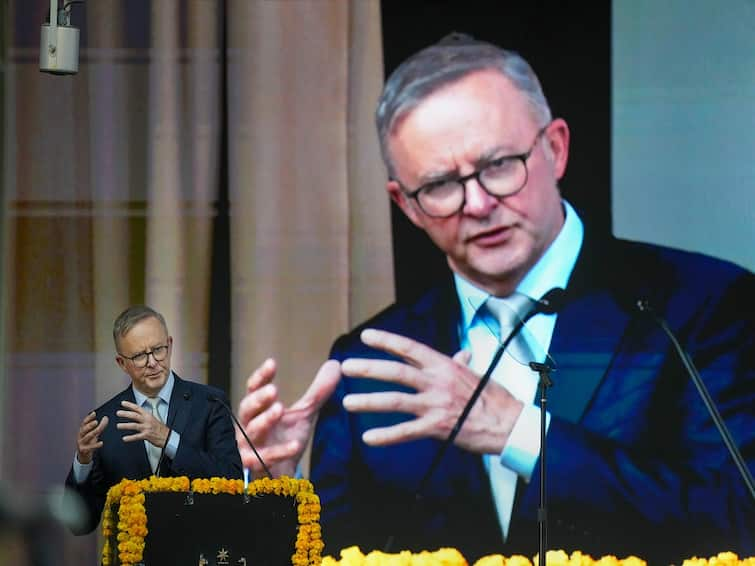

India is in a unique position to provide leadership in the Global South and there can be no solution to climate challenges without the country being central to it, Australian Prime Minister Anthony Albanese said on Friday.
Addressing a gathering at the Indian Institute of Technology (IIT) Delhi, Albanese announced the appointment of Tim Thomas as the first chief executive officer (CEO) of the Centre for Australia-India Relations, which will start functioning later this year.
“India is in a unique position to provide leadership in the Global South. There can be no solution to climate challenges without India being central to that. In the face of a changing climate, both Australia and India have begun to heed such warnings with the seriousness they deserve.”
“Prime Minister Narendra Modi’s remarkable goal for India to install 500 gigawatts of renewable energy capacity by 2030 will have a profound impact on the global energy transition. The global move to a clean energy economy is here. And it is shifting gears quickly. To get a sense of what is possible, look at what India has already achieved. Between 2018 and 2021, India increased solar generation by 31 terrawatt-hours. That is enough power for 24.7 million (2.47 crore) Indians,” he said.
Albanese stressed that Australia will become a renewable energy superpower, given its location.
“India will be too, and therefore, there are great opportunities to collaborate and work together. Australia is blessed with natural resources and critical earth minerals that can help in the production of renewables. Hence, this partnership will help India meet the growing energy demands,” he said.
Noting that education is about helping an economy grow as it is key to productivity, new ideas, and more efficiency, Albanese said, “I very much want to see growing numbers of Australian and Indian students to have the experiences of living and studying in our respective countries, and to bring those experiences home. Think of it as human cross-pollination.” “Through it, we draw from each other’s strengths and add to our own and in the process, each of us becomes something greater. Of course, joining up our best minds is not just desirable, it is a necessity, especially where the globe’s biggest challenges are concerned,” he added.
Talking about the Centre for Australia-India Relations, Albanese said it will work “across governments, industry, academia and community to build greater understanding of the Australia-India relationship and support opportunities that arise from our growing connections”.
He asserted that India’s development has been “extraordinary”.
“The perception of India in the world (today) is very different from what it was in 1991, when I visited the country for the first time, and this is a great tribute to the people essentially,” the Australian prime minister said.
Noting that India is a natural leader in the Indian Ocean region and the world’s fastest growing major economy, he said, “India and Australia are natural partners. Together, we can do more and will do more for a shared future based on common interests and visions for embracing a better tomorrow.” “India and Australia need to be strategic partners in the Indo-Pacific in a much deeper sense and not just in defence and security. The visit to India is a celebration of our close partnership. It also marks the beginning of an ambitious future and highlights the great potential that this bilateral relationship holds.
“The Comprehensive Strategic Partnership and the ECTA (Economic Cooperation and Trade Agreement) have laid the groundwork for more. Trade, investment, strategic and security engagement, and a future built on clean and green energy are the potential areas for cooperation. There is a need to pay more attention to global supply chains and diversify our existing trading partnership. India and Australia are natural partners and we are looking at ways to strengthen business, especially with Indian Ocean island economies,” Albanese added.
(This story is published as part of the auto-generated syndicate wire feed. Apart from the headline, no editing has been done in the copy by ABP Live.)

India is in a unique position to provide leadership in the Global South and there can be no solution to climate challenges without the country being central to it, Australian Prime Minister Anthony Albanese said on Friday.
Addressing a gathering at the Indian Institute of Technology (IIT) Delhi, Albanese announced the appointment of Tim Thomas as the first chief executive officer (CEO) of the Centre for Australia-India Relations, which will start functioning later this year.
“India is in a unique position to provide leadership in the Global South. There can be no solution to climate challenges without India being central to that. In the face of a changing climate, both Australia and India have begun to heed such warnings with the seriousness they deserve.”
“Prime Minister Narendra Modi’s remarkable goal for India to install 500 gigawatts of renewable energy capacity by 2030 will have a profound impact on the global energy transition. The global move to a clean energy economy is here. And it is shifting gears quickly. To get a sense of what is possible, look at what India has already achieved. Between 2018 and 2021, India increased solar generation by 31 terrawatt-hours. That is enough power for 24.7 million (2.47 crore) Indians,” he said.
Albanese stressed that Australia will become a renewable energy superpower, given its location.
“India will be too, and therefore, there are great opportunities to collaborate and work together. Australia is blessed with natural resources and critical earth minerals that can help in the production of renewables. Hence, this partnership will help India meet the growing energy demands,” he said.
Noting that education is about helping an economy grow as it is key to productivity, new ideas, and more efficiency, Albanese said, “I very much want to see growing numbers of Australian and Indian students to have the experiences of living and studying in our respective countries, and to bring those experiences home. Think of it as human cross-pollination.” “Through it, we draw from each other’s strengths and add to our own and in the process, each of us becomes something greater. Of course, joining up our best minds is not just desirable, it is a necessity, especially where the globe’s biggest challenges are concerned,” he added.
Talking about the Centre for Australia-India Relations, Albanese said it will work “across governments, industry, academia and community to build greater understanding of the Australia-India relationship and support opportunities that arise from our growing connections”.
He asserted that India’s development has been “extraordinary”.
“The perception of India in the world (today) is very different from what it was in 1991, when I visited the country for the first time, and this is a great tribute to the people essentially,” the Australian prime minister said.
Noting that India is a natural leader in the Indian Ocean region and the world’s fastest growing major economy, he said, “India and Australia are natural partners. Together, we can do more and will do more for a shared future based on common interests and visions for embracing a better tomorrow.” “India and Australia need to be strategic partners in the Indo-Pacific in a much deeper sense and not just in defence and security. The visit to India is a celebration of our close partnership. It also marks the beginning of an ambitious future and highlights the great potential that this bilateral relationship holds.
“The Comprehensive Strategic Partnership and the ECTA (Economic Cooperation and Trade Agreement) have laid the groundwork for more. Trade, investment, strategic and security engagement, and a future built on clean and green energy are the potential areas for cooperation. There is a need to pay more attention to global supply chains and diversify our existing trading partnership. India and Australia are natural partners and we are looking at ways to strengthen business, especially with Indian Ocean island economies,” Albanese added.
(This story is published as part of the auto-generated syndicate wire feed. Apart from the headline, no editing has been done in the copy by ABP Live.)

India is in a unique position to provide leadership in the Global South and there can be no solution to climate challenges without the country being central to it, Australian Prime Minister Anthony Albanese said on Friday.
Addressing a gathering at the Indian Institute of Technology (IIT) Delhi, Albanese announced the appointment of Tim Thomas as the first chief executive officer (CEO) of the Centre for Australia-India Relations, which will start functioning later this year.
“India is in a unique position to provide leadership in the Global South. There can be no solution to climate challenges without India being central to that. In the face of a changing climate, both Australia and India have begun to heed such warnings with the seriousness they deserve.”
“Prime Minister Narendra Modi’s remarkable goal for India to install 500 gigawatts of renewable energy capacity by 2030 will have a profound impact on the global energy transition. The global move to a clean energy economy is here. And it is shifting gears quickly. To get a sense of what is possible, look at what India has already achieved. Between 2018 and 2021, India increased solar generation by 31 terrawatt-hours. That is enough power for 24.7 million (2.47 crore) Indians,” he said.
Albanese stressed that Australia will become a renewable energy superpower, given its location.
“India will be too, and therefore, there are great opportunities to collaborate and work together. Australia is blessed with natural resources and critical earth minerals that can help in the production of renewables. Hence, this partnership will help India meet the growing energy demands,” he said.
Noting that education is about helping an economy grow as it is key to productivity, new ideas, and more efficiency, Albanese said, “I very much want to see growing numbers of Australian and Indian students to have the experiences of living and studying in our respective countries, and to bring those experiences home. Think of it as human cross-pollination.” “Through it, we draw from each other’s strengths and add to our own and in the process, each of us becomes something greater. Of course, joining up our best minds is not just desirable, it is a necessity, especially where the globe’s biggest challenges are concerned,” he added.
Talking about the Centre for Australia-India Relations, Albanese said it will work “across governments, industry, academia and community to build greater understanding of the Australia-India relationship and support opportunities that arise from our growing connections”.
He asserted that India’s development has been “extraordinary”.
“The perception of India in the world (today) is very different from what it was in 1991, when I visited the country for the first time, and this is a great tribute to the people essentially,” the Australian prime minister said.
Noting that India is a natural leader in the Indian Ocean region and the world’s fastest growing major economy, he said, “India and Australia are natural partners. Together, we can do more and will do more for a shared future based on common interests and visions for embracing a better tomorrow.” “India and Australia need to be strategic partners in the Indo-Pacific in a much deeper sense and not just in defence and security. The visit to India is a celebration of our close partnership. It also marks the beginning of an ambitious future and highlights the great potential that this bilateral relationship holds.
“The Comprehensive Strategic Partnership and the ECTA (Economic Cooperation and Trade Agreement) have laid the groundwork for more. Trade, investment, strategic and security engagement, and a future built on clean and green energy are the potential areas for cooperation. There is a need to pay more attention to global supply chains and diversify our existing trading partnership. India and Australia are natural partners and we are looking at ways to strengthen business, especially with Indian Ocean island economies,” Albanese added.
(This story is published as part of the auto-generated syndicate wire feed. Apart from the headline, no editing has been done in the copy by ABP Live.)
India is in a unique position to provide leadership in the Global South and there can be no solution to climate challenges without the country being central to it, Australian Prime Minister Anthony Albanese said on Friday.
Addressing a gathering at the Indian Institute of Technology (IIT) Delhi, Albanese announced the appointment of Tim Thomas as the first chief executive officer (CEO) of the Centre for Australia-India Relations, which will start functioning later this year.
“India is in a unique position to provide leadership in the Global South. There can be no solution to climate challenges without India being central to that. In the face of a changing climate, both Australia and India have begun to heed such warnings with the seriousness they deserve.”
“Prime Minister Narendra Modi’s remarkable goal for India to install 500 gigawatts of renewable energy capacity by 2030 will have a profound impact on the global energy transition. The global move to a clean energy economy is here. And it is shifting gears quickly. To get a sense of what is possible, look at what India has already achieved. Between 2018 and 2021, India increased solar generation by 31 terrawatt-hours. That is enough power for 24.7 million (2.47 crore) Indians,” he said.
Albanese stressed that Australia will become a renewable energy superpower, given its location.
“India will be too, and therefore, there are great opportunities to collaborate and work together. Australia is blessed with natural resources and critical earth minerals that can help in the production of renewables. Hence, this partnership will help India meet the growing energy demands,” he said.
Noting that education is about helping an economy grow as it is key to productivity, new ideas, and more efficiency, Albanese said, “I very much want to see growing numbers of Australian and Indian students to have the experiences of living and studying in our respective countries, and to bring those experiences home. Think of it as human cross-pollination.” “Through it, we draw from each other’s strengths and add to our own and in the process, each of us becomes something greater. Of course, joining up our best minds is not just desirable, it is a necessity, especially where the globe’s biggest challenges are concerned,” he added.
Talking about the Centre for Australia-India Relations, Albanese said it will work “across governments, industry, academia and community to build greater understanding of the Australia-India relationship and support opportunities that arise from our growing connections”.
He asserted that India’s development has been “extraordinary”.
“The perception of India in the world (today) is very different from what it was in 1991, when I visited the country for the first time, and this is a great tribute to the people essentially,” the Australian prime minister said.
Noting that India is a natural leader in the Indian Ocean region and the world’s fastest growing major economy, he said, “India and Australia are natural partners. Together, we can do more and will do more for a shared future based on common interests and visions for embracing a better tomorrow.” “India and Australia need to be strategic partners in the Indo-Pacific in a much deeper sense and not just in defence and security. The visit to India is a celebration of our close partnership. It also marks the beginning of an ambitious future and highlights the great potential that this bilateral relationship holds.
“The Comprehensive Strategic Partnership and the ECTA (Economic Cooperation and Trade Agreement) have laid the groundwork for more. Trade, investment, strategic and security engagement, and a future built on clean and green energy are the potential areas for cooperation. There is a need to pay more attention to global supply chains and diversify our existing trading partnership. India and Australia are natural partners and we are looking at ways to strengthen business, especially with Indian Ocean island economies,” Albanese added.
(This story is published as part of the auto-generated syndicate wire feed. Apart from the headline, no editing has been done in the copy by ABP Live.)

India is in a unique position to provide leadership in the Global South and there can be no solution to climate challenges without the country being central to it, Australian Prime Minister Anthony Albanese said on Friday.
Addressing a gathering at the Indian Institute of Technology (IIT) Delhi, Albanese announced the appointment of Tim Thomas as the first chief executive officer (CEO) of the Centre for Australia-India Relations, which will start functioning later this year.
“India is in a unique position to provide leadership in the Global South. There can be no solution to climate challenges without India being central to that. In the face of a changing climate, both Australia and India have begun to heed such warnings with the seriousness they deserve.”
“Prime Minister Narendra Modi’s remarkable goal for India to install 500 gigawatts of renewable energy capacity by 2030 will have a profound impact on the global energy transition. The global move to a clean energy economy is here. And it is shifting gears quickly. To get a sense of what is possible, look at what India has already achieved. Between 2018 and 2021, India increased solar generation by 31 terrawatt-hours. That is enough power for 24.7 million (2.47 crore) Indians,” he said.
Albanese stressed that Australia will become a renewable energy superpower, given its location.
“India will be too, and therefore, there are great opportunities to collaborate and work together. Australia is blessed with natural resources and critical earth minerals that can help in the production of renewables. Hence, this partnership will help India meet the growing energy demands,” he said.
Noting that education is about helping an economy grow as it is key to productivity, new ideas, and more efficiency, Albanese said, “I very much want to see growing numbers of Australian and Indian students to have the experiences of living and studying in our respective countries, and to bring those experiences home. Think of it as human cross-pollination.” “Through it, we draw from each other’s strengths and add to our own and in the process, each of us becomes something greater. Of course, joining up our best minds is not just desirable, it is a necessity, especially where the globe’s biggest challenges are concerned,” he added.
Talking about the Centre for Australia-India Relations, Albanese said it will work “across governments, industry, academia and community to build greater understanding of the Australia-India relationship and support opportunities that arise from our growing connections”.
He asserted that India’s development has been “extraordinary”.
“The perception of India in the world (today) is very different from what it was in 1991, when I visited the country for the first time, and this is a great tribute to the people essentially,” the Australian prime minister said.
Noting that India is a natural leader in the Indian Ocean region and the world’s fastest growing major economy, he said, “India and Australia are natural partners. Together, we can do more and will do more for a shared future based on common interests and visions for embracing a better tomorrow.” “India and Australia need to be strategic partners in the Indo-Pacific in a much deeper sense and not just in defence and security. The visit to India is a celebration of our close partnership. It also marks the beginning of an ambitious future and highlights the great potential that this bilateral relationship holds.
“The Comprehensive Strategic Partnership and the ECTA (Economic Cooperation and Trade Agreement) have laid the groundwork for more. Trade, investment, strategic and security engagement, and a future built on clean and green energy are the potential areas for cooperation. There is a need to pay more attention to global supply chains and diversify our existing trading partnership. India and Australia are natural partners and we are looking at ways to strengthen business, especially with Indian Ocean island economies,” Albanese added.
(This story is published as part of the auto-generated syndicate wire feed. Apart from the headline, no editing has been done in the copy by ABP Live.)
India is in a unique position to provide leadership in the Global South and there can be no solution to climate challenges without the country being central to it, Australian Prime Minister Anthony Albanese said on Friday.
Addressing a gathering at the Indian Institute of Technology (IIT) Delhi, Albanese announced the appointment of Tim Thomas as the first chief executive officer (CEO) of the Centre for Australia-India Relations, which will start functioning later this year.
“India is in a unique position to provide leadership in the Global South. There can be no solution to climate challenges without India being central to that. In the face of a changing climate, both Australia and India have begun to heed such warnings with the seriousness they deserve.”
“Prime Minister Narendra Modi’s remarkable goal for India to install 500 gigawatts of renewable energy capacity by 2030 will have a profound impact on the global energy transition. The global move to a clean energy economy is here. And it is shifting gears quickly. To get a sense of what is possible, look at what India has already achieved. Between 2018 and 2021, India increased solar generation by 31 terrawatt-hours. That is enough power for 24.7 million (2.47 crore) Indians,” he said.
Albanese stressed that Australia will become a renewable energy superpower, given its location.
“India will be too, and therefore, there are great opportunities to collaborate and work together. Australia is blessed with natural resources and critical earth minerals that can help in the production of renewables. Hence, this partnership will help India meet the growing energy demands,” he said.
Noting that education is about helping an economy grow as it is key to productivity, new ideas, and more efficiency, Albanese said, “I very much want to see growing numbers of Australian and Indian students to have the experiences of living and studying in our respective countries, and to bring those experiences home. Think of it as human cross-pollination.” “Through it, we draw from each other’s strengths and add to our own and in the process, each of us becomes something greater. Of course, joining up our best minds is not just desirable, it is a necessity, especially where the globe’s biggest challenges are concerned,” he added.
Talking about the Centre for Australia-India Relations, Albanese said it will work “across governments, industry, academia and community to build greater understanding of the Australia-India relationship and support opportunities that arise from our growing connections”.
He asserted that India’s development has been “extraordinary”.
“The perception of India in the world (today) is very different from what it was in 1991, when I visited the country for the first time, and this is a great tribute to the people essentially,” the Australian prime minister said.
Noting that India is a natural leader in the Indian Ocean region and the world’s fastest growing major economy, he said, “India and Australia are natural partners. Together, we can do more and will do more for a shared future based on common interests and visions for embracing a better tomorrow.” “India and Australia need to be strategic partners in the Indo-Pacific in a much deeper sense and not just in defence and security. The visit to India is a celebration of our close partnership. It also marks the beginning of an ambitious future and highlights the great potential that this bilateral relationship holds.
“The Comprehensive Strategic Partnership and the ECTA (Economic Cooperation and Trade Agreement) have laid the groundwork for more. Trade, investment, strategic and security engagement, and a future built on clean and green energy are the potential areas for cooperation. There is a need to pay more attention to global supply chains and diversify our existing trading partnership. India and Australia are natural partners and we are looking at ways to strengthen business, especially with Indian Ocean island economies,” Albanese added.
(This story is published as part of the auto-generated syndicate wire feed. Apart from the headline, no editing has been done in the copy by ABP Live.)
India is in a unique position to provide leadership in the Global South and there can be no solution to climate challenges without the country being central to it, Australian Prime Minister Anthony Albanese said on Friday.
Addressing a gathering at the Indian Institute of Technology (IIT) Delhi, Albanese announced the appointment of Tim Thomas as the first chief executive officer (CEO) of the Centre for Australia-India Relations, which will start functioning later this year.
“India is in a unique position to provide leadership in the Global South. There can be no solution to climate challenges without India being central to that. In the face of a changing climate, both Australia and India have begun to heed such warnings with the seriousness they deserve.”
“Prime Minister Narendra Modi’s remarkable goal for India to install 500 gigawatts of renewable energy capacity by 2030 will have a profound impact on the global energy transition. The global move to a clean energy economy is here. And it is shifting gears quickly. To get a sense of what is possible, look at what India has already achieved. Between 2018 and 2021, India increased solar generation by 31 terrawatt-hours. That is enough power for 24.7 million (2.47 crore) Indians,” he said.
Albanese stressed that Australia will become a renewable energy superpower, given its location.
“India will be too, and therefore, there are great opportunities to collaborate and work together. Australia is blessed with natural resources and critical earth minerals that can help in the production of renewables. Hence, this partnership will help India meet the growing energy demands,” he said.
Noting that education is about helping an economy grow as it is key to productivity, new ideas, and more efficiency, Albanese said, “I very much want to see growing numbers of Australian and Indian students to have the experiences of living and studying in our respective countries, and to bring those experiences home. Think of it as human cross-pollination.” “Through it, we draw from each other’s strengths and add to our own and in the process, each of us becomes something greater. Of course, joining up our best minds is not just desirable, it is a necessity, especially where the globe’s biggest challenges are concerned,” he added.
Talking about the Centre for Australia-India Relations, Albanese said it will work “across governments, industry, academia and community to build greater understanding of the Australia-India relationship and support opportunities that arise from our growing connections”.
He asserted that India’s development has been “extraordinary”.
“The perception of India in the world (today) is very different from what it was in 1991, when I visited the country for the first time, and this is a great tribute to the people essentially,” the Australian prime minister said.
Noting that India is a natural leader in the Indian Ocean region and the world’s fastest growing major economy, he said, “India and Australia are natural partners. Together, we can do more and will do more for a shared future based on common interests and visions for embracing a better tomorrow.” “India and Australia need to be strategic partners in the Indo-Pacific in a much deeper sense and not just in defence and security. The visit to India is a celebration of our close partnership. It also marks the beginning of an ambitious future and highlights the great potential that this bilateral relationship holds.
“The Comprehensive Strategic Partnership and the ECTA (Economic Cooperation and Trade Agreement) have laid the groundwork for more. Trade, investment, strategic and security engagement, and a future built on clean and green energy are the potential areas for cooperation. There is a need to pay more attention to global supply chains and diversify our existing trading partnership. India and Australia are natural partners and we are looking at ways to strengthen business, especially with Indian Ocean island economies,” Albanese added.
(This story is published as part of the auto-generated syndicate wire feed. Apart from the headline, no editing has been done in the copy by ABP Live.)
India is in a unique position to provide leadership in the Global South and there can be no solution to climate challenges without the country being central to it, Australian Prime Minister Anthony Albanese said on Friday.
Addressing a gathering at the Indian Institute of Technology (IIT) Delhi, Albanese announced the appointment of Tim Thomas as the first chief executive officer (CEO) of the Centre for Australia-India Relations, which will start functioning later this year.
“India is in a unique position to provide leadership in the Global South. There can be no solution to climate challenges without India being central to that. In the face of a changing climate, both Australia and India have begun to heed such warnings with the seriousness they deserve.”
“Prime Minister Narendra Modi’s remarkable goal for India to install 500 gigawatts of renewable energy capacity by 2030 will have a profound impact on the global energy transition. The global move to a clean energy economy is here. And it is shifting gears quickly. To get a sense of what is possible, look at what India has already achieved. Between 2018 and 2021, India increased solar generation by 31 terrawatt-hours. That is enough power for 24.7 million (2.47 crore) Indians,” he said.
Albanese stressed that Australia will become a renewable energy superpower, given its location.
“India will be too, and therefore, there are great opportunities to collaborate and work together. Australia is blessed with natural resources and critical earth minerals that can help in the production of renewables. Hence, this partnership will help India meet the growing energy demands,” he said.
Noting that education is about helping an economy grow as it is key to productivity, new ideas, and more efficiency, Albanese said, “I very much want to see growing numbers of Australian and Indian students to have the experiences of living and studying in our respective countries, and to bring those experiences home. Think of it as human cross-pollination.” “Through it, we draw from each other’s strengths and add to our own and in the process, each of us becomes something greater. Of course, joining up our best minds is not just desirable, it is a necessity, especially where the globe’s biggest challenges are concerned,” he added.
Talking about the Centre for Australia-India Relations, Albanese said it will work “across governments, industry, academia and community to build greater understanding of the Australia-India relationship and support opportunities that arise from our growing connections”.
He asserted that India’s development has been “extraordinary”.
“The perception of India in the world (today) is very different from what it was in 1991, when I visited the country for the first time, and this is a great tribute to the people essentially,” the Australian prime minister said.
Noting that India is a natural leader in the Indian Ocean region and the world’s fastest growing major economy, he said, “India and Australia are natural partners. Together, we can do more and will do more for a shared future based on common interests and visions for embracing a better tomorrow.” “India and Australia need to be strategic partners in the Indo-Pacific in a much deeper sense and not just in defence and security. The visit to India is a celebration of our close partnership. It also marks the beginning of an ambitious future and highlights the great potential that this bilateral relationship holds.
“The Comprehensive Strategic Partnership and the ECTA (Economic Cooperation and Trade Agreement) have laid the groundwork for more. Trade, investment, strategic and security engagement, and a future built on clean and green energy are the potential areas for cooperation. There is a need to pay more attention to global supply chains and diversify our existing trading partnership. India and Australia are natural partners and we are looking at ways to strengthen business, especially with Indian Ocean island economies,” Albanese added.
(This story is published as part of the auto-generated syndicate wire feed. Apart from the headline, no editing has been done in the copy by ABP Live.)

