

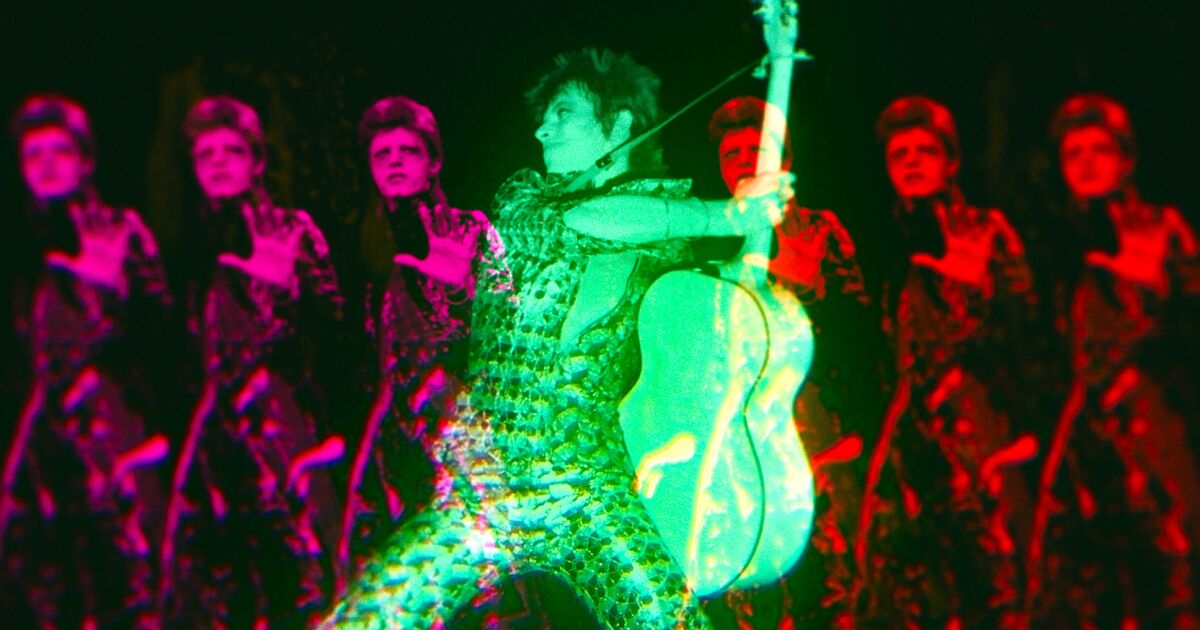
Liberated from the narrative conventions that plague most biographical documentaries, “Moonage Daydream” lures us into a cosmic dance of intoxicating imagery and timeless music in honor of the late shapeshifting, gender-defying, rock philosopher David Bowie.
Amid psychedelic splashes of color, pristine concert footage and an assortment of filmic references, director and editor Brett Morgen distills the essence of the nearly messianic figure whose disruptively ravishing art continues to puzzle and inspire into a vertiginous stream of conciseness. Audio from multiple interviews he granted over the decades underscores the free-flowing footage to let Ziggy Stardust speak for himself.
Unconcerned with providing a rigid timeline of events, the filmmaker’s sole marker for the passage of time comes from Bowie’s own mentions of his age and the relevant creative or personal transitions at each stage. By age 33, the British-born intergalactic artist had succeeded at a plethora of disciplines including painting, sculpture and even film acting as an extraterrestrial inside a human body in Nicolas Roeg’s “The Man Who Fell to Earth.”
Likewise, there are no experts or contemporaries featured to contextualize Bowie’s legacy. And yet, through the firsthand insight interspersed between mood-altering tracks such as “Heroes” or “Sound + Vision,” we witness Bowie’s innermost evolution. Although he openly discusses his estranged relationship with his mother, reinventing his musical language alongside collaborator Brian Eno and becoming a curious globe wanderer, it’s the eventual change in his stance on romantic love that most concretely humanizes him.
In combining performances of the same song recorded years apart, “Moonage Daydream,” also the name of one of Bowie’s early releases, glides across time and space positioning the icon as an entity that remained just as captivating throughout his mortal existence.
Morgen’s structural approach to Bowie’s history is akin to his take on the troubled mindset of Nirvana front man Kurt Cobain in “Montage of Heck,” except for the use of talking-head interviews. Both are monuments to singular psyches that demanded the filmmaker dive into intimate ideas and public memories to mold them into a compelling visual vessel.
Wielding chaos into cinema — rather than creating an accumulation of factoids and anecdotes told by those who knew the performer — Morgen manifests a sensorial invocation of Bowie’s spirit, suited to delight acolytes and nonbelievers alike, for a tribute worthy of his unclassifiable genius.
‘Moonage Daydream’
Rated: PG-13, for some sexual images/nudity, brief strong language and smoking
Running time: 2 hours, 14 minutes
Playing: Starts Sept. 16 in general release

Liberated from the narrative conventions that plague most biographical documentaries, “Moonage Daydream” lures us into a cosmic dance of intoxicating imagery and timeless music in honor of the late shapeshifting, gender-defying, rock philosopher David Bowie.
Amid psychedelic splashes of color, pristine concert footage and an assortment of filmic references, director and editor Brett Morgen distills the essence of the nearly messianic figure whose disruptively ravishing art continues to puzzle and inspire into a vertiginous stream of conciseness. Audio from multiple interviews he granted over the decades underscores the free-flowing footage to let Ziggy Stardust speak for himself.
Unconcerned with providing a rigid timeline of events, the filmmaker’s sole marker for the passage of time comes from Bowie’s own mentions of his age and the relevant creative or personal transitions at each stage. By age 33, the British-born intergalactic artist had succeeded at a plethora of disciplines including painting, sculpture and even film acting as an extraterrestrial inside a human body in Nicolas Roeg’s “The Man Who Fell to Earth.”
Likewise, there are no experts or contemporaries featured to contextualize Bowie’s legacy. And yet, through the firsthand insight interspersed between mood-altering tracks such as “Heroes” or “Sound + Vision,” we witness Bowie’s innermost evolution. Although he openly discusses his estranged relationship with his mother, reinventing his musical language alongside collaborator Brian Eno and becoming a curious globe wanderer, it’s the eventual change in his stance on romantic love that most concretely humanizes him.
In combining performances of the same song recorded years apart, “Moonage Daydream,” also the name of one of Bowie’s early releases, glides across time and space positioning the icon as an entity that remained just as captivating throughout his mortal existence.
Morgen’s structural approach to Bowie’s history is akin to his take on the troubled mindset of Nirvana front man Kurt Cobain in “Montage of Heck,” except for the use of talking-head interviews. Both are monuments to singular psyches that demanded the filmmaker dive into intimate ideas and public memories to mold them into a compelling visual vessel.
Wielding chaos into cinema — rather than creating an accumulation of factoids and anecdotes told by those who knew the performer — Morgen manifests a sensorial invocation of Bowie’s spirit, suited to delight acolytes and nonbelievers alike, for a tribute worthy of his unclassifiable genius.
‘Moonage Daydream’
Rated: PG-13, for some sexual images/nudity, brief strong language and smoking
Running time: 2 hours, 14 minutes
Playing: Starts Sept. 16 in general release

Liberated from the narrative conventions that plague most biographical documentaries, “Moonage Daydream” lures us into a cosmic dance of intoxicating imagery and timeless music in honor of the late shapeshifting, gender-defying, rock philosopher David Bowie.
Amid psychedelic splashes of color, pristine concert footage and an assortment of filmic references, director and editor Brett Morgen distills the essence of the nearly messianic figure whose disruptively ravishing art continues to puzzle and inspire into a vertiginous stream of conciseness. Audio from multiple interviews he granted over the decades underscores the free-flowing footage to let Ziggy Stardust speak for himself.
Unconcerned with providing a rigid timeline of events, the filmmaker’s sole marker for the passage of time comes from Bowie’s own mentions of his age and the relevant creative or personal transitions at each stage. By age 33, the British-born intergalactic artist had succeeded at a plethora of disciplines including painting, sculpture and even film acting as an extraterrestrial inside a human body in Nicolas Roeg’s “The Man Who Fell to Earth.”
Likewise, there are no experts or contemporaries featured to contextualize Bowie’s legacy. And yet, through the firsthand insight interspersed between mood-altering tracks such as “Heroes” or “Sound + Vision,” we witness Bowie’s innermost evolution. Although he openly discusses his estranged relationship with his mother, reinventing his musical language alongside collaborator Brian Eno and becoming a curious globe wanderer, it’s the eventual change in his stance on romantic love that most concretely humanizes him.
In combining performances of the same song recorded years apart, “Moonage Daydream,” also the name of one of Bowie’s early releases, glides across time and space positioning the icon as an entity that remained just as captivating throughout his mortal existence.
Morgen’s structural approach to Bowie’s history is akin to his take on the troubled mindset of Nirvana front man Kurt Cobain in “Montage of Heck,” except for the use of talking-head interviews. Both are monuments to singular psyches that demanded the filmmaker dive into intimate ideas and public memories to mold them into a compelling visual vessel.
Wielding chaos into cinema — rather than creating an accumulation of factoids and anecdotes told by those who knew the performer — Morgen manifests a sensorial invocation of Bowie’s spirit, suited to delight acolytes and nonbelievers alike, for a tribute worthy of his unclassifiable genius.
‘Moonage Daydream’
Rated: PG-13, for some sexual images/nudity, brief strong language and smoking
Running time: 2 hours, 14 minutes
Playing: Starts Sept. 16 in general release
Liberated from the narrative conventions that plague most biographical documentaries, “Moonage Daydream” lures us into a cosmic dance of intoxicating imagery and timeless music in honor of the late shapeshifting, gender-defying, rock philosopher David Bowie.
Amid psychedelic splashes of color, pristine concert footage and an assortment of filmic references, director and editor Brett Morgen distills the essence of the nearly messianic figure whose disruptively ravishing art continues to puzzle and inspire into a vertiginous stream of conciseness. Audio from multiple interviews he granted over the decades underscores the free-flowing footage to let Ziggy Stardust speak for himself.
Unconcerned with providing a rigid timeline of events, the filmmaker’s sole marker for the passage of time comes from Bowie’s own mentions of his age and the relevant creative or personal transitions at each stage. By age 33, the British-born intergalactic artist had succeeded at a plethora of disciplines including painting, sculpture and even film acting as an extraterrestrial inside a human body in Nicolas Roeg’s “The Man Who Fell to Earth.”
Likewise, there are no experts or contemporaries featured to contextualize Bowie’s legacy. And yet, through the firsthand insight interspersed between mood-altering tracks such as “Heroes” or “Sound + Vision,” we witness Bowie’s innermost evolution. Although he openly discusses his estranged relationship with his mother, reinventing his musical language alongside collaborator Brian Eno and becoming a curious globe wanderer, it’s the eventual change in his stance on romantic love that most concretely humanizes him.
In combining performances of the same song recorded years apart, “Moonage Daydream,” also the name of one of Bowie’s early releases, glides across time and space positioning the icon as an entity that remained just as captivating throughout his mortal existence.
Morgen’s structural approach to Bowie’s history is akin to his take on the troubled mindset of Nirvana front man Kurt Cobain in “Montage of Heck,” except for the use of talking-head interviews. Both are monuments to singular psyches that demanded the filmmaker dive into intimate ideas and public memories to mold them into a compelling visual vessel.
Wielding chaos into cinema — rather than creating an accumulation of factoids and anecdotes told by those who knew the performer — Morgen manifests a sensorial invocation of Bowie’s spirit, suited to delight acolytes and nonbelievers alike, for a tribute worthy of his unclassifiable genius.
‘Moonage Daydream’
Rated: PG-13, for some sexual images/nudity, brief strong language and smoking
Running time: 2 hours, 14 minutes
Playing: Starts Sept. 16 in general release

Liberated from the narrative conventions that plague most biographical documentaries, “Moonage Daydream” lures us into a cosmic dance of intoxicating imagery and timeless music in honor of the late shapeshifting, gender-defying, rock philosopher David Bowie.
Amid psychedelic splashes of color, pristine concert footage and an assortment of filmic references, director and editor Brett Morgen distills the essence of the nearly messianic figure whose disruptively ravishing art continues to puzzle and inspire into a vertiginous stream of conciseness. Audio from multiple interviews he granted over the decades underscores the free-flowing footage to let Ziggy Stardust speak for himself.
Unconcerned with providing a rigid timeline of events, the filmmaker’s sole marker for the passage of time comes from Bowie’s own mentions of his age and the relevant creative or personal transitions at each stage. By age 33, the British-born intergalactic artist had succeeded at a plethora of disciplines including painting, sculpture and even film acting as an extraterrestrial inside a human body in Nicolas Roeg’s “The Man Who Fell to Earth.”
Likewise, there are no experts or contemporaries featured to contextualize Bowie’s legacy. And yet, through the firsthand insight interspersed between mood-altering tracks such as “Heroes” or “Sound + Vision,” we witness Bowie’s innermost evolution. Although he openly discusses his estranged relationship with his mother, reinventing his musical language alongside collaborator Brian Eno and becoming a curious globe wanderer, it’s the eventual change in his stance on romantic love that most concretely humanizes him.
In combining performances of the same song recorded years apart, “Moonage Daydream,” also the name of one of Bowie’s early releases, glides across time and space positioning the icon as an entity that remained just as captivating throughout his mortal existence.
Morgen’s structural approach to Bowie’s history is akin to his take on the troubled mindset of Nirvana front man Kurt Cobain in “Montage of Heck,” except for the use of talking-head interviews. Both are monuments to singular psyches that demanded the filmmaker dive into intimate ideas and public memories to mold them into a compelling visual vessel.
Wielding chaos into cinema — rather than creating an accumulation of factoids and anecdotes told by those who knew the performer — Morgen manifests a sensorial invocation of Bowie’s spirit, suited to delight acolytes and nonbelievers alike, for a tribute worthy of his unclassifiable genius.
‘Moonage Daydream’
Rated: PG-13, for some sexual images/nudity, brief strong language and smoking
Running time: 2 hours, 14 minutes
Playing: Starts Sept. 16 in general release
Liberated from the narrative conventions that plague most biographical documentaries, “Moonage Daydream” lures us into a cosmic dance of intoxicating imagery and timeless music in honor of the late shapeshifting, gender-defying, rock philosopher David Bowie.
Amid psychedelic splashes of color, pristine concert footage and an assortment of filmic references, director and editor Brett Morgen distills the essence of the nearly messianic figure whose disruptively ravishing art continues to puzzle and inspire into a vertiginous stream of conciseness. Audio from multiple interviews he granted over the decades underscores the free-flowing footage to let Ziggy Stardust speak for himself.
Unconcerned with providing a rigid timeline of events, the filmmaker’s sole marker for the passage of time comes from Bowie’s own mentions of his age and the relevant creative or personal transitions at each stage. By age 33, the British-born intergalactic artist had succeeded at a plethora of disciplines including painting, sculpture and even film acting as an extraterrestrial inside a human body in Nicolas Roeg’s “The Man Who Fell to Earth.”
Likewise, there are no experts or contemporaries featured to contextualize Bowie’s legacy. And yet, through the firsthand insight interspersed between mood-altering tracks such as “Heroes” or “Sound + Vision,” we witness Bowie’s innermost evolution. Although he openly discusses his estranged relationship with his mother, reinventing his musical language alongside collaborator Brian Eno and becoming a curious globe wanderer, it’s the eventual change in his stance on romantic love that most concretely humanizes him.
In combining performances of the same song recorded years apart, “Moonage Daydream,” also the name of one of Bowie’s early releases, glides across time and space positioning the icon as an entity that remained just as captivating throughout his mortal existence.
Morgen’s structural approach to Bowie’s history is akin to his take on the troubled mindset of Nirvana front man Kurt Cobain in “Montage of Heck,” except for the use of talking-head interviews. Both are monuments to singular psyches that demanded the filmmaker dive into intimate ideas and public memories to mold them into a compelling visual vessel.
Wielding chaos into cinema — rather than creating an accumulation of factoids and anecdotes told by those who knew the performer — Morgen manifests a sensorial invocation of Bowie’s spirit, suited to delight acolytes and nonbelievers alike, for a tribute worthy of his unclassifiable genius.
‘Moonage Daydream’
Rated: PG-13, for some sexual images/nudity, brief strong language and smoking
Running time: 2 hours, 14 minutes
Playing: Starts Sept. 16 in general release
Liberated from the narrative conventions that plague most biographical documentaries, “Moonage Daydream” lures us into a cosmic dance of intoxicating imagery and timeless music in honor of the late shapeshifting, gender-defying, rock philosopher David Bowie.
Amid psychedelic splashes of color, pristine concert footage and an assortment of filmic references, director and editor Brett Morgen distills the essence of the nearly messianic figure whose disruptively ravishing art continues to puzzle and inspire into a vertiginous stream of conciseness. Audio from multiple interviews he granted over the decades underscores the free-flowing footage to let Ziggy Stardust speak for himself.
Unconcerned with providing a rigid timeline of events, the filmmaker’s sole marker for the passage of time comes from Bowie’s own mentions of his age and the relevant creative or personal transitions at each stage. By age 33, the British-born intergalactic artist had succeeded at a plethora of disciplines including painting, sculpture and even film acting as an extraterrestrial inside a human body in Nicolas Roeg’s “The Man Who Fell to Earth.”
Likewise, there are no experts or contemporaries featured to contextualize Bowie’s legacy. And yet, through the firsthand insight interspersed between mood-altering tracks such as “Heroes” or “Sound + Vision,” we witness Bowie’s innermost evolution. Although he openly discusses his estranged relationship with his mother, reinventing his musical language alongside collaborator Brian Eno and becoming a curious globe wanderer, it’s the eventual change in his stance on romantic love that most concretely humanizes him.
In combining performances of the same song recorded years apart, “Moonage Daydream,” also the name of one of Bowie’s early releases, glides across time and space positioning the icon as an entity that remained just as captivating throughout his mortal existence.
Morgen’s structural approach to Bowie’s history is akin to his take on the troubled mindset of Nirvana front man Kurt Cobain in “Montage of Heck,” except for the use of talking-head interviews. Both are monuments to singular psyches that demanded the filmmaker dive into intimate ideas and public memories to mold them into a compelling visual vessel.
Wielding chaos into cinema — rather than creating an accumulation of factoids and anecdotes told by those who knew the performer — Morgen manifests a sensorial invocation of Bowie’s spirit, suited to delight acolytes and nonbelievers alike, for a tribute worthy of his unclassifiable genius.
‘Moonage Daydream’
Rated: PG-13, for some sexual images/nudity, brief strong language and smoking
Running time: 2 hours, 14 minutes
Playing: Starts Sept. 16 in general release
Liberated from the narrative conventions that plague most biographical documentaries, “Moonage Daydream” lures us into a cosmic dance of intoxicating imagery and timeless music in honor of the late shapeshifting, gender-defying, rock philosopher David Bowie.
Amid psychedelic splashes of color, pristine concert footage and an assortment of filmic references, director and editor Brett Morgen distills the essence of the nearly messianic figure whose disruptively ravishing art continues to puzzle and inspire into a vertiginous stream of conciseness. Audio from multiple interviews he granted over the decades underscores the free-flowing footage to let Ziggy Stardust speak for himself.
Unconcerned with providing a rigid timeline of events, the filmmaker’s sole marker for the passage of time comes from Bowie’s own mentions of his age and the relevant creative or personal transitions at each stage. By age 33, the British-born intergalactic artist had succeeded at a plethora of disciplines including painting, sculpture and even film acting as an extraterrestrial inside a human body in Nicolas Roeg’s “The Man Who Fell to Earth.”
Likewise, there are no experts or contemporaries featured to contextualize Bowie’s legacy. And yet, through the firsthand insight interspersed between mood-altering tracks such as “Heroes” or “Sound + Vision,” we witness Bowie’s innermost evolution. Although he openly discusses his estranged relationship with his mother, reinventing his musical language alongside collaborator Brian Eno and becoming a curious globe wanderer, it’s the eventual change in his stance on romantic love that most concretely humanizes him.
In combining performances of the same song recorded years apart, “Moonage Daydream,” also the name of one of Bowie’s early releases, glides across time and space positioning the icon as an entity that remained just as captivating throughout his mortal existence.
Morgen’s structural approach to Bowie’s history is akin to his take on the troubled mindset of Nirvana front man Kurt Cobain in “Montage of Heck,” except for the use of talking-head interviews. Both are monuments to singular psyches that demanded the filmmaker dive into intimate ideas and public memories to mold them into a compelling visual vessel.
Wielding chaos into cinema — rather than creating an accumulation of factoids and anecdotes told by those who knew the performer — Morgen manifests a sensorial invocation of Bowie’s spirit, suited to delight acolytes and nonbelievers alike, for a tribute worthy of his unclassifiable genius.
‘Moonage Daydream’
Rated: PG-13, for some sexual images/nudity, brief strong language and smoking
Running time: 2 hours, 14 minutes
Playing: Starts Sept. 16 in general release

Liberated from the narrative conventions that plague most biographical documentaries, “Moonage Daydream” lures us into a cosmic dance of intoxicating imagery and timeless music in honor of the late shapeshifting, gender-defying, rock philosopher David Bowie.
Amid psychedelic splashes of color, pristine concert footage and an assortment of filmic references, director and editor Brett Morgen distills the essence of the nearly messianic figure whose disruptively ravishing art continues to puzzle and inspire into a vertiginous stream of conciseness. Audio from multiple interviews he granted over the decades underscores the free-flowing footage to let Ziggy Stardust speak for himself.
Unconcerned with providing a rigid timeline of events, the filmmaker’s sole marker for the passage of time comes from Bowie’s own mentions of his age and the relevant creative or personal transitions at each stage. By age 33, the British-born intergalactic artist had succeeded at a plethora of disciplines including painting, sculpture and even film acting as an extraterrestrial inside a human body in Nicolas Roeg’s “The Man Who Fell to Earth.”
Likewise, there are no experts or contemporaries featured to contextualize Bowie’s legacy. And yet, through the firsthand insight interspersed between mood-altering tracks such as “Heroes” or “Sound + Vision,” we witness Bowie’s innermost evolution. Although he openly discusses his estranged relationship with his mother, reinventing his musical language alongside collaborator Brian Eno and becoming a curious globe wanderer, it’s the eventual change in his stance on romantic love that most concretely humanizes him.
In combining performances of the same song recorded years apart, “Moonage Daydream,” also the name of one of Bowie’s early releases, glides across time and space positioning the icon as an entity that remained just as captivating throughout his mortal existence.
Morgen’s structural approach to Bowie’s history is akin to his take on the troubled mindset of Nirvana front man Kurt Cobain in “Montage of Heck,” except for the use of talking-head interviews. Both are monuments to singular psyches that demanded the filmmaker dive into intimate ideas and public memories to mold them into a compelling visual vessel.
Wielding chaos into cinema — rather than creating an accumulation of factoids and anecdotes told by those who knew the performer — Morgen manifests a sensorial invocation of Bowie’s spirit, suited to delight acolytes and nonbelievers alike, for a tribute worthy of his unclassifiable genius.
‘Moonage Daydream’
Rated: PG-13, for some sexual images/nudity, brief strong language and smoking
Running time: 2 hours, 14 minutes
Playing: Starts Sept. 16 in general release
Liberated from the narrative conventions that plague most biographical documentaries, “Moonage Daydream” lures us into a cosmic dance of intoxicating imagery and timeless music in honor of the late shapeshifting, gender-defying, rock philosopher David Bowie.
Amid psychedelic splashes of color, pristine concert footage and an assortment of filmic references, director and editor Brett Morgen distills the essence of the nearly messianic figure whose disruptively ravishing art continues to puzzle and inspire into a vertiginous stream of conciseness. Audio from multiple interviews he granted over the decades underscores the free-flowing footage to let Ziggy Stardust speak for himself.
Unconcerned with providing a rigid timeline of events, the filmmaker’s sole marker for the passage of time comes from Bowie’s own mentions of his age and the relevant creative or personal transitions at each stage. By age 33, the British-born intergalactic artist had succeeded at a plethora of disciplines including painting, sculpture and even film acting as an extraterrestrial inside a human body in Nicolas Roeg’s “The Man Who Fell to Earth.”
Likewise, there are no experts or contemporaries featured to contextualize Bowie’s legacy. And yet, through the firsthand insight interspersed between mood-altering tracks such as “Heroes” or “Sound + Vision,” we witness Bowie’s innermost evolution. Although he openly discusses his estranged relationship with his mother, reinventing his musical language alongside collaborator Brian Eno and becoming a curious globe wanderer, it’s the eventual change in his stance on romantic love that most concretely humanizes him.
In combining performances of the same song recorded years apart, “Moonage Daydream,” also the name of one of Bowie’s early releases, glides across time and space positioning the icon as an entity that remained just as captivating throughout his mortal existence.
Morgen’s structural approach to Bowie’s history is akin to his take on the troubled mindset of Nirvana front man Kurt Cobain in “Montage of Heck,” except for the use of talking-head interviews. Both are monuments to singular psyches that demanded the filmmaker dive into intimate ideas and public memories to mold them into a compelling visual vessel.
Wielding chaos into cinema — rather than creating an accumulation of factoids and anecdotes told by those who knew the performer — Morgen manifests a sensorial invocation of Bowie’s spirit, suited to delight acolytes and nonbelievers alike, for a tribute worthy of his unclassifiable genius.
‘Moonage Daydream’
Rated: PG-13, for some sexual images/nudity, brief strong language and smoking
Running time: 2 hours, 14 minutes
Playing: Starts Sept. 16 in general release
Liberated from the narrative conventions that plague most biographical documentaries, “Moonage Daydream” lures us into a cosmic dance of intoxicating imagery and timeless music in honor of the late shapeshifting, gender-defying, rock philosopher David Bowie.
Amid psychedelic splashes of color, pristine concert footage and an assortment of filmic references, director and editor Brett Morgen distills the essence of the nearly messianic figure whose disruptively ravishing art continues to puzzle and inspire into a vertiginous stream of conciseness. Audio from multiple interviews he granted over the decades underscores the free-flowing footage to let Ziggy Stardust speak for himself.
Unconcerned with providing a rigid timeline of events, the filmmaker’s sole marker for the passage of time comes from Bowie’s own mentions of his age and the relevant creative or personal transitions at each stage. By age 33, the British-born intergalactic artist had succeeded at a plethora of disciplines including painting, sculpture and even film acting as an extraterrestrial inside a human body in Nicolas Roeg’s “The Man Who Fell to Earth.”
Likewise, there are no experts or contemporaries featured to contextualize Bowie’s legacy. And yet, through the firsthand insight interspersed between mood-altering tracks such as “Heroes” or “Sound + Vision,” we witness Bowie’s innermost evolution. Although he openly discusses his estranged relationship with his mother, reinventing his musical language alongside collaborator Brian Eno and becoming a curious globe wanderer, it’s the eventual change in his stance on romantic love that most concretely humanizes him.
In combining performances of the same song recorded years apart, “Moonage Daydream,” also the name of one of Bowie’s early releases, glides across time and space positioning the icon as an entity that remained just as captivating throughout his mortal existence.
Morgen’s structural approach to Bowie’s history is akin to his take on the troubled mindset of Nirvana front man Kurt Cobain in “Montage of Heck,” except for the use of talking-head interviews. Both are monuments to singular psyches that demanded the filmmaker dive into intimate ideas and public memories to mold them into a compelling visual vessel.
Wielding chaos into cinema — rather than creating an accumulation of factoids and anecdotes told by those who knew the performer — Morgen manifests a sensorial invocation of Bowie’s spirit, suited to delight acolytes and nonbelievers alike, for a tribute worthy of his unclassifiable genius.
‘Moonage Daydream’
Rated: PG-13, for some sexual images/nudity, brief strong language and smoking
Running time: 2 hours, 14 minutes
Playing: Starts Sept. 16 in general release
Liberated from the narrative conventions that plague most biographical documentaries, “Moonage Daydream” lures us into a cosmic dance of intoxicating imagery and timeless music in honor of the late shapeshifting, gender-defying, rock philosopher David Bowie.
Amid psychedelic splashes of color, pristine concert footage and an assortment of filmic references, director and editor Brett Morgen distills the essence of the nearly messianic figure whose disruptively ravishing art continues to puzzle and inspire into a vertiginous stream of conciseness. Audio from multiple interviews he granted over the decades underscores the free-flowing footage to let Ziggy Stardust speak for himself.
Unconcerned with providing a rigid timeline of events, the filmmaker’s sole marker for the passage of time comes from Bowie’s own mentions of his age and the relevant creative or personal transitions at each stage. By age 33, the British-born intergalactic artist had succeeded at a plethora of disciplines including painting, sculpture and even film acting as an extraterrestrial inside a human body in Nicolas Roeg’s “The Man Who Fell to Earth.”
Likewise, there are no experts or contemporaries featured to contextualize Bowie’s legacy. And yet, through the firsthand insight interspersed between mood-altering tracks such as “Heroes” or “Sound + Vision,” we witness Bowie’s innermost evolution. Although he openly discusses his estranged relationship with his mother, reinventing his musical language alongside collaborator Brian Eno and becoming a curious globe wanderer, it’s the eventual change in his stance on romantic love that most concretely humanizes him.
In combining performances of the same song recorded years apart, “Moonage Daydream,” also the name of one of Bowie’s early releases, glides across time and space positioning the icon as an entity that remained just as captivating throughout his mortal existence.
Morgen’s structural approach to Bowie’s history is akin to his take on the troubled mindset of Nirvana front man Kurt Cobain in “Montage of Heck,” except for the use of talking-head interviews. Both are monuments to singular psyches that demanded the filmmaker dive into intimate ideas and public memories to mold them into a compelling visual vessel.
Wielding chaos into cinema — rather than creating an accumulation of factoids and anecdotes told by those who knew the performer — Morgen manifests a sensorial invocation of Bowie’s spirit, suited to delight acolytes and nonbelievers alike, for a tribute worthy of his unclassifiable genius.
‘Moonage Daydream’
Rated: PG-13, for some sexual images/nudity, brief strong language and smoking
Running time: 2 hours, 14 minutes
Playing: Starts Sept. 16 in general release
Liberated from the narrative conventions that plague most biographical documentaries, “Moonage Daydream” lures us into a cosmic dance of intoxicating imagery and timeless music in honor of the late shapeshifting, gender-defying, rock philosopher David Bowie.
Amid psychedelic splashes of color, pristine concert footage and an assortment of filmic references, director and editor Brett Morgen distills the essence of the nearly messianic figure whose disruptively ravishing art continues to puzzle and inspire into a vertiginous stream of conciseness. Audio from multiple interviews he granted over the decades underscores the free-flowing footage to let Ziggy Stardust speak for himself.
Unconcerned with providing a rigid timeline of events, the filmmaker’s sole marker for the passage of time comes from Bowie’s own mentions of his age and the relevant creative or personal transitions at each stage. By age 33, the British-born intergalactic artist had succeeded at a plethora of disciplines including painting, sculpture and even film acting as an extraterrestrial inside a human body in Nicolas Roeg’s “The Man Who Fell to Earth.”
Likewise, there are no experts or contemporaries featured to contextualize Bowie’s legacy. And yet, through the firsthand insight interspersed between mood-altering tracks such as “Heroes” or “Sound + Vision,” we witness Bowie’s innermost evolution. Although he openly discusses his estranged relationship with his mother, reinventing his musical language alongside collaborator Brian Eno and becoming a curious globe wanderer, it’s the eventual change in his stance on romantic love that most concretely humanizes him.
In combining performances of the same song recorded years apart, “Moonage Daydream,” also the name of one of Bowie’s early releases, glides across time and space positioning the icon as an entity that remained just as captivating throughout his mortal existence.
Morgen’s structural approach to Bowie’s history is akin to his take on the troubled mindset of Nirvana front man Kurt Cobain in “Montage of Heck,” except for the use of talking-head interviews. Both are monuments to singular psyches that demanded the filmmaker dive into intimate ideas and public memories to mold them into a compelling visual vessel.
Wielding chaos into cinema — rather than creating an accumulation of factoids and anecdotes told by those who knew the performer — Morgen manifests a sensorial invocation of Bowie’s spirit, suited to delight acolytes and nonbelievers alike, for a tribute worthy of his unclassifiable genius.
‘Moonage Daydream’
Rated: PG-13, for some sexual images/nudity, brief strong language and smoking
Running time: 2 hours, 14 minutes
Playing: Starts Sept. 16 in general release
Liberated from the narrative conventions that plague most biographical documentaries, “Moonage Daydream” lures us into a cosmic dance of intoxicating imagery and timeless music in honor of the late shapeshifting, gender-defying, rock philosopher David Bowie.
Amid psychedelic splashes of color, pristine concert footage and an assortment of filmic references, director and editor Brett Morgen distills the essence of the nearly messianic figure whose disruptively ravishing art continues to puzzle and inspire into a vertiginous stream of conciseness. Audio from multiple interviews he granted over the decades underscores the free-flowing footage to let Ziggy Stardust speak for himself.
Unconcerned with providing a rigid timeline of events, the filmmaker’s sole marker for the passage of time comes from Bowie’s own mentions of his age and the relevant creative or personal transitions at each stage. By age 33, the British-born intergalactic artist had succeeded at a plethora of disciplines including painting, sculpture and even film acting as an extraterrestrial inside a human body in Nicolas Roeg’s “The Man Who Fell to Earth.”
Likewise, there are no experts or contemporaries featured to contextualize Bowie’s legacy. And yet, through the firsthand insight interspersed between mood-altering tracks such as “Heroes” or “Sound + Vision,” we witness Bowie’s innermost evolution. Although he openly discusses his estranged relationship with his mother, reinventing his musical language alongside collaborator Brian Eno and becoming a curious globe wanderer, it’s the eventual change in his stance on romantic love that most concretely humanizes him.
In combining performances of the same song recorded years apart, “Moonage Daydream,” also the name of one of Bowie’s early releases, glides across time and space positioning the icon as an entity that remained just as captivating throughout his mortal existence.
Morgen’s structural approach to Bowie’s history is akin to his take on the troubled mindset of Nirvana front man Kurt Cobain in “Montage of Heck,” except for the use of talking-head interviews. Both are monuments to singular psyches that demanded the filmmaker dive into intimate ideas and public memories to mold them into a compelling visual vessel.
Wielding chaos into cinema — rather than creating an accumulation of factoids and anecdotes told by those who knew the performer — Morgen manifests a sensorial invocation of Bowie’s spirit, suited to delight acolytes and nonbelievers alike, for a tribute worthy of his unclassifiable genius.
‘Moonage Daydream’
Rated: PG-13, for some sexual images/nudity, brief strong language and smoking
Running time: 2 hours, 14 minutes
Playing: Starts Sept. 16 in general release
Liberated from the narrative conventions that plague most biographical documentaries, “Moonage Daydream” lures us into a cosmic dance of intoxicating imagery and timeless music in honor of the late shapeshifting, gender-defying, rock philosopher David Bowie.
Amid psychedelic splashes of color, pristine concert footage and an assortment of filmic references, director and editor Brett Morgen distills the essence of the nearly messianic figure whose disruptively ravishing art continues to puzzle and inspire into a vertiginous stream of conciseness. Audio from multiple interviews he granted over the decades underscores the free-flowing footage to let Ziggy Stardust speak for himself.
Unconcerned with providing a rigid timeline of events, the filmmaker’s sole marker for the passage of time comes from Bowie’s own mentions of his age and the relevant creative or personal transitions at each stage. By age 33, the British-born intergalactic artist had succeeded at a plethora of disciplines including painting, sculpture and even film acting as an extraterrestrial inside a human body in Nicolas Roeg’s “The Man Who Fell to Earth.”
Likewise, there are no experts or contemporaries featured to contextualize Bowie’s legacy. And yet, through the firsthand insight interspersed between mood-altering tracks such as “Heroes” or “Sound + Vision,” we witness Bowie’s innermost evolution. Although he openly discusses his estranged relationship with his mother, reinventing his musical language alongside collaborator Brian Eno and becoming a curious globe wanderer, it’s the eventual change in his stance on romantic love that most concretely humanizes him.
In combining performances of the same song recorded years apart, “Moonage Daydream,” also the name of one of Bowie’s early releases, glides across time and space positioning the icon as an entity that remained just as captivating throughout his mortal existence.
Morgen’s structural approach to Bowie’s history is akin to his take on the troubled mindset of Nirvana front man Kurt Cobain in “Montage of Heck,” except for the use of talking-head interviews. Both are monuments to singular psyches that demanded the filmmaker dive into intimate ideas and public memories to mold them into a compelling visual vessel.
Wielding chaos into cinema — rather than creating an accumulation of factoids and anecdotes told by those who knew the performer — Morgen manifests a sensorial invocation of Bowie’s spirit, suited to delight acolytes and nonbelievers alike, for a tribute worthy of his unclassifiable genius.
‘Moonage Daydream’
Rated: PG-13, for some sexual images/nudity, brief strong language and smoking
Running time: 2 hours, 14 minutes
Playing: Starts Sept. 16 in general release
Liberated from the narrative conventions that plague most biographical documentaries, “Moonage Daydream” lures us into a cosmic dance of intoxicating imagery and timeless music in honor of the late shapeshifting, gender-defying, rock philosopher David Bowie.
Amid psychedelic splashes of color, pristine concert footage and an assortment of filmic references, director and editor Brett Morgen distills the essence of the nearly messianic figure whose disruptively ravishing art continues to puzzle and inspire into a vertiginous stream of conciseness. Audio from multiple interviews he granted over the decades underscores the free-flowing footage to let Ziggy Stardust speak for himself.
Unconcerned with providing a rigid timeline of events, the filmmaker’s sole marker for the passage of time comes from Bowie’s own mentions of his age and the relevant creative or personal transitions at each stage. By age 33, the British-born intergalactic artist had succeeded at a plethora of disciplines including painting, sculpture and even film acting as an extraterrestrial inside a human body in Nicolas Roeg’s “The Man Who Fell to Earth.”
Likewise, there are no experts or contemporaries featured to contextualize Bowie’s legacy. And yet, through the firsthand insight interspersed between mood-altering tracks such as “Heroes” or “Sound + Vision,” we witness Bowie’s innermost evolution. Although he openly discusses his estranged relationship with his mother, reinventing his musical language alongside collaborator Brian Eno and becoming a curious globe wanderer, it’s the eventual change in his stance on romantic love that most concretely humanizes him.
In combining performances of the same song recorded years apart, “Moonage Daydream,” also the name of one of Bowie’s early releases, glides across time and space positioning the icon as an entity that remained just as captivating throughout his mortal existence.
Morgen’s structural approach to Bowie’s history is akin to his take on the troubled mindset of Nirvana front man Kurt Cobain in “Montage of Heck,” except for the use of talking-head interviews. Both are monuments to singular psyches that demanded the filmmaker dive into intimate ideas and public memories to mold them into a compelling visual vessel.
Wielding chaos into cinema — rather than creating an accumulation of factoids and anecdotes told by those who knew the performer — Morgen manifests a sensorial invocation of Bowie’s spirit, suited to delight acolytes and nonbelievers alike, for a tribute worthy of his unclassifiable genius.
‘Moonage Daydream’
Rated: PG-13, for some sexual images/nudity, brief strong language and smoking
Running time: 2 hours, 14 minutes
Playing: Starts Sept. 16 in general release

