

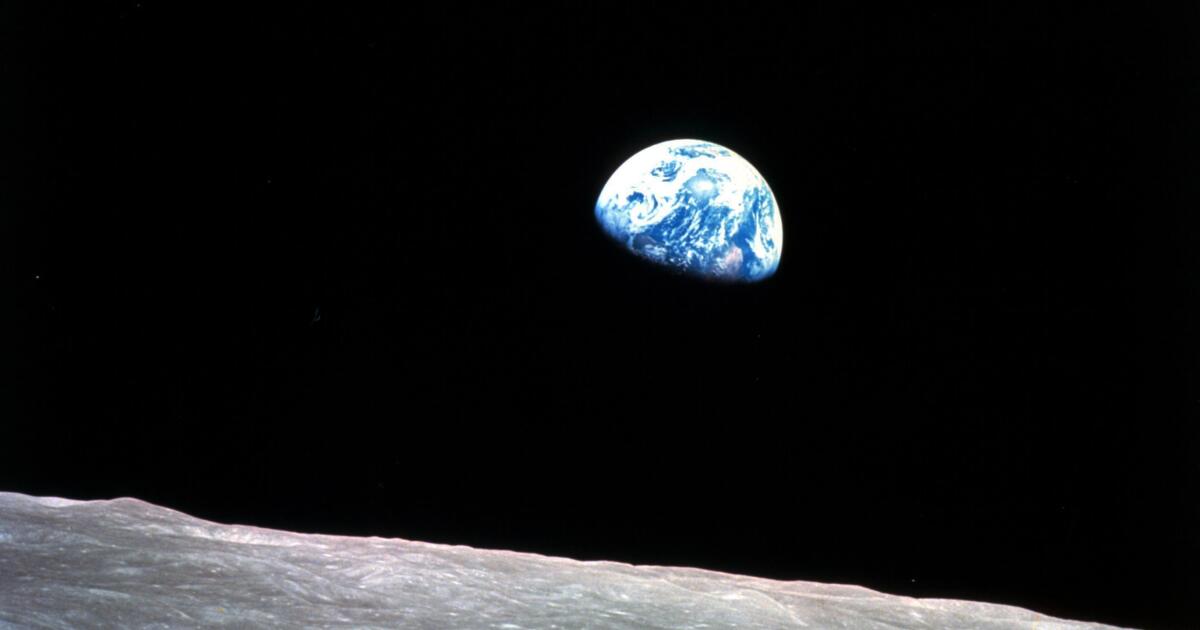
Bill Anders, the Apollo 8 astronaut who was one of the first humans to orbit the moon and who took the iconic first photo of Earth rising over the lunar surface, died Friday when a plane he was piloting crashed near the San Juan Islands off the coast of Washington state. He was 90.
His son Greg Anders confirmed the death to the Associated Press.
The plane, a Beechcraft T-34 Mentor, went into the water near Roche Harbor, Wash., about 11:40 a.m., the Federal Aviation Administration said.
The FAA said the pilot was thought to be the only person on board, though local authorities could not immediately confirm that.
A dive team was called in to search the area Friday afternoon, San Juan County Sheriff Eric Peter said.
The crash is under investigation by the FAA and the National Transportation Safety Board.
Bill Anders, center, with fellow Apollo 8 astronauts Jim Lovell, left, and Frank Borman in November 1968.
(NASA)
On Dec. 24, 1968, Anders and two other astronauts aboard Apollo 8, Frank Borman and Jim Lovell, became the first people to orbit the Moon. Anders famously read from the Book of Genesis on a live Christmas Eve broadcast from space.
Anders and his crewmates were also the first humans to witness the blue Earth rising over the moon’s gray surface.
As the spacecraft was rotating, Anders took the iconic photo “Earthrise” capturing the moment. The image captivated people worldwide and became a profound symbol of the environmental movement, showing the fragility of life on Earth in the vastness of space.
Looking out from the spacecraft, Anders said later, the Earth seemed “like a fragile Christmas tree ornament. And I thought to myself, you know, it’s too bad we don’t treat it more like a Christmas tree ornament.”
The International Astronomical Union commemorated the event in 2018 by naming one of the moon’s craters Anders’ Earthrise.
NASA Administrator Bill Nelson said Anders “offered to humanity among the deepest of gifts an astronaut can give.”
“He traveled to the threshold of the Moon and helped all of us see something else: ourselves. He embodied the lessons and the purpose of exploration. We will miss him,” Nelson wrote in a social media post.
William A. Anders was born in 1933 in Hong Kong to a military family. His father was a U.S. Navy officer.
Anders attended Grossmont High School in El Cajon in San Diego County. He went on to the Naval Academy, then was commissioned by the Air Force.
He retired from the Air Force reserve as a major general. But he never stopped flying, even decades after he returned from space.

Anders at San Diego County’s Ramona Airport in 2006.
( John Gastald / San Diego Union-Tribune)
After Apollo, Anders carved out an executive career that spanned the public and private sectors. Known for a gruff manner and exacting attention to detail, he served as executive secretary of the National Aeronautics and Space Council, a commissioner on the Atomic Energy Commission and the first chairman of the Nuclear Regulatory Commission.
Later came stints as ambassador to Norway, vice president of General Electric Co. and executive vice president at Textron Inc. In the early 1990s, he served as chairman and chief executive office of General Dynamics, overseeing belt-tightening at the defense contractor.
In 1996, Anders and his wife co-founded the Heritage Flight Museum, now located next to Skagit Regional Airport in Burlington, Wash. In early October, Anders and his son Greg — who is now the museum’s executive director — flew a pair of T-34 aircraft in a formation demonstration above the museum.
Anders and his wife, Valerie, divided their time between Washington and the San Diego community of Point Loma. He is survived by six children and more than a dozen grandchildren.
The Associated Press contributed to this report.

Bill Anders, the Apollo 8 astronaut who was one of the first humans to orbit the moon and who took the iconic first photo of Earth rising over the lunar surface, died Friday when a plane he was piloting crashed near the San Juan Islands off the coast of Washington state. He was 90.
His son Greg Anders confirmed the death to the Associated Press.
The plane, a Beechcraft T-34 Mentor, went into the water near Roche Harbor, Wash., about 11:40 a.m., the Federal Aviation Administration said.
The FAA said the pilot was thought to be the only person on board, though local authorities could not immediately confirm that.
A dive team was called in to search the area Friday afternoon, San Juan County Sheriff Eric Peter said.
The crash is under investigation by the FAA and the National Transportation Safety Board.
Bill Anders, center, with fellow Apollo 8 astronauts Jim Lovell, left, and Frank Borman in November 1968.
(NASA)
On Dec. 24, 1968, Anders and two other astronauts aboard Apollo 8, Frank Borman and Jim Lovell, became the first people to orbit the Moon. Anders famously read from the Book of Genesis on a live Christmas Eve broadcast from space.
Anders and his crewmates were also the first humans to witness the blue Earth rising over the moon’s gray surface.
As the spacecraft was rotating, Anders took the iconic photo “Earthrise” capturing the moment. The image captivated people worldwide and became a profound symbol of the environmental movement, showing the fragility of life on Earth in the vastness of space.
Looking out from the spacecraft, Anders said later, the Earth seemed “like a fragile Christmas tree ornament. And I thought to myself, you know, it’s too bad we don’t treat it more like a Christmas tree ornament.”
The International Astronomical Union commemorated the event in 2018 by naming one of the moon’s craters Anders’ Earthrise.
NASA Administrator Bill Nelson said Anders “offered to humanity among the deepest of gifts an astronaut can give.”
“He traveled to the threshold of the Moon and helped all of us see something else: ourselves. He embodied the lessons and the purpose of exploration. We will miss him,” Nelson wrote in a social media post.
William A. Anders was born in 1933 in Hong Kong to a military family. His father was a U.S. Navy officer.
Anders attended Grossmont High School in El Cajon in San Diego County. He went on to the Naval Academy, then was commissioned by the Air Force.
He retired from the Air Force reserve as a major general. But he never stopped flying, even decades after he returned from space.
Anders at San Diego County’s Ramona Airport in 2006.
( John Gastald / San Diego Union-Tribune)
After Apollo, Anders carved out an executive career that spanned the public and private sectors. Known for a gruff manner and exacting attention to detail, he served as executive secretary of the National Aeronautics and Space Council, a commissioner on the Atomic Energy Commission and the first chairman of the Nuclear Regulatory Commission.
Later came stints as ambassador to Norway, vice president of General Electric Co. and executive vice president at Textron Inc. In the early 1990s, he served as chairman and chief executive office of General Dynamics, overseeing belt-tightening at the defense contractor.
In 1996, Anders and his wife co-founded the Heritage Flight Museum, now located next to Skagit Regional Airport in Burlington, Wash. In early October, Anders and his son Greg — who is now the museum’s executive director — flew a pair of T-34 aircraft in a formation demonstration above the museum.
Anders and his wife, Valerie, divided their time between Washington and the San Diego community of Point Loma. He is survived by six children and more than a dozen grandchildren.
The Associated Press contributed to this report.

Bill Anders, the Apollo 8 astronaut who was one of the first humans to orbit the moon and who took the iconic first photo of Earth rising over the lunar surface, died Friday when a plane he was piloting crashed near the San Juan Islands off the coast of Washington state. He was 90.
His son Greg Anders confirmed the death to the Associated Press.
The plane, a Beechcraft T-34 Mentor, went into the water near Roche Harbor, Wash., about 11:40 a.m., the Federal Aviation Administration said.
The FAA said the pilot was thought to be the only person on board, though local authorities could not immediately confirm that.
A dive team was called in to search the area Friday afternoon, San Juan County Sheriff Eric Peter said.
The crash is under investigation by the FAA and the National Transportation Safety Board.
Bill Anders, center, with fellow Apollo 8 astronauts Jim Lovell, left, and Frank Borman in November 1968.
(NASA)
On Dec. 24, 1968, Anders and two other astronauts aboard Apollo 8, Frank Borman and Jim Lovell, became the first people to orbit the Moon. Anders famously read from the Book of Genesis on a live Christmas Eve broadcast from space.
Anders and his crewmates were also the first humans to witness the blue Earth rising over the moon’s gray surface.
As the spacecraft was rotating, Anders took the iconic photo “Earthrise” capturing the moment. The image captivated people worldwide and became a profound symbol of the environmental movement, showing the fragility of life on Earth in the vastness of space.
Looking out from the spacecraft, Anders said later, the Earth seemed “like a fragile Christmas tree ornament. And I thought to myself, you know, it’s too bad we don’t treat it more like a Christmas tree ornament.”
The International Astronomical Union commemorated the event in 2018 by naming one of the moon’s craters Anders’ Earthrise.
NASA Administrator Bill Nelson said Anders “offered to humanity among the deepest of gifts an astronaut can give.”
“He traveled to the threshold of the Moon and helped all of us see something else: ourselves. He embodied the lessons and the purpose of exploration. We will miss him,” Nelson wrote in a social media post.
William A. Anders was born in 1933 in Hong Kong to a military family. His father was a U.S. Navy officer.
Anders attended Grossmont High School in El Cajon in San Diego County. He went on to the Naval Academy, then was commissioned by the Air Force.
He retired from the Air Force reserve as a major general. But he never stopped flying, even decades after he returned from space.
Anders at San Diego County’s Ramona Airport in 2006.
( John Gastald / San Diego Union-Tribune)
After Apollo, Anders carved out an executive career that spanned the public and private sectors. Known for a gruff manner and exacting attention to detail, he served as executive secretary of the National Aeronautics and Space Council, a commissioner on the Atomic Energy Commission and the first chairman of the Nuclear Regulatory Commission.
Later came stints as ambassador to Norway, vice president of General Electric Co. and executive vice president at Textron Inc. In the early 1990s, he served as chairman and chief executive office of General Dynamics, overseeing belt-tightening at the defense contractor.
In 1996, Anders and his wife co-founded the Heritage Flight Museum, now located next to Skagit Regional Airport in Burlington, Wash. In early October, Anders and his son Greg — who is now the museum’s executive director — flew a pair of T-34 aircraft in a formation demonstration above the museum.
Anders and his wife, Valerie, divided their time between Washington and the San Diego community of Point Loma. He is survived by six children and more than a dozen grandchildren.
The Associated Press contributed to this report.
Bill Anders, the Apollo 8 astronaut who was one of the first humans to orbit the moon and who took the iconic first photo of Earth rising over the lunar surface, died Friday when a plane he was piloting crashed near the San Juan Islands off the coast of Washington state. He was 90.
His son Greg Anders confirmed the death to the Associated Press.
The plane, a Beechcraft T-34 Mentor, went into the water near Roche Harbor, Wash., about 11:40 a.m., the Federal Aviation Administration said.
The FAA said the pilot was thought to be the only person on board, though local authorities could not immediately confirm that.
A dive team was called in to search the area Friday afternoon, San Juan County Sheriff Eric Peter said.
The crash is under investigation by the FAA and the National Transportation Safety Board.
Bill Anders, center, with fellow Apollo 8 astronauts Jim Lovell, left, and Frank Borman in November 1968.
(NASA)
On Dec. 24, 1968, Anders and two other astronauts aboard Apollo 8, Frank Borman and Jim Lovell, became the first people to orbit the Moon. Anders famously read from the Book of Genesis on a live Christmas Eve broadcast from space.
Anders and his crewmates were also the first humans to witness the blue Earth rising over the moon’s gray surface.
As the spacecraft was rotating, Anders took the iconic photo “Earthrise” capturing the moment. The image captivated people worldwide and became a profound symbol of the environmental movement, showing the fragility of life on Earth in the vastness of space.
Looking out from the spacecraft, Anders said later, the Earth seemed “like a fragile Christmas tree ornament. And I thought to myself, you know, it’s too bad we don’t treat it more like a Christmas tree ornament.”
The International Astronomical Union commemorated the event in 2018 by naming one of the moon’s craters Anders’ Earthrise.
NASA Administrator Bill Nelson said Anders “offered to humanity among the deepest of gifts an astronaut can give.”
“He traveled to the threshold of the Moon and helped all of us see something else: ourselves. He embodied the lessons and the purpose of exploration. We will miss him,” Nelson wrote in a social media post.
William A. Anders was born in 1933 in Hong Kong to a military family. His father was a U.S. Navy officer.
Anders attended Grossmont High School in El Cajon in San Diego County. He went on to the Naval Academy, then was commissioned by the Air Force.
He retired from the Air Force reserve as a major general. But he never stopped flying, even decades after he returned from space.
Anders at San Diego County’s Ramona Airport in 2006.
( John Gastald / San Diego Union-Tribune)
After Apollo, Anders carved out an executive career that spanned the public and private sectors. Known for a gruff manner and exacting attention to detail, he served as executive secretary of the National Aeronautics and Space Council, a commissioner on the Atomic Energy Commission and the first chairman of the Nuclear Regulatory Commission.
Later came stints as ambassador to Norway, vice president of General Electric Co. and executive vice president at Textron Inc. In the early 1990s, he served as chairman and chief executive office of General Dynamics, overseeing belt-tightening at the defense contractor.
In 1996, Anders and his wife co-founded the Heritage Flight Museum, now located next to Skagit Regional Airport in Burlington, Wash. In early October, Anders and his son Greg — who is now the museum’s executive director — flew a pair of T-34 aircraft in a formation demonstration above the museum.
Anders and his wife, Valerie, divided their time between Washington and the San Diego community of Point Loma. He is survived by six children and more than a dozen grandchildren.
The Associated Press contributed to this report.

Bill Anders, the Apollo 8 astronaut who was one of the first humans to orbit the moon and who took the iconic first photo of Earth rising over the lunar surface, died Friday when a plane he was piloting crashed near the San Juan Islands off the coast of Washington state. He was 90.
His son Greg Anders confirmed the death to the Associated Press.
The plane, a Beechcraft T-34 Mentor, went into the water near Roche Harbor, Wash., about 11:40 a.m., the Federal Aviation Administration said.
The FAA said the pilot was thought to be the only person on board, though local authorities could not immediately confirm that.
A dive team was called in to search the area Friday afternoon, San Juan County Sheriff Eric Peter said.
The crash is under investigation by the FAA and the National Transportation Safety Board.
Bill Anders, center, with fellow Apollo 8 astronauts Jim Lovell, left, and Frank Borman in November 1968.
(NASA)
On Dec. 24, 1968, Anders and two other astronauts aboard Apollo 8, Frank Borman and Jim Lovell, became the first people to orbit the Moon. Anders famously read from the Book of Genesis on a live Christmas Eve broadcast from space.
Anders and his crewmates were also the first humans to witness the blue Earth rising over the moon’s gray surface.
As the spacecraft was rotating, Anders took the iconic photo “Earthrise” capturing the moment. The image captivated people worldwide and became a profound symbol of the environmental movement, showing the fragility of life on Earth in the vastness of space.
Looking out from the spacecraft, Anders said later, the Earth seemed “like a fragile Christmas tree ornament. And I thought to myself, you know, it’s too bad we don’t treat it more like a Christmas tree ornament.”
The International Astronomical Union commemorated the event in 2018 by naming one of the moon’s craters Anders’ Earthrise.
NASA Administrator Bill Nelson said Anders “offered to humanity among the deepest of gifts an astronaut can give.”
“He traveled to the threshold of the Moon and helped all of us see something else: ourselves. He embodied the lessons and the purpose of exploration. We will miss him,” Nelson wrote in a social media post.
William A. Anders was born in 1933 in Hong Kong to a military family. His father was a U.S. Navy officer.
Anders attended Grossmont High School in El Cajon in San Diego County. He went on to the Naval Academy, then was commissioned by the Air Force.
He retired from the Air Force reserve as a major general. But he never stopped flying, even decades after he returned from space.
Anders at San Diego County’s Ramona Airport in 2006.
( John Gastald / San Diego Union-Tribune)
After Apollo, Anders carved out an executive career that spanned the public and private sectors. Known for a gruff manner and exacting attention to detail, he served as executive secretary of the National Aeronautics and Space Council, a commissioner on the Atomic Energy Commission and the first chairman of the Nuclear Regulatory Commission.
Later came stints as ambassador to Norway, vice president of General Electric Co. and executive vice president at Textron Inc. In the early 1990s, he served as chairman and chief executive office of General Dynamics, overseeing belt-tightening at the defense contractor.
In 1996, Anders and his wife co-founded the Heritage Flight Museum, now located next to Skagit Regional Airport in Burlington, Wash. In early October, Anders and his son Greg — who is now the museum’s executive director — flew a pair of T-34 aircraft in a formation demonstration above the museum.
Anders and his wife, Valerie, divided their time between Washington and the San Diego community of Point Loma. He is survived by six children and more than a dozen grandchildren.
The Associated Press contributed to this report.
Bill Anders, the Apollo 8 astronaut who was one of the first humans to orbit the moon and who took the iconic first photo of Earth rising over the lunar surface, died Friday when a plane he was piloting crashed near the San Juan Islands off the coast of Washington state. He was 90.
His son Greg Anders confirmed the death to the Associated Press.
The plane, a Beechcraft T-34 Mentor, went into the water near Roche Harbor, Wash., about 11:40 a.m., the Federal Aviation Administration said.
The FAA said the pilot was thought to be the only person on board, though local authorities could not immediately confirm that.
A dive team was called in to search the area Friday afternoon, San Juan County Sheriff Eric Peter said.
The crash is under investigation by the FAA and the National Transportation Safety Board.
Bill Anders, center, with fellow Apollo 8 astronauts Jim Lovell, left, and Frank Borman in November 1968.
(NASA)
On Dec. 24, 1968, Anders and two other astronauts aboard Apollo 8, Frank Borman and Jim Lovell, became the first people to orbit the Moon. Anders famously read from the Book of Genesis on a live Christmas Eve broadcast from space.
Anders and his crewmates were also the first humans to witness the blue Earth rising over the moon’s gray surface.
As the spacecraft was rotating, Anders took the iconic photo “Earthrise” capturing the moment. The image captivated people worldwide and became a profound symbol of the environmental movement, showing the fragility of life on Earth in the vastness of space.
Looking out from the spacecraft, Anders said later, the Earth seemed “like a fragile Christmas tree ornament. And I thought to myself, you know, it’s too bad we don’t treat it more like a Christmas tree ornament.”
The International Astronomical Union commemorated the event in 2018 by naming one of the moon’s craters Anders’ Earthrise.
NASA Administrator Bill Nelson said Anders “offered to humanity among the deepest of gifts an astronaut can give.”
“He traveled to the threshold of the Moon and helped all of us see something else: ourselves. He embodied the lessons and the purpose of exploration. We will miss him,” Nelson wrote in a social media post.
William A. Anders was born in 1933 in Hong Kong to a military family. His father was a U.S. Navy officer.
Anders attended Grossmont High School in El Cajon in San Diego County. He went on to the Naval Academy, then was commissioned by the Air Force.
He retired from the Air Force reserve as a major general. But he never stopped flying, even decades after he returned from space.
Anders at San Diego County’s Ramona Airport in 2006.
( John Gastald / San Diego Union-Tribune)
After Apollo, Anders carved out an executive career that spanned the public and private sectors. Known for a gruff manner and exacting attention to detail, he served as executive secretary of the National Aeronautics and Space Council, a commissioner on the Atomic Energy Commission and the first chairman of the Nuclear Regulatory Commission.
Later came stints as ambassador to Norway, vice president of General Electric Co. and executive vice president at Textron Inc. In the early 1990s, he served as chairman and chief executive office of General Dynamics, overseeing belt-tightening at the defense contractor.
In 1996, Anders and his wife co-founded the Heritage Flight Museum, now located next to Skagit Regional Airport in Burlington, Wash. In early October, Anders and his son Greg — who is now the museum’s executive director — flew a pair of T-34 aircraft in a formation demonstration above the museum.
Anders and his wife, Valerie, divided their time between Washington and the San Diego community of Point Loma. He is survived by six children and more than a dozen grandchildren.
The Associated Press contributed to this report.
Bill Anders, the Apollo 8 astronaut who was one of the first humans to orbit the moon and who took the iconic first photo of Earth rising over the lunar surface, died Friday when a plane he was piloting crashed near the San Juan Islands off the coast of Washington state. He was 90.
His son Greg Anders confirmed the death to the Associated Press.
The plane, a Beechcraft T-34 Mentor, went into the water near Roche Harbor, Wash., about 11:40 a.m., the Federal Aviation Administration said.
The FAA said the pilot was thought to be the only person on board, though local authorities could not immediately confirm that.
A dive team was called in to search the area Friday afternoon, San Juan County Sheriff Eric Peter said.
The crash is under investigation by the FAA and the National Transportation Safety Board.
Bill Anders, center, with fellow Apollo 8 astronauts Jim Lovell, left, and Frank Borman in November 1968.
(NASA)
On Dec. 24, 1968, Anders and two other astronauts aboard Apollo 8, Frank Borman and Jim Lovell, became the first people to orbit the Moon. Anders famously read from the Book of Genesis on a live Christmas Eve broadcast from space.
Anders and his crewmates were also the first humans to witness the blue Earth rising over the moon’s gray surface.
As the spacecraft was rotating, Anders took the iconic photo “Earthrise” capturing the moment. The image captivated people worldwide and became a profound symbol of the environmental movement, showing the fragility of life on Earth in the vastness of space.
Looking out from the spacecraft, Anders said later, the Earth seemed “like a fragile Christmas tree ornament. And I thought to myself, you know, it’s too bad we don’t treat it more like a Christmas tree ornament.”
The International Astronomical Union commemorated the event in 2018 by naming one of the moon’s craters Anders’ Earthrise.
NASA Administrator Bill Nelson said Anders “offered to humanity among the deepest of gifts an astronaut can give.”
“He traveled to the threshold of the Moon and helped all of us see something else: ourselves. He embodied the lessons and the purpose of exploration. We will miss him,” Nelson wrote in a social media post.
William A. Anders was born in 1933 in Hong Kong to a military family. His father was a U.S. Navy officer.
Anders attended Grossmont High School in El Cajon in San Diego County. He went on to the Naval Academy, then was commissioned by the Air Force.
He retired from the Air Force reserve as a major general. But he never stopped flying, even decades after he returned from space.
Anders at San Diego County’s Ramona Airport in 2006.
( John Gastald / San Diego Union-Tribune)
After Apollo, Anders carved out an executive career that spanned the public and private sectors. Known for a gruff manner and exacting attention to detail, he served as executive secretary of the National Aeronautics and Space Council, a commissioner on the Atomic Energy Commission and the first chairman of the Nuclear Regulatory Commission.
Later came stints as ambassador to Norway, vice president of General Electric Co. and executive vice president at Textron Inc. In the early 1990s, he served as chairman and chief executive office of General Dynamics, overseeing belt-tightening at the defense contractor.
In 1996, Anders and his wife co-founded the Heritage Flight Museum, now located next to Skagit Regional Airport in Burlington, Wash. In early October, Anders and his son Greg — who is now the museum’s executive director — flew a pair of T-34 aircraft in a formation demonstration above the museum.
Anders and his wife, Valerie, divided their time between Washington and the San Diego community of Point Loma. He is survived by six children and more than a dozen grandchildren.
The Associated Press contributed to this report.
Bill Anders, the Apollo 8 astronaut who was one of the first humans to orbit the moon and who took the iconic first photo of Earth rising over the lunar surface, died Friday when a plane he was piloting crashed near the San Juan Islands off the coast of Washington state. He was 90.
His son Greg Anders confirmed the death to the Associated Press.
The plane, a Beechcraft T-34 Mentor, went into the water near Roche Harbor, Wash., about 11:40 a.m., the Federal Aviation Administration said.
The FAA said the pilot was thought to be the only person on board, though local authorities could not immediately confirm that.
A dive team was called in to search the area Friday afternoon, San Juan County Sheriff Eric Peter said.
The crash is under investigation by the FAA and the National Transportation Safety Board.
Bill Anders, center, with fellow Apollo 8 astronauts Jim Lovell, left, and Frank Borman in November 1968.
(NASA)
On Dec. 24, 1968, Anders and two other astronauts aboard Apollo 8, Frank Borman and Jim Lovell, became the first people to orbit the Moon. Anders famously read from the Book of Genesis on a live Christmas Eve broadcast from space.
Anders and his crewmates were also the first humans to witness the blue Earth rising over the moon’s gray surface.
As the spacecraft was rotating, Anders took the iconic photo “Earthrise” capturing the moment. The image captivated people worldwide and became a profound symbol of the environmental movement, showing the fragility of life on Earth in the vastness of space.
Looking out from the spacecraft, Anders said later, the Earth seemed “like a fragile Christmas tree ornament. And I thought to myself, you know, it’s too bad we don’t treat it more like a Christmas tree ornament.”
The International Astronomical Union commemorated the event in 2018 by naming one of the moon’s craters Anders’ Earthrise.
NASA Administrator Bill Nelson said Anders “offered to humanity among the deepest of gifts an astronaut can give.”
“He traveled to the threshold of the Moon and helped all of us see something else: ourselves. He embodied the lessons and the purpose of exploration. We will miss him,” Nelson wrote in a social media post.
William A. Anders was born in 1933 in Hong Kong to a military family. His father was a U.S. Navy officer.
Anders attended Grossmont High School in El Cajon in San Diego County. He went on to the Naval Academy, then was commissioned by the Air Force.
He retired from the Air Force reserve as a major general. But he never stopped flying, even decades after he returned from space.
Anders at San Diego County’s Ramona Airport in 2006.
( John Gastald / San Diego Union-Tribune)
After Apollo, Anders carved out an executive career that spanned the public and private sectors. Known for a gruff manner and exacting attention to detail, he served as executive secretary of the National Aeronautics and Space Council, a commissioner on the Atomic Energy Commission and the first chairman of the Nuclear Regulatory Commission.
Later came stints as ambassador to Norway, vice president of General Electric Co. and executive vice president at Textron Inc. In the early 1990s, he served as chairman and chief executive office of General Dynamics, overseeing belt-tightening at the defense contractor.
In 1996, Anders and his wife co-founded the Heritage Flight Museum, now located next to Skagit Regional Airport in Burlington, Wash. In early October, Anders and his son Greg — who is now the museum’s executive director — flew a pair of T-34 aircraft in a formation demonstration above the museum.
Anders and his wife, Valerie, divided their time between Washington and the San Diego community of Point Loma. He is survived by six children and more than a dozen grandchildren.
The Associated Press contributed to this report.

Bill Anders, the Apollo 8 astronaut who was one of the first humans to orbit the moon and who took the iconic first photo of Earth rising over the lunar surface, died Friday when a plane he was piloting crashed near the San Juan Islands off the coast of Washington state. He was 90.
His son Greg Anders confirmed the death to the Associated Press.
The plane, a Beechcraft T-34 Mentor, went into the water near Roche Harbor, Wash., about 11:40 a.m., the Federal Aviation Administration said.
The FAA said the pilot was thought to be the only person on board, though local authorities could not immediately confirm that.
A dive team was called in to search the area Friday afternoon, San Juan County Sheriff Eric Peter said.
The crash is under investigation by the FAA and the National Transportation Safety Board.
Bill Anders, center, with fellow Apollo 8 astronauts Jim Lovell, left, and Frank Borman in November 1968.
(NASA)
On Dec. 24, 1968, Anders and two other astronauts aboard Apollo 8, Frank Borman and Jim Lovell, became the first people to orbit the Moon. Anders famously read from the Book of Genesis on a live Christmas Eve broadcast from space.
Anders and his crewmates were also the first humans to witness the blue Earth rising over the moon’s gray surface.
As the spacecraft was rotating, Anders took the iconic photo “Earthrise” capturing the moment. The image captivated people worldwide and became a profound symbol of the environmental movement, showing the fragility of life on Earth in the vastness of space.
Looking out from the spacecraft, Anders said later, the Earth seemed “like a fragile Christmas tree ornament. And I thought to myself, you know, it’s too bad we don’t treat it more like a Christmas tree ornament.”
The International Astronomical Union commemorated the event in 2018 by naming one of the moon’s craters Anders’ Earthrise.
NASA Administrator Bill Nelson said Anders “offered to humanity among the deepest of gifts an astronaut can give.”
“He traveled to the threshold of the Moon and helped all of us see something else: ourselves. He embodied the lessons and the purpose of exploration. We will miss him,” Nelson wrote in a social media post.
William A. Anders was born in 1933 in Hong Kong to a military family. His father was a U.S. Navy officer.
Anders attended Grossmont High School in El Cajon in San Diego County. He went on to the Naval Academy, then was commissioned by the Air Force.
He retired from the Air Force reserve as a major general. But he never stopped flying, even decades after he returned from space.
Anders at San Diego County’s Ramona Airport in 2006.
( John Gastald / San Diego Union-Tribune)
After Apollo, Anders carved out an executive career that spanned the public and private sectors. Known for a gruff manner and exacting attention to detail, he served as executive secretary of the National Aeronautics and Space Council, a commissioner on the Atomic Energy Commission and the first chairman of the Nuclear Regulatory Commission.
Later came stints as ambassador to Norway, vice president of General Electric Co. and executive vice president at Textron Inc. In the early 1990s, he served as chairman and chief executive office of General Dynamics, overseeing belt-tightening at the defense contractor.
In 1996, Anders and his wife co-founded the Heritage Flight Museum, now located next to Skagit Regional Airport in Burlington, Wash. In early October, Anders and his son Greg — who is now the museum’s executive director — flew a pair of T-34 aircraft in a formation demonstration above the museum.
Anders and his wife, Valerie, divided their time between Washington and the San Diego community of Point Loma. He is survived by six children and more than a dozen grandchildren.
The Associated Press contributed to this report.
Bill Anders, the Apollo 8 astronaut who was one of the first humans to orbit the moon and who took the iconic first photo of Earth rising over the lunar surface, died Friday when a plane he was piloting crashed near the San Juan Islands off the coast of Washington state. He was 90.
His son Greg Anders confirmed the death to the Associated Press.
The plane, a Beechcraft T-34 Mentor, went into the water near Roche Harbor, Wash., about 11:40 a.m., the Federal Aviation Administration said.
The FAA said the pilot was thought to be the only person on board, though local authorities could not immediately confirm that.
A dive team was called in to search the area Friday afternoon, San Juan County Sheriff Eric Peter said.
The crash is under investigation by the FAA and the National Transportation Safety Board.
Bill Anders, center, with fellow Apollo 8 astronauts Jim Lovell, left, and Frank Borman in November 1968.
(NASA)
On Dec. 24, 1968, Anders and two other astronauts aboard Apollo 8, Frank Borman and Jim Lovell, became the first people to orbit the Moon. Anders famously read from the Book of Genesis on a live Christmas Eve broadcast from space.
Anders and his crewmates were also the first humans to witness the blue Earth rising over the moon’s gray surface.
As the spacecraft was rotating, Anders took the iconic photo “Earthrise” capturing the moment. The image captivated people worldwide and became a profound symbol of the environmental movement, showing the fragility of life on Earth in the vastness of space.
Looking out from the spacecraft, Anders said later, the Earth seemed “like a fragile Christmas tree ornament. And I thought to myself, you know, it’s too bad we don’t treat it more like a Christmas tree ornament.”
The International Astronomical Union commemorated the event in 2018 by naming one of the moon’s craters Anders’ Earthrise.
NASA Administrator Bill Nelson said Anders “offered to humanity among the deepest of gifts an astronaut can give.”
“He traveled to the threshold of the Moon and helped all of us see something else: ourselves. He embodied the lessons and the purpose of exploration. We will miss him,” Nelson wrote in a social media post.
William A. Anders was born in 1933 in Hong Kong to a military family. His father was a U.S. Navy officer.
Anders attended Grossmont High School in El Cajon in San Diego County. He went on to the Naval Academy, then was commissioned by the Air Force.
He retired from the Air Force reserve as a major general. But he never stopped flying, even decades after he returned from space.
Anders at San Diego County’s Ramona Airport in 2006.
( John Gastald / San Diego Union-Tribune)
After Apollo, Anders carved out an executive career that spanned the public and private sectors. Known for a gruff manner and exacting attention to detail, he served as executive secretary of the National Aeronautics and Space Council, a commissioner on the Atomic Energy Commission and the first chairman of the Nuclear Regulatory Commission.
Later came stints as ambassador to Norway, vice president of General Electric Co. and executive vice president at Textron Inc. In the early 1990s, he served as chairman and chief executive office of General Dynamics, overseeing belt-tightening at the defense contractor.
In 1996, Anders and his wife co-founded the Heritage Flight Museum, now located next to Skagit Regional Airport in Burlington, Wash. In early October, Anders and his son Greg — who is now the museum’s executive director — flew a pair of T-34 aircraft in a formation demonstration above the museum.
Anders and his wife, Valerie, divided their time between Washington and the San Diego community of Point Loma. He is survived by six children and more than a dozen grandchildren.
The Associated Press contributed to this report.
Bill Anders, the Apollo 8 astronaut who was one of the first humans to orbit the moon and who took the iconic first photo of Earth rising over the lunar surface, died Friday when a plane he was piloting crashed near the San Juan Islands off the coast of Washington state. He was 90.
His son Greg Anders confirmed the death to the Associated Press.
The plane, a Beechcraft T-34 Mentor, went into the water near Roche Harbor, Wash., about 11:40 a.m., the Federal Aviation Administration said.
The FAA said the pilot was thought to be the only person on board, though local authorities could not immediately confirm that.
A dive team was called in to search the area Friday afternoon, San Juan County Sheriff Eric Peter said.
The crash is under investigation by the FAA and the National Transportation Safety Board.
Bill Anders, center, with fellow Apollo 8 astronauts Jim Lovell, left, and Frank Borman in November 1968.
(NASA)
On Dec. 24, 1968, Anders and two other astronauts aboard Apollo 8, Frank Borman and Jim Lovell, became the first people to orbit the Moon. Anders famously read from the Book of Genesis on a live Christmas Eve broadcast from space.
Anders and his crewmates were also the first humans to witness the blue Earth rising over the moon’s gray surface.
As the spacecraft was rotating, Anders took the iconic photo “Earthrise” capturing the moment. The image captivated people worldwide and became a profound symbol of the environmental movement, showing the fragility of life on Earth in the vastness of space.
Looking out from the spacecraft, Anders said later, the Earth seemed “like a fragile Christmas tree ornament. And I thought to myself, you know, it’s too bad we don’t treat it more like a Christmas tree ornament.”
The International Astronomical Union commemorated the event in 2018 by naming one of the moon’s craters Anders’ Earthrise.
NASA Administrator Bill Nelson said Anders “offered to humanity among the deepest of gifts an astronaut can give.”
“He traveled to the threshold of the Moon and helped all of us see something else: ourselves. He embodied the lessons and the purpose of exploration. We will miss him,” Nelson wrote in a social media post.
William A. Anders was born in 1933 in Hong Kong to a military family. His father was a U.S. Navy officer.
Anders attended Grossmont High School in El Cajon in San Diego County. He went on to the Naval Academy, then was commissioned by the Air Force.
He retired from the Air Force reserve as a major general. But he never stopped flying, even decades after he returned from space.
Anders at San Diego County’s Ramona Airport in 2006.
( John Gastald / San Diego Union-Tribune)
After Apollo, Anders carved out an executive career that spanned the public and private sectors. Known for a gruff manner and exacting attention to detail, he served as executive secretary of the National Aeronautics and Space Council, a commissioner on the Atomic Energy Commission and the first chairman of the Nuclear Regulatory Commission.
Later came stints as ambassador to Norway, vice president of General Electric Co. and executive vice president at Textron Inc. In the early 1990s, he served as chairman and chief executive office of General Dynamics, overseeing belt-tightening at the defense contractor.
In 1996, Anders and his wife co-founded the Heritage Flight Museum, now located next to Skagit Regional Airport in Burlington, Wash. In early October, Anders and his son Greg — who is now the museum’s executive director — flew a pair of T-34 aircraft in a formation demonstration above the museum.
Anders and his wife, Valerie, divided their time between Washington and the San Diego community of Point Loma. He is survived by six children and more than a dozen grandchildren.
The Associated Press contributed to this report.
Bill Anders, the Apollo 8 astronaut who was one of the first humans to orbit the moon and who took the iconic first photo of Earth rising over the lunar surface, died Friday when a plane he was piloting crashed near the San Juan Islands off the coast of Washington state. He was 90.
His son Greg Anders confirmed the death to the Associated Press.
The plane, a Beechcraft T-34 Mentor, went into the water near Roche Harbor, Wash., about 11:40 a.m., the Federal Aviation Administration said.
The FAA said the pilot was thought to be the only person on board, though local authorities could not immediately confirm that.
A dive team was called in to search the area Friday afternoon, San Juan County Sheriff Eric Peter said.
The crash is under investigation by the FAA and the National Transportation Safety Board.
Bill Anders, center, with fellow Apollo 8 astronauts Jim Lovell, left, and Frank Borman in November 1968.
(NASA)
On Dec. 24, 1968, Anders and two other astronauts aboard Apollo 8, Frank Borman and Jim Lovell, became the first people to orbit the Moon. Anders famously read from the Book of Genesis on a live Christmas Eve broadcast from space.
Anders and his crewmates were also the first humans to witness the blue Earth rising over the moon’s gray surface.
As the spacecraft was rotating, Anders took the iconic photo “Earthrise” capturing the moment. The image captivated people worldwide and became a profound symbol of the environmental movement, showing the fragility of life on Earth in the vastness of space.
Looking out from the spacecraft, Anders said later, the Earth seemed “like a fragile Christmas tree ornament. And I thought to myself, you know, it’s too bad we don’t treat it more like a Christmas tree ornament.”
The International Astronomical Union commemorated the event in 2018 by naming one of the moon’s craters Anders’ Earthrise.
NASA Administrator Bill Nelson said Anders “offered to humanity among the deepest of gifts an astronaut can give.”
“He traveled to the threshold of the Moon and helped all of us see something else: ourselves. He embodied the lessons and the purpose of exploration. We will miss him,” Nelson wrote in a social media post.
William A. Anders was born in 1933 in Hong Kong to a military family. His father was a U.S. Navy officer.
Anders attended Grossmont High School in El Cajon in San Diego County. He went on to the Naval Academy, then was commissioned by the Air Force.
He retired from the Air Force reserve as a major general. But he never stopped flying, even decades after he returned from space.
Anders at San Diego County’s Ramona Airport in 2006.
( John Gastald / San Diego Union-Tribune)
After Apollo, Anders carved out an executive career that spanned the public and private sectors. Known for a gruff manner and exacting attention to detail, he served as executive secretary of the National Aeronautics and Space Council, a commissioner on the Atomic Energy Commission and the first chairman of the Nuclear Regulatory Commission.
Later came stints as ambassador to Norway, vice president of General Electric Co. and executive vice president at Textron Inc. In the early 1990s, he served as chairman and chief executive office of General Dynamics, overseeing belt-tightening at the defense contractor.
In 1996, Anders and his wife co-founded the Heritage Flight Museum, now located next to Skagit Regional Airport in Burlington, Wash. In early October, Anders and his son Greg — who is now the museum’s executive director — flew a pair of T-34 aircraft in a formation demonstration above the museum.
Anders and his wife, Valerie, divided their time between Washington and the San Diego community of Point Loma. He is survived by six children and more than a dozen grandchildren.
The Associated Press contributed to this report.
Bill Anders, the Apollo 8 astronaut who was one of the first humans to orbit the moon and who took the iconic first photo of Earth rising over the lunar surface, died Friday when a plane he was piloting crashed near the San Juan Islands off the coast of Washington state. He was 90.
His son Greg Anders confirmed the death to the Associated Press.
The plane, a Beechcraft T-34 Mentor, went into the water near Roche Harbor, Wash., about 11:40 a.m., the Federal Aviation Administration said.
The FAA said the pilot was thought to be the only person on board, though local authorities could not immediately confirm that.
A dive team was called in to search the area Friday afternoon, San Juan County Sheriff Eric Peter said.
The crash is under investigation by the FAA and the National Transportation Safety Board.
Bill Anders, center, with fellow Apollo 8 astronauts Jim Lovell, left, and Frank Borman in November 1968.
(NASA)
On Dec. 24, 1968, Anders and two other astronauts aboard Apollo 8, Frank Borman and Jim Lovell, became the first people to orbit the Moon. Anders famously read from the Book of Genesis on a live Christmas Eve broadcast from space.
Anders and his crewmates were also the first humans to witness the blue Earth rising over the moon’s gray surface.
As the spacecraft was rotating, Anders took the iconic photo “Earthrise” capturing the moment. The image captivated people worldwide and became a profound symbol of the environmental movement, showing the fragility of life on Earth in the vastness of space.
Looking out from the spacecraft, Anders said later, the Earth seemed “like a fragile Christmas tree ornament. And I thought to myself, you know, it’s too bad we don’t treat it more like a Christmas tree ornament.”
The International Astronomical Union commemorated the event in 2018 by naming one of the moon’s craters Anders’ Earthrise.
NASA Administrator Bill Nelson said Anders “offered to humanity among the deepest of gifts an astronaut can give.”
“He traveled to the threshold of the Moon and helped all of us see something else: ourselves. He embodied the lessons and the purpose of exploration. We will miss him,” Nelson wrote in a social media post.
William A. Anders was born in 1933 in Hong Kong to a military family. His father was a U.S. Navy officer.
Anders attended Grossmont High School in El Cajon in San Diego County. He went on to the Naval Academy, then was commissioned by the Air Force.
He retired from the Air Force reserve as a major general. But he never stopped flying, even decades after he returned from space.
Anders at San Diego County’s Ramona Airport in 2006.
( John Gastald / San Diego Union-Tribune)
After Apollo, Anders carved out an executive career that spanned the public and private sectors. Known for a gruff manner and exacting attention to detail, he served as executive secretary of the National Aeronautics and Space Council, a commissioner on the Atomic Energy Commission and the first chairman of the Nuclear Regulatory Commission.
Later came stints as ambassador to Norway, vice president of General Electric Co. and executive vice president at Textron Inc. In the early 1990s, he served as chairman and chief executive office of General Dynamics, overseeing belt-tightening at the defense contractor.
In 1996, Anders and his wife co-founded the Heritage Flight Museum, now located next to Skagit Regional Airport in Burlington, Wash. In early October, Anders and his son Greg — who is now the museum’s executive director — flew a pair of T-34 aircraft in a formation demonstration above the museum.
Anders and his wife, Valerie, divided their time between Washington and the San Diego community of Point Loma. He is survived by six children and more than a dozen grandchildren.
The Associated Press contributed to this report.
Bill Anders, the Apollo 8 astronaut who was one of the first humans to orbit the moon and who took the iconic first photo of Earth rising over the lunar surface, died Friday when a plane he was piloting crashed near the San Juan Islands off the coast of Washington state. He was 90.
His son Greg Anders confirmed the death to the Associated Press.
The plane, a Beechcraft T-34 Mentor, went into the water near Roche Harbor, Wash., about 11:40 a.m., the Federal Aviation Administration said.
The FAA said the pilot was thought to be the only person on board, though local authorities could not immediately confirm that.
A dive team was called in to search the area Friday afternoon, San Juan County Sheriff Eric Peter said.
The crash is under investigation by the FAA and the National Transportation Safety Board.
Bill Anders, center, with fellow Apollo 8 astronauts Jim Lovell, left, and Frank Borman in November 1968.
(NASA)
On Dec. 24, 1968, Anders and two other astronauts aboard Apollo 8, Frank Borman and Jim Lovell, became the first people to orbit the Moon. Anders famously read from the Book of Genesis on a live Christmas Eve broadcast from space.
Anders and his crewmates were also the first humans to witness the blue Earth rising over the moon’s gray surface.
As the spacecraft was rotating, Anders took the iconic photo “Earthrise” capturing the moment. The image captivated people worldwide and became a profound symbol of the environmental movement, showing the fragility of life on Earth in the vastness of space.
Looking out from the spacecraft, Anders said later, the Earth seemed “like a fragile Christmas tree ornament. And I thought to myself, you know, it’s too bad we don’t treat it more like a Christmas tree ornament.”
The International Astronomical Union commemorated the event in 2018 by naming one of the moon’s craters Anders’ Earthrise.
NASA Administrator Bill Nelson said Anders “offered to humanity among the deepest of gifts an astronaut can give.”
“He traveled to the threshold of the Moon and helped all of us see something else: ourselves. He embodied the lessons and the purpose of exploration. We will miss him,” Nelson wrote in a social media post.
William A. Anders was born in 1933 in Hong Kong to a military family. His father was a U.S. Navy officer.
Anders attended Grossmont High School in El Cajon in San Diego County. He went on to the Naval Academy, then was commissioned by the Air Force.
He retired from the Air Force reserve as a major general. But he never stopped flying, even decades after he returned from space.
Anders at San Diego County’s Ramona Airport in 2006.
( John Gastald / San Diego Union-Tribune)
After Apollo, Anders carved out an executive career that spanned the public and private sectors. Known for a gruff manner and exacting attention to detail, he served as executive secretary of the National Aeronautics and Space Council, a commissioner on the Atomic Energy Commission and the first chairman of the Nuclear Regulatory Commission.
Later came stints as ambassador to Norway, vice president of General Electric Co. and executive vice president at Textron Inc. In the early 1990s, he served as chairman and chief executive office of General Dynamics, overseeing belt-tightening at the defense contractor.
In 1996, Anders and his wife co-founded the Heritage Flight Museum, now located next to Skagit Regional Airport in Burlington, Wash. In early October, Anders and his son Greg — who is now the museum’s executive director — flew a pair of T-34 aircraft in a formation demonstration above the museum.
Anders and his wife, Valerie, divided their time between Washington and the San Diego community of Point Loma. He is survived by six children and more than a dozen grandchildren.
The Associated Press contributed to this report.
Bill Anders, the Apollo 8 astronaut who was one of the first humans to orbit the moon and who took the iconic first photo of Earth rising over the lunar surface, died Friday when a plane he was piloting crashed near the San Juan Islands off the coast of Washington state. He was 90.
His son Greg Anders confirmed the death to the Associated Press.
The plane, a Beechcraft T-34 Mentor, went into the water near Roche Harbor, Wash., about 11:40 a.m., the Federal Aviation Administration said.
The FAA said the pilot was thought to be the only person on board, though local authorities could not immediately confirm that.
A dive team was called in to search the area Friday afternoon, San Juan County Sheriff Eric Peter said.
The crash is under investigation by the FAA and the National Transportation Safety Board.
Bill Anders, center, with fellow Apollo 8 astronauts Jim Lovell, left, and Frank Borman in November 1968.
(NASA)
On Dec. 24, 1968, Anders and two other astronauts aboard Apollo 8, Frank Borman and Jim Lovell, became the first people to orbit the Moon. Anders famously read from the Book of Genesis on a live Christmas Eve broadcast from space.
Anders and his crewmates were also the first humans to witness the blue Earth rising over the moon’s gray surface.
As the spacecraft was rotating, Anders took the iconic photo “Earthrise” capturing the moment. The image captivated people worldwide and became a profound symbol of the environmental movement, showing the fragility of life on Earth in the vastness of space.
Looking out from the spacecraft, Anders said later, the Earth seemed “like a fragile Christmas tree ornament. And I thought to myself, you know, it’s too bad we don’t treat it more like a Christmas tree ornament.”
The International Astronomical Union commemorated the event in 2018 by naming one of the moon’s craters Anders’ Earthrise.
NASA Administrator Bill Nelson said Anders “offered to humanity among the deepest of gifts an astronaut can give.”
“He traveled to the threshold of the Moon and helped all of us see something else: ourselves. He embodied the lessons and the purpose of exploration. We will miss him,” Nelson wrote in a social media post.
William A. Anders was born in 1933 in Hong Kong to a military family. His father was a U.S. Navy officer.
Anders attended Grossmont High School in El Cajon in San Diego County. He went on to the Naval Academy, then was commissioned by the Air Force.
He retired from the Air Force reserve as a major general. But he never stopped flying, even decades after he returned from space.
Anders at San Diego County’s Ramona Airport in 2006.
( John Gastald / San Diego Union-Tribune)
After Apollo, Anders carved out an executive career that spanned the public and private sectors. Known for a gruff manner and exacting attention to detail, he served as executive secretary of the National Aeronautics and Space Council, a commissioner on the Atomic Energy Commission and the first chairman of the Nuclear Regulatory Commission.
Later came stints as ambassador to Norway, vice president of General Electric Co. and executive vice president at Textron Inc. In the early 1990s, he served as chairman and chief executive office of General Dynamics, overseeing belt-tightening at the defense contractor.
In 1996, Anders and his wife co-founded the Heritage Flight Museum, now located next to Skagit Regional Airport in Burlington, Wash. In early October, Anders and his son Greg — who is now the museum’s executive director — flew a pair of T-34 aircraft in a formation demonstration above the museum.
Anders and his wife, Valerie, divided their time between Washington and the San Diego community of Point Loma. He is survived by six children and more than a dozen grandchildren.
The Associated Press contributed to this report.
Bill Anders, the Apollo 8 astronaut who was one of the first humans to orbit the moon and who took the iconic first photo of Earth rising over the lunar surface, died Friday when a plane he was piloting crashed near the San Juan Islands off the coast of Washington state. He was 90.
His son Greg Anders confirmed the death to the Associated Press.
The plane, a Beechcraft T-34 Mentor, went into the water near Roche Harbor, Wash., about 11:40 a.m., the Federal Aviation Administration said.
The FAA said the pilot was thought to be the only person on board, though local authorities could not immediately confirm that.
A dive team was called in to search the area Friday afternoon, San Juan County Sheriff Eric Peter said.
The crash is under investigation by the FAA and the National Transportation Safety Board.
Bill Anders, center, with fellow Apollo 8 astronauts Jim Lovell, left, and Frank Borman in November 1968.
(NASA)
On Dec. 24, 1968, Anders and two other astronauts aboard Apollo 8, Frank Borman and Jim Lovell, became the first people to orbit the Moon. Anders famously read from the Book of Genesis on a live Christmas Eve broadcast from space.
Anders and his crewmates were also the first humans to witness the blue Earth rising over the moon’s gray surface.
As the spacecraft was rotating, Anders took the iconic photo “Earthrise” capturing the moment. The image captivated people worldwide and became a profound symbol of the environmental movement, showing the fragility of life on Earth in the vastness of space.
Looking out from the spacecraft, Anders said later, the Earth seemed “like a fragile Christmas tree ornament. And I thought to myself, you know, it’s too bad we don’t treat it more like a Christmas tree ornament.”
The International Astronomical Union commemorated the event in 2018 by naming one of the moon’s craters Anders’ Earthrise.
NASA Administrator Bill Nelson said Anders “offered to humanity among the deepest of gifts an astronaut can give.”
“He traveled to the threshold of the Moon and helped all of us see something else: ourselves. He embodied the lessons and the purpose of exploration. We will miss him,” Nelson wrote in a social media post.
William A. Anders was born in 1933 in Hong Kong to a military family. His father was a U.S. Navy officer.
Anders attended Grossmont High School in El Cajon in San Diego County. He went on to the Naval Academy, then was commissioned by the Air Force.
He retired from the Air Force reserve as a major general. But he never stopped flying, even decades after he returned from space.
Anders at San Diego County’s Ramona Airport in 2006.
( John Gastald / San Diego Union-Tribune)
After Apollo, Anders carved out an executive career that spanned the public and private sectors. Known for a gruff manner and exacting attention to detail, he served as executive secretary of the National Aeronautics and Space Council, a commissioner on the Atomic Energy Commission and the first chairman of the Nuclear Regulatory Commission.
Later came stints as ambassador to Norway, vice president of General Electric Co. and executive vice president at Textron Inc. In the early 1990s, he served as chairman and chief executive office of General Dynamics, overseeing belt-tightening at the defense contractor.
In 1996, Anders and his wife co-founded the Heritage Flight Museum, now located next to Skagit Regional Airport in Burlington, Wash. In early October, Anders and his son Greg — who is now the museum’s executive director — flew a pair of T-34 aircraft in a formation demonstration above the museum.
Anders and his wife, Valerie, divided their time between Washington and the San Diego community of Point Loma. He is survived by six children and more than a dozen grandchildren.
The Associated Press contributed to this report.

